
III
Zeno's conversion to philosophy is connected with Socrates through his reading Xenophon's Memorabilia[9] and also with Crates the Cynic, as the living philosopher most similar to Socrates. We are told that Zeno found it hard to practice Cynic "shamelessness" (anaideia ). In spite of this information, Zeno's earliest work, The Republic , showed remarkable traces of Cynic influence (it had been written "on the dogs tail," as somebody said for a joke, DL 7.4). All this is well known, but I would like to stress
[8] This set of problems goes back to Socrates as well, and to the portrait or portraits made by his pupils, in which ideal and reality were closely interwoven.
[9] My argument is not affected by the different versions about the way this happened: DL 7.3, 31, and Themistius Or . 23 = SVF 1.9. For the philosophical presence of Socrates in Hellenistic philosophy, see now A. A. Long, "Socrates in Hellenistic Philosophy," CQ 38 (1988): 150-171.
the fact that Zeno's behavior in everyday life, as described in many anecdotes, shows that "Cynicism," although in a less radical form than that adopted by Crates or Diogenes, continued to be part of his image. This may be explained either as a stereotype, a kind of literary topos, or as an indication that Zeno aimed to preserve some connection with the Cynic tradition. I take the latter alternative to be more plausible and to fit our evidence better. In fact, Zeno accepted that part of the Cynic heritage which he considered genuinely Socratic and which mostly concerned the philosopher's role in the community and his protreptic and pedagogical function.
At the end of his book devoted to the Cynics, Diogenes Laertius writes (6.104): "For indeed there is a certain close relationship between the two schools. Hence it has been said that Cynicism is a shortcut to virtue  ; and it was in this way that Zeno of Citium lived his life."[10]
This statement is important, and more compatible with what we read in the biography of Zeno than scholars usually believe. I hope to show that it is connected with the philosopher's image and its function and, further, that in Zeno's case we can infer from sources of the b type some conclusions of the a type.
Even if Zeno did not, in fact, adopt his teacher Crates' radical way of living, nevertheless he held fast to some fundamental patterns of the Socratic-Cynic tradition, the ones that helped to convey a philosophical message, like a kind of school advertising. We are told about the place Zeno chose for teaching: a public one, the Painted Colonnade (stoa ) alongside the agora, in the very center of the town, but at the same time one that made it difficult for many people to listen to him, even if many wanted to (see DL 7.5: "his object being to keep the place uncrowded").[11]
This is a significant choice, especially if we compare it with other schools' locations—Epicurus' Garden, the Academy—or with the crowd of people who sometimes listened to Theophrastus' lectures.[12] Zeno's decision seems to me to reveal a typical and important feature: the intention of isolating himself while remaining under other people's eyes , instead of withdrawing completely from them. In this sense, he is a follower of
[10] Diogenes Laertius, Lives of Eminent Philosophers , with an English trans. by R. D. Hicks (Loeb Classical Library, 1958), adapted.
[11] Cf. the story about Crantor, DL 4.24, who had retired to the temple of Asclepius because of an illness, and people flocked round him while he walked up and down because they thought he was starting a new "school." This gives us an idea of the Athenians' attitude to philosophy.
[12] DL 5.36-37; cf. the witticism in SVF 1.280: "And Zeno, seeing that Theophrastus was admired for having many pupils, said, 'It is true his chorus is larger, but mine is more harmonious.'"
Socrates' "displacement" (atopia ) and of the Cynics, who spent all their time among people, even if not with people as such. If we may trust both Aristophanes and Plato on this point—and I believe we should—Socrates deliberately chose not to look or to behave in the way one could expect from him, given both his social status and his exceptional intellectual gifts.[13] This was a good way for somebody with a message to attract attention. Socrates was followed in this practice by Antisthenes and in a much more radical form by Diogenes. Socrates' personality stood out among his contemporaries and looked strange to people who did not understand the philosophical meaning of apparently paradoxical behavior. Plato, who spoke of wonder as the starting point of philosophy (Tht . 155c), connected it beautifully to Socrates in the Phaedo , describing the reactions of his pupils to his attitude to death (58a3; 58e1; cf. 59a5); and Alcibiades' famous description of Socrates in the Symposium is on much the same lines. It emphasizes the typical Socratic opposition between appearance and reality, which so much impressed his followers and friends and which was mocked in Aristophanes' Clouds .[14]
Wonder arises when we are confronted with something we don't expect, or someone behaving unusually. A precondition for wonder is visibility, and this is what some of the Socratics and the Cynics sought to achieve. Zeno likewise. He used to go around with two or three persons, asking for money in order to make people run away from him, and selecting students in various memorable ways. All this shows his attracting and repelling pupils at the same time. These activities are surely connected as deliberate ways for Zeno to distinguish himself from the crowd of contemporary philosophers performing in Athens.[15]
We are told that, although he agreed to take part in Antigonus Gonatas' symposia, he stayed by himself (DL 7.13-14) and avoided close contacts with the populace. He was "sour and his face was screwed up. He was very miserly and un-Greek in his stinginess, using economy as his excuse.[16] If he criticized anyone, he would do it concisely and not
[13] This emerges from an important passage of Xenophon (Mem . 1.6), where Antiphon objects to Socrates that he does the opposite of what one should do to be happy: the interesting point is his deliberate refusal to make money out of philosophy, as his colleagues did and as he could easily have done. From a social point of view, this is a very strong form of atopia .
[14] For instance, Socrates is described as somebody able to teach people how to be successful in order to get money and live easily, while he looked pale, hungry, and miserable.
[15] Selecting pupils is a feature of Socrates as well, continuing in the Socratic tradition. In the Hellenistic age it became, of course, an urgent problem because of the strong rivalry between the schools; cf. Hieronymus on Timon, DL 9.112.
[16] This is a typical commonsense explanation, perhaps coming from contemporary comedy; we shall see on the contrary that Zeno's euteleia has a clear philosophical meaning.
effusively, from a distance" (DL 7-16; Athenaeus 2, 55F): 
 ,[17]
,[17] are the terms used to describe him, all of them, we may note in passing, rather far from the ideal image of the Stoic sage, polite and gentle
  . I will come back to this point later.
Yet Zeno was held in high honor by citizens both of Athens and of Citium (DL 7.6) and by Antigonus Gonatas, who "also favored him, and whenever he came to Athens would hear him lecture and often invited him to his court." It is likely that part of Zeno's ultimate popularity depended on his attracting Antigonus' attention. The text of the decree concerning Zeno voted by the Athenians and probably inspired in some way by the king (DL 7.15) deserves attention and careful explanation (DL 7.10-11):[18]
[19]


Whereas Zeno . . . has for many years been devoted to philosophy in the city and has continued to be a good man in all other respects, exhorting to virtue and moderation those of the young who came to him to be taught, directing them to what is best, exhibiting to everyone his own life as a model consistent with the doctrines that he presented.
Many anecdotes treat the educational function of Zeno as comparable to the one attested by Eubulus for Diogenes the Cynic's behavior toward Xeniades' children.[20] The stories concerning Zeno's relation to pupils and his own conduct show two apparently contrasting features: a moderate one, so to speak, and a radical one. This corresponds to divergent
[18] W. W. Tarn, Antigonos Gonatas (Oxford, 1913; repr. 1969), 309 and n. 106, thinks that the text in Diogenes Laertius combined two different decrees, one in honor of Zeno in his lifetime, and the other for his burial. This is not relevant to the way I shall make use of it.
[19] This is an important remark, indirectly showing that Athens was a place where many ephemeral schools were opened and soon passed away. The importance of continuity in philosophy—a typical Socratic theme—is underlined also by Epicurus on many occasions.
information about Zeno's way of life. According to Antigonus of Carystus he was rich enough to use money for helping his master Crates and for public enterprises like any other citizen of Athens or Citium (DL 7.12); his diet is described as healthy but not at all ascetic (DL 7.13). Elsewhere (DL 7.26-27), however, descriptions of his way of life correspond rather closely to the Cynic one:
He was extremely hardy and frugal; the food he ate did not require cooking and the cloak he wore was thin (
). Hence it was said of him: "He is the victor over winter's cold, incessant rain, blazing sun and dread disease. Public festivity does not sap his strength. Night and day he concentrates tirelessly on his teaching."[21]

This is certainly hyperbole, but the relevant question is: Why and what for? All the more so, as this is not an isolated text. Some comic fragments (DL 7.27) show that Zeno was usually described by contemporaries in similar terms. There is an unmistakable emphasis on poverty, and this is also apparent in Timon's verses on Zeno's followers (DL 7-16), a quotation that may well stem from Antigonus, who was well informed about the subjects of his biographies:[22]

And he had about him some ragamuffins, as Timon says in these lines: "While he got together a crowd of the poor, who surpassed everyone in beggary and were the most poverty-stricken of people."
Antigonus reports a comment by Zeno which sounds like an apology (Athenaeus 13, 565D = SVF 1.242) and helps to confirm the general appropriateness of Timon's words:
That wise Zeno of yours, as Antigonus of Carystus says, had a premonition, as it would seem, of your lives and of your hypocritical profession; he said that they who listened casually to his discourses and failed to understand them would be filthy and mean
, just as those of Aristippus' school who have gone wrong are sensualist and aggressive.[23]
Dirtiness is a superficial sign of poverty, something one can adopt without any serious ethical intent, a mask to conceal a mean spirit (
[21] Trans. A. A. Long. Together with the points of difference, we can dearly catch parallels to the endurance of Diogenes the Cynic and Grates.
[22] For the Antigonean source of Zeno's bios , cf. Wilamowitz, Antigonos , 103 ff.
 in Antigonus' words). Polemics of the Roman imperial age against false Cynics are well known, but the problem of distinguishing a serious philosophical use of poverty from a merely exploitative one is as old as Socrates.[24] Plato describes Socrates' going "washed" (leloumenon ) to Agathon's symposium as exceptional.[25] Poverty and a careless attitude to the body's toilet are often connected in descriptions of philosophers; but it is noteworthy that in other cases—for instance the Academics or the Peripatetics[26] —the emphasis is on just the opposite feature. That is why I believe that the features comic poets emphasized and made fun of, even though they doubtless exaggerated them, were real.
Zeno's sentence and Timon's satiric verses, combined with the evidence from poetry and comedy (DL 7.27-28), suggest a rather strong connection between early Stoicism and poverty.[27] In fact, if we look closer at it, we realize that the sentence quoted by Antigonus in Athenaeus assumes that the choice of life by Zeno's followers depended in some way on his attitude. We have a version of this sentence by Zeno's fellow Stoic Ariston which tends in the same direction (Cicero ND 3.77):
If it is true, as Ariston of Chios was in the habit of saying, that philosophers do harm to their audience when the audience put a bad interpretation on good doctrines, since people could leave Aristippus' school sensualist and Zeno's austere (acerbos ). . . .
Austerity (acerbitas ), as we have seen, was just the quality attributed to Zeno by the biographers: that is to say, it may be considered part of his image.
All this can perhaps be better understood by reference to Diogenes the Cynic's words (DL 6.35):
He used to say that he imitated the chorus trainers; for they too set the note a little high, to ensure that the rest should hit the right note.
[26] Cf. Antiphanes F 33 (11 p. 23 K.); Ephippus F 14 (II p. 257 K.) and T. B. L. Webster, Studies in Later Greek Comedy (Manchester, 1953), 52-53, who recalls Theophrastus Char . 26 on the oligarchic man and Plato Rep . 425a; for Aristotle, see I. Düring, Aristotle in the Early Biographical Tradition (Göteborg, 1957), 356.
Equally relevant is Crates' description of the island of Pera (F 4 Diels = 351 Lloyd-Jones/Parsons v. 2): "fair, fruitful, rather squalid, owning nothing" ( ,[28]
,[28] ). In this verse the oxymoron between the two half-lines shows very aptly the difference between the true nature of the Cynic town and way of life (
 ) and the way it appears to other people, who look at it from outside, that is, from their conventional world.
According to Stoic theory, both wealth and poverty arc "indifferent": they make no difference to happiness, but wealth is "preferable" to poverty (DL 7.106 = SVF 3.127). Yet Zeno, in the biographical tradition, makes a strong didactic use of poverty; it is something he practices, and he expects others to do likewise. In a sense, then, poverty is presented as something "preferable," and the Stoic, at least from a practical-pedagogical point of view, seems to modify in some way the theory mentioned above.[29]
Athenaeus 6, 233 A-B (= SVF 1.239) reports:
The Stoic Zeno, while he made an exception of the legitimate and honorable use of money, nevertheless deemed it in all other respects "indifferent," and discouraged both the pursuit and the avoidance of it, prescribing that one should preferably make use of plain and simple things.[30]
This text shows the same ambiguity in the attitude to wealth and poverty that we find in the biographical tradition. Anecdotes on Cleanthes (DL 7.168, 169-70) seem to confirm the emphasis on poverty and its significance. So too, for instance, does a story about the handsome and rich but untalented youth who wanted to attend Zeno's lectures (DL 7.22):
First of all Zeno made him sit on the dusty benches, so that he might dirty his cloak; then he put him in the place where the beggars sat, so he would rub up against their rags. In the end the young man went away.[31]
Taking all the evidence into account, we may conclude that poverty was part of the Stoic philosopher's original image—I mean something essentially connected with him. We may also assume he stressed it on
[29] Cf. DL 6.87, about Crates turning his property into money and distributing it among his fellow citizens.
purpose, in spite of his actually being less poor than such sources might lead one to believe.
Contemporary comic poets confirm this feature of Zeno. In his play Philosophers ,[32] Philemon wrote:
A single loaf, dessert of dried figs, water to drink—a newfangled philosophy this man adopts: he teaches poverty and gets disciples.
So too Theognetus in his play The Ghost or Miser :[33]
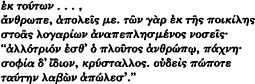
You'll be the death of me, fellow, with all this! You have stuffed yourself sick with the silly doctrines of the Painted Porch, that "wealth is not man's concern, wisdom is his peculiar possession, standing as solid ice to thin frost; once obtained it is never lost."
When we turn to Epicurus' frugality, which is described as very similar in practice to that of the Stoics (cf. DL 10.11), one big difference from Zeno is evident. There is no hint that poverty as such was part of Epicurus' image. This is shown not only by the lack of positive evidence, which by itself is significant and to which I shall return, but also by statements like the following (Ep. Men . 130):
We also regard self-sufficiency as a great good, not with the aim of always living off little, but to enable us to live off little if we do not have much (
[34] ), in the genuine conviction that they derive the greatest pleasure from luxury who need it least.[35]


Diogenes Laertius (10.119), reporting from Epicurus' second book On Lives , says that the Epicurean wise man will not become a Cynic or a beggar, and even when he has lost his sight he will not withdraw himself from life (
[32] DL 7.27 = F 85 (IV p. 29 M.).
[33] F 1 (III p. 364 K.); cf. also Phoenicides ap. Stob. Flor . 6, 30 = IV, 511 Meineke for the topos of philosophical contempt for money.
[35] Trans. A. A. Long and D. N. Sedley, The Hellenistic Philosophers , vol. 1 (Cambridge, 1987), 114.
 [36]
[36] ). Similarly, the Epicurean is advised to combine frugality with cleanliness.[37] All these passages look like polemics against Cynicism, and I believe we should take them as attacking early Stoicism as well, in its retention of Cynic features as part of the philosopher's image (in spite of an apparently similar sentence by Zeno [DL 7.22]). This is confirmed by some facts: (1) the connection in Epicurus' same book On Lives of Cynic and Stoic themes, such as an attack on the Stoic defense of well-reasoned suicide (SVF 3.757); (2) a fragment by Colotes (p. 166 Crönert) in which attacks on Stoics and Cynics show them to be virtually inseparable in Epicurean eyes; and (3) a passage in Stobaeus (2 p. 114 Wachsmuth = SVF 3.638) where the Stoics are quoted explicitly on the sage's Cynicism: "They say that the sage will be Cynic, this being identical to persisting in Cynicism, not that, being a sage, he will engage in Cynicism" (

 ).[38]
Zeno's Republic could hardly have been a permanent target of attack unless some relevant aspects of Cynicism were preserved by the Stoics even later. I take the meaning of Stobaeus' sentence to be a request that the Stoic, once he has become a "sage," should preserve that part of Cynic principles he had adopted in his previous progress toward virtue and that "practicing Cynicism"  must not be interpreted as inaugurating a Cynic "sect" (as far as one can use this term for Cynicism) in a stricter sense: this is just what I have previously labeled as part of the philosopher's "image."[39]
What is left of Metrodorus' book On Wealth is even more helpful in order to understand the different attitudes to money of Zeno and Epicurus. What distinguishes them is precisely, in my opinion, Zeno's Cynic tendencies.
In fact, Zeno's public attitude to money and his deliberate roughness should be interpreted as exhibiting "the short way to virtue" to people who did not follow him on the long and hard route to philosophy. His
[36] So Bywater (cf. DL 7.130); see H. S. Longs apparatus ad loc.
[38] Cf. also Apollodorus ap. DL 7.121 = SVF 3.17. The passage, whose text has been much discussed, has been recently examined by M. O. Goulet-Cazé, L'ascèse cynique: Un commentaire de Diogène Laërce VI 70-71 (Paris, 1986), 22 and n. 22. Even if the sentence reached Arius Didymus from Apollodorus, Epicurus' parallel text shows that the discussion on this theme started much earlier.
[39] If I am right, perhaps our evidence on Epicurean anti-Cynic polemic should be reconsidered and also the traditional opinion on the lack of anti-Stoic attacks.
impressive image stood for a way of life which seemed to the Athenians' eyes to recall and restore the ancient and traditional civic virtues, above all sophrosyne , for which he was praised in the decree.[40]
In the same text much emphasis is laid on Zeno's consistency of theory and practice. By itself, this was nothing new:[41] "I hate a sophist who is not wise toward himself"  is a well-known sentence by Euripides (F 905 N.[2] ) and later adopted by Menander (Monost . 332). If, as we have seen, Antigonus Gonatas might be considered the inspiration of the decree, it may be fruitful to look more closely into the relationship between the two men, as described by the sources.
After Zeno's death, Antigonus is reported to have said: "What a life performance I have been deprived of."[42]
Plutarch accused Zeno of inconsistency because he spoke about politics without practicing it.[43] In fact, Zeno's attitude to political power is an important feature of his image and witness to his consistency: the Athenians appreciated his choice of "a peaceful lifestyle"  and the refusal to visit royal courts or to send messages to kings.[44] His allegedly silent response to royal ambassadors sharply contrasts with the traditional court-philosopher type.[45] This detached attitude is not called in question by the supposed letter he wrote to Antigonus Gonatas. As Wilamowitz rightly remarked,[46] the two letters quoted in Diogenes Laertius 7.7-9 are patently false, and his arguments can be supplemented.
The idea that Zeno refused to go to Macedonia purely because of his old age is totally inconsistent with the general picture we have of him. In our sources Antigonus is described as visiting him, inviting him, offering
[44] SVF 1.284, in two versions, one concerning Ptolemy, the other Antigonus.
[45] Cf. SVF 1.273, where Zeno reports a story about Crates reading Aristotle's Protrepticus in the shoemakers shop and criticizing its dedication to Themison.
[46] Wilamowitz, Antigonos 110 and n. 15.
him gifts, in other words as a king paying honor to the philosopher, never vice versa. So DL 7.15:
And when asked why he admired him, he said: "Because, although I gave him many substantial presents, they never made him arrogant nor yet appear humble."
Old age as the only reason for refusing to go to Macedonia does not suit this picture, since it implies that, were it not for his age, Zeno would accept.
Besides, Antigonus' letter speaks about Zeno's "perfect happiness"  . Zeno proposes to send his pupils,
 ("if you associate with these, you will in no way fall short of the conditions necessary for perfect happiness"). Addressed to a king, this is a flattering sentence, completely out of tune with what we are otherwise told about Zeno; and so in a sense is the "perfect happiness" attributed to the philosopher by the king, who was expected to be acquainted with his teaching. In fact, if we look carefully at the evidence concerning Zeno, we find no hint of his thinking or presenting himself as the perfectly virtuous and happy sage.
On the other side, the stories about Stoic philosophers of the earlier generation visiting a kings court sound rather unfavorable and look as if they were collected (or invented) in order to show off the philosopher's conceit about being a good politician (referring to the Stoic theory of the sage as the expert in politics) and failing in this undertaking. This is reported about Persaeus in his collaboration with Antigonus; and even Sphaerus is described as having to defend himself against Ptolemy's attempt to refute his claim to wisdom.
Antigonus once, wishing to test him out [sc. Persaeus], caused some false news to be brought to him that his estate had been ravaged by the enemy, and his face fell: "Do you see," he said, "that wealth is not a matter of indifference?"[47]
"Testing out the philosopher" (
 .) is an aspect of the contest between the monarch and the philosopher which had been commonplace since the early Socratic tradition. Now, the emphasis is on the typical Hellenistic theme of con-
sistency, just as we find in the Athenian decree. It is worth noticing that in this particular case Zeno, the philosopher who refuses invitations, is the winner, while Persaeus, who accepts the king's invitation, is described as losing his match.
In Sopater's Celts (Athenaeus 4, 160E = F 193 Kaibel) we read:
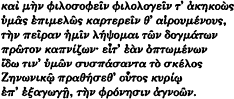
Among them it is the custom, whenever they win any success in battle, to sacrifice their captives to the gods; so I, imitating the Celts, have vowed to the heavenly powers that I shall burn three of those counterfeit dialecticians on the altar. Look! Having heard that you diligently choose philosophy and philology and that you have stoical endurance, I am going to make a test of your doctrines first by smoking you; then, if I see one of you during the roasting pulling up his leg, he shall be sold to a Zenonian master for export, as one who knows no wisdom.
This passage recalls an apophthegm ascribed to Zeno (SVF 1.241), that he would prefer to see one Indian being burnt  , than to listen to all the arguments on labor
  . It is remarkable that in Sopater's text (which should be dated to about 270 BC ) the mocking is directed more against followers than against Zeno as the preacher of endurance (apatheia ). Shall we consider this a casual fact? Perhaps not, if we take into account all the evidence I have collected.
If we look closer at this fact from our specific point of view, we realize that Zeno's attitude to kings and his refusal to leave Athens[48] have two alms, connected to each other: of staying under the Athenians' eyes and of compelling a king to look for the philosopher. This seems to me to have a very important consequence concerning the philosopher's image: one could say that the king in visiting the philosopher becomes a kind of advertising agent, in fact the best in an age in which the new political trend strongly imposes some very powerful and impressive individuals on public opinion, if I may use this anachronistic expression. One recalls the deification of Demetrius by the Athenians, and the hymn that was
composed in his and his wife's honor.[49] This corresponds to an increasing personality worship, inconceivable in Greece before Alexander's deeds, and relevant to our subject.
Writing about the Stoic sage, L. Edelstein stressed the importance of "the new consciousness of man's power that arose in the fourth century, the belief in the deification of the human being."[50] Taking this remark as a starting point, we may say that part of the success and renown of a particular type of philosopher in the first period of the Hellenistic age arises indirectly, as a kind of reflex of his political interlocutor's power and fame—not so much in the trivial sense that friendship with a king is useful to a philosopher for help and support, but in a more subtle sense: the more the philosopher resists the king, the more he consolidates his public image and role, as a kind of counterpower or alternative paradigm of the happy and successful life. I assume this to be an important feature not only of the ideal Stoic sage but even of the Stoic philosopher himself, as showing the way to the happy life.
This typically Hellenistic way of building a philosopher's image is familiar from accounts of the meeting between Diogenes the Cynic and Alexander. Most of the anecdotes concerning Diogenes' relation to political men must be considered complete fiction, and quite implausible historically. Yet as fiction, some of them have a special meaning and function, transcending the traditional monarch/philosopher opposition. DL 6.79:
Demetrius in his work On Men of the Same Name asserts that on the same day on which Alexander died in Babylon Diogenes died in Corinth.
The invention of perfect synchronism between two events as important as death[51] has a symbolic purpose, as is evident in some of the other anecdotes. Two of these, surely the most famous ones, are particularly relevant; DL 6.60, 38:
Alexander once came and stood in front of him and said, "I am Alexander the great king." "And I," he said, "am Diogenes the Cynic." (
)


When he was sunning himself in the Craneum, Alexander came and stood in front of him and said, "Ask me anything you like." To which he replied, "Stand out of my light." (
.)

[49] Cf. Athenaeus 6, 253 D ff.
[50] L. Edelstein, The Meaning of Stoicism (Cambridge, Mass., 1966), 13.
[51] One could mention Plato's biography and the coincidence of dates between his birth and Apollo's, and the relation between him and Socrates through the same kind of remarks; cf. A. S. Riginos, Platonica: The Anecdotes concerning the Life and Writings of Plato (Leiden, 1076).
In both cases, the meeting and the remarks of the two men are impressive for their complete ease and economy of description. In the first text, perfect symmetry is the relevant feature; in the second, it is Diogenes' down-to-earth rejoinder to the kings conceited exhibition of power. We are clearly being confronted with two divergent ideals and contrasting images.[52]
The point of some other anecdotes, as has often been noticed, is to praise Alexander's magnanimity,[53] but another aspect needs to be stressed too: I mean the propaganda this kind of material offers to a philosopher, to enjoy in a parasitical way, so to speak, the extraordinary fame and glory of his interlocutor. The man who is a symbol of all the traditional contents of eudaimonia (youth, beauty, strength, power, wealth, glory) is contrasted with and in a sense defeated by somebody endowed with nothing of this sort, just the inner power of intelligence, logos , and virtue. As a result, all the kings qualities are metaphorically transferred to the philosopher. The symbolic event so described exhibits the perfect Cynic or, in more abstract terms, his perfect moral freedom.
These anecdotes probably arose in the period immediately following Diogenes' death. What seems worth stressing is their affinity with the evidence for Zeno's life and attitude to royal politics. The main difference in the anecdotes I have quoted between the image of Zeno and the one of Diogenes is that Diogenes and Alexander, in spite of their being historical figures, are symbolic or ideal characters, while Zeno is not, nor does he seem to encourage in any way the assimilation of his own person to the Stoic sage.[54] This recalls the fact that the Stoic sage was conceived as a model of rational perfection and, as he has been rightly called, "a bearer of ethical paradoxes" (ein Trager ethischen Paradoxien ).[55] The sage could be concretely exemplified only through mythical or very remote historical personages.
A crucial feature of the Stoic theory about the sage is the radical opposition between the "virtuous" and the "vicious" person (
 ), and the absence of any ethical type in between. In addition, at least in theory, the Stoics held that a human being could become virtuous,[56] though the difficulty of finding an actual sage is emphasized by
[52] The wit of these texts presumes Alexander to be at his fullest glory, hence they postdate his Asian adventure; of course, that is another reason to consider them deliberate fiction.
[53] Cf. Socraticorum reliquiae VB31 Giannantoni and his commentary, vol. 3, 398 ff.
[54] In the case of Zeno we don't seem to have anything comparable to the idealization of Plato in the Academy, which started with Speusippus' Encomium Platonis , or to Epicurus' deification.
[55] E. Schwartz, Ethik der Griechen , ed. W. Richter (Stuttgart, 1951), 69.
many sources.[57] Since happiness depends entirely on virtue, and every adult human is either virtuous or vicious, none of the latter could strictly be deemed happy  . Chrysippus (SVF 3-510) said:
The man who progresses to the furthest point performs all proper functions without exception and omits none. Yet his life . . . is not yet happy, but happiness supervenes on it when these intermediate actions [sc. his performance of proper functions] acquire the additional properties of firmness and tenor and their own particular fixity.[58]
There is only one passage in Zeno's biography where he is described as "happy" (DL 7.28):
In this species of virtue [i.e., self-control,
] and in dignity he surpassed everyone, and indeed in happiness. (
.)

Immediately after this we are told that Zeno died at a great age and in good health, which, according to popular morality, was a sign of eudaimonia . Such remarks, like the praise for his virtue and moderation in the public decree, show how a biographer could ignore Chrysippus' distinction between the state of the man who has progressed to the furthest point ( , the text cited above) and the state of the sage. But to the Stoics themselves the distinction remained of capital importance. In fact, they stressed it so strongly that it became a commonplace even outside the school.
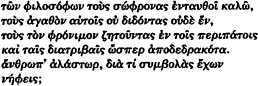
Baton, a comic poet familiar with philosophy,[59] in a passage from The Murderer quoted by Athenaeus (4, 163 B = III 326 Kock) has somebody deliver the following verses:
[57] Cf. A. Dyroff, Die Ethik der alten Stoa (Berlin, 1897 [repr. 1979]), 200, and the detailed discussion in R. Hirzel, Untersuchungen zu Ciceros philosophischen Schriften 2.1 (Leipzig, 1882).
[58] Trans. Long and Sedley, The Hellenistic Philosphers 1:363.
[59] Of. Plutarch De adul. et amico 55C, and I. Gallo, "Commedia e filosofia in età ellenistica, Batone," Vichiana 5 (1976), 205-242.
I summon here the philosophers who are moderate, who never give themselves a single good thing, who look for the wise man in their strolls and talks, as for one who has run away . Wretched fellow, why, when you have the income, do you stay sober?
Baton likewise compares the Stoic sage to a runaway slave in a passage where the goal of Epicurus is opposed to the Stoic telos (Athenaeus 3, 103 C-D = III 328 Kock):
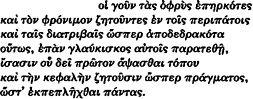
Those at least with raised eyebrows, who seek on their walks and in their discourses for the "wise man," as if he were a runaway slave, once you set a strange fish before them, know what "topic" to attack first and seek so skillfully for the "capital" point, that everybody is amazed.
In a long passage by Damoxenus, about a cook connecting his science to Epicurean physics, Stoics and Epicureans are opposed in similar but even more explicit terms (Athenaeus 3, 103B = III 349 Kock):
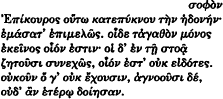
In this way Epicurus condensed pleasure into the sum of wisdom [?]. He could chew carefully. He is the only one who saw what the Good is. The Stoics are always seeking for it, but they don't know what its nature is. What, therefore, they have not got and do not know, they cannot give to anyone else.
These verses may allude not only to the Stoic model of the sage but also to discussion between Stoics and Academics. The main point, however, is their confirmation of the other sources—I mean that Zeno did nothing to present himself as a wise man, but simply as somebody aiming at virtue.[60]
The joke about the Stoic searching for the sage, as if the latter were a runaway slave, recalls the story that Diogenes the Cynic went around with his lamp in daylight looking for a "man." In both cases the philosopher is described, in a Socratic way,[61] as not achieving completely what he is talking about; in spite of this, he may be praised for his "consistency"  since the proposed model is a goal he aims at by rules of behavior that never lose sight of it and are never self-contradictory. As we have seen above in the case of politics, problems concerning the image of the Stoic philosopher arise when the difference between the ideal paradigm and its historical realization fades away. This did not seem to happen in the case of Zeno.