
Undulant-Oblique:
A Study of Wave Patterns on Ionico-Massalian Pottery
If wine, as we're told, allowed Mediterranean civilization to penetrate the still-protohistoric world of Provence, the history of wine cannot be disassociated from the amphoras in which it was transported, nor the cups, kraters, skyphos from which it was drunk.[1] For here, "contained" and "container" form a single cultural entity. Imported into Provence in the seventh century B.C. by both Etruscans and Phoenicians, wine and, inseparably, the clay vessels in which it came constituted—as barter—the single most sought-after commodity. With the arrival of the Ionians a century later, this trade increased considerably. For the Ionians not only exchanged goods with the indigenous populations (trading essentially wine, pottery, and bronze ware for tin, iron, and salt) but established emporia of their own for stocking and distributing those goods. The first and by far the most significant of those emporia—those fortified trading posts—was Massalia: present-day Marseilles.
Called by Herodotus the "progenitors of history," the Ionians were Greeks
who had settled in Asia Minor and assimilated the cultures of kindred societies flourishing in those very regions. This assimilation would prove to be highly generative. Founding, in a short period of time, their own schools of philosophy, art, and architecture, inventing coinage, and propagating the acquisitions of an entirely original culture throughout the Mediterranean, they quickly became the radiant center of all Hellenism. Nothing they touched, it seems, wasn't marked by a natural sense of measure, grace, innate proportion, by what might be called, indeed, an "auroral intelligence."
Nowhere would the expression of that intelligence be more widely diffused than in their pottery and especially in the motifs with which that pottery was decorated. One particular motif, the wave pattern (misleadingly labeled in English the "wood pattern") seems particularly relevant. For there, in oscillating ripples, the Ionians would give expression to the very energies at play in that generative period of their evolution. Whether the ceramics in question happened to have originated in Ionia itself or in its new emergent colony to the west, Massalia, matters little, for in both cases the motif underwent a virtually identical evolution. In tracing that evolution, we find ourselves following—quite inadvertently—the vibratory weave of an originating vision. Find ourselves drawn, on oscillation alone, over the threshold of that inaugural occasion.
"For the fuller's screw, the way, straight and crooked, is one and the same."[2] So wrote Heraclitus, an Ionian himself, describing the apparent contradiction of opposites in the inseparable flow of the singular: that of Being. No statement more accurately describes the energies inherent in that undulant pattern. Written at the very moment the Ionian decor had come to free itself from cer-
tain "orientalizing" characteristics (manifest in static, geometric motif), it expressed the fluidity of the new philosophy. It spoke of a universe in continuous motion, change, in which "all things are driven through all others" by a single governing principle.[3] The waves, indeed, illustrate that principle. Existing in a harmony of "opposing forces," they, like Heraclitus's lyre, vibrate to a series of tensions and releases.[4]
Studying this particular motif in regional museums or in those rare archeological papers devoted to the Hellenization of Gaul, one is struck by a curious phenomenon. In the sixth century B.C. —at the beginning of the Ionian colonization of Marseilles—the wave pattern tends to oscillate freely, to ripple in a loose set of seemingly erratic intervals. Labeled by the archeologists as oblique, uneven, or irregular, it's generally dismissed by those specialists as something primitive if not, quite simply, maladroit. But is it? We seem to be in the presence, rather, of a graphic rendering of that very flux Heraclitus himself first evoked. In the presence, that is, of an incipient—emergent—energy flow, interpreted here through an artisanal medium. What the potter's hand, incising the freshly thrown clay, had delineated.
Flux, flow: we're reminded of the Greek infinitive, rhein , which describes this very movement, and which Emile Benveniste qualified as the "essential predicate" in Ionian philosophy from the time of Heraclitus onward. In Benveniste's luminous essay, "La notion de 'rythme' dans son expression linguistique," we learn that rhein , as generatrix of rhitmos (from which we derive rhythm ), signifies the manner by which objects in nature are deployed, positioned, momentarily situated. In combining rhein (to flow) and the suffix-thmos (suggesting the mode by which a particular action is actively perceived by the senses), we arrive at the signifier for an immensely rich, immensely variable quantity. Rhitmos , at this diacritical moment in Western thought, isn't to be
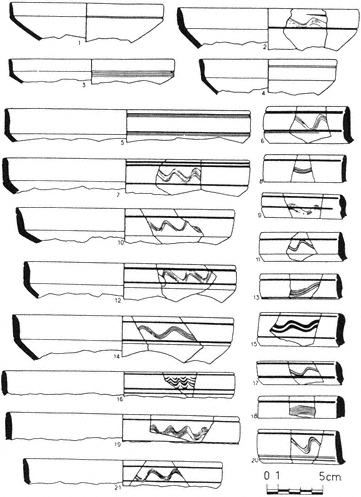
Examples of the wave pattern in Ionico-Massalian pottery.
Courtesy Fonds Fernand Benoit, Palais du Roure, Avignon.
seen as some idea, some fixed, inalterable concept, but as the fluid architectonics of each given instance. "It designates form," in Benveniste's words, but "form as shaped by the mobile, the moving, the liquid; as something that possesses no organic consistency of its own. It is more like a pattern drawn across water, like a particular letter arbitrarily shaped, like a gown, a peplos casually arranged, or a sudden shift in an individual's mood or character." It constitutes form, certainly, but form as something "improvised, provisional, modifiable."[5]
How close this definition comes to describing the archaic wave pattern itself, so quickly dismissed by the specialists as something "irregular." To the contrary, the potter was giving free play not to his own whims and fancies but to the vibratory flow of yet unregulated energies. He was, we might call it, expressing himself in an ontological script, the calligraphy of Logos itself. The parallel lines he traced appear to rush, undulant, out of some immediate if invisible point of origin. They rise, plummet, exult—convulsively—about the flanks of some terra-cotta vase like a freshly released creature. If anything, they seem alive .
Here we're very close to a vision of existence that, after being rapidly suppressed, would have to wait two and a half millennia to see itself reasserted. How familiar it sounds to readers of Nietzsche's Philosophy in the Tragic Age of the Greeks or—more immediately—Heidegger's Being and Time . We might be reminded, too, in the realm of modern aesthetics, of Klee's definition of art as Gestaltung : as form in the perpetual process, or act, of formation. Or Olson's interpretation of the poem as a "high-energy construct" in which "form is never more than an extension of content."[6] These, indeed, are archaic canons. Together, they share a common vision. Within that vision, the world (and the works by which that world is made manifest) erupts continuously out of an irrepressible point of origin. An iridescent chaos, as Cézanne once put it: a place
from which the virginity of the world might, once again, be experienced. An area that antecedes reference, coordinates, points of orientation, that refuses any form of pre-established measure in its protean capacity to generate—and perpetuate—all such measure.
The waves writhe. About the rims, shoulders, hips of so much earthenware, the pattern thrives in each of its fresh releases. As conceived by artisans, it celebrates the preconceptual. It speaks of a world that hasn't yet fallen under the dictates of human determinism. Spontaneous, convulsive, this original wave pattern, however, will adorn Ionico-Massalian pottery for a remarkably short period of time. Under the effects of an emergent humanism, the pattern itself will rapidly harden. Codified into bands of identical, oscillating units, it will vanish altogether as an expression of emergence. By the fifth century B.C. , it appears as little more than a script confined to mechanical repetition. It has fallen victim, in short, to number.
This evolution followed that of philosophy itself. Within a half-century—from the time, that is, of Heraclitus and most of the pre-Socratics to that of Socrates—rhitmos would find itself redefined in an increasingly narrow manner. Plato himself qualified rhythm as "the order of movement" manifested, say, by a dancer in measured, predetermined intervals. One had already entered the reign of metron . From an elemental vision of emergence, notions of number, of discrete units of articulated time, increasingly predominated. The potter's hand could only follow. Indeed, in Henri Maldiney's words, "measure had introduced the idea of limit (peras ) into the midst of the limitless (apeiron ). Between these two extremes, the destiny of rhythm itself would unfold: would die, finally, from inertia, dissipation."[7] Would die, finally, with the Latin cadare, cadentia , the mechanical breath-fall of our own acquired notions of "cadence."
With the ossification of the wave pattern, we become witnesses to the cryptic birth of a certain technological ideation. Traveling from Logos to Eidos , we reach—in an amazingly brief period of time—the very thresholds of concept, an order of thought that no longer needs to acknowledge its own origins, inception, emergence. In recognizing no antecedent, it cannot, in turn, generate sequence, translate energy. Static, self-sufficing, it can do little more than replicate—ex nihilo —its own formulations.
How much of modern conceptual art today celebrates this very immobility, exults in its own truncated vision? "Sad," Schiller will warn Hegel, "the empire of concept: out of a thousand changing forms, it will create but one: destitute, empty."[8] We see it all too often in galleries; read it, over and over, in postmodernist journals; find ourselves increasingly exposed to an astonishingly similar, astonishingly rigid vision of existence. An art so deliberately sepulchral can only be, indeed, an end-art. Can only be, finally, a vain exercise in the service of a terminal aesthetics.
Here, though, we're not concerned with endings but beginnings: with that inaugural instant in Western civilization that would recognize itself not in its mirrors but its waves, in the irrepressible flow of an inexhaustible dynamic: that of Being. Vectorial by nature, it would express itself in a multitude of ways. The archaic wave pattern happens to be one such way. As a signature, it ripples freely across the flanks of so much salvaged terra-cotta in its own inimitable script. It speaks, as it goes, pure transmission.
How can we help but marvel, discovering one of those potsherds ourselves? At Saint Blaise, for instance, after the winter rains, a fragment may inch its way to the surface out of some excavated cross section. Examining the supple lash of its undulations whipping their way across this all-too-abbreviated fragment, we might find ourselves wondering what is it, exactly, if not current itself. If
not the still-living filament to a lost luminosity. If not, indeed, the limpid inscription that has somehow survived (like Heraclitus's fragments) its vernal discourse. We might find ourselves asking these questions as we hold the potsherd between thumb and forefinger. Hold it like some kind of key. Hold it like some very particular kind of key to some very particular kind of door. The door, alas, has long since vanished.