
Introduction
Historical mind-sets are difficult to gauge. Historians of modern China quickly learn, for example, that in 1898 New Text Confucianism, the first of all imperial Confucianisms, became the last stand for radical Confucians. During that fateful year the mercurial New Text advocate K'ang Yu-wei and his coterie (including Liang Ch'i-ch'ao and T'an Ssu-t'ung) came to the attention of the Kuang-hsu Emperor, who with K'ang's support initiated the eventful but abortive Hundred Days' Reform in Peking.[1] Earlier New Text scholars like Wei Yuan and Kung Tzu-chen are characterized in twentieth-century accounts of modern Chinese intellectual history as the stalking-horses for late imperial reformers. In the Hundred Days' Reform forty years after Wei Yuan's death, New Text ideas were quixotically appropriated in place of Neo-Confucian orthodoxy to legitimate imperial sovereignty and to promote extensive political reform.
The uproar over New Text Confucianism in late imperial scholarly circles has, however, led to the misrepresentation of the historical circumstances within which that movement incubated and developed. Linear accounts that organize the historical record in neat cadences from K'ang Yu-wei back to Wei Yuan and Kung Tzu-chen too often reflect unexamined assumptions about the key issues and important
[1] See Liang, Intellectual Trends in the Ch'ing Period , pp. 85-110. For a revisionist account see Kwong, A Mosaic of the Hundred Days . For a discussion see T'ang and Elman, "The 1898 Reforms Revisited."
figures in modern Chinese intellectual history. A phenomenal number of books and articles have been published on K'ang, Liang, Kung, and Wei since 1900, and essays on them continue to proliferate in Chinese, Japanese, and Western scholarly journals. Although hundreds of works that touch on the nineteenth-century vicissitudes of New Text Confucianism have appeared, few scholars have explored the roots of New Text ideas in the late eighteenth century beyond some perfunctory paragraphs. The roles played by Chuang Ts'un-yü and Liu Feng-lu in the reemergence of New Text Confucianism have, when acknowledged, been conveniently subsumed within a linear historical agenda that makes 1898 the target of explanation,[2]
New Text Confucianism is unfortunately a case in point that scholarly expectations have colored scholarly research. It has long been assumed that the story of New Text Confucianism centers on K'ang Yu-wei and the 1898 reforms initiated by the Kuang-hsu Emperor. It therefore comes as a surprise that opposition between a well-placed but aging Chinese imperial grand secretary (Chuang Ts'un-yü) and a youthful Manchu palace guard (Ho-shen) who gained the ear of the Ch'ien-lung Emperor should be at the heart of the classical reemergence of New Text Confucianism in the 1780s.
Who was Chuang Ts'un-yü? Normally he appears as a curious footnote in accounts by historians who are satisfied that Wei Yuan and Kung Tzu-chen accurately represent the reformist ethos of nineteenth-century China. Who was Liu Fengdu? Usually he is depicted in historical accounts as no more than the teacher of Wei and Kung. When the historical documents, genealogies, and manuscripts of Chuang and Liu are examined, however, a scholarly vertigo sets in. Chuang Ts'un-yü was on center stage in the political world of late imperial China. Indeed, by comparison Wei Yuan and Kung Tzu-chen were marginal figures whose historical importance has been determined largely by a consensus of twentieth-century scholars.
Furthermore, it is curious that Confucians first actively dissented from the late imperial state's orthodox raison d'être beginning in the late Ming, not after the Opium War. When New Text Confucianism reemerged in the late eighteenth century, after centuries of neglect, its advocates were retracing political agendas that had been raised and
[2] An exception to this general trend is On-cho Ng's "Text in Context: Chin-wen Learning in Ch'ing Thought" (Ph.D. diss., University of Hawaii, 1986), which was brought to my attention after I completed a first draft of my study.
then rejected in the seventeenth century, when Manchu armies destroyed the Ming dynasty. Sixty years before Western imperialism began to transform the political, military, economic, and social institutions through which the Ch'ing (1644-1911) state legitimated itself, Confucians were already showing an interest in alternative forms of political discourse. Why?
Such dissent raises intriguing questions about the history of Confucianism and its links to the imperial state. They force us to reconsider the tensions within Confucian political culture that gave rise to dissenting movements such as the New Text reform initiative. What continuities existed in Confucian political discourse following the Western incursion? Why did New Text studies reemerge in the eighteenth century? Why was the New Text agenda first rearticulated in Ch'ang-chou Prefecture, a trading center on the Grand Canal in the prosperous Yangtze Delta (map 2)? After all, Ch'ang-chou had been the center for much of the gentry political dissent in the 1620s, which challenged the usurpation of Ming imperial power by palace eunuchs.
Accounts of the 1898 reform movement have presented New Text Confucianism as a subset of what historians considered "more important" events in late-nineteenth-century political and intellectual history. To remedy this situation, I will reevaluate the origins of the New Text revival during the Ch'ing dynasty in light of long-standing political battles to control the interpretation of the Classics in the imperial state. The reemergence of New Text Confucianism in eighteenth-century Ch'ang-chou also provides us with an interesting example of the interaction of scholarship and politics in the late empire before the advent of Western imperialism.
The origins of New Text Confucianism will tell us a great deal about long-term historical developments in late imperial China—more, in any event, than its political climax in the 1890s revealed, when K'ang Yu-wei briefly rose to national prominence in Peking. By 1899 New Text was already passé as a political force, although it remained important among intellectuals and scholars. In contrast, New Text Confucianism in eighteenth-century Ch'ang-chou reveals important features of gentry intellectual and social life. The Chuang and the Liu families, whose high social standing in Ch'ang-chou society lasted from 1450 until 1850, exemplify the interaction of classical scholarship, corporate lineages, and Confucian politics in the rise of the Ch'ang-chou school of New Text Confucianism.
I try to avoid the biases inherent in typical linear accounts of New
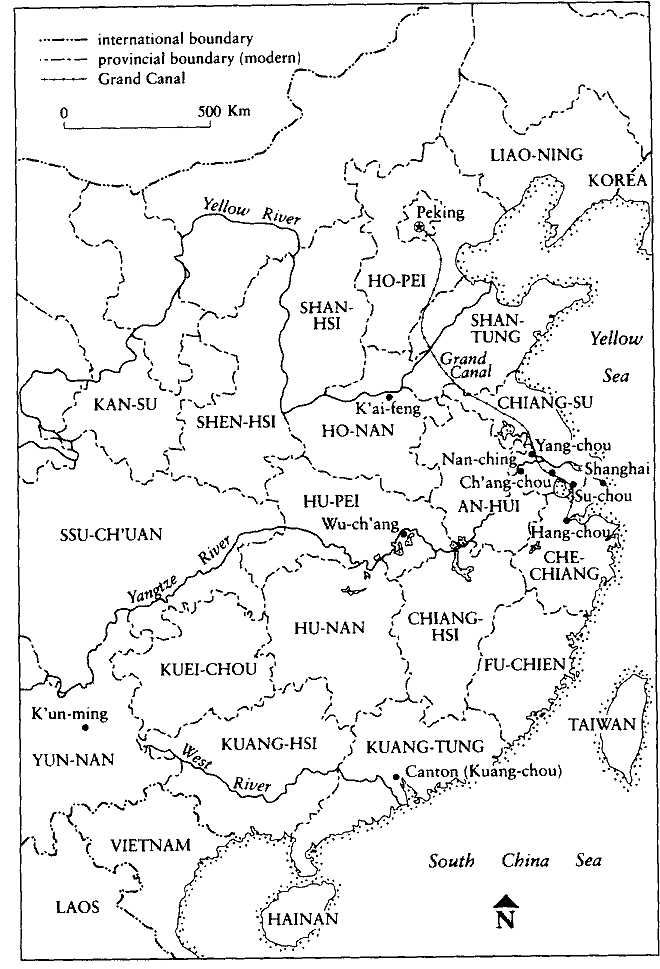
Map 2.
Administrative Map of China
Source: Benjamin Elman, From Philosophy to Philology: Intellectual and Social
Aspects of Change in Late Imperial China . Reprinted with the permission
of the publishers, the Council on East Asian Studies, Harvard University. © 1984.
Text during the Ch'ing dynasty by not focusing on the achievements of Wei Yuan, Kung Tzu-chen, Liang Ch'i-ch'ao, or K'ang Yu-wei. They appear in these pages to help elucidate the accomplishments of Chuang Ts'un-yu[*] and Liu Feng-lu. Whether this substitution of beginnings for endings will stand up over time is unclear. My aim is not to downplay the importance of New Text Confucianism in the 1898 reforms. Rather, my intent is to discover the beginnings as beginnings, without the historical teleologies commended by hindsight.
In my earlier work I have suggested that the philosophic rebellion spawned by the Ch'ing dynasty k'ao-cheng (evidential research, lit., "search for evidence") movement set the stage for the social and political conclusions drawn by New Text scholars. In the present work I shall try to document this claim. New Text Confucianism must be understood in light of its ties to classicism and philology, for without such an understanding, it may appear to be a peculiar Confucian aerolite that depended entirely on the nineteenth-century Western influence for its visibility.[3]
During the Ch'ing dynasty k'ao-cheng scholars advocated a program to reconstruct missing sources from antiquity. They first sought out T'ang (618-906) and then Later Han (25-220) sources to overcome limitations they found in Sung (960-1279) and Ming forms of Neo-Confucianism. Because Later Han classical sources were relatively unaffected by the Neo-Taoist and Buddhist notions that had influenced T'ang, Sung, and Ming Confucians, Han Confucians received increased respect and attention from textual purists in the seventeenth and eighteenth centuries.
The debate between those who favored Later Han classical scholarship (that is, Han Learning [Han-hsueh ]) and those who adhered to the Neo-Confucian school (that is, Sung Learning [Sung-hsueh ]) was philologically technical, but its political repercussions were considerable. Han Learning represented more than just an antiquarian quest. Its advocates cast doubt on the Confucian ideology enshrined by Manchu rulers when they legitimated imperial power. When tied to classical studies, philology thus had a political component.
Reconstruction of Han Learning during the eighteenth century
[3] Levenson's account in his Confucian China and Its Modern Fate , vol. 1, pp. 79-94, remains the most influential interpretation of New Text Confucianism. See also Chang, Liang Ch'i-ch'ao and Intellectual Transition , pp. 3-34, and Philip C. C. Huang, Liang Ch'i-ch'ao and Chinese Liberalism , pp. 13-24. Cf. Hsiao, Modern China and a New World .
brought with it the discovery that Confucianism during the Later Han dynasty—when the Old Text school became, if not the dominant, at least the most influential intellectual force—differed greatly from the Confucianism of the Former Han (206B.C. —A.D. 8), when the New Text school had been in vogue. When New Text Confucianism lost its political authority, its very existence was forgotten for fifteen hundred years.
Han Learning, strictly speaking, denotes a school of scholarship that came into fashion in Su-chou in the mid-eighteenth century. In raising the slogan of Han Learning to prominence in the Yangtze Delta, Hui Tung and his large Su-chou following actively opposed Sung Learning. They turned instead to a study of Later Han classical interpretations, especially those by Cheng Hsuan, who had successfully synthesized earlier New and Old Text doctrines. It was assumed that because such interpretations were closer to the time the Classics were compiled than T'ang and Sung sources were, they were more likely to reveal the authentic meanings of the Classics.
This rediscovery in the eighteenth century of the Old Text vs. New Text debate led some Ch'ing scholars to view the Confucian tradition in a new light. Scholars in Ch'ang-chou were the first Ch'ing literati to stress the New Text school of the Former Han dynasty. First, they turned to the New Text scholar Ho Hsiu, of the Later Han, who had been Cheng Hsuan's major rival. Ho Hsiu had defended the New Text ideas of the Former Han. After rediscovering Ho Hsiu, Ch'ing New Text scholars then returned to Tung Chung-shu's Former Han New Text orthodoxy. Accordingly, New Text learning really meant "Former Han Learning." Deep and potentially irreconcilable differences among competing orthodoxies emerged in the Han Learning agenda for classical studies. By returning to what they considered a purer form of Han Learning, New Text scholars in Ch'ang-chou touched off from within their ranks the breakup of Han Learning itself.[4]
New Text scholars, as we shall see, alleged that much of what had once been considered orthodox by Sung and Ming Neo-Confucians and Ch'ing k'ao-cheng scholars was in fact based on Old Text sources fabricated by Confucian scholars during the reign of the "Han usurper," Wang Mang. New Text advocates turned instead to the Kung-yang
[4] See the comments by Wei Yuan in his "Hsu" (Introduction) to Shu ku-wei , pp. la-6b. On the New Text-Old Text debate during the Later Han dynasty see Dull, "Historical Introduction," pp. 338-411. See also Chou, Chou Yü-t'ung hsuan-chi , pp. 93-95.

Fig. 1.
New Text: Clerical Script (Li-shu 
Source: Hah Ts'ao Ch'üan pei

Ts'ao Ch'uan[*] ; Peking: Hsin-hua Bookstore, 1982).
commentary on Confucius's Spring and Autumn Annals because it was the only New Text commentary on one of the Classics that had survived intact from the Former Han dynasty. Recorded in contemporary-style script (chin-wen, hence "New Text" [fig. 1]), the Kung-yang Commentary supported the Former Hah New Text school's portrayal of Confucius as a charismatic visionary and institutional reformer—an uncrowned king (su-wang ).

Fig. 2.
Large Seal (Ta-chuan 
Source: "Hsiao K'e-ting ming-wen"

smaller K'e tripod), in Yü-ting K'e-ting

Shanghai: Shanghai Museum, 1959).
During the middle of the second century B.C. , however, versions of the Classics written in pre-Han styles of calligraphy (figs. 2 and 3) were purportedly discovered in Confucius's old residence in what is today Shan-tung Province. They were subsequently placed in the imperial archives. According to Former Han accounts, these Old Text Classics were recorded in ancient script (ku-wen, hence "Old Text"), that is, various forms of ancient seal script (chuan-shu ) (fig. 2) in use during the Chou dynasty (11227-221 B.C. ). Because the Old Text Classics were written in more ancient calligraphic forms (fig. 3), their defenders claimed priority for those versions over the New Text Classics. The latter were

Fig 3.
Old Text: Small Seal (Hsiao-chuan

Source: Ch’in-Han wa-tang wen-tzu 
on palace roof-end tiles; 1878 Heng-ch'ü shu-yuan edition).
written in the Former Han contemporary-style clerical script (li-shu ) (see fig. 1), a calligraphy instituted after the unification of writing forms and the burning of the books (fen-shu ) during the Ch'in dynasty (221-207 B.C. ) and were thus much later in origin.
Among the texts in the imperial archives was another commentary to the Spring and Autumn Annals, which later became known as the Tso chuan (Tso Commentary ). Portraying Confucius as a respected teacher and transmitter of classical learning, rather than as a charismatic visionary, the commentary lent support to the Later Han Old Text School. After the demise of the Later Han dynasty in A.D. 220, however, the Confucian Canon was not reconstituted until the seventh century, under the T'ang. Thereafter, the Tso Commentary remained the orthodox guide to the Spring and Autumn Annals until the mid-eighteenth century, when Ch'ang-chou scholars called it into question,[5]
Han dynasty Old Text vs. New Text debates had not been limited to textual issues. Textual expertise on a particular Classic was a prerequisite for appointment as an erudite (po-shib ) in the prestigious and politically powerful Han Imperial Academy (T'ai-hsueh). The latter had been formed to ensure the transmission of orthodox texts under state sponsorship. After disciples of erudites completed their course of study, they were examined and then granted government positions if they passed. In essence, this simple recruitment process was the precursor to the elaborate Confucian civil service examination system set up during the T'ang and Sung dynasties. Accordingly, classical texts and their interpretation were the basis for political loyalties in the schools system (chia-fa ) for classical studies. When eighteenth-century Ch'ang-chou scholars reopened the New Text-Old Text controversy, they recognized they were not dealing with an idle textual issue. In fact, they were reconstructing the fortunes of an academic and, by implication, political movement that had been replaced by another.[6]
In chapters 1 and 2 I will explore the social, political, and intellectual circumstances in Ch'ang-chou Prefecture and the Yangtze Delta region during the sixteenth and seventeenth centuries. The rise to prominence of the Chuang and Liu lineages in Ch'ang-chou Prefecture during the
[5] On the Old Text version of these events see Liu Hsin, "I T'ai-ch'ang po-shih shu." See also Ssu-ma Ch'ien, Shih-chi , vol. 10, pp. 3124-27 (chüan 121). See also Karlgren, On the Tso Chuan , and Maspero, "La composition et la date du Tso tchouan."
[6] Dull, "Historical Introduction," pp. 338ff. See also Lu Yuan-chün, "Ching-hsueh chih fa-chan."
late Ming will be interpreted in light of sixteenth- and seventeenth-century gentry political dissent directed against the authoritarian imperial state.
In chapter 2 I will measure the success of the Chuangs and the Lius in civil service examinations during the Ming and Ch'ing dynasties and, in chapter 3, I will reconstruct statecraft traditions in Ch'aug-chou in an effort to understand the intellectual and social milieu from which Chuang Ts'un-yü emerged. Chuang was a distinguished scion of a powerful local lineage, which for generations placed members in the prestigious late imperial Hanlin Academy and other high government positions in Peking. A former secretary to the Ch'ien-lung Emperor, Chuang Ts'un-yü turned to the Kung-yang Commentary late in his official career to depict in classical garb Ho-shen's usurpation of imperial power. Ho-shen reminded late-eighteenth-century Ch'aug-chou literati of the infamous eunuch Wei Chung-hsien. In the late Ming Wei had similarly usurped power from the T'ien-ch'i Emperor and purged dissident literati who were associated with the Tung-lin Academy from nearby Wu-hsi County.
Ch'aug-chou intellectual traditions drew heavily on the statecraft formulations enunciated in the late Ming by T'ang Shun-chih. An analysis of the affinal ties between the T'angs and Chuangs reveals how Tang Shun-chih's scholarship was emulated first by Chuang Ch'i-yuan in the late Ming and then by Chuang Ts'un-yü in the middle of the Ch'ing dynasty. The "learning of Ch'aug-chou" eventually became associated with precise scholarship and practical statecraft; the Ch'ang-chou New Text school should be seen as an outgrowth of these native currents.
In chapters 4-7 I will present the scholarly setting in which New Text Confucianism reemerged after fifteen hundred years of obscurity. My account will try to recapture the centrality of Confucian classical studies for political discourse in imperial China and the conflicting positions read into the Classics during the Ming and Ch'ing dynasties. The role of Sung Neo-Confucianism as the orthodox voice of the late imperial state permits us to weigh the political significance of recurrent classical controversies from which the New Text agenda reemerged.
Chapter 5 describes how Chuang Ts'un-yü resisted the inroads of Hah Learning philology and the resulting fragmentation of the classical legacy by appealing to a holistic vision of the Classics. Chuang placed particular emphasis on the monistic cosmology of the Change Classic and the lessons of voluntarism encoded in the Kung-yang Commentary.
In chapter 6 I trace the way in which Chuang Ts'un-yü's holistic vision was advanced by his successors in the Chuang lineage. I also explain how the unraveling of Sung Learning first into Han Learning and then into New Text Confucianism tied in to Chuang Ts'un-yü's Kung-yang Confucianism.
In chapter 7 the official career and scholarly contributions of Liu Feng-lu are presented. If Chuang Ts'un-yü marked the reemergence of Kung-yang Confucianism in the eighteenth century, Liu Feng-lu in the nineteenth century linked his grandfather's Kung-yang theoretical vision to evidential research (k'ao-cheng) techniques. In Liu's hands, New Text Confucianism emerged as a sophisticated reinterpretation of Confucius's prophetic role in establishing the Classics for posterity. Moreover, Liu Feng-lu turned to k'ao-cheng for the epistemological leverage he needed to convince other Han Learning scholars of the dubious provenance of the Old Text Classics and the superior value of the New Text ones.
By analyzing the scope of the debate over Han Learning vs. Sung Learning among Confucian literati during the Ch'ing dynasty we can pinpoint the classical reformation represented by Chuang Ts'un-yü's turn to Kung-yang Confucianism and the way his legacy culminated in a recasting of the classical tradition among his immediate lineage and affines. Liu Feng-lu's articulation of a unified vision of New Text Confucianism signified the logical outcome of Chuang and Liu lineage traditions and cultural resources, which Chuang Ts'un-yü passed on to his grandson Liu Feng-lu, and which Liu then transmitted to Wei Yuan and Kung Tzu-chen.
In my concluding discussions in chapters 8 and 9 I will place the rise of New Text studies in Ch'ang-chou within a broader discussion of the unity between late imperial conceptual change, ch'ing-i (voices of remonstrance) political protest, and literary debate in the early nineteenth century. The reemergence of New Text Confucianism was paralleled by a revival of interest in late Ming political activism after the demise of Ho-shen. The renewed popularity of ancient New Text studies and more recent Tung-lin-style political concerns in the early nineteenth century was a twin legacy of Ch'ang-chou statecraft traditions.
Chapter 8 will refer to the underlying themes of pragmatism and realpolitik that Ch'ing dynasty New Text Confucians rediscovered while retracing the Confucian-Legalist synthesis of rituals and laws during the Former Han dynasty. In chapter 9 I will contend, following Mizoguchi Yuzo[*] , that late Ming political activism, although defeated,
was not completely eliminated. Tensions between the autocratic imperial state and local gentry interests reappeared during the late eighteenth century, when Ho-shen and his men are said to have carved out personal financial empires not seen since the appropriations of late Ming eunuchs. The Ho-shen era was a watershed for imperial politics: the classical legitimation for autocratic government weakened, and the politics of literary expression shifted decisively in favor of literati dissent.[7]
I will end by presenting the reformist sentiments of the Ch'ang-chou literatus Yun Ching, which set the political direction that New Text ideas would take after transcending their origins in Ch'ang-chou. Written between 1800 and 1809, Yun's political tracts contained formulations for institutional reform later elaborated by Wei Yuan, Kung Tzu-chen, and K'ang Yu-wei. New Text Confucianism and ancient-style prose, strands woven together by Yun Ching, symbolized the rise of gentry dissent in the early nineteenth century.
My major themes are the interaction of Confucian classical scholarship, elite kinship structures, and orthodox imperial ideology in the formation of the Ch'ang-chou New Text tradition. I hope thereby to show how the intellectual history of China can be enriched when social and political history is interwoven with the history of ideas. The Ch'ang-chou New Text school, we shall discover, represented a lineage of ideas, whose scholarly transmission depended on elite kinship ties and cultural resources within a particular social and political context. The history of ideas in Ch'ang-chou mirrored the social configurations that Confucians there unconsciously presupposed as they grappled with local and national political issues.
New Text studies became a strand in the larger web of gentry challenges to the diminishing power of the Manchu imperial court; under the additional pressures of massive peasant rebellion and Western imperialism, they culminated in the 1911 Revolution and the demise of imperial China. By 1800, then, new intellectual forces had appeared in late imperial China. Investigation of the Ch'ang-chou New Text school of Confucianism in the Yangtze Delta enables us to trace the native origins and internal mutations of one of these new strands, whose supporters were destined under the influence of Western ideas to champion a radical reworking of imperial institutions and traditional ideology.
[7] Mizoguchi, "Iwayuru Torinha[*] jinshin no shiso[*] ."