
Stream Channel
Riffle Bars
Riffle bars in the relatively undisturbed portions of lower Dry Creek are characterized by low elevations. The highest elevations on these bars are seldom more than 2 m. above the lowest point in the channel cross section. The gradient across these bars, normal to streamflow, is generally very low, although some bars had slopes approaching 45° at the edge of the streambed.
Vegetation on these bars consists of occasional strips of basket sedge (Carexbarbarae ), mulefat, sandbar willow, or sandbar willow/cottonwood. At the back of some riffle bars, adjacent to the floodplain bank, we encountered a narrow secondary streambed which carried water only during higher flows. A lagoon was formed at both the upstream and downstream ends of this streambed. Red willow thickets were common on the floodplain side of these secondary stream banks, while mulefat, sandbar willow, and cottonwood were more commonly found on the riffle bar side.
To determine the pattern of seedling establishment and survival on riffle bars, we measured species density of seedlings and young saplings (plants less than 1 m. tall, assumed to be 1 year old in June 1981) in June and September, 1981. Twenty one-quarter-square-meter quadrats were established in strips of germinating seedlings near the stream edge during the last two weeks of June. Separate sets of 20 quadrats each were located in areas which appeared to be dominated by: 1) basket sedge; 2) mulefat; 3) sandbar willow; 4) cottonwood; and 5) red willow. A similar set of 20 quadrats was established in a zone of young saplings in which mulefat, sandbar willow, cottonwood, and red willow were present.
Results of these measurements suggest there are correlations between 1) species seedling establishment and gravel size; and 2) mortality during the first growing season and depth to groundwater. The transient viabilities of riparian species limit their germination to a moist zone adjacent to the receding stream in late spring. Floating seeds are concentrated on this moist zone. Successful establishment depends upon gravel size in the moist zone. Establishment of some species is limited by larger sizes of gravel. Our results indicate a close correlation between occurrence of particles less than 0.2 cm. and the establishment of sandbar willow (fig. 1.) Available moisture is present for a longer period of time in the fine-textured portions of riffle bars. The transient viability of sandbar willow prevents its establishment on the rockier and drier portions of the bars.
Seedling survival depends upon the availability of soil moisture through the summer months. Among tree species, mortality ranged from 65% to 100% on those plots adjacent to the section of the stream which dried out by September 1, 1981 (table 1). Weekly observations indicated mortality began during the third week in July. Mortality ranged from 6% to 88% for these same species on plots adjacent to water. The depth to water was about 20 cm. on these plots, while it exceeded 1 m. on the former plots by September 1, 1981.
In addition to drought-induced mortality, direct heat injury may kill seedlings during the summer months. Differences in survival among trees may be due to root growth capacity. Cottonwood roots for 1981 seedlings were three times
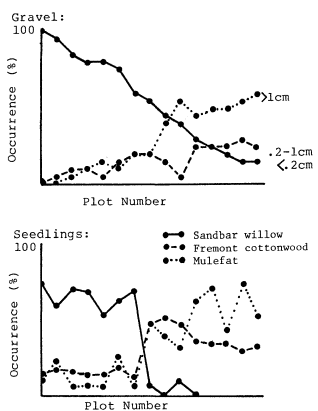
Figure l.
Percentage occurrence of gravel sizes and seedlings
on riffle bar plots along lower Dry Creek.
| ||||||||||||||||||||||||||||||||||||||||||||||||||||||||
as long as those of the willows. No mortality was recorded on the sapling plots. It is assumed that the seedlings on sapling plots produced sufficient root growth to remain in contact with a water supply during the summer of 1980. Furthermore, these plants survived the winter period of peak discharge. The absence of saplings from many areas on riffle bars suggests that winter scouring of the bars often removes seedlings which survive the first summer. Older saplings on point bars frequently have basal scars on the upstream side of their stems which are the result of scouring away of the bark, phloem, and cambium.
Examination of a series of aerial photographs of Dry Creek dating from the 1940s indicates a shifting of the locations of riffle bars. The streambed may move completely across the stream channel and obliterate a riffle bar with any seedlings and saplings growing upon it. The temporary nature of the riffle bar prevents the development of the riparian woodland beyond the pioneer stage.
Point Bars
The environment of the point bar shares certain characteristics with that of the riffle bar; however, since the point bar is built outward as the stream meanders, it is more stable over time and provides an environment for further development of the riparian woodland. Point bars along Dry Creek had a more significant increase in elevation as one moved away from the streambed than did riffle bars. They were also characterized by more vegetative cover. Seedling establishment at the margin of the streambed followed the same pattern as was observed on the riffle bars. Large numbers of seedlings became established in June only to succumb to heat and drought. Those which survived the rigors of summer, as well as winter scouring, produced linear stands ranging in length from a few to as many as 30 m. in length.
Plants in these strips reduced the velocity of water during high-flow periods and, therefore, caused gravels and smaller-sized particles to accumulate. As a result, point bars often had the appearance of ridges and swales as one moved from the streambed to the bank of the floodplain terrace. The pattern of sediment-trapping depended upon the density of the vegetation and the distance water travelled over the bar. Plant stems often trap larger-sized gravels at the upstream end of point bars and along the edge of the streambed. Finer sediments are deposited toward the downstream end of the bar and the floodplain terrace bank.
To study woodland succession on point bars we conducted a reconnaissance of several point bars along Dry Creek. Vegetative cover on these bars appeared to be closely tied to gravel size distribution and location relative to the streambed. Our reconnaissance indicated that point bars could be divided into five environments as follows: 1) point bar bank; 2) first ridge and swale; 3) interior ridges and swales; 4) lagoons; and 5) base of the floodplain terrace. Not all point bars exhibited all five of these environ-
ments along Dry Creek. Smaller point bars sometimes lacked areas of interior ridges and swales. Lagoons were also not found on all point bars.
A typical point bar exhibiting all five environments was chosen for a detailed analysis of its vegetation and gravel size distribution. The vegetation on the point bar was mapped and four transects were chosen to cut across the various environmental zones and vegetation-types. Along each transect ten adjacent one-quarter square meter plots were established parallel to the streambed in the point bar bank, first ridge and swale, and base of the floodplain terrace environments. In the area of interior ridges and swales, 10 similar plots were established at the top of each ridge and the bottom of each swale along the transect lines. Plants occurring on each plot were tallied as seedlings or, if they were older, their basal diameter and height were recorded. A point frame was also used to determine the distribution of gravel size on each plot.
The data collected along these transects suggested that an autogenic pattern of succession followed the establishment of seedlings along the point bar bank (table 2). Initial seedling establishment along these banks appeared to follow the pattern observed on the riffle bars. Numerous seedlings became established as water receded in the spring. Species success depended upon gravel size. The absence of any seedlings in the 1 cm. size-class suggested that none of last year's cohort survived. The occurrence of plants in the 1–5 cm. and >5 cm. size-classes indicated establishment had been successful in previous years.
On the first ridge and swale, current seedling establishment was dominated by cottonwood and red willow as evidenced by the 1981 seedlings and plants under 1 cm. in diameter. These ridges and swales were dominated by older sandbar willow and mulefat. It would appear that these pioneers established a footing on an earlier streambank and have trapped gravel to produce a ridge as the point bar advanced. The larger gravel sizes trapped by these plants, combined with the higher elevation of the seed beds, have not provided a suitable environment for the continued establishment of sandbar willow and mulefat. Cottonwood and red willow can become established here as evidenced by the data in table 2.
In the zone of interior ridges and swales, gravel size was associated with the distribution of the dominant species. Alder was found on areas of the smallest-sized particles, while sandbar willow and cottonwood occurred on sandy and gravelly sites. Many point bars along Dry Creek lacked extensive areas of smaller-sized particles and did not support alder. No current or recent seedling establishment was observed on any of the plots on the interior ridges and swales. Light intensities were reduced in this zone due to the crown canopy, which may have prevented successful establishment. More important, the elevation
| |||||||||||||||||||||||||||||||||||||||||||||||||||||||||||||||||||||||||||||||||||||||||||||||||||||||||||||||||||||||||||||||||||||||||||||||||||||||||||||||||||||||||||||||||||||||||||||||||||||||||||||||||||||||||||||||||||||||||||||||||||||||||||||||||||||||||||||||||||||||||||||||||||||||||||||||||||||||||||||||||||||||||||||||||||||||||||||||||||||
of this zone was above the elevation where the stream appeared to have deposited vast numbers of seeds during the spring. Seed beds in the interior ridges and swales zone may have been too dry for successful germination during this period of seed dispersal. Vegetative reproduction by layering may have been very important in this zone. Many alder sprouts were growing from buried trunks.
At the base of the floodplain terrace, a gulley occurred across the back of most of the point bars along Dry Creek. Bed shear stress is high at this location during periods of peak runoff. The larger percentage of smaller particle sizes reduces the bed shear stress necesssary to transport material. The gulleys were higher in elevation than the bank of the streambed and dried out much earlier. The more xeric character of these gulleys was responsible for the presence of arroyo willow (Salixlasiolepis ) and the absence of mulefat and sandbar willow. No seedling establishment was observed on the plots measured in these gulleys at the base of the floodplain terrace. Periodic establishment would be expected to occur in years of higher streamflow later in the spring. Winter scour may also be a factor in the dynamics of plants in this zone.
The lagoons supported a margin of mulefat or cattail (Typhalatifolia ) and basket sedge, depending upon the gravel size distribution. Mulefat occurred on coarser gravels, while the cattail and basket sedge grew on sediments less than 0.2 cm. Red willow also occurred above the lagoon margin on the finer sediments.
The conclusion drawn from investigation on point bars is that a type of autogenic succession is occurring in which the initial trapping of coarser sediments by mulefat, willows, and cottonwood produces a ridge of gravel along the outer edge of the point bar. This ridge is a more favorable environment for further cottonwood establishment. As the ridge is built up, finer sediments are deposited between it and the base of the floodplain terrace, toward the downstream end of the point bar. New ridges form adjacent to the stream as the point bar extends laterally. With the growth of cottonwood and willows in the interior ridges, more smaller-sized sediments are trapped, and the swales between ridges begin to fill in.
The increasing height of the bars also contributes to the trapping of smaller-sized particles. The decreased particle size of this substrate results in a more favorable soil-moisture regime for plant growth; however, seed bed conditions are less favorable for willows because of their transient viability. Alder becomes established on the finer sediments of these interior swales and grows up to form a dominant canopy. Shade-intolerant willows and cottonwood cannot survive beneath this canopy. With time, alder dominates the interior downstream portions of the point bars, reproducing primarily by layering. More gravelly areas remain dominated by cottonwood and willow. Floodplain terrace building during unusually high floods may eventually make the ground surface too high and therefore too dry for continued layering of the alder. As the point bar advances laterally, the distance from the streambed to the root systems of alders near the base of the floodplain terrace will become too great for effective water transport. Under these conditions alder will be replaced by species with better adaptations for the floodplain terrace environment.