
Chapter Six
The Decline of Community and the Roles of Big-men
I want to return to Bala and George Town in order to explore what has happened to the Beeri Chettiar community and civic individuality during the twentieth century. But in order to put George Town into perspective let us look for a moment at another section of Madras, which, after all, is a city of about five million. My purpose is to demonstrate how the forces that wed neighborhood and community, that motivate the union of big-men and their constituencies, have determined the organization and character of not just George Town, but of other parts of Madras City as well.
As we have seen in previous chapters, times change and what it is that people want and leaders can accomplish changes with them. Big-men and their clients respond by renegotiating their relationships and by redefining their roles. In the process, the character of the neighborhoods of the city change also. In the second part of the chapter, 1 return to George Town to describe its evolution since the nineteenth century lawsuits. There, today, Bala is trying to pull together a neighborhood that is coming apart. The forces of change that Bala confronts are broad-based and are impelled by shifts in the needs and motivations of ordinary people.
Looking back over the past one hundred years, I see three major changes in community leadership and in the integration of George Town, each of which is associated with changes in the meaning of civic individuality. First is the period of gumbuhal , headman, and the head-man council, the Periyagramam. Second is the period of a looser form
of leadership, a period of big-men, their institutions, and constituencies. Third is the present day. Big-men still exist, but there are fewer of them, and they are redefining their roles and relationships among a shrinking clientele. Neighborhood localities are losing their community integration. An evolution is occurring that affects the entire city, every neighborhood, old and new. Madras City has begun to change rapidly. It is entering a new period.
Today, a drive down any major street in Madras City reveals clear signs of a vigorously developing metropolis. Consider Nungambakam High Road, which cuts through one of the city's old residential districts: vehicular traffic is congested; diesel exhaust hangs heavily in the air. Lining the road are apartment buildings, a multistoried, "five-star" Western-style hotel called the Taj Coromandel, new businesses, restaurants, and shopping centers. Then, turning down Krishnamachari Road,[1] a side street, the driver enters an older world. At first the driver passes old houses set in large garden compounds. A few of these are posted with signs indicating the businesses they now house. Traveling further, the driver suddenly finds himself in the center of what was once a village, the "village" of Nungambakam. In the small bazaar, street vendors sell vegetables and rolled sets of banana leaves to be used as dinner plates. A small village-style temple dedicated to the elephant god, Vinayakar, is located there (see fig. 10). A second structure not far away is a devotional society dedicated to the god Ram, and not far from that is a third small temple.
When I first visited the village with a Nungambakam friend, it was September, just prior to my beginning work in George Town. We had gone because it was a festival day, Vinayakar cathurthi (Full-moon Day). In the street near the Vinayakar temple, children clustered around a man selling small, brightly colored paper umbrellas, symbols of the god. Next to him a vendor was molding and selling clay copies of the god for people to take home for their private worship. Later they would drop the mud idol into their household wells or into the sea, the proper methods for disposing of these clay images. The central event of the temple festival occurred when the bronze temple idol, garlanded in flowers, was taken in procession, carried on his palanquin through the village streets.
The names of these streets recall the castes and the big-men who once lived here: Krishnamachari Road, a Brahman Iyer name; Kumarappa Mudali Street, the name of a high caste agriculturist; Mangadu Sami Aiyar Street, another Brahman Iyer name (Nungambakam is known as a Brahman Iyer village); and Rama Naicken Street, the name of the mere-
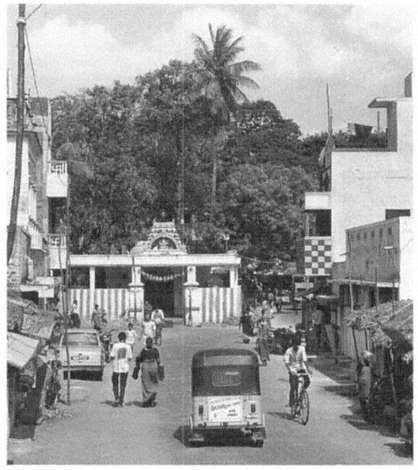
Figure 10.
The Vinayakar temple in Nungambakam, Madras City, 1992. The
photo shows the village-like quality of the neighborhood, which is located in the
heart of the city.
ber of yet another dominant agriculturalist caste. Here the houses are not set in large compounds; instead, their verandas line the streets so that their inhabitants can sit out in the evenings and talk with passers-by, much as in a village or small town. In inner-city villages like this, there may even be an agricultural plot or two. Called "gardens," these bits of agricultural land, now behind walls, are remnants of the time when the area really was a country village. Madras was once known as the
"Garden City" because of these plots, and in the 1960s when I first lived there, urban agricultural "gardens" were still fairly common. Now, land values and urban growth have eliminated most of them.
Should the driver continue his short journey through the center of the "village," he will leave these traces of a rural past. Suddenly, just as abruptly as he entered, he will pass a wall and emerge once again onto a major road, Nungambakam Village Road, and into the bustling metropolitan present. The village, after all, lies in the heart of Madras City.
What the driver has experienced on his short drive is evidence that Madras's urbanization has been a process of the city spreading and engulfing the villages and towns that once surrounded it. Today Madras City is an agglomeration of villages and towns, each of which retains characterizing features of its own. J. Talboys Wheeler's map of Madras as it was in 1733 (compare maps 7 and 8) depicts the villages and small towns that today lend their names to the municipal districts surrounding George Town at its core: Egmore (Elambore), Nungambakam (Nungambaucum), Purasawakam (Persiwaukam), Vepery (Wepery), Triplicane, San Thome. Unlike the new outlying residential suburbs of the city, where neighbors are strangers and proximity is a product of class, these urban "villages" preserve their small-scale atmosphere. Residents know one an-other—if not always intimately—and strangers are noticed when they enter. Caste, too, remains an important determinant of residence. The identities of these localities have yet to be lost to the homogenizing forces of urbanization. As in George Town, it is in the context of places like Nungambakam that civic individuality finds expression. It has always fascinated me that these urban villages still influence the atmosphere of the city and leave traces in people's lives.
The experience of a graduate student of mine, who comes from Nungambakam, provides one sense of this influence. Her family has lived in Madras for nine generations. Recently her father and his brothers sold the family's ancestral home in the old "village" center. My student's father, mother, and brother were the only ones living in the house at the time. The father's brothers, who jointly owned the house, had for some years lived elsewhere, in Bombay and Delhi. In old age and in a cooperative spirit when they sold the house, the brothers bad all agreed that the time to partition family holdings had come. Like many inner-city houses, it has now been converted into a business. When the house was sold, my student's father and mother rented a nearby house, owned separately by one of the brothers. There, today, they live modestly, a seemingly ordinary middle-class family, neither poor nor rich. They own a
scooter, but frugality dictates that they rarely use it. However, if, as observers, we change our perspective so that we see them, not as a single family, but instead as a household at the center of an extended circle of kin, our understanding of the status of the family changes dramatically. My graduate student's extended family is well known in Madras and claims within its circle several highly placed and influential members both in its past and at present. It is no ordinary family.
One summer my graduate student returned to Madras to marry. When she came back to the university in the fall, I asked her about her wedding. "How many people came?" I asked. "Oh," she replied, "it was strictly a family event." "How many attended?" "About a thousand," she said with a smile. Curious about the extent of her family ties and knowing that her family was widespread in India, I asked her further, "If you were to walk down the streets where your father and mother have lived, how many houses would you still pass in which relatives of yours reside?" After reflecting a moment, she said, "About seven." Later, I learned from her father that about 1,200 relatives and close friends had attended the wedding. When I mentioned this to another Tamil friend, he had replied matter-of-factly, "Yes, that's her family."
Among other things, what this story reveals is that kinship ties are still important in Madras and its inner-city village localities. Until relatively recently, locality and kinship were overlapping categories for all castes in Tamil Nadu. For many they still are. When personal connections are important to social success, extensive kinship networks are an outcome, and community localities such as Nungambakam and George Town tend to persist. It is within the contexts of kinship circles and community localities that civic individuality finds expression. Without such contexts, there would be no civic individuality, and without a need for knowing who people are, the ties that unite a community, including those of kinship, need not be strong. It behooves us, therefore, to understand the forces that have contributed to the maintenance of these contexts and to their change so that we can understand how the role and nature of civic individuality is changing in the twentieth century.
Four factors in particular reinforce the association of kinship with locality or contribute to the continuity of urban localities as communities, notably: (1) locality-based marriage rules, (2) the roles that personalized trust and connections (including kinship ties) continue to play as determinants of social and economic success, (3) the community-making roles that big-men play, and (4) the presence of "charitable" community institutions—"big-man institutions," such as temples, production cooperative
societies,[2] schools, and scholarship funds—which are the institutional contexts in which local big-men define their roles as community leaders and shape their followings. Like kinship and trust, big-men and their institutions are defining elements of community and social locality. Because big-man institutions have geographic location and often a distinct and sometimes impressive architectural form (e.g., temples, marriage halls, schools), informants describe them as key features of the physical layout of their own community and as distinguishing features of other locales. When institutional management is "denominational," that is, when it is controlled by a single locality-delimited caste, the connection between institution, locale, leadership, and kinship is further emphasized, even when the clientele the institution serves is not caste exclusive, as few are. But keep in mind that all of these forces and connections are weakening in the face of changes that are diminishing the role that communities play in people's lives in Madras City today. When community ties weaken, the spatial context community provides for expressions of civic individuality loses its significance, and the role that civic individuality plays changes.
Consider the nature of the four forces strengthening the association of kinship and locality and of those countervailing forces that are weakening community. First, locality-based marriage rules: Even today within Tamil castes most marriages still occur within recognized locality-based endogamous subgroups. This is true despite the fact that locality rules are no longer enforced and inter-subgroup marriages are increasingly accepted, especially among elite families. Smartha Brahman (Iyer) elites in Madras, the Iyers of Nungambakam included, were among the first to discard subgroup marriage rules. However, working to counter trends toward interlocality marriages, many south Indians still prefer marriages that maintain kinship ties by uniting related individuals: Tamil culture specifies cross-cousins and sister's daughter/mother's brother marriages. In fact, the mother's brother's daughter is called "murai pennu " by her father's sister's son, a term that means the girl over whom the son has a right [of marriage]. Genealogies that I have collected reveal that in fact Tamils often do marry relations, if not always these specific ones. My own assistant married his elder sister's daughter in 1986, for example. In some communities, the majority of marriages are among relations (Mines 1972). When I seek motivations for these preferences from informants, south Indians have ready answers: they stress the desirability of arranging marriages with families with whom they share custom and outlook, the better to avoid incom-
patibility and conflict. However, even when great care is taken to ensure suitability, marriage is fraught with difficult adjustments. Families are naturally concerned about the welfare of their children, especially daughters, who will leave the family when they marry. Consequently, mothers and fathers feel more secure when their children marry into families that they know intimately, and they like their children to live close by so they are able to see them frequently. In part, therefore, these marriage patterns reflect matters of trust, a much cited concern of informants. It is easier to trust people you know and with whom you have continuing relations than those who lack these traits.
But as we have seen, the need to establish trust through personal knowledge is diminishing in India today, and reflecting this in south India, community ties are weakening and strict subgroup endogamy rules with them. The disbanding of subgroup endogamy rules is closely associated with the spread of Western-style education and modern occupational diversity that has led to occupational mobility. Family heads prefer to marry their children to spouses with similar educational back-grounds, to avoid matching a person with a progressive outlook, for example, to someone whose outlook is narrowly circumscribed. Opportunity and territory are closely linked, and education expands opportunity well beyond the locality. Members of educated families tell me that sub-group endogamy rules work against their alliance-making interests because they restrict the field of suitable families too severely. Consequently, as soon as families in a caste begin to educate their children, they begin to chafe at locality-based subgroup endogamy restrictions. If there are no other reasons for restricting marriages to their locality, elite families soon begin to arrange interlocality marriages, although the majority still arrange marriages within their subgroups. In some instances, full-blown intercaste marriages begin to occur as well, but the number of these marriages is small. Usually these are "love marriages," arranged by the partners concerned.
Since the 1960s, my data shows that the numbers of intercaste marriages have increased in Madras City; by 1986 every genealogy I collected in George Town included one or more. What is important is not the number of such marriages, which is still small, but the change in attitude toward them. Twenty years ago families cut off ties with inter-caste couples and were reluctant to discuss them. Today people ac-knowledge them as part of life, something with which kin have had to learn to live. But informants privately tell me they still dislike them. They say their caste community disapproves of them, and families become
quite upset when they occur. In George Town, the family priest, purohit , who conducts marriages for the Beeri Chettiars, told me that twenty years ago if he had conducted an intercaste marriage, he would have been boycotted by the caste. Intercaste marriage ceremonies were then small private events. Today he performs intercaste marriages at five-star hotels. However, despite such evidence of growing tolerance, continued reliance on personalized trust among business and artisan castes acts as a countervailing conservative force that works to preserve subgroup caste marriages. So do the personal preferences of individuals. In fact, I found among the Beeri Chettiars of George Town the vast majority of marriages still unite families that belong to the same gumbu subgroup.
Also reinforcing the association of kinship with locality are the roles that personalized trust and connections continue to play as determinants of social and economic success: locality integrity is maintained because castes whose members still rely on personalized social trust to regulate their economic relationships also tend to see advantages in maintaining close community ties. Business and artisan communities are of this sort, although there is considerable variation among them. Take the case of the merchant. Community membership facilitates business because it enables the merchant to achieve a reputation for trust and establish en-during social and economic ties. Within his community he may achieve a reputation for credit-worthiness, for example. This may enable him to enact verbal contracts among his fellows at will. "His word is money," is highest praise for the Tamil businessman because it attributes great integrity, and large sums are sometimes exchanged on the basis of such a word. A merchant's reputation in India is worth money. Further, knowing the members of the community, a merchant has a sense of whom to trust, mistrust, or be cautious about. Of course, any merchant will also tell you that you can never really tell about anyone. But, among people he knows, or knows indirectly through big-men, the merchant who maintains strong community ties has the advantage of greater information with which to assess risks compared to one who lacks such ties.
Another factor strengthening the association of kinship and locality is the community-making roles that big-men play. In particular, this includes the various ways in which big-men and personal relationships are put to use to support reputations, to determine social trust, and to organize the ways and means of accomplishing ends. These uses together create forces that contribute to the preservation of neighborhood localities and the urban village phenomenon. Communities are preserved because people preserve and use personal ties as means to achieve an ordered so-
cial life and other important social ends. Knowing this, whenever I set up household in India, I make an effort to obtain most of the household services I need through a big-man or woman. This helps ensure for me the reliability of the service providers, because they choose not to abuse their relationship with me lest they jeopardize their continuing relationship with the big-man/woman through whom I made my contact.
Of course, relations with big-men and women are two-way streets. Such leaders also make deals on behalf of clients who seek to negotiate their relationship with me. I remember once, while conducting research among Muslim merchants, wanting to do a survey of Muslim women in their houses. I checked with a number of the community's leading Muslim men before beginning, explained to them that I had hired a female Muslim social worker to administer my survey—purdah , the seclusion of women, precluded my personally conducting the survey—and began the survey when I thought I had the support needed. I had been conducting fieldwork in the town for over a year and thought I knew my way around. Two days into the survey, the religious head (moulvi ) of a small but conservative faction objected strenuously to the survey and demanded that it be stopped at once. I went back to the Muslim big-men with whom I had first consulted and asked their advice. In a most friendly manner, they explained to me that while they personally thought the idea of the survey was fine, after I had gone back to the U.S., they were going to have to live with the conservative members of their community. Perhaps it would be better, they suggested, if I gave up the survey. I did.
The fourth factor reinforcing the association between kinship and locality is the presence of charitable, big-man institutions. The big-man institutions that mark and delineate distinct communities reflect the important roles that big-men play in these social formations. However, when people rely on education and new occupations, such as government service, to achieve success, their need for big-man connections to establish their trustworthiness or to act as brokers on their behalf lessens. Bureaucracy, measured in terms of standards established by certification, law, and codified procedure (e.g., diplomas, the courts, elections), grows in importance as a mechanism for maintaining reliability and provides alternatives to the wrath of big-men for countering transgressions and restoring order. Consequently, people are less willing to submit to the personal dictates of big-men and there is less reason to maintain community membership. Concomitantly, reputations and community identity become less important, and individuality is muted. When in association with Western-style education caste members also
pursue new occupations monitored by bureaucratic controls, then the roles of big-men are challenged and diminished at the same time as sub-group endogamy rules are abandoned. There is even less motivation for individuals to maintain their community ties.
To understand the impact of the historic spread of bureaucracy and the decline of community, a distinction needs to be made here between "big-man," which I am using as a generic term, and "caste headman" (ejamaanan ). A caste headman is merely one type of big-man, the recognized head of a caste subgroup. As we have seen, many castes in Madras City and elsewhere once had, but no longer have, headmen, although members of these castes do continue to recognize men and women whom they consider big-men and big-women. A consequence of the growth of bureaucracy is that over the last one hundred years, communities have been rebelling against the dictatorial control that caste subgroup headmen once were able to wield. For castes such as the George Town Beeri Chettiars that had families who turned to education early, rebellions began in the nineteenth century. For others, rebellions began later. A few castes still have recognized headmen, although their power is consider-ably curtailed.[3] Recall Natarajan: Since the power and authority of a headman depends on consensus, once that authority has been success-fully challenged—by even one individual—the end of the office of head-man is at hand. This is because without consensus, anyone can disregard the headman's commands. The way former headmen explain the disappearance of their role is that they are no longer given "respect," the respect that they need to command others. However, this does not mean that big-men no longer have a role in community life. On the contrary, if caste members continue to pursue occupations that rely upon high levels of personal trust, then subgroup endogamy may persist and, while the dictatorial headman will disappear from the community stage, big-men will continue to be influential arbiters of trust and manipulators of connections. As such, they continue to play similar roles to those that headmen once had, but without the dictatorial authority to command others to do their bidding. In Madras City, since the nineteenth-century lawsuits, individuals have sought to limit the personal autonomy and power of big-men, using bureaucracy to curtail their independence. They have done so by limiting the big-man's control over institutional offices by converting these into elected positions with defined terms of office. And they have circumscribed the big-man's independent control of institutional funds by implementing bureaucratic checks such as public audits and governmentally instituted and court-reviewed management schemes. Insti-
tutional big-men who used to have great entrepreneurial independence in the way they used their institutions have now been entangled in the web of law. As a result, the importance of their civic individuality has been diminished.
The Decline of the Beeri Chettiars’ George Town Community
In order to understand the role and nature of civic individuality in George Town today, it is necessary to understand how the community has changed. Although, as described in chapter 4, the nineteenth-century lawsuits mark the end of headman leadership among the George Town Beeri Chettiars, the caste community remained strong and gumbu subdivisions, which headmen had controlled, continued as an important feature of social identity and community organization. Beeri Chettiar informants say that it was not until the late 1950s and early 1960s, when inter-gumbu marriages started to be common in the Town, that gumbu distinctions finally and precipitously begin to lose their social importance. Among the Town Beeri Chettiars, therefore, transgressions of endogamous cluster distinctions were unusual until seventy years after rivals had successfully challenged the dictatorial powers of the Beeri Chettiar headmen in the High Court lawsuits of the 1880s. Today, while informants can still recall gumbu names, and a few elderly people still use the initial of their gumbu as part of their name, most people agree that memory of them is fading and that they are no longer socially very important. Why, then, did gumbuhal persist for so long after the demise of their headmen and of the Periyagramam council, their collegial body? And what finally brings gumbu endogamy to an end? The answers to these questions help explain the decline of the Muthialpet-Park Town Beeri Chettiar community at the end of the 1950s and the changing importance of individuality in the Town and city. In hindsight, the answers also reveal the historic relationship between caste organization and agency among the Beeri Chettiars. A caste is a mutable association, reflecting symbiotic interaction between leaders and members, whose organization reflects the purposes to which it is put.
One reason the Beeri Chettiar gumbuhal persisted is that the economic and social value of gumbu membership continued unabated in the George Town Beeri Chettiar community until the late 1950s, long after the disappearance of the Periyagramam council and headman offices. It is easy to understand why this was true. For one thing, the Muthialpet-Park
Town Beeri Chettiars were still predominantly a business community operating on connections and trust. Each headed by its own big-man, a gumbu was a small, tightly knit grouping composed largely of interrelated business families. The strong sense of gumbu identification and the need to maintain one's good name helped to create the high levels of public trust that elder informants still talk about. The nineteenth century lawsuits had left this linkage between family and business unaffected. Continuing gumbu -locality endogamy ensured, therefore, that relationships among families were enduring and that the trust and connections that facilitated the conduct of business were maintained.
The son of Natesa Chettiar (Natesa Chettiar [b. 1890 - d. 1964]; Kandasami temple trustee 1918-24, head trustee 1931-36), himself a descendant of Ramsami and Ratnavelu, two of the progressive big-men of the nineteenth-century lawsuits, told me that until the late 1950s Beeri Chettiars married street to street, with no intermarriage between Park Town and Muthialpet, even when families belonged to the same gumbu . People liked to marry people they knew intimately and with whom they had enduring relations. Known to one another, these were families that would have something to lose if they were to act dishonorably, namely, their reputations and the trust of others, losses that would carry high costs in business and social networking.
Informants also describe a strong desire for the families linked to them by marriage to share their interests and lifestyles. But the Town Beeri Chettiars were a heterogeneous community. In the twentieth century, Park Town had the highest concentration of prominent business families. Muthialpet also included business families but was occupationally and socially more diverse, counting among its numbers families in prominent service with the English in business and government as well as increasing numbers of new professionals. Complicating marriage matters, in Muthialpet, several prominent families were also considered to have traces of English blood, the result of generations of close association with the British. In the eyes of many, this tinged their eminence with a strong sense of ambiguity, and Park Town's elite avoided intermarrying with such families. Some members of these families are said to have had blue eyes and light skin, and, as several informants remarked, they preferred tea to coffee, as their descendants do now—"just like the English." It is also true that some of the most prominent families counted Christians among their kin, as the nineteenth-century lawsuits, my genealogies, and public knowledge of family histories bear witness. Descendants from among these families continue to be among today's most prominent big-men, nonetheless.
The hereditary family priest serving the Muthialpet Beeri Chettiars once remarked to me that the meaning of "gumbu" was a group doing a single type of business. Although an exaggeration, the families of each gumbu did tend to specialize in particular businesses—a matter of fathers teaching sons their line of work, Bala told me. For example, the Poonamallee and Salem gumbuhal were known as dealers in iron and steel and as wholesalers and retailers of betel nut. But they were also coconut, provision, and rice merchants in Kothawal Chavadi, the city's wholesale produce market, and wholesale and retail textile merchants. Kasukaarar gumbu families were known as close associates of the British and, as I have noted, were distinguished as cashiers and bullion dealers, although they too counted families engaged in a variety of businesses. Similarly, the leitmotif of "Tobacco" (Pangaiyalai) gumbu families was tobacco, while nonferrous metals were the specialty of the "Tin-sheet" gumbu , the Tagararkaarar Chetti gumbu . Again, families belonging to both these gumbuhal pursued other enterprises as well.
Another reason for the preservation of the Beeri Chettiar gumbuhal and the Muthialpet-Park Town community was that under British colonial rule, Madras City was the capital of Madras Presidency, and George Town was located at the center of business, finance, education, and government. Situated at the Town's southern edge, the High Court of the Presidency was literally just across the road from Muthialpet (see map 2), which was a short walk from the Secretariat in Fort St. George. Next to the court was the Law College. Across from it and also in the Town were Christian College (founded 1837), and later Pachaiyappa's College, although subsequently both moved to less crowded quarters.[4] These three colleges played important roles in the late-nineteenth- and early-twentieth-century creation of a Western educated Indian elite in the Presidency.
The listing of a few names illustrates the growing presence in the twentieth century of Beeri Chettiar big-men among this educated elite. The purohit[5] of the Muthialpet Beeri Chettiars says that in pre-Independence Madras, Soma Chettiar (Kasukaarar gumbu ), who was head trustee of the Mallegeeswarar temple on Thambu Chetti Street (see map 2), was also a president of Pachaiyappa's College as well as a "director" of Binny and Co., one of the major English companies. The priest says Soma Chettiar was a descendant of the Thambu Chetti family. His grandson still lives in Muthialpet today, although he is an ordinary person without claims to big-man status. Soma Chetti's sister's husband was the hereditary trustee (suroodiriyamtaar ) of the Tiruvotriyur temple to the north of George Town. His sister's son is the head trustee and suroodiriyamtaar today. Another family, well known prior to Independence, was that of
O. (for Ottakadu gumbu ) Tanikacalam Chettiar, descendant of Lingi Chetti. O. Tanikacalam was for a time a small-causes court judge, a Madras Legislative Council member, and president of the Madras City Corporation. One of his brothers, O. Kandasamy Chettiar, was a student of Dr. William Miller, the highly respected founding principal of Christian College. O. Kandasamy Chettiar himself became a well-known teacher in the college. His daughter, O. Jeevarathanam Ammal, B.Litt., was the first non-Brahman woman graduate in the Town. Other members of the family were advocates, doctors, engineers, military officers, and bank officers. V. Chakra Chettiar was yet another prominent graduate. He was the brother of Venkal Sundara Ramanujam Chettiar, a trustee of the Kandasami temple from 1930 to 1935. According to the purohit , V. Chakra Chettiar was an advocate, a well-known labor leader in Madras, and for a time its mayor. He was also a convert to Christianity. In addition to the Kandasami trusteeship, his brother was the president of the Beeri Chettiar caste madam and founder of the Muthialpet Benefit Fund, a charity serving the community's poor. In 1910, Natesa Chettiar, the grandson of Ramasami Chettiar—the man whose outcasting led to the nineteenth-century lawsuits—became the first Poonamallee gumbu college graduate. His gumbu was and still is the dominant business gumbu among the Beeri Chettiars in Park Town. To this day his house is known to old residents as "B. A. House" ("B. A. Viidu"). Later Natesa was a trustee of the Kandasami temple between 1931 and 1936, and an adjunct professor of physics at Pachaiyappa's College. What is apparent from this listing of prominent Beeri Chettiar names is that George Town was a center of new opportunities, and, consequently, big-man institutional leadership, achievement of Western-style education, and eminence in enterprise had all become intertwined.
The big British and Indian banks were also located in George Town, and Beeri Chettiar leaders were prominently associated with these. The elder sister of one of my retired informants married P. Cittaraman, who became the head cashier of the Mercantile Bank (now the Hong Kong Bank). His father before him had also been a cashier in the bank, while his father's brother was the cashier of Binny and Co. Marambuttasamy Chettiar, the grandfather of another informant, was an agent of the M.C.T. Bank, an Indian bank run by Nattakottai Chettiars on Coral Merchant Street. Nattakottai Chettiars were the premier Indian bankers of south India (see, e.g., Rudner 1989). Beeri Chettiars, especially those belonging to the Kasukaarar gumbu , were prominent cashiers in other banks, offices, and important British businesses as well: the Imperial
Bank (now the State Bank of India), the National Bank of India (now Grindlay's Bank), government offices (the tahsildar office and the Collectorate),[6] and in Wilson and Co., Shaw Wallace, Best and Co., Parry and Co., Burma Shell, and Binny. Positions were often passed from father to son, because, as my informants explained, families had established traditions of "trust and heredity" with these companies. What they meant by this was that so long as a cashier served his company honorably, his son could succeed him. As we have seen in chapter 4, this reflected employment practices dating back to the early days of British East India Company rule.
We see, therefore, that individual Beeri Chettiars were influential leaders in their community and often close associates of the British, employed in government, banking, and business, right up to Independence. If it is remembered that personal reputations, relationships of personalized trust, and "connections" with people of influence were important determinants of how things were done and of how relationships were established in business and government, then it is clear that maintaining community ties would have proved valuable in this special urban environment, especially for Beeri Chettiars, who were members of a caste that was not only wealthy and well connected, but also the dominant caste of the Muthialpet and Park Town sections. In short, George Town was and continued to be a place where people of influence lived. If, in towns outlying Madras, people left their localities seeking to achieve influence and wealth, then Madras City was where the most ambitious were likely to go. The George Town Beeri Chettiars were at the center of things in Madras Presidency.
Nonetheless, there were significant changes in the organization of the Beeri Chettiars after the nineteenth-century lawsuits. True, the eighteen gumbuhal that composed the Beeri Chettiar caste in George Town continued to divide the caste into leader-centered constituencies. But these leaders lacked the authority of headmen and, Bala tells me, were now called perundanakaarar (syn. of periyadanakaarar ) rather than ejamaanan , headmen. Further, the Periyagramam, which had been composed of headmen and had given the caste its administrative unity, was now defunct, as was the post of caste guru. The failure to replace the caste guru, the guardian of the caste's ritual identity and behavioral rules, who had gone off in the midst of the nineteenth-century disputes, is also a clear indication that leaders remained divided among themselves and that, internally divided, they were never again able to establish their collective authority.
But the perundanakaarar still had an important role to play, which was similar to that of headmen, even if they no longer administered the caste locality as a unit. As headmen had done before them, these leaders used caste institutions—especially the three big caste temples, the Kandasami, Kachaleeswarar, and Mallegeeswarar temples—as institutions of leadership. Genealogies indicate that some of these preeminent men were former headmen, their descendants, or the offspring of marriage alliances with descendants of headmen. Indeed, as noted, Natesa Chettiar was one such leader, and Bala's father-in-law's father-in-law was Natesa's kinsman, Kali Rattina, the "diamond-giver." In the last years of the nineteenth century, probably most temple trustees and preeminent gumbu leaders were either ex-headmen, kin to them, or their close allies.
Kaattavur Subramaniam Chettiar (hereafter, K.S.) was such a twentieth-century big-man. A wealthy iron and steel merchant and the recognized perundanakaarar of Salem gumbu , he was a man of humble origins who came to Madras to work for a Salem gumbu big-man family and, proving his worth, ended up marrying the boss's daughter. Later, he started the South India Corporation with Raja Annamalai Chettiar, a company that subsequently grew very large under Raja Annamalai's direction. K.S. was the head trustee of the Kandasami temple for three consecutive terms, from 1941 to 1958. In addition, he was trustee of the Mallegeeswarar temple and of the caste madam , and, with four other big-men, served as a trustee and member of the caste funeral shrine and tank (the Attipattam Kulam) building committee. An elderly informant[7] told me that K.S. was among the last big-men to hold regular gumbu community meetings. He called his meetings at the caste madam , sending meeting notices to Salem gumbu families living in Muthialpet, Park Town, and Chintadripet.
Another big-man and contemporary of K.S. was Maangadu Ellappa Chettiar (Maangadu gumbu ), prominent member of a low-ranking gumbu that counted a number of wealthy families among its members. Although not the preeminent leader of his gumbu , Ellappa worked hard to establish his status as a wealthy and eminent businessman. He built temple cars for both the Mallegeeswarar temple and for the Tiruvotriyur temple located in north Madras. He also built a choultry in his name at the Tiruvotriyur temple, and he built the Mallegeeswarar gopuram . With K.S. he served as a trustee of the caste burial shrine and tank and renovated the burial shrine building. These two men may be taken as examples from a lengthy list of twentieth-century gumbu leaders residing in
Muthialpet-Park Town prior to the 1960s. Their generation was the last before the breakup of the George Town Beeri Chettiar community.
Thus, although headmen and their Periyagramam council had ceased to function, eminent men, including ex-headmen, continued to play big-man roles. Asserting their generosity and altruism, some of them made spectacular endowments to community temples, as my now familiar example of the cup of diamonds that Kali Rattina gave to the Kandasami temple in 1901 illustrates. But where previously the Periyagramam had appointed the trustees of community institutions from among their number, now trustees were elected. Then again, big-men acted as brokers and arbiters of social trust on behalf of their gumbu constituents, just as headmen had done, but without the overarching authority of the Periyagramam. In other words, gumbus persisted in George Town because endogamy did not stand in the way of new paths to success, and because, even without the office of headman, gumbuhal continued as groupings of social identity and prestige, constituting important contexts within which individuals organized action, manipulated connections, achieved reputations, and managed personalized trust outside the law courts.
But despite the persistence of gumbuhal and the importance of the Muthialpet-Park Town caste domain, the Beeri Chettiar's nineteenth-century lawsuits do pinpoint the period of transition from headman rule and corporate community to what might be described as a more informal period of big-man influence, when the caste was no longer corporate, but still retained a strong community identity. Not surprisingly, this transition also marks the period when the integrity of the Town Beeri Chettiar community began to unravel. And unravel it most certainly did. Today, under Bala's headship, the Kandasami temple complex and its endowments are the only institutional aggregate left that still provides a base for castewide big-man leadership. And as we have seen, only a fraction of the Beeri Chettiar families that used to live in George Town still do.
What happened that would explain this near-collapse of what was once one of Madras City's most powerful caste communities by the end of the 1950s? The answer is that with few exceptions gumbu leadership simply failed to reproduce itself. This was not for the lack of sons, but because for several reasons the locale had lost its importance as the locus of interests and influence among caste members. In part, this was a result of Independence, which removed the British, with whom Beeri Chettiars had for so long maintained symbiotic ties, from a major role in the area. And in part, it was a consequence of the declining role
business played in the lives of caste members. My genealogies show that the sons and daughters of prominent families were attending school and, in most cases, university, but sons were not returning to run the family businesses or to take over roles in George Town-based enterprises. Instead, they were taking jobs in government service or in professions which offered secure employment but lacked significant centers of influence in George Town. As a result, families no longer felt compelled to live in their old neighborhoods, and in increasing numbers, when brothers partitioned, they sold their ancestral homes in the Town and, each taking his share, moved separately to what each considered more desirable, less crowded, less expensive residential areas of the city. The role of the Town's remaining big-men was diminished by this process and their hold over their constituencies weakened. Elder Beeri Chettiars explained to me that educated caste members often felt little compulsion to subordinate themselves to gumbu leadership. Why should they? Their successes depended on education and were no longer embedded within the caste community. The community's decline was a result, therefore, of the changing manner in which Beeri Chettiars made a living. While business was potentially far more lucrative than bureaucratic employment, it was also much riskier.
In 1939, emerging from the world Depression, secure employment was new and novel, and jobs that Beeri Chettiars would consider not very desirable today seemed wonderful opportunities. When K. Sundaram (b. 1921), a retired General Post and Telegraph officer and scion of a once influential family, told me his own story, he laughed good-naturedly at what he clearly saw as the irony of his own career choice. Sundaram comes from a prominent Kasukaarar family that counts caste leaders among its members and once had close ties with the British. I have already mentioned his maternal grandfather, O. Tanikacalam (d. 1929), who was a lawyer and judge of the Madras Small-Causes Court, as well as a Justice Party[8] leader. Sundaram is an only son, but reflecting the family's prominence, one of his sisters is married to an advocate who practices before the High Court, while another is the widow of a former appointed trustee of the Kandasami temple, P. Seetharama Chettiar, M.A. (trustee 1964-1969; 1969-1977), who was cashier of the Mercantile Bank prior to his death.
Sundaram told me that he graduated in 1939 with a B.Sc. degree in chemistry. After graduation, without giving it much thought, he applied to medical school and was accepted. In those days, he says, it was relatively easy to gain admission. Now, of course, medicine and engineering
are regarded by most south Indians as among the most desirable professions one can pursue. But in 1939 that was not the case. He discussed his options with his family and with them decided that instead of pursuing medicine he should take a job with the postal service, which he did in 1940. He says being an only son married to a woman who was an only child factored into the family decision. His father and in-laws wanted him to lead a "quiet life," one that would keep him near.
Sundaram told me with a chuckle that, given the prestige and earnings associated with medicine today, it is hard to imagine that the postal service could have actually appeared the better choice. But in those days many still considered medicine an unclean profession, and government service was desirable and secure work. He says his starting salary was Rs. 40 per month. In 1940, you could get a meal for 20 p., a small fraction of a rupee. "Now you cannot get an egg shell." When he retired in 1977 after thirty-eight years of service, he had risen to assistant director of the General Post and Telegraph Office in Madras. A good position, but one that has no constituency within the Beeri Chettiar community.
Retired and receiving a pension of Rs. 850 per month when I interviewed him, Sundaram is an ordinary man, well liked, but without the wealth and connections that he could call on to make himself an important leader among Beeri Chettiars. Yet, for all his ordinariness, in a neighborhood emptied of Beeri Chettiars, he holds a number of positions that once would have marked him as an important and influential big-man: he is a trustee and treasurer of the caste madam located in the Kachaleeswarar agraharam off Armenian Street and the locality representative to two other madams in which the Beeri Chettiars have interests, one in Tiruvaalangadu, some twenty-plus miles from Madras, and the other in Nerinjipet near Bhavani to the south (see map 1). In addition, from 1962 until 1985, he was first the joint secretary and then general secretary of the Tamil Nadu Ayira Vaishya Sangam, the statewide association with which Beeri Chettiars are affiliated. And he is a lieutenant and ally of Bala's. Nonetheless, despite his offices, Sundaram is a minor leader with limited influence. None of the institutions in which he holds offices attracts much interest from George Town Beeri Chettiars today and none of his offices gives him control over significant assets. In other words, his offices are "hollow crowns"—markers of status that lack substance.
Sundaram's story points up the relative absence of preeminent big-men in George Town today. The big-man form of organization had been well adapted to the high levels of personalized trust that facilitated business,
but for university-educated professionals and government employees big-man leadership is unnecessarily restrictive and personal. Elder residents in George Town explained to me that by the 1950s big-men were finding that the community was no longer willing to give them the respect they needed to carry out their leadership roles. There were still community giants in the 1920s, 1930s, and even 1940s, but by the late 1950s, the link between claims to eminence and strong community constituencies had weakened to the point where conflict between contenders was rampant.
This was especially true with regard to temple trusteeships, the institutions that gave leaders communitywide recognition. Unlike Sundaram's offices, temple trusteeships were not hollow crowns. Education, occupational diversification, and the dispersal of Beeri Chettiar families meant that too few men had constituencies large enough or cohesive enough to enable them to claim the preeminence needed to defeat or discourage contenders in competition for control of the caste's denominational temples. Seen from the perspective of leaders, the fabric of community had become thin. Looked at the other way around, Beeri Chettiars no longer felt a compelling need to support caste leaders, since big-men now played a much less important role in their lives. When, in the late 1950s, heated squabbling over control of caste temples erupted among Beeri Chettiar residents, the Hindu Religious and Charitable Endowments (HRCE) Department, a state agency, stepped in to fill the leadership vacuum, first taking direct charge of the management of the Mallegeeswarar and Kachaleeswarar[9] temples.
By the early 1960s, trouble was also brewing over management of the Kandasami temple. Symptomatically, in 1962, the man whose symbolic role it was to call temple elections, the man who would have been the head of caste in the nineteenth century, the head trustee of the caste madam , resigned his madam position. I suspect he did so because, although there were vacancies on the Kandasami temple board that should have resulted in a call for elections, the two temple trustees remaining in office, P. A. Ragava Chetty and K. Venugopal Chetty, instead entered into an agreement with the HRCE Department wherein the department was given the right to appoint the temple's board, with the stipulation that appointees should be drawn only from the Beeri Chettiar community. Why they made this agreement is not completely clear today, but it appears that they may have done so as a bid to maintain Beeri Chettiar involvement in the management of the temple. Because of temple leadership disputes, the HRCE Department had been at the time actively
considering taking over management of the temple. The result of the deal they made was that for a time it looked as if the Beeri Chettiars, while they would remain temple trustees, nonetheless would lose direct control of the last remaining important institution of big-man leadership in George Town. With this loss, the crucial social roles that Beeri Chettiar big-men had for so long played as the organizers of their caste corporate community within the city seemed at an end.
Bala Tries to Rebuild the Community: 1964-1087
In keeping with the deal, the HRCE Department selected P. A. Ragava Chetty in 1964 as a returning member of the first appointed board of the Kandasami temple. Of K. Venugopal Chetty, however, we hear no more. P. Seetharama Chettiar, Sundaram's brother-in-law, was among the four other appointed members.
But big-men dislike HRCE Department control because bureaucratic constraints inhibit the personalized and entrepreneurial nature of their patronage. By giving the department control over the appointment of trustees, the Beeri Chettiar caste had in effect lost its right to select its own leading men, including who among them was to be preeminent, the head trustee. Even more important, HRCE control greatly curtailed the ability of big-men to compete for temple offices and resources. Since the HRCE Department was a state agency, its control of appointments also meant that party politics would play an important role in the future selection of trustees. The HRCE takeover marked the low point in Beeri Chettiar community integration. It looked as if the community had lost its last institutional context in which meaningful eminent civic individuality could be achieved and expressed.
Three years later, in 1967, several residents rallied to regain control of the temple. Sundaram was a key figure among them. On behalf of the community, he and three like-minded Beeri Chettiars[10] filed a petition with the HRCE Department requesting that the right to conduct temple elections be returned to the caste, arguing that the agreement that had been made was without the consent of the Beeri Chettiar community and that the two trustees purported to have made the deal, in fact, never signed the agreement. Sundaram told me that only the lawyers of the two men had signed. He insisted that because of that fact the agreement should not be binding on the caste community.
In due course, the HRCE Department ruled that the issue of control could not be decided by a writ petition, but would have to be settled by
a civil suit. Accordingly, in 1976, Sundaram and his colleagues filed suit and requested the court to allow the caste again to hold temple elections until such time as the case could be decided. This request was granted, and elections were called in 1978, the first since 1959. As a result of those elections, Bala was elected to his first term as head trustee.
Like the generation of leaders who immediately preceded him, Bala straddles the worlds of education and enterprise. He is both an engineer employed in a government undertaking, All India Radio, and, succeeding his father, a successful businessman, the proprietor of a retail iron and steel enterprise. He is a man of enormous energy, intelligence, and accomplishment with extensive ties within the Beeri Chettiar caste community in Madras City. In part, as mentioned before, these ties stemmed from his links to preeminent men of the past. In particular, he counts among his wife's antecedents a number of prominent community leaders including KaliRattina, the diamond-giver, his wife's grandfather. Although he is himself a member of the Salem gumbu , Bala, who married in 1959, belongs to the first generation of Beeri Chettiars among whom inter-gumbu marriages were common. His wife's gumbu , like that of Kali Rattina, is the top-ranked Poonamallee cluster. Bala also counts among his affines Natesa Chettiar, whom I have described above, a link that ties him to the progressives of the nineteenth-century lawsuits. Through these ties, Bala is related to a number of former Kandasami temple trustees, both in the distant and more recent past, and he traces kinship ties to some of his closest allies as well as to some of his most dedicated enemies.
But Bala's success in the 1978 elections was by no means merely a matter of connections. Already by that year, he had earned a reputation of his own, one which he had achieved as a community leader among the Park Town Beeri Chettiars. Key to this reputation was the "arts" association that he had founded in 1969 to promote music, drama, and literature, the Kandan Arts Academy. Bala says he founded this association with the aim of bringing the Beeri Chettiar caste community together again, uniting them through patronage. Today the Academy has four hundred members, drawn mostly from the Park Town Beeri Chettiar business community. It annually sponsors two major public concerts, held each year on a platform erected in the street in front of the Kandasami temple under a huge thatch pandal (roof) constructed for the occasion. The concerts are grand events that bring well-known music stars to perform, and they are extremely popular. Spectators pack the street. During the concerts, Bala plays a prominent public role and is seen as its organizing patron.
Leaders like to sponsor dramatic events to attract public interest. In 1974, the arts academy gave two cash prizes of Rs. 51,000 to artists it judged up-and-coming, one to the music director S. B. Subbaya Naidu, the other to the poet S. D. Sundaram. Artists like these two men are low-income people, Bala says, so the prizes gave them a boost. The prizes were raised by the academy's performances and were a gesture of grand patronage that attracted a great deal of public attention. Bala told me in 1986 that he hoped to make similar awards in the near future. Through the academy, therefore, Bala successfully organized the Park Town Beeri Chettiar merchant community as sponsors of what have proved to be very popular annual events. Doing so, he earned a reputation as a hard-working altruistic community leader as well as the backing among his fellow merchants that enabled him to win his first trusteeship election.
In 1978, the extent of Bala's ties within the caste community was reflected in the 1,062 votes he garnered. The election was a close race in which he won the head trusteeship by a mere 28 votes. The nearest contender was his ally, K. Kesavalu Chettiar, who had served as an appointed trustee since 1964. Twenty-two candidates had contested the election, competing for 2,667 voters, each of whom voted for five candidates, five being the number of board members to be elected. Bala's detractors put this 1978 election in perspective by noting that less than half of the 7,500 eligible voters voted. But the electorate had to travel from all over the city to the Kandasami Spring Hall next to the temple where ballots were cast. This is more than a small inconvenience in a city the size of Madras, and indicates that Bala and his runner-up did well to rally the supporters they did.
Big-man politics accentuate personal rivalries and are typically contentious. It is hardly surprising, therefore, that Bala was to have enemies even among his fellow elected board members. As it turned out, his key rival was the younger brother of P. A. Ragava Chetty, a man whom I shall call Kaliraja. Recall that Ragava Chetty was one of the men who originally made the deal with the HRCE Department and was then reap-pointed by the department to the temple board. After the 1978 election, as Bala's successes as a leader began to mount, Kaliraja was to do his best to unseat Bala through a steady barrage of charges of wrongdoing, including a lawsuit accusing him and his temple board allies of malfeasance in the administration of temple affairs (Mines and Gourishankar 1990). Kaliraja's aim was to succeed Bala as head trustee. Failing that, he hoped to weaken Bala's influence by supporting increased HRCE Department involvement in temple management, including as a last resort
a department takeover of the temple. If Kaliraja could not be head trustee and thereby enhance his own civic individuality, then he wanted to destroy the temple as an institution of leadership for others.
In the context of these conflicts, the case to return temple elections to the caste community finally came to trial in 1986 and, despite Kaliraja's efforts, was decided in favor of the Beeri Chettiar community in 1987. During the trial, Sundaram and his associates were de facto representatives of Bala's factional interests, while Kaliraja backed HRCE control. As events transpired, Bala's allies were able to discredit Kaliraja in court and so disarm his charges against Bala while simultaneously undercutting Kaliraja's claim that HRCE control was needed. During the course of the trial, Sundaram told me that no one was taking Kaliraja's charges seriously, including the HRCE Department. If they had, he said, the department would have intervened in temple management.
The turning point in the trial seems to have come when Sundaram was able to impugn Kaliraja's integrity by gleefully countercharging that Kaliraja was apparently not even a Beeri Chettiar and so should not be involved in Kandasami temple affairs. To Kaliraja's great embarrassment, Sundaram documented in court that Kaliraja had fraudulently registered his son as the member of another caste in order to lay claim to special educational benefits. The court burst into laughter at this piece of evidence. Following that court session, to this enthnographer's eye, Bala and his friends could only be described as in the highest of spirits. They were absolutely tickled with the way their enemy had been trapped by his own indiscretion. Some months later the trial concluded, and in September 1987, for the first time in nearly a decade, new elections for the temple board were held. Bala was again elected the head trustee of the temple board, this time in what amounted to a landslide victory. His contentious opponent, Kaliraja, failed to be reelected.[11]
Since his first election, Bala has dreamed of using his status as the head trustee of the Kandasami temple to revitalize the sense of community among Beeri Chettiars. His motivations for doing so are a mix of community spiritedness and his self-interested desire to strengthen his own leadership, which is necessarily caste-based. His motivations, therefore, are somewhat paradoxical, just as they are also inseparably intertwined. In this regard at least, Bala is probably much like his predecessors. His success as a leader depends on displays of community spiritedness, which earn him a reputation and civic stature. These are attributes that in turn distinguish him as unique, as an individual. But Bala is also aware that conditions and leadership roles have changed since the times of his pre-
decessors. He is moved by a nostalgia for the glory days of the old caste neighborhood, which he would like to recreate. But the conditions that in those days gave authority and power to caste headmen are gone, and the caste neighborhood has dispersed. Bala can build a reputation as a civic leader, and as such, he has influence, but he has little authority over his caste fellows. He can influence, but outside the context of the temple, he cannot command.
Today in Madras, few Beeri Chettiars would say that there are any recognized leaders of caste. Not even Bala gets that recognition. Yet, if Bala could, he would have the galactic polity that he controls be the organization of the Beeri Chettiars in Madras. In fact, built as that polity is around the Kandasami temple, the caste electorate is his constituency, and so, in point of fact, his polity is an important part of what constitutes the organization of the Beeri Chettiars in the city today. But for most, that organization and leadership only lightly touches their lives.
Bala sees himself as a leader struggling to pull together a disintegrating community. He would like to reinvolve community members—to create the conditions where caste members would have a renewed stake in their relations with each other and would again turn to the big-men of the caste for leadership. He would also like to bring all the institutional interests and assets of the caste under a single administrative structure, which he envisions himself as heading. But there are few Beeri Chettiars who share Bala's vision or who see real benefits in the community organization of old. They no longer need gumbu headmen and are glad to be free of the constraints that the old system imposed on them. Nearly every Beeri Chettiar in Madras knows Bala. Many have even voted for him. But they do not think of him as someone who has power over their lives, nor do they envision him ever having such power.
Among his caste fellows, Bala is a perundanakaarar , a big-gift-giver, an influential big-man, and the preeminent trustee of an important Beeri Chettiar caste temple, but that is it. To be effective he must appeal to followers as an altruistic benefactor, but there is a halo of suspicion that always surrounds public altruism when it is associated with achieved charismatic preeminence and control of public resources. After all, the more a leader benefits his followers, the more important his own individuality becomes. Who is he helping more—himself or his constituents? In Bala's case, the suspicion is mild, but it is there. Tamils think it naive to presume that any public figure's actions are moved purely by altruism. One elder informant, a retired municipal politician and something of a self-styled skeptic, summed up his feelings about Bala's leadership
this way: He did not know what went on behind the scenes at the Kandasami temple (meaning that, for all he knew, Bala might be mismanaging temple funds, as his enemies charge), but as head trustee of the temple, Bala had done good work and the community had benefited. This was high praise from a man who for philosophical and political reasons had not entered a temple for over thirty years.
Today, the central institution of Bala's galactic polity is, therefore, the Kandasami temple. And it is in his role as head trustee of the temple that Bala enacts most broadly his role as patron, struggling to recreate his community. The Kandasastri Festival (Kandasastri Kotti Arccanai), a six-day period ending the day after Deepavali, the fall "Festival of Lights," may serve as a brief reminder of the breadth of appeal that the temple has among Beeri Chettiars and so its importance to Bala. During this festival, Bala says, about twenty-two thousand families visit the temple to make an offering and to sit and be greeted by Bala, the head trustee. For Bala, this is exposure at the grassroots constituency-building level. Moreover, it is exposure in an important ritual context that depicts him as the preeminent big-man within his community. The worshipers get the prestige of being seen with him, and he the opportunity to provide them the honor of his presence. It is in public contexts such as this that Bala makes himself most visible as a leader and builds his reputation as a civic individual. Bala's desire, therefore, is to achieve as much exposure of this sort as possible. This means attracting crowds to temple events.
A chief aim of Bala's is to increase the popularity of the Kandasami temple—to make the Kandasami temple the Beeri Chettiar temple—the most popular of all the temples controlled by the Beeri Chettiars in Madras City. To do so, Bala pursues two primary strategies. His first is to maximize the spectacular in temple events. Temple trustees have always used grand display and ritual innovation to attract crowds and dramatize their patronage. His second strategy is to reinvigorate the sense of community among the caste, as he says, "to get the community together." For this purpose, Bala uses the institutional resources that he controls to create benefits for as many people as possible. Again, his aim is constituency building.
A popular name for Park Town, the location of the Kandasami temple, is Kandakottam, "Kandan's Place," reflecting the landmark importance of the temple to the area. Since 1980, Bala has invested over two crore rupees (a crore equals Rs. 10,000,000) of Kandasami temple funds in projects designed to enhance the prestige of the temple and benefit the Beeri Chettiars in the city. During each of his terms in office, Bala has
completed a temple project with high spectacle value. His first, completed in 1984, was to build the gold-plated temple car. Covered with seven kilograms of gold and costing twenty lakhs[12] (Rs. 2,000,000), it is a rarity in south India. The gold temple car has added significantly to the fame of the temple and to Bala's reputation as head trustee. Today, the splendor of this magnificent car is a major feature of temple processions in which it is used. Who would want to miss seeing it? His second project, carried out in 1989, was to orchestrate and conduct the ritual purification and renewal of the temple, a kumbabisheekam ceremony, an elaborate and expensive consecration ritual of major importance, the performance of which seems to be one of the dream goals of most temple head trustees. As part of this latter event, Bala published a commemorative volume, which documents the spectacle and describes the history of the temple and the George Town Beeri Chettiars. The volume includes numerous photographs portraying Bala himself as a principal figure. It also includes congratulatory advertisements from businesses and community institutions, some of which are Bala's, and a large collection of color photos depicting the wealth of the temple, the crowns and jewelry of the Kandasami idol, and the many golden processional vehicles that Beeri Chettiars have built for the temple. In effect, the volume is a statement that the George Town Beeri Chettiars are a wealthy and influential community and Bala is a central figure within it.
Together these two projects, the gold temple car and the kumbabisheekam , have kept Bala and the Kandasami temple in the eye of the public both because they are spectacular and because they are major projects that build on anticipation and require a great deal of community involvement. They have enhanced the reputation of both temple and leader. These projects have also been community building, increasing the pride Beeri Chettiars feel in their temple, which they equate with their collective identity.
Using the popularity of the temple as a resource, Bala is also trying to revive the tradition of giving first honors to the heads of the old leading families of the various gumbuhal . In this instance, first honors consists of sending a temple employee to the houses of these men to present them personally with invitations and announcements concerning temple functions. It also involves publicly offering them special respect when temple processions pass in front of their houses. Bala feels that too many of the old prominent families who used to handle gumbu affairs have become "just average" people and so no longer claim eminent status nor feel that they are in a position to help others. Nonetheless, he reasons that it is these men who could bring the community together again. If
they are again given respect within the community, then ordinary people may once more turn to them for help in their affairs; for example, in settling a dispute, arranging a marriage, or finding a job. Make these men eminent within the caste, reasons Bala, and they will form points of influence around which the community can coalesce.
But even Bala is skeptical about whether this can be done. Too many families, both influential and ordinary, are moving out of George Town. High real estate costs and a desire for more open surroundings are frequently cited incentives. Bala uses his own family as an example. He says his ancestral home is worth ten lakhs. Since he is one of five brothers and his father is deceased, when his mother dies, he and his brothers will sell the house. Each will take his two lakhs, Bala says, and go his own direction. Real estate is too expensive in Park Town, and his brothers already live elsewhere. It used to be, Bala says, that all of his neighbors were Beeri Chettiars. Now most have sold their homes or let them out, some to businesses. It is getting so now there is very little neighborhood left.
But, although sometimes discouraged, Bala has not given up. The temple resources that are at his disposal as head trustee have been particularly important to his community-building efforts. Using temple funds, Bala has founded a number of satellite big-man institutions designed to benefit the caste community and extend its collective reputation. Using donations collected at the temple, for example, he has founded and built two schools and is planning the development of a polytechnical college. One of the schools is a high school, open to all communities, which enrolls one thousand students. It is located in Periswakam to the west of George Town on land valued at ten lakhs. The land was donated by Bala's deceased affine, P. Venugopal Chettiar. The other is located in Park Town itself. Called "Hindu High School," it instructs children from nursery school through high school and is housed in a new two-story building, which Bala says cost seven lakhs. In conjunction with Kandan Arts, Bala has also started a small music school, which at present trains students in vina and singing.
Located to the front of the temple's kingly tower (Raja Gopuram), the main entrance into the temple, Bala has also founded a free library, featuring magazines, dailies, and more than four thousand books concerned with literature, religion, and how to start small industries. The latter category of books reflects an ideal of Bala's. He believes that all Beeri Chettiars would benefit if caste members shared a community interest in helping their poorer caste fellows. An aim of the library is to provide a source of information for the average Beeri Chettiar seeking ways to come up in life. Bala points to the Komati Chettiars and Jains as examples of communities that have successfully pursued self-help strategies in Madras.
Since the 1950s, Jains have been particularly successful in their competition with Beeri Chettiar merchants in George Town, and Bala feels they are out-competing and gradually displacing Beeri Chettiars in part because they lend money to their caste fellows who want to start businesses. The Beeri Chettiars should do the same, Bala feels.
Bala has also founded two free medical dispensaries, one on Thambu Chetti Street, the Muttu Kumaraswami Devasthanam [Kandasami temple] Chamundi Iswari Ammal Free Medical Dispensary, named after the woman who donated her house for the dispensary. The second dispensary, the Kandakottam Free Medical Dispensary, is located opposite the temple on Rasappa Chetti Street in Park Town. Within the temple itself, Bala also manages the rental of the temple's sixty-plus properties and sells at concession rates prasadam (savories "blessed" by the god) and prayer-offering (arccanai ) packets for the benefit of worshipers. And—a sign of the times—another temple concession sells religious videos.
Bala is also the managing trustee of the Vasantha Mandabam, the Spring Hall, which abuts the temple, and of a marriage mandabam on Mint Street, which is owned by the temple and rented for wedding parties and other important family occasions, such as the seventh-month ceremony celebrated on behalf of a woman by her parents during her first pregnancy. The Spring Hall is a well-endowed institution that serves as a community meeting hall as well as an institutional extension of the temple. I have mentioned, for example, how each spring the idol of Kandasami is taken to the hall to "rest." The hall is used by Bala for Beeri Chettiar Association meetings, for community meetings, for example, to select caste representatives for the Nerinjipet madam , and as the voting place for temple elections. The hall also funds a charity, the Vasantha Mandabam Arakattalai, which each month gives Rs. 500 to poor Beeri Chettiars to assist them in starting a business, finding work, or meeting marriage expenses.
Bala has also founded several other associations, independent of the temple, with the aim of serving his community and strengthening grass-roots support for his leadership. I have already mentioned Kandan Arts. In 1984, he organized the Park Town Benefit Fund, a financial institution offering secured and unsecured loans to middle-class Beeri Chettiars, as well as a deposit scheme designed to assist parents saving to meet dowry expenses. The fund was created to provide a means by which Beeri Chettiars could help one another. Bala is the fund's "honorary advisor."
In 1985, Bala also organized a new Beeri Chettiar Association (sangam ) with himself as president. Initially, the rationale for the sangam was to certify the caste identity of members who wished to register for
"backward class" benefits. These are government benefits aimed at assisting educationally disadvantaged communities.[13] This service, however, has failed to induce many Beeri Chettiars to join, and the sangam remains a "hollow crown" at present. Nonetheless, Bala has aspirations for the association. He feels if he can get enough of his caste fellows to join the sangam , he can claim for it the right to represent caste interests generally. His goal is to make the sangam the premier institution over-seeing all organizations and endowments controlled by the caste, including the Kandasami temple. This would provide him with an institution that would administratively unify all caste assets and organizations, including the caste madam , giving him control of resources worth many crores. This kind of integrated institutional control, however, has never before existed, not even in the nineteenth century, when the Periyagramam board, composed of caste headmen, used to meet to administer caste affairs at the madam . In those days, the Periyagramam and madam were the premier institutions of caste.
Today, there is no chance of the madam regaining this premier institutional role. The symbolic head of the Beeri Chettiar's madam normally should be its Brahman guru, a part of whose function it is to instruct his Beeri Chettiar disciples about what for them is an appropriate code for behavior. As we have seen in chapter 4, by the 1870s both the role of caste guru and the enforcement of strict caste codes clashed with urban needs for behavioral flexibility. In 1876, when the Beeri Chettiar's guru left the madam , he was never replaced. Today, persistent anti-Brahman attitudes continue to make the madam unsuitable for the role that Bala has in mind for his sangam . It is likely, therefore, that the caste madam itself will remain a hollow crown. The current head of the madam is Bala's lieutenant, Sundaram. Bala's plan would give his sangam control over madam interests and would subordinate the trustee who oversees them. Sundaram told me privately he doubted the consolidation would ever take place.
Nevertheless, Bala is currently attempting to make sangam member-ship attractive to Beeri Chettiars. He has sent his supporters on a door-to-door campaign championing the benefits of a reunited community and soliciting members. But Beeri Chettiars are not attracted to join abstractions; they join when they calculate that there are real benefits to be gained. In 1985, therefore, in the name of the sangam , Bala also founded a form of financial institution known as a "chit fund," the Kandan Financial Corporation, this for the benefit of wealthier Beeri Chettiar merchants. The hope was that if the caste's perundanakaarars joined the
fund, they might be persuaded to join the sangam as well. If they did, then ordinary men might also see benefits in joining the sangam in order to be able to associate with such influential men. In point of fact, however, the fund is not really under the control of the sangam , although Bala tries to play up connections between the two.
Businessmen join chit funds of this sort to self-finance lump-sum business expenses (see Mines 1972). To begin the fund, Bala brought together twenty founders, each of whom gave between Rs. 20,000 and 25,000 to establish a reserve fund. Each of the Financial Corporation's "chits" is for Rs. 100,000. A chit-fund group consists of forty members, each of whom contributes Rs. 2,500 for forty months. Month by month, members pressed for cash bid to buy the fund, members being eligible to buy once in every period of forty months. At month's end, the month's bid is distributed as earnings among fund members and at the end of the forty-month period, when the chit is completed, members are each given a silver tumbler or other silver utensils. By 1986, the corporation had twenty groups of forty members each. Bala told me that in business, people tend to borrow outside the caste community for fear of spoiling their reputations. The chit fund, which is seen more as a risky form of investment[14] than a form of borrowing, serves a valuable function among wealthy merchants, providing them with both earnings and a source of unencumbered cash, which they can access quickly with a high bid, if need be.
Bala's abounding personal vigor and determination can be seen in all these efforts described here. His efforts also illustrate how a leader who wishes to expand his civic identity must multiply the contexts in which he attracts and serves different clientele. A community is composed of such multiple contexts. In each new institution that Bala founds, he seeks to attract a constituency of followers, who together will recreate the community that has been lost. But except for the temple and Bala himself there is really very little that connects the different groups that constitute his following. In 1978, when Bala was first elected head trustee of the Kandasami temple, he was, as he is today, a caste leader of a new generation, a generation that lacked a strong connection between caste identity and neighborhood community. Without this connection, Bala has been constantly faced with the challenge of how to pull together a constituency he could serve. His response has been to attempt to revitalize his caste as an integrated community, not as it was—that would be impossible—but as a citywide community, founded on shared interests in the Kandasami temple and the institutional galactic polity that
surrounds it. If successful, the caste he would create would be a community only weakly integrated by a shared need to control social trust; the new community would not be a phoenix, therefore, raised from the ashes of what once was. Although Bala does not fully realize this, and despite the fact that he would still use temples and institutions to attract constituencies, much as his predecessors did, the new community would necessarily be a new kind of organization. But despite his efforts, it seems unlikely that Bala can succeed. The conditions that created tight-knit organization are past. Although he believes he is trying to revitalize his caste fellows' sense of community, what he has done in fact is to put together successfully a coalition of constituencies within his caste without recreating the community for which he nostalgically longs. Grappling with a variety of approaches to recreate community integration, Bala is succeeding as a big-man but failing to recreate the caste community. Although caste neighborhoods still exist, they are disappearing. They no longer reflect the dynamics of city organization, which, after all, reflect the needs and interests of the city's inhabitants. The city is undergoing profound change and the organization of civic leadership is changing with it. Big-man networks are still important, indeed central to city organization, but the caste neighborhoods that leading individuals once created to organize their affairs and regulate social trust are no longer essential.