
Poisson Resurrected
In late August Dirac received from Fowler the proofs of Heisenberg's seminal paper. Even before he was able to judge the relevance of the new scheme, he tried his favorite game, finding a relativistic extension. While this premature attempt fell short, it revealed what Dirac considered to be the essence of Heisenberg's new ideas. First there was a substitution of "Heisenberg's product" for the ordinary product, then an endeavor to maintain as much as possible of the structure of classical dynamics: "The
[40] "Minutes of the Kapitza Club," AHQP, entry of 28 July 1925. In Dirac 1977, Dirac remembered having heard Heisenberg's talk, in contradiction of his earlier statement in Dirac [1962]. The source of Heisenberg's talk was Heisenberg 1925b. See Kragh 1990, 14, 317 n. 1.
main point in the present dynamics is that when we have to choose a quantum coefficient, we do so in such a way as to make as many classical relations as possible still true between the quantum quantities."[41]
Another characteristic of Heisenberg's paper, the organic relation between the new kinematics and the structure of the emitted radiation, initially diverted Dirac's attention from more essential features of the theory. In his tentative relativistic extension, he invoked the unidirectional character of the emitted radiation to justify the introduction of the atomic momentum in the labeling of stationary states. In another manuscript he tried to explain the absence of radiation in the fundamental state by introducing a new distinction between two types of "virtual oscillators." The "i -type" with an amplitude q = a eiwt was unable to radiate by itself, if only the general expression of radiated energy was assumed to be A 2 + B2 , where A and B are defined by

Not to radiate, the fundamental state had to be a pure i -oscillator; the possibility of emission in the other states was then to be attached to a corruption of the i -oscillators by "j -oscillators," with an amplitude bejwt , wherein j = — i .[42]
As Dirac quickly realized, this strange idea had every chance to be irrelevant, since it connected subsets of virtual oscillators to definite levels, in the naive fashion

which is not compatible with Heisenberg's product. The manuscript ends with the words: "We cannot, however, put xy (n ) = x (n )y (n ), so that coordinates associated with a stationary state can have only a very restricted meaning."[43]
The title and introduction of the above-mentioned manuscript, "Virtual oscillators," clearly indicates that Dirac originally interpreted Heisenberg's new scheme as a modification of the BKS theory. In this modification the distinction between positive and negative oscillators was erased, but an alternative distinction, that between i - and j -oscillators, was needed to give some insight into the mechanism of radiation. Heisenberg's own
[41] Heisenberg 1925c; Dirac [1925d], [1925e], undated but almost certainly written before the discovery of the connection between Poisson brackets and commutators. The quotation is from the second manuscript.
[42] Dirac [1925f].
[43] Ibid.
emphasis on radiation properties—the only observable things—probably suggested this misinterpretation. Nevertheless, his careful elimination of the term "virtual oscillator" indicated a fundamental departure from the BKS approach: radiation properties could no longer be connected with a given stationary state, as reflected by the interlocked character of quantum products. After his failed distinction between i - and j -oscillators Dirac also emphasized this impossibility: "The components of a varying quantum quantity are so interlocked . . . that it is impossible to associate the sum of certain of them with a given state."[44]
The Brackets
Having given up on trying to gain insights into the mechanism of radiation, Dirac turned to the more formal side of Heisenberg's scheme, first to the new quantum rule. Since Heisenberg presented this rule as deducible from the high-frequency limit of Kramers's dispersion formula, Dirac naturally went back to the Kramers-Heisenberg paper for a full derivation. On the one hand, he found that Heisenberg's new product already appeared in the dispersion formulae for the incoherent case (see (220) of part B).[45]
On the other hand, he knew well that in Hamiltonian dynamics the first-order perturbation P1 of a quantity P0 (like the electric moment that was responsible for classical dispersion) could be expressed in the form

wherein e f is the generating function of the first-order canonical transformation connecting old and new action-angle variables. He probably had learned this from Whittaker's Analytical dynamics , or from Fowler's lectures, which used this type of expression in the perturbative treatment of the Stark effect, and in the classical dispersion formula leading to the Kramers-Heisenberg formulae (see (202) of part B). Poisson brackets also occurred in several of Dirac's early manuscripts, even though he might not have remembered that they were named so. Now, according to the Kramers-Heisenberg procedure for translating from the classical dispersion formula, the Poisson bracket had to be translated into a commutator.[46]
[44] irac 1925g, 652.
[45] Kramers and Heisenberg 1925.
[46] Whittaker 1904, 302 of the 1960 ed. for the Poisson brackets in perturbation theory; see Dirac's notes and Thomas's more detailed notes on Fowler lectures, AHQP. Poisson brackets (without the name) appeared in Dirac [1924?b] and in the manuscript kept with Darwin's letter (see n. 38 above).
This explanation of Dirac's first important discovery in the new quantum mechanics is not unfounded reconstruction; it may be surmised from a rough calculation found on a back page of a recycled manuscript. The following transcription is the closest possible.[47]
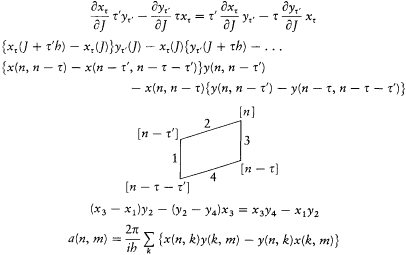
The diagram was obviously taken from the Kramers-Heisenberg paper. In fact, the whole calculation is very similar to that of Kramers and Heisenberg (which is discussed in the equations (214-220) of part B). The second line results from the prescription[48]

The factor 2p /ih in the expression of a (n, m ) enables us to reestablish its meaning as the quantum amplitude "corresponding" to the harmonic n - m of the classical bracket

Indeed, if

[47] Back page of Dirac [1925c]. Mehra and Rechenberg 1982d discuss Dirac's back-page calculation.
[48] I remind the reader that Dt is defined by Dt f(J )=f (J+t h)-f (J ) and that xt (J ) "corresponds" to a quantum amplitude x (n', n ") with n' - n"=t . The choice of n ' is directed by considerations of symmetry (for Kramers and Heisenberg) or by the desire to make matrix products appear in the final formula (m Dirac's case). The diagram is m Kramers and Heisenberg 1925, 694.
then

where the quantity in parentheses is the exact starting point of Dirac's note. Finally, the h in 2p /ih comes from the translation rule (12).
Most important, Dirac's discovery of the relation between commutators and Poisson brackets appears to have been based on Kramers's procedure of symbolic translation. Therefore, it was directly connected with the previous sharpening of the correspondence principle. Here lies the secret of Dirac's revelation of a structural analogy between old and new mechanics—one more significant than Heisenberg's formal transposition of classical dynamic equations.
In his final paper, however, Dirac adopted a different presentation of the relation between classical and quantum brackets. There he used the correspondence principle backward, from the commutator to the Poisson bracket, and in its narrower but safer acceptance as an asymptotic convergence of quantum relations toward classical ones. The resulting calculation looks artificial, since it is nothing but the original one, read from bottom to top:[49]

which is asymptotically equal to

of

The latter expression is, as we saw, ih/2p times a Fourier coefficient of the Poisson bracket[50]

[49] Dirac 1925g, 647-648.
[50] Dirac used the notation [x, y ] instead of {x, y } for the Poisson brackets. In order to avoid confusion, I will conform to the modern usage, which reserves [x, y ] for the commutator.
As immediately noticed by Dirac, the first attractive feature of the Poisson brackets is their canonical invariance: for any choice q, p of the canonical coordinated, they can be expressed as

Moreover, they have the same simple algebraic properties as commutators: antisymmetry, bilinearity, distributivity, and Jacobi's identity, which respectively read:
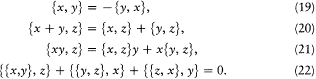
All of this suggested to Dirac the following assumption:[51] "The difference between the Heisenberg product of two quantities is equal to ih/2p times their Poisson bracket expression. In symbols,

In the case of a canonical pair q, p , this rule gave

In this way Dirac reached the canonical form of the new quantum rule independently of Born and Jordan, and in a more profound way, one showing the intimate structural analogy between classical and quantum mechanics. He concluded: "The correspondence between the quantum and classical theories lies not so much in the limited agreement when  as in the fact that the mathematical operations on the two theories obey in many cases the same laws." What Heisenberg had judged to be an "essential difficulty" of his new scheme, the noncommutativity of the quantum product, Dirac viewed as having a natural classical counterpart in the Poisson bracket algebra. As Dirac could not have failed to notice, it also had antecedents, even geometrically meaningful ones, in the algebra of quaternions or in Baker's symbols. This prompted him to develop a "quantum algebra," abandoning commutativity but saving associativity and distributivity.[52]
[51] Dirac 1925g, 648.
[52] Ibid., 649, italicized by Dirac; Heisenberg 1925c, 883.
For the sake of homogeneity of quantum operations, Dirac required every classical operation to have a counterpart in the quantum algebra. Consequently, he introduced a "quantum differentiation" d/dv , with the characteristic property that

Linear realizations of this property, he showed, could always be expressed under the form

For example, the partial derivatives of Hamilton's equations could be represented as commutators in the equations

resulting from the corresponding classical equations

In this elegant manner Dirac dispensed with the awkward mixture of differential and algebraic operations that was being developed with great pain in Göttingen. As Fowler wrote to Bohr: "I think it is a very strong point of Dirac's that the only differential coefficients you need in mechanics are really all Poisson brackets, and that the direct redefinition of the Poisson brackets is better than the invention of formal differential coefficients."[53]
Action-Angle Variables
On the basis of the extended analogy between classical and quantum mechanics, Dirac hoped to be able to transpose classical methods of resolution of dynamic problems. One method, the introduction of new canonical variables, received an immediate counterpart through the canonical criterion: The variables Q, P shall be canonical if and only if


[53] Dirac 1925g, 645; Fowler to Bohr, 22 Feb. 1926, AHQP; see also penetrating comments in Birtwistle 1928, 77.
For systems that were multiperiodic at the classical level, there would presumably be something like quantum action-angle variables (which Dirac rather called uniformizing variables).[54]
In a first exploration of this notion, Dirac found it convenient to introduce the canonical variables (similar to the modern creators and annihilators)

In the light of the correspondence principle he requested that the corresponding quantum variables have vanishing matrix elements, except for the elements  and
and  with
with  . This condition implies the identities

In order to be canonical the variables have to verify another identity:

Hence,

and

wherein the constant must be taken to be zero in order that all amplitudes may vanish when  .
.
Granted that the classical relation

still holds at the quantum level, the (diagonal) values of the action variables are restricted to Jr = n r h. Implicitly assuming the classical expression of the energy in terms of the J 's, Dirac commented: "This is just the ordinary rule for quantising the stationary states, so that in this case [when relation (35) is true] the frequencies of the system are the same as those given by Bohr's theory." This was too simple to be true, as we shall presently see. Nevertheless, the general tendency to adapt classical methods in the new mechanics proved to be very productive in Dirac's subsequent work.[55]
"The fundamental equation of quantum mechanics" was received in early November 1925 by the editors of the Proceedings of the Royal Society
[54] Dirac 1925g, 651-653.
[55] Ibid., 653.
and was hurried to publication by Fowler. The introduction expressed Dirac's personal view of quantum mechanics:
Heisenberg puts forward a new theory, which suggests that it is not the equations of classical mechanics that are in any way at fault, but that the mathematical operations by which physical results are deduced from them require modification. All the information supplied by the classical theory can thus be made use of in the new theory.
Dirac contrasted this outlook with the one associated with the correspondence principle, which confined the validity of classical equations to the asymptotic case of high quantum numbers and to "certain other special cases." In reality the discovery of the connection between commutators and Poisson brackets was inspired by the conception of correspondence as formal translation earlier developed by Kramers, Born, and Heisenberg under Bohr's guidance. The concomitant formal analogy between classical and quantum mechanics was, though Dirac did not know it, the most perfect expression of the "general tendency" expressed in the latest form of the correspondence principle.[56]