
Between Law and Grace
Let us try to develop Philosophical Letters like a photographic negative. Perhaps those areas that become bright will turn out to be about Russia, after all.
OSIP MANDELSTAM, "Petr Chaadaev" (1914)
Two strategies, traceable in Mandelstam's early poetry, seem to be defined by this antithesis between the contemporary assumptions concerning poetry and poets and the personal problems that Mandelstam had to face as a Russian Jew growing up and living in St. Petersburg in the final decades of the old regime. One strategy belonged to the "Symbolist" period and found expression in an involved development of the confessional theme, so involved, in fact, that it took modern readers a while to figure out what this "confession" was about.[64] The other strategy, which has established Mandelstam's public persona as a decorous, philosophical, and formidably cultivated poet, bore the imprint of Acmeist thematics and style and took the form of large-scale cultural and historiosophic edifices in which the poet, in part an outcast, could find well-defined and honorable points of self-reference. In this section I shall concentrate on the first of these strategies.
Composed in 1910, neither of the two "encoded" poems below happened to be included in Stone I, II, or III, although they appeared as part of a selection of Mandelstam's poems in Apollon in 1911. I shall cite them here in my own, emphatically literal translation.
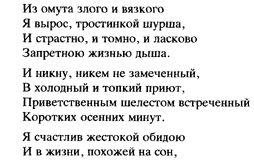
Out of an evil and miry pool,
I have grown—a rustling little reed—
And, with passion and longing and tenderness,
Breathing the forbidden life.
And I droop, noticed by no one,
Into the cold and boggy asylum,
Hailed by the greeting lisp
Of short autumnal moments.
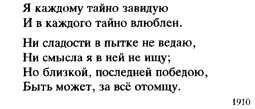
I am happy with the cruel offense,
And in the life resembling a dream,
I envy everyone secretly,
And with everyone I am secretly in love.
I neither know sweetness in torment,
Nor do I search for meaning in it;
But, perhaps, with the imminent ultimate victory
I shall avenge it all.
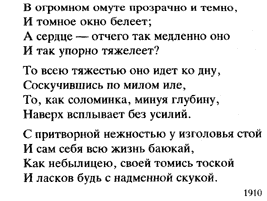
The enormous pool is limpid and dark,
And a longing window is gleaming.
But the heart—why is it so slowly
And so stubbornly growing heavy?
Now, with all its heaviness, it sinks to the bottom,
Homesick for the dear silt,
Now, like a little straw, bypassing the deep,
It floats up on the top without effort.
Stand, feigning tenderness, at the head of your bed,
Lull yourself the entire life,
Languish in your sorrow as if it were a made-up tale,
And be gentle with the haughty boredom.[65]
In retrospect, one can hardly question the legitimacy of interpreting these poems as meditations of an "assimilated" (and therefore not entirely assimilated) Jew on the conflict of his cultural loyalties. The first indicates an awareness of one's otherness and a sharply felt desire to participate in the "forbidden life," even at the price of pain and humiliation. The second, in which the "pool" figures as a metaphor of a mirror,[66] outlines a strategy for distancing the poetic self from the "actual" ego by transforming it into aesthetic material ("a made-up tale").
What gives such an interpretation added credibility is yet another poem, which, although composed at the same time as the other two, was not published until 1915, and then only in a newspaper.[67] All three poems share a set of images—the pool, the slender stem (the reed and the straw), the deep, the sinking, the heaviness—but it is the particular subject matter of the last poem that serves as a clue to the thematics developed in this cycle. The poem, also a meditation, focuses on Christ's last moments on the cross:
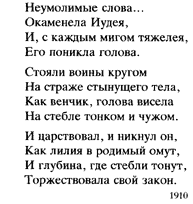
The implacable words . . .
Judea became petrified,
And, heavier with every moment,
His head drooped.
Warriors stood guard
Around the cooling body.
His head, like a corolla, hung
On a slender and alien stem.
And He reigned, and He drooped,
Like a lily into its native pool,
And the deep where stems sink
Was celebrating its law.[68]
One way of grasping the meaning of this "triptych" is to relate it to two poems by Fedor Tiutchev on which Mandelstam drew both for the vocabulary (the "reed") and for the conceptual framework, that is, the insoluble contradiction of belonging to two conflicting worlds. One of these allusions, as Kiril Taranovsky has pointed out, goes back to Tiutchev's reversal of Pascal's definition of man as a "thinking reed."[69] For Pascal, the ability of the human "reed" to think was the highest asset; for Tiutchev, it represented the fatal liability, the cause of human alienation from the harmony of nature: "Why does the soul sing not what the sea sings and why does the thinking reed grumble?" It is this latter "reed" that serves as a metaphor for the protagonist of Mandelstam's poem. Tiutchev's second poem, too, contains a paraphrase from Pascal, this time a definition of man as a "citizen of two worlds" (Tiutchev's "The soul is an inhabitant of two worlds"). One is the daylight of reason; the other is the deep night of irrational desire that threatens to tear the soul apart unless it, "like Mary [Magdalene], presses forever against the feet of Christ."[70] In both cases, the Tiutchevian subtext reinforces Mandelstam's theme of the rift between the "native pool" and the "forbidden life," and, as in Mandelstam's cycle, attempts to bring about a resolution of the eternal conflict by reiterating the ultimate resolution that took place at Calvary. This similarity between the two poets brings into sharper focus the central difference in their use of the name of Christ. Whereas for Tiutchev, Christ alone can give peace to the unsettled soul, for Mandelstam, he is subject to the same, if more intense, divisions that afflict the poet's own self.
Another approach to the triptych is to examine how each of its members realizes the plot that they all share—a protagonist caught between two conflicting value systems in a way similar to the protagonist caught between two equidistant bales of hay in Buridan's paradox. The first poem, "Out of an evil and miry pool," is so rife with tension between the "pool" and the "forbidden life" that it hardly makes logical sense. How, for example, can one be at the same time "happy with the cruel offense" and "neither know sweetness in torment nor . . . search
for meaning in it" while planning imminently to "avenge it all" with the "ultimate victory"? Removing the last stanza, as Mandelstam (or his editors) did in the 1928 edition, helps matters considerably, though at the expense of the original intensity of this cultural double bind.
The second poem, "The enormous pool is limpid and dark," may at first appear to be a picture of tranquility and reconciliation, but the bitterness of the last quatrain makes this initial impression misleading. Mandelstam's "confession" here seems to run as follows: the choice of lyric poetry as one's vocation involves a particular concentration on one's self, which is what occupies the poet as he is examining the split in his "heart" before the "enormous pool" of the mirror. So far so good, but the poem concludes on a sinister note. The poet qua poet does not like the reflection he sees ("feigning tenderness"); he commands himself to deny or conceal his anguish ("as if it were a made-up tale") and to be "gentle with the haughty boredom," a personification, I believe, of an affected Petersburg snob.
The third poem presents the most telling account of frustration stemming from a divided loyalty. Here is a poet's essay in measuring his self against the figure of Christ. As with any consistent comparison, this one focuses on a set of shared features that establishes a relationship of similitude and contrast between the two terms. Taken in random order, these features are the experience of ordeal; affinities to two contradictory orders, one of origins and the Law (Judaism), the other of the new faith and Grace (Christianity);[71] the simile of the "stem" (the "reed," the "straw"); and, finally, the "pool" which, because it is "native," has the irresistible power to draw back into itself what has once issued from it.
The last poem provides a decisive clue for the elucidation of the cycle precisely in the unexpected metaphoric shift from the "petrified Judea" to the deep "pool" of the Law. As far as the poet is concerned, this pool is associated not only with the painful ordeal of seeing one's face in the mirror of the "host culture" but also, and here the similarity ends, with the comfort of return to the native realm. In Russian, the "silt" for which the poet feels nostalgic (the second poem) is emphatically "dear" thanks to the paranomastic play on the two words: mILyi IL . The Judaic, therefore, can manifest itself both as something "petrified," hard, emotionally unresponsive, "implacable" (its association with God the Father and the Law) and as something receptive and "dear," a home that can be "missed." This duality lends an air of legitimacy to the otherwise surprising choice of attribute, "native and dear" (rodimyi ), qualifying the "pool" in the poem about Christ. After all, Mandelstam wrote these lines with the full awareness of the "sa-
tanic" connotation that the word "pool," omut, has in Russian usage: "In a quiet pool—that's where devils live."[72]
Another near contrast between the two subjects rests on a shared vegetative metaphor: whereas Christ is likened to a complete and specific flower, the poet appears as a generic "reed" and "straw"—lifeless, infertile stems devoid of corolla—which sink into the deep as quickly as they float up to the surface. The name "lily," given to Christ, signifies a completeness on yet another level—the plenitude of the divine androgyne[73] —similar to the one attributed to Christ in Blok's The Twelve.[74] As Vladimir Solov'ev once asserted, "One way or another, all true poets knew and sensed this 'feminine shadow' [of God]."[75] To develop the parallelism further, the transcendent plenitude of Christ, which allowed him to "reign" and to return to his origin in Judaism, has its mortal analogue in the poet's anguish, his doubts whether he would be able to reconcile his desire to breathe the air of the "forbidden life" with the clinging "silt" of his inherited identity. Recalling Annenskii's remark and Mandelstam's choice of metaphor for poetry, "the breathing of the mystery of marriage,"[76] this analogy may be safely extended into the realm of eros, not the physical variety, but the displaced, mystical, Platonic and Manichean eros that Russian Symbolists had preached, beginning with Vladimir Solov'ev.[77] The frequency with which the common lexical attributes of the erotic appear in the cycle offers an additional justification for a reading of this sort. Consider: "with passion and longing and tenderness," "in love," and "sweetness," or even "voluptuousness" [sladost' ] in the first poem; the "heart," "heaviness," "tenderness," in the second; and "heavier," the "lily," and "native," or "dear,"[78] in the third. A curious mythic narrative begins to emerge from the "pool" of these early poems—a specific mythology of the poet's self, his poetry, and his milieu.
Existing in a state of tension, these three elements are integrated into a pattern where attraction and repulsion define their place in the world. In the first poem, the "pool" that gave birth to the poet is "evil and miry," a "cold and boggy asylum," while the "forbidden life" outside elicits feelings of "passion and longing and tenderness." The "cruel offense" that the poet hopes to "avenge" is ambiguously defined—as either an offense to a victim of anti-Semitism, or of a man despairing of having been born to Jewish parents—and the ambiguity suggests the not uncommon coexistence of these sentiments, something that one encounters often enough. Yet the coexistence, too, is antagonistic and conflict-ridden. A similar relationship of attraction and repulsion determines the poem's coda, where the disclaimer of the first two lines is negated in the conclusion.
As if such a piling up of negatives were not enough, the second poem offers an opposite view of the predicament. Here, Mandelstam is wearied by the necessity of "feigning tenderness" when what he feels is self-hate or of being "gentle" when confronted with the "haughty boredom." Furthermore, what prompted a bitter outburst in the preceding poem is given a tender treatment in this one: the "silt" is "dear," and there is nothing to prevent the poet from either going down to the bottom or floating up to the surface of the "pool." It would appear that Mandelstam was at least of two minds on the subject of his identity, and with the last poem this ambivalence acquired an even greater intensity as the theme took the form of a meditation on the "historical" origins of his confused state.
As often happens with meditations of this sort, which create a god in one's own image, Mandelstam imputed to the Event and to Christ the features of his own predicament. But where the reflection of the self came out different from the image of God, Mandelstam was able, albeit indirectly, to formulate his fundamental notions of the mythic narrative centered around himself as a poet. It should not appear surprising, although one need not take it for granted, that Mandelstam chose to present himself in terms of the Christian doctrine according to which the New Testament superseded the old faith based on Mosaic Law. After all, he might as well have chosen the teachings of Marx or Nietzsche. These two popular and powerful ideological constructs of the time could have provided him with an equally intricate grammar and a capacious vocabulary. Yet he did not choose them even though he was adequately familiar with both.[79]
Among the many reasons for choosing as he did, two stand out as important: his sensitivity to his "otherness" and his commitment to the art of poetry. They were by no means unrelated, if only because being a Russian poet made Mandelstam feel alien all the more. The Symbolist vocabulary, its set of values and its myths, although not properly Christian in any orthodox sense, were permeated with conceptualizations and imagery for which Christianity served as the ultimate source and reference point. No doubt experienced as a necessary condition, this aspect of contemporary poetic culture could not be ignored unless Mandelstam was willing—and he was not—to remain on the margins of Russian letters. What is more, Russian Christian culture had to be accepted and internalized, and, for obvious reasons in Mandelstam's case, reformulated so that it might suit the poet's particular and still unusual situation. This reformulation took the form of a more archaic integrative myth that was capable of organizing into a
distinct and highly evocative narrative pattern the disparate elements of the poet's view of the world and of the self.
What I have in mind is the myth of incest. This myth offers an economical model for the analysis of Mandelstam's poetry, as it helps to keep track of the twists and turns in his own life story without obscuring the persistent patterns holding together the complete narrative of this "poète et martyr de son temps."[80] Since his career as a poet has been perceived as a charismatic performance (a characteristic to which much of Mandelstam scholarship testifies),[81] this myth, one of transcendence, may also help to account for the effectiveness with which Mandelstam relied on patterns of verbal magic and, consequently, for the intensity of his charismatic appeal.[82] But most important, the myth of incest apparently provided Mandelstam with an archetypal framework capable of supporting the symbolic vocabulary of his native Russian culture while giving him an opportunity to exploit his problematic relation to it. One is indeed hard put to come up with another universal myth, popular in Mandelstam's milieu, that could have accommodated a conflict of this nature and magnitude.