
The Guelders Wars and the "Common Man" in Holland
Leonardo Bruni, humanist and chancellor of republican Florence, remarks at one point that when the armies of a republic lose a battle, citizens will sooner believe they have been betrayed than that they have been beaten.[3] The process by which human beings attribute sinister motives to those who rule over them has seldom been addressed by historians, perhaps because the phenomenon is too commonplace, or because scholars prefer to avoid the nettlesome task of deciding which suspicions are worth taking seriously and which are not. But there are no good reasons for thinking that princes were ever so fiendishly clever as (for instance) Erasmus makes them out to be, when he suggests that rulers deliberately provoke each other to war in order to have an excuse for taxing their subjects.[4] It is true that
sixteenth-century rulers could find reasons for thinking that war was "not altogether a bad thing." As J. H. Shennan says of Charles V's political testament, the old Emperor believed that war "kept soldiers occupied and prevented them from causing trouble at home; people paid their taxes more readily in wartime and formed the habit of paying."[5]
War was also seen as providing a certain tension that was needed for the health of the body politic. For example, Guillaume Budé, the great French humanist, suggested that the blessings of peace were not unmixed: "Yet peace also brings forth a hesitant and sluggish sense of security, which usually gives birth to luxury and laziness, whence come torpor and shameless pleasures."[6] Despite the fact that it was sometimes jurists, "men of the long robe," who argued for war while noblemen with military experience counselled against it, nobles were commonly thought to encourage their princes to enter into conflicts in which the nobles themselves found employment. During ceremonies to celebrate the Peace of Cambrai, ending hostilities between France and the Habsburg lands (1529), the chamber of rhetoric of the French town of Amiens put on a play about how wars were ended. While merchants and peasants plead for peace, Mars objects; when the parties appeal to Lady Nobility, she explains that peace is difficult because the nobles are nourished by war. The conclusion is that only God can bring war to an end.[7]
Suspicions of this kind were no doubt enhanced by the special circumstances of the Habsburg Netherlands in its long conflict with the Duchy of Guelders (1493–1528). To begin with, the Emperor Maximilian was always seen as the foreigner who entered into his Low Countries inheritance by marriage, and he did hope to employ the wealth of the Low Countries to help finance his projects elsewhere in Europe, even if he had little success in doing so.[8] In addition, the usages of war made combat a matter of life and death for the ordinary peasant or townsman, but not for rival noble commanders. Noble commanders on both sides regularly made private truces with one another (stillsaeten ) to exempt their own lands from the ravages of campaigning. Netherlands peasants who lived outside the enclaves of feudal jurisdiction thus bore the brunt of enemy attacks,
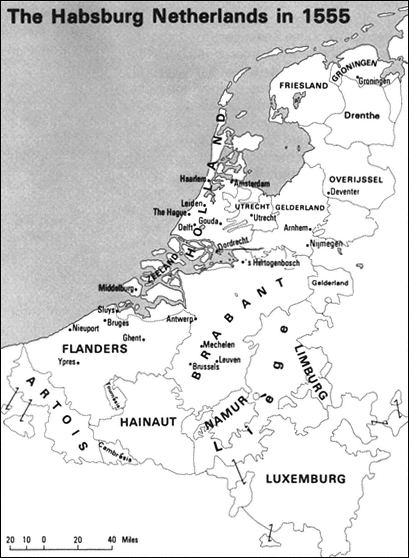
Map 3.
The Habsburg Netherlands in 1555
and when the Duke of Guelders' mercenaries chanced to fall within their grasp, their vengeance was swift and sure.[9] .
In addition, Guelders was ideally located to conduct "exploits" into the Netherlands provinces of Holland and Brabant—that is, to inflict damage on the subjects of Charles V.[10] The Duke's lands bestrode three branches of the Rhine important to Holland's commerce—the Waal, the Lek, and the Nederrijn. To the south, it adjoined Holland's fertile southeastern salient along the Maas. To the north, its coastline was a springboard for harrassment of the merchant shipping that threaded its way to Amsterdam along well-marked channels through the Zuider Zee shallows. In between, Guelders was separated from Holland by the down-river portion of the episcopal principality of Utrecht (later, the province of Utrecht), but this did not prevent Karel van Egmont's armies from striking through into central Holland.[11] Facing an invasion from Guelders almost as soon as she assumed office as Regent (1506), Margaret of Austria found the problem compounded by the fact that the States General consistently refused to vote funds for the war, just as they had done under Charles's father, Archduke Philip.[12] After a brief interval of personal rule by the young Archduke Charles (1514–1517), Margaret resumed the regency just in time to witness the enemy's most stunning success in thirty-five years of campaigning. The Black Band, a feared mercenary army now in the service of Guelders, crossed from Friesland and cut a swath of destruction down the length of Holland; before returning to Guelders, they sacked the small town of Asperen with a brutality that impressed itself vividly on the minds of contemporaries.[13] The modern historian of this conflict finds that Margaret and Maximilian were quite reasonable in demanding stern measures against Guelders and that critics of this policy, among), the nobles and in the States General, were naive to think that Karel van Egmont could be controlled by maintaining good relations with his patron, the King of France. But what struck contemporaries was the inability of the seemingly powerful Habsburg state to protect its subjects from the depradations of a robber-baron princeling. As an English envoy in Brussels remarked in 1516, "Even now the prince [Charles] is in the Low Countries, and the Duke of Guelders takes his subjects prisoner."[14]
Moreover, the secret nature of diplomacy was bound to cause suspicion in a regime in which ministers of the prince had to offer some explanations to the parliamentary bodies that granted new taxes, but did not wish to explain everything. When Habsburg officials met with the Bishop of Utrecht at Schoonhoven (November 1527), the States of Holland were told the Bishop had offered his lands to the Emperor in return for protection against Guelders, but that no final agreement was made since the Regent had no authority to accept such an offer. Amsterdam's Andries Jacobszoon rightly scoffed at this evasion: "I don't believe a bit of it, because they were there together in Schoonhoven for a whole week." Deputies grudgingly admitted on another occasion that they could not expect to be privy to all of the Emperor's "mysteries," but they would no doubt have been shocked by some of the schemes concocted by clever and ambitious officials for expanding Habsburg dominion. (For example, in 1535 there were contacts between emissaries of the radical Anabaptist kingdom of Münster [1534–1535] and Habsburg officials who saw in the Anabaptist uprising a chance to grab the Bishop of Münster's lands.)[15] Even the more ordinary and reasoned processes of statecraft involved strategic thinking that was difficult to grasp from the more local vantage point of the states. In his Historia Brabantiae Ducum the Leuven humanist Hadrianus Barlandus suspects a sinister motive for the inaction of a Habsburg commander and his 2,500 landsknechten while a Guelders army sacked the town of Tienen in Brabant (1507). In fact, Rudolf von Anhalt, a respected commander, was under orders from Margaret of Austria to avoid a direct engagement until he had more troops.[16]
All of these circumstances may help to explain why Charles V's Netherlands subjects mistrusted their government. Yet it is a surprise to see how matter-of-factly sensible men like Barlandus and Erasmus can talk about devilish intrigues mounted by princes against their own subjects. Indeed, one might be tempted not to believe they meant what they said, were it not for the fact that equally sensible and learned men a generation or two later spoke in the same matter-of-fact way about the reality of witchcraft. One must not underestimate the fears of ordinary
people about the mysterious world of power politics or discount the capacity of intellectuals to spin such fears into theories so as to give them the appearance of rationality.
Sources for political opinion in the Habsburg Netherlands for the first two decades of the sixteenth century are sparse and indirect. For debates within the states, there are only the brief summaries of States General meetings edited by Gachard,[17] and a similar compilation at the provincial level, the "Roet Boek van de Staten van Brabant," which is extant from 1506.[18] For Holland in particular there are several chronicles or histories, including three by friends of Erasmus: Hollandiae Gelriaeque Bellum, a narrative of the 1507–1508 campaigns by Willem Hermans, an Augustinian canon of the congregation at Steyn (near Gouda) to which Erasmus had also belonged;[19] the Divisie Chronyk, a compilation attributed to Cornelis Geraerts (called Goudanus or Aurelius), another monk of the same order, which covers Holland's medieval history down to 1517;[20] and the De Rebus Batavicis Libri XIII of Reynier Snoy, a physician of Gouda.[21] Rather more interesting and seemingly better informed than any of these works is the unpublished "Historie van Hollant" (1477–1534) by an anonymous author who clearly had close ties with Amsterdam and who reports on religious matters with a detail that suggests a clerical hand.[22]
These authors are by no means unanimous in assigning blame for the depradations Holland suffered in the Guelders wars. The point of Hermans's narrative is that the seige of the strategic castle Poederoy (1508) failed because Holland's towns were squabbling among themselves, "as in the fables: the frog and the mouse were having a fight; the crow, watching from on high, snatched up both warriors and tore them to pieces."[23] Cornelius Aurelius, in a Latin verse essay on the ancient Batavians, apostrophizes Holland in a similar vein:
But though you have such power on land and sea,
it is to be regretted
That Guelders alone diminishes your praise,
For does it not seem that, by the great sluggishness
of the Senate [i.e. the States],
All your ancient glory has ebbed away?[24]
Elsewhere in the same work Aurelius has letters to his "patrons," including one who was a member of the Council of Holland, and it seems likely that his views on Guelders reflect the outlook of Habsburg officials in The Hague.[25] Holland's leading commander in these campaigns was Floris van Egmont, Count of Buren and lord of IJsselstein, whom Reynier Snoy portrays as the innocent victim of destructive jealousy among other nobles.[26] Since Snoy (like Hermans and Aurelius) had ties with Gouda,[27] it may be that all three writers represent the clear hostility to Guelders that one finds in the regions most often subject to direct attack, that is, northern Brabant ('s Hertogenbosch) and southern Holland (Dordrecht and Gouda). But the "Historie van Hollant" blames Holland's problems on the government and its commanders, and occasional references in discussions within the States General suggest that similar views were not uncommon.
Floris van IJsselstein, a military hero for Reynier Snoy, was apparently the object of widespread suspicion. Since Karel van Egmont was a distant cousin of the Holland Egmonts, IJsselstein's leading role in the Guelders wars might be attributed to family jealousy. Thus in March 1512 he complained to the Regent that deputies from Delft and Amsterdam undercut his appeal to the States of Holland by "coming into your presence crying for peace." Some months later, Thomas Spinelly, an English agent in the Low Countries, reported that the Hollanders were willing to raise funds for 1,200 landsknechten, should the Duke of Braunschweig command them, but would do nothing for IJsselstein.[28] The anonymous author of the "Historie van Hollant" recognizes in many instances that it was IJsselstein's timely intervention that raised a seige or beat back an invading force,[29] yet on other occasions he represents IJsselstein as deliberately refraining from pressing home the attack. In the fall of 1504, IJsselstein withdrew his army south of the Maas to's Hertogenbosch, even though the weather was still fair, thus permitting Guelders to make forays into Holland; in 1508 his fainthearted counsel stayed the brave Rudolf von Anhalt[30] from storming the town of Weesp after it had been taken by the enemy; and he played the same role at Venlo in 1511, where a combined AngloNetherlands army eventually had to break off its seige.[31]
Conversely IJsselstein is blamed by this anonymous writer for starting up the war against Guelders after the Peace of Cambrai (December 1508) by his incursion into Guelders territory the next spring.[32] As the chronicler reads them, IJsselstein's intentions were to prolong the fighting. Though other "lords" also advised Anhalt against storming Weesp, it was IJsselstein, "so the common rumor went," who spoke as follows: "Let the Hollanders have experience of war, until we get the bottom ones out of the chest."[33] Theodoricus Velius, a seventeenth-century chronicler of Hoorn, reports a similar rumor for 1517, when the Black Band passed under the walls of Hoorn in the course of its destructive foray: "Lord Floris van IJsselstein stood with the lord of Wassenaar and other nobles on the north bulwark, and as the enemy passed by, said to those around him, 'This is not the way it was said.' Hearing these words the burghers misunderstood them, and suspected the lords of having known about this attack in advance."[34] It was thus not just IJsselstein whom some evidently mistrusted, but other great lords as well. According to the "Historie van Hollant," Anhalt left Holland after the dilatory seige of Weesp "because he could see that what the old lords were doing here was nothing but foolishness, and there was no honor to be gained."[35]
The devastating invasion of Holland by the Black Band (1517) was the occasion for special recrimination against those deemed responsible. The author of the "Historie van Hollant" calls attention to the fact that Haarlem was one of the places where Stadtholder Hendrik van Nassau had stationed cavalry as a defensive measure. Since Haarlem was remote from Guelders and Friesland, whence invasion might come, "many people wondered" why cavalry had been posted there. But once the invasion came, "it gave testimony that the lords of the Court had known very well what the lord of Guelders would do, and that the whole business was planned."[36] When Nassau's (including a detachment of the Black Band that had chosen to remain "Burgundian") were giving chase to the Black Band, they arrived at Amsterdam's Haarlem gate and sought passage through the city to shorten their way. The burgomasters were amenable to this proposal, but citizens gathered at the Haarlem gate and prevented its being opened to the mercenaries. Without doubt, says the
anonymous chronicler, what the burghers feared would indeed have come to pass if the knechten had been let in, "for, as some of the knechten later admitted, had they gotten within the gates they would have at once cried out, 'Guelders, Guelders' "![37] Even as Asperen was being sacked, Erasmus, then in Brussels, provided an account of the invasion in a private letter to a close friend. Unlike the anonymous chronicler, he was unaware that Nassau had posted troops in various towns. He blamed the government for not even allowing the towns of Holland to defend themselves, much less providing for their defense, and predicted that the mercenary band responsible for the sack of Alkmaar would be allowed to escape unpunished. Rather, they were themselves the chosen instrument to punish Holland for its refusal to accede to government requests for a second bede to cover the costs of Prince Charles's journey to Spain: "Since the Hollanders grumbled about this, the storm was loosed on them by design; everyone understands the trick, but it is not safe to speak." When the members of the Black Band were in fact released some months later, after being surrounded and forced to surrender, Erasmus was not surprised.[38]
Another major invasion from Guelders some years later seems to have provoked similar suspicions in Holland. When Maarten van Rossum occupied The Hague (March 1528), instead of sacking the city, he extorted from its burghers the sum of 28,000 pounds, roughly twenty times its quota in the ordinaris bede . Two later chroniclers, Lambertus Hortensius of Amsterdam and Pontus Heuterus of Delft, assert that Van Rossum's assault on The Hague was carried out by agreement with Margaret of Austria, whose intention was to induce the Hollanders to be more generous in granting new taxes (the accounts seem to be independent of each other, since each writer gives a different reason for reaching this conclusion). D. S. van Zuider, the scholar who in 1911 published a comparison of these two accounts, notes cautiously that he has found no information in the archives to confirm the allegations of Heuterus and Hortensius.[39] Here, it is possible to recognize the stories related by Heuterus and Hortensius as elements in a persistent political myth: when Hollanders suffer defeat, they are not beaten by the enemy, but betrayed by their leaders.
Such extreme suspicions of the government were by no means confined to Holland. In April 1509, when Margaret of Austria was again trying without success to pry some money loose from the States General, Maximilian received reports about "certain secret damned devils who are making the deputies believe that lord Floris van IJsselstein and I are not content with the Peace made at Cambrai and that we two are trying to break it—unlike their beloved idol, the aforesaid Karel van Egmont, who will be well content to keep the peace if no one gives him occasion to break it."[40] In 1512 Margaret complained of her constant difficulties with the States of Brabant, in which two of the great cities, 's Hertogenbosch and Antwerp, were willing to support the war against Guelders, while the other two (Brussels and Leuven, which lay farther from the usual theater of action) were "unmanageable." Certain wicked spirits, she writes, "say that I ask only to have war and destroy them, as you did before, and many other evil words tending to arouse the people. What is worse, on Good Friday night they were so bold as to post secretly certain notices on the church door of this city [Mechelen?], to my derision and scorn."[41] Such people could not be reasoned with; they could only be humored. One way to deal with the states, often employed by Margaret, was to offer peace to Guelders on favorable terms, with the understanding that the states would grant subsidies once peace was concluded.[42] Another way, suggested by Maximilian, was to send a commanderinchief whom the states trusted (Duke Heinrich of Braunschweig), while offering the states a chance to name the captains who would serve under him.[43] It was a measure of the government's desperation that deputies to the states, mere laymen in military affairs, were invited to play a role in important decisions. It remains now to be seen how the States of Holland responded to such invitations in the 1520s, when the campaigning against Guelders was renewed.