
Sexuality in a New Light
Most data on adolescent sexuality between 1945 and the mid-1960s point to no major enlargement during this period of the role of coitus or even heterosexual genital sex play more generally—even though attitudes apparently shifted enough in an accepting direction to alarm many adults into inferring a real increase in adolescent sexual behavior.[72] At just about this point, however, as the double standard of sexual conduct fell out of ideological favor among adolescents (as among adults), sexual expression did increase, although without its ideological attachment to lasting affection being much challenged.[73] Attitudinal developments in the late 1960s and early 1970s add up to a near-revolution in received values regarding people's relationships to one another, including the sexual.[74] The definitive national surveys of adolescent girls' sexual activity carried out by Zelnik and his associates show that the attitudinal change was accompanied by a change in behavior. They found a marked enlargement of the proportion of single girls having
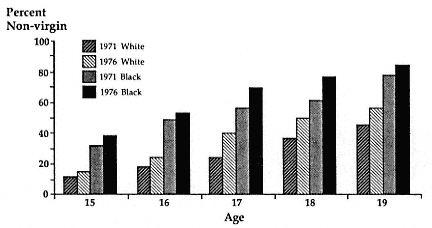
Figure 22.
Percent of Young Women Having Had Premarital Intercourse,
1971 and 1976
had coitus from the early 1970s to the mid-1970s and again to the late 1970s.[75] The proportion of single girls no longer virgins through the teenage years is shown in figure 22. Sharp increases in nonvirginity took place at all ages by both white and black girls. For both, the sharpest increases were at around the ages at which virginity was no longer the modal state—18 for white girls in 1976, and 16 for black girls.
Quite generally, premarital coitus had become much more acceptable. When a Roper poll asked a national sample of adults in 1959 whether they thought "it is all right for either or both parties to a marriage to have had previous sexual experience," only 22 percent said that they thought it was all right, and an additional 8 percent said it was all right for the man but not the woman. By 1972, when another national sample was introduced to the idea that "there's been a lot of discussion about the way morals and attitudes about sex are changing in this country" and asked "If a man and a woman have [non-marital] sex relations do you think it is always wrong, almost always wrong, wrong only sometimes, or not wrong at all," only 47 percent thought it was wrong more often than only sometimes. And by 1975, this proportion had dropped to 42 percent.[76]
Marriage in this sense, too, had become less special—sex outside of marriage and sex within marriage became technically
and ideologically more similar. Sexual advice books ceased being written (as though) for married people, because the kind of advice that married people needed was no longer even said to be unique. Much of this evolution was also taking place in social scripts of a much more mundane sort—for instance the "rhetorical visions of interpersonal relations in popular magazines." In the mid-1960s the older vision—in which "characters . . . played roles in society rather than playing parts in a personal drama"—was shattered by feminists such as Betty Friedan. In the new vision, according to Kidd,
growth was portrayed as the natural state of life and the ultimate legitimatizer for behavior . . . In such a world of growth and change, neither rules nor meanings could be absolute. . . . Meaning was negotiable, between the individuals involved. . . . In a dramatic scene which contained no predetermined meanings, the structure of relationships and roles was also negotiable. The dramatic scenarios included experiments in marriage and family life styles [and] freedom in sex behavior.
In the 1950s love had been defined in terms of meeting role expectations. Now it was "characterized by 'meeting the needs' of the other through interaction, commitment, affection, and nonpossessiveness."[77] Mutuality was no longer a theme of "coming together" in mystic sexual union but rather of each partner enhancing the other's happiness. Each couple represented a fresh negotiation of promising but uncertain potential that would endure while each partner gratified the openly pleasure-seeking self of the other.
Sexuality, in fact, was an important theme of the feminism of the period, and this entailed a revised interpretation of sex in which women's needs were seen as physiologically different from men's but not because they were less urgent . Masters and Johnson had taught women the importance of the clitoris in female sexual response. Now popular writers could argue that "the ease with which women [achieve] orgasm during masturbation certainly contradicts the general stereotypes about female sexuality. . . . The truth seems to be that female sexuality is thriving—but unfortunately underground."[78]
Murray S. Davis describes an ideological contest in this pe-
riod among proponents of three value orientations: those who would sustain the old order by repressing sexuality, those who (like rebels of the 1960s) would overthrow the old order by celebrating and inverting sexuality, and those "Naturalists" who would treat sexuality as a morally neutral phenomenon .[79] These last, the children of Kinsey, exercised an increasingly powerful sway in the 1960s and 1970s, their most characteristic text Masters and Johnson's 1966 study, Human Sexual Response .[80] That pleasure itself was a good thing was taken for granted. So substantial was the repositioning of sexuality within American culture that theorists have suggested that its expression rather than its repression came to lie near the core of the energy that structures the society.[81] This fits with a broader drift away from values derived from an ethic of work toward an ethic based on the expansion and glorification of the self. The quantitative balance of work and leisure time has shifted nowhere near so much as the evaluative balance placed on the two. Leisure was no longer thought of so much as an opportunity for self-improvement as an occasion for enjoyable self-expression.[82]
Masters and Johnson's study, based in part on direct observation of couples engaging in sexual intercourse, was highly technical but sold extremely well on the trade market, inspiring both the Playboy Press and the New American Library to publish interpretations. The introduction to one of these characteristically explained to readers that Masters and Johnson talk more about female than about male orgasm, because "emphasis on female orgasm is warranted by the fact that its absence so frequently sets a limit to human experience. Once that limit is overcome, the whole transcendent experience with all its psychological and physiological overtones can follow."[83] Sexuality became a recognized, valued, worthy, even necessary component of the good life, a prime means of attaining self-discovery. David Reuben told Americans, very many of whom bought his book in 1970, that "an active and rewarding sexual life, at a mature level, is indispensable if one is to achieve his full potential as a member of the human race."[84] A broadened, thoroughly legitimized notion of sex education had become a vehicle for expanding the normalization of sex and the sexualization of life. Kahn, for instance, moves from her discussion of
themes of sexual fantasy to a proposal for sex education within the family such that
each reproductive part of the body has a dual function: physiological and pleasurable. What I am calling for is the acknowledgment of this very important second function so that children can begin to be comfortable associating their developing sexual body with their increasing sexual desires and needs. By providing specific recognition and approval of the pleasurable dimension of sexuality, the parent can help the child to develop a sense of achievement and growth that is directly related to the enhancement of the sexual self.[85]
The powerful ideology no less than the powerful instrumentation of medical science was now fully connected to a view that sexuality, indeed orgasm, was linked to "the whole transcendent experience." Davis describes an ironic outcome:
Having reduced copulation to behavior and having permitted it in any way with anyone or even anything, Naturalists are often surprised to discover that they have succeeded in weakening sexual motivation itself. Those who no longer feel that their sexual behavior transgresses major taboos [i.e. ideological structures sustaining social structures] may find that their sexual desire is no longer reinforced by psychological, social, or cosmic overtones."[86]
Survey data point to the increasing breadth of acceptance of sexuality as a good thing, a view held by both women and men, young people not set off from their elders in this regard. Americans with increasing uniformity came to employ at least some method of birth control and approve of the dissemination of information about how to control births.[87] The development of tidy and efficient methods under the direct control of women has allowed a more nearly symmetrical approach to sexual enjoyment, an agenda of "choice," in this sense, achieving a dominant position in the public sphere.
Sexual intercourse seemed if anything to have become a positive part of the structure of dating in the mid-1970s. A 1973 replication of an excellent 1970 local study showed that even over this short period, coitus had increased in incidence for both boys and girls, now began younger, and was more closely
| ||||||||||||||||||||||||||||||||||||||||||||||||||||||||||||||||||||||||||||||||||||
integrated into the formerly conventional series of "stages" of sexual expression.[88] What had happened was, simply, that "going all the way" was increasingly "on the scale," not normatively out of bounds but rather integrated into the range of activities formerly carried out within but limited by the dating system. Table 47, based on Zelnik and Kanter's 1976 National Survey of Adolescent Female Sexual Behavior, indicates that even as young as age 15, sexually faster girls were also those girls who were actively engaged in dating.[89] And those girls who absolutely rejected premarital intercourse as necessarily a bad thing were also less likely to date than were girls who believed either that eventual marriage plans justified premarital intercourse or that no justification was needed.[90]
The detailed findings in table 47 deserve some exposition, partly because they point to changes with age, and differences between whites and blacks, within the generalizations just proposed. Thus, we find that for both races, dating as a system was still spreading between age 15 and age 16: some girls did not yet date who, obviously, shortly would. This was true both for those who had had intercourse (and for those who approved of it in theory) and for virgins. The point to be emphasized is that sexual behavior and dating to some extent spread, with age, independently of one another. This same pattern of a general proliferation of dating (from a lower point of initial spread) can be seen among blacks even at 18 and 19: apparently at, or by, this time, dating simply was just not what black girls did to the same extent as white girls. Among white girls, nonvirgins were about 20 percent more likely to have dated in the past four weeks than were virgins, regardless of the age. But among black girls, age made a great deal of difference in how much sexual status affected dating: among the youngest black girls, twice as many (a percentage difference of 30 percent) separated nonvirgins from virgins in their likelihood of having dated recently, but this difference declined gradually to barely perceptible. Why might whites and blacks differ in this regard? I suspect that the considerably lighter moral weight that blacks gave to premarital coitus—certainly by the late teens—meant that among them girls who had and girls who had not just were not so different as were white girls who had and who had not, even in 1976. This is borne out by the parallel significance of the attitudinal question by race. For young black girls, expressed attitudes toward premarital coitus was tied to their dating behavior as it was not for older black girls. But for whites, the significance of dating for attitudes toward premarital coitus was in no way diminished through the teen years. For whites and young blacks it was those girls "in circulation" as defined by the dating system who seemingly were more exposed to the values—and opportunities—that led to a reevaluation in more modern terms of the meaning of premarital sexuality.
But then there is the surprising fact that for blacks the attitude that marriage plans justified sexual intercourse was asso-
ciated with almost as much dating as a belief that sexual intercourse was always acceptable but that among white girls the association of premarital sexual intercourse and eventual marriage to one's sex partner was associated with more frequent dating. What we see, apparently, is that although many things contributed to the link between dating and premarital coitus, among white girls but not among black girls the link between dating and marriage was cemented by a positive evaluation of the sexual link that led from dating to marriage. But in the mid-1970s, as had not been the case in the classical dating system, this sexuality might be fully consummated before marriage: necking need not be enough.
Together, boys and girls embraced the idea that sex was, on the whole, under the proper conditions, a good thing—which did not necessarily exclude marriage. We can gain an idea of what happened during this period by looking closely at the main findings of two intensive studies of sexual attitudes, separated in period of observation by the experience of the 1960s. Reiss's study of high school and college youth between 1959 and 1963 establishes a baseline that shows us the emergence but not yet the preeminence at that juncture of what, with nice precision, he calls "permissiveness with affection."[91] Essentially, the relevant part of Reiss's depiction of adolescent sexual attitudes just at the end of the baby boom can be abstracted to three dimensions, representing beliefs young people held about the relationship of sexual behavior to marriage, on the one hand, and to love, on the other, and about the relationship between love and marriage. In essence, he found that each of these relationships varied with the dating experience of his respondents, with their sexual experience , and with their gender . Thus, girl respondents who had dated more frequently were more likely to have approved of the sexual expression of love; they were also more likely to have seen a strong and vital link between love and marriage. But those whose experience had included one or several episodes of having fallen in love were less likely to have linked love and marriage very closely. The pattern of relationships found by Reiss is fairly complex, but it shows that dating in the late baby boom period was interrelated to beliefs about the morality of premarital sexual expression in a complexly in-
terwoven pattern, on the whole more crystallized for girls than for boys. In this complex, "shoulds" tie the individual's status in the dating system to what he or she believes about sexuality, both through normative constraints on behavior and through ideologically governed notions concerning the relationship of feeling to the path toward marriage.
There were, of course, many young people who did not fit this pattern: it was a statistical pattern only, and one undergoing change at the time. But it is fair to say that as of 1959 to 1963, the young people Reiss interviewed by and large held a view of the right way to grow up, in which feelings and sexuality were tied together through dating, which in turn linked them to the marital institution. There was a path, and very many adolescents felt themselves on it and understood what they felt and what they did sexually in those terms. Reiss explicates this arrangement:
The young person gains his basic set of values from his parents, his friends, and from the basic type of social groupings he is exposed to as he matures. As dating begins he comes increasingly under the influence of the more permissive peer values that dominate the courtship area. How quickly he responds to these permissive pressures depends on their strength as well as the type of basic values brought to the situation from his parental upbringing. These values in turn reflect his position in his own family, his race, sex, social class, city size, religious attitudes, [and] level of general liberalism. . . . Following marriage the individual comes more under the influence of the adult-run family institution and its relatively low premarital permissive values [i.e., values favoring premarital coitus].[92]
By the early 1970s, this sense of a normatively defined path had become obliterated. DeLamater and MacCorquodale's fine 1973 study of Wisconsin college students and high school graduates (aged 18 to 23), oriented in part by Reiss's earlier study, permits us to see how this had happened.[93] In that survey, belief in the "abstinence" standard—a standard proposed by a majority of the girls and over a quarter of the boys in Reiss's study a decade earlier—was now held by less than one in ten . Likewise, the double standard was gone. "Permissiveness with
affection" had more than doubled, to become the majority position. Barely present as an articulated value in Reiss's study but attracting about a third of the 1973 respondents was sex without affection if with mutual consent .