
Shifting Power Within a Lindeage: 1670-1756
At the time, Ken's lineage was subdivided into two sublineages, headed by two patrons: Gendayu[*] and Juzaemon[*] . It had not always been that
[32] Anne Walthall, upon reading this, made the interesting remark that while Shinzo[*] was presumably too destitute (0.19 koku) to take a wife, Ken succeeded in adopting a husband, which was supposed to be more difficult than marrying a woman. Ken's obviously strong personality may perhaps partly explain this.
[33] Pierre Bourdieu, The Logic of Practice (Stanford: Stanford University Press, 1991), 179.
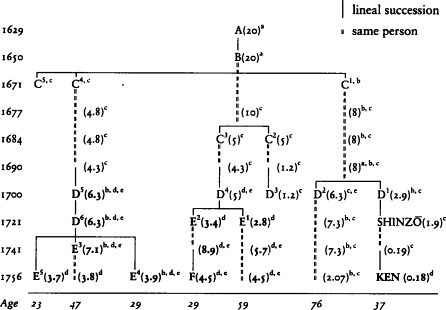
Fig. 1.
Genzaemon's Lineage, 1629-1756
a village headman (plus lineage head and titled peasant)
b lineage or sublineage head
c household in dependent relationship with C line lineage
d household in dependent relationship with D line sublineage
e possession of one horse
Source : Adapted from Ozaki, "Kenjo ikken," table 4 (p. 57).
Notes : The total yield of the lineage property held by Genzaemon (A)
in 1629 is 20 koku; that held by 7 households in 1756 is 22 koku.
Note that Ken switched sublineages: she is not dependent on D2 but on E4 .
way. Originally Ken's paternal ancestors had headed the lineage. Since around 1670 there had been four households, headed then by Rihei I, Ken's grandfather (C1 of fig. 1) Around 1700 there were five households (D1 —D5 ) headed by two patrons, Ken's father, Rihei II (D1 ), being patron to two units, and Rihei's cousin (D5 ), to one. By the 1750s, however, power within the lineage had shifted further away from Rihei's line, for now Rihei II's cousin's son Juzaemon[*] (E4 ) was patron to four households (E1 , F, E3 , E5 ), while the other "patron," Gendayu[*] (D2 ), had Ken "registered under him," but not as a fully established branch house, so that he was, properly speaking, no longer patron of a segment of the lineage.
As mentioned above, the patron-client (or main house-branch house) lineage structure was a strictly internal village affair, not regulated by shogunal law (although disputes concerning it, unresolvable in the village, could come before intendants). That it was private or informal from the lord's point of view does not mean that lineage practice was not formalized and regulated locally. The distinction between private and public does not pertain to the presence or absence of political regulation as such; rather, it defines the modality of jurisdictional recognition between two social units one of which encompasses the other. Thus the famous revenge of the forty-seven ronin[*] of Ako[*] , masterless samurai who avenged their lord, was for the bakufu not a private but a public act and therefore under its jurisdiction. The bakufu left lineages alone, recognizing as legal entities only neighborhood kumi as public institutions at the subvillage level. Nevertheless, as we shall see repeatedly, lineages were crucial for the communal organization of villages.
Every peasant household in the Kita-Saku area had to be accounted for intramurally in a patron-client relationship; none could function otherwise. Even new settlers from outside had first to secure a sponsoring patron in addition to the village council's approval. Since political power was limited to titled peasants, who held access shares to irrigation, common grass or mountain land, and so on, and lineage heads were always titled peasants, a client's access to power and its benefits was totally dependent on his or her relationship to a patron and the latter's position and standing among the titled peasants. A client who had serious complaints about his or her patron or lineage head could ask the village council to switch the household to a different patron.[34] Such change, together with the reasons for it, was duly recorded in the village.
Ken was able to elevate her status from co-resident back to branch house, as it had been when her brother and mother were still alive, by securing a male head and eventual successor to the house through marriage. This increased her autonomy vis-à-vis her lineage patron. Ken's switch to Juzaemon[*] as her new patron was a double blow for
[34] For examples of newcomers seeking a patron, clients wanting m switch lineages (in the neighboring villages of Gorobe-shinden and Yawata}, and other cases illustrating the position of clients, see Oishi[*] Shinzaburo[*] , Kinsei sonraku no kozo[*]to ie seido (Ochanomizu shobo[*] , 1968), 125-37.
Gendayu[*] , for now he lost control over Ken's household and his status as patron, for he had no other clients. The whole lineage, except for himself, because he was a titled peasant, was now controlled by Juzaemon[*] , who had five branch houses as his clients.
The reason for this change was recorded as "disharmony (fuwa )" between Ken and her uncle: "Horeki[*] 6 [1756]. Ken is taken out as coresident from under Gendayu[*] . There being disharmony with her uncle [Gendayu[*] ], Ken is also removed as client and will be client of her cousin [in reality her linealogical third cousin] Juzaemon." Ken's failed marriages and her three-year absence from the village must have been related as cause or effect to this "disharmony," but relations must have been very strained for her to want and to be granted severance from her uncle. We know the real reason from a petition she submitted to the headman in the summer of 1757, a year after her marriage to Rokuemon.