
The Authenticity of the Tsun-Ch'ien Chi
The overriding problem raised by the Tsun-ch'ien chi is that of authenticity. There are actually two different questions at issue. The first, with which students of the collection have been chiefly concerned hitherto, has to do with the date and authenticity of the collection itself, the second with the reliability of its attributions of the poems that it contains, regardless of when or how they came to be gathered into it.
The second question can be dealt with quite simply. Although the Tsun-ch'ien chi 's attributions of individual poems to particular poets
clearly cannot be relied upon in every case, in general, and with one important exception, the Tsun-ch'ien chi is clearly a collection of poems that are genuine products of the periods to which they are assigned. The exception referred to is of course the selection of poems attributed to Li Po, which have been shown elsewhere to be works of the tenth century.[1] The period authenticity of the other poems is supported by a comparison of their rhyming categories with those of contemporary shih and tz'u poems known from other sources.[2]
The problems associated with deciding on the authenticity of the anthology itself are more complex. Much of the doubt that has tended to cling to the Tsun-ch'ien chi derives from the preface to it written in 1582 by one Ku Wu-fang, who published an edition that is a direct or indirect ancestor of several of those currently extant.[3] Ku's preface is a frustratingly ambiguous document. After an introductory passage comparing the tz'u to older forms of poetry, he continues,
As for Hsüan-tsung's "Hao shih kuang," Li Po's "P'u-sa-man," Chang Chih-ho's "Yü-fu," and Wei Ying-wu's "San-t'ai," the grace of their tones is of far-reaching import and their wonders surpass those of a thousand ages. Others, such as Wang [Chien], Tu [Mu], Liu [Yü-hsi], and Po [Chü-i] towered aloft as great masters. After them came the group of worthy officials at the end of T'ang.[4] Linking their creations to form two chüan , first and second, [the collection] has been titled Tsun-ch'ien chi and carved on blocks to be passed on to fellow aficionados.
Earlier, there were the Hua-chien chi from T'ang and the Ts'ao-t'ang shih-yü from Sung, which were current, while few had heard of the Tsun-ch'ien chi .
Ku goes on to lament the contamination of China by "despicable northern tastes" consequent on the Chin and Yüan occupations of the "central districts," having particularly in mind the supplanting of the tz'u by the ch'ü , which he regards as completing an unhappy development begun by the evolution of the tz'u itself in the direction of longer
[1] See Daniel Bryant, "On the Authenticity of the Tz'u Attributed to Li Po," T'ang Studies 7 (1989): 105–36.
[2] See Daniel Bryant, "The Rhyming Categories of Tenth Century Chinese Poetry," Monumenta Serica 34 (1979–80): 319–47.
[3] Ku Wu-fang (hao Ts'un-i chü-shih) is not otherwise known. Chao Tsun-yüeh identified him with Ku Ch'i-feng ("Tz'u-chi t'i-yao," Tz'u-hsüeh chi-k'an 3, no. 3 [Sept. 1936]: 65–71), but he gave no evidence, and the Dictionary of Ming Biography , ed. L. Carrington Goodrich (New York: Columbia University Press, 1976), p. 736, lists Ch'i-feng as a younger brother of Ku Ch'i-yüan (1565–1628), which means that he was no more than a teenager, if that, in 1582, the date of Wu-fang's preface.
[4] This listing of poets and poems is consistent with the contents of the Tsun-ch'ien chi .
melodies. He continues: "I am simply more fond of the Hua-chien chi than of the Ts'ao-t'ang shih-yü and wish to disseminate it and pass it on. Some years ago, [I] was staying in Wu-hsing. Mr. Mao had also been 'attaching and supplementing,' and what I had compiled and put in order was of a similar kind [Mao shih chien yu fu pu erh yü ssu pien ti yu lei yen ]."
Now the first passage, with its reference to "linking" (lien ) and publication, along with the assigning of a title, emerges quite suddenly, with no prior mention of Ku's personal interest, and one might take this passage in isolation as descriptive of the formation of the text in the remote past, especially since it is followed by an account of the vicissitudes of the tz'u tradition after Sung. The second translated passage must be understood as referring to the hsiao-ling (short song) tradition by way of the Hua-chien chi and to an effort, similar to his own, by "Mr. Mao" to supplement that text by collecting other short tz'u from the T'ang and Five Dynasties period. In light of this passage, we might understand the extended complaint about the eclipse of this tradition as serving to link the reference to compilation and publication to the appearance of Mr. Mao and his similar production.
But all this succeeds better in raising questions than in resolving them. What exactly is Ku claiming to have done? Is this preface attached to his own compilation, to Mao's, to some conflation of the two, or to a preexisting work that he is only claiming to have compiled? If to his own work, did its publication precede or follow his acquaintance with Mr. Mao and that gentleman's work? Was the "attaching and supplementing" done to an existing Tsun-ch'ien chi or are we to understand that the Tsun-ch'ien chi was compiled as an attachment and supplement to the Hua-chien chi ?
The latter interpretation was evidently adopted by the celebrated seventeenth-century publisher Mao Chin, who reprinted Ku's edition as part of his Tz'u-yüan ying-hua collection and asserted in his colophon to it that Ku had simply gathered a variety of early tz'u poems together into a new anthology and published it under the old title. Mao's skepticism was soon challenged. Chu I-tsun (1629–1709), in a colophon dated 1671, recorded that he had compared a copy of Ku Wu-fang's edition with an old manuscript text in the hand of Wu K'uan (1436–1504) and found their contents to be substantially the same. Later, the great bibliophile Ting Ping (1832–99) described a Ming dynasty manuscript edition lacking Ku's preface but bearing the seal of the noted scholar, dramatist, and publisher Mei Ting-tso (1549–1618). Ting's conclusion was that the collection was genuine, for if it had not been, Mei Ting-tso
would not have treasured his manuscript version of it, since he was close enough in time—a contemporary, almost—to Ku Wu-fang to be able to judge its authenticity.[5]
Indeed, it now seems possible to be reasonably certain that the presently extant Tsun-ch'ien chi is a genuine compilation of Northern Sung date, put together sometime during the eleventh century, but perhaps slightly altered or supplemented in the course of transmission. We shall not try to narrow down the date of compilation of the Tsun-ch'ien chi here, being chiefly concerned with showing it to be a Sung collection rather than one compiled in the Ming. Wang Chung-wen has argued that it cannot be later than the Yüan-feng period (1078–86), since it is mentioned in a colophon to Feng Yen-ssu's collected tz'u , the Yang-ch'un chi , which is dated to that time. Nor can it, Wang adds, be earlier than the reign of Jen-tsung (r. 1023–64), since it misattributes a poem by Li Kuan, active in Jen-tsung's time, to Li Yü.[6] The latter argument, of course, is valid only if one agrees that Li Kuan wrote the poem in question. In any event, something like 1040–80 seems a reasonable approximate date for the Tsun-ch'ien chi . The Ssu-k'u editors were troubled by the lack of any listing of it in the Sung bibliography Chih-chai shu-lu chieh-t'i , but a number of Sung references to the title were later discovered and discussed by Wu Ch'ang-shou, Wang Kuo-wei, and subsequent writers. These references match, in general, the text as it stands today. Shizukuishi Koichi[*] has since displayed remarkable resourcefulness in further demonstrating the Sung provenance of the current text, showing that it was used in the compilation of the supplement (wai-chi ) to the works of Liu Yü-hsi and that the "mode" (tiao ) names used in it correspond to those current in the time of Chang Hsien (990–1078).[7]
The only recent scholar strongly skeptical of the authenticity of the Tsun-ch'ien chi is Ch'i Huai-mei, who points out that the "Wu K'uan" manuscript that Chu I-tsun saw could well have been a forgery, that the agreements between Ku Wu-fang's text and scattered Sung extracts could simply be the result of Ku's having copied the latter, and that Ting Ping was perhaps not justified in assuming that Mei Ting-tso was convinced of the authenticity of the Tsun-ch'ien chi just because his seal is found on a copy of it.[8] There is, of course, something to be said for all of
[5] Shan-pen Shu-shih ts'ang-shu chih (rpt., Taipei: Kuang-wen shu-chü, 1967) 40.30a–b (pp. 2087–88). Ting gives Ku's name as Wan-fang.
[6] Wang Chung-wen, ed., Nan-T'ang erh-chu tz'u chiao-ting (Peking: Jen-min wen-hsüeh ch'u-pan-she, 1957), p. 20.
[7] Shizukuishi Koichi, "Sonzenshu[*] zakko[*] ," Kangakkai zasshi 9 (1941): 97–106.
[8] Ch'i Huai-mei, "Hua-chien chi chih yen-chiu," Tai-wan sheng-li Shih-fan ta-hsüeh yen-chiu chi-k'an 4 (1960): 507–604.
these objections, but they really do no more than remind us how far from "proof" in any legal or scientific sense so much of our reasoning about early Chinese bibliography really is. The surest way of dealing with these problems is by the full and imaginative use of internal evidence, the method adopted by Shizukuishi Koichi[*] , reference to whose work might have saved Ch'i from error. With respect to Ch'i's last point, though, it might be added that Mao Kuang-sheng too discounts Ting Ping's testimony. Mao is inclined to adopt a suggestion originally made only tentatively by Wang Kuo-wei, that the Tsun-ch'ien chi goes back to a collection made by a man of the T'ang period named Lü P'eng.[9] As Wang himself admitted, there is only the slimmest evidence for this attribution, and since nothing whatever is known of Lü P'eng, not much more can be said of it. Since many of the tz'u in the Tsun-ch'ien chi are of post-T'ang date, the collection would have to have been extensively supplemented some time between the time of Lü P'eng and that of Wu K'uan.
More recently, the printing of another old edition of the Tsun-ch'ien chi has tended to confirm the authenticity of Ku Wu-fang's text, although it raises new questions about his role in editing it. This copy is part of the T'ang Sung ming-hsien pai-chia tz'u , a collection put together by Wu Na (1372–1457), but not printed until 1940. This text, provided that it is genuine—and there appears to be no reason to doubt this—antedates Ku Wu-fang's preface by more than a century, but it is nearly identical to his edition in its contents and arrangement.[10]
The available early editions now number three: Wu Na's collection, the edition published by Mao Chin in the Tz'u-yüan ying-hua , which he copied from Ku Wu-fang's text, and the edition published by Chu Tsu-mou in the Chiang-ts'un ts'ung-shu . Chu Tsu-mou says in his colophon (dated 1914/15) that he followed the manuscript that had been in Mei Ting-tso's possession as his copy-text but emended it where necessary on the basis of Mao Chin's text. There is also a manuscript copy in the collection of the Toyo[*] Bunko in Tokyo, with a colophon by Wang Kuo-wei. Wang records that he copied the first chüan from Chu I-tsun's copy of the text printed by Ku Wu-fang and then added the second chüan
[9] Mao Kuang-sheng, "Tsun-ch'ien chi chiao-chi," pts. 1, 2, T'ung-sheng yüeh-k'an 2, no. 6 (June 1942): 73–78; 2, no. 9 (Sept. 1942): 82–94.
[10] One possibility is that the manuscript that Mei Ting-tso and Ting Ping saw was Wu Na's. I tend to doubt this, since Wu Na's edition was part of a much larger collection. As we shall see later, in discussing the edition of the Nan-T'ang erh-chu tz'u included in Wu's compendium, the typeset edition introduced many "corrections" into the text, but there is no reason to suppose that these extended so far as to invalidate the significance of Wu Na's text for our argument here.
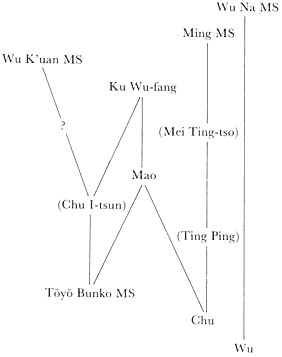
Figure 1
Nan-T'ang erh-chu tz'u: tentative filiation of the
known texts. Names in parentheses refer to persons
who describe the text, not to separate exemplars.
from Mao. The arrangement of the text is the same as that of Mao, wherever this differs from Chu and Wu. The three chief exemplars will be referred to henceforth as Wu, Mao, and Chu. On the basis of the external evidence discussed so far—and it is not proposed to go much further, in the present study, into the relationship between the different editions of the Tsun-ch'ien chi —we can construct a tentative filiation of the known texts (Fig. 1).[11]
[11] Shao I-ch'en's bibliography of editions, the Ssu-k'u chien-ming mu-lu piao-chu (rpt., Taipei: Shih-chieh shu-chü, 1967), pp. 955–56, as supplemented by Shao Ch'ang, lists eight exemplars. In addition to Mao and Chu, these are Ku Wu-fang's printed edition, Chu I-tsun's manuscript, a copy printed in the tenth year of Wan-li (1582—Ku Wu-fang's?), a Sung manuscript, an early Ming reproduction of a Sung edition, and a Ming manuscript. I have not seen any of these additional exemplars. There are, of course, several other recent printed editions, such as that included in Shih-chieh shu-chü's Kuo-hsüeh ming-chu series, but these are all clearly based on one of the old editions.
The importance to us of this diagram does not lie in its claim to represent the recent history of the textual tradition of the Tsun-ch'ien chi so much as in what it suggests about the form in which we find the text. That is, first, since there is virtually no difference in the contents of the three extant editions, and since at least one of them (Wu) and quite possibly a second (Chu) can be traced back to a time earlier than Ku Wu-fang, it follows that Ku's role as "editor" was limited to deciding what readings to follow when his copy-text was unclear in some way and that he was not responsible for actually collecting any poems at all, even as a supplement. Second, the nature of the slight differences that do exist suggests that the Wu Na manuscript and the one owned by Mei Ting-tso may have been more closely related to each other than either was to the ancestor of Ku Wu-fang's.
The differences are two. First, Wu and Chu are in one chüan , while Mao is in two. The location of the division is quite arbitrary, occurring in the midst of a group of related poets, and may have been added by Ku Wu-fang.[12] The second difference concerns the location of a poem by Li Yü. In the Chu and Wu editions it is found by itself, following a group of seven lyrics by Feng Yen-ssu that in turn follow eight others by Li Yü.[13] In the Mao text, this poem comes directly after these latter eight and before those by Feng Yen-ssu, with a note to the effect that in "another edition" it occurs separately. In all three editions the heading to the larger group reads "Eight Poems." The confusion may be related to uncertainty as to whether the melody "Wang Chiang-nan," which begins the group of eight poems, should be counted as two single-stanza poems, as in Chu and Wu, or as one poem of two stanzas, as in Mao. We shall return to consider this question in more detail below. For the moment, we need only point out that both of the differences were apparently introduced by Ku Wu-fang or Mao Chin—which suggests that the ancestors of Ku Wu-fang's edition were essentially similar
[12] Juan T'ing-cho has called attention to Shao I-ch'en's listing of a Sung manuscript in two chüan ; see Juan, "Chi-ku-ko pen Tsun-ch'ien chi pa," in Ch'ing-chu Jui-an Lin Ching-i hsien-sheng liu-chih tan-ch'en lun-wen-chi , ed. Ch'ing-chu Jui-an Lin Ching-i hsien-sheng liu-chih tan-ch'en lun-wen-chi pien-chi wei-yüan-hui (Taipei: Kuo-li Cheng-chih ta-hsüeh kuo-wen yen-chiu-so, 1969), pp. 2389–90 (also published in Ta-lu tsa-chih 40 [1970]: 376). Provided that Shao judged its age correctly, this would substantiate the existence of editions in two chüan much earlier than Ku Wu-fang's. Ku's rather awkward division may simply reflect an attempt to restore an earlier state of the text that he did not know at first hand, rather than corresponding to the division in the original.
[13] Actually, six by Li Yü, one by his father Li Ching, and one by Wen T'ing-yün—but all are attributed here to "Prince Li" (Li-wang).
to Wu Na's edition and the Ming manuscript ancestral to Chu Tsu-mou's.
Actually, it is the location of some of the poems by Li Yü and Feng Yen-ssu that raises the most difficult questions about the arrangement of the text. To discuss this, however, it will first be necessary to digress somewhat by summarizing the contents of the Tsun-ch'ien chi and taking up a few other related points. Although no grouping of the poets is explicit in the text, they do fall neatly into the following clusters:
T'ang emperors (3 poets; 7 poems) and "Prince Li" (5 poems)
Poets of the T'ang and Southern T'ang (13 poets, including Li Po, Liu Yü-hsi, and Feng Yen-ssu; 131 poems)
Poets of the Hua-chien school (12 poets, from Wen T'ing-yün to Li Hsün, in the same sequence employed in the Hua-chien chi ; 120 poems)[14]
"Prince Li" (8 poems; 9 in the Mao text)
Feng Yen-ssu (7 poems, followed in Chu and Wu by one by "Prince Li")
Miscellaneous (7 poets not included earlier, including two from the Hua-chien school; 10 poems)
Both the identical ordering of the Hua-chien poets in the Tsun-ch'ien chi and Hua-chien chi and the near absence of overlap between the contents of the two anthologies suggest, as Ku's preface implies and Shizukuishi was again apparently the first to notice, that the former was compiled with the conscious intent of supplementing the latter. Shizukuishi (p. 103) tabulates the eight poems duplicated in the two. Three of these are poems by Wen T'ing-yün to the melody "Keng-lou-tzu" that are attributed to Li Yü (one in each group of his poems) and Feng Yen-ssu in the Tsun-ch'ien chi . Then there are four to the melody "P'u-sa-man" by Wen T'ing-yün and one to "Hsi-ch'i-tzu" by Li Hsün attributed to the same poets in both anthologies. Evidently unaware of Shizukuishi's work, Ch'i Huai-mei and Li Hsin-lung both consider the question of poems duplicated in the two collections, and here each has something new to add. Ch'i, while missing three of the duplications that Shizukuishi noticed, caught another, although she does not make its nature clear. This is the first of the "P'u-sa-man" poems attributed to Li Po in the Tsun-ch'ien chi , which is in fact made up entirely of lines selected from two separate lyrics to this melody attributed, and no doubt cor-
[14] The Mao text claims 33 lyrics by Sun Kuang-hsien in both of its tables of contents, as well as in the heading to the poems proper, but in fact only 23 poems are included, just as in the Wu and Chu editions.
rectly, to Wei Chuang in the Hua-chien chi . Li Hsin-lung makes more clearly and thoroughly a point that Ch'i had only mentioned in passing (Ch'i was, after all, chiefly concerned with the Hua-chien chi ), that the location of the duplicated poems suggests that they may be evidence of textual supplementation in the editing of one of the anthologies. That is, the four "P'u-sa-man" poems by Wen T'ing-yün not only occur in the same order in both anthologies, but also come at the end of Wen's "P'u-sa-man" poems in both, as if they had been "tacked on" at the end, as it were. Li's hunch is that in this case it may actually have been the Tsun-ch'ien chi that was being used to "restore" a damaged Hua-chien chi .[15] If this is what happened, it must have taken place quite early, for an early Southern Sung printed edition of the Hua-chien chi is extant in which these poems are already included. Presumably it was the well-defined length of the Hua-chien chi (exactly five hundred poems) that invited the attempt at restoration.
Even more evident than any relationship between the two anthologies is the appearance the Tsun-ch'ien chi gives of having been supplemented after its initial compilation by the addition of more poems by "Prince Li," Feng Yen-ssu, and the miscellaneous group at the end. When did this happen and who was responsible for it? All we can say at this point is that it was not the work of Ku Wu-fang.[16] This question is one we shall be returning to more than once in what follows.