
Messages of Uncertain Origin:
The Textual Tradition of the Nan-T'ang erh-chu tz'u
Daniel Bryant
Writing almost ten years ago, in the preface to my book, Lyric Poets of the Southern T'ang: Feng Yen-ssu, 903–960, and Li Yü, 937–978 , I tried to excuse my failure to provide any discussion of textual questions by promising to produce in due course a separate study dealing specifically with such questions. This chapter is both more and less than the promised study. Less than promised because it does not discuss the works of Feng Yen-ssu, it is also something more than I envisioned at the time, for it leads to questions about the nature of textual history that surely have implications for all who work with traditional Chinese texts.
This study owes a good deal to other people. Some parts of it go back many years to work done as a student at the University of British Columbia, and I am grateful to my teachers there, E. G. Pulleyblank, Florence C. Y. Chao (Yeh Chia-ying), and Jan W. Walls, for all the advice and encouragement they offered then or have since. The portions of the study that involve the use of a computer were made possible by a series of grants from the President's Committee on Faculty Travel and Research, University of Victoria. I am particularly grateful to Professor Vinton A. Dearing of the University of California at Los Angeles, author of the programs used, and to Mr. Martin Milner and Ms. Laura Proctor, formerly consultants for Computing Services at the University of Victoria, for the extensive help they rendered me in this portion of the project, as well as for their patience with my questions and mistakes. Needless to say, all the errors, omissions, oversights, and misjudgments are mine.
Abbreviations used in Notes and Bibliography
PP Pai-pu ts'ung-shu chi-ch'eng reprint. Citations are given in the form PP x/y, where x is the series number and y the number of the case (t'ao ) within the series. Pagination is the same for the original ts'ung-shu edition and the reprint.
SPTK Ssu-pu ts'ung-k'an reprint. Page numbers are given both for the original and (in parentheses) the consecutive pagination of the reprint.
Getting to the implications will, however, require that we traverse a good deal of terrain, much of it heavily thicketed in prickly detail. Our journey comprises five distinct stages, as follows. 1) Because the nature and authenticity of the Tsun-ch'ien chi bear crucially on issues to be taken up in later sections, we shall begin by reviewing the problems and evidence surrounding this anthology. 2) On taking up the textual tradition with which we are chiefly concerned, the Nan-T'ang erh-chu tz'u , we shall first examine the compilation process that formed the text. The discussion is long and in many ways inconclusive, but it serves both to set the stage and to suggest the need for the section that follows. 3) Having examined aspects of the Nan-T'ang erh-chu tz'u from a bibliographic standpoint, we shall turn next to an analysis of the genealogy of the extant editions, employing a computer-assisted methodology that has not, so far as I know, previously been brought to bear on a Chinese textual tradition. The process aims first to construct a "directionless diagram" representing the relationships among the different editions ("states" of the tradition), and second to locate within this diagram an archetype, transforming the diagram into a genealogical "tree" and allowing us—or so we will argue—to resolve many cases of variant readings in the tradition. 4) From the discussion of the process for locating an archetype for the Nan-T'ang erh-chu tz'u it becomes evident that some further advance in our understanding of a particular problem in the text of the Tsun-ch'ien chi may be possible. We shall return to that collection briefly in order to explore this problem and strengthen the claim of the Tsun-ch'ien chi to textual authority. 5) Finally, we shall consider some of the implications of our findings, both as they apply to a particular poem (one also discussed by Stephen Owen in another chapter) and as they reflect on the methodology employed. Readers rendered faint of heart by the prospect of so long and arduous a trek may wish to consult this final section first before deciding to saddle up.
The Authenticity of the Tsun-Ch'ien Chi
The overriding problem raised by the Tsun-ch'ien chi is that of authenticity. There are actually two different questions at issue. The first, with which students of the collection have been chiefly concerned hitherto, has to do with the date and authenticity of the collection itself, the second with the reliability of its attributions of the poems that it contains, regardless of when or how they came to be gathered into it.
The second question can be dealt with quite simply. Although the Tsun-ch'ien chi 's attributions of individual poems to particular poets
clearly cannot be relied upon in every case, in general, and with one important exception, the Tsun-ch'ien chi is clearly a collection of poems that are genuine products of the periods to which they are assigned. The exception referred to is of course the selection of poems attributed to Li Po, which have been shown elsewhere to be works of the tenth century.[1] The period authenticity of the other poems is supported by a comparison of their rhyming categories with those of contemporary shih and tz'u poems known from other sources.[2]
The problems associated with deciding on the authenticity of the anthology itself are more complex. Much of the doubt that has tended to cling to the Tsun-ch'ien chi derives from the preface to it written in 1582 by one Ku Wu-fang, who published an edition that is a direct or indirect ancestor of several of those currently extant.[3] Ku's preface is a frustratingly ambiguous document. After an introductory passage comparing the tz'u to older forms of poetry, he continues,
As for Hsüan-tsung's "Hao shih kuang," Li Po's "P'u-sa-man," Chang Chih-ho's "Yü-fu," and Wei Ying-wu's "San-t'ai," the grace of their tones is of far-reaching import and their wonders surpass those of a thousand ages. Others, such as Wang [Chien], Tu [Mu], Liu [Yü-hsi], and Po [Chü-i] towered aloft as great masters. After them came the group of worthy officials at the end of T'ang.[4] Linking their creations to form two chüan , first and second, [the collection] has been titled Tsun-ch'ien chi and carved on blocks to be passed on to fellow aficionados.
Earlier, there were the Hua-chien chi from T'ang and the Ts'ao-t'ang shih-yü from Sung, which were current, while few had heard of the Tsun-ch'ien chi .
Ku goes on to lament the contamination of China by "despicable northern tastes" consequent on the Chin and Yüan occupations of the "central districts," having particularly in mind the supplanting of the tz'u by the ch'ü , which he regards as completing an unhappy development begun by the evolution of the tz'u itself in the direction of longer
[1] See Daniel Bryant, "On the Authenticity of the Tz'u Attributed to Li Po," T'ang Studies 7 (1989): 105–36.
[2] See Daniel Bryant, "The Rhyming Categories of Tenth Century Chinese Poetry," Monumenta Serica 34 (1979–80): 319–47.
[3] Ku Wu-fang (hao Ts'un-i chü-shih) is not otherwise known. Chao Tsun-yüeh identified him with Ku Ch'i-feng ("Tz'u-chi t'i-yao," Tz'u-hsüeh chi-k'an 3, no. 3 [Sept. 1936]: 65–71), but he gave no evidence, and the Dictionary of Ming Biography , ed. L. Carrington Goodrich (New York: Columbia University Press, 1976), p. 736, lists Ch'i-feng as a younger brother of Ku Ch'i-yüan (1565–1628), which means that he was no more than a teenager, if that, in 1582, the date of Wu-fang's preface.
[4] This listing of poets and poems is consistent with the contents of the Tsun-ch'ien chi .
melodies. He continues: "I am simply more fond of the Hua-chien chi than of the Ts'ao-t'ang shih-yü and wish to disseminate it and pass it on. Some years ago, [I] was staying in Wu-hsing. Mr. Mao had also been 'attaching and supplementing,' and what I had compiled and put in order was of a similar kind [Mao shih chien yu fu pu erh yü ssu pien ti yu lei yen ]."
Now the first passage, with its reference to "linking" (lien ) and publication, along with the assigning of a title, emerges quite suddenly, with no prior mention of Ku's personal interest, and one might take this passage in isolation as descriptive of the formation of the text in the remote past, especially since it is followed by an account of the vicissitudes of the tz'u tradition after Sung. The second translated passage must be understood as referring to the hsiao-ling (short song) tradition by way of the Hua-chien chi and to an effort, similar to his own, by "Mr. Mao" to supplement that text by collecting other short tz'u from the T'ang and Five Dynasties period. In light of this passage, we might understand the extended complaint about the eclipse of this tradition as serving to link the reference to compilation and publication to the appearance of Mr. Mao and his similar production.
But all this succeeds better in raising questions than in resolving them. What exactly is Ku claiming to have done? Is this preface attached to his own compilation, to Mao's, to some conflation of the two, or to a preexisting work that he is only claiming to have compiled? If to his own work, did its publication precede or follow his acquaintance with Mr. Mao and that gentleman's work? Was the "attaching and supplementing" done to an existing Tsun-ch'ien chi or are we to understand that the Tsun-ch'ien chi was compiled as an attachment and supplement to the Hua-chien chi ?
The latter interpretation was evidently adopted by the celebrated seventeenth-century publisher Mao Chin, who reprinted Ku's edition as part of his Tz'u-yüan ying-hua collection and asserted in his colophon to it that Ku had simply gathered a variety of early tz'u poems together into a new anthology and published it under the old title. Mao's skepticism was soon challenged. Chu I-tsun (1629–1709), in a colophon dated 1671, recorded that he had compared a copy of Ku Wu-fang's edition with an old manuscript text in the hand of Wu K'uan (1436–1504) and found their contents to be substantially the same. Later, the great bibliophile Ting Ping (1832–99) described a Ming dynasty manuscript edition lacking Ku's preface but bearing the seal of the noted scholar, dramatist, and publisher Mei Ting-tso (1549–1618). Ting's conclusion was that the collection was genuine, for if it had not been, Mei Ting-tso
would not have treasured his manuscript version of it, since he was close enough in time—a contemporary, almost—to Ku Wu-fang to be able to judge its authenticity.[5]
Indeed, it now seems possible to be reasonably certain that the presently extant Tsun-ch'ien chi is a genuine compilation of Northern Sung date, put together sometime during the eleventh century, but perhaps slightly altered or supplemented in the course of transmission. We shall not try to narrow down the date of compilation of the Tsun-ch'ien chi here, being chiefly concerned with showing it to be a Sung collection rather than one compiled in the Ming. Wang Chung-wen has argued that it cannot be later than the Yüan-feng period (1078–86), since it is mentioned in a colophon to Feng Yen-ssu's collected tz'u , the Yang-ch'un chi , which is dated to that time. Nor can it, Wang adds, be earlier than the reign of Jen-tsung (r. 1023–64), since it misattributes a poem by Li Kuan, active in Jen-tsung's time, to Li Yü.[6] The latter argument, of course, is valid only if one agrees that Li Kuan wrote the poem in question. In any event, something like 1040–80 seems a reasonable approximate date for the Tsun-ch'ien chi . The Ssu-k'u editors were troubled by the lack of any listing of it in the Sung bibliography Chih-chai shu-lu chieh-t'i , but a number of Sung references to the title were later discovered and discussed by Wu Ch'ang-shou, Wang Kuo-wei, and subsequent writers. These references match, in general, the text as it stands today. Shizukuishi Koichi[*] has since displayed remarkable resourcefulness in further demonstrating the Sung provenance of the current text, showing that it was used in the compilation of the supplement (wai-chi ) to the works of Liu Yü-hsi and that the "mode" (tiao ) names used in it correspond to those current in the time of Chang Hsien (990–1078).[7]
The only recent scholar strongly skeptical of the authenticity of the Tsun-ch'ien chi is Ch'i Huai-mei, who points out that the "Wu K'uan" manuscript that Chu I-tsun saw could well have been a forgery, that the agreements between Ku Wu-fang's text and scattered Sung extracts could simply be the result of Ku's having copied the latter, and that Ting Ping was perhaps not justified in assuming that Mei Ting-tso was convinced of the authenticity of the Tsun-ch'ien chi just because his seal is found on a copy of it.[8] There is, of course, something to be said for all of
[5] Shan-pen Shu-shih ts'ang-shu chih (rpt., Taipei: Kuang-wen shu-chü, 1967) 40.30a–b (pp. 2087–88). Ting gives Ku's name as Wan-fang.
[6] Wang Chung-wen, ed., Nan-T'ang erh-chu tz'u chiao-ting (Peking: Jen-min wen-hsüeh ch'u-pan-she, 1957), p. 20.
[7] Shizukuishi Koichi, "Sonzenshu[*] zakko[*] ," Kangakkai zasshi 9 (1941): 97–106.
[8] Ch'i Huai-mei, "Hua-chien chi chih yen-chiu," Tai-wan sheng-li Shih-fan ta-hsüeh yen-chiu chi-k'an 4 (1960): 507–604.
these objections, but they really do no more than remind us how far from "proof" in any legal or scientific sense so much of our reasoning about early Chinese bibliography really is. The surest way of dealing with these problems is by the full and imaginative use of internal evidence, the method adopted by Shizukuishi Koichi[*] , reference to whose work might have saved Ch'i from error. With respect to Ch'i's last point, though, it might be added that Mao Kuang-sheng too discounts Ting Ping's testimony. Mao is inclined to adopt a suggestion originally made only tentatively by Wang Kuo-wei, that the Tsun-ch'ien chi goes back to a collection made by a man of the T'ang period named Lü P'eng.[9] As Wang himself admitted, there is only the slimmest evidence for this attribution, and since nothing whatever is known of Lü P'eng, not much more can be said of it. Since many of the tz'u in the Tsun-ch'ien chi are of post-T'ang date, the collection would have to have been extensively supplemented some time between the time of Lü P'eng and that of Wu K'uan.
More recently, the printing of another old edition of the Tsun-ch'ien chi has tended to confirm the authenticity of Ku Wu-fang's text, although it raises new questions about his role in editing it. This copy is part of the T'ang Sung ming-hsien pai-chia tz'u , a collection put together by Wu Na (1372–1457), but not printed until 1940. This text, provided that it is genuine—and there appears to be no reason to doubt this—antedates Ku Wu-fang's preface by more than a century, but it is nearly identical to his edition in its contents and arrangement.[10]
The available early editions now number three: Wu Na's collection, the edition published by Mao Chin in the Tz'u-yüan ying-hua , which he copied from Ku Wu-fang's text, and the edition published by Chu Tsu-mou in the Chiang-ts'un ts'ung-shu . Chu Tsu-mou says in his colophon (dated 1914/15) that he followed the manuscript that had been in Mei Ting-tso's possession as his copy-text but emended it where necessary on the basis of Mao Chin's text. There is also a manuscript copy in the collection of the Toyo[*] Bunko in Tokyo, with a colophon by Wang Kuo-wei. Wang records that he copied the first chüan from Chu I-tsun's copy of the text printed by Ku Wu-fang and then added the second chüan
[9] Mao Kuang-sheng, "Tsun-ch'ien chi chiao-chi," pts. 1, 2, T'ung-sheng yüeh-k'an 2, no. 6 (June 1942): 73–78; 2, no. 9 (Sept. 1942): 82–94.
[10] One possibility is that the manuscript that Mei Ting-tso and Ting Ping saw was Wu Na's. I tend to doubt this, since Wu Na's edition was part of a much larger collection. As we shall see later, in discussing the edition of the Nan-T'ang erh-chu tz'u included in Wu's compendium, the typeset edition introduced many "corrections" into the text, but there is no reason to suppose that these extended so far as to invalidate the significance of Wu Na's text for our argument here.
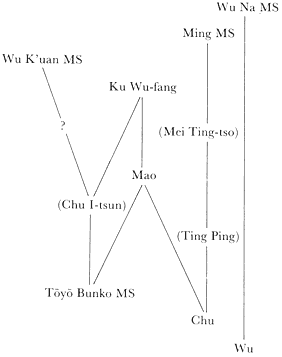
Figure 1
Nan-T'ang erh-chu tz'u: tentative filiation of the
known texts. Names in parentheses refer to persons
who describe the text, not to separate exemplars.
from Mao. The arrangement of the text is the same as that of Mao, wherever this differs from Chu and Wu. The three chief exemplars will be referred to henceforth as Wu, Mao, and Chu. On the basis of the external evidence discussed so far—and it is not proposed to go much further, in the present study, into the relationship between the different editions of the Tsun-ch'ien chi —we can construct a tentative filiation of the known texts (Fig. 1).[11]
[11] Shao I-ch'en's bibliography of editions, the Ssu-k'u chien-ming mu-lu piao-chu (rpt., Taipei: Shih-chieh shu-chü, 1967), pp. 955–56, as supplemented by Shao Ch'ang, lists eight exemplars. In addition to Mao and Chu, these are Ku Wu-fang's printed edition, Chu I-tsun's manuscript, a copy printed in the tenth year of Wan-li (1582—Ku Wu-fang's?), a Sung manuscript, an early Ming reproduction of a Sung edition, and a Ming manuscript. I have not seen any of these additional exemplars. There are, of course, several other recent printed editions, such as that included in Shih-chieh shu-chü's Kuo-hsüeh ming-chu series, but these are all clearly based on one of the old editions.
The importance to us of this diagram does not lie in its claim to represent the recent history of the textual tradition of the Tsun-ch'ien chi so much as in what it suggests about the form in which we find the text. That is, first, since there is virtually no difference in the contents of the three extant editions, and since at least one of them (Wu) and quite possibly a second (Chu) can be traced back to a time earlier than Ku Wu-fang, it follows that Ku's role as "editor" was limited to deciding what readings to follow when his copy-text was unclear in some way and that he was not responsible for actually collecting any poems at all, even as a supplement. Second, the nature of the slight differences that do exist suggests that the Wu Na manuscript and the one owned by Mei Ting-tso may have been more closely related to each other than either was to the ancestor of Ku Wu-fang's.
The differences are two. First, Wu and Chu are in one chüan , while Mao is in two. The location of the division is quite arbitrary, occurring in the midst of a group of related poets, and may have been added by Ku Wu-fang.[12] The second difference concerns the location of a poem by Li Yü. In the Chu and Wu editions it is found by itself, following a group of seven lyrics by Feng Yen-ssu that in turn follow eight others by Li Yü.[13] In the Mao text, this poem comes directly after these latter eight and before those by Feng Yen-ssu, with a note to the effect that in "another edition" it occurs separately. In all three editions the heading to the larger group reads "Eight Poems." The confusion may be related to uncertainty as to whether the melody "Wang Chiang-nan," which begins the group of eight poems, should be counted as two single-stanza poems, as in Chu and Wu, or as one poem of two stanzas, as in Mao. We shall return to consider this question in more detail below. For the moment, we need only point out that both of the differences were apparently introduced by Ku Wu-fang or Mao Chin—which suggests that the ancestors of Ku Wu-fang's edition were essentially similar
[12] Juan T'ing-cho has called attention to Shao I-ch'en's listing of a Sung manuscript in two chüan ; see Juan, "Chi-ku-ko pen Tsun-ch'ien chi pa," in Ch'ing-chu Jui-an Lin Ching-i hsien-sheng liu-chih tan-ch'en lun-wen-chi , ed. Ch'ing-chu Jui-an Lin Ching-i hsien-sheng liu-chih tan-ch'en lun-wen-chi pien-chi wei-yüan-hui (Taipei: Kuo-li Cheng-chih ta-hsüeh kuo-wen yen-chiu-so, 1969), pp. 2389–90 (also published in Ta-lu tsa-chih 40 [1970]: 376). Provided that Shao judged its age correctly, this would substantiate the existence of editions in two chüan much earlier than Ku Wu-fang's. Ku's rather awkward division may simply reflect an attempt to restore an earlier state of the text that he did not know at first hand, rather than corresponding to the division in the original.
[13] Actually, six by Li Yü, one by his father Li Ching, and one by Wen T'ing-yün—but all are attributed here to "Prince Li" (Li-wang).
to Wu Na's edition and the Ming manuscript ancestral to Chu Tsu-mou's.
Actually, it is the location of some of the poems by Li Yü and Feng Yen-ssu that raises the most difficult questions about the arrangement of the text. To discuss this, however, it will first be necessary to digress somewhat by summarizing the contents of the Tsun-ch'ien chi and taking up a few other related points. Although no grouping of the poets is explicit in the text, they do fall neatly into the following clusters:
T'ang emperors (3 poets; 7 poems) and "Prince Li" (5 poems)
Poets of the T'ang and Southern T'ang (13 poets, including Li Po, Liu Yü-hsi, and Feng Yen-ssu; 131 poems)
Poets of the Hua-chien school (12 poets, from Wen T'ing-yün to Li Hsün, in the same sequence employed in the Hua-chien chi ; 120 poems)[14]
"Prince Li" (8 poems; 9 in the Mao text)
Feng Yen-ssu (7 poems, followed in Chu and Wu by one by "Prince Li")
Miscellaneous (7 poets not included earlier, including two from the Hua-chien school; 10 poems)
Both the identical ordering of the Hua-chien poets in the Tsun-ch'ien chi and Hua-chien chi and the near absence of overlap between the contents of the two anthologies suggest, as Ku's preface implies and Shizukuishi was again apparently the first to notice, that the former was compiled with the conscious intent of supplementing the latter. Shizukuishi (p. 103) tabulates the eight poems duplicated in the two. Three of these are poems by Wen T'ing-yün to the melody "Keng-lou-tzu" that are attributed to Li Yü (one in each group of his poems) and Feng Yen-ssu in the Tsun-ch'ien chi . Then there are four to the melody "P'u-sa-man" by Wen T'ing-yün and one to "Hsi-ch'i-tzu" by Li Hsün attributed to the same poets in both anthologies. Evidently unaware of Shizukuishi's work, Ch'i Huai-mei and Li Hsin-lung both consider the question of poems duplicated in the two collections, and here each has something new to add. Ch'i, while missing three of the duplications that Shizukuishi noticed, caught another, although she does not make its nature clear. This is the first of the "P'u-sa-man" poems attributed to Li Po in the Tsun-ch'ien chi , which is in fact made up entirely of lines selected from two separate lyrics to this melody attributed, and no doubt cor-
[14] The Mao text claims 33 lyrics by Sun Kuang-hsien in both of its tables of contents, as well as in the heading to the poems proper, but in fact only 23 poems are included, just as in the Wu and Chu editions.
rectly, to Wei Chuang in the Hua-chien chi . Li Hsin-lung makes more clearly and thoroughly a point that Ch'i had only mentioned in passing (Ch'i was, after all, chiefly concerned with the Hua-chien chi ), that the location of the duplicated poems suggests that they may be evidence of textual supplementation in the editing of one of the anthologies. That is, the four "P'u-sa-man" poems by Wen T'ing-yün not only occur in the same order in both anthologies, but also come at the end of Wen's "P'u-sa-man" poems in both, as if they had been "tacked on" at the end, as it were. Li's hunch is that in this case it may actually have been the Tsun-ch'ien chi that was being used to "restore" a damaged Hua-chien chi .[15] If this is what happened, it must have taken place quite early, for an early Southern Sung printed edition of the Hua-chien chi is extant in which these poems are already included. Presumably it was the well-defined length of the Hua-chien chi (exactly five hundred poems) that invited the attempt at restoration.
Even more evident than any relationship between the two anthologies is the appearance the Tsun-ch'ien chi gives of having been supplemented after its initial compilation by the addition of more poems by "Prince Li," Feng Yen-ssu, and the miscellaneous group at the end. When did this happen and who was responsible for it? All we can say at this point is that it was not the work of Ku Wu-fang.[16] This question is one we shall be returning to more than once in what follows.
The Compilation of the Nan-T'ang Erh-Chu Tz'u
It is curious that the Nan-T'ang erh-chu tz'u , which is without doubt more often read than the Tsun-ch'ien chi , and about whose principal poet, Li Yü, there has grown up an extensive (if generally lightweight) body of secondary literature, has attracted the attention of fewer textual scholars than has the latter anthology. There are, however, two excellent brief discussions of it, and we are, as a result, in a position to date the text at least roughly.
It was Wang Kuo-wei who, in his colophon (dated 1909) to the edition of the Nan-T'ang erh-chu tz'u printed in the Ch'en-feng ko ts'ung-shu , made the first serious attempt to date it and describe its compilation.
[15] Li Hsin-lung, "Tsun-ch'ien chi yen-chiu," in Ch'ing-chu Jui-an Lin Ching-i hsien-sheng , pp. 2261–388.
[16] Wang Chao-yung's hypothesis that the supplementing of the text was evidence of Ku Wu-fang's careful editing is thus no longer tenable, reasonable, indeed acute, as it was at the time he advanced it; "Chi-ku-ko pen Tsun-ch'ien chi shu-hou," Tz'u-hsüeh chi-k'an 3, no. 2 (June 1936): 161–62.
Relying on the names and official titles of several persons mentioned in the notes to the original, particularly Ts'ao Hsün, he proposed that the Nan-T'ang erh-chu tz'u was put together early in the Southern Sung, during the Shao-hsing period (1131–63).
In his comments on this colophon, which he reprints as part of an appendix to his Nan-T'ang erh-chu tz'u chiao-ting , Wang Chung-wen makes several additional points (pp. 103–4). In the first place, he notes that all of the extracts from tz'u-hua writings and the like that are included in the original text can be found in the compendium T'iao-hsi yü-yin ts'ung-hua of Hu Tzu, which was presumably the source from which they were taken. Thus, Wang reasons, the Nan-T'ang erh-chu tz'u can only have been compiled after the completion of Hu's work, that is, after 1167. The terminus ante quem cannot, he continues, be fixed much earlier than the death of Ts'ao Hsün (1174), who is referred to in the text as chieh-tu (military governor), a title that he received in 1150. This would not have been used after his elevation to grand protector (t'ai-wei ), which took place sometime during the reign of Emperor Hsiao-tsung (r. 1163–90). Second, Wang points out that the Nan-T'ang erh-chu tz'u , unlike most other Sung tz'u collections, is not arranged according to melody name, chronology, musical mode, or seasonal reference, nor does it follow any other apparent principle of order. He suggests, therefore, that it was compiled in a bookshop, specifically for publication as a commercial venture, as was at least one other well-known early tz'u anthology, the Ts'ao-t'ang shih-yü . Wang's conclusions are very persuasive, although it does seem possible that the consultation of the T'iao-hsi yü-yin ts'ung-hua could have taken place quite late in the process of compiling the Nan-T'ang erh-chu tz'u , the larger part of which may have occurred before 1167. In any case, the present compilation must have been printed by 1208, since it heads a series of tz'u collections published by the Liu clan's Changsha bookstore and recorded in the Chih-chai shu-lu chieh-t'i . The series was titled Pai-chia tz'u , and was evidently the ancestor of Wu Na's compendium. The latter, however, included the Tsun-ch'ien chi , which is not included in the Chih-chai list.[17]
Lacking a compiler's name or an original preface, even an anonymous one, we cannot tell just who was responsible for putting the collection together or how it was done. The one source of information that we do have is the various notes appended to the poems or to their titles. These clearly formed part of the original text, and they are found with
[17] See Jao Tsung-i, Tz'u-chi k'ao (Hong Kong: Hsiang-kang ta-hsüeh ch'u-pan-she, 1963), pp. 28–31. The Chih-chai description of the Nan-T'ang erh-chu tz'u will be taken up below.
only minor variants in all extant exemplars of it.[18] They report on the sources from which the poems were taken, raise questions of attribution, and recount anecdotes associated with the poems. Since much of the discussion to follow will refer to particular poems or the notes attached to them, it will prove convenient if all thirty-seven poems in the Nan-T'ang erh-chu tz'u are listed here. For each poem, the following table supplies a serial position in the collection, the melody title, and the opening phrase. (These phrases are transcribed as given in Wang Chung-wen's text, without prejudice as to arguments that may be advanced later concerning the readings.) In addition, the editorial notes are translated or summarized as they occur:
1. "Ying t'ien ch'ang" i kou ch'u yüeh lin chuang ching
Headnote: "Hou-chu's inscription reads, 'Lyrics composed by the late emperor.' The manuscript belongs to the household of Ch'ao Kung-liu."[19]
2. "Wang yüan hsing" pi ch'i hua kuang chin hsiu ming
3. "Huan hsi sha" shou chüan chen chu shang yü kou
Appended note: Quotes the Man-sou shih-hua , discussing a tasteless emendation of the poem.[20]
4. "Huan hsi sha" han t'an hsiang hsiao ts'ui yeh ts'an
First appended note: Anecdote involving a witty exchange between Li Ching and Feng Yen-ssu in which this poem is quoted; no source is given in the note.
Second appended note: Anecdote relating a conversation about tz'u between Wang An-shih and Huang T'ing-chien in which this poem is cited; no source is given in the note.
5. "Yü mei-jen" ch'un hua ch'iu yüeh ho shih liao
Headnote: "In the Tsun-ch'ien chi there are eight poems in all, lyrics by the last ruler, Ch'ung-kuang [Li Yü]."
6. "Wu yeh t'i" tso yeh feng chien yü
7. "I hu chu" hsiao chuang ch'u kuo
[18] While the notes that refer to published works might conceivably have been added later, those that identify manuscript sources can scarcely be from any hand but that of the original compiler. As we shall see in the next section, the textual evidence provided by these notes is important in the establishment of a genealogy of the extant editions. That it contributes to a consistent interpretation shows that, at the very least, the notes were part of a common ancestor of all the extant editions.
[19] Ch'ao Kung-liu is unidentified, but he must have been related to Ch'ao Yüeh-chih, who is said elsewhere to have added an inscription to the manuscript. See below.
[20] The Man-sou shih-hua is extant only in fragments. See Kuo Shao-yü, Sung shih-hua chi-i (1937; rpt., Taipei: Wen-ch'üan ko, 1972), A.429–51.
8. "Tzu-yeh ko" jen sheng ch'ou hen ho neng mien
9. "Keng-lou-tzu" chin ch'üeh ch'ai
10. "Lin chiang hsien" ying t'ao lo chin ch'un kuei ch'ü
Appended note: Quotes an anecdote from the Hsi-ch'ing shih-hua that purports to explain the unfinished state of this poem as it is found in the Nan-T'ang erh-chu tz'u ; a continuation comments on the anecdote.[21]
11. "Wang Chiang-nan" to shao hen
12. "Ch'ing-p'ing yüeh" pieh lai ch'un pan
13. "Ts'ai sang-tzu" t'ing ch'ien ch'un chu hung ying chin
14. "Hsi ch'ien ying" hsiao yüeh chui
15. "Tieh lien hua" yao yeh t'ing kao hsien hsin pu
Headnote: "Found in the Tsun-ch'ien chi ; the Pen-shih ch'ü treats it as a work by Li Kuan of Shantung."[22]
16. "Wu yeh t'i" lin hua hsieh liao ch'un hung
17. "Ch'ang hsiang-ssu" yün i kua
Headnote: "When Tseng Tuan-po collected the [Yüeh-fu ] ya-tz'u , he treated this as a work by Sun Hsiao-chih; this is incorrect."[23]
[21] The Hsi-ch'ing shih-hua too is extant only in fragmentary form; see Kuo, Sung shih-hua , A.317–70. This poem and the anecdotes related to it are discussed in considerable detail in Daniel Bryant, "The 'Hsieh Hsin En' Fragments of Li Yü and His Lyric to the Melody 'Lin Chiang Hsien,'" Chinese Literature: Essays, Articles, Reviews 7 (1985): 37–66.
[22] On the Pen-shih ch'ü , see Liang Ch'i-ch'ao, "Chi Shih-hsien Pen-shih ch'ü-tzu chi ," Pei-p'ing Pei-hai t'u-shu-kuan yüeh-k'an 2 (1929): 1–3, and She Chih, "Li-tai tz'u-hsüan-chi hsü-lu," pt. 2, Tz'u-hsüeh 2 (1983): 238–39. According to Liang, this collection was a large and relatively early collection of tz'u and anecdotes related to them. She Chih, on the other hand, doubts that it was all that large. It appears to have been lost by the end of the Yüan dynasty, and the only surviving references to it are in notes such as this one in the Nan-T'ang erh-chu tz'u . The compiler of the Pen-shih ch'ü was one Yang Hui (1027–88), a political opponent of Wang An-shih. Li Kuan failed to pass the chin-shih examination, but did hold minor local office. Little else is known of him.
[23] Tseng Tuan-po is Tseng Tsao (d. 1185), compiler of several books of various sorts. For his Yüeh-fu ya-tz'u , see Chao Tsun-yüeh, "Tz'u-chi t'i-yao," Tz'u-hsüeh chi-k'an 6, no. 2 (n.d.): 14; Li Ting-fang, "Sung-jen hsüan-pien ti Sung tz'u tsung-chi," Wen-hsüeh i-ch'an 1980, no. 3: 148; She Chih, "Li-tai tz'u hsüan-chi hsü-lu," pt. 1, Tz'u-hsüeh 1 (1981): 284–86; and Wu Hsiung-ho, T'ang Sung tz'u t'ung-lun (Hangchow: Che-chiang ku-chi ch'u-pan-she, 1985), pp. 338–40. The Yüeh-fu ya-tz'u was transmitted in manuscript form for a long period before it was printed, and consequently has suffered textual loss and corruption, although it remains a valuable source. Sun Hsiao-chih is Sun T'an, a virtual cipher. The Ch'üan Sung tz'u , ed. T'ang Kuei-chang (Peking: Chung-hua shu-chü, 1965), p. 1037, prints two poems under his name, the authenticity of both being in dispute.
18. "Tao lien-tzu ling" shen yüan ching
Headnote: "Comes from the Lan-wan ch'ü-hui ."[24]
19. "Huan hsi sha" hung jih i kao san chang t'ou
Headnote: "This tz'u is found in the Hsi-ch'ing shih-hua ."
20. "P'u-sa-man" hua ming yüeh an lung ch'ing wu
Headnote: "Found in the Tsun-ch'ien chi ; the Tu Shou-yü tz'u also includes this poem, with some variants in the text."[25]
21. "Wang Chiang mei" hsien meng yüan
22. "P'u-sa-man" p'eng lai yüan pi t'ien t'ai nü
23. "P'u-sa-man" t'ung huang yün ts'ui ch'iang han chu
24. "Juan lang kuei" tung feng ch'ui shui jih hsien shan
Headnote: "Presented to the prince of Cheng, my twelfth brother."[26
] Additional note: "Followed by the seal of the Heir Apparent's Library in clerical script."
25. "Lang t'ao sha" wang shih chih k'an ai
Headnote: "Comes from the Hsia family at Ch'ih-chou."[27]
26. "Ts'ai sang-tzu" lu lu chin ching wu t'ung wan
Headnote: "The autograph of these two tz'u is in the household of Examiner Wang Chi-kung."[28]
27. "Yü mei-jen" feng hui hsiao yüan t'ing wu lü
28. "Yü-lou ch'un" wan chuang ch'u liao ming chi hsüeh
Headnote: "The following two tz'u come from the household of Governor Ts'ao Kung-hsien; it is said that the autograph used to be in the quarters of an old gentleman living in retirement in the Prince Li Monastery outside the Liang Gate
[24] For the Lan-wan ch'ü-hui , see Liang Ch'i-ch'ao, "Chi Lan-wan chi ," Pei-p'ing Pei-hai t'u-shu-kuan yüeh-k'an 2 (1929): 5–6; Chao Tsun-yüeh, "Tz'u-chi t'i-yao," Tz'u-hsüeh chi-k'an 3, no. 3 (Sept. 1936): 53–54; She Chih, "Tz'u-hsüan-chi," pt. 2, pp. 236–37; and Wu Hsiung-ho, T'ang Sung tz'u , pp. 335–36. Liang points out that the Lan-wan chi must be earlier than 1196, since it is cited in a book of that date. It was compiled by K'ung I, a friend of Yang Hui, and so was probably contemporaneous with Yang's Pen-shih ch'ü . Chao Tsun-yüeh cites references to the Lan-wan chi in notes to the Yang-ch'un chi and concludes that it must predate the latter collection (1057). This point seems to conflict with its having been compiled by K'ung I, who did not pass the chin-shih examination until the period 1086–94. The text of the Lan-wan chi has long been lost.
[25] The Tu Shou-yü tz'u is the collected tz'u of Tu An-shih, about whom little is known.
[26] The prince of Cheng was Ts'ung-shan, who was later held prisoner in the north by the Sung court.
[27] Ch'ih-chou is in modern Kuei-ch'ih, in Anhwei.
[28] I have been unable to identify this person.
of the capital, and that as a consequence it is in poor condition and hard to read."[29]
29. "Tzu-yeh ko" hsün ch'un hsü shih hsien ch'un tsao
30. "Hsieh hsin en" chin ch'uang li k'un ch'i huan yung
Headnote: "The autograph of the following six poems is in the household of Prince Meng."[30]
31. "Hsieh hsin en" ch'in lou pu chien ch'ui hsiao nü
32. "Hsieh hsin en" ying hua lo chin chieh ch'ien yüeh
33. "Hsieh hsin en" t'ing k'ung k'o san jen kuei hou
34. "Hsieh hsin en" ying hua lo chin ch'un chiang k'un
35. "Hsieh hsin en" jan jan ch'iu kuang liu pu chu
36. "P'o chen-tzu" ssu shih nien lai chia kuo
Appended note: Quotes [Su] Tung-p'o's description of Li Yü's departure from his conquered state, to which the poem apparently refers.
37. "Lang t'ao sha ling" lien wai yü ch'an ch'an
Appended note: Quotes the Hsi-ch'ing shih-hua on Li Yü's homesickness in captivity.
Wang Chung-wen has already wrung from these notes what little information they can be made to yield on the subjects of the dating and authenticity of the poems. It remains to be seen if further examination of them can advance us to a better understanding of how the book was compiled. Once again, a table will be the clearest way of summarizing the material. For each poem, one or more sources is given, unless none is known. Sources explicitly referred to in the notes summarized and translated above are given without parentheses; sources given here in parentheses are those known to have been in existence by the time of the compilation of the Nan-T'ang erh-chu tz'u but not mentioned in its notes. The three groups of poems assigned to "Prince Li" in the Tsun-ch'ien chi are designated by the letters A, B, and C, and the poems are numbered according to their position in each group. For example, "TCC A-4" means "the fourth poem in the first group of 'Prince Li' poems in the Tsun-ch'ien chi ."[31]
[29] Ts'ao Kung-hsien is Ts'ao Hsün; see above. The temple would have been in Kaifeng, the Northern Sung capital where Li Yü died while in captivity.
[30] Prince Meng is Meng Chung-hou (d. 1157), the elder brother of the empress of Emperor Che-tsung (r. 1086–1101). He held a number of official posts under both Northern and Southern Sung. He was created prince of Hsin-an prefecture in 1137. For a full discussion of the textual problems in the poems from this autograph, see Bryant, "The 'Hsieh Hsin En' Fragments."
[31] TCC B-3 is a poem by Wen T'ing-yün not included in the Nan-T'ang erh-chu tz'u ; see below. TCC C-1 appears under the melody title "Tzu-yeh t'i" in the Tsun-ch'ien chi , but under "P'u-sa-man" in the Nan-T'ang erh-chu tz'u .
1–4. manuscript from Ch'ao Kung-liu (3 is TCC A-4; 4 is TCC B-8)
5. TCC A-5 (headnote says that there were eight poems in TCC)
6. (no other source is known for this poem before the Ming dynasty)
7. (TCC A-1)
8. (TCC A-2)
9. (TCC A-3; Hua-chien chi attributes it to Wen T'ing-yün)
10. Hsi-ch'ing shih-hua ; (T'iao-hsi yü-yin ts'ung-hua )
11. (TCC B-1,2)
12. (TCC B-5)
13. (TCC B-6)
14. (TCC B-7)
15. TCC B-4; Pen-shih ch'ü attributes it to Li Kuan; (Yüeh-fu ya-tz'u attributes it to Ou-yang Hsiu)
16. (Yüeh-fu ya-tz'u , anonymous)
17. Yüeh-fu ya-tz'u , anonymous
18. Lan-wan ch'ü-hui ; (TCC attributes it to Feng Yen-ssu)
19. Hsi-ch'ing shih-hua
20. TCC C-1; Shou-yü tz'u attributes it to Tu An-shih
21–23. (no other source is known for these poems before the Ming dynasty)
24. manuscript from the Heir Apparent's Library; (Yüeh-fu ya-tz'u attributes it to Ou-yang Hsiu; Yang-ch'un chi attributes it to Feng Yen-ssu, with an editorial note in some editions reading, "Misattributed to Yen Shu in the Lan-wan chi ")
25. manuscript from the Hsia family in Ch'ih-chou
26–27. manuscript from the household of Wang Chi-kung
28–29. manuscript from the household of Ts'ao Hsün
30–35. manuscript from the household of Meng Chung-hou
36. Tung-p'o chih-lin ; (T'iao-hsi yü-yin ts'ung-hua )
37. Hsi-ch'ing shih-hua ; (T'iao-hsi yü-yin ts'ung-hua )
Now, there is a certain amount of order to be found here. The poems by Li Ching, all from the same manuscript source, are placed at the beginning; all other poems from manuscripts (24–35) are grouped together, the last being the fragmentary set of poems on the unique pattern "Hsieh hsin en." Three of the four poems found in the Yüeh-fu ya-tz'u are grouped together, as are three of the four poems known from no other pre-Ming source. The poems taken from (or at least appearing in) the Tsun-ch'ien chi are found in the same three groups as in that collection and appear at first glance to have been treated with considerable care. The two poems by Li Ching are transferred to his works, and one by Wen T'ing-yün is silently excluded (B-3). In two cases (15, 20)
involving poems whose attribution to Li Yü in the Tsun-ch'ien chi is contested by another source, the discrepancy is mentioned in the headnotes.
In view of all this, it seems all the more curious that the following questions arise: Why is the division of the poems into three groups followed? Why is another poem by Wen T'ing-yün (9, TCC A-3), whose spurious character is just as evident as that of the one excluded (B-3), included here without comment? Why is poem 18 included on the basis of the Lan-wan ch'ü-hui without any mention of its attribution to Feng Yen-ssu in the Tsun-ch'ien chi ? Why does the headnote to poem 5 simply and specifically say that the latter collection includes eight poems by Li Yü, when there are fourteen poems attributed to "Prince Li" there, and from nine to twelve (depending upon whether one counts poems 11 and 21 as two or four poems, whether one includes poem 18, and so on) from the Tsun-ch'ien chi appearing in the Nan-T'ang erh-chu tz'u ?
In addressing these questions, we shall, in the interest of clarity of presentation, examine the poems in the following groups: 1–4, poems by Li Ching from the Ch'ao manuscript; 5–14, poems from the Tsun-ch'ien chi , with interpolations and deletions; 15–23, poems from other published or unknown sources; 24–35, poems from manuscript sources; 36–37, poems apparently added from the T'iao-hsi yü-yin ts'ung-hua .
If it were not for the manuscript from which poems 1–4 were entered into the Nan-T'ang erh-chu tz'u , it is unlikely that we would know them to be the work of Li Ching, for the Tsun-ch'ien chi makes no distinction between Ching and his son Yü, suggesting that the collection's editor did not know that Ching was a poet.[32] There seems to be no good reason, however, for doubting the authenticity of the manuscript, which is described in more detail in the Chih-chai shu-lu chieh-t'i . Moreover, some of the poems are cited in anecdotes concerning Li Ching that are recorded in historical sources, in particular the Nan-T'ang shu of Ma Ling. The compiler of the Chih-chai shu-lu chieh-t'i , Ch'en Chen-sun (fl. 1230–50), offered the following comment:
The Nan-T'ang erh-chu tz'u , in one chüan , by the second ruler, Li Ching, and the third ruler, Li Yü. The four poems at the beginning, to "Ying t'ien ch'ang," "Wang yüan hsing" (one each), and two to "Huan hsi sha," are by the second ruler. Ch'ung-kuang [Li Yü] wrote them out, the autograph being with the Ch'ao clan in Hsü-chiang. The inscription reads, "Lyrics composed by the late emperor." I have seen it. It is on mai-kuang
[32] Ch'i Huai-mei takes this as evidence that the Tsun-ch'ien chi cannot have been compiled very early in the Northern Sung.
paper, in the po-teng style of script, with an inscription by Ch'ao Ching-yü. I do not know where it is now. The rest of the poems are by Ch'ung-kuang.[33]
Taking this manuscript as authority, the compiler of the Nan-T'ang erh-chu tz'u evidently began the collection with these four poems on the assumption that the father's work ought to precede that of the son, even if there were fewer of the father's poems.
Poems 5–14 are somewhat more difficult to account for. It seems clear that the compiler's next step was essentially to transcribe the poems that were found in the Tsun-ch'ien chi . But it is just as clear that this was not done in a mechanical way, at least not from a Tsun-ch'ien chi identical to the texts now current. A straight listing of the poems in the Tsun-ch'ien chi according to their sequence in the Nan-T'ang erh-chu tz'u gives the following order: Group A: 7, 8, 9, 3, 5; Group B: 11a, 11b, (Wen T'ing-yün poem not included), 15, 12, 13, 14, 4; Group C: 20. It is not impossible to see what was done instead. Poems 3 and 4, of course, were omitted, since they had already been included on the basis of the Ch'ao manuscript; 11a and 11b were treated as one, the Wen T'ing-yün poem was simply dropped as spurious, poems 15 and 20 were set aside temporarily because of questions concerning their authenticity, and—and this is simply conjecture—poem 5 was shifted to the head of the group just because it is one of Li Yü's most beautiful and best-known creations and seemed to deserve pride of place.[34] Such a procedure would give the sequence 5, 7, 8, 9, 11, 12, 13, 14, and these are
[33] Ch'en Chen-sun, Chih-chai shu-lu chieh-t'i (Chü-chen pan ts'ung-shu ed.) (PP 27/35), 21.1b. Mai-kuang was a special type of paper made from hemp fibers. Li Yü was an acknowledged master of the po-teng or "light in the stirrups" style of calligraphy. Ch'ao Ching-yü is Ch'ao Yüeh-chih, an important literary figure of the Northern Sung. The Ch'ao clan was prominent during the entire Northern Sung and followed the common Chinese practice of having all members of a single generation share one character of their personal names. Thus, the personal names of Ch'ao Yüeh-chih's brother and cousins all end with chih (it). The character shared by members of the next generation was kung , as in Kung-liu, the owner of the manuscript. Some members of the Ch'ao clan settled in Hsü-chiang, in Kiangsi, at the beginning of the Southern Sung. It is possible that Kungliu was the son, or at least a nephew, of one of them. Presumably they carried the Li Ching manuscript south, and it seems likely, if it was in their possession, that they were brothers or close cousins of Yüeh-chih.
[34] The placement of this poem and of another great "late" poem, "Lang t'ao sha ling," which comes at the very end of the collection, has a striking analogue in the placement of The Tempest and The Winter's Tale at the beginning and end of the canon of Shakespeare's comedies. In that case, as in this, there appears to be insufficient evidence for anything more than speculation.
presumably the eight poems referred to in the headnote, which must have been added at this time.
The questions that remain are two. First, why was poem 9 not omitted at the same time as the other one by Wen T'ing-yün? And second, where did poems 6 and 10 come from, and when were they added? The omitted poem is the first of the "Keng-lou-tzu" lyrics by Wen T'ing-yün in the Hua-chien chi , while poem 9 is the third. One might suppose that the first poem's position called attention to it, while the other one was missed because it was not quite so "visible," though it is only a few lines away in the text. At any event, the oversight probably originated within the textual tradition of the Tsun-ch'ien chi , rather than in that of the Nan-T'ang erh-chu tz'u . In the former, both poems have a headnote specifying the mode to which the lyric was to be sung, but this is augmented in the Wu and Mao editions by a reference to Wen T'ing-yün's possible authorship of the poem not found in the Nan-T'ang erh-chu tz'u . Since in general the Wu and Chu editions agree against Mao, Wang Chung-wen's suggestion (p. 65) that the additional note was omitted in the manuscript belonging to Mei Ting-tso, from which Chu was printed, is probably correct. If the additional note goes back so far in the textual tradition of the Tsun-ch'ien chi that it is shared by the Mao and Wu editions, then it may have been present in the original, or at least added to the text by the time of the compilation of the Nan-T'ang erh-chu tz'u , whose compiler would have been sufficiently reassured by it that he would not have troubled to check poem 9 against the Hua-chien chi (or Wen T'ing-yün's collected tz'u , to which the Tsun-ch'ien chi note refers) himself, assuming that this had already been done. This hypothesis is consistent with what we can deduce of the care that went into the compilation of the two texts. The Tsun-ch'ien chi , valuable as it is, is prone to misattributions and careless errors, while the Nan-T'ang erh-chu tz'u seems to be the product of an editor who, if not infallible, was remarkably careful and thorough in his work.
Unfortunately, he was not quite so thorough as to tell us where he got poems 6 and 10, or why he entered them where he did. It seems very likely that 10 came either directly from the Hsi-ch'ing shih-hua , with the additional comments added later from the T'iao-hsi yü-yin ts'ung-hua , or else, with both comments, directly from the latter, which quotes the Hsi-ch'ing shih-hua . The question then is not so much where the poem came from, but rather why it was inserted where it was.[35] The same
[35] Wang Kuo-wei's hypothesis, offered in his colophon to the Tsun-ch'ien chi , that the latter originally included poem 10 but that Ku Wu-fang dropped it because it was incomplete, is rendered implausible by the arguments presented here.
question can be asked about poem 6, except that here there is an added element of uncertainty, since no other source for this poem earlier than the Ming dynasty is known. We shall return to this problem after other questions of a simpler nature have been dealt with.
If understanding how the compiler of the Nan-T'ang erh-chu tz'u incorporated the poems taken from the Tsun-ch'ien chi has required a measure of ingenuity and left behind a residue of unresolved doubts, the measure and the residue that are required and left behind in dealing with the next group of poems are considerably greater. In fact, the rationale for treating poems 15–23 as a group lies only in their being distinct from poems 5–14 before them and from 24–35 after. One can divide them into a number of subgroups. Poem 15, taken from the Tsun-ch'ien chi (B-4), seems to have been shifted here simply to separate it from the eight poems in that source that required no additional discussion. There seems to be no good reason why poem 20 could not have been treated in the same way and placed immediately before or, more consistently, after 15, but this was not done. The poems found in the Yüeh-fu ya-tz'u present a particular problem due to the present state of the text of that work. It has clearly suffered a good deal of corruption, particularly as regards the names of the authors of the poems that it includes. The compiler of the Nan-T'ang erh-chu tz'u seems to have supposed that poems without an author's name attached were by the writer of the preceding poem, and this may even have been true, in general, of the edition at hand. But it led to the assumption that poem 17 was attributed to Sun T'an in the Yüeh-fu ya-tz'u , although it is not so attributed in the current text, only the poem that precedes it. The more puzzling questions about the four poems found in both the Yüeh-fu ya-tz'u and the Nan-T'ang erh-chu tz'u are these: Why is poem 24 separated from the other three? And why, since the headnote to poem 17 cites the Yüeh-fu ya-tz'u only to disagree with it, are the other poems from the same collection (15, 16, 24) not credited to it in separate headnotes? The first question is not too hard to answer. It seems clear that poem 24 was entered on the basis of the old manuscript that had once been in the Heir Apparent's Library—the heir, of course, was Li Yü himself. That it was also to be found attributed to Ou-yang Hsiu in the Yüeh-fu ya-tz'u and to Feng Yen-ssu in the Yang-ch'un chi was apparently overlooked by the compiler; or perhaps, having the autograph in hand, he did not think the discrepancy worth discussing.
It is possible that poems 16 and 17 were entered not from the Yüeh-fu ya-tz'u , but from some other source, specified in a headnote to poem 16 that has since disappeared from the text, as Wang Chung-wen suggests
(p. 28).[36] Clearly there must have been some other source for poem 17, for otherwise there would have been nothing to contradict the supposed attribution to Sun T'an. No other extant Sung source includes either poem, however, so we cannot suggest what the alternative source may have been.
The source for poem 18 is not a problem in itself, since it is specified in the headnote. The poem is, however, also found in the Tsun-ch'ien chi , where it is attributed to Feng Yen-ssu. It was not included in the Yang-ch'un chi , Feng's collected tz'u , and this suggests that the attribution to Feng in the Tsun-ch'ien chi may be erroneous.
The problem with poem 19 is not so much its source, which is specified in the note, as its location. That is, one poem from the Hsi-ch'ing shih-hua , 10, is entered earlier, and one, 37, later. To complicate matters, it is very possible that the direct source for 10 and 37 was in fact not the Hsi-ch'ing shih-hua itself, but rather the T'iao-hsi yü-yin ts'ung-hua , which quotes it. But the latter collection also includes this poem, the source cited there being not the Hsi-ch'ing shih-hua , but another, no longer extant book of Northern Sung date, the Chih-i of Liu Fu.[37] Why the Chih-i is not mentioned in the note to this poem is hard to say. It is possible that Ts'ai T'ao, the compiler of the Hsi-ch'ing shih-hua , took the poem from the Chih-i without acknowledging this, and that the compiler of the Nan-T'ang erh-chu tz'u got it from the Hsi-ch'ing shih-hua , while Hu Tzu cited the original source. The poem is also cited in another Sung dynasty source, the Men-shih hsin-hua of Ch'en Shan, where it is treated as a shih poem.[38]
Reference has already been made to the puzzling separation of poems 15 and 20, which one would have expected to be grouped together. Poem 20 is also cited in Ma Ling's Nan-T'ang shu , but this text is not explicitly referred to in the Nan-T'ang erh-chu tz'u . The separation is probably not related to poem 20's uncertain placement in the Tsun-ch'ien chi , which placement is, as already noted, most readily explained as the result of an unrelated event in the textual history of that collection.
Poems 21–23 are also something of a puzzle, since they, like poem 6, are known from no other source earlier than the Ming dynasty. Had they come from a manuscript, its origin would presumably have been cited, and they probably would have been placed after the poem taken from the autograph with Li Yü's own seal on it.
[36] Both poems are found in the shih-i (supplement) section of the Yüeh-fu ya-tz'u , which consists of poems probably set apart because their authors were unknown.
[37] Almost nothing is known of Liu Fu.
[38] Ch'en Shan, Men-shih hsin-hua (Ju-hsüeh ching-wu ed.) (PP 1/1), A.2.8b (33.8b).
The poems from manuscript sources (24–35) are the easiest to deal with, since, except for poem 24, there are no disputed attributions and no questions about the ordering of the poems. Some of them are textually corrupt or incomplete, but that is a different sort of problem.
The last two poems too are quite straightforward, so far as their source, the T'iao-hsi yü-yin ts'ung-hua , is concerned. The authenticity of poem 36 has been questioned on the grounds that it comes from a book of doubtful authenticity, the Tung-p'o chih-lin . As has been pointed out elsewhere, the challenge rests on very shaky logic and is best ignored.[39]
Now, what sort of general conclusions can we draw about the compilation of the Nan-T'ang erh-chu tz'u on the basis of the specific observations above? Perhaps the most important one is that a remarkable amount of care went into it, at least in the earlier stages of the process. Both the searching of numerous published works and the gathering of copies from scattered manuscript sources suggest that every effort was taken to make the collection as complete and accurate as possible. Only four poems are still extant that are likely to have been Li Yü's work but not included in the Nan-T'ang erh-chu tz'u . Two of these are written to the melody "Yü-fu." They were inscribed on a painting and then copied into an eleventh-century history of Five Dynasties painting, the Wu-tai ming-hua pu-i of Liu Tao-ch'un.[40] One, to the melody "Liu-chih," is cited as a shih poem in several Northern Sung works; only much later is it treated as a tz'u .[41] The "Yü-fu" melody too is close to a shih in structure, and it is possible that some or all of these poems were known to the compiler of the Nan-T'ang erh-chu tz'u , who excluded them as not being true tz'u . The other omitted poem, to the melody "Wu yeh t'i," was attributed to Meng Ch'ang in an early Southern Sung work, the Ku-chin tz'u-hua of Yang Shih, and to Li Yü only—among extant works—in the later, but generally more reliable anthology T'ang Sung chu-hsien chüeh-miao tz'u-hsüan , compiled by Huang Sheng.[42] It is quite possible, then, that the compiler of the Nan-T'ang erh-chu tz'u knew this poem too but did not have sufficient reason to attribute it to Li Yü.
If a good deal of care and effort went into gathering and evaluating the materials that went into the collection, the apparently haphazard
[39] See the introduction to Daniel Bryant, Lyric Poets of the Southern T'ang: Feng Yenssu, 903–960, and Li Yü, 937–978 (Vancouver: University of British Columbia Press, 1982), and the article cited there, K'ung Ying-te, "Li Hou-chu wang-kuo shih-tz'u pien-cheng," Li-hsüeh 2 (1934): 91–97.
[40] Liu Tao-ch'un, Wu-tai ming-hua pu-i, Ssu-k'u ch'üan-shu chen-pen , ser. 5 ed., p. 11b.
[41] See, for example, Shao Po, Shao-shih wen-chien hou-lu (Hsüeh-chin t'ao-yüan ed.) (PP 46/24), 17.4a; and Chang Pang-chi, Mo-chuang man-lu (Pai-hai ed.) (PP 14/3), 2.7b.
[42] Huang Sheng, T'ang Sung chu-hsien chüeh-miao tz'u-hsüan (SPTK ed.), 1.22b (p. 15).
arrangement of the whole calls for some explanation, even if it is only conjecture. The work of collecting materials must have been done by someone with access to high social circles, possibly a member of the educated class himself, for the manuscript sources were presumably in collections that would not have been readily accessible. The materials gathered would have been transcribed on separate sheets of paper as they were located, with an identifying note attached to each. The sheets may have been loosely bound in a fixed order, or they may simply have been left sorted but unassembled. Eventually, however, they would have been recopied in order, in preparation for printing. It is possible that the preparation of this transcribed "final" copy, and perhaps some tasks of the later stages of collecting as well, were not the work of the original compiler, that someone else undertook to publish the collection and in so doing either mixed up a few of the sheets or perhaps simply added newly found material on blank parts of sheets that had not been completely filled. If poem 5, for example, had been copied separately by the original compiler with the intention of setting it at the beginning of Li Yü's tz'u (i.e., out of order with respect to its source, the Tsun-ch'ien chi ), there might well have been room for poem 6 to have been added on the rest of the sheet later, perhaps by a different hand. Poem 10 might similarly have been added at the end of what was originally the A group of poems from the Tsun-ch'ien chi , and so forth. Of course, it is possible to imagine various other ways in which the text as it presently exists might have taken shape. Our concern should be not so much to determine the indeterminable as to delimit and reduce—eliminate, if possible—the inexplicable, and some variant of the "careful compiler + conscientious but less meticulous publisher" formula seems to offer the most reasonable way of doing this. The collection of most, if not all, of the materials, the addition of the editorial headnotes, and at least a rough ordering of the contents would have been the work of the former. Preparation of the final copy, perhaps with the addition of some poems or of the anecdotes from the T'iao-hsi yü-yin ts'ung-hua , very probably with a certain amount of rearrangement of the material and perhaps the accidental omission of one or more editorial notes, that of the latter.
Our curiosity is naturally aroused by the question of the original compiler's identity. There is no reason to suppose that we shall ever know who was responsible for assembling the book, but we can deduce a good deal about what sort of person it could have been: a careful scholar, perhaps, well-connected socially, interested in tz'u poetry, and present in Hangchow during some part of the period 1150–70 or so. The lack of a compiler's name attached to the text itself could be due
to any of a variety of circumstances, from political disgrace to accidental loss of the editor's preface from the original text. One doubts, in any case, that identifying the actual compiler of the Nan-T'ang erh-chu tz'u will ever become as popular a pastime as proving that someone else wrote the plays of Shakespeare.
The Textual Genealogy of the Nan-T'ang Erh-Chu Tz'u
In the preceding section, we have been concerned only with the compilation of the Nan-T'ang erh-chu tz'u as a bibliographic problem. That is, we have not been directly concerned with such problems as choosing between variant readings or determining which of the extant editions of the text is closest to the original compilation or, at an even more remote level, the intentions of the poets themselves. These problems are at once more difficult and more important to solve, for the purpose of bibliography is surely to provide us with better texts. But in the case of these poems, the difficulties are very formidable. In the first place, the standard collection of them was not, as we have seen, assembled until two centuries after the poems were written, and then on the basis of materials of widely varying reliability. Some of the poems had already been included in anthologies or cited in historical or literary works, and such inclusion and citation has continued until the present day. In working with the poems, whether as a critic and interpreter, a translator, or simply an active reader, one faces uncertainties in virtually every line that only a detailed textual study can really resolve: Which edition of the Nan-T'ang erh-chu tz'u is to be preferred? Is the Tsun-ch'ien chi , as an earlier compilation, to be followed where it differs from the Nan-T'ang erh-chu tz'u ? In isolated cases one may avoid facing these larger questions by simply rejecting a clearly erroneous reading on its own demerits, so to speak, by sticking to one copy-text, such as one of the early editions of the Nan-T'ang erh-chu tz'u , except when it is manifestly wrong, or by simply choosing a preferred reading on impressionistic grounds.[43] But the questions remain, and perhaps the time has come to face them squarely.
To say this is not to suggest that earlier students of the text have been negligent in not undertaking the job before now. The human labor
[43] Among the many merits of Wang Chung-wen's edition is his clear statement of his practice, which is to follow the "Mo-hua chai" edition of Lü Yüan (see below) in general, emending on occasion by adopting a reading from one of the other states of the text and making the fact of emendation explicit in each case.
required to construct a logically consistent textual genealogy of the sort referred to, one that takes into account all of the testimony from the several dozen different witnesses whose readings are incorporated into Wang Chung-wen's magisterial apparatus, would be immense, probably beyond the capacity of a single scholar with only one lifetime to devote to the task. The only practicable way of carrying out such a project is with the help of a computer, and it is with such help that much of what follows was accomplished.[44]
The question we shall investigate here is that of the relationships between the five extant independent editions of the Nan-T'ang erh-chu tz'u . These are the only sources to include all the poems, but no other works. The five editions (in each case preceded by the siglum to be used in subsequent discussion) are the following:[45]
CHEN: The Ch'en-feng ko ts'ung-shu edition. This ts'ung-shu was published by Shen Tsung-chi in 1909, but the editing of the Nan-T'ang erh-chu tz'u was the work of Wang Kuo-wei (the edition was subsequently included in Wang's collected works). The base text was a "Nan-tz'u" edition now held in the Peking Library.[46]
HOU: The Shih ming-chia tz'u edition. This ts'ung-shu was compiled by Hou Wen-ts'an in the third year of the K'ang-hsi reign (1689) and reissued in 1887 by Chin Wu-hsiang as part of his Su-hsiang shih ts'ung-shu .
HSIAO: This is a manuscript edition prepared by Hsiao Chiang-sheng during the K'ang-hsi period. Our analysis relies on Wang Chungwen's report of this edition, also in the collection of the Peking Library.[47]
LU: This edition was published by one Lü Yüan in the keng-shen year of the Wan-li reign (1620). The copy consulted is in the library of the Jimbun Kagaku Kenkyujo[*] at Kyoto University. It has a note by Yü P'ing-po attached. The collation of the text was carried out by one T'an Erh-chin.
WU: This is the T'ang Sung ming-hsien pai-chia tz'u edition compiled by Wu Na during the Ming (see the discussion of the Tsun-ch'ien chi above). The analysis here is based on Wang Chung-wen's apparatus, which reports on the original manuscript edition. A typeset
[45] The numbering of the variations is based on Wang Chung-wen's apparatus, which I follow throughout this analysis. In most cases, I was able to check it against the original sources he cites. I found only one error in his collation. In come cases, Wang includes several variations in one note; these I have divided.
[46] Pei-ching t'u-shu-kuan shan-pen-pu, ed., Pei-ching t'u-shu-kuan shan-pen shu-mu (Peking: Chung-hua shu-chü, 1959), 8.61a. The catalogue number is 10972. It is not clear why this edition was not collated by Wang Chung-wen.
[47] Ibid., 8.67b, number 7175. The date is given as K'ang-hsi 54 (1715/16).
edition edited by Lin Ta-ch'un was produced in Shanghai in 1940 by the Commercial Press.[48]
There are 142 variations to be considered, places in the text where these five states of the text are not in agreement. Nine of these variations are identified by the computer's sorting process as inconsistent with the simplest logical interpretation of the relationships between the five editions.
(1) 1.2b: This is a variation in the headnote to the first poem in the collection.[49] HOU and LU omit the phrase "imperially composed song text" (yü-chih ko-tz'u ), which is found in CHEN, HSIAO, and WU. The computer process divides CHEN, HSIAO, and WU here. The bibliographic implication of this is that two of these states, or an intermediary between two of them, restored the phrase, either by reference to the other or on the basis of the familiar passage in the Chih-chai shu-lu chieh-t'i —which T'an Erh-chin, the editor of the LU text, cites in his preface. That WU records the words in a different place, following the book title rather than the melody title, a feature recorded in variation 1.2c, supports this interpretation. The alternative possibility is that the omissions in HOU and LU are independent. We shall test this possibility as well, but in any case variation 1.2b and its formal duplicates 34.1 and 34.3 (see below) are inconsistent with fifteen of the other variations, including nine that would have to be rewritten if 1.2b, 34.1, and 34.3 were not (the other six are themselves rewritten by the computer).
(2) 4.5: This variation occurs in the third line of the second of Li Ching's poems to the melody "Huan hsi sha." The reading yüan (distant) is shared by HSIAO, LU, and WU, against huan (return), which is found not only in CHEN and HOU, but also in all other texts that include these poems.[50] The computer separates CHEN
[48] There is a recent study of Wu Na's collection: Ch'in Hui-min, "T'ang Sung ming-hsien pai-chia tz'u-chi pan-pen k'ao-pien," Tz'u-hsüeh 3 (1985): 146–60. Ch'in notes that Lin Ta-ch'un did some silent "correcting" of the text while preparing it for publication. In fact, it is clear that he did a great deal, making Lin's edition virtually useless as evidence for the readings of Wu Na's text. See also Wu Hsiung-ho, T'ang Sung tz'u , pp. 320–25.
[49] Since the various editorial notes were part of the original collection, we take them into account. They are "authorial" in the sense that they were present in the archetype of the collection , even though they were not the work of the authors, Li Ching and Li Yü, whose work the poems are said to be.
[50] LU includes a textual note saying that the reading of the Hua-chien chi was huan .There are, of course, no poems attributed to Li Ching or Li Yü in the Hua-chien chi , nor does this line occur in any poem presently contained in that collection. It is probable that T'an Erh-chin had in mind the Hua-chien chi pu , as Wang Chung-wen suggests (Nan-T'ang erh-chu , p. 4, discussing variation 2.7). Because this note is clearly an editorial addition to LU, we do not include a variation recording it in the data files submitted to the computer. The same holds for analogous notes to 2.7 and 4.13. Note that the glosses for text variants supplied in parentheses are intended only as mnemonics to help mitigate the absence of characters in the text of the paper.
and HOU. It may be that either, or both, of them was contaminated by the rest of the tradition, or that CHEN took its reading from HOU (or even that HOU took its reading from an ancestor of CHEN).[51] Whatever the cause of this variation, it is inconsistent with thirty-four others, thirty-one of them not rewritten by the computer.
(3) 6.5: In the sixth line of the poem "Wu yeh t'i," where CHEN and HOU read meng-li (in dream), WU reads only meng , with no space for a missing character,[52] and HSIAO and LU (along with all other texts that include this poem) read i meng (a single dream). Here again the computer divides CHEN and HOU. Variation 6.5 and its formal duplicate 27.4 are inconsistent with thirty-five other variations, thirty-one of which are not rewritten by the computer program.
(4) 14.4: In the third phrase of "Hsi ch'ien ying," CHEN, HOU, and WU read p'ing (rely), while HSIAO and LU (along with the Tsun-ch'ien chi and all but one of the later anthologies to include the poem) read p'in (frequent). The computer divides HSIAO and LU. Here again the implication is independent agreement. This possibility is supported to some extent by a note added to the poem in the Su-hsiang shih ts'ung-shu reissue of HOU, which says that p'ing should perhaps be p'in instead. Here it is twenty-four variations, twenty of them not rewritten, that conflict with the one chosen by the computer for division.
(5) 27.4: In the penultimate line of "Yü mei-jen," HSIAO and LU read t'ang (hall); WU reads ko (song), which Wang Chung-wen char-
[51] We know that Wang Kuo-wei consulted HOU while preparing CHEN. He reports that the "Nan-tz'u" edition lacked poem 24 and that he made up the omission by taking his text for this poem from HOU. Wang Chung-wen (Nan-T'ang erh-chu , pp. 35–36) concludes that the omission of poem 24 was a peculiarity of the "Nan-tz'u" edition rather than a characteristic of the original Nan-T'ang erh-chu tz'u . The results of our analysis support Wang's conclusion; see below.
[52] Li is supplied in the typeset edition of WU. In variation 34.1 (discussed below), the typeset edition agrees with HOU and LU.
acterizes as an error; CHEN and HOU, along with all but one of the other texts to include the poem, have lou (tower). Here again the computer divides CHEN and HOU, and contamination seems the likely explanation.
(6) 29.6: This variation is a formal duplicate of 14.4, occurring in the penultimate line of "Tzu-yeh ko." HSIAO and LU agree in reading p'ing (critique), while CHEN, HOU, and WU have a homophone meaning "level." The former is clearly the better reading. That the computer divides the two states that have it, HSIAO and LU, is consistent with our interpretation that one or both emended the received text.
(7) 30.2: In the headnote to the shortest of the "Hsieh hsin en" fragments, CHEN, HOU, and HSIAO read chen (true), while LU and WU read mo (ink) (the Su-hsiang shih reedition of HOU reads mo ).[53] The computer divides HOU from CHEN and HSIAO. Both readings are plausible, and it is hard to see why the variation would occur. It is inconsistent with fourteen others, nine of them not rewritten.
(8) 34.1: This variation, which occurs in the first line of the penultimate poem in the "Hsieh hsin en" group, is a formal duplicate of 1.2b, and so the computer treats it in the same way, dividing WU from CHEN and HSIAO. These states read ying-hua (cherry blossom) while HOU and LU read ying-t'ao (bush cherry). This variation was probably affected by the reading ying-hua in the corresponding position in poem 32. The implication is that either WU or an intermediary between CHEN and HSIAO was emended on the basis of the parallel passage.
(9) 34.3: This variation is the occasion of the only error to have been discovered in Wang Chung-wen's apparatus. Wang notes that the word an (dark) is missing in HOU. In fact, it is also missing in LU, which makes the variation a formal duplicate of 1.2b and 34.1. In this case, however, the form of the note makes it unlikely that WU and an intermediary between CHEN and HSIAO could have come to their agreement independently, so we intervene to divide HOU and LU in this variation.[54]
[53] The reading of HOU is to be found in Wang's account of variation 30.3.
[54] A test of the consequences of dividing HOU and LU in variations 1.2b and 34.1 as well produces the same preliminary diagram as the unaltered process but divides two variations differently, 14.4 and 29.6, in both of which, given a prior division of HOU and LU in 1.2b and 34.1, the computer divides CHEN from HOU and WU. This division (of states having the less satisfactory readings) is clearly less plausible on bibliographic grounds than the computer's original sorting process.
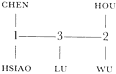
Figure 3
Relationships among
the five states in Nan-
T'ang erh-chu tz'u .
The points numbered
1 – 3 are inferential
intermediaries.
There are two points to be made about these variations before we proceed.
The first is that they are strikingly few in number. The Nan-T'ang erh-chu tz'u is a very short text, to be sure, less than two thousand characters, even including the original editorial notes. All the same, and especially considering the relatively large number of variations that occur, that only nine of them are inconsistent with the genealogical diagram implied by all the rest calls attention to the relative isolation within which the textual tradition of the collection appears to have evolved.
The second point is perhaps incidental, but still worth making. It is that the "automatic" process has produced results that are entirely plausible when set against the text itself (the computer process, of course, works only with the abstract relations among sigla as reported in variations). Where the computer has rewritten variations, they have, with the one exception of 34.3, been ones in which either emendation of an evidently less satisfactory reading or contamination from other texts can be seen as providing explanatory occasions.
The computer program concludes this stage of the process by constructing a directionless preliminary diagram that shows the relationships among the five states without implying the location of an archetype (Fig. 3).
The next problem is the location of the archetype. It should be recognized at the outset that any archetype that may be reconstructed for the Nan-T'ang erh-chu tz'u can be claimed to be significant only for the collection as it was assembled in twelfth-century Hangchow (if that was indeed where the compilation took place). If we are to comment at all on the earlier history of the tradition of these poems, we shall have to take other materials into account.
The formal archetype may be located at any of fifteen points on the preliminary diagram—that is, at one of the five states examined, at one of the three inferential intermediaries, or at a point on one of the seven lines connecting these. The search for the formal archetype is essentially
a process of elimination.[55] One looks for clearly directional variations and eliminates the states or intermediaries with the descendant readings. It must be emphasized that the identification of clearly directional variations is not the same as simply identifying variations in which one reading is obviously better than another.
The reason for this is clear if we consider the relation between the manuscript state WU, as reported in Wang Chung-wen's apparatus, and the typeset edition produced from it by Lin Ta-ch'un. No other type of variation is as common in the tradition of the Nan-T'ang erh-chu tz'u as those that divide WU off from all the other states (twenty-four examples), and the readings unique to WU are often manifestly inferior, as Wang Chung-wen unceasingly points out. It is precisely this manifest inferiority that makes the variations poor candidates for recognition as clearly directional. The more obviously wrong a reading is, the more likely it is to be corrected, and this is what we see in the typeset edition of WU, in which time after time the errors of the manuscript are replaced by readings found elsewhere in the tradition.
The significance of this is of course that it presents us with an example, though perhaps an exaggerated one, of what may have happened in the past as the textual tradition of the Nan-T'ang erh-chu tz'u was being transmitted. The lesson for the textual analyst is that great caution is required in the selection of clearly directional variations. This is perhaps particularly important in tz'u poetry, in view of both the highly determined metrical structures and the tendency to conventionalized diction characteristic of the tz'u . It is often easy to see what is "wrong" with a tz'u text, and not much less easy to replace it with something "right." What we shall look for are readings that are not so obviously wrong as to provoke an editor's or copyist's instinct to emend or conflate, while, on the other hand, they can be seen as clearly descended from better readings. The following variations in the Nan-T'ang erh-chu tz'u seem to be possible candidates for the status of clearly directional:
(1) 1.1: The omission of shu (written) in CHEN, HSIAO, and l slightly weakens the clarity of the note but hardly suggests a need for emendation. It is important to bear in mind that the notes of the original compiler are as much a part of the text of the Nan-
[55] For more detailed comments on the process of locating an archetype, see Bryant, "Computer-Assisted Determination." Dearing's comments on clearly directional variations are particularly illuminating; see Principles and Practice , pp. 42–56. Dearing has developed a program for locating an archetype as well, but this problem is sufficiently simple to allow its solution by hand.
T'ang erh-chu tz'u as the poems. Indeed, because they are not subject to the thematic and structural conventions of the poems, they are potentially of particular importance to the textual analyst. Note also that variation 1.2b cannot be treated as clearly directional since the group with the apparently "authorial" reading has been divided by the computer and the evidence of the variations alone cannot tell us which of the resulting subgroups is authorial and which the result of emendation or conflation.
(2) 2.10: Liao-yang is clearly preferable here, being parallel to Mo-ling in the next phrase. The reading found in CHEN, ts'an (remnant), is both a possible misreading of a cursive liao and, combined with the yüeh (moon) that follows, a convincing example of tz'u diction. WU leaves a blank here, also non-authorial.
(3) 5.3: The omission of the headnote in HOU is evidently non-authorial.
(4) 7.7: The editorial note that a character is lacking is typical of the textual notes found in the original and is thus probably authorial in the states including it, HOU and WU.
(5) 17.3: We know from other sources that the tz'u of Sun T'an was Hsiao-chih, written with hsiao (disperse), as found in HOU and LU. The homophone meaning "sleet" found in CHEN and HSIAO is thus probably a mistake, but we cannot say for certain that it was not the reading of the original compilation. The reading in WU, on the other hand, chih (substance), is both wrong and readily understood as a misreading of "disperse" arising after Sun T'an's brief period as a current poet was past.
(6) 18.2: The misplacement of the note in CHEN is non-authorial. As Wang Chung-wen points out, the note actually belongs with the next poem.
(7) 20.3a: The lack of much of the headnote to this poem in HOU is non-authorial.
(8) 25.4: The reading so (lock) in LU and WU (and hence in 2 and 3) is, we should argue, ancestral both to the homophonic so (tiny) in CHEN and HSIAO and to the chien (sword) in HOU. The latter looks, at first sight, like the best reading, given the phrase chuang-ch'i (valiant manner) in the next line, and this is why, once introduced into the textual tradition, it was not corrected. (Indeed, it is common in the anthologies, in which it even gives rise to a variant of its own.) But the whole poem, in fact, is an evocation of the deserted palace, within which "lock" is surely the authorial reading.
(9) 29.4: All states but HSIAO indicate two missing characters, with an editorial note reporting that the manuscript source from which the poem was copied into the Nan-T'ang erh-chu tz'u was damaged and illegible but that the characters were perhaps ho fang (what obstacle). HSIAO simply inserts ho fang into the text proper and drops the note, which makes its reading non-authorial. (Variation 29.4a records a difference in the note. CHEN and LU have mo-mieh [worn away], while HOU and WU have man-mieh [smudged].)
(10) 31.1: The note in CHEN is different in nature from all the rest and thus probably non-authorial.
(11) 31.6: It appears that the "authorial" text had a blank space followed by liu (remain), as in CHEN and HSIAO. LU and WU have the single character ti (flute), while HOU reads ko (item). The latter is hardly intelligible in the context, so it cannot be considered non-authorial on its own. "Flute," on the other hand, makes sense of a sort: "In a jasper window, dreams of a flute in the last of day." But comparison with the adjacent poems makes it clear that this line should have seven syllables, and in fact an argument can be made for filling the lacuna in CHEN and HSIAO with tuan (broken).[56] The ko in HOU can plausibly be seen as a variation on ti by an editor or copyist who could no longer "see" the lacuna and had to work with the text as he found it.
When we combine the evidence of these eleven variations, we find that all but one of them agree on a location for the archetype. That is, it is clear, to begin with, that four of the five extant states are excluded: CHEN, by 2.10, 18.2, and 31.1; HOU, by 5.3 and 20.3a; HSIAO, by 29.4; and WU, by 2.10 and 17.3. Inferential intermediary 1 (and hence CHEN and HSIAO) is excluded by 1.1 and 25.4, while 3 (along with LU, 2, HOU, and WU), is ruled out by 31.6. The one point that will satisfy all ten variations is located between inferential intermediaries 1 and 3. The exceptional variation is 7.7, the textual note in HOU and WU, which requires that the archetype be located either at 2 or at a point between 2 and 3. The argument that this note is authorial because it is similar in kind to others that are is not of course ironclad. The note itself is puzzling in that it seems clear that no character is in fact missing at this point. Therefore, it seems reasonable to adopt, at least provisionally, the location of the archetype implied by the other ten variations.
Now that the archetype has been located, we have a "tree" that
[56] See Bryant, "The 'Hsieh Hsin En' Fragments," p. 44.
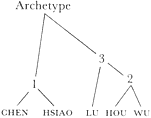
Figure 4
Nan-T'ang erh-chu tz'u : the
derivation of the five extant
states from the logical
archetype.
shows the derivation of the five extant states from the logical archetype (Fig. 4). Such a diagram allows us to determine by inspection the archetypal reading in all variations except those in which the inferential intermediaries 1 and 3 do not agree. In addition, it is now possible to comment collectively on the variations occurring at each link of the tree and hence to characterize the processes involved in the production of each of the states. Although this discussion of the variations is in one sense the goal of the entire procedure (it amounts, in effect, to the critical apparatus for a variorum edition), it is here treated as a by-product of our exploration of the history of the textual tradition and is placed in an appendix below.
The Nan-T'ang Erh-Chu Tz'u and the Tsun-Ch'ien Chi
We now return one last time to the Tsun-ch'ien chi . That we have been able to construct a plausible genealogy for the textual tradition of the Nan-T'ang erh-chu tz'u naturally suggests the possibility of applying the same methodology to the Tsun-ch'ien chi . We shall not attempt to do this for the entire text of the latter collection, but we shall take up the particularly interesting question of the two (or three) separate groups of poems in it by "Prince Li."
What we should like to know, of course, is if these groups have a consistent common genealogy, which would suggest that they were all included in the earlier editions of the text. If, on the other hand, their genealogies differ, this would suggest that at least one group was added to the text later than the other (or others). We shall not argue that our findings here are conclusive, but rather that they are undeniably suggestive.
In cases such as this one, the advantages of working with a computer

Figure 5
Alternative assumptions about the history of the Tsun-ch'ien chi .
become even more apparent, in that it allows us to test alternative hypotheses quickly and consistently. In the present case, we can not only add the Tsun-ch'ien chi to our Nan-T'ang erh-chu tz'u problem to see how the two anthologies are related, we can also embody in our tests different assumptions about the history of the Tsun-ch'ien chi . We do this by preparing two different data files. In one of these, all readings from the Tsun-ch'ien chi are treated as though they came from one homogeneous source, represented by the siglum TCC. In the second file, the readings are treated as though they came from three different sources, ACC, BCC, and CCC. The resulting diagrams are shown in Figure 5.
There are at least three interesting points to notice about these diagrams (we shall consider shortly the variations rewritten in the tests). The first is that the position of ACC and BCC in the right-hand diagram supports the hypothesis that these two groups of poems share a common history at least as far back in the tradition of the Tsun-ch'ien chi as we can see. We cannot prove, of course, that these poems were not added in two stages of compilation, but we can suggest with some confidence that the addition, if it took place at all, did so early in the history of the text.
The second concerns the point at which ACC and BCC are joined to the diagram: it is just where we located the archetype for the textual tradition of the Nan-T'ang erh-chu tz'u . This again does not constitute proof, but it surely adds support to the argument in favor of that location of the archetype.
The third concerns CCC, which is joined to the diagram not at the "archetype" point, but "out on a limb," as it were. CCC consists of poem 20 alone and is, moreover, a separate group in only two of the three editions of the Tsun-ch'ien chi . We shall consider this point in more detail at the end of our examination of the variations rewritten in these two tests.[57]
[57] Testing for each of the three editions separately, in both TCC and ACC/BCC/CCC forms (ACC/BCC in the case of Mao Chin's edition), produces results entirely consistent with these two tests. We shall not pursue further here the question of how the threeeditions of the Tsun-ch'ien chi are related to one another, as this could only be done by analyzing the variations found in the entire text.
(1) 3.6: This variation is rewritten only in the TCC problem, where it is found inconsistent with 5.1 (see below). In the second line of the poem, virtually all states of the text read ch'ung-lou (storeyed pavilion). The exceptions are the Wu and Chu editions of TCC, which read mei-t'ou (eyebrow). The program divides the Mao edition of TCC from the other states. The bibliographic interpretation is probable emendation by contamination in TCC (Mao).
(2) 4.5: See the discussion of the Nan-T'ang erh-chu tz'u problem in the preceding section for this variation. The computer divides as follows in this problem: /CHEN/HOU/TCC/.
(3) 5.1: This variation is rewritten only in the ACC/BCC/CCC problem. The same inconsistency between it and 3.6 is discovered, but ACC includes fewer variations than TCC (of which it is only a section), and this shifts the way in which the inconsistency is resolved. The variation consists of ACC (Wu) and ACC (Mao) giving the melody of poem 5 as "Yü mei-jen ying," while ACC (Chu) agrees with all editions of the Nan-T'ang erh-chu tz'u in lacking the ying (image). The bibliographic explanation is analogous to that in 3.6: emendation of ACC (Chu) by contamination from the tradition of the Nan-T'ang erh-chu tz'u .
(4) 7.14: In the penultimate line, all states but LU and the Wu edition of TCC read jung (gauze); the contrasting reading is a homophone meaning "tangled." Since other variations do not suggest any pattern of contamination between LU and TCC (Wu), the likelihood is that the convergence is the result of independent emendation or error conditioned by homophony. The two characters are occasionally used interchangeably.
(5) 14.4: For this variation, see the discussion of the Nan-T'ang erh-chu tz'u above (TCC agrees with LU and HSIAO). In this case, however, the program divides CHEN from HOU and WU. As this division is also consistent with the tree constructed for the Nan-T'ang erh-chu tz'u editions taken alone, we do not intervene.
(6) 20.7: In the second line, where all editions of the Nan-T'ang erh-chu tz'u except CHEN read chao (morning), CHEN and TCC (followed by many later anthologies and compendia) read hsiao (night). The latter is the lectio facilior , and we are thus inclined to accept the program's division of CHEN from TCC and explain it in bib-
liographic terms as emendation by contamination in CHEN.[58] This variation occurs only in the TCC problem. In the ACC/BCC/CCC version, there is no inconsistency because CCC is entirely distinct from ACC and BCC. Instead, this variation, not rewritten, "pulls" CCC to its position adjacent to CHEN. That there is a ready bibliographic explanation for the inconsistency of course weakens the need to treat CCC independently at all.
Concluding Reflections
We shall conclude with reflections that are theoretical, or at least methodological, in nature. Before inflicting these on a reader perhaps already weary of technicalities, we might well ask what bearing our findings have on the reader who is not interested in textual problems per se. The simplest way to respond to such a question is to look at an actual case.
We shall consider, for this purpose, the fifth poem in the Nan-T'ang erh-chu tz'u , Li Yü's famous song lyric to the melody "Yü mei-jen." The following text is that of Wang Chung-wen's edition; the translation is Stephen Owen's, as it appears in his chapter in this volume. We shall be suggesting one emendation in the course of the discussion that follows.
Spring flowers, autumn moonlight—when will they end?
How much of what is past can we know?
In the small building last night, spring wind once again.
To my homeland I dare not turn my head in the bright moonlight.
Carved balustrades and stairs of jade—I'm sure they are still there,
it's only the color of a young man's face that changes.
I ask you, how much sorrow can there be?—
it's just like a riverful of spring water flowing to the east.
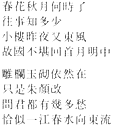
Professor Owen discusses this poem in his essay, recognizing the existence of textual variants and commenting on one of them. Wang Chung-wen's apparatus numbers sixteen variations associated with this
[58] The Wu edition of TCC has a homophone meaning "sleet," an independent error.
poem. Subtracting the five in the headnote and two that involve only very late and rarely consulted texts, and lumping together several that are best treated in clusters, we are left with six significant variations in the text of the poem proper, some of them variations that have already appeared in our discussion. We will take them up one by one:
5.7: This variation is found in a famous line and presents a real quandary. Should we read "autumn moon" (ch'iu yüeh ) or "autumn leaves" (ch'iu yeh )? CHEN and HSIAO, together with the only other texts of Sung date to include the poem, prefer "leaves"; HOU, LU, and WU, together with all post-Sung texts, choose "moon." We might best approach the problem by asking two separate questions: First, how might the variation have arisen? Second, which reading is to be preferred?
A likely answer to the first question seems obvious enough, at least to the reader who "hears" these poems in Mandarin. Yeh and yüeh are, after all, close to being homophones in modern Mandarin, sharing even the same tone. That the matter is not necessarily so simple is clear as soon as we consider their pronunciation in Li Yü's place and time, yiap and ngüat .[59] Although these differences might have been lost by the end of the thirteenth century in northern China, perhaps even around Nanking, they persist to this day in the Hangchow area, where the Nan-T'ang erh-chu tz'u was probably compiled. Nonetheless, the variation is surely more likely to have arisen from a confusion of the two sounds than from a confusion of the two characters. Hence, it is likely to have arisen after the time of the compilation of the Nan-T'ang erh-chu tz'u , and among speakers of an early form of Mandarin rather than among "true southerners."
In order to consider which reading is better, we have to decide first what we mean by "better." Highly qualified contemporary readers differ on the question of which is the more satisfactory version. Some argue, in favor of the less familiar yeh , that the repetition of words in tz'u is uncommon except occasionally in parallel positions (yüeh appears also in the fourth line), that the poem must be "placed" in one of the two seasons, that the third and the final lines argue for spring (though Professor Owen might object that the latter is a "quoted" season), and that two "vegetable" images make the more appropriate pair to balance the two seasons. Readers who favor yüeh have the familiarity of the reading on their side—only specialists are likely to be aware of the alternative—and can respond to the opposing arguments in the Olympian idiom of Arthur Waley, "If the poem were by P'an Lang, we should entirely
[59] For an account of the transcription system used, see Bryant, Lyric Poets , pp. xlvii–li.
agree."[60] In short, if our question is which reading is aesthetically superior, the evidence is indecisive and the best judges are split.
We might, on the other hand, ask which reading is more likely to have been the original. Bearing in mind both that the occasion of the derived reading's first occurrence is likely to have been northern and late, and that the three texts whose traditions go back the farthest, the Nan-T'ang erh-chu tz'u , the Tsun-ch'ien chi , and the T'ang Sung chu-hsien chüeh-miao tz'u-hsüan all include the poem and all read yeh (to be sure, only one of the two limbs leading from the archetype of the Nan-T'ang erh-chu tz'u does), it seems clear that the evidence favors yeh as the archetypal, and indeed the authorial, reading. "Favors," of course, is not the same as "proves," but it shifts the burden of proof in the direction of those who favor the yüeh reading. They must explain how, if yeh did not enter the tradition until the thirteenth century or later, it is to be found in, and only in, the three textual traditions that go most reliably back to earlier times, traditions that were, moreover, relatively "inert"—little known and rarely reproduced until comparatively recent times.
At the same time, we might usefully wonder when the yüeh reading, if not archetypal, entered the tradition and why it has become commonly accepted. What follows is speculative, but perhaps not too remote from actuality. The earliest textual tradition to show the yüeh reading is that of the Ts'ao-t'ang shih-yü , an "active" tradition (as opposed to the "inert" variety characterized above). This text was originally compiled in the Sung dynasty, but was extensively and repeatedly reedited in Ming and Ch'ing times, during which it was the classic anthology of Sung tz'u .[61] It seems reasonable to suppose that yüeh appeared, by phonetic confusion, in this text first and then spread because of its popularity.
One might pursue this speculative history of yeh and yüeh one step farther by asking why contemporary scholars and editors continue to
[60] In a review of Ivan Morris, The World of the Shining Prince , which contains an appendix setting out a series of cogent arguments for believing that the Genji monogatari is unfinished, Waley quotes his own translation of the ending of the received text, pronounces himself entirely satisfied by this, and dismisses all of Morris's arguments with, "If the novel were by Willkie Collins, I should entirely agree." See Ivan Morris, ed., Madly Singing in the Mountains: An Appreciation and Anthology of Arthur Waley (1970; rpt., New York: Harper and Row, 1972), pp. 375–78.
[61] This work has had, in part because of its recognized importance, a complex history. See Li Ting-fang, "Sung-jen tsung-chi"; T'ang Kuei-chang, "Tu tz'u hsü-chi," Wen-hsüeh i-ch'an 1981, no. 2:88, where T'ang argues, on the basis of materials supplied by Shimizu Shigeru of Kyoto University, that the original compiler of the work was one Ho Shih-hsin; She Chih, "Tz'u hsüan-chi," pt. 2, pp. 226–28; Wu Hsiung-ho, T'ang Sung tz'u , pp. 340–42; and Ch'in Huan-ming, "Kuan-yü Ts'ao-t'ang shih-yü ti liu-ch'uan yenpien," Wen shih 29 (1988): 413–19.
prefer yüeh over yeh , assuming either that the textual evidence supports it or that such evidence is hopelessly inconclusive and that judgment can be made only on aesthetic grounds. Whether one of the readings is preferable on such grounds is, as we have seen, not a question that can be answered here. What can be ventured is an account of how the reading of the whole poem is affected by the variation. If the poem begins "Spring flowers, autumn leaves," it has a particular "location," a garden in which the alternation of spring and autumn is seen from a single vantage point located in the physical world, whether this is the tiny pavilion in Pien-ching of the first stanza or the carved railings in Chien-k'ang of the second. If, on the other hand, we begin with "Spring flowers, autumn moon," the "location" of the poem is shifted from the garden to the poet's mind; the angle of vision moves from the outward gaze in which the aspect of a single plant can be seen to alternate with the cycle of the seasons to an inward reflection in the mind that perceives flowers in springtime and the moon in autumn as parallel elements in its inner experience of the universe "outside." This kind of difference is perhaps particularly significant in this poem, which is built around the alternation between those lines, the first in each rhymed pair, that register perceptions of something outside, and those, the answering second lines, that respond. (In the last two lines, it is an imagined interlocutor who asks, and the poetic persona who aligns his sorrow with the image of the river.) To read yüeh in the first line does not change this larger pattern, but it blurs the focus, as though the "jadeite stairs" of the fifth line were to be replaced with "bright mirrors." That this blurring was either not noticed or was thought an improvement seems symptomatic of the rise of sentiment (ch'ing ) in the Ming and Ch'ing periods, when a tz'u could be read as though it were framed within some imagined drama. In such a context, the sooner the inner locus for the poetic event is established, the better, and "leaves" is less significantly loaded for this purpose than "moon."
The remaining variations can be dealt with much more briefly, since the evidence concerning them is much less complex and its import more readily grasped.
5.8, 5.9, 5.10: Ma Ling's Nan-T'ang shu quotes the third and fourth lines of this poem as an example of Li Yü's poetry reflecting his homesickness in captivity. There are no fewer than three variant readings, none of which is found in any other text: "Last night to my small garden [yüan ] the west [hsi ] wind came again; I could not bear to raise [ch'iao ] my head to my old kingdom shining beneath the moon."[62] Now, Ma
[62] Ma Ling, Nan-T'ang shu (SPTK hsü-pien ed.), 5.10b; also Mo-hai chin-hu ed. (PP 47/3), 5.9a.
Ling quotes all or part of five different poems found in the Nan-T'ang erh-chu tz'u in his history, which was compiled around 1100. Variant readings found in Ma Ling's text are found nowhere else in the tradition except in later works that cite it explicitly. The nature of these variants suggests neither the graphic confusion that arises in the copying of documents nor the phonetic confusion (e.g., yüeh for yeh ) that occurs when a text is misheard or misremembered. They are instead substitutions involving words of parallel function, as in the three variants in this poem, a sort of variation that tends to occur when a text is being quoted not for its own sake, but as a "token" signifying some attitude or event connected with a character in a historical narrative. Nonetheless, these three variants are not to be dismissed simply because their absence elsewhere in the tradition makes them unfamiliar. There is something to be said in favor of each of them. Reference to a garden would take up more naturally from the images of the first line, especially if they were flowers and leaves rather than flowers and the moon, as we have suggested. A "west" wind would avoid the repetition in the final line. It would also, of course, suggest autumn rather than spring, and this does not resonate well with the poem's final line. As for ch'iao , it is the more natural motion of someone looking at the moon, and also not the commonplace reading that "look back" is, considered as a piece of poetic diction. We shall not argue that any of these readings is authorial, but they are all early, perhaps earlier than the Tsun-ch'ien chi , and they call attention to the instability of textual traditions in their early history.
5.11: Stephen Owen calls attention to this variation in his essay. This is a case in which there is no doubt about the archetypal reading of the Nan-T'ang erh-chu tz'u , but room for discussion, at least, of what the authorial reading might have been. I-jan (just the same) is the reading of all editions both of the Nan-T'ang erh-chu tz'u and the Tsun-ch'ien chi , ying yu (must still) that of all other texts. This is not a case in which the arguments made in favor of the "leaves" reading in 5.7 can be persuasive. Although the pronunciation of both phrases has evolved, along with the rest of the language, between the Nanking of Li Yü's day and the Peking of ours, the changes are not striking and certainly do not allow us to argue that confusion would have occurred more readily at one time than at another. This variation does not appear to be the result of phonetic confusion in any case, but rather a matter of "substitution in context," rather like the three in Ma Ling's history. Moreover, both variants were known in Sung times, ying yu being found both in the T'ang Sung chu-hsien chüeh-miao tz'u-hsüan and, as Wang Chung-wen points out, in Ch'en Yüan-lung's notes (which appear first in an edition dated
1211–12) to the song lyrics of Chou Pang-yen. These are later texts than the Nan-T'ang erh-chu tz'u and the Tsun-ch'ien chi , but not so much so as to render their readings necessarily less probable. The likeliest ground for choice, aside from the early agreement of the Nan-T'ang erh-chu tz'u and Tsun-ch'ien chi , may be one raised by Stephen Owen: that ying yu would be the less likely reading in T'ang poetic forms that are functionally, if not formally, antecedent to the song lyric. Neither form appears in the Hua-chien chi , nor does any phrase similar to ying yu ; but i-chiu (just as of old) is found there seven times.[63]
5.12, 5.16: These two variations are not adjacent, but parallel, so it will be convenient to treat them together. In place of the phrases wen chün (I ask you) and ch'ia ssu (exactly resembles), which open the last two lines of the poem, the Tsun-ch'ien chi , followed by only a few later texts, reads pu chih (do not know) and ch'ia shih (exactly is). Here again, substitution of functionally equivalent "lead-in" phrases seems to lie behind the variation. It is worth pointing out that this kind of variant is particularly likely to arise in the case of performance literature, such as these lyrics for singing. A performer may not remember the right words, but something must be sung, and something that makes sense in the context. It needs to be recognized that one argument adduced in favor of reading i-jan in 5.11 above pulls the other way here: pu chih is common in the Hua-chien chi , while wen chün is not found. Which is the more satisfying pair of readings depends a good deal on how one reads the rest of the poem. The consistent alternation of outer and inner within each pair of lines, discussed above, is hardly possible with pu chih . On the other hand, the sort of reversal, on which Professor Owen remarks, of the "things, then feelings" pattern (and breaking a pattern is, after all, a common strategy in final couplets) is unaffected by the alternation between wen chün and pu chih , while his reading of the final line as embodying a quasi-quotation is, if anything, strengthened by reading ch'ia shih rather than ch'ia ssu . This, however, only contributes to a preference for ch'ia ssu (and hence wen chün ), for his reading of the poem as a self-conscious combination of frames and clichés inspires its own Waleyesque response (in light of Kang-i Sun Chang's discussion in another essay), "If the poem were by Ch'en Tzu-lung, we should entirely agree."
5.13: The last two variations to be discussed come as an anticlimax; they are both more complicated and essentially trivial. We shall be brief
[63] Aoyama Hiroshi, comp., Kakanshu[*] sakuin , Toyogaku[*] Bunken Senta[*] sokan[*] , no. 21 (Tokyo: Tokyo[*] daigaku, 1974), p. 247.
in consequence. All editions of the Nan-T'ang erh-chu tz'u except CHEN have, in the penultimate line, tou yu (in all have), the alternative reading being neng yu (possibly have). There are, in fact, three other possibilities recorded by Wang Chung-wen, including huan yu (still have) in the T'ang Sung chu-hsien chüeh-miao tz'u-hsüan and other texts. Neng yu is found in Sung texts, but only in a fragment of the poem quoted in an anecdote. Such readings do not usually influence the textual tradition of the whole text, but this one apparently did, for it is found in several of the most commonly consulted late compendia, including the Ch'üan T'ang shih . It was apparently one of these late texts that contaminated CHEN.
5.14: This variation is discussed in the Appendix. Either reading makes sense. In fact, given the line's function as a rhetorical question, both make about the same sense. Since the Tsun-ch'ien chi and T'ang Sung chu-hsien chüeh-miao tz'u-hsüan both agree with HOU, LU, and WU against CHEN and HSIAO, to read chi would perhaps show good judgment, while to avoid spending a great deal of energy on the decision would surely be wisdom itself.
Finally, it may be worthwhile to return to the simple tree constructed for the Nan-T'ang erh-chu tz'u and to look more reflectively at the four sorts of elements that compose it—the extant states, the inferential intermediaries, the archetype, and the links among the other three. They are elements in a logical genealogy of states; what are their possible relationships with records, with the actual printing blocks and paper and ink, the voices and memories and inspirations by which these poems have been conveyed across a millennium from the poets' minds to ours?
Let us begin with the states. What is LU, for example? Is it Lü Yüan's edition, as printed? Is it the photocopy, taken from an exemplar of that edition now in the collection of the Jimbun Kagaku Kenkyujo[*] at Kyoto University, used in checking? Is it the sum of the readings in some other copy of the edition, as reported in Wang Chung-wen's apparatus? Is it the result of the check of the Kyoto photocopy against Wang Chung-wen (recall that this check turned up Wang's only error)? In fact, it is none of these, though if our work has been done well and if the Kyoto text really is a copy of the Lü Yüan edition, it will be a duplicate of all of them except the third (because we differ with Wang at that one point). What it really is, of course, is the account, found in the data file prepared for the computer, of the evidence for the readings in Lü's edition. If Wang's apparatus has been misinterpreted or if additional errors in it have been missed, LU will be a fifth "version" of Lü Yüan's edition and one clearly of less value than the others. If, on the other hand, LU succeeds in incorporating a true account of Lü Yüan's text, then it is, for the purpose of textual analysis, a duplicate of it.
In the simplest case, each of the inferential intermediaries represents an actual, distinct edition that has not been collated but whose existence can be inferred on the basis of the readings of the collated states. Like most "simplest cases," this one rarely occurs. What an inferential intermediary really is, is a collection of readings whose existence is necessary to explain the relationship between the collated states. For example, the intermediary labelled I accounts for the agreements of CHEN and HSIAO against LU, HOU, and WU; it certainly does not amount to an assertion that there was exactly one version of the text intermediate between the archetype and CHEN or HSIAO. In many cases, inspection of the variations and of the external bibliographic evidence suggests that the number of actual intermediaries may have been either greater or less than that proposed by the program, whose operations observe the principle of parsimony. It is inherently unlikely, though not demonstrably impossible, that the textual tradition has been transmitted directly from the archetype of ca. 1160 to CHEN, dated 1909, with only one intervening edition, but the program can only infer intermediaries that have at least two independent descendants.[64] That the number of actual intermediaries might be greater is more immediately apparent than that it might be less. It is possible for a single edition to appear in more than one place in the diagram. We see no likely case of this in the Nan-T'ang erh-chu tz'u problem, but it does occur in other textual traditions.[65] Suppose an exemplar of edition A, from which a descendant B derives, is subsequently damaged. If the damaged exemplar and the descendant, but no undamaged examplar, are collated, they will be found to be joined by an inferential intermediary. This latter is, of course, in bibliographic terms the same artifact as its damaged "descendant," but the textual analyst treats them as separate states because the readings they provide are no longer identical.
In other words, both the inferential intermediaries and the collated states are treated by the program as collections of readings, rather than as physical objects, and the value of the process lies above all in its consistent handling of the evidence provided by these readings, which are, after all, by far the most concrete, detailed, and reliable evidence available. The links between elements in the diagram are thus not necessarily lines of descent from one edition to another (although they often are), but rather the loci of textual variation. This is why it is important to
[64] For example, Wang Kuo-wei's report that the copy-text he used in preparing CHEN, the "Nan-tz'u" edition, lacked poem 24 tells us that there must have been at least one intermediary between CHEN and I, which the evidence of HSIAO shows must have included the poem.
[65] See Bryant, "Computer-Assisted Determination."
examine the variations occurring at each link, for doing so often reveals patterns that can be useful in the process of relating the diagram to bibliographic evidence.
The archetype remains to be considered. As we have seen, the archetype reconstructed for the Nan-T'ang erh-chu tz'u can be considered valid only for the collection as compiled in the twelfth century. In order to approximate any more closely the authorial states of the poems, we must take into consideration the sources of the collection, as in our discussion of "Yü mei-jen." Even when this has been done, the relationship between an "archetype," as reconstructed by the process followed here, and the textual analyst's presumed final goal, the recovery of the author's last and best intentions concerning the text of his work remains problematic. It should be obvious that even under the most favorable conditions the analyst can never be certain of having entirely attained this goal, and in most cases failure to have done so must be assumed.
Faced with such uncertainty, we can only reiterate the need to acknowledge the difficulties and to devise means of overcoming them to the greatest possible extent. Crucial to such means is the application of the sort of consistent testing mechanism that the computer programs used here represent. We may not find answers to all our questions, but we must be sure that we have asked all the questions possible and sought answers to them in a logical and consistent way. By so doing we can expect not only to have greater confidence in the answers we do arrive at, but also to have a more precise understanding of what the unanswerable questions really are and why they cannot be answered.[66]
Appendix: Commentary on the Variations
The following commentary is organized according to the links in the tree diagram on p. 331, moving from left to right. For each link, defined by the two states (extant or inferential) that it joins, a list of variations is given, followed by the commentary.
1-CHEN : 2.8, 2.10, 4.6, 5.13, 5.14a, 12.2, 13.3, 13.7, 14.2, 16.3, 16.4, 18.1a, 18.2, 20.2, 20.7, 20.23, 21.2, 25.6, 26.11, 28.2, 28.17, 28.18, 28.19,
[66] One may reasonably ask how much effect such an examination of the textual tradition can have. As an instance, I offer my book, Lyric Poets , in which I generally followed Wang Chung-wen's already very carefully edited text. I now see five places where I would emend my text as a result of the analysis presented here, one of them being "leaves" in place of "moon" in "Yü mei-jen." Perhaps equally important are all the variations in which I would not emend, the crucial gain in both cases being a more confident sense of just how much interpretive weight the text can bear at any particular point.
29.3, 31.1, 31.5, 32.1, 35.1, 37.3, 37.9; plus the rewritten variations 4.5, 6.5, and 27.4. Of these, 2.8, 5.14a, 12.2, 13.3, 13.7, 14.2, 18.1a, 18.2, 20.2, 21.2, 28.2, 28.18, 29.3, 31.1, 32.1, and 35.1 are singleton readings; that is, they are unique to CHEN, being found in no other source. In all the other variations, CHEN agrees with from one to twenty-one other texts, though not with any other state of the Nan-T'ang erh-chu tz'u . It is too early in the analysis to offer an explanation of this phenomenon (as we shall see, it stands in considerable contrast to the case of the other four states of the Nan-T'ang erh-chu tz'u ). In eight of the fourteen variations, there is at least one Sung text in agreement with CHEN, but in all cases there is at least one late text so agreeing, including the Li-tai shih-yü in all but two cases. These agreements suggest that CHEN was more "present" in the transmission of the tradition of tz'u poetry than were some of the other states of the Nan-T'ang erh-chu tz'u , but at this stage we cannot say whether this was a matter of CHEN's being contaminated by other texts or of its being more readily available as a source for later works. In any case, this tendency of CHEN to agree with texts outside the tradition of the Nan-T'ang erh-chu tz'u is consistent with the pattern of the rewritten variations 4.5, 6.5, and 27.4, in each of which CHEN and HOU shared a common reading with such other texts.
1-HSIAO : 3.9, 4.6, 5.14a, 7.16, 10.21, 13.4, 17.7, 17.17, 17.18, 19.7, 21.1, 21.3, 26.11, 29.4, 29.4a, 30.1, 30.4, 31.5, 33.3a, 33.4a, 33.5, 35.2, 35.3, 36.5, and 36.7; plus the rewritten variations 14.4 and 29.6. The contrast with CHEN is striking here. In all but four of the non-rewritten variations (3.9, 17.18, 21.3, and 29.4) HSIAO has a singleton reading, and only one text agrees with HSIAO more than once among these four (the Ch'üan T'ang shih , in 3.9 and 21.3). In most cases, the readings unique to HSIAO are plainly careless errors. In the two rewritten variations, however, the reading common to HSIAO and LU is the better one. If it were characteristic of HSIAO to "improve" its text in general, we should feel more comfortable with assuming independent emendation in HSIAO and LU in these two cases. On the other hand, in 29.6, no other texts agree with CHEN, HOU, and WU, so this variation is unlike those rewritten by dividing CHEN from HOU (4.5, 6.5, and 27.4). In the latter cases, CHEN and HOU share their reading with other texts, which suggests the possibility of contamination.
1-3 : 1.1, 2.1, 2.5, 3.2, 4.6, 4.11, 4.13, 5.7, 5.14 (5.14a), 6.3, 9.6, 15.4, 17.3, 22.2, 23.4, 25.3, 25.4, 26.11, 28.3, 28.12, 31.3, 31.5, 31.6, 34.4, 37.4; plus the rewritten variations 1.2b, 30.2, and 34.1. This is the link within which the archetype is located, which means that in none of these variations can we identify an archetypal reading simply by reference to the tree. Four of them (1.1, 17.3, 25.4, and 31.6) are among the
"clearly directional variations" used in locating the archetype. The rest can only be dealt with individually and provisionally. We shall discuss them in four groups.
(a) Variations dividing only states of the Nan-T'ang erh-chu tz'u :
28.3: In the note to this poem to the melody "Yü-lou ch'un," 1 read ni (nun), while 3 read chü-shih (recluse). It is easy to see how the confusion could arise from the shapes of the characters, difficult to be sure which reading is preferable.
34.4: In a textual note to another of the "Hsieh hsin en" poems, 1 had shih (is), while 3 read jih (sun). Shih appears to be the better reading, and Wang Chung-wen adopts it. In the Ch'üan T'ang Wu-tai tz'u of Chang Chang and Huang Yü (rpt., Taipei: Wen-shih-che, 1986), p. 485, the reading in HOU is reported to be yüeh (says). I have not seen HOU since the appearance of the Ch'üan T'ang Wu-tai tz'u , but the Suhsiang shih reprint of it reads jih . Chang and Huang are probably right in supposing that either form would be evidence of an ancestral shih either miscopied or derived from a damaged ancestor.
(b) Variations in which other texts agree only with 1:
4.13: While 1 and all other texts read i (lean), 3 evidently read chi (send). The former reading is clearly better, and its being found in all other Sung texts that include this passage tends to confirm that it was the reading of the archetype. It is significant that Wang Chung-wen, who generally follows LU as his copy-text, reads i here. Indeed, he follows 1 in all five variations in this group.
15.4: The reading of 3 (found in HOU, LU, and WU), tao (reverse) for hsin (trust), is unintelligible, as Wang Chung-wen argues. The other texts that include this passage, five of them of Sung date, all read hsin .
26.11: The reading of 3 was a lacuna, while CHEN reads ch'ü (bends) and HSIAO, yüeh (moon). One of the latter is probably the archetypal reading. Both make sense in the context, but ch'ü makes more and better sense. It is also the reading of all other texts that include this poem, and this tends to support its claim to be the reading of the archetype.
28.12: The lacuna in 3, in place of chien (interval) or hsien (leisure), cannot be authorial. The typeset edition of WU and the Su-hsiang shih reedition of HOU both restore the text.
31.5: This variation is most conveniently discussed here, although it is not entirely analogous to the others in the group. The reading of 3 was chin (suffer), which does not make sense in the context. HSIAO reads chih (branch). The reading of CHEN, chin (band), is a homophone of that in 3 and is also written with a similar character. Although the latter two readings both make good sense, the similarity of those in CHEN and 3
suggests that one of them was the reading in 1, and we are naturally inclined to suppose that it was that of CHEN, which is also found in the only other text, a late anthology, to include the poem. On the other hand, if 1 already had an intelligible reading, the chances of variation occurring between it and HSIAO would naturally be reduced. In short, we propose "band" with greater confidence as the authorial reading for the poem than we do as the reading of the archetype of the Nan-T'ang erh-chu tz'u .
(c) Variations in which other texts agree only with 3:
2.1: The reading of 1 was yü (jadeite). WU leaves a space here, and 3 read pi (emerald). Neither reading is clearly preferable, but it may be significant that the T'ang Sung chu-hsien chüeh-miao tz'u-hsüan , the only other Sung text to include the poem, agrees with 3.
3.2: That 1 read erh shou (two poems) after the title of this poem while 3 did not is not a dilemma that reference to other texts can resolve; nor is it one of much importance.
4.11: Both the ho (what) of 3 and the wu (without) of 1 are satisfactory readings in the context. That the Tsun-ch'ien chi and the T'ang Sung chu-hsien chüeh-miao tz'u-hsüan both read ho increases the plausibility of accepting it as the authorial reading.
9.6: This variation resembles the preceding. Both shan ("hill," i.e., "high") in 3 and its homophone meaning "coral" in 1 are acceptable readings. That both the Tsun-ch'ien chi , which attributes the poem to "Prince Li," and the Hua-chien chi , in which it is included as the work of Wen T'ing-yün, read "hill" similarly tends to support it as the authorial reading.
22.2: The two homophones in this variation, both read so ("tiny" in 1, and "lock" in 3), occur as substitutions for one another fairly frequently, meaning "chain" or "link." Here the other texts are few in number and late, so they do not help much in resolving this variation, which is of little significance in any case. We are inclined to adopt the "lock" form to be consistent with the clearly directional variation 25.4 (see above), which involves the same pair of homophones. That the elements of the pair take the same positions on either side of the archetype in both variations naturally suggests that we may be dealing with a case of "scribal style."
25.3: Two late texts agree with 3 in reading hang (row), which makes easier sense than jen (allow), the reading of 1. Other late texts have other readings still. While hang is the easier reading, jen remains possible ("One allows the beaded curtains to hang idly unrolled all the time , [since] all day long no one visits").
31.3: The variation between chin (gold) in 3 and han (enclose) in 1 is clearly the result of graphic confusion. "Gold" is probably the better reading, as it matches the fen (pink) earlier in the line.
d) Variations in which other texts agree with both 1 and 3:
2.5: The reading of 1 was yeh (night), while that of 3 was yü (remnant) (WU leaves a blank here). The T'ang Sung chu-hsien chüeh-miao tz'u-hsüan agrees with 3, while a late compendium, the Hua-ts'ao ts'ui-pien , agrees with 1. "Night" is the easier reading, perhaps, but it is not decisively better.
4.6: The reading of 3 here was jung (countenance), with which several Sung collections of anecdotes that cite the poem, as well as a number of later texts, agree. CHEN has shao (beautiful), with which the Tsun-ch'ien chi , the T'ang Sung chu-hsien chüeh-miao tz'u-hsüan , and most later texts agree. HSIAO reads han (cold). The latter looks like an error derived from the reading of 3, which suggests that 1 also may have read jung , in which case the error in HSIAO would be independent of the reading in CHEN, which might be the result of contamination. Alternatively, the reading of 1 (and perhaps even of the archetype) may have been han . Choice of an archetypal reading here is not possible on formal grounds. All three make good sense in the context. That han is found only as a singleton in HSIAO greatly reduces the likelihood of its being archetypal, but the division of even the Sung sources between jung and shao is equivocal.
5.7: See the concluding section of the essay for a full discussion of this variation, in which the reading of 1 was yeh (leaves), while that of 3 was yüeh (moon). We argue there that yeh has the better chance of being the reading of the archetype.
5.14: This variation might well have been classed with group 3 above, as only one late text agrees with 1 in reading hsü (quite), while all others, including seven of Sung date, read chi (how much). This suggests that chi is more likely to have been the reading of the archetype.
6.3: This is a more complex case than most, in that the reading of 3 cannot be determined on formal grounds. The reading of 1, with which several late texts agree, is ti (drip). LU and one late text read tuan (broken). The lacuna in 2, in place of tuan or ti , is non-authorial (the typeset edition of WU fills it with tuan ). The difficulty is, of course, that the reading of 3 cannot be determined when 2 and LU disagree, and this is particularly important since the reading of the archetype was probably that of 3.
23.4: This poem is not included in any Sung texts other than the Nan-T'ang erh-chu tz'u , so it is not so significant (at least not for our attempt
to determine the reading of the archetype) that only one late text agrees with 1 in reading hun (soul), while many agree with 3 in reading meng (dream).
37.4: Most of the Sung texts that include this poem agree with 3 in reading nuan (warm), while the Lei shuo and a few minor texts read nai1 or nai2 (help, fend off) with 1. The latter reading makes the whole line one sentence ("Gossamer covers do not fend off the fifth-watch chill"), while the former makes it two independent clauses ("Gossamer covers are not warm; the fifth watch is chilly").
In short, whenever the archetype is located on a link in the diagram, rather than at a particular state or inferential intermediary, variations occurring across that link can be resolved only by such nonce methods as the authority of other texts or the judgment of an editor.
3-LU: 6.2, 6.3, 7.14, 8.1, 13.4, 19.7, 20.10, 21.3, 23.5, 23.5a, 26.10, 28.16, 37.1, 37.11; plus the rewritten variations 14.4, 29.6, and 34.3. The first point to note about these variations is that they are relatively few in number, fewer than those occurring across any other link leading to an extant state. Only four of them (7.14, 8.1, 23.5a, and 37.1) are not singleton variations, and even in these four the agreements with other texts are not of great significance. Although only in the case of the complex variation 6.3 (see above) can we argue that LU's reading is possibly archetypal, the relatively small number of variations arising at this link suggests that LU is generally the most reliable of the extant states. The result of our formal analysis of the variations thus agrees with Wang Chung-wen's judgment, when he chose LU as the copy-text for his edition.
3-2: 6.3, 7.7, 8.4, 16.4, 19.1, 19.9, 20.5, 29.3, 29.4a, 34.5. These variations too are strikingly few in number. In the most common case, the reading of 2 was a lacuna. In only one of these variations, 20.5, do other texts share the reading of 2. The two Sung texts to include the poem, the Tsun-ch'ien chi and the T'ang Sung chu-hsien chüeh-miao tz'u-hsüan (the latter attributes it to Tu An-shih), both agree with 3 (and hence with the archetypal reading of the Nan-T'ang erh-chu tz'u ) in reading lung (cage), and many later texts agree. This seems a much more interesting reading in the context than the fei (fly) of 2 and a number of later texts.
2-HOU: 1.2a, 1.6, 1.13, 5.3, 8.2, 9.7, 14.1, 15.1, 17.4, 18.1b, 19.2, 20.3, 20.3a, 20.16, 25.1, 25.4, 26.2, 28.4, 30.3, 31.6, 31.7, 35.4; plus the rewritten variations 4.5, 6.5, 27.4, 30.2, and 34.3. Here again, virtually all the variations consist of singleton readings unique to HOU. The three exceptions, 1.6, 20.16, and 25.4 (see above), are all cases of a lectio if not facilior , then at least facilis , and it is possible that independent error is
responsible for one or more of them. Most of the other variants in HOU are clearly erroneous readings or slight variations in the placement of the notes.
2-WU: 1.2c, 1.15, 2.1, 2.3, 2.5, 2.9, 2.10, 3.1, 4.10, 5.2, 6.4, 6.5, 10.4, 13.8, 15.3, 16.2, 16.5, 17.2, 17.3, 24.7, 26.9, 26.10, 27.4, 27.5, 29.2, 29.5, 29.7, 31.2, 31.7, 32.2, 34.2, 37.6; plus the rewritten variations 1.2b and 34.1. In all but one of these numerous variations (the exception is trivial), WU has a singleton reading, and one that is in the majority of cases manifestly inferior, as Wang Chung-wen frequently points out in his apparatus. Many of these errors are "corrected" in the typeset edition.