
Is Ours a "Rootless" Society?
How has the connection of Americans to their localities changed over the years? Many believe that ours has become an ever more "rootless" society; sage commentators diagnose "placelessness" as the source of modern America's ills.[13] The facts are more complex. In several ways, Americans have become more "rooted" to their localities, and in several ways, less rooted. To simplify these complexities, I will argue that, in net, several historical changes have increased Americans' commitments to their localities, decreased their dependence on the locality for sociability, but increased their political—and thus, social—significance.
We cannot directly judge how people of earlier periods felt about their localities and compare them to people of today, but we can examine several changes that, logically, should have affected Americans' attachments to place.[14] Several historical changes probably increased how much Americans care about and invest themselves in their localities.
Reduced residential mobility is one such change. Americans are more mobile than other Western peoples, and they have always been highly mobile. But this mobility has been declining. Historians, by comparing lists of town residents from one year to another, have found that Americans in the nineteenth century were at least as geographically mobile and perhaps twice as much so as contemporary Americans.[15] Since World War II, Census Bureau evidence shows, the total rate of moving from one house to another generally dropped (see figure 4.1). Among those who moved, proportionately more crossed county lines recently, a change attributable to suburbanization and thus implying that these movers remained in the same urban area. The year-to-year fluctuations can be tied to oscillations in the job and housing markets. But the general picture is one of modestly increasing residential stability .[16]
In cross-national perspective, however, Americans remain notably more footloose than Europeans, although only a little more so than the other continental Anglophone countries, Canada and Australia.[17] The reasons are probably structural (our many dispersed metropolises), historical (our open-door immigration until 1924), and cultural (our famed individualism). What has probably changed over the years is a modest shift from "push" to "pull" mobility. Some pushes on nineteenth-century Americans to move—such as land shortages, job losses, disasters, and poverty—weakened in the twentieth century, while pulls—such as retirement communities, climate, college, and job opportunities—expanded.
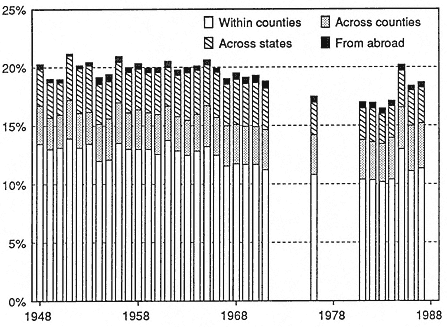
4.1
Percentage of U.S. Population Changing Residence in Previous Year.
SOURCES : Larry H. Long, Migration and Residential Mobility in the United
States (New York: Russel Sage Foundation, 1988), 51; U.S. Bureau of
the Census, Geographic Mobility: March 1986 to March 1987 ,
Current Population Reports, Series P-20, No. 430
(Washington, D.C.: Government Printing Office, 1989), 2.
NOTE : Year refers to the twelve months prior to the spring of the indicated year.
Americans' greater residential stability has probably increased their attachment to their localities. Studies have repeatedly shown that the longer people live in a place the stronger their emotional and social commitments to it.[18]
Another secular change that, in net, probably increased local commitment is the dispersal of the urban population. Despite the popular image of the ever more crowded city, over the last century, American metropolises have been spreading and thinning out. As a result, proportionally more Americans live in suburban single-family houses, located in small, autonomous, suburban municipalities. For about a generation now, more Americans have lived in suburbs than in either center cities or non-metropolitan areas. These, low-density housing, and suburban governments, in turn, tend to encourage local commitments.[19]
(What about the great migration from farm to city in this century? In that area, one of rural Americans' chronic problems was their difficulty in forming communities—in organizing associations, mobilizing politi-
cally, or seeing one another socially.[20] For former homesteaders, the move to town probably increased local involvement.)
A third change, one connected to the growth of urban sprawl, has been the evolution of class-homogenous neighborhoods. At least until the early streetcar era in the 1880s, all but the affluent lived close to their jobs. The elite had their suburban enclaves, but different classes mixed in city neighborhoods, although residents were sometimes well separated by ethnicity. Today, neighborhoods are less segregated by ethnicity—greatly excepting black ghettos—but more finely differentiated by income level.[21] Greater local homogeneity also reinforces neighboring and attachment to the neighborhood.[22]
The great exception of the black ghettos in fact gives emphasis to the general increase in local homogeneity. During the twentieth century, blacks, at least those in the North, became more segregated from whites, even as white ethnic groups, and for that matter Asians and Hispanics, became less segregated from one another. This racial divide has provided to whites neighborhoods devoid of what many find to be the unsettling presence of blacks. It has largely confined blacks, including many in the middle class, to districts with other blacks, including the very poor. Analyses by Douglas Massey and his colleagues suggest that there may have been some small breaches in racial walls recently, but for poor blacks, geographic isolation increased through the 1970s.[23]
A fourth trend is increasing home ownership. Over the century, most American families came to own their homes, with the fastest increase occurring between 1940 and 1960, as figure 4.2 illustrates. The most dramatic change was among the young. In the 1940s the median age of male homeowners was forty-one, but in 1970 it was 28.[24] Home ownership has stagnated in the last fifteen to twenty years of housing inflation and economic doldrums, but remained historically high. (These data do not consider any increase in homelessness.)
Although Americans have long vested their dwellings with important moral qualities—a proper house both reflects and nurtures noble values[25] —in the nineteenth century, Americans did not esteem ownership as they do now. Many middle-class families were content to be renters. The connection between property and propriety apparently arose around the turn of the century, when increasing affordability, suburbanization, and ideologies of domesticity combined to make ownership easier and socially correct. Then, in the twentieth century, rising affluence, new mortgage instruments, government subsidies, tax breaks, and in the 1950s the family boom spurred home ownership to its current levels.[26]
Today, home ownership, preferably of a single, detached house, is the American ideal, despite the financial hurdles involved. In a 1985 poll, for example, 76 percent of respondents agreed that people who do not
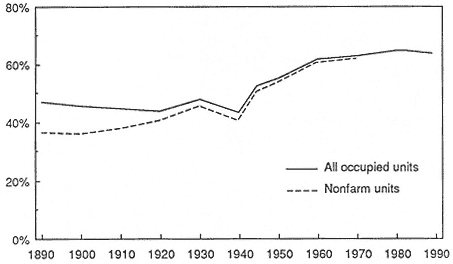
4.2
Percentage of Housing Units That Are Owner-Occupied.
SOURCE : U.S. Bureau of the Census, Historical Statistics of the United States,
Colonial Times to 1970 (Washington, D.C.: Government Printing Office, 1975),
646; U.S. Bureau of the Census, Statistical Abstract of the United States 1988
(Washington, D.C.: Government Printing Office, 1987), 688; U.S. Bureau of
the Census, Census and You 25 (December 1990), 5.
own their homes are "missing out on an important part of the American dream."[27] Being a renter is stigmatizing unless the person is in a transitional stage, a young single, or elderly.[28]
Growth in home ownership has slowed and even declined slightly in the late 1980s.[29] A sense of crisis about middle-class housing arose, a sense that Michael Dukakis tried to exploit in his presidential campaign in 1988. In historical perspective, still, the decline has been mild. Demographic changes in the last thirty years—aging of the baby-boomers, more divorce, delayed marriage and child rearing—should have led to home ownership sagging much more than it did. The big drop in ownership during the 1980s was precisely among Americans under thirty, who were increasingly putting off marriage and childbearing. Still, income losses, housing speculation, and financing changes strained many families, forcing some to rely on two incomes when they would have preferred one, and pushing some home-seekers out of the market.[30] Other would-be owners turned to condominiums or, in rural areas, mobile homes.[31] The proportion of available housing that is single detached units has dropped since the 1960s.[32] This shift to condos or trailers also contributes to a sense of crisis, since the American dream is so closely tied to the single-family house. Altogether, much of the concern arises
from a comparison to the late 1960s, when, with boom times, owning a detached house was easier than now and seemed so normal.
Despite fluctuations owing to changes in demographics and economics, the great increase in home ownership during the twentieth century is unlikely to be soon reversed.
These conditions—urban sprawl, segregation, and home ownership—distinguish America from most European societies. David Popenoe credits them for creating a higher level of neighborhood involvement in the United States than he observed in either Sweden or the United Kingdom.[33] Changes in these conditions over the last few generations, along with declining mobility, would all seem to have helped Americans further attach themselves to their neighborhoods and towns. Besides, most Americans have enjoyed increasing freedom of choice in where they live. Freedom can mean lack of commitment and transiency; but it seems here to have made it easier for most people to find and stay in places they most prefer.[34]
Yet, other changes in the twentieth century may have reduced commitment to the locality. One such change has been the increasing separation of home and workplace. Although some commentators have exaggerated the extent to which home and work were entwined in the past—most people in days gone by were not independent craftsmen working in their homes—the distance between where people live and where they work expanded, particularly with the coming of streetcars in the 1880s.[35] Working outside one's home area probably detracts not only from the time people spend in the neighborhood but also from their subjective feeling of commitment to it.
A second such change is the increasing participation of married women in the labor force. In 1900, 6 percent of married women worked for pay; by 1987, 56 percent did. (The rates for divorced women, a growing fraction of all women, were much higher.)[36] Though married women's employment has typically been part-time, it does mean that fewer American households have a "traditional" homemaker at home all day, the same homemaker who critically connected the family to the neighborhood.[37]
Third, households shrank. With the virtual disappearance of servants, boarders, and lodgers, with later marriage, more divorce, and fewer children, the size of the median American household shrank from 4.8 people in 1900 to 2.7 in 1987.[38] We can assume that, generally, the fewer people at home, the less attached the household is to the locality.
Thus, in the complex weave of twentieth-century social changes, some drew Americans closer to and some pulled them from their neighborhoods and towns. Could we assess past people's identifications, senti-
ments, and actions more directly, we would not need to so indirectly estimate the change in local attachment. As it stands, the changes that more tightly bound people to places probably outweighed those that weakened the bonds, and the best estimate is that, contrary to convention, Americans are more "rooted," practically and sentimentally, to their communities than ever before.