
The Leacht
At the western end of the terrace approximately one meter east of the rock face are the remains of a rectangular stone-built structure 1.1 by 1.6 meters; its present height above the level of the pavement is .45 meter (Fig. 34). The basic structure is well preserved, but the uppermost level has been damaged by weathering. This setting of stones is the remains of a leacht .
Leachta , square or rectangular structures built of rough, unmortared stones, are associated with Irish Early Christian monastic sites. Today they are found primarily at the island monasteries off the west coast of Ireland. Their original distribution is unknown, as they are easily destroyed, but because some have been found in northern Britain, we know they were not limited to the western coastline. Outstanding examples are found today in the monasteries of Skellig Michael, Illauntannig, and Inishmurray. A typical example of a leacht from Inishmurray is shown in Figure 35. It is a quadrangular mass of masonry roughly one meter high, with a tall engraved cross slab set in its center (Wakeman 1893, 71, Fig. 34).
The function of leachta has long been debated. They may have been used to mark burial places, particularly for special saints, or to house relics, mostly the bones of saints; or they may have served as places for prayer, either as stations of the cross or as altars for celebrating mass. It is quite possible that all of these conjectures are correct and that leachta served different functions in different times and places.[13] Only the systematic excavation of a carefully selected group of Irish leachta might ascertain their precise function
[11] Other well-preserved examples illustrating this distinction between the designs of oratories and dwellings exist at the monasteries of Inishmurray and Illauntannig, both built, like Skellig Michael, on treeless islands. For further discussion of the distinction between circular dwellings and rectangular oratories see Horn, 1973, 23–31.
[12] On the adoption of architectural features peculiar to timber construction in Irish stone churches see Leask, 1955, vol. 1, chaps. 5 and 6. His theory has been generally accepted (Thomas, Early Christian Archaeology , 1971, 75; and de Paor and de Paor [1958], 1967, 58–60).
[13] Thomas, in Early Christian Archaeology , 1971, 169–75, gives the best summary of our current state of knowledge.
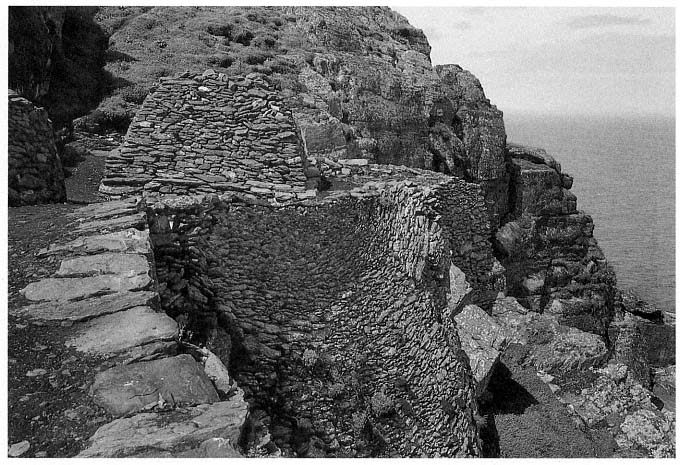
Fig. 33
Monastery of Skellig Michael. View from the south of the small oratory that served as the model for Grellan Rourke's
reconstruction in Figure 39.
Photograph by Walter Horn.
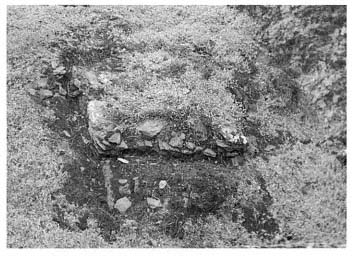
Fig. 34
Skellig Michael, South Peak. Remains of a leacht .
Photograph by Walter Horn.
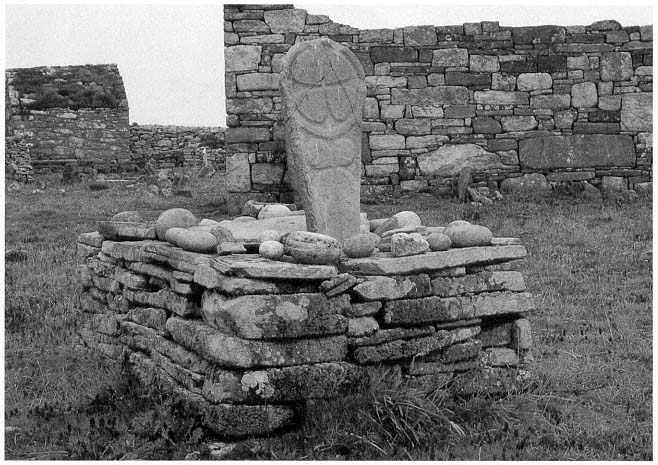
Fig. 35
Island monastery of Inishmurray, County Sligo. A leacht , referred to locally as altóir beag , "the little altar," one of
approximately fifteen leachta on Inishmurray of similar construction. Three lay within the monastery's walls; twelve
along the periphery of the island served as pilgrimage stations.
Photograph by Walter Horn.
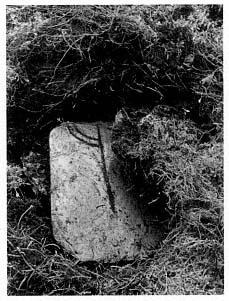
Fig. 36
Skellig Michael, South Peak. Oratory
terrace. The cross slab discovered in
1982 at the location indicated in
the plan of the terrace (Fig. 32).
Photograph by Lee Snodgrass.
Some leachta , however, are known to contain human bones. The larger of the two leachta in the Skellig Michael monastery is situated north of the large oratory; the other, smaller, one is built against the monastery retaining wall south of the large oratory. In the course of badly needed repair to the perimeter of these leachta , the National Monuments Service found some human bones. Because the bones were discovered by chance during the rebuilding of the wall face, not in the course of an excavation, no attempt was made to explore the leachta in depth, and the bones were returned to their original position.
The remains of a leacht on the South Peak oratory terrace give evidence of a structure too small to be the original burial place of anyone. Possibly this leacht was either a memorial shrine, containing the translated bones of a hermit, or an altar.