
From Rock 'n' Roll to Rocanrol
Virtually every song recorded during this period was a translation of a foreign hit imposed on the musicians by the recording companies themselves. When rock 'n' roll first arrived in the mid-1950s singers had naturally tried to imitate the English original. As Johnny Laboriel tells it, "The first time I heard rock 'n' roll was on the jukebox. We used to go to this ice-cream café, and it was there that we started to hear what it was all about. I remember the first word I heard was 'darling,' but shouted out like this!...So that was the first thing I did. I started to sing rock 'n' roll. But I didn't know any English...[so] I used to sing to the girls, making up the words as I went along."[21] Singing in guttural English undoubtedly came across as more authentic, but it was largely impractical for recording. (Gloria Ríos was an exception, with her masterful rendition of Haley's "Rock around the Clock.") Moreover, because of the close associations between rock 'n' roll and rebeldismo, copying the English original connoted a level of authenticity that record producers were at this point anxious to tone down. What was needed was a Spanish-language equivalent that maintained the essential rhythm and structure of the original (with perhaps some token English thrown in) but that provided greater control for producers who needed to deflect assaults by conservatives. For Orfeón, the process was simple: "We saw what was a hit in the United States...and then we brought in the record, in fact even before it was sold here [in Mexico], and we immediately made a cover version with one of our [contracted] groups. Then we promoted it on television and radio...and in twenty-four hours we had a record on the street for sale."[22] Marketing Spanish-language covers of foreign hits was a strategy that directly undercut the transnationals' inherent advantage, as José Cruz Ayala explained:
In an album by Los Teen Tops, there exists the best of the best as a copy, so it already had a certain preestablished sales value. They were already covering a series of points—one already knew which songs were going to be hits....You took the recordings by Elvis Presley and could choose not just one but lots—there were easily twenty to forty songs that one could make a cover out of—and this was the same with the recordings of whatever other person that occurred to us.[23]
Such was the popularity of rocanrol that despite a 1961 recession that affected record sales in other Latin American markets, Billboard reported
that "[t]he significant and still increasing trend of 1961 in Mexican music has been the absolute predominance of rock in record sales and radio programs," performed by the "dozens of teen-age singers and 'wild' rock groups [that] have been and are still recording."[24]
Rocanrol was above all a middle-class phenomenon, which neither replaced the mass appeal of more traditional musical styles nor reached much beyond urban consumers of the capital and provincial cities. Nonetheless, its impact significantly realigned musical tastes and fashions, in the end redefining an image of Mexican modernity that had been overly dependent on the stereotyped mariachi performer. For example, in early 1961 an agreement was reached between Channel 5 of New York City and Tele-sistema to initiate an exchange of videotapes featuring how each country had influenced the other's musical styles. Not by coincidence, the first program was "devoted to [the] invasion of Mexico by rock-and-roll rhythms, with [the] top groups interpreting the frenzied music appearing in the segment."[25] According to a report in Variety in early 1961, rocanrol had "eclipsed all other melodies," leading to "one of the poorest years [for traditional music] because of the frenzied switch to rock and roll."[26] Government policy, which had aimed to influence popular tastes by threatening sanctions against radio stations dominated by foreign-language songs, now adopted the added position of a protective tariff. In mid-1961 the tariff on imports went from U.S. $0.005 per kilo on records with a 10 percent ad valorem to U.S. $1.20 per kilo and a 40 percent ad valorem. This meant that the average cost of an imported record increased around 50 percent, resulting in a notable drop in imports [27] (see Graph 2). While the tariff undoubtedly reflected the combined pressures of musicians' unions, nationalist government officials, and local media interests, its impact was twofold. First of all, it forced a shift toward local pressing from the masters which, where available, now replaced imports. Billboard, for instance, reported at the end of 1962 that "90 per cent of records formerly imported are now pressed locally."[28] This created a boon for local production. Secondly, however, the new tariff also induced record companies across the board to market a native rocanrol product as a more flexible substitute for costly imports.
Indeed, a 1962 report by the Banco Nacional de Comercio Exterior indicated that "modern rhythms" were "displacing the music that is authentically Mexican." The report argued that the popularity of such rhythms had created incentives for the recording industry to tailor domestic demand according to trends set by "those countries from which modern music originates."[29] Clearly, the marketing trends were being set by styles imported from abroad, and the record companies, both locally owned and transna-
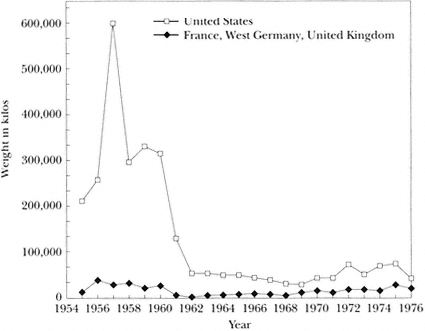
Graph 2.
Record imports into Mexico, 1955–1976. Source: Anuario del Comercio
Exterior (Mexico City: Banco Nacional de Comercio Exterior, 1955–1976).
tional, were active participants in the process. Orfeón, for instance, in addition to promoting its own contracted artists, had signed an exclusive, two-year contract with Bill Haley "to handle r'n'r rhythms in Spanish, to [the] accompaniment of Mexican musicians."[30]
Best epitomizing this influence was the international sensation caused by the twist. At the start of 1962 Variety was reporting that "the [twist] dance craze has spread around the globe,"[31] and RCA's Mexican subsidiary was quick to promote the style locally, seeing it as an opportunity to " 'rejuvenate' traditional Mexican songs."[32] As Rubén Fuentes, artistic director at RCA-Vfctor Mexicana, said, "We will give a Latin twist to The Twist," pointing out that such standards as "Bésame mucho" would be "adapted to 'twisting.' "[33] In an effort to arrest this "exotic rhythms kick," the Mexican Society of Authors and Composers, in collaboration with the National Tourist Council and the major record companies, promoted a Mexican Song Festival as a way to "renew interests in national tunes."[34] Still, an artistic director at CBS argued that Mexican composers would benefit "if they
would learn to keep up with the times and musical fashions, and create accordingly." This position was backed by a spokesperson at Orfeón, who urged that composers should pursue "new ways of expression" aimed at youth.[35]
Reaction to the popularity of rocanrol varied, with certain radio broadcasters eagerly promoting it while others viewed it as anathema and deemed it "vulgar, obnoxious and in bad taste."[36] One radio station, for example, flatly refused to program rocanrol calling it "a sample of bad taste that we must avoid at all cost."[37] Calling them "musical rebels without a cause," Alfredo Urdián, an executive with the powerful Mexico City Musicians' Union, announced a boycott in October 1960 of any establishment that allowed young rockers to perform, arguing that the measure was necessary to protect "legitimate musicians" from "unfair competition."[38] This campaign was underscored by a petition to the Office of Public Entertainment asking it to issue a decree prohibiting dance halls from hiring, in Variety's words, the "youthful musical maniacs."[39] Yet two months later it was announced that an Association of Rocanrol Units was being formed as an ad hoc union for the musicians. According to the group's president, Antonio Figueroa, its purpose was to "'dignify' rock and roll in Mexico and to weed out questionable elements," such as "student or worker groups who 'think' they can interpret rock and roll rhythms."[40]
This reflected a fundamental ideological element of the movement, which was to be reinforced at all levels of the media during the 1960s: the containment of rock "n" roll began with the musicians themselves but extended to all aspects of their media representation. Having vowed to "sweep the Mexican musical scene clean of the 'musical hoodlums,'"[41] even Venus Rey, head of the musicians' union, soon succumbed to the reality of rocanrol's popularity with the public. In a measure of the rhythm's inexorable march, now wholly backed by television and radio, by the fall of 1961 the musicians' syndicate had agreed to accept the rocanrol groups as "meritorious" members of the union but on the condition that for every rock 'n' roller hired, a "bona fide union musician" must also be contracted, a clause no doubt difficult for the union to enforce.[42] As a current director of sales at Orfeón, Carlos Beltrand Luján, now recalls, "Everyone had a friend in some [rocanrol] group. And they all performed in afternoon gigs.... [S]oon after their records came out, all of this pushed aside demand for the foreign groups. We all supported our [Mexican] groups and bought their records. Of the five or six radio stations that had supported foreign rock, only one remained.... The rest started to support rock in Spanish."[43] By the end of 1962 Billboard was reporting that the best-selling U.S. artists
were "[o]ut of favor, and practically never played at radio stations." "No English lyrics ... are accepted by the Mexican public," the trade magazine noted.[44]
As a result of Orfeón's all-out investment in rocanrol, the company saw its share of the total domestic market for all music increase from 2 percent in 1957 to 16 percent by 1962, still far short of RCA's 40 percent.[45] In fact, despite a climate of hostility and conflict with RCA and CBS, Orfeón's ties to other media placed the company at an important advantage over the transnationals, allowing Orfeón, according to Beltrand Luján, to capture around 80 percent of the rocanrol market by the end of this period.[46] Conflicts first emerged between Orfeón and RCA toward the end of 1961, when the latter sought to discredit Orfeón by claiming that it was headed toward bankruptcy, a charge far from true. In fact, the conflict in large part centered on Orfeón's undercutting the transnationals by developing "cutrate and bargain sale tactics," a strategy that had set off a price war in the industry.[47] But the price war was only one side of the picture that was emerging. The other concerned the transnationals' steady moves to compete with Orfeón for the rocanrol market. For example, CBS initiated an aggressive marketing strategy aimed at broadening its market share throughout Latin America, a company trend that accelerated throughout the decade. In an effort designed "to give [CBS] a stronger foothold in the international market," the company pursued a strategy "to have greater involvement in the local artists & repertoire production activities, creating [a] product for the specific country itself as well as [a] repertoire of value to the entire international area."[48] Thus, starting in 1961, new recording studios and expanded manufacturing facilities were built in Argentina, and the company announced that it had "launched long-range plans to broaden [its] distribution and recording operations in all major markets throughout the world."[49] During 1962, the company was reporting "excellent sales volumes ... by wholly-owned records subsidiaries in Argentina, Australia, Brazil, Canada and Mexico."[50] In June 1962 CBS increased the capitalization of its Mexican subsidiary, which was now generating 352,000 records per month.[51]
Shortly thereafter, Orfeón began to accuse CBS of stealing its artists and dominating the newly formed Mexican Association of Record Producers, leading Orfeón to quit the association briefly in protest.[52] Meanwhile, CBS continued its advance into the Spanish-language markets, upgrading its facilities in Latin America and establishing a distribution contract with the Spanish recording company, Hispavox, through which Columbia Records' Latin American artists, such as Los Teen Tops, were now distributed in Spain.[53] In 1963, the transnational could report that the "Columbia Rec-
ords U.S. repertoire is not only now packaged, distributed and promoted throughout the world by foreign subsidiaries and affiliates, but, in turn, these companies record native artists which are marketed on a world-wide basis by Columbia."[54] With their offers of lucrative contracts and the accompanying benefits of recording for a global company, RCA and CBS quickly cultivated their own roster of Mexican rocanrol performers, often aggressively luring artists away from contracts already established with other companies. In various instances, for example, contracts with Orfeón were broken as performers switched recording companies.[55] In one notable case, Los Locos del Ritmo switched from Orfeón to CBS, where they were promoted throughout South America as well as the southwestern United States.[56] Indeed, via their recordings and appearances in film, groups such as Los Teen Tops, Los Loud Jets, and Los Rebeldes del Rock came to be widely known not only throughout the republic but also in Latin America, Spain, parts of the United States, and even Europe and Asia.[57]
While the transnationals had tremendous advantages—their economies of scale, direct access to cataloged material, and global marketing networks—Mexican companies were also able to compete for the rising consumer demand created by what the industry was calling la nueva ola, or "new wave" of youth-oriented music. Orfeón was best positioned to take advantage of this opportunity because of the company's complex ties to other mass media, but other local companies also profited.[58] Thus in 1960 Orfeón launched its own television program as a front for its contracted artists. Initially called Premier Orfeón, in 1962 the name was changed to Orfeón a go-go, which reflected its strong youth-oriented catalog under the popular Orfeón label. Around the same time as the start of Premier Orfeón RCA announced that it was following suit with its own weekly program to "featur[e] one or more of the firm's recording artists, as well as dance routines."[59] A score of dance-oriented television programs cropped up around the country in rapid succession. In short, the rocanrol boom affected the entire industry, from the recording companies to the radio and television networks. While exports of "traditional" Mexican music continued to show modest signs of increase during this period, especially to the growing Mexican American communities in the United States, domestic demand was dramatically displaced by la nueva ola of music groups targeted at youth.