
Chapter 7
The Old Testament Patriarchs, or Elders of the Apocalypse, on the Three Outer Archivolts
Above the embrasures on the left and right, in the three outer archivolts, the twenty-four elders of the Apocalypse sit in orderly tiers “round about the throne” (Apocalypse 4:4). According to the vision of the Second Coming revealed to John of Patmos, they carry musical instruments and vials filled with “odours which are the prayers of saints” (Apocalypse 5:8). As mentioned in Chapter 4, the figures in the fourth and outermost archivolt occupy niches formed by an intertwined vine iconographically equated with the Tree of Jesse. Its presence here refers to the descendants of Jesse as the ancestors of the crucified Christ of the tympanum. The Tree of Jesse symbolically unites the patriarchs of the Old Testament with the elders of the Apocalypse.[1] (The imagery of the Tree had not previously appeared in monumental sculpture.) The choice of the epithet “Master of the Elders” follows the usual identification of the twenty-four figures, but giving them the label “patriarchs” acknowledges the significance that the conflated identities bring to overall interpretation of the sculptural ensemble.
The nineteenth-century restorations to the figures replaced all twenty-four heads with the usual unfortunate visual result. Three twelfth-century heads identified as coming from Saint-Denis and now in the collection of the Louvre belonged to three of the patriarchs or elders in the archivolts (Figs. 13a and 30a–b). Proportionally compatible with those figures, the Louvre heads have measurements that also accord with the mean measurement of the nineteenth- century replacements.[2] But once again, instead of the monumental, abstract style of the twelfth-century heads, the nineteenth-century faces provide bland, devitalized imitations. In trying to reproduce the large, bulging twelfth-century eyes rimmed with flat ridges or bands, the restorer created blank, sightless ones devoid of the awesome intensity of the prototypes. The smooth contours and
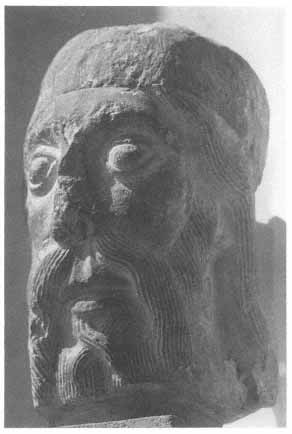
Fig. 30a.
Twelfth-century head originally belonging to patriarch Y,
fourth archivolt, right, fourth tier.Paris, Musée du Louvre,
cat. no. 55
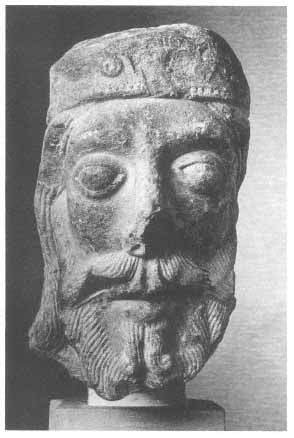
Fig. 30b.
Twelfth-century head originally belonging to patriarch O,
third archivolt, right, first tier.Paris, Musée du Louvre,
cat. no. 52
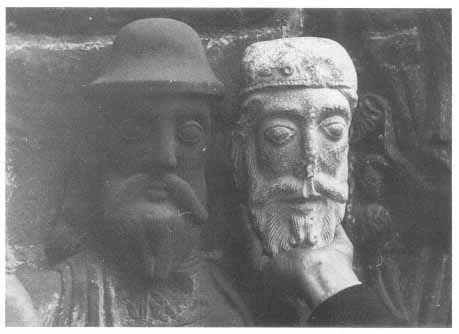
Fig. 30c.
Detail of patriarch O, third archivolt, right, first tier, with
plaster cast of head. Paris, Musée du Louvre, cat. no. 52
planes of the moon-faced nineteenth-century heads capture nothing of the starkness of the original three. Quite primitive in feeling, two of the three surviving faces are elongated to the point of distortion. The third, somewhat broader through the eyes, appears more normally proportioned.
The restoration took even greater liberties with the headdresses. Nothing about the mutilated headcoverings of the twelfth-century survivors suggests precedents for the various bonnets, cloches, toques, and hats, both hard and soft, that the patriarchs now wear. The vestiges of the original headdresses, although shaved and cut back, sit like crowns, quite low and nearly horizontally on the patriarchs' brows. Traces of beading and jewels also survive on the headdress of Louvre head cat. no. 52. The combined evidence, although not conclusive, favors the identification of those vestiges as crowns—attributes conforming to the biblical description: “And round about the throne were four and twenty seats; and upon the seats four and twenty ancients sitting, clothed in white garments, and on their heads were crowns of gold” (Apocalypse 4:4).[3]
In addition to the three heads in the Louvre, which may have been in place when the restoration began, vestiges of the original hair and beards survived to guide the restorer. As the diagrams show, remnants of beards greatly out-number traces of hair (Plates VIb, VIIb, VIIIb, and IXb). Beard ends, short and long, usually divided, sometimes crimped or twisted, remain in sixteen of the twenty-four figures. A comparison of the fragments visible on the collars and chests of patriarchs C, D, G, P, and T show the remarkable variety possible in the arrangement of those terminal locks alone. The windblown beard of patriarch C seems especially noteworthy (Plate VIa). A gust of wind from the northwest seems to have lifted one of the twelfth-century locks and flattened it against the right stem of the enframing vine. In restoring the head, the nineteenth-century sculptor perpetuated that original conceit.
Patriarch C and four others in the fourth archivolt, patriarchs F, J, M, and Z, suffered extensively from the combined effects of exposure, iconoclasts, and restoration. The severe recutting that accompanied inept insets distorted the anatomy in the lower portions of patriarchs F and J. Yet those two, unlike patriarch C, at least retain their basic twelfth-century poses and drapery arrangements (Plate VIa).[4] Of the two demi-figures within the topmost niches of the Tree of Jesse (patriarchs M and Z; Plate Va), only the foliage that terminates the enframing vines retains enough of the unspoiled carving to have value and interest today. Although showing mutilations and losses, the curling
fronds as they close in upon themselves or occasionally shelter a stylized bud or cluster of small fruits typify the lively handling of Dionysian foliate forms. At times fully undercut, the leaves and stems create a lacework pattern reflecting a general and marked increase in the depth of undercutting. Once again, as the distance from the viewer increased, so did the forward projection and undercutting of the sculptures. In the archivolts, as elsewhere, the sophistication of composition and of formal organization equals that of the iconography.
Although patriarchs M and Z have not always been accepted as part of the original arrangement, enough of the old stone survives to certify that the demi-figures perpetuate the original plan, even to the position of the heads which, on the right in the bust of patriarch Z, conforms to the requirements of the surviving twelfth-century hair on his shoulder.[5] By placing those two small busts in the uppermost niches of the vine rather than making full-length, seated figures, the twelfth-century artist again showed his formal sophistication. As well as accommodating to space limitations, he also avoided overwhelming the archivolts with an arrangement visually too heavy or weighty for that upper, central location.
Although badly weathered, recut, and repaired, the other five figures of the fourth archivolt, patriarchs L, P, S, V, and Y, generally retain the original drapery arrangements and much of their twelfth-century character. Nevertheless, as diagrammed, each one has a particularly disfigured area, which must be noted and avoided whenever those draperies are cited for comparisons or used as examples of the development of artistic ideas (Plates VIIb, VIIIb, and IXb).
In the second and third archivolts, the condition of the figures varies from the nearly perfect figure of patriarch T (Fig. 32 and Plate IX) to the almost completely recut drapery of patriarch R and the deformed lower portions of patriarch H, cited in Chapter 2 as an example of the most drastic recutting (Plates VIIb, VIIIb, and IXb). Patriarchs B, E, R, and W also belong on the list of heavily restored figures in the middle two archivolts, although each retains at least one area of particular interest that will receive attention. For instance, before extensive recutting and skinning, patriarch W, the uppermost figure in the third archivolt, right, probably would have ranked among the best sculptures in the middle two archivolts and numbered among the most skillfully carved figures in terms of interesting variations on mid-twelfth-century drapery conventions. In particular, the well-preserved drapery over the lower legs and the unretouched foliate console on which his feet rest give evidence of the
quality and fluency of the original carving (Fig. 33). The richly ornamented borders of the tunic collar, left sleeve, and hem contrast with the relative simplicity of the other elders' garments. As the diagrams indicate, recutting, more than any other aspect of the restoration, has deprived this group of the vitality of the original carving. By and large, the twelfth-century arrangements of the draperies survive, but often the restorer's chisel has so blurred the folds composing the familiar twelfth-century drapery conventions that, in the aggregate, the draperies have lost much of their clarity as well as their vigor.
The remaining figures in the second and third archivolts, patriarchs A, D, G, K, N, O, Q, T, and U, survived the restorations better than the figures already discussed. Although the diagrams pinpoint many recut areas as well as a variety of small, scattered insets, especially in figures A, K, O, Q, and U, those patriarchs remain valuable examples of the twelfth-century work. For instance, the recutting proved so light in the lower drapery of patriarch A that the figure is able to provide the key to the identification of the work of the sculptor whose ideas dominate the carving in the archivolts (Fig. 31).
The characteristics of this artist's hand seem quite distinct from those that distinguish the Master of the Tympanum Angels and the Master of the Apostles, although all three used many of the same drapery conventions and, without doubt, interacted in their deliberate efforts to create a harmonious ensemble. Nevertheless, since the sculpture reflects their differences, detailed analyses of several figures in the archivolts are needed to reveal enough stylistic idiosyncracies to identify the dominant hand in the archivolts, the artist who merits the title Master of the Elders.[6]
The upper half of the figure of patriarch A survives in excellent condition, whereas the lower half shows only the lightest recutting. In fact, the mortar filling the eroded joints proved the most disfiguring aspect of the restoration. As the diagram indicates (Plate VIb), the figure also required several small insets, among them the blunt, square, bare feet flanking the restored central palmette of the foliate footrest. His nineteenth-century feet and toes compare unfavorably with the slender, anatomically correct feet of patriarch N on the opposite side of the portal (Plate VIIIb), whose feet survive from the twelfth century and give credence to the restoration of patriarch A as barefooted.
Since only two of the twenty-four patriarchs are barefooted, those exceptions present an iconographical enigma. By the mid-twelfth century the Deity,
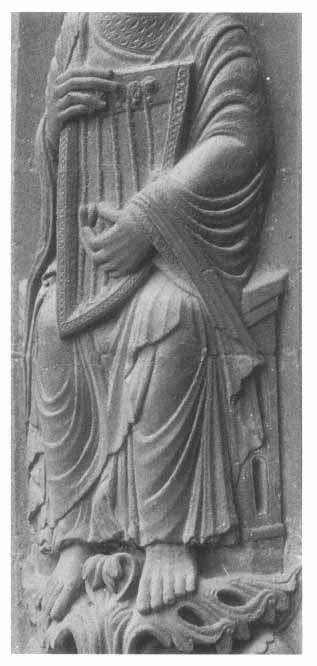
Fig. 31.
Patriarch A, second archivolt, left, first tier
Christ, the Apostles, and angels were conventionally represented with bare feet, and the Virgin, patriarchs, prophets, elders, and other biblical and holy personages were shod. Moissac is one of the notable and somewhat earlier exceptions where all of the elders are depicted barefooted. Several biblical references to bare feet may have inspired those of the two patriarchs at Saint-Denis. In the Old Testament, bare feet were associated with a holy place and with sorrow and weeping. The first biblical reference occurs in the Lord's injunction to Moses: “Put off the shoes from thy feet, for the place whereon thou standest is holy ground” (Exodus 3:5). Another occurs in a similar injunction to Joshua; as a
result of those texts, removing shoes became an act of reverence, so that priests customarily went barefooted while officiating in the temple (Josue 5:16). Such an interpretation would accord with the symbolism here: the barefooted patriarchs flanking the entrance to the church would make a specific reference to holy ground, the church, which is equated with the Heavenly City and with the New Jerusalem of the Apocalypse (Apocalypse 21:1–3, 10–14).
The reference to sorrow seems no less appropriate to the bare feet of the two figures who flank the scene conflating the Crucifixion with the Second Coming. One of the two Old Testament references associating bare feet with sorrow involves David at the time of Absalom's conspiracy. David “went up by the ascent of Mount Olivet, going up and weeping, walking barefoot, and with his head covered” (2 Samuel 15:30). That Old Testament association seems especially pertinent if the harp-playing, barefooted patriarch A should be identified as King David. The biblical gloss by the Venerable Bede provides a plausible identification for the other barefooted figure, patriarch N. Bede, referring to the ancestors of Christ in the genealogy of the Book of Matthew (1:1–17), equated David and Abraham with two columns that stand in front of the door which is Christ.[7] The metaphor of the columns derives from the two columns before the door to the Temple of Solomon, in itself a symbol of the church (3 Kings 7:15, 21).[8] Authenticated as twelfth-century iconographical details, doubtless the bare feet and the harp playing were intended to add new layers of meaning to the patriarchal ensemble.
Patriarch A is short, with squat proportions in comparison to the adjacent elders on his right and the two above him. Accommodation to the expanding arcs of the archivolts necessitated figures of differing heights. Although most of the seated patriarchs occupy five voussoirs, patriarchs G, O, and Q actually extend across six. On the left side of the portal, none of the figures in the archivolt covers six voussoirs, but the necessary expansion was achieved by the use of several outsized voussoirs. Patriarch A in the lowest tier is carved in less pronounced relief than the upper figures, as is true throughout in the lower levels of the portal. The shallower projection increases the impression of compact proportions. The form and volume of his anatomy, although neither unsubstantial nor exaggerated, seem somewhat subordinate to the richly patterned design of the drapery.
The elongated torsos of patriarchs G and O, their narrow, slopping shoulders, and the exceptionally stiff, narrow pleating of the drapery cascades that
fairly bristle along the hem edges raise the question again of stylistic variations attributable to an assistant. Although the same narrow shoulders and fine, bristling pleats recur in the elongated torso of patriarch B, the outsized figure of patriarch Q has the stocky proportions more typical of the Elder Master's style. Because such variations are infrequent (or, as in the proportions of the fourth archivolt figures, reflect limitations imposed by the enframing vines), and because the distinctions lie for the most part within the framework of the master's artistic ideas, the sculpture deserves to be considered as an ensemble that expresses his style. Attempts to isolate areas of a figure attributable to an assistant would be a pedantic as well as an extremely dubious exercise.
Typical of all of the elders, the costume of patriarch A consists of two simple garments, an ankle-length tunic under a light mantle or cloak. In over half of the figures, the drapery of the mantle also covers the lap and continues in an arrangement, often quite complicated, over the knees and lower legs. Galons, broad jeweled or ornamental collars, band the necks of the tunics, but, as noted, only patriarch W has a decorated hem (Fig. 33). One other figure, patriarch B, has a patterned border edging his mantle, and in four instances the sleeves of the tunics have ornamented cuffs (patriarchs A, O, Q, and W). Such details commonly embellish the garments of other figures on the portal, but in general, the costumes of the elders appear less lavish than those of the Apostles.
Since the musical instruments and vials carried by the elders cover large areas of the upper drapery, the most distinctive elements of the Elder Master's style occur in the lower portions of the seated figures and in the sleeves and drapery over the shoulders. As the mantles fall lightly over the tunics, the arrangement of their folds and the overlapped cascades of drapery afforded the artist his greatest opportunity to create interesting patterns. Formed by a thin, often seemingly brittle material, the mantles define the anatomy they cover, but at the same time assume independent and often arbitrary surface designs. The usual tensions resulted from the artist's discrepant use of natural folds and stylized conventions. In his most arbitrary arrangements, he frequently confused the folds of the tunic with the overlapping mantle, and he often failed to make a clear distinction between the fabric of the mantle and that of the sleeve.
The well-preserved drapery of patriarch A exemplifies those confusions in the visually striking, multipleated fall of material from the left wrist and in the contrived cascade of pleated foldbacks beside the right leg (Fig. 31). The latter demonstrates the artist's preoccupation with the complication of a design. In the
combination of materials from the mantle and tunic, the component parts become quite indistinguishable, especially along the intricate, convoluted, and overlapped hem. In the unnaturally stiff diagonal fall of drapery from the left arm, the zigzag of foldbacks falling from the wrist merge arbitrarily with those of the lower portions of the mantle and finally with the tunic undergarment. A notable variant on that complex pattern occurs in the intricate drapery of patriarch T, particularly along his left side (Fig. 32).
The treatment of the short overlap on the left knee of patriarch A also distinguishes the hand of the Master of the Elders from his companions. Sharp fluted ridges separate rhythmic hollows that respond to the projecting, rounded form of the knee. The mortar that repaired the masonry there caused some distortion to the drapery, but similar, more complicated, and better-preserved examples cover the knees of patriarchs K and T. The same type of fluted drapery recurs in the arrangements veiling the hands of patriarchs F, J, L, and T. Along the hem, the splayed inner edges of the symmetrical underfolds typify this master's treatment of that much-used convention, in contrast with the closed form favored for the central foldbacks by the Master of the Tympanum Angels. Although the Angel Master never employed the fluted arrangement covering the knees, its use by the Apostle Master provides telling comparisons. On the left knee of Apostle no. 31 (Plate IVa), similar drapery with softer and flatter ridges and fluting defies gravity to follow and accent the diagonal line of the shank. Less crisply executed, that more arbitrary arrangement also has rounded, thicker hem edges evoking heavy materials associated with the Apostle Master. They contrast in texture with the brittle, thin edges that characterize so much of the drapery of the Master of the Elders.
In the stylized folds of the zigzag cascades and in the overlapped foldon the right thigh, the artist depicted the mantle of patriarch A as alight, flexible textile. He expressed the same texture even moreexplicitly in the thin line of the hem of the mantle that forms adiagonal across the legs of patriarch U, and in the similar but somewhatrecut hemlines slanting across the legs of patriarchs D, E, and Q. Thethin, lightly defined drapery over the legs of patriarch A contrastswith the heavy, curving folds that sag below his left forearm and withthe firmly incised tubular folds defining his upper arm. That seeminglyillogical variation in the quality of the fabric forming parts of thesame garment illustrates the artist's primary concern for variety in thesurface patterns of the drap-
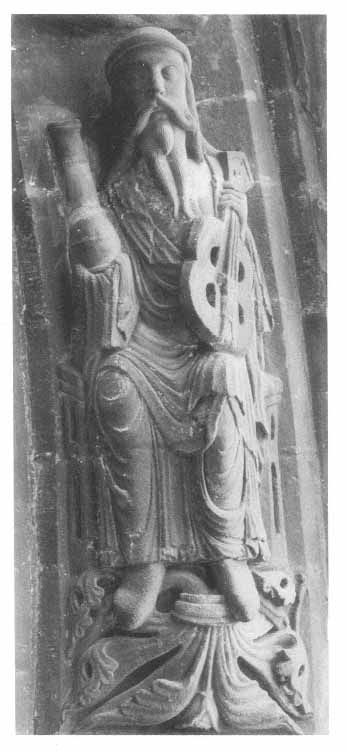
Fig. 32.
Patriarch T, second archivolt, right, third tier
ery. Nevertheless, the patterns neither obscure nor distort the natural definition of arms and legs that are essentially normal in their proportions.
The varied details of the drapery of the twenty-four elders exhibit another recurrent convention that helps to identify the work of this master. In keeping with his ingeniously overlapping folds and contrived patterns, he occasionally
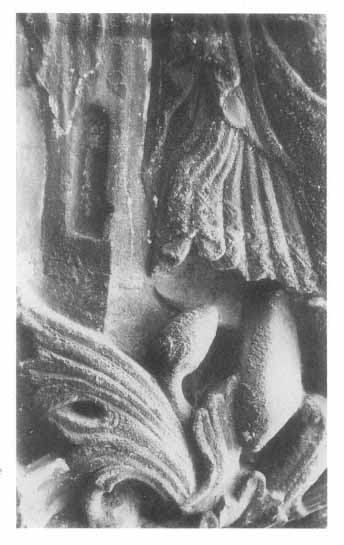
Fig. 33.
Detail of hemline and console of patriarch W, third archivolt,
right, fourth tier
used a purely decorative swirl, or gathering, along the hemline of the tunic. Such a device occurs in the drapery between the ankles of patriarch A, where a gathering of small folds seems to emerge through a slit, or opening, in the border of the tunic. In the hemline beside the ankle of patriarch T, an even more contrived flourish occurs where the swag of folds crossing the shank meets the vertical fall of pleats beside the leg (Fig. 32). Less pronounced but related stylizations embellish the lower borders or hems of patriarchs R and W (Fig. 33).
Despite many shared conventions, the Master of the Elders treated the hemlines of the tunics quite differently from those carved by the Master of the Tympanum Angles or by the Apostle Master. A certain stiffness infects even the most fluid of the hemlines in the archivolt figures (see patriarchs A, N, T, V, and W). His most severe treatment of a hem seems especially rigid and brittle when compared with the curving, sinuous lines created by the hems of the
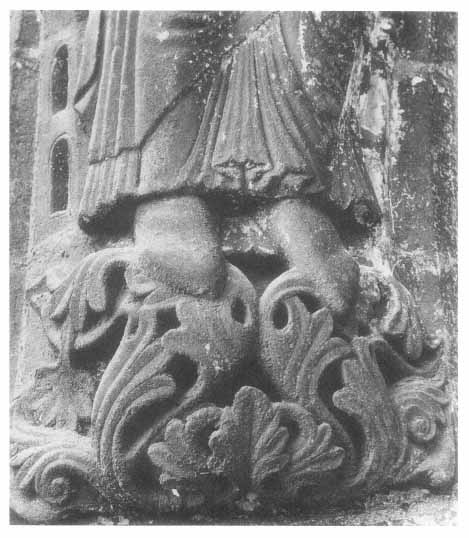
Fig. 34.
Foliate console supporting feet of patriarch D, second archivolt, left, second tier
Apostles' tunics or by those of the Wise and Foolish Virgins on the jambs (see especially patriarchs G, O, Q, and U; virgin no. 8, Fig. 26; and Apostles, Plates IIIa and IVa). In addition, the manner in which the Elder Master depicted the inner or back hemline differed from the handling of the same convention by the other two masters. The deeply undercut front hems of the patriarchs' tunics and their prominent feet subordinate the back hems. Despite full articulation, the contours of those hemlines are modified by shadow in the recesses above the foliate consoles, especially those of patriarchs D, K, and Q. In contrast, the Apostle Master used the inner hemlines as a background for the feet and as a well-defined frame that helped to organize the figures into groups. Frequently the Master of the Elders also depicted the inner surfaces and back edges of folded leaves on the consoles in a manner echoing the convention of the inner hemline (see, for example, those of patriarchs A, D, N, Q, T, and W, Figs. 31–33).
All the foliate consoles below the feet of the elders of the middle two archivolts deserve close attention as an important part of the sculpture in the archivolts. Their rhythmic designs, balanced but never rigidly symmetrical, display the technical skills of the master both in the articulation of the foliate forms and in the depth of undercutting (Figs. 33 and 34). In almost every instance, the placement of the elders' feet proves integral to the balance and to the pattern. Infinitely varied, the designs include vegetal forms such as the out-of-scale acorn and cluster of berries in the console below patriarch A (Fig. 31), and the somewhat mutilated bud on a stem projecting on central axis in the palmette below patriarch T (Fig. 32). In the latter design, the boldly conceived foliage emerges from the clasp, or circular band, that holds the bases of the leaves together—a typical Dionysian conceit. As noted in Chapter 5, the deep undercutting and centrally organized designs of the footrests contrast with the lower relief and overall patterns of the foliate consoles below the scenes of Paradise and the Elect in the first archivolt (Plates VIa and VIIa).
Although tensions exist between natural and arbitrary forms in the figures of the patriarchs, the master consistently demonstrated his knowledge of anatomy. In his depiction of hands that hold the attributes and play the musical instruments, his observation of one structure seems especially keen and sensitive. An unexpectedly large number of the hands have survived untouched by the restorer except for minor repairs or minimal recutting. Their comparison with other original hands both in the Apostle frieze and in the figures of the Wise and Foolish Virgins of the jambs further distinguishes the style of the Master of the Elders (Figs. 9, 15a, 25a, and 26). Despite the nineteenth-century insets in the index and middle fingers of the right hand of patriarch A, the unusually elongated fingers demonstrate the artist's knowledge of and interest in the process of plucking and stopping the strings of a harp.[9] With even more elaboration he modeled the well-preserved and bony fingers of patriarchs Q and R (Plate VIIIa). Other hands with a high degree of naturalism conforming to the type survive in the figures of patriarchs B, D, G, K, N, O, T, W, and Y. Although delicacy and sensitivity also characterize hands carved by the Apostle Master, with the single exception already noted of Apostle no. 32, their more rounded, softer forms distinguish them from the work of the Master of the Elders. Only the right hand of Apostle no. 32 approaches the structural precision and sinuous elongation of the patriarchs' hands, and that exception seems
to demonstrate the artists' influence on each other. Despite their elongation, the patriarchs' hands never show the disproportion that typifies many of the hands of the Wise and Foolish Virgins attributed to the Master of the Tympanum Angels.
The vials held by all but two of the elders also reflect the artist's interest in accurate imagery. The vase carried by patriarch B—a well-preserved example with only the lightest recutting on its rounded bowl and none at all on the long neck encircled with jeweled bands—closely resembles the famous royal justa (ceremonial vase) given by Louis VII to Suger, who eventually presented it to the patron saints of the abbey.[10] The similarities in form and decoration seem more than coincidental and suggest that the artist deliberately chose the royal gift as his model.
The musical instruments reveal the same meticulous attention to detail.[11] The artist accurately carved tightly twisted wire strings that coil from right to left around the tuning pegs along the upper frames of the harps held by patriarchs A and N (Fig. 31 and Plate VIIIa). Carved with even more precision, the instrument held by patriarch R has similar twisted wires, but only for the longer bass strings; single, untwisted strands represent the strings in the higher range. Other well-observed details, such as the bow of patriarch D and the finial on the harp of patriarch H, testify to the fidelity of the artist's observations of twelfth-century instruments (Plates VIa and VIIa). The small animal-head finial still has its carefully articulated ears and eyes, as well as incised caricaturing lines on the face. Presumably the worn animal-head finials of the harps held by patriarchs E and R once had similar details (Plates VIa and VIIIa).
Although the wealth of well-preserved detail made the figure of patriarch A an excellent example of the Elder Master's style, patriarchs K, N, and T, despite variations in posture, degree of relief, and drapery arrangements, also belong within the scope of this versatile artist, and each adds to the definition of his style.
In the figure of patriarch N, the artist exuberantly restated and elaborated the ideas discussed in the analysis of patriarch A.[12] But patriarchs K and T, in the upper reaches of the archivolts, present significant developments within the master's style (Fig. 32 and Plate VIIa). The edge of the mantle falling from the right shoulder of patriarch K reaches almost to his left knee where, forming a graceful swag, it loops over the left wrist. The increased relief and surface
modeling and the greater depth of undercutting that distinguish this detail have counterparts in the drapery of patriarch T. The unusual plasticity of the stylized gathering beside the elder's left ankle, the deep undercutting of the folded-back edges in the cascade of drapery falling from his left wrist, and the strong modeling of the insistent parallel folds that suggest overall pleating endow the stylizations in the drapery of patriarch T with an unexpected plausibility and naturalism. In effect, the increased modeling that compensated for the increased distances of those figures from the viewer also resolved the tensions of contrasting ideas that are so apparent in the lower figures, and which are especially pronounced in the drapery of patriarch A. As well as increasing the surface modeling, the artist also achieved a greater sense of volume through increasing the projection of the figures from the surface plane. The vase, the veiled right hand, and the vielle resting on the left knee of patriarch T have such a realistic forward projection and visual prominence that they dominate the entire figure.
Although somewhat modified by mortar repairs along the eroded masonry joint and by sporadic light recutting, the folds overlapping the knees of patriarch K belong in the same category as the ridged and fluted drapery covering the left knee of patriarch A. Involving both the left and right knees, patriarch K's arrangement resulted in a more complicated design incorporating a series of deep V -shaped folds across the lap. In conception and handling the series closely resembles not only the perfectly preserved V -shaped folds between the knees of patriarch T, but also the drapery defining the lap of the central figure of Christ in the tympanum. In all three arrangements, the deep incisions between the diagonal ridges produce heavy shadows that underscore the active surface patterns.
A survey of artistic ideas that dominate the figures of the patriarchs would be incomplete without citing what survives of particular interest in the figures of patriarchs D, G, O, and U. Patriarch U ranks among the most competent achievements of the Master of the Elders (Plates VIa, VIIa, VIIIa, and IXa). Although his pose is contorted to a degree that has no equal among the elders, his figure nevertheless shows no distortions. Prominent diagonals still emphasize the reversed positions of the upper and lower portions of the elder's body, despite the recutting that occurred along the smooth surfaces of his left and right thighs. The easy, natural folds of the end of the mantle rest
lightly on the seat of the bench and provide an unexpected note of reality juxtaposed with the strongly incised, insistent fold defining the oval of his right thigh. Although now distorted by recutting, the drapery defining the right leg of patriarch H (Plate VIIb) probably originally paralleled that of patriarch U. In pose and degree of surface modeling, the two figures on opposite sides of the portal appear to balance each other. Despite fairly pervasive but not distorting recutting, the neighboring figures of patriarchs L and Y, the uppermost full figures in the fourth archivolt, still give evidence of pronounced modeling and surface plasticity typical of the best-preserved drapery in the upper reaches of the archivolts.
With the exception of the new head, minor recutting, and a few small insets along the masonry joints, as diagrammed, patriarch G remains essentially intact (Plate VIIb). In contrast to patriarch A, the torso of the figure appears considerably elongated, and his shanks seem unconvincingly foreshortened—relative proportions already noted as being somewhat dependent on the additional voussoir required for adjustment to the expanding arc of the second archivolt. The complicated cascade of overlapping drapery that falls from his right shoulder to his ankle exaggerates the elongation. In conception, the cascade has an equivalent in the fall of pleats along the left side of patriarch T, but the flat, stiff rendering of patriarch G's cascade has an even closer affinity with the bristling falls of drapery from the right shoulder and beside the left leg of patriarch O—another figure with elongated proportions also attributable in part to the expansion of the arcs in each successive archivolt (Plate VIII).
The restorations caused some distortion in the figure of patriarch O, as well as a confusion in the drapery falling from his left shoulder. The recutting that pared the silhouette of that shoulder and upper arm also completely eliminated the seat of his bench below. The mantle, originally responding to the contours of the seat, curved over it realistically. Now no longer supported by the bench, the arrangement could be mistaken for a gravity-defying stylization. Considerable recutting of the area above the left knee reduced the foreshortened ridge of the thigh, thereby creating another distortion that accentuates the elongation of the torso. Except for occasional recutting, as diagrammed, the rest of the figure retains its original appearance. The twisted torso and crossed arms and feet enliven and give variety to the seated figure, and the elaborate drapery seems designed to emphasize the complicated pose.
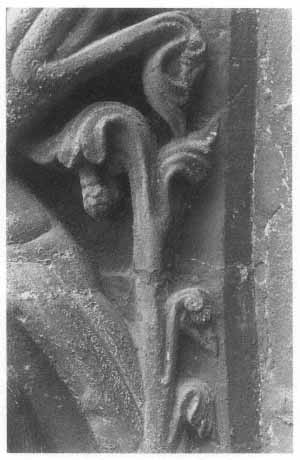
Fig. 35.
Detail, Tree of Jesse showing typical simplification of
forms as vine crosses voussoir joints, fourth archivolt,
right, at junction of sixth and seventh voussoirs.
The lower portion of the figure of patriarch D (Plate VI) provides yet another well-preserved example of the quality and style of the Master of the Elders. Almost as well preserved as the flaring pleats along the hem, the deeply undercut foliage of the footrest typifies the intricacies of Dionysian variations on the basic palmette design (Fig. 34). Viewed in the aggregate, the consoles show considerable variation in scale and boldness of the foliate designs. Both in the scale of the leaves and the degree of projection, the consoles of patriarchs D and W (Plate IXa) rank with the bolder arrangements.
The visual prominence and scale of the foliage is usually repeated on the opposite side of the portal in the footrest of the patriarch occupying the equivalent location. That balance contributes to the sense of order in the overall composition. The distribution of musical instruments also reveals the artist's same concern with the composition—a concern shared by the other artists at Saint-Denis. Eight of the twelve pairs of elders occupying parallel locations on opposite sides of the portal carry identical instruments (Plate I). The order underlying the schema shows a subtle alternation of those pairs, with additional
variations in the placement of the instruments. Reflecting a preference for balance without absolute symmetry, that order, intuitively understood by the viewer, is best revealed in a diagram.[13]
Other subtle variations in the arrangement of the elders implement the artist's conception not only of order, but also of rhythm. Even the disturbing visual effect of the assorted headdresses invented by the restorer does not destroy the deliberate variations in the scale of the figures within an archivolt—again variations with equivalents on the opposite side of the portal. The rhythmic patterns depend not only on scale and on the numerical progression of figures represented in the second, third, and fourth archivolts, but also on variations in poses and in richness of surface designs.[14]
With the exception of the Deity in the keystone of the third archivolt, every archivolt figure occupies two or more voussoirs. Three of the patriarchs spread across as many as six stones. Despite the difficulties that several stones per figure present to the sculptor in the workshop, careful examination produced no evidence suggesting that the voussoirs were carved in situ—a procedure that would have been contrary to customary practice. Evidence accumulated during the examination of the jambs and embrasures tends to confirm that carving was done in the workshop. The masonry system, the type of stone used, and numerous structural discrepancies discussed earlier indicated that the decoration below the level of the archivolts was carved in the workshop and then assembled and inserted into the masonry of the facade.[15] Above the level of the jambs, the scant evidence available also points to the final assemblage and insertion of completed sculpture with, at most, only minor adjustments made in situ to accommodate the carving on either side of a joint. For instance, the overall view of the archivolts shows masonry joints directly above and below each patriarch (Plate I). The divisions between figures and groups of figures appear to have been designed both to facilitate carving in units and to minimize problems in final assemblage. Contrived so that only stems and trunks meet at the joining of two voussoirs, the vines of the fourth archivolt have no delicately carved and undercut foliate forms overlapping the masonry joints. On the right the junction of the outer vine, where the sixth and seventh voussoirs abut, provides a revealing example of how easily the forms could be merged at a joint (Fig. 35). The trunk of the vine of the sixth archivolt fused readily with the fully
articulated stem in the seventh. The minimal need for accommodation of the lower portion to the upper one at the masonry joint simplified the task of the sculptor during installation, when he had to work from scaffolding.
Another detail suggests that the two large tympanum stones were not in place at the time they were carved. The design of the foliate molding framing the hemicycle varies somewhat in the upper and lower stones (Plates IIc–d, IIIa, and IVa). The two versions of the continuous, vertically organized palmette frieze probably reflect, as already proposed, that one hand was responsible for the zone containing the seated Apostles and another for the tympanum angels of the upper stone. In effect, the two foliate designs prove so harmonious that the differences, like those of the figure styles, do not startle the viewer but emerge only on close examination.
A third hand also worked on the sculpture of the tympanum. The figure of Christ, which spreads across both the upper and lower stones, seems closely affiliated stylistically with the figures of the Master of the Elders. Although the differences in scale complicate comparisons, the attitudes of the artist and the ideas expressed in the figure of Christ have the greatest consonance with the figures of patriarchs K and T (Fig. 32 and Plates I and VIIa). As noted earlier, the concentric V -shaped folds between their knees provide remarkably close comparisons. In general, their draperies reveal the same preoccupation with surface pattern in all three figures, and pronounced modeling invigorates comparable series of highly stylized conventions that combine to create the overall drapery designs. The hand of the Master of the Elders seems equally apparent in the deep undercutting of the hem, in the large scale of the prominent feet, and in the crisp and fully undercut edges of the mantle and of its overlapped cascades as well as in the splayed inner edges of the symmetrical underfolds. Although seriously affected by the fracture cutting diagonally across the left side of the figure, the arrangement of drapery over Christ's left leg develops into a swirl typical of this master. Both in form and in the handling, it is comparable with the drapery across and beside the left leg of patriarch T. The careful articulation of the skeletal structure of Christ's torso seems an extension of the artistry and precision with which the Master of the Elders rendered the bony, elongated hands of the patriarchs. The torso of Christ contrasts with the softer forms of the bodies in the Resurrection frieze and inner archivolts—the work of the Master of the Tympanum Angels, who emphasized the musculature of the
torso rather than its bone structure. Before the nineteenth-century recutting under the right armpit and along the ribs—a repair that deprived the upper portion of Christ's body of the original, substantial volume—the proportions of the figure would have approximated those of the seated figures of the patriarchs. Christ's proportions contrast sharply not only with the stumpy figure of Abraham, the only seated figure associated with the Angel Master, but also with the generally short-waisted figures of the seated Apostles. The same volume noted in the analysis of the figure of patriarch A also exists beneath the active surface patterns of Christ's drapery.[16]