
2—
Existing Elements Are Enhanced or Transformed in Positive Ways
This principle is manifested in two ways, in buildings and in people's behavior. In the case of the Grand Avenue, the Plankinton Arcade, which had withered in both its role and its physical condition, was refurbished and given a new life as the centerpiece of the Grand Avenue development. Previously remote from the action of Wisconsin Avenue, the arcade is now the skylit crossroads of the complex. Behavioral patterns have changed, too. Downtown in Milwaukee traditionally had meant retailing, but the range of retail activity had declined with the appearance of suburban shopping centers. In less than two years following the development of the Grand Avenue, downtown was once again the prime center in the Milwaukee retail market.
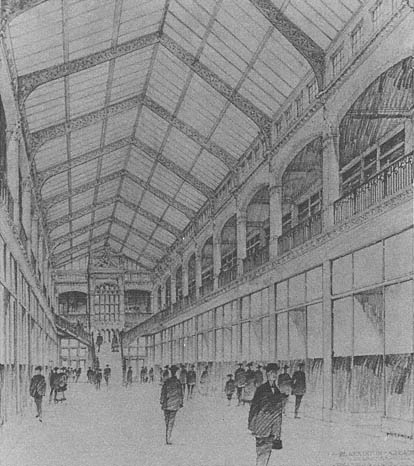
37.
Original design drawing for the long interior space of the Plankinton Arcade.
Holabird and Roche, architects, 1916.
Restoration and preservation need no justification; their utility and economic sense are proven. It is instructive, however, to identify the range of attitudes that characterized even this one revitalization project.
Restoration
The Plankinton Arcade had an architectural character and a physical organization that suited the concept for the Grand Avenue; in fact, with its interior circulation spine, it established the pattern for the whole complex. The arcade had been unsympathetically modified; it needed only to be restored.
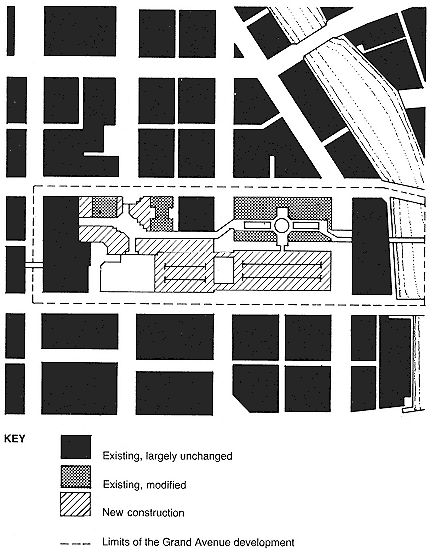
38.
New construction respects and incorporates existing buildings.
Modification
Buildings in the block west of the Plankinton Arcade had a conventional orientation to the street and turned their backs to the service alley to the rear. Here the task was to give these buildings a dual orientation without compromising their architectural character or functional utility. The Woolworth Building required the most extensive changes. The two existing department stores needed only to add interior aisles to connect with the skywalks.
It would be misleading to suggest that nothing is destroyed in a catalytic process. At the Grand Avenue, the old (but unexceptional) Plankinton Hotel had to make way for a needed parking structure. Other, minor, commercial and office structures were also destroyed. But landmark buildings like Gimbels (now Marshall Field), the Plankinton Arcade, and Boston Store remained. The commercial flavor of Wisconsin Avenue was retained. The key to enhancing and transforming rather than destroying the context is to formulate a plan that retains and improves places characterized by good architectural and urban design; often such a plan requires a patchwork approach to development, one that incorporates existing buildings instead of cleaning the urban slate.
Sometimes social costs are associated with large developments like the Grand Avenue, but this was not the case in Milwaukee, since there was little housing in the area being developed. And, if anything, the improvements seem to have created jobs.