
3—
Monumental Culture
See the power of national emblems.
—Ralph Waldo Emerson, "The Poet"
Stranded Citizens
Seized with an often monomaniacal desire to move faster and eclipse old transportation records and thus make history, steamship captains taxed their boilers to the point of devastating explosions. The people transported to the afterlife were certainly lamented by relatives and neighbors, but within the design of an expanding and progressing America, these individuals mattered little. Blessed with a cultural capacity to absorb calamities within a grand historical context, Americans did not severely bemoan the loss of individual life that accompanied national progress. In an 1852 editor's column introduced as "Victims of Progress," Harper's confidently forgot human tragedy by sacrificing citizens to a narrative of an advancing, industrial American civilization. Within an equally optimistic and federal vision, individual casualties of transportation disasters found resurrection as "martyrs of an ever-advancing, never-finished civilization,—they die that steamboats may be better built, that railroads may be better laid, that the speed of traveling, by land and sea, may be accelerated in a ratio which never becomes constant, and toward a maximum which is never to be attained." Barely a generation old, the nation, unlike its individual citizens, would endure, according to the filiopietism of the day, because of its own structural innocence, which ratified the outlook celebrated by Harper's , allowing for the pursuit of commercial and colonial expansion while thus appropriating even its graver consequences for those ends. An episode in William Wells Brown's Clotel portrays the nation's casual disregard for human life when measured against the grand spectacle of a steamboat race on the Mississippi. Amid the "wildest excitement" a boiler blows, causing "shrieks, groans, and cries" to fill the vessel. The dead and injured, however, do not weigh upon the collective
conscience of the crew; they are "put on shore," and the steamboat is "soon again on its way."[1]
Brown christens these two steamships with resonant names from the arsenal of American mythic history—the Patriot and the Columbia . His critical representation thus encompasses more than the reckless character of slaveholding society. By naming the two vessels Patriot and Columbia , Brown suggests that what encourages an indifferent and even careless regard for passengers, citizens, and chattel is a myopic world view that depends upon uncritical configurations of the past. From boldly affirming representations of history, Americans are propelled not only to competitive achievements and national zeal, but also to amnesia. Within symbolic designations such as Patriot , individual victims and local considerations do not slow the course of American history.[2] This sketch from Clotel outlines the construction of national history in the post-Revolutionary period—powered by symbolic affiliations with the founding past, national narratives forged onward like Brown's steamships, committed to a course of remembering that often forgot individuals whose aberrant bodies and memories lay outside of national ends.
Americans proved themselves a fortunate people when they were able to intellectualize steamship sinkings as violent upheavals of history's progression. In the context of such technological disasters, the editor of Harper's asked:
For what, after all, are a few lives, or a few hundred, or even a few thousand lives to the great cause of human advance! What is the individual, or any number of individuals, to the improvement of the race? and what is any amount of present or passing pain, to the triumph of ideas?
Again—these sufferers by fire and flood, and steam furnish the occasion of advancing our knowledge of the physical laws—and there is much consolation surely in this.... At the cheap price of a hundred lives, we purchase the most useful knowledge that the elasticity, or expansive power of steam may exceed the cohesion of ill-wrought iron.
Sacrifice of the individual citizen to the indomitable, steam-driven advance of epistemological, technological, economic, or political progress was a common story: aboard the Pequod , the mad captain rejects Starbuck's prudence, disregarding ominous warnings that
would have been apparent to any Puritan, to pursue the metaphysical mystery of a white whale; valuing a whale more than the market value of Pip, Stubb abandons the cabin boy upon the face of the waters; Ishmael loses himself while gazing into the furnaces of the industrial tryworks; and Queequeg, Tashtego, and Daggoo give up their lives to the possession of that political sorcerer, Ahab. As twin stories of technology and political rhetoric, Moby-Dick diagnoses a culture's monomania that had small regard for its individual crew members. Ahab's pursuit of the "unwonted magnitude" of the white whale replays the millennial fervor of mid-nineteenth-century America that carried forth the national mission into imperialism, dizzying industrial development, and expanding commerce.[3]
Queequeg, the passengers aboard the Patriot , the scarcely lamented crews in Harper's , all are abandoned and forgotten, not so much by the narrative of technology, which makes humans incidental, but by narratives of American history that obscured its citizens. In the first half of the nineteenth century, as America self-consciously articulated a national history, impressive artifacts of culture sprang up in painting, literature, architecture, and biography. The panoramas of the Hudson River School, the nativist mission of the Young America movement in literature, the memorial towers at Washington D.C., Baltimore, and Bunker Hill, all imagined a particularly American greatness of civilization and national unity. These expressions combined to form a national attitude of monumentalism whose very grandeur hailed America as an exceptional nation no longer dependent upon European civilization. Arising from the mighty cataracts, endless forests, and limitless vistas of a great continent destined to become the province of all Americans, the monumental stature of America was a peculiarly "natural" cultural concept. But while a monumental identity may have been a way to define all Americans at once, it posed serious consequences for individual citizens, whose desires to remember and exercise civic being have taken diverse and heterogeneous forms.
While the nation had real geographic borders and actual custom houses to police those borders, fictional constructs mobilized the idea of a nation that collects and regulates many different bodies, each with different memories. Lauren Berlant sees this array of fictional constructs as a "national fantasy" that organizes a mass identity.[4] In The Anatomy of National Fantasy , she argues that the vehicles of the "Na-
tional Symbolic"—images, narratives, icons, and monuments—pervade the capillaries of the social body, transplanting and absorbing the local into the official site of national identity. Following Berlant, who derives the National Symbolic from the prototypical symbol in American literature, the scarlet A that Hester Prynne wears on her chest, I want to situate that examination of nationalism within popular culture as a monumental narrative disseminated across a range of expressive sites in the antebellum United States, including painting, architecture, oratory, and fiction. Monumentalism stands forth as a particular historical mode of articulating national culture, and this specificity enables an understanding of how these varied discourses intersected with the elaboration of the nation. Most importantly, monumentalism underscores the interstices between the fabrication of historical consciousness and civic being. From monere , meaning not simply "to remind" but also "to instruct" and "to say with authority," monumentalism suggests that remembering prompts more than independent musings on the past; rather, monumentalism narrates a history exercised with power over citizens. It is indeed power that shapes the history that defines people as citizens and collects them in the construct of a nation.
As a critical term, monumentalism functions with both descriptive and theoretical import, corresponding to an ability to act literally as well as figuratively. On one level, as an analysis of the material expressions of culture, monumentalism describes how similar narratives underlie different forms, from landscape painting, to the patriotic monument, to Transcendentalist manifestos. A painting of Niagara Falls or an essay by Ralph Waldo Emerson each produces within the viewing or reading subject an attitude of awe and reverence. Frederic Edwin Church's Niagara (1857), in an effort to reproduce the experience of the sublime, places the subject as a viewer at the brink of the cataract, which is also the edge of the canvas. The painting does not reinforce the subject's position as exterior to the painting, but instead, drawn from the position of the viewer, and poising the viewer at a commanding yet terrifying overlook, Niagara situates the viewer within the sublime landscape (Figure 2). In the same fashion, Emerson's Nature encourages the reader to enter the environment of nature, which, like the text of Nature , "stretcheth out her arms to embrace man, only let his thoughts be of equal greatness." This sympathy for nature, however, is more than a passage into an
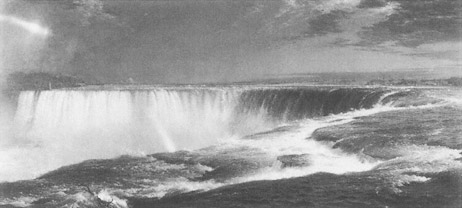
Fig. 2.
Frederic Edwin Church, Niagara, 1857, oil on canvas, 42 1/2 × 90
1/2 in (107.95 × 229.87 cm.). In the Collection of the Corcoran Gallery of Art,
Museum Purchase, Gallery Fund.
unmarked wilderness; Emerson's Nature and Church's sublime are political enclosures. At this other level, monumentalism indicates a discursive formation connected to nationalism. The Bunker Hill Monument observes the same aesthetic principles as an American landscape painter's or Emerson's representation of the sublime, and yet, as a nationalist expression, it narrativizes a political experience in which the citizen-subject undergoes incorporation, not into a natural scene, but into the national body.[5] Monumentalism refers not simply to various cultural artifacts of grand theme or dimension; it also delineates how the narratives encoded within these artifacts, whether literary text or architectural column, access the authority of monere to instruct people to enter the nation as citizens.
As a narrative form connected to the reminding of monere , monumentalism necessarily operates within the realm of history. Nietzsche's "On the Uses and Disadvantages of History for Life" underscores the connections between monumentalism and nationalism by asserting that without a "monumental history," national consciousness remains inert. He identifies the monumental mode as the historical sense best suited for action. Within monumental history resides the "great stimuli " of "mythical fiction" that can be unleashed to rally people around an exemplary figure who directs them toward a single purpose. Strength and potential inhere in the monumental
because as a construction of history it discards the restrictive particularities of the past so that the hero remembered will seem universal. As Nietzsche writes, if monumental history is "to produce that mighty effect, how violently what is individual in it would have to be forced into a universal mould and all its sharp corners and hard outlines broken up in the interest of conformity." So powerful are the discursive regularities emerging from monumentalism that historical representation sacrifices the memories and experiences that would impede articulation of a homogeneous narrative. Details, which have an unavoidably local character, must be transcended and forgotten for monumentalism to make its broad, unifying appeal. Calling monumental history "fiction," Nietzsche implicitly acknowledges its discursive nature, which privileges power over a regard for "absolute veracity." Much as Ishmael's experiments in "Cetology" communicate that truth is not the concern of authorized discourses such as ethnology, Nietzsche's excavations of the monumental reveal that "approximations and generalities" are the disciplinary imperatives of nationalist historiography. Like any constructed story, monumental history alters "facts" as it forgets others; monumental history thus necessarily contains a thorough dosage of the "unhistorical," which Nietzsche understands as vital to any action. Constant and faithful remembrance stifles life, paralyzing humans with tired precedents and stultifying anxieties that the present will never bear any action that measures up to the examples of the past. Forgetfulness, in contrast, frees humans from a dependence on sluggish rumination so that they can live, act, and create: "Forgetfulness," writes Nietzsche, "is essential to action of any kind." National history, as a source of "great stimuli " that animate citizens to unite and act together, involves a remembering of the past that forsakes strict accounting and casts off an obedience to factual accuracy. Once committed to remembering unhistorically, a people can forge heroes, icons, and myths that narrativize stories of a nation. "No painter will paint his picture, no general achieve his victory, no people attain its freedom without first having desired and striven for it in an unhistorical condition," asserts Nietzsche.[6]
Urging the completion of the Bunker Hill Monument (Figure 3), Edward Everett reached similar conclusions—though he certainly lacked Nietzsche's critical irony—when he described the interrelation of monumental history and national identity: "The American who
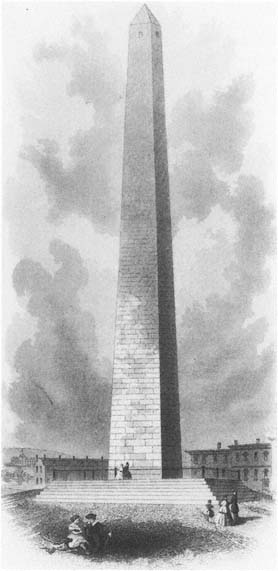
Fig. 3.
The Bunker Hill Monument, "a fit type of
the national unity."
could look on it [the monument] with indifference, does not deserve the name of American." Instructing citizens in lessons of patriotic history, the monument was to act as a democratic narrator, disseminating the same story to all. From seemingly innate memories, a narrative was to emerge in which individuals would gather as Americans. Identity would not emanate from autobiography, but rather from a vague, self-justifying experience in which people, if they were Americans, would act and remember as Americans. In fact, the very structure of "the Bunker Hill Monument is a fit type of the national unity," emblematic of the virtues of incorporation: "Built in the form of a monolithic structure, but of such large proportions, and of such unique interior arrangement, as to compel the use of many separate blocks, it aptly illustrates, in its grandeur as a single object, and in the beautiful adaptation and harmony of its several parts, the national motto, 'E pluribus unum .' " As an architectural structure the monument may be rooted on a patch of ground, but as a narrative invested with aesthetic codes of homogeneity, the monument casts off local geography, becoming authoritative and abstract. When Webster characterized the completed monument as a "plain shaft ... that bears no inscriptions," he did not construe its specific textual paucity as a failure; instead, this blankness pointed to narratival plenitude, to encompassing meanings that did not recognize any non-national stories that would stand in the way of political universality. Although this monumental narrative is undoubtedly fixed in history, recalling the specific site where in 1775 American patriots fell in defense of political rights, the national identity that it gave the citizen was prone to forgetfulness and civic disinterest. Monumental history can supplant human action, dwarfing the crowd that gathers at its base. Alongside the great potentiality of monumentalism, Nietzsche notes the dangers of a swaggering history that can master those who erect and narrate it. Daniel Kemmis reframes this concern by identifying the growth of American nationalism as "the story of the eclipse of republicanism." History may have served as the foundation of nationalism, but within the course of empire, critical preservation of the past and responsible civic participation became castaways in the wake of cultural expressions and historical representations that were too grand to include the concerns or plight of the citizens they alienated. Monumentalism stands as an ambivalent force: it provides impetus for national unity and independence even as it poses dangers
of disempowerment and political estrangement. The purpose of this chapter is to assess the oscillation of a citizenry united in a sublime, unified consciousness and a citizenry transformed, as Nietzsche puts it, into a "dancing mob" obsessed with a "half-understood monument to some great era of the past."[7]
The "Natural" Origins of the Culture of Monumentalism
American monumentalism was exceptional from the start. Although other nations had erected colossal structures and had stretched across vast regions, America imagined itself to possess a natural innocence that distinguished its monuments from the swaggering productions of the Old World. The claim that American culture lacked antecedents bolstered the conception of antebellum politics, art, and literature as wholly original and American, capable of arising only from this nation. Who could equate the Bunker Hill Monument with the Pyramids, orators asked, if ancient Egypt lacked democratic forms of government? Nor did the Tower of Babel compare, for God had deemed that structure sinful and shattered that culture's prideful pretensions to unity. Though engaged in a similar project, antebellum America did not fear its grandiose expressions of unity would incur divine wrath. Whereas human arrogance built the Tower of Babel, nature cultivated American monumentalism. The vastness of the continent, its natural wonders, the richness of its resources, all bespoke a New World that dwarfed the tiny countries across the Atlantic. In Notes on the State of Virginia , Thomas Jefferson concluded that the ever expanding dominions of America provided ample likelihood for the existence of yet undiscovered mammoths that belittled diminutive European species. When Rembrandt Peale, best known for his portraits immortalizing George Washington, unearthed a mammoth skeleton, he seemed to have found an antediluvian record of America's destined monumental stature. The discovery of fossil traces convinced Jefferson that "the largest of all terrestrial beings" still roamed the aboriginal and unexplored territories of the western United States. Mammoths would be only a fitting complement to the already awesome topography of the New World that Jefferson found expressed by Virginia's Natural Bridge, "the most sublime of nature's works."[8]
Artists of the nativist Hudson River School painted "the most sublime" landscapes, where endless vistas lay just beyond towering mountain peaks. The works of Frederic Edwin Church, Jasper F. Cropsey, Asher B. Durand, and Thomas Cole depict an immensity of space out of which natural monuments arise. Certainly, European civilization had reared imposing cathedrals and castles, but such man-made expressions appeared as swaggering idols when placed next to the native innocence of American landscape. "You see no ruined tower to tell of outrage—no gorgeous temple to speak of ostentation; but freedom's offspring—peace, security, and happiness, dwell there, the spirits of the scene," wrote Thomas Cole in his "Essay on American Scenery" (1836). The pristine quality of the monumental produced a sense of nature that seemed innately American, unavailable to decaying countries of the Old World. Even the name, Hudson River School, fastened cultural expression to a particular non-European landscape, regardless of any similarities between American canvases and those from English artists such as J. W. M. Turner. Church "was immune to European influences, so at least it was believed," observes one critic. These nationalist associations coalesced into a tautological cultural logic: because the lakes of New Hampshire possess a character that, for Cole, was "truly and peculiarly American," they were sublime; and, because natural monuments preserved a homogeneous purity even within their grandeur, they deserved to be American. And because they were American, representations of nature transcended European creations; comparing the heavens of Italy and America, Cole declared: "For variety and magnificence American skies are unsurpassed."[9] Nationalism effects a series of metonomies in which an exceptional natural landscape substituted for America, an ideological configuration that was already heralded as transcendent. The sublime attributes of an undefiled cultural history were readily transferable to the "magnificence" of the natural world. The self-enclosed structure of this tautology, built entirely of domestic experiences, ratified American nationalism by making it the culmination of native, independent resources. Democracy, like Niagara or the Natural Bridge, was seemingly organic to the scene. No foreign influence, so liable to tarnish the view, was required.
Jasper Cropsey's canvases gather clouds and the rising mist from cascading waterfalls to suggest the terrible and forceful beauty—
terriblità —of an American nature capable of pulverizing matter into air. His Niagara (1856), in which spray rises above crushed rocks, stands among many views of the falls that, along with scenes of Virginia's Natural Bridge, were popular among antebellum patrons and critics. Both as tourist site and visual representation, Niagara Falls rushed forth as the single most consumed image in nineteenth-century America. Not uncoincidentally, only portraits of George Washington rivaled the popularity of Niagara's representations. That a single natural icon acquired this preeminence was instrumental to the imagining of a nation. The icon transmitted a vital lesson that stemmed from its dialectical properties of geographic uniqueness and democratic familiarity—unity. For a scattered people in a diverse territory, Niagara offered a common point of reference, a shared narrative of the nation as innocent, onrushing, inexhaustible. The metonymic structure of nationalism that substitutes and interchanges America, the sublime, and homogeneous purity encourages this lesson of federal unity, coordinating diverse aesthetic, political, and spiritual experiences around a single ideological axis. Paintings, lithographs, and tourist memories of such scenes amounted to an iconic currency in which the incredible volume of water flowing at the nation's border gave shape to a New World revealed after the Flood. The circulation and repetition of images permitted a distant mecca like Niagara to transcend the limitations of time, place, and context. What once seemed only a feature of upstate New York entered the contours of the nation. The particular environment became an icon whose lack of context and homogeneity enabled citizens to envision, in Benedict Anderson's terms, an "imagined community." Reproduced in visual representations and visited as part of what John Sears calls "one of the primary rituals of democratic life," Niagara conveyed a narrative of fecundity and power to a wide range of consumers and citizens, despite differences in class, background, or location. A Boston preacher in 1860 could thus exhort his congregation: "look at Niagara. What does it represent? Does it not resemble our country,—our vast immeasurable, unconquerable, inexplicable country?"; he knew that his listeners had of course seen paintings of the falls, had received the lithograph of Church's Niagara , then a fashionable wedding present, or had traveled there on a northern tour. He asked his countrymen to participate in a collective imagining that was in effect a journey from the specific to the federal, from nature to nation.[10]
Abraham Lincoln mused that the cataract's monumental stature and everlasting innocence made it an appropriate national beacon:
Niagara-Falls! By what mysterious power is it that millions and millions, are drawn from all parts of the world, to gaze upon Niagara Falls? ... When Columbus first sought this continent ... nay, even, when Adam first came from the hand of his Maker—then as now, Niagara was roaring here. The eyes of that species of extinct giants, whose bones fill the mounds of America, have gazed on Niagara, as ours do now. Cotemporary with the whole race of men, and older than the first man, Niagara is strong, and fresh today as ten thousand years ago. The Mammoth and Mastodon—now so long dead, that fragments of their monstrous bones, alone testify, that they ever lived, have gazed on Niagara.[11]
Thinking of the falls and how they evoke "the indefinite past," Lincoln experiences the sublime primarily as a temporal wonder that commemorates human action even as it belittles the human historical record, exposing its inconsequential tenure and subordinate status. For American landscape painters, the sublime unveiled itself in the spatial dimensions of consciousness. In fact, for his painting, Church rejected traditional proportions, finding it necessary to enlarge the width in order to encompass the horizon of this national icon of Manifest Destiny. At the margins of Church's Romantic image of cosmic unity, human presence intrudes, only to be dwarfed by the incessant magnitude of the waters (see Figure 2). Lying prophetically within the arc of the rainbow of Niagara stands the United States border, with Terrapin Tower presiding over the scene. Only by using binoculars, as David Hunington notes, can the viewer who thus becomes the tourist at the falls glimpse the human figure on the tower's balcony. Diminutive figures also appear in Cole's Niagara Falls (1830), though with enough specificity to reveal they are Native Americans. One critic suggests that the Native Americans act as "surrogates" for the white viewer, but a more sinister economy is at work: their tragic and trivial aloneness—a convenient coincidence of Romantic aestheticism and Manifest Destiny—also presages their eventual and forced disappearance.[12] In each formulation, human subjects have a precarious toehold in representation: for Lincoln, human history is little more than a few seconds of natural history; for Cole and Church, the distinct triumph of New World grandeur
remains connected to the marginal stature or inevitable effacement of individuals.
The object lesson of the preacher who asked his worshipers to "look at Niagara" was not to propel an examination of conscience; rather, the intent of the comparison was to acquaint people with an entity so large they could barely conceive it—not God, but a divine nation. In similar fashion, if Church's painting aimed to stir the individual's soul with the sublime, the quintessence of that experience was national. In The Vagabond (1859), Adam Badeau looked at Church's Niagara and recorded that its transcendent qualities emerged from its political representation of natural phenomena: "If it is inspired by Niagara, it is grand and sublime; it is natural to the nation.... it is a true development of the American mind; the result of democracy, of individuality, of the expansion of each, of the liberty allowed to all." Factoring the individual into an overarching unity is the goal of the sublime experience, whether emotional or political. Cole intended the depiction of a beautifully threatening environment to bow the viewer down before the colossal unity of nature: "In the terrible and the grand ... when the mind is astonished, the eye does not dwell upon the minute but seizes the whole. In the forest, during an hour of tempest, it is not the bough playing in the wind, but the whole mass stooping to the blast that absorbs the attention: the detail, however fine, is comparatively unobserved." Showing human figures shrouded by a looming torrent of water and represented by little more than a touch of paint, artists of Niagara Falls sketched how the terriblità of national landscape was supposed to force citizens to ponder their own insignificance and abstract themselves from restrictive localities in the experience of the sublime. Aesthetic experience encoded the lessons and imperatives of rearing a nation-state.[13]
Elevated above the affairs of humans, the natural world was to impel the imagination toward a pure spirituality of the infinite. Overshadowed by natural immensity, the spectator experiencing the sublime at first senses his or her own ephemeral insignificance and then rises to a contemplation of divinity and creation. Unlike the haughty human project of the Tower of Babel, American monumentalism was properly reverential. "You involuntarily fall on your hands and feet, creep to the parapet, and peep over it," wrote Jefferson of the spectator's experience atop the Natural Bridge.[14] The dynamic of the sublime seems paradoxical: at one moment, its awe-
some magnificence reduces human beings to the posture described by Jefferson, and at the next, such transcendental power uplifts the meditative subject to the heights of Emerson's "transparent eyeball." Yet this apparent contradiction between degradation and transcendence actually inspires a harmonious metaphysics. Only by sensing one's insignificant relation to the rest of the universe can a human properly begin to conceive of a transcendental unity; only by understanding his or her position in the earthly world of nature and society could the nineteenth-century American, in Emerson's words, be "uplifted into infinite space" and shot through with "the currents of Universal Being" (Nature , 10).
Preachers and poets like Emerson, William Cullen Bryant, or even Henry David Thoreau helped popularize the sublime, suggesting that the realm of transcendence was egalitarian, equally the province of the farmer and the philosopher. Paintings and illustrations from the Hudson River School testify that art and literature attended the same classroom of nature. Thomas Cole painted scenes of steep crags and unearthly mists dwarfing savages and swooning women to accompany Cooper's The Last of the Mohicans . Cooper's Leatherstocking tales likewise draw detailed, painterly descriptions of the natural world, constructing a backdrop against which characters sense the interplay of their own insignificance and divine infinitude. Humans wait upon the landscape, offering their small stature as a measure of the grandeur of nature. The details in Cooper's novels function in the same manner as do the tiny, human particulars of nature in paintings of Niagara; as Cole said, the "minutest parts" are "subordinate and administrative" to the sublime. Durand's Thanatopsis commemorates William Cullen Bryant's famous paean by the same title, and his Kindred Spirits (1849) places Cole and Bryant in humble contemplation of a spectacular gorge and the airy horizon beyond it. Holding a short staff, the persona of Cole in the painting gestures toward the extending horizon, leading the viewer beyond an eventually insignificant foreground to the hazy distance. While the trees and gorge in Kindred Spirits envelop and embrace painter and poet, the background horizon and distant mountains claim the viewer's eye and subtly dominate the scene. If the fleeting horizon encourages contemplation of infinitude, then this aesthetic "truth" of Romantic harmony also supplies a national lesson: the eye searching after the painting's horizon enacts the imperatives of an expansionist
discourse in which westward progress toward the setting sun and thoughts of greater unities outstrip the particularities of private, rooted localities.[15]
In its imaginative expanse, the sublimity of nature evolved into the sublimity of the nation. In The Pioneers , Natty Bumppo's lamentations over the destruction of game and forests describe how American monumentalism was only ephemerally located in nature. Monumentalism that once found a home in the imaginative conception of the natural sublime, in the resilient optimism of an American like Jefferson, who insisted that great mammoths must be out there somewhere, was developed and refined by a nation embarking upon the course of empire within its own borders. The change in addressee of Melville's prefaces from Pierre , dedicated to "the majestic mountain, Greylock," to Israel Potter , in which the Bunker Hill Monument dominates the textual landscape, charts the translation of the American sublime from the natural to the national. Not more than three years elapsed between these prefaces, and yet the change in referent from mountain to fabricated structure registers a significant evolution in the sublime. The nation's political legacies, not just its landscape and natural phenomena, were taken to originate as transcendent entities, innocent, pristine, and seamless. To be sure, within reproductions of Niagara, the panoramic landscape is not natural but a cultural representation of nature; however, with the articulation and expansion of American nationalism, the sublime ceased to take nature as its referent. To identify this desire for political transcendence is not to say that aesthetic representation in landscape painting does not relay a political code—indeed, the manner in which details give way to a whole synthetic representation of nature no doubt reenacts the imperatives of federalism and unity central to an incipient nation-state.[16] Instead, American culture, its institutions and historical narratives, became sublime. Cropsey's Niagara may have performed a political function and conveyed the nation's power and grandeur, but under this new configuration I am describing, the political realm itself becomes sublime. More specifically, the political history of the Revolutionary past is inscribed within the monumental mode as a magnificent narrative of homogeneity and unity. Memory becomes national.
The search for narratives of American national culture first began among literary nationalists. Sounding a call for literature to match the
divine destiny of America and challenging the country's authors to facilitate the transition of the monumental from nature to culture, the United States Magazine and Democratic Review asked of American writers in 1859:
When will they be inspired by the magnificent scenery of our own world, imbibe the fresh enthusiasm of a new heaven and a new earth, and soar upon the expanded wings of truth and liberty? Is not nature as original—her truths as captivating—her aspects as various, as lovely, as grand—her Promethean fire as glowing in this, our Western hemisphere, as in that of the East? ... Why, then do our authors aim at no higher degree of merit, than a successful imitation of English writers of celebrity?
The emphasis this editorial places on literature as a central component of Manifest Destiny underscores the interconnections between nationalism and literature. The storied expanse of the American novel proffered a discursive territory where the nation could be imagined. Moby-Dick , for instance, brings together the "staid, steadfast" Starbuck as the exemplar of New England morality, the "easy, and careless" Stubb as the archetype of the jaunty Westerner, and the hot-blooded and "hereditarily" minded Flask as the Southerner always ready to fight a duel to defend a "point of honor." The Spy likewise spins a unifying tale in its final visions of Southerner and Northerner as kin who surmount differences in geography and ideology to battle the British. The novel, as Benedict Anderson contends, thus served the needs of protonationalism by allowing authors, readers, and citizens to imagine themselves as part of a single community in which the mortar of synchronicity and homogeneity is fictive.[17]
During the years called the American Renaissance, the national component of literature was by no means an unconscious drive or a latent ideology. Instead, the call for a literature to administer to the idea of the nation developed as a manifest duty for writers. A "native literature is essential to national patriotism—to the independence of the national mind," wrote Southern novelist William Gilmore Simms. Eminent literati complained of America's embarrassing indebtedness to European culture and urged literature to keep pace with the independence of the nation's political institutions. "Americanness" marked artistic originality and acted as the criteria of literary merit that faulted Melville's Pierre for its "Frenchified mode."
Writers and editors styling themselves Young America mandated the production of a national literature whose thematics and tone would distinguish it as a faithful aesthetic expression of the vast continent. Such literary nationalism paralleled the production of books with titles like Behemoth: A Legend of the Mound-Builders and Big Abel and the Little Manhattan or the writing of an epic sea voyage across the watery expanses in search of a monstrous leviathan named Moby Dick. According to Perry Miller, Young America operated under the "thesis ... that we should automatically create a big literature because we were a big country." As an instrument of national culture, literature promised to surpass visual representations of the wilderness because it marked the refinement of a nation that had evolved beyond simply tapping metaphoric resources of the natural environment. Literature appeared as a more potent medium capable of transmitting biographies and legends that would make up a shared culture, capable of instilling a specifically American political morality and distinctness. Melville's review of Hawthorne captured this transition in its vision of an American literary genius in whose "deep and noble nature, you will hear the far roar of his Niagara." During his association with Young America, Melville prophesied the historicization of the sublime even as, in gestures of profound ambivalence, he doubted such national bravado and questioned if it was promise or threat to articulate national history as transcendent.[18]
The Historicization of the Sublime
Nationalism most consciously engineered monumentalism within the limitless domain of popular historical representation. Compared with the Old World, whose traditions and customs stretched across centuries, America seemed a blank historical slate. Yet this very blankness opened up a virgin domain of history for America. Like the lands beyond the Mississippi, the unwritten history of America was ripe for discovery, exploration, and development. Jefferson's mammoth had more than biological interest; as an inhabitant of the American landscape, the anticipated mammoth announced a natural history predating the most ancient artifacts of European culture. This corollary between nature and history, however, simultaneously registered America's discomfort with its own historical virginity. "Our
historical works are attempts, not achievements," confessed one critic of the American art scene, who then sought a more hopeful cultural vista: "But in landscapes the sky is brighter.... there is the inspiring theme."[19] And yet, the Edenic scenes produced by Durand or Church did little to allay this insecurity. No matter how monumental portraits of Niagara Falls may have seemed to the antebellum public, these scenes could never be properly monumental. The represented innocence of a garden wilderness shirked any sense of monere , of memory, reminding, restoring, and transmitting an instructive past to a younger generation. If anything, nineteenth-century landscape painting dedicated itself to advertising a memoryless tabula rasa, inviting the marks of settlement, inviting history, even as it forgot that the land had ever been populated by others. This incipient character of the national project marked America with an inexperience that, no matter how endearing, denoted a glaring lack of history necessary for foundations, continuity, and political ritual. To fill this void, filial America argued that it had lost its innocence in the trials of the Revolution.
The National Symbolic requires an official history; national culture can hardly be authoritative if it lacks the legitimation of the past. George Washington's death on the eve of the nineteenth-century provided one such source of legitimation, turning over a mythic ancestor to be embalmed by a collective imagination. Gilbert Stuart, the artist famous for his portraits of Washington taken from life, perceived the potential for profit when a culture saw him not simply as an artist, but as a living oracle of America's past. Working from "originals" he had painted of the deceased president, Stuart and his daughter turned out their Washingtons and found a market eager for artifacts of national history. Until America found a new martyr in Lincoln, Washington remained the supremely popular topic for oratory and iconography, and the anniversary of his birth never failed to gather speakers to discuss his exemplary character or his sacred understanding of national union. As a monumental icon, the founding father inspired sublime lessons of citizenship; speaking on the centennial of his birth, Daniel Webster proclaimed that the name of Washington secured the "unity of government which constitutes us one people ." All these gravediggers unearthed a mummified memory of Washington and made it part of a mythic culture. This translation and resurrection of Washington into "Washington," of lived body
into mythic corpus, of natural body into a reified text, represented the most sublime moment of historical monumentalism. Thus, urging the preservation of Washington's home, one orator noted how Mount Vernon far exceeded "the sublime cataract of Niagara" because it is not a natural site, but a topos rich in the historical material of national narrative. With history, America ascended from the natural to the national.[20]
As a mythic-historical figure who dominated antebellum imagination, Washington relocated the sublime on a national scale. The private matters of his life did not remain mere details, but as with Cole's "minutest parts," which served to reinforce the "whole mass" of nature's unity, trivial memories of the founding father extended beyond the particular to represent America as an encompassing union. In Kirkland's Memoirs of Washington , even as Washington administers the federal government, he pays attention to local affairs at Mount Vernon: "not a broken fence or dilapidated negro hut but was repaired under his direction." Within the biography of the national father, even the most irregular particulars—such as human bondage—could be subsumed under the project of union. The dynamics of the sublime lent symmetry and order to a culture that contained potentially jarring social and institutional practices. Washington's simultaneous management of the nation and his plantation repeated the overall harmony of landscape paintings of Niagara Falls: particular sprays of water and jagged rocks give way to a larger scheme of a natural wonder that seems divine. As Kirkland puts it to her young readers, Washington's mind was expansive, able to encompass "now the shadow of an eyelash, now the perspective of Niagara."[21] As the founding father was allied with the most prominent image of grandeur and spiritual order, he translated and extended these themes of power and hierarchy to the ideological continuity of the United States.
A genealogy attempting to date the transformation of the natural sublime into a monumental historical culture might pinpoint Washington as the great man who, by an array of symbolic actions, most notably his own death, ushered America into history. A mezzotint engraving entitled A Symbol of America (Figure 4) graphically represents the symbolic interplay among nature, Washington, and history. Published in 1800, just after Washington had lost his natural body to acquire a corpus, this engraving centers upon the allegorical
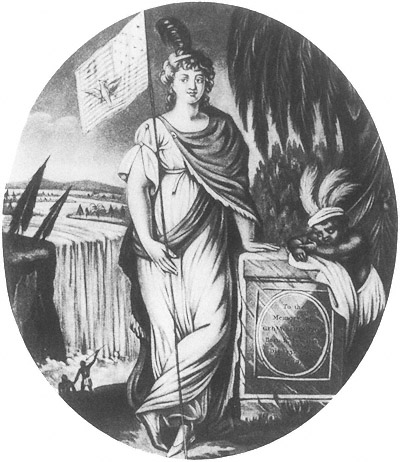
Fig. 4.
Anonymous British artist, A Symbol of America, 1800, mezzotint
engraving. Print Collection, Miriam and Ira D. Wallach Division of Art,
Prints, and Photographs, The New York Public Library, Astor, Lenox, and
Tilden Foundations.
representation of Columbia as a female figure holding the national banner. This figuration of America evokes the fertile nature of the continent via the ample body of a woman. Washington's tombstone lends support to her graceful attitude and gives rest to a crippled, despairing Native American. The posture of these figures, accented
by the downward slant of the branches, directing the spectator to the site of remembrance, makes Washington's absence the source of an extravagant historical symbolism. Inscribed with the bare facts of biography, the monument in the engraving reveals the national history that has "naturally" evolved from the savage state of the degraded original inhabitant to the confident and civilized demeanor of Columbia. Washington's iconographic presence, made possible only by the memory of his absence, provides a solid foundation for her emblematic being. Niagara Falls flows in the engraving's background as testimony that the inexhaustible splendor of the landscape is found in the historical legacy. Although Elizabeth McKinsey points to this image as "a moment when national and natural impulses came together," the authority of writing—"To the Memory of Geo. Washington"—makes this union a relation of power in which historical wonder overcomes natural splendor.[22] The engraving maps a predestined story of progression and development: the nation emerges from an aboriginal, ahistorical context to acquire the dominant stability of a monument to its patriarchal sire.
A discordant note enters this family romance of legendary father, mythic mother, and infant nation a year later, in 1801, when a variation of A Symbol of America replaces the humbled Native American with a dejected black slave. Yet within the economy of the sublime as national history, how disruptive is the presence of the slave? The slave serves the allegory of this engraving, America , updating the representation in the same way that the altered details of Columbia (rustic hair style, simple sandals, and a liberty cap instead of a diadem) more correctly identify the nation as an agrarian republic rather than a classical polity (Figure 5). The slave—to use Kirkland's formula—is "the shadow of the eyelash" whose reduced state contributes to the overall "perspective of Niagara;" or, using Cole's account of the sublime, the slave is "subordinate and administrative" to the larger national narrative the engraving imparts. Just as the speaker in "Self-Reliance" imagines himself dismissing the distraction of the "angry bigot [who] assumes this bountiful cause of Abolition, and comes to me with his last news from Barbadoes" in order that he can better love those at home, in an analogous move in America , the detail of the slave is subsumed by care shown to another community—the whole of the United States ("Self-Reliance," 262). Whereas Emerson prefers to pay attention to neighbors who fell

Fig. 5.
Anonymous British artist, America, 1801 mezzotint engraving.
McAlpin Collection, Miriam and Ira D. Wallach Division of
Art, Prints, and Photographs, The New York Public Library,
Astor, Lenox, and Tilden Foundations.
outside institutions, the allegory of America cherishes a country replete with institutions. The fact that America could accommodate this forlorn racial body testifies to the triumph of the ideological concordance of institutional practice, unique natural wonder, and the unique historical personage, Washington, represented by the urn and bas-relief. Union—as aesthetic principle and political imperative—dominates.[23]
Narrating a monumental history was at first analogous to painting a portrait glorifying America's landscape. But these engravings indicate that the natural sublime was not the final vision, but a conduit that invested icons with the power to narrate history. This transition from pristine wilderness to written memorial, from nature to culture, signified the triumph of an American project that created a historical imagination as potent as the natural forces it displaced. Whereas the Natural Bridge once humbled and then "elevated" Jefferson "up to heaven," now history served as the vehicle of transcendence. The foremost spokesman of monumental history, Emerson, outlines the dynamics that inform a new sublime historical sense revolving around participatory, temporal insights rather than geographic vistas: "all public facts are to be individualized, all private facts are to be generalized. Then at once History becomes fluid and true, and Biography deep and sublime," ("History," 246). Remembrance promises to elevate the citizen to the height of democratic vistas, where the subject becomes a "transparent eye-ball" and captures sight of the universal. Not only does the spirit of the citizen's fellows circulate through his or her body and being, but the mind domesticates time and renders its barriers meaningless; the individual's soul, according to Emerson, can worship across the centuries with the soul of Plato or Pindar. When in his 1825 address delivered at the laying of the cornerstone of the Bunker Hill Monument, Daniel Webster said "we are among the sepulchres of our fathers," he hoped the thousands of Americans gathered in front of him would disregard time and skip across the years to recover the storied viability of democratic origins.[24]
Having harnessed the forces of the sublime, democracy became a transcendental image. As an exalted political idea, however, antebellum democracy had more in common with Ahabian abstraction than Melville's "ruthless democracy." Its constituency could only be ideal: mid-nineteenth-century America attained an ascendant, self-
satisfying representation by dismissing enduring concerns over the political and social status of women, slaves, and those who held no property, all of whom were denied elective franchise, much in the same way that Emerson achieves self-reliance by shunning the "last news from Barbadoes." Still, a monumental culture assured of its own democratic principles demanded an illusion of vibrant civic participation, making history subjective, rather than making the individual subject to history. As Emerson understands the process: "The student is to read history actively and not passively; to esteem his own life the text, and books the commentary. All history becomes subjective; in other words there is properly no history, only biography" ("History," 239–40). In his schema, iconic symbols act as the nuts and bolts of monumental history, enabling the viewer to transcend his or her limited being as well as the material form of the symbol itself. Berlant notes the operation of a similar symbolic force in Hawthorne's representation of the American eagle outside the custom house as an icon that leads to the "transcendence of local history, narrative, and desire."[25] Governed by the metaphoric grammar of symbols, monumental history engenders the collective flowing together of citizens. The overwhelming crowds that gathered to inaugurate the Bunker Hill and Washington monuments dramatize the manner in which icons pervaded and shaped the culture's consciousness. Available to citizens of every class, symbols created an egalitarian outlook: as Emerson writes in "The Poet," "this universality of the symbolic language" caused "the distinctions which we make in events, and in affairs, of low and high, honest and base [to] disappear" (454). From the Greek symbollein , meaning "to throw together," symbols encouraged popular confluence around monumental historical icons—though, as we will see, that assemblage could bear alarming resemblance to Nietzsche's "dancing mob" that memorializes the forgetting of the past.
The symbol effects transcendence by rendering an event or person universally intelligible to the common mind through the stripping away of restrictive particulars—just as Ahab does in his demono-logical reification of the pagan harpooners. Historical events and people are subject to a similar Ahabian process of abstraction that prepares entry into national narrative. Harper's spelled out the criteria for determining what was qualified to be incorporated into the National Symbolic. For instance, to assess the symbolic resonance
of March 5, 1770, a citizen might ask: "What the masses were doing.... But even could this be ascertained it would not be history. On that day the three millions of our land were engaged in the various avocations connected with their ordinary life and ordinary interests." Hardly worth memorialization, the people are not the stuff of history. Instead, history resides solely in the national. Thus March 5, 1770 has significance because, as the date of the Boston Massacre, it "was thought by all, felt by all, and therefore became, for the time in which it was thought and felt, the one common history of all." In the same manner, for Washington to evolve as national symbol, for him to be represented as A Symbol of America , the restrictive peculiarities of his life had to be transformed and made "universally" significant. "Oh no! give us his private virtues ! In these , every youth is interested, because in these every youth may become a Washington," exclaims Parson Weems at the outset of his biography of the general, which then magnifies to epic proportion childhood peccadilloes such as chopping down a cherry tree.[26] Childhood transgression is elevated to the height of a national myth. Antebellum historiography defies distinctions between public and private to posit a universal memory of the past common to all citizens; as Emerson's first sentence in "History" asserts: "There is one mind common to all individual men" ("History," 237).
Actualizing a monumental history with symbols thus necessarily generates a degree of forgetfulness.[27] Monumental history is paradoxical; as a mode of history, it encourages a departure from the materiality of facts to embrace what Nietzsche called "unhistorical" representation. Only through forgetting could Washington be made a historical symbol of national dimensions. Consider what happened on a small scale when biography exhumed the body of Washington. Besides ignoring a natural body subject to decay and restricted by temporality, a biographer preparing the body of George Washington for a monumental history visible from every corner of the republic would necessarily reconstitute that body. Remembering the natural body he never saw, Weems unabashedly writes: "It was at Bermuda that George took the small-pox which marked him rather agreeably than otherwise." In other biographical accounts, monumental history must forget the general's tactical blunders and sublimate them as prudent military strategy. A national symbol can include neither the history of public dissatisfaction with the Washington adminis-
tration's treaty with the British nor the subsequent denunciations of the president as a new King George. In fact, most popular nineteenth-century biographies of Washington tended to gloss over his eight years of presidency and remember the more glorious days of cannon fire and captured enemy colors. So when the 1855 edition of Jared Sparks's Life of George Washington admits to "omissions ... mostly of a political or general nature," it can nevertheless insist that the essence of "the narrative [has] been preserved without change and nearly complete."[28] The generalized form of narrative—a story of youth achieving a heroic destiny—is what makes such omissions possible, even desired.
Lapses in memory underpin monumental history. Only forgetfulness can produce a sublime history in which specificities like smallpox scars or details of Washington's less than glorious foreign policy dissolve into a allegorical and repeatable pattern of national narrative. Lacking some amount of amnesia, antebellum historiography never could indulge in the unhistorical sense that invests icons and myths with a federal, unifying power. But even as Nietzsche declares that "it is altogether impossible to live at all without forgetting," he modifies this assertion with the caution that a zealous disregard for the past can become a "seductive" pursuit that tyrannizes a culture. Though Nietzsche warns us about "this kind of history in the hands and heads of gifted egoists and visionary scoundrels,"[29] neither Parson Weems nor Sparks fits this description. Instead, the threat of tyranny, the most severe danger to democratically inspired political and narrative representation, stems from a citizenry that actively, monomaniacally participates in national mythology.
Sublime Democracy and the Invisible Citizen
Monumentalism, by the interplay of forgetting and colossal representation, sought to inspire people to muster around a symbol whose sublime qualities empowered it with the capacity to reflect a unified and directed national consciousness. But how are we to evaluate politically the narratives monumental history erected? Emerson, in Nature , like any one of the monumental emblems of national remembrance, the Washington Monument in Baltimore (1815–1829),
the Bunker Hill Monument (1825–1843), or the Washington Monument (1848–1886) in the nation's capital, told the same story of democracy; it is an optimistic story, championing the democratic individual and his or her boon companion—national society.[30] Emerson's account of transcendence, culminating in the rapturous experience as "currents of the Universal Being circulate through me," introduces itself on a modest, yet resoundingly significant stage of "a bare common" (10). The individual reaches ecstatic unity at the mundane site of public space that denotes the New England township's commitment to democracy. Only by sensing a physical legacy of direct citizen participation can the individual encounter the landscape of sublime democracy. When the transcendence described in Nature solidifies into a historical monument, the importance of the individual's connection to a tangible democratic locus still remains. High above Boston or Washington, D.C., the monument cannot dismiss the "bare common" from which it ascends. The groundbreaking and final dedication ceremonies of these pillars occasioned mass gatherings of citizens collecting themselves into a common space where the individual could visibly see himself or herself as a constituent part of the public. On dates calculated to jog citizen memory, such as the fiftieth anniversary of the Battle of Bunker Hill or the Fourth of July, citizens gathered at these democratic temples to practice the rites of civil religion and publish their support for an architecture of national remembrance.
These lofty summits, it would seem, could not obscure the citizen even as they towered over him or her. Orators triumphed in interpretations decreeing that these monuments surpassed the wonders of antiquity because their design allowed for citizen participation on a previously unimaginable scale. Edward Everett, second as an orator only to Webster, wrote as part of an effort to boost popular support for the Bunker Hill Monument that whereas the "pyramids and obelisks of Egypt, the monumental columns of Trajan and Aurelius, have paid no tribute to the rights of feelings of man," the American memorial stood alone as an act of symbolic architecture courting the approval of the political "man" Staircases, even an elevator in the Washington Monument, invited the tourist to participate in the monumental and climb to the heights of the national sublime. So vital was the idea of participatory architecture that the "modern" designs of the Bunker Hill and Washington monuments
eclipsed the already completed Baltimore Monument. A 15-foot statue of Washington presided atop the 160-foot column in Baltimore, deaf and indistinct to the populace below. In Moby-Dick , Ishmael suspiciously considers this iconic Washington who has lost contact with Emerson"s "bare common": "Great Washington, too, stands high aloft on his towering main-mast in Baltimore, and like one of Hercules' pillars, his column marks that point of human grandeur beyond which few mortals will go.... [He never] will answer a single hail from below."[31] In contrast, the unified shape of the later monuments in which the entire structure, not just the pinnacle, represents the greatness of Washington, implied no such distance. The past, if isolated from human subjectivity, could decline into tyranny, as the populace, in Washington's towering eyes, degenerated into trivial, antlike beings. No conception of monumental history could be democratic if it forgot Emerson's reminder that the "Jerseys were handsome ground enough for Washington to tread" ("Heroism," 378).
Under this enactment of democratic architecture, the citizen could ascend the monumental icon without forsaking contact with the world. Like Antaeus, citizen and democratic icon located their powerful appeal in a bond with the earth, with the affairs of the "bare common." Atop these monuments, the visitor's eye embraced boundless geography rushing off to its Manifest Destiny, the metropolis of Baltimore bustling with commerce, and the edifices of the capitol's representative institutions presenting themselves with transparent austerity—in short, the individual intuitively sensed his or her connectedness and placement within the great democratic vastness of territorial expansion, capitalism, and governmental power. Enveloped by the political sublime, the citizen grasped an image of state power circulating through his or her civic being. A national impression rivaled the spectacle of nature's terriblitá beheld by the painters of Niagara Falls. Just as outcroppings of rock, misty rainbows, and half-obscured figures contributed to the overall harmony of a single, nativist phenomenon, the monumental vision looked out over a complex unity of resources, development, and federal administration. Emerson's Nature , according to Pease, attempts to fulfill this vision by proposing the congruence of "the nation's principles" and "nature's laws."[32] The conception of something divine conjured up out of nature's magnificence was to give
way to an equal, if not more powerful idea—the American nation. Aided by monuments of his own fabrication, the American was to overtake nature and move up the chain of being to manufacture a sociopolitical system whose grandeur would surpass the natural sublime because Americans themselves created that system. Struck by the extent of his or her view and the corresponding vista in the mind's eye, the citizen was to be awed by a capacity not only to conceive of America, but also to understand his or her connection to the larger democratic body.
Any icon, if it adheres to the Emersonian conception of a transcendent symbol, must guard as inseparable this unadorned connection to the common. Thus, as Weems set about fictionalizing Washington's boyhood, he portrays an unpretentious youth amid a humble scene. Prefiguring the legendary barefoot existence of Abe Lincoln, Weems reports that young George pondered God's bounty "while with his little naked toes he scratched in the soft ground ." Similarly, both the Bunker Hill and Washington monuments reached their heights with the assistance of funds collected from the community at large. Edward Everett detailed the national vistas the citizen would behold from the monument's summit, only to suggest that this summit could not be completed without citizen participation: "The monument must be erected by the union of all the classes and members of society, and the smallest assistance, by contribution or encouragement, will aid in the great design." Echoing Emerson's description of the egalitarian monumentalism that "drive[s] men of every class to the use of emblems" ("The Poet," 454), Everett's circular pronounced a subjective history responsive to the actions of individuals who defined themselves as part of a pervasive, national community. Certificates given to contributors verified that the donor was not just an individual, but a national subject, someone who, through demonstrated reverence for the national historical narrative, had become an American. The 1833 certificate given to supporters of the Bunker Hill Monument, for example, imparted sublime lessons of the past: "The Law of Nature ordains equality among men in political rights and duties. The American Revolution established the dominion of the of this law, but at the cost of Valiant Patriots, who devoted their lives that future generations might rise to the dignity of Free Citizens.... The People of this day ... unite in raising a monument on the field of battle."[33] Appeals for popular support converted financial
donations into a badge of citizenship; making a pledge to these designs confirmed one as a citizen who properly exercised a common civic memory. Even the trivial action of contributing a single dollar became sublime, instructing the citizen in the deeds of the fathers, enrolling him or her in a "higher" national community.
A monumental history built in accord with democratic principles narrates a story not only of great ancestors but of the everyday patriots who make up the nation's fabric. The history erected around George Washington and other fallen heroes includes a metanarrative in which the architects of that history give an autobiographical performance of a community articulating itself as a unified body. Monumental history does not tell the story of a citizen's life, but rather it pronounces the story of citizens sharing a common autobiography that is coincident with the nation. When troubles with finances and land mortgages stalled the work at Bunker Hill, the stoppage seemed to indict the fidelity of the post-Revolutionary generation's memory: "The whole community was in a false position, and it became absolutely necessary that the work should be finished," commented one nineteenth-century historian about the 1840 cessation of the project. The unfinished state of the Washington Monument during the decades of constitutional crisis and civil war gave undeniable and embarrassing proof that a unified people did not exist. Torn between beliefs of freedom and practices of slavery, public construction became an impossibility. When the Washington Monument Society warned in 1859 that "the completion of the Monument now in progress is far more important to the fame of the American people than to the fame of Washington," it hoped that a sublime history could transcend vitriolic sectional oppositions and renew the national unity of a divinely chosen people. But by 1861, when the society appealed for donations, the campaign for the year netted $88.52, with Virginia and Mississippi making sarcastic pledges of $48 and $.15 (Figure 6).[34]
Communion around symbols of the monumental was supposed to meld individuals into a structure much like Ahab's "indissoluble league," affiliating them through a simultaneity of experience. Benedict Anderson identifies the novel and the newspaper as two modern "forms of imagining" that have acted as key disseminators of such temporal coincidence. Consumers of novels and newspapers receive more than information; they ingest a temporal context in which
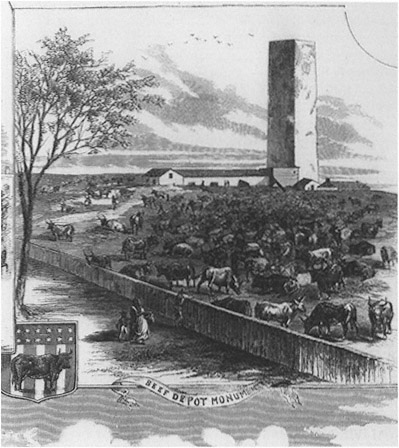
Fig. 6.
With construction stalled during the Civil War, the Washington
Monument became a source of national embarrassment. Here lampooned
as the Beef Depot Monument, this engraving records how the monument
grounds were converted, perhaps all too appropriately, into a Union slaugh-
terhouse during the war. Library of Congress.
events happen within an empty simultaneity that disregards the barriers of past, present, and future. As events happen across this simultaneity of time for readers of the morning newspaper, for instance, a cohesive consciousness develops. While this notion of "homogeneous, empty time" may describe a temporal attitude that
united Americans, even those not present at the Bunker Hill dedication ceremonies, those receiving the experience via the avenues of print capitalism, this description of simultaneity fails to capture a republican understanding of history that was central to national imagination in the antebellum period. Republican remembrance enrolled citizens within a genealogical continuity linking the present to the past. Overleaping temporal barriers, not to dismiss the notion of a past, but to reestablish contact with the fathers, citizens insisted upon the pastness, the historical depth, of their present. Rather than "re-presenting" the imagined community, as Anderson puts it, republican remembrance of America historicized the present, making it a recovery of the authority and legitimacy of ancestral founders.[35] In genealogical terms, the sons maintained the past so that they could follow in the footsteps of the fathers.
The Bunker Hill Monument thus supplied more than an observation tower surveying present horizons of territorial expansion. It articulated a historical overlook that bore the citizen back to the origins of American independence. Webster told the crowd of this memorial's sublime communication with the monumental past: "Its silent, but awful utterance ... brings to our contemplation the :17th of June, 1775, and the consequences which have resulted to us, to our country, and to the world, from the events of that day, and which we know must continue to rain influence on the destinies of mankind to the end of time, the elevation with which it raises us high above the ordinary feelings of life, surpass all." The column of remembrance bound the citizen to a patriotic tradition in the same way Emerson's understanding of subjective history catapulted him to a region where conversation with Plato or Pindar seemed possible. The Washington Monument no less effectively doubled as a time machine, recapturing instructive instances of Washington's virtuous life and dignified public career. Monuments enabled a remembrance that was politically religious in the sense of religare , of rearticulating the ligaments of the founding. Monumental architecture revealed the sublime moments of American history; it was a catalyst for a healthy, republican remembrance that saw itself extending, back into the future, backward to the great deeds of the fathers. Like a priest, Webster guided the civic mass back to the martyrs who fell battling the British and did not end this historical
journey until the crowd returned to the fount of patriarchal authority—the founding father: "Washington! ... The structure now standing before us, by its uprightness, its solidity, its durability, is no unfit emblem of his character. His public virtues and public principles were as firm as the earth on which it stands; his personal motives as pure as the serene heaven in which its summit is lost."[36] Civil religion sanctified Washington as a vessel through which the American public achieved a monumental stature rooted in the common ground of an ancestral legacy. Within the architectural incarnation of national narrative, monumental form was as vital as monumental content. While the manifest content of the Bunker Hill Monument referred to the events of June 17, 1775, its structural attributes provided emblematic expression of the persistent formal qualities of antebellum historiography: coherence, directedness, and unity. The present was to be no different from the past; indeed, the future was to be its continuation. The monumental impelled the citizen to a summit where civil religion held sway, where ligaments between generations were fixed. Within these rites, a transcendental vision operated, not just in space, but in time.
Visible to all as an iconographic marker in which citizens identified shared points of space and memory, as a discursive construction, monumentalism nevertheless took on sinister political implications. Although the expansive visibility of sublime iconography represented an openness characteristic of democracy, manifest openness simultaneously functions as a primary pathway of power in disciplinary society. Foucault can help diagnose the more effective deployment of power onto individual bodies that occurs when discourses of knowledge, especially monumental narrative, become more open and accessible. The transfer of punishment from hidden spaces, such as dungeons and madhouses, to sites of acknowledged and authorized disciplines, such as penal reform and psychology, stands as a revolutionary reconceptualization of knowledge as a more efficient, pervasive, and, in its frankness, scarcely noticeable form of power. As Foucault observes of the Panopticon, "He who is subjected to a field of visibility, and who knows it, assumes responsibility for the constraints of power; he makes them play spontaneously upon himself; he inscribes in himself the power relation in which he simultaneously plays both roles; he becomes the principle
of his own subjection."[37] Power, by virtue of this insidious gaze, functions automatically and is exercised without effort; it is the individual who subjects the self to the self's own surveillance. In contrast to this panoptic power that places minute and ordinary details under constant vigilance, monumental vision overlooks differentiated aspects of the particular. Whereas disciplinary society enforces the visibility of the subject, American monumentalism propagates majestic affiliations and cosmic notions of community that obliterate the cultural differences of individuals as a meaningful political index.
But American monumentalism never transferred its visibility to the individual as self-induced observation. That is, American monumentalism by its blatant visibility rendered the citizen invisible. From the expansive height of cultural monumentalism, the citizen lost definition, forfeited distinctness, and melded into rituals of the democratic mass. In Foucault's account, panopticism regulates and normalizes a population because it breeds suspicions that people are the objects of a disciplinary vision; within monumentalism, an inverse relation was at work, however. Citizens entertained a fantasy of subjectivity, understanding themselves as agents who chose to look upon a single point of observation. Whereas panopticism implements multiple points of surveillance to codify diverse or aberrant individuals within a controlling system of knowledge, in monumentalism, diverse individuals all survey a common point that unifies them as sharers of the same historical vision, as citizens each equally versed in the narrative of the symbol. As Pease argues, in "antebellum America the masses were not homogeneous"; monumentalism was an attempt to render them so.[38]
In other words, moving from Foucault's model of panopticism to monumentalism involves a significant shift in the agency of the gaze. The panoptic regime looks out upon individuals; however, within expressions of American nationalism, individuals unified their gaze upon determined icons of remembrance. And yet, within each apparatus of vision, power bears a similar relation, grouping individuals in a systematized discipline of knowledge. Whether that system is penal reform or narratives of national remembrance makes little difference—the intent of each remains the inscription of individuals within a discourse. Choosing to view sublime moments
of history, citizens no doubt experience themselves as free subjects, yet the singularity of that vision challenges notions of diversity, difference, and dissent that make citizens not only a visible, but a viable force. Underneath the harmony of Emerson's declaration that "there is one mind common to all individual men," the tension between narrative homogeneity and narrative difference emerges. National identity, as constructed in the antebellum era, ran the risk of effacing democracy.
One might argue, however, that the necessity of civic participation within American monumentalism dispelled any fears of tyrannous homogeneity. Neither Young America's call for a national literature nor popular support for national architecture were the results of coercion. As cultural productions, these literary and material narratives proudly attested to their creators' freely motivated and consensual accord; the design of the Bunker Hill Monument, Webster in 1843 affirmed, "rested on voluntary contributions, private munificence, and the general favor of the public."[39] Because active democratic participation powered the sublime textualization. of key moments and figures of collective memory, these icons seemingly never could deteriorate into tyrannical structures. Washington and Bunker Hill adamantly symbolized the nascent democracy's resistance to despotic oppression, and their iconic memorializations arose from more elaborated and organized desires to preserve the legacy of that founding spirit. Yet citizens who consciously labored to produce a monumental culture came to resemble the residents within the panoptic regime who are "caught up in a power situation of which they are themselves the bearers"; each elaborated a structure within culture and consciousness that overshadowed them. That universal participation in the configuration of the monumental was not precluded, but actively solicited, recalls the democratic governance of the Panopticon: in Bentham's reformist vision, the observation tower is open to any member of the public, thereby preventing the possibility that "the panoptic machine may degenerate into tyranny; the disciplinary mechanism will be democratically controlled."[40] The frank visibility of monumentalism's openness provided a democratic foundation for America's towering expressions of sublime political unity; yet, it was a democracy fraught with ambivalence that descended from the earliest conflicts between Hamilton and Jefferson, centralization and localism, federal citizens and civic actors. These
contradictory impulses produced a democracy unable to coordinate its vision between the fluctuating extremes and similarities of Emerson's "transparent eye-ball" and Foucault's eye of power.
Melville's Critique of Transcendental History
When, in March 1861, Herman Melville visited the nation's capital, he was received with reassuring familiarity. At the White House, he shook Abraham Lincoln's hand, noting a refreshingly common aura about the president: "He shook hands like a good fellow—working hard at it like a man sawing wood at so much per cord." The next afternoon, however, he made the pilgrimage to a monumental icon, only to report somewhat dejectedly: "I visited the Washington Monument. Huge tower some 160 feet high of white marble. Could not get inside. Nothing been done to it for long time."[41] What Melville experienced personally—greeted by the human representative of democracy and rebuffed by the reified memorial to democratic foundings—he had expressed as ironic critique in his 1855 novel, Israel Potter: His Fifty Years of Exile . In an effort to navigate a course for America between democratic candor and democratic repression, Melville resurrects forgotten history and argues for its placement within monumental culture even as he reveals the political pitfalls of figuring history within nationalist discourse. Melville's project is beleaguered by foundational American tensions between Federalists and Antifederalists, between the unity of individuals and the erasure of individuals, between national identity and anonymity. Caught within this dialectical ambivalence, Israel Potter embraces the transcendent power of democratically inspired monumental history only to employ the parricidal force of critical parody to renounce sublime national narrative. As self-conscious biographer, the narrator of Israel Potter aligns himself with Emerson and the monument builders and then reverses his position by the end of the novel, when the title character plummets from the illusive heights of democracy.
Israel Potter thus appears as a case study of a history made sublime by its inclusion within the Revolutionary mythos. An Emersonian principle seems to inform the biographical project of Israel Potter , and its author might interrogate history as does Emerson to ask: "what food or experience or succor have they [dead, unindividualized facts]
for the Esquimaux seal-hunter, for the Kanaka in his canoe, for the fisherman, the stevedore, the porter"—or for an American exile named Potter? ("History," 256). This biographer recalling the Revolution acts in concert with the transcendental thinker crossing "a bare common." Melville descends into the most common of circumstances to retrieve and elevate the life of this forgotten patriot. Browsing among the tatters of the "rag-pickers," the narrator stumbles across "a little narrative of ... adventures, forlornly published on sleazy gray paper."[42] Out of "this blurred record" consigned to the dingy annals of obscurity, the narrator commemorates the life of a democratic hero who fought at Bunker Hill and humbly dedicates the resulting product to "His Highness the Bunker-Hill Monument" (425). Even though Israel dies impoverished and insignificant, when subjected to the elixir of democratic biography, he rises up, his story mingling with the architectural sublime of this monumental icon. The monument, a political echo of the "all" seen by Emerson's "transparent eye-ball," may "be deemed the Great Biographer" (426); it is through the influence of this lofty eminence that the almost forgotten Israel enters the currents of American national history. Melville imparts all this information in a preface dated June 17, 1854, the anniversary of American resistance to British forces on the heights above Boston. Monumental history once again works its democratic wonders of time, space, and status: barriers of time, centuries long, evaporate, and spatial divisions of low and high, common and noble, forgotten and remembered, dissipate in a sublime homogeneity of subject, biographer, and national history.
Just as orators held as indispensable the role of public desire in the erection of a monument, the design of Israel Potter emerged from Melville's anticipations of common readers. Although Melville lay his biography at the base of "His Highness," the popular mind guided the biographer. Aware that the novel was to appear serially in Putnam's Monthly Magazine , he wrote the editors: "I engage that the story shall contain nothing of any sort to shock the fastidious. There will be very little reflective writing in it; nothing weighty. It is adventure." The author who had declared his reluctance to write in accordance with the tastes of a widespread audience now, after the commercial failures of Moby-Dick and Pierre , took notice of the "bare common" and constructed a tale calculated to please a mass readership. He seems of the breed of vigorous intellectuals called
forth by Emerson in "The American Scholar" who will "embrace the common ... and explore and sit at the feet of the familiar, the low" (68–69); he agrees with the editorial position in Harper's that history "has presented us only with names of isolated pre-eminence. The time has come when we 'must change all that.'"[43] The authorial sovereign who killed off characters in Mardi with regal indifference and alienated readers with a belabored allegory experimented with democratic authority.
The popular dynamics informing Melville's narrative give birth to a democratic hero. Israel enacts his American story in a prose whose religious and political overtones replay the national history of revolution and liberation. Fleeing the oppressive conditions under his patriarchal roof, shunning "the tyranny of this father," Israel departs for new lands, the frontier, though this quest will eventually and ironically land him back to the fleshpots and prisons of the Old World (435). He enters a textual landscape marked by tenets of hard work and opportunity similar to the world described in Letters from an American Farmer ; like Crèvecoeur's outcast immigrant from the Scottish Hebrides who achieves the American Dream, Israel collects his wages, purchases a tract of land, clears it, and establishes a homestead. But once seized by that unquiet American spirit, he lights out for the territories, becoming an Ishmael wandering in the wilderness as a surveyor, hunter, trapper, quick-witted peddler, and Nantucket harpooner. Israel stumbles across an American identity in his restlessness, falling into generic company with the archetypal Yankee folk hero, the jack-of-all-trades. The itinerant and changing nature of his commercial endeavors requires wit and native intelligence, characteristics to become embedded in the national folk fabric as American know-how and ingenuity. When the always pursued Israel outwits his captors by masquerading as a scarecrow or by intoxicating English sailors though remaining sober himself, he reveals his kinship with the "agile, jig-dancing, shrewd, talkative, humorous, flaxen-haired hero," Brother Jonathan of the early 1800s, who would evolve into Uncle Sam.[44]
The cultural distinctness of Israel's Americanisms leads to a notorious, though common, articulation of a politicized self that inevitably conflicts with the Old World mores of British culture. An original American son, Israel stands as independent from Europe as Jefferson's mammoths or as innocent as Cole's sketch of the United
States' historically virgin landscape. The young patriot naturally takes up arms at Bunker Hill, where his previous days in the woods shooting deer give him the marksman's skills to take exact aim "between the golden epaulettes" of the officers as though he were shooting "between the branching antlers" (440). Rustic talent with the rifle translates into monumental resistance to the legions of the British pharaoh. Israel, however, is taken prisoner at a later engagement and transported to England, beginning his fifty years of Babylonian captivity. Escaping from an English prison ship soon after, Israel nevertheless remains imprisoned within the confines of exile. Although he evades detection by disguising himself as a cripple, a ghost, a gardener in the king's garden, and a London brickmaker under the taskmasters of "the English Egypt," only with difficulty can Israel conceal his particularly American spirit (602). Unable to quell the distaste for patriarchal authority that first led him to "emancipat[e] himself from his sire," Israel cannot subdue his innate passion for independence: he fails, no matter how much he might try, to address his employer as "Sir John" and not "Mr. Millet"; he touches, but cannot bring himself to remove his hat when he bumps into King George along the walks of the garden; and he informs the monarch "firmly, but with deep respect, 'I have no king' " (434, 460). Politically as well as aesthetically, Israel springs up from humble origins to mature as a transcendent type in whom a community of nineteenth-century Americans would share a common cultural legacy. The calculated popularity of Israel's fictional figure transforms a forgotten soldier of Bunker Hill into a nationally recognized icon.
To say, however, that Melville inscribed himself as a writer of democracy simply because he considered what the popular mind would consume would be fallacious. Though he made his home in the democracy of nineteenth-century America, Melville thought himself as much an exile as Israel Potter. As Richard Brodhead observes, Melville's novels and correspondence often contained "brutal assaults on his readers and on American literary culture."[45] Melville found companionship only in his own forlorn fictional creation, Bartleby; both would "prefer not to" copy and write within the accepted forms of notation or narration. Bartleby's fate is well known; finding no place in society, he dies huddled at the base of a prison wall. Ishmael represented a more encouraging example for
Melville by overcoming alienation to outline a "ruthless democracy" in his friendship with a tattooed savage speaking broken English. Yet Melville could not enter into such a contractual agreement with the urbane and literate transcendental thinker of Nature . After hearing this popularizer of monumentalism give a lecture, Melville wrote: "I do not oscillate in Emerson's rainbow, but prefer rather to hang myself in mine own halter than swing any other man's swing."[46] And in "The Mast-Head" chapter of Moby-Dick , Ishmael effectively parodies Emerson's transcendental sublime, cautioning those who would swing from the top of an isolated eminence. Ishmael muses in an Emersonian strain, only to arrive at a grim reminder of the consequences of forgetting the self within transcendental currents:
but lulled into such an opium-like listlessness of vacant, unconscious reverie is this absent-minded youth by the blending cadence of waves with thoughts, that at last he loses his identity, takes the mystic ocean at his feet for the visible image of that deep, blue, bottomless soul, pervading mankind and nature; and every strange half-seen, gliding, beautiful thing that eludes him ... seems to him the embodiment of those elusive thoughts that only people the soul by continually flitting through it. In this enchanted mood, thy spirit ebbs away to whence it came; becomes diffused through time and space.... There is no life in thee, now, except that rocking life imparted by a gently rolling ship; by her, borrowed from the sea; by the sea, from the inscrutable tides of God. But while this sleep, this dream is on ye, move your foot or hand and inch; slip your hold at all; and your identity comes back in horror. Over Descartian vortices you hover. And perhaps, at mid-day, in the fairest weather, with one half-throttled shriek you drop through that transparent air into the summer sea, no more to rise for ever. Heed it well, ye Pantheists! (136)
Transcending to an elevated state where soul and cosmos become mutually transparent is not without its dangers. Unity, capable of expanding the individual to the scale of an empire, is also capable of effacing the individual in that expansion. Melville's quarrel with Emerson encompassed more than the ether of ontology, however; his comic imitation points to the blindness of the "transparent eyeball" and its destructive consequences for the citizen living within a political culture dedicated to monumentalism. Following the tastes of the American public and gratifying a culture pursuing the
monumental may produce a paste-board mask of democracy, but not the "ruthless" substance of democracy necessary for the uniqueness of individual contribution and participation.
Despite its status as a memorial pillar to democracy, the Bunker Hill Monument obscured the patriot of democracy. When democracy became reified as a monumental structure, it loomed over the individual; when the representation of democracy achieved a grand scale, the individual forfeited political, local, biographical specificity in an exchange for a national identity that overrode and silenced the particular heroism as well as the personal tragedies of a common, exiled citizen such as Israel. Like much of nineteenth-century American culture, the April 1852 issue of Harper's could acknowledge the desirability of monumental modes of historical representation even as it affirmed without qualms that "national memory [or] ... public spirit is often most blindly destructive of private interest ."[47] Stranded in England for a half century, Israel returns to the promised land of democracy on a day specifically designated for remembrance—the Fourth of July. He steps ashore in Boston and meets a mass celebration commemorating the heroes of Bunker Hill. In this sense, the monumental performs the key function of preserving the hero's fragile actions with a symbolic recollection. The monumental administers a civic memory, integral in instructing post-Revolutionary sons to remember the indispensable foundations laid by the American fathers. At the same time, however, Israel reaches "the Fortunate Isles of the Free" only to discover his exile remains intact (611). The patriotism enacted by Israel, now reified as public ritual, has no need for Israel: "the old man narrowly escaped being run over by a patriotic triumphal car in the procession, flying a broidered banner, inscribed with gilt letters:—'BUNKER-HILL . 1775. GLORY TO THE HEROES THAT FOUGHT !' " (613). The American fervor for monumental remembrance inadvertently tramples the citizen who, ironically, may have performed the very deeds that are being remembered. Although the public enthusiastically reaffirms the bravery of men like Israel, it has little space to commemorate Israel himself. America, able to articulate democracy only in monumental proportions, cannot construct a panegyric to a democratic individual and has no place for Israel; the former minuteman finds sanctuary only on Copp's Hill, a position occupied by British troops during the battle, to view the ceremonies at the "incipient monument" (613).
Undertones of monumentalism's pitfalls exist even within the ebullient dedication of Israel Potter . The narrator lavishes praise upon the patriotic column and concludes with a simile that yokes together Israel and the monument, but it is an uncomfortable union: "[I wish] summer's suns may shine as brightly on your brow as each winter snow shall lightly rest on the grave of Israel Potter" (426). The incongruities uneasily paralleling summer and winter, high and low, radiance and solemnity, all prevent the reassuring supposition of a sublime harmony that might raise up Israel out of his neglected grave. Even in death, Israel remains alienated, untouched by the impassive mode of the history reified by the Bunker Hill Monument. Unconcerned with Israel, unconcerned with the lost children of democracy, this "Great Biographer," whose intractable granite composition Melville emphasizes, stands above the subjects it honors. Under the aegis of monumental history, the political citizen is forgotten. This is not to say, however, that a sublime configuration of history could make no place for the individual. Just as the descending torrent in a painting of Niagara Falls diminishes the human figure, locating the individual as a minuscule element of the natural order, so, too, the historical sublime understood the individual as part of a greater historical process. Israel's life has meaning only insofar as it conforms to a national history too myopic to notice and avoid running him down with "a patriotic triumphal car." Under the gaze of "the Great Biographer," Israel becomes nameless and joins ranks with "the anonymous privates of June 17, 1775, who may never have received other requital than the solid reward of your [the Bunker Hill Monument's] granite" (426). Once enveloped by the iconic representation of the independence he defended, Israel forfeits the spirit of resistance he had faithfully preserved throughout his long years of exile and becomes dependent upon monumental history. Remembered as an anonymous patriot of Bunker Hill, Israel loses his identity as a sufferer exiled from America and achieves a new identity as an alienated subject marked by the nonmarkings of historical obscurity and political neurasthenia.[48]
Gathered up in the folds of a processional banner, Israel Potter as a human actor ceases to have significance. He forms an incidental part of the historical picture, just as the shrunken figures emphasize the natural order in a landscape portrait. Whether in the depiction of nature or the monumental representation of American history, a
mystified process subsumes the individual. Yet an important difference exists: whereas the "natural" need not embrace human action, American history and the politics it remembers is a discursive space of human creation where individuals should be able to act and appear to one another as citizens. What Hannah Arendt calls the "space of appearance," where citizens speak and act to "reveal actively their unique personal identities and thus make their appearance in the human world," dwindles and decays before a mammoth construction of history designed to be stable and immortal in contradistinction to the fragility of human affairs. In short, the national architecture of monumental representation in the nineteenth century invalidated politics. The discourse of American monumentalism held that monolithic iconic remembrance would supplant the doddering and transitory memory of human deeds with a more permanent icon of history. Although most dedications honored the veterans of Bunker Hill who attended the 1825 groundbreaking ceremonies, noting the "venerable men, the relics of a past generation, with emaciated frames, tottering limbs, and trembling voices," orators and writers mentioned these individual patriots only to gain support for a less frail historical construction. By the time of the monument's completion in 1843, Webster would stand before the column and deny his own human agency as a participant in historical discourse: the monument "is itself the orator of this occasion. It is not from my lips, it could not be from any human lips, that that strain of eloquence is this day to flow most competent to move and excite the vast multitudes around me."[49]
Transcendent and unifying, the Bunker Hill Monument was the sublime national icon. Webster's optimism that its lessons and history would extend to "vast multitudes" depended upon monumentalism in several ways. Its expansive, highly visible character allowed for the enactment of democracy on a grand scale, but also imperative to the perpetuation of Webster's democracy was an understanding of monere as an action of reminding and instructing Americans in examples of civic virtue garnered from the past. Without monere , citizens would lapse into forgetfulness of the founding principles. The monument, however, was to guard against prodigal sons, becoming, as Webster hoped, a ritual space of memory where "troops of ingenuous youth shall be gathered ... [and] there shall rise from every youthful breast the ejaculation, "Thank God, I—I also—AM AN AMERICAN !" Yet ironically, in its triumph over time, Webster's version of the monumental
sacrifices the vital element of human responsibility and participation that characterizes a notion of republican remembrance best expressed by Lincoln in his 1838 address before the Young Men's Lyceum. Lincoln called for a "political religion of the nation" that, however improvident it may have seemed, could be located, lived, and experienced, only in subjects who would appear tenuous, ephemeral, and impermanent in comparison with the durability of the monumental. Rather than preserving history within a monolithic icon of remembrance, a diffused structure of republican memory had to be supported by "other pillars," whose rag-tag heterogeneity—"the old and the young, the rich and the poor, the grave and the gay, of all sexes and tongues, and colors and conditions"—defied the aesthetic and political principles of unified, enduring construction.[50] Like Webster, Lincoln acknowledged the imperative of preserving the founding legacy, but unlike Webster, he saw that democratic principles could be transmitted only by human beings. Icons, uninhabited by citizens, played no role in Lincoln's thinking. Whereas Webster preferred to trust the "Great Biographer," Lincoln understood that history, if it was to preserve an inheritance of participatory democracy, had to arise from human articulation.
Emerson also pronounced the death of politics, but little grief accompanied his announcement. In "Heroism" he writes: "Who that sees the meanness of our politics, but inly congratulates Washington that he is long already wrapped in his shroud, and for ever safe" (381). Death emerges as the supreme moment of historical transcendence, the summit where one forever escapes the obstacles that could sully the self with the physical dealings of the "bare common." Emerson's outlook emphatically opposed federal orderings, leading him to declare that "every actual State is corrupt" ("Politics," 563). What appeared in the void, perhaps unforeseen by Emerson, was not the ideal state founded on individual conscience, but the nation-state. The apex of politics was to be not involved in politics at all. Emerson represented the culmination of history as a sacrosanct realm that citizens enter only upon forfeiture of their lives, specific, full, and local. Advancing beyond Webster's understanding of the Bunker Hill Monument as a triumph over time, the Emerson of monumental culture posited the national historical icon as a triumph over life. Ishmael's parody of the transcendental dreamer atop the masthead—"There is no life in thee"—reads as the epitaph of Lincoln's republican citizen. In its sublime, transcendent configuration, monumental
history stifled civic being; it resulted in the nihilistic slogan "Let the dead bury the living."[51]
The edifices towering over the Israels and Melvilles evoked what transpired within the culture of monumentalism as acting politically gave way to a fabricated remembrance that precluded the necessarily impermanent and unpredictable quality of action. The individual became a speck in the political landscape. Immediately after the speaker in Nature announces "I become a transparent eye-ball," material being fades, and he declares "I am nothing; I see all" (10). Despite the focus on "all," which may indicate ideals of brotherhood and community, Carolyn Porter states that within this passage the "rhetorical emphasis falls on the predicates, distracting us from the miraculous return in the second clause of the 'I' who has just been voided by the first. Swallowed up by its role as seer, the material self disappears."[52] This unsubstantial self can hardly participate in the materiality of daily life and the politics that emerge from life thus lived. Transcendence, although it may originate in the "bare common," severs the citizen from all the things—history, place, community, desire—that make him or her a citizen. Concern for a vital political community vanishes in an ethereal atmosphere: "The name of the nearest friend then sounds foreign and accidental: to be brothers, to be acquaintances, master or servant, is then a trifle and a disturbance" (Nature , 10). Politics are sublimated, as though the affairs of "street and village," the happenings that can occur only within public spaces, corrupt individuals. Emerson expands this view to affirm the value of a transcendent existence unconcerned with acting or speaking in the world, the sole ways to realize civic self-definition. He does not sing the praises of the political citizen; instead, he prefers the apolitical being whom he celebrates in "The Poet": "Thou shalt leave the world, and know the muse only. Thou shalt not know any longer the times, customs, graces, politics, or opinions of men, but shalt take all from the muse" (467). Monumental culture encouraged the purification of the individual, and it carried forth that process until any political sensibility was refined out of being.
Critical Mass and Critical History
Although the "Great Biographer" eventually conscripts Israel Potter to the forces of monumental historical progress, Melville preserves
the vibrancy of human political action in writing Israel Potter . Turning to the subversive possibilities of irony and humor, Melville offers a strategy of biography calculated to undermine the monumentalism to which he pays tribute in his preface. Despite what appears to be the preface's abdication to the orthodox history of the iconic shaft, Melville safeguards the heroism of individual action, refusing to surrender his novel to the grand iconic moments and figures of American history. The narrator obsequiously approaches the Bunker Hill Monument, begging excuse for the slight changes he has made in the 1824 prototype of his tale, Life and Remarkable Adventures of Israel R. Potter : "Well aware that in your Highness' eyes the merit of the story must be in its general fidelity to the main drift of the original narrative, I forbore anywhere to mitigate the hard fortunes of my hero" or to retouch significantly the events described in that "tattered copy" (425). Melville, however, shared his hero's propensity for evasion and deception: just as Israel masquerades as a lowly beggar to escape notice, Melville adopted the disguise of a sycophant cowering before the icon of monumental historical narrative in order to tell another, properly human story. As a fugitive, Israel understands the potential risk "if he adhered to the strict truth" and thus cloaks his identity as an escaped Yankee (507). And as a novelist aware of his own fugitive dissent from a culture's passion for monumental historical representation, Melville discovered he too had to depart from any notion of "strict truth."[53]
While Melville's preface pledges historical faithfulness, his narrative betrays any confidence in the author's avowed regard for "general fidelity" to monumental history. Melville puffs up monumental history only to give it the exaggerated dimension needed for parody. He appears to revel in the grand stature of heroes like John Paul Jones or Benjamin Franklin, but this act of filial honor actually initiates the practice of parricidal criticism. That is, Melville enters the domain of monumental history as a subversive, employing parody to critique the iconic substance and construction of American national legacies. Parody as parricide attains its critical force by creating a disjunction in the patriarchal inheritance. Rewriting the history of the fathers in this ironic mode places the fathers at variance with themselves: at one moment they are unquestionable paragons of national virtue and at the next stifling buffoons. Parody indeed behaves as parricide, for it poses as a dutiful son and adopts a reverential attitude
toward history, except that the posture becomes overblown, suggesting that the fathers expect too much deference and humility.[54]
In both the original narrative and Melville's refurbished version, Israel enjoys the honor of meeting Benjamin Franklin; however, in its sardonic portrayal of Franklin, Melville's biography commits far more than the "one or two shiftings" he apologizes for in the preface. Whereas the Life and Remarkable Adventures of Israel R. Potter succinctly wraps up the encounter with the venerable sage by saying "My interview with Dr. Franklin was a pleasing one—for nearly an hour he conversed with me in the most agreeable and instructive manner," Melville's story approaches this archetypal American at both great length and ironic distance.[55] He expands Potter's single sentence into four chapters, until the representation of Franklin collapses under its own weight. What begins as a scene where "stray bits of strange models in wood and metal" and books on "history, mechanics, diplomacy, agriculture, political economy, metaphysics, meteorology" attest to Franklin's prodigious mind soon degenerates into a caricature of an old man who employs dogmatic homilies to stifle the desires of youth (468). Although the visible signs of Franklin's intellect and maxims from Poor Richard's Almanack impress Israel, the exile feels constrained by the paradigmatic American who denies him brandy to substitute "white wine of the very oldest brand"—water—who discourages him from humor, counseling "never permit yourself to be jocose upon pecuniary matters. Never joke at funerals, or during business transactions," and who insists upon "business before pleasure" when Israel would rather explore the mysteries of Paris (475, 473, 474).
The narrator begs pardon for manifesting Franklin "in his far lesser lights; thrifty, domestic, dietarian, and, it may be didactically waggish" (479). Yet Melville intensifies the burlesque so that Franklin's insistence on "business before pleasure, my friend. You must absolutely remain in your room, just as if you were my prisoner," takes on an ominous and oppressive truth (474). Israel is trapped within an icon of American independence. Monumental culture, with all its patriarchal implications, afflicts Israel as he prepares for bed when Franklin enters the room, removes the cordials and pastries, and scolds his guest for flirting with the chambermaid. Franklin resembles Israel's father-tyrant who refuses to let his son marry the girl next door; the only difference is that Franklin's fatherly guidance
is more insidious, insincere, and encompassing. Israel complains of this pervasive and prohibitive patriarch who insists upon dependence at each turn: "Every time he comes in he robs me ... with an air all the time, too, as if he were making me presents. If he thinks me such a very sensible young man, why not let me take care of myself?" (486). Under the roof of an icon who does not see this wanderer as an individual, but as one indistinct part of the public addressed en masse in Poor Richard , Israel finds his goals and desires incarcerated—in short, he cannot act with independence. While patriarchal solicitude confines our hero in Franklin's lodging house, Melville escapes via the trapdoors of irony and satire. For instance, when the wise man confiscates the pleasures in Israel's room and warns him of the chambermaid, "an artful Ammonite," Franklin adds wantonly: "I think I had better convey your message to the girl forthwith" (485).
Recovering what is not included in the iconic—in this case the putative lechery of Franklin—Melville's revisionary history disables any projected leaps towards transcendence. Sublime lechers remain inescapably mired in the "bare common," hardly the stuff of patriotic lore. Wit and humor conspire to suggest an individualized space not authorized by the monumental figure of history. We might call this individualized space a story, as opposed to the generalized eminence of history, which tells the life of a hero who may possess no sublime qualities. Narrative, as Melville realized, is vitally political: narrative strategies can lead either to a story or to history, to heroes as human as Queequeg and Israel or to icons as lifeless and indifferent as Washington "aloft on his towering main-mast in Baltimore." Israel Potter makes a definite choice in this matter, resolutely following a failed story of a failed hero. Despite these bleak circumstances, Israel Potter reclaims an older inheritance in which the story reveals every human actor as a hero. The word hero , according to Arendt, in its earliest connotations implies particularity and difference. In Homer, "hero" indicated "no more than a name given each free man who participated in the Trojan enterprise and about whom a story could be told." Thus, while Israel certainly is, as Peter Bellis suggests, "a decidedly antiheroic figure, alienated from and dispossessed by history itself," Israel is also a hero because he falls outside the structures of history and is capable of being represented only in a novel constructed from discarded and repressed memory.[56]
Indistinct and indistinguishable from the forgotten mass, Israel nevertheless forms part of a critical mass. Foucault's sense of the panoptic regime identifies the individualized space of Israel's story as the most insidious reach of iconic repression, but elsewhere Foucault stresses that the local, regional spaces steeped with "popular knowledges" and "disqualified knowledges" are precisely where "criticism performs its work." Counter-memory appears in these stories saturated with nonauthoritative knowledges that can be used to articulate criticism of official forms of history. Berlant makes effective use of Foucault's notion of counter-memory in her study of Hawthorne. Even at sites infused with the discourses of official culture, such as the female body of Hester Prynne, counter-memory resides. If counter-memory, as Berlant states, is "a politically neutral category of knowledge and experience," it nevertheless contains the potential to evolve as a site of challenge, contestation, and criticism. Thus, the letter A signifies the inscription of the body with theocratic law, but the A also slips outside of this official codification. No longer dependent upon established regimes of thought, the A "circulates among the people, [and] becomes a vehicle for its imagination, a site on which a local collectivity emerges." From such sites, according to Foucault, the "local character of criticism" emerges as a "noncentralised kind of theoretical production"; for Berlant's reading of The Scarlet Letter , such theoretical work leads to the articulation of local heterotopias that effectively challenge the hegemonic structure of American nationalist discourse.[57]
One can locate similar instances of counter-memory embodied within Israel Potter . And, as Israel Potter becomes Israel Potter , as autobiography is reinscribed within the narrative strategy of Melville's biography, counter-memory evolves into critical history. The cross of saber scars on his chest provides an alternate memory to the unreflective puffery of patriotic history surrounding the Bunker Hill Monument. But in the end, counter-memory remains inert for Israel; as an instance of counter-memory, his story has "faded out of print—himself out of being—his name out of memory" (615). Melville, however, realized the potential dormant in Israel's counter-memory. Whereas Franklin addresses Israel as part of the uncritical mass in need of Poor Richard's wisdom, and whereas Israel understands himself as a nonpolitical entity dismissed by American history, within Melville's novel, Israel forms part of a critical mass
productive of what Nietzsche calls critical history. Critical history offers more than the solace of resistance experienced within pockets of knowledge that have escaped incorporation into official discourse. While it may originate in a local situation, critical history moves beyond the local to examine grand, entrenched moments and monuments of history. In other words, critical history begins with counter-memory, but soon sloughs off its particularly local character to assess and even destroy seemingly implacable narratives of national history.
This distinction between counter-memory and critical history lies in the difference between Israel Potter and Israel Potter , between the politics of identity found in the autobiography of an oppressed Revolutionary soldier and the ironic practices found in a novelist's destabilizing historiography. Disgusted by the "riotous crowd" rallying around the Bunker Hill Monument, Israel returns to his rural birthplace in the Housatonic valley, futilely hoping to recapture local counter-memories that might identify him as his father's son and not the lost and forgotten son of America (613). Israel Potter , in contrast, practices critical history, reworking a national narrative as homogeneous as the uniform granite blocks of the Bunker Hill Monument so that it becomes disarticulated into a series of incomplete portraits and fractured histories. Israel's permanent exile—his homecoming leads to recognition of the tragic depth of his cultural abandonment—presents the biography of a nation whose sameness has become alienated in contradiction and irony. As a disjunctive repetition of the Revolution, Melville's novel fulfills Nietzsche's imperative that discourse must bring the past "before the tribunal, scrupulously examining it and finally condemning it." No matter how sublime the Bunker Hill Monument, no matter how revered the character of Dr. Franklin, Israel Potter resituates these fixed icons of national remembrance as ambivalent narratives doubtful of the nationalist project that those icons represent. As discourse, Israel Potter declares along with Nietzsche: "Every past ... is worthy to be condemned."[58]
Melville had as little chance of eradicating a repressive, iconic Franklin from American cultural consciousness as he did of toppling the Bunker Hill Monument or even of forcing his way into the Washington Monument when it was closed. Yet Melville's purpose was not to destroy monumental history and make the American public an unhistorical herd, but to democratize implacable icons and
make them subject to the participation of human interpretation. Rather than uproot Franklin, Melville intended to reinterpret such fixtures of monumental history as "spaces of appearance," as "bare commons" where citizens would not sublimate or transcend politics, but would appear as articulate political beings, revealing their human distinctness as they speak and act together. Melville's configuration of Franklin suggests abandoning docile reverence for what Nietzsche calls "Olympian laughter." It is "Olympian laughter" that allowed Melville to declare "that a thief in jail is as honorable as Gen. George Washington"; it is with the heroic humor of Israel Potter that Melville hurled the critical irony embedded within the "nobody" of this American Odysseus into the Cyclops eye of monumental history. Without such laughter, without such irony that smirks at the iconic representation of Franklin, criticizes the mode of history embodied by the "Great Biographer," and pillages Emerson's transcendental democracy to render it a space for parody, monumental culture engineers its own exile and imprisonment. As Nietzsche asks: what are the consequences "when the impotent and indolent take possession of it [monumental history] and employ it!" National narrative, no matter how many different democratic agents intone its promises, encourages representation founded upon the violence of political abstraction. Unless the citizen can reveal the iconic as ironic, the human endeavor of cultural remembrance becomes an unassailable representation of history.[59]