
Lemma 11—
A Detailed Discussion
Principia : Lemma 11. The vanishing subtense of an angle of contact [the line BD] is ultimately in the doubled ratio of the subtense of the conterminous arc [the line AB].
Figure 7.1 is based upon the diagram that appears in the Principia . The lemma demonstrates that the line BD is proportional to the square of the line AB as the point B approaches the point A . In the 1687 edition of the Principia , Newton employs this result in the scholium to Proposition 4 on circular motion and in Proposition 9 on spiral motion. In the revised editions of the Principia , however, this result also plays a primary role in Proposition 6, in which the basic linear dynamics ratio is derived. The demonstration of this lemma makes reference to "the properties of circles," by which Newton means the existence of a unique circle of curvature at the general point A on the curve. Newton makes this reference clearer in the revised editions of the Principia when he inserts in the opening statement of the lemma the qualification, "in all curves which have finite curvature at the point of contact." In the 1687 edition, however, the reader has no advanced warning that the concept of curvature lies behind Newton's demonstration. The opening statement of the lemma is followed by three cases, which I discuss in detail.
Case 1. Let AB be the arc , AD its tangent , BD the subtense of the angle of contact perpendicular to the tangent, and AB the subtense of the arc. Perpendicular to the latter subtense AB and to the tangent AD, erect AG and BG, meeting at G; then let the points D, B, and G approach the points d, b, and g;
Here, the elements of the diagram in figure 7.1 are defined. A subtense is simply the chord that subtends a given angle or arc. The statement of Case 1 continues.
[Case 1] and let J be the intersection of the lines BG and AG, ultimately occurring when the points D and B approach up to A. It is obvious that the distance GJ can be less than any assigned one .
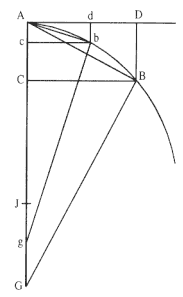
Figure 7.1
Based on Newton's diagram for
Lemma 11.
Figure 7.2 is the diagram based on Newton's original drawing into which has been added a set of three circles drawn tangent to the curve at point A . The two outer circles pass through the points B and b . The innermost circle represents the circle of curvature to the curve at point A and the line AJ is the given finite diameter of curvature. As the point B approaches the point A , the outer circles approach the circle of curvature and the diameters of those circles approach the diameter AJ . Thus, the point G approaches the point J in the limit as the point B approaches the point A and, as Newton states, "It is obvious that the distance GJ can be less than any assigned one."
[Case 1] Now ( from the nature of circles passing through points ABG and Abg) AB2is equal to AG × BD,
Critical to the demonstration of this lemma is the parenthetical expression: "(from the nature of circles . . . )." As the point B approaches the point A along the general curve AbB , then the set of circles drawn through the points ABG and Abg will approach the limiting circle of curvature drawn through the points A and J . This parenthetical expression is the only explicit reference to the underlying concept of curvature. Figure 7.3 gives the details of the circle drawn through the points A, B , and G . The line AC is perpendicular to the line BC by construction. The line AB is perpendicular to the line BG because AB and BG are chords of the circle ABG and hence, from Euclid's Elements , Book 3, Proposition 31, the angle between
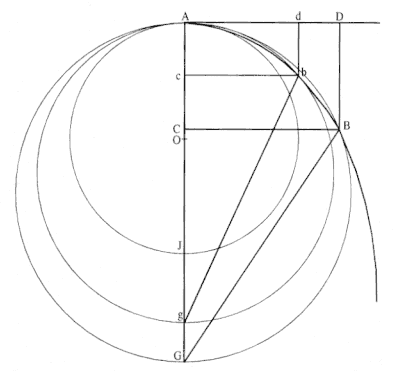
Figure 7.2
A revision of Newton's diagram for Lemma 11 with a set of three circles
drawn tangent to the curve at point A . The innermost circle AJ represents
the circle of curvature at point A .
chords drawn to a diameter is a right angle. Thus, triangles ABC and AGB are similar and AG / AB = AB / AC , where AC = BD by construction. Thus, AB2 = AG × BD as given above.
[Case 1] and Ab2is equal to Ag × bd, and hence the ratio AB2 to Ab2is composed of the ratios AG to Ag and BD to bd.
By a similar demonstration to that given above, Ab2 = (Ag ) (bd ) and the ratio of AB2 / Ab2 = (AG) (BD) / (Ag) (bd) = (AG / Ag) (BD / bd) or "the ratio AB2 to Ab2 is composed of the ratios AG to Ag and BD to bd ." Case 1 concludes with the following statement:
[Case 1] But since JG can be assumed less than any assigned length, it can be arranged that the ratio AG to Ag differs from the ratio of equality less than for any assigned difference, and thus as the ratio AB2to Ab2differs from the ratio BD to bd less than for any assigned difference. By Lemma 1 there is, therefore, the last ratio AB2to Ab2equal to the last ratio BD to bd. Which was to be proven.
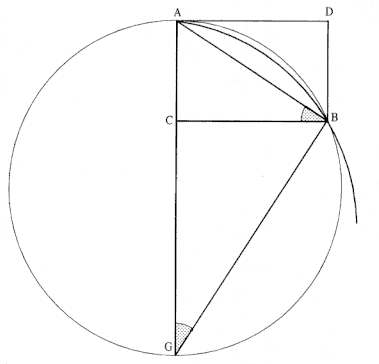
Figure 7.3
Details of the circle ABG from figure 7.2. The triangles ABC and AGB
are similar.
Since both of the diameters AG and Ag approach the given finite diameter AJ of the circle of curvature as the points B and b approach the point A , then the ratio AG / Ab approaches unity and the "last ratio" AB2 / Ab2 becomes equal to the "last ratio" BD / bd .
Case 2. Now let BD be inclined to AD at any given angle, and there will always be the same last ratio as before and hence also the same AB2to Ab2 , as was to be proven .
If the line BD were not perpendicular to the tangent line AD , then the perpendicular BD' would be BD' = BD cosq , where q is the given angle. The angle would be the same for bd as for BD and hence the ratio BD' / bd' = BD cosq /bd cosq = BD / bd and thus the last ratio will be unchanged.
Case 3. Moreover, although the angle D may not be given, [if BD converge to a given point, or be drawn according to any other law ] the angles D and d [constructed by this law common to both ] will always verge toward equality and approach nearer to each other than for any assigned difference, and hence, by Lemma 1, will ultimately be equal, and accordingly, the lines BD, bd will be in the same ratio to each other as before. Which was to be proven .
In the revised editions of the Principia , Newton enlarged this statement by inserting the qualifications given in brackets. Thus, if the inclination of BD is determined by its relationship to a given curve, as with the circle in Proposition 4 and the spiral in Proposition 9, then the last ratio remains the same and the relationship given in the lemma holds.