
Social Ills and Comic Relief: the Chimmie Fadden Series
Although comedy appears at first to be unrelated to realist modes of representation linked to the urban experience, regional writers and local colorists had introduced to the reading public amusing characters who spoke in the vernacular. Chimmie (James) Fadden, a Bowery lad known to news and short story readers and to stage audiences before his appearance on screen, was such a character. Since DeMille was associated with the melodramatic playwriting tradition rather than comedy, the Chimmie Fadden series provides an interesting point of departure to investigate his articulation of urban relations. In fact, the Chimmie Fadden films are not pure comedies but also function as sentimental melodrama in that romance mitigates social tensions. Such a mixture of genres is revealing with respect to controversial issues involving not only ethnicity and class but also gender. Comedies exploiting cultural differences presumed social distance and thus violated the conventions of sentimental literature that stressed emotional identification with characters. Genteel women, moreover, considered laughter irreligious and a breach of tenets of self-control and performance required in the drawing room.[21] Yet a great deal of the humor in the Chimmie Fadden short stories and films is based on the hero's inability to comprehend or to conform to upper-class etiquette. By artfully merging comic and sentimental modes of expression in his adaptations, DeMille struck a compromise. Ultimately, he preferred melodrama to comedy, despite critical acclaim for the Chimmie Fadden series and the early Jazz Age films, because he indulged his penchant for orchestrating spectacle.
Unfortunately, there is no extant print of Chimmie Fadden , the first of at least two features in a series based on the well-known comic character. The reconstruction of any film that has not survived is problematical, but in this case there exists, in addition to the sequel, several reliable texts, including short stories and scripts of both the stage play and film adaptations. A character indebted to the correspondence of dominant cultural forms in an urban milieu, Chimmie progressed from print media to stage to screen in such a manner that sentiment increasingly displaced satire. As opposed to
sustaining the hilarity provoked by extreme class differences in the short stories, DeMille registered a shift in genres, signified at times by lighting effects, to emphasize social reconciliation based on sentimental values. A closer reading of the Chimmie Fadden intertexts demonstrates that even before he was widely acknowledged as an author, DeMille left his own inscription on texts adapted from middle-class cultural practice.
Chimmie, an enterprising Irish tough who lives on the Lower East Side with his mother and brother, first appeared in the columns of the influential New York Sun in the 1890s. Although he was a fictional character invented by Edward W. Townsend, his credibility was enhanced by colorful dialect and scenes of slum life based on actual observations. So popular was this engaging rogue that Townsend, who later pursued a Congressional career, published several volumes of collected short stories. Adapted for the legitimate stage by Augustus Thomas, former art director of the Charles Frohman Company, and by Townsend himself, Chimmie Fadden played to audiences in New York and then toured the country.[22] A photograph of Broadway taken in the 1890s shows a huge sign painted on the side of the tallest building in the area to advertise the play.[23] Chimmie thereafter became a familiar character in theatrical entertainment. Victor Moore, recruited by Beatrice DeMille to star in the Lasky Company adaptations, was billed as "Broadway's most popular comedian" because he had previously played Chimmie as well as other Bowery types both on stage and in vaudeville.[24] Situated at a point of convergence for several media including newspapers, best-sellers, vaudeville, legitimate theater, and feature film, Chimmie mediated the experience of the urban poor for middle-class readers and spectators.
An intertext that provided the basis for several adaptations, Townsend's short stories in turn exploited middle-class familiarity with stage conventions. Chimmie, for example, continually affirms that he has no "langwudge" problem while addressing his readers, as would a vaudeville actor, in first person and in street dialect. At his best, he regales his audience with hilarious anecdotes about life as a footman for a Fifth Avenue household. Subject to ridicule are the idiosyncrasies of the rich, such as Miss Fannie's theatrics as lady bountiful in the slums. According to Chimmie, "Wese goes down dere in de street cars, cause dey strings ye down dere if ye goes in er carriage, an' Miss Fannie she puts on er dress wot she tinks looks like er factory girl's dress. . . . It looks like one er dem loidies wot plays on der stage when dey goes t' de war t' be nurses when dere fellys is sojers. See?" As Chimmie discerns, Fannie is deliberately engaging in a performance, a mode of behavior inaccessible to the untutored poor, to impress a suitor: "now dat 'e's back an' ev'ryting is up to de limit wid Miss Fannie, she ain't breakin' 'er neck no more 'bout no orphans, nor no kids in hospitals wid crooked legs, nor no old womin wot ain't got no good grub nor no Bibles in de slums. See?"[25] Assuming a satirical attitude toward the self-
theatricalization of the well-to-do, Chimmie comments on the moral dilemma involved in genteel performance as a basis for social interaction. And for good measure, he expresses the resentment of tenement dwellers constantly subjected to the scrutiny of philanthropists, reformers, social workers, journalists, and social scientists.
Although laughter dissipated the reader's anxiety about unwelcome social problems in the pages of the New York. Sun , Townsend focused on class antagonism in the stage version by introducing elements of melodrama. Larry, a young man who has just been released from prison, declares, "Well I ain't so much better out than in. A mug might as well be doing time at Sing Sing as being here with no graft to work, no job, square or crooked, to make the price of a meal with." Commenting on the plight of Miss Fannie's maid, he bitterly remarks, "you heard what Maggie said about her wages all going for rent, with nothing left to fill the cupboard or coal scuttle with."[26] DeMille, however, vitiates both the short stories as outrageous satire and stage melodrama as discourse on class conflict in the film adaptation. As a result, Larry is no longer an ex-convict who makes stinging observations about the plight of the poor but a delinquent brother in Chimmie's family. Chimmie himself loses some of his toughness and opportunism as a street character, if none of his charm, and is definitely a straight-arrow. According to the conventions of melodrama as romantic realism, the forces of social injustice are thus reduced to a question of individual ethics, a formula reworked in the social problem films that originated at the time.[27]
Drawing upon realistic illustrations of urban inequality in newspapers and magazines, DeMille begins the first Chimmie film with a contrast edit to juxtapose the circumstances of rich and poor. The script indicates: "Street scene in Bowery of Kelly sending Mrs. Murphy a pint of suds in pail, which Chimmie empties before it reaches the woman; then cut to [a scene DeMille has pencilled in as] Van Cortlandts Summer Home on Long Island."[28] As sentimental heroines, Fanny, now spelled with a y and surnamed Van Cortlandt (Anita King), and her French maid, Duchess (Camille Astor), both lose their temperamental qualities in the role of ingénues. Fanny in fact ceases to be the butt of jokes as a lady bountiful and becomes an earnest social worker who pleads with her father, "Daddy—I need more money for the sick babies in the slums." Class difference, on the contrary, is satirized rather than sentimentalized in the stage version. When the Duchess accompanies Miss Fannie to the tenements, she exclaims in a reference to economic warfare in Paris, "Mon Dieu! is this what M'mselle calls slumming? It is worse than the commune!" As if to substantiate this observation, Larry steals Miss Fannie's purse and explains, "I wouldn't pinched nothing only Maggie told me dere wasn't money enough at home to pay the rent, and I wanted to save the old woman from being put out on the street."[29] DeMille, interestingly, rewrites this episode in the film so that Chimmie
prevents an unidentified drunkard from seizing Fanny's pocketbook and is rewarded with employment as a footman, a sure sign of noblesse oblige.
DeMille's narrative strategy, to defuse Chimmie Fadden as satire by sentimentalizing the characters did not, however, dilute the film's exploitation of vaudeville humor. According to the script of the first film, Victor Moore looks straight into the camera during the credits and addresses an audience already familiar with Chimmie's previous incarnations in newspaper columns, short stories, and stage plays. Similarly, the actor is introduced in an iris shot in the sequel, Chimmie Fadden Out West , as the camera tilts up the horizontal stripes of the back of his shirt. Yawning as he turns around to greet the audience in a close-up, he is quite likeable as he mutters, "Hello, Folks!" Unquestionably, his direct address recalls vaudeville that began as entertainment based on ethnic stereotypes for working-class audiences and became middle-class fare in big-time theaters built by the Keith-Albee circuit. According to Variety , the audience applauded Moore's entry and exit in the film as they would performers on a vaudeville stage.[30] Surely, they enjoyed outrageous antics and faux pas as a result of social interaction across class and ethnic barriers that remained firmly in place. An elegant dinner party provided just the right setting in the first film. Struggling into an ill-fitting uniform that elicits contempt from a haughty butler, Chimmie creates mayhem. As detailed in the film script, he rushes into the kitchen and "says, 'Give me the feed.' The cook hands him tray with cups of bouillon on it. Chimmie starts in a hurry through swinging door . . . looks at cups—decides it is tea, grabs sugar and cream from side board, puts bouillon down in front of guests and says, grandly,. . . 'Do yez take one lump or two?'"[31] Such comedy is obviously based on audience awareness of violations of social rituals conducted according to proper etiquette among the genteel classes.
Although Townsend's play was compared unfavorably with the work of Edward Harrigan, who invented Irish characters in the Bowery without "straining for the picturesque," DeMille's screen adaptation won favorable reviews.[32] While regretting that comedy "changed to sentiment," a shift in genres noticed by at least one critic, the New York Dramatic Mirror pointed out:
One thing this picture would seem to prove . . . is that slapstick is nearing the termination of its present vogue. Victor Moore got more laughter in avoiding what the best of slapstick artists do than he could have in any other way obtained. . . . Rarely have we heard more enjoyment than the other night at a Strand performance. The audience literally howled itself hoarse, not only at Mr. Moore, but at the slangy inserts.[33]
Clearly, the middle-class audience enjoyed the humor of Chimmie's street vernacular, a sign that dialogue titles could provoke as many laughs as
slapstick comedy constructed with sight gags. Assuming a different perspective, W. Stephen Bush emphasized the societal as opposed to the comic elements of the film in Moving Picture World :
There is the fine dramatic story and the contrast between The Bowery and Fifth Avenue. The human bond which connects these extremes of society is most carefully constructed and most artistically. . . . The atmosphere is splendid, both of the Lower East Side with its struggling human bee hive and its picturesqueness, and of the Fifth Avenue section the settings and the photography. . . are up to the best Lasky standard.[34]
The critics' repeated use of the term picturesque as well as the audience's hilarious response to Chimmie's dialect implied that voyeuristic tours of urban slums had become commonplace. Unfortunately, DeMille's representation of tenements in the first Chimmie Fadden film, a product of his collaboration with Wilfred Buckland, has not been preserved in an extant print.
DeMille exhibited such a talented flair for comedy in Chimmie Fadden that the Lasky Company quickly announced plans to make a sequel. Motion Picture News informed the industry, "More 'Chimmie Fadden' Plays with Moore Coming. Popularity of the First One, Demonstrated by the First Few Showings and Letters Received by Exhibitors Prompts Lasky to Arrange for a Series Featuring the Comedian." E. W. Townsend, whose letter to Samuel Goldwyn was included as a testimonial in the article, applauded the adaptation of his stories: "Frankly, I was amazed as I was delighted with the vitality of the pictures. You have reproduced the group of people Chimmie fought, loved, teased, jollied, not only with quite astonishing fidelity to physical characteristics, but the very spirit of the character is shown."[35] Consistent with the Lasky Company's strategy to establish its reputation for quality film, ads for the sequel described Chimmie as "a character of American literature likely to live as long as Tom Sawyer or other familiar youths of fiction."[36] The exploitation of early film adaptations still relied heavily on the circulation of recognized intertexts in middle-class culture to achieve cultural legitimacy.
The sequel, Chimmie Fadden Out West , represented progress in DeMille's effort to establish himself as an author because he shared an original screenplay credit with Jeanie Macpherson, who later collaborated with him on the scripts of most of his silent features.[37] Characteristic of Macpherson's touch is the sentimental romance between the Irish rogue and the French maid. A tale of adventurous travel in the West, the initial story treatment shows the young hero discovering gold and beset by bandits. A dream sequence then presents Chimmie, dressed in gentlemen's clothes and riding in an automobile, as he apes the Van Cortlandts and dispenses charity on a tour of his former neighborhood.[38] But DeMille abandoned this story
treatment of the Bowery boy makes good in favor of a script that contrasts Chimmie's sterling moral character with the greed of unscrupulous businessmen. Unlike his fate in the Townsend short stories, Chimmie does not prosper after marrying the Duchess, a spirited and savvy woman who arranges for him to serve as a valet. Indeed, his lack of employment in the film sequel constitutes a serious financial and romantic dilemma. Sadly, he tells the Duchess, "I wonder if I'll ever git enough coin so's we kin get spliced!" Contrary to the story treatment in which he discovers gold, Chimmie is drawn into a dishonest and speculative venture in the sequel by Van Cortlandt (Ernest Joy) and his business associate, Preston (Harry Hadfield). Acting in response to an urgent telegram from the company president, who insists on "snappy advertising" to stimulate business on the Southwest Railway, the two scoundrels persuade the Irish lad to fake a gold mine discovery in Death Valley. Chimmie, buoyed by the prospect of winning a fortune that will enable him to marry the Duchess, momentarily buries his scruples.
A script that appeals to middle-class sensibility Chimmie Fadden Out West provokes laughter at the good-natured but inept poor and moralizing about the gluttonous rich. Again, a great deal of amusement results from class and ethnic differences expressed by Chimmie's costume, speech, and mannerisms. When he scrambles on board a train destined for Death Valley, for example, the Bowery lad knows nothing about sleeping car etiquette. DeMille uses tight framing, editing, and low-key lighting to dramatize a series of hilarious antics that occur in extremely crowded spaces on the train. Chimmie and an irate spinster, interestingly, serve as the butt of laughter rather than a black porter whose dialogue titles are grammatically correct. During a comic sequence filmed mostly in sleeping berths, Chimmie exclaims to authorities, who accuse him of designs on the old woman, "If I was goin' to get fixed up wid a dame, do you t'ink I'd grab dat!" Chimmie's antics in the Wild West are also hilarious. Dressed in a cowboy outfit that includes a kerchief, suspenders, shearling chaps, elbow-length gloves, knife, and gun—not to mention his trademark bowler—Chimmie finds uninhibited saloon behavior a bit tame. When drunken cowboys shoot up the floor, he comments, "Wid a little practice you guys might get by in New York."
Chimmie's comic adventures are overshadowed, however, in a melodramatic turn of events that foregrounds his moral dilemma. As he prepares for his wedding by donning formal dress, his brother Larry (Raymond Hatton) horrifies both their mother and the Duchess by exposing the fake gold mine as a crooked investment scheme. Ashamed, he confronts Preston and Van Cortlandt at the office and announces to reporters, "De Chimmie Fadden Mine is on de blink. Dese gents will hand back ever), cent!" Although he has redeemed his character, Chimmie returns dejected and empty handed to a darkened Bowery apartment. DeMille uses extreme low-key lighting in a medium shot in which Chimmie, seated at a table, stares at a
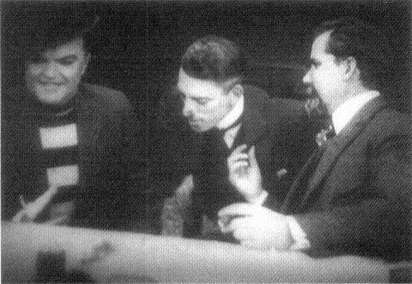
12. Broadway comedian Victor Moore, in the title role of Chimmie Fadden
Out West (1915), buries his scruples and agrees to a dishonest investment
scheme plotted by Eastern businessmen. (Photo courtesy George
Eastman House)
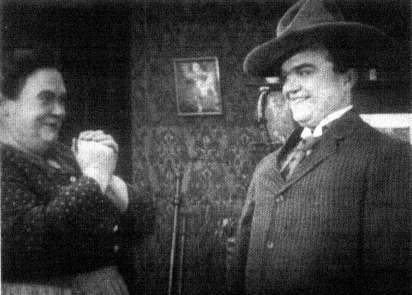
13. As the Irish tough, Moore exchanges his bowler for a cowboy
hat and elicits the admiration anad hopes of his proud mother
(Mrs. Lewis McCord). (Photo courtesy George Eastman House)
wedding ring and is comforted by his mother. She removes his bowler, takes his hand, and kisses him on the cheek to signify both approval of his good deed and sympathy for his plight. A cut to a medium shot at the Van Cortlandt mansion, where the Duchess has resumed her duties as a maid, shows her listening to news about Chimmie's heroic action. DeMille moves his camera in for an even closer medium shot as he next cuts to the Duchess entering the dimly lit apartment to reconcile with her despondent lover. Addressing the audience he greeted during the credits, Chimmie exclaims, "Wot d'ye mean—I lost my gold mine!" and embraces the Duchess before a fade-out.
Among the first Lasky Company films to merit a review in the New York Times, Chimmie Fadden Out West drew a favorable notice for Victor Moore's acting and for humor that proved "a picture may be funny without even a single Chaplin kick." Also attesting to the success of the comedy, the New York Dramatic Mirror noted that it "called forth roar after roar of laughter."[39] Although the Chimmie Fadden series as nonslapstick comedy represented a departure for DeMille, melodrama subverted laughter so that a morality tale could be told. Class and ethnic antagonisms were thus resolved in a sentimental manner, ensuring that the audience experienced moral certitude as well as emotional uplift. At the conclusion of the first film in the series, Chimmie is accused of theft when he is caught returning goods stolen from the Van Cortlandt mansion by his brother Larry. Paranoia about the lower orders, it should be noted, characterized several films in which middle- and upper-class residents find their homes invaded by thieves. Class reconciliation is stressed, however, as the Van Cortlandts agree not to prosecute Chimmie's delinquent brother. In Chimmie Fadden Out West , thievery exists in a more sophisticated form as financial transactions in a capitalistic economy. A good-natured Bowery lad, Chimmie finds himself surrounded by corruption not only among Eastern businessmen but among frontier lawmen. Yet his honesty and decency prevail in the end.
DeMille's adaptation of the Chimmie Fadden stories defuses the issue of social injustice by focusing on the morality of sterling characters like Chimmie. Particularly noteworthy is the personification of Protestant or "old" middle-class values by slum inhabitants whose class and ethnic traits are otherwise a source of amusement. Such a narrative strategy has several implications worth considering. On the one hand, feature film adaptations based on romantic realism mediated the urban experience for middle-class audiences. A flood tide of immigration that peaked in 1907 intensified a resurgence of nativism and xenophobia as well as racism among native-born Americans, including the elite. Partly an impulse to impose order on a chaotic metropolitan landscape, realistic representations objectified the "Other" for genteel consumers touring slum areas as exotic sites. Film narratives such as the Chimmie Fadden series, moreover, focused on lower-class characters who were not only reassuringly comical but ethical as well.
On the other hand, features produced for the appropriation of sophisticated audiences in first-run theaters also became part of a preexisting plebeian film culture. A variety of working-class and ethnic subcultures undoubtedly mediated the reception of feature film adaptations at local exhibition sites. The issue of what constitutes humor for different cultural groups was particularly relevant for the Chimmie Fadden series because lower-class spectators may not have found the Irishman as amusing as patrons at downtown movie palaces. Indeed, the sequel's failure to attract as large a number of filmgoers as were flocking to Geraldine Farrar films led Lasky to conclude, "We think the name of Chimmie Fadden is keeping the people out of the Theatres."[40] Chimmie was most likely an unfamiliar character among uneducated audiences, but therein lay the limitations of marketing features based on highbrow intertexts consumed by the genteel classes. Yet as entrepreneurs succeeded in expanding film production based on middle-class aesthetic and ideology, a process of homogenization previously resisted by workers and immigrants began to occur, even as they were cinematically defined as the urban "Other." Contrary to their hostility to genteel reformers intent on shaping recreational activities, the lower classes became enthusiastic patrons of commercialized amusement.[41] Feature films, in other words, functioned as a primer on middle-class values for the lower orders being counseled to Americanize and assimilate.