
3
Hedging Bets in a Time of Troubles:
Algeria, 1830–1849
While they were in power
The Turks were the elites among men
Each fort had its garrison.[1]
The decades immediately preceding the French expedition of 1830 are usually characterized in the literature, both colonial and recent, as the nadir of Turkish rule in Algeria.[2] However, this dismal picture must be fundamentally modified. True, the regime in Algiers suffered in comparison with Tunisia, where the Husaynid dynasty was firmly embedded in the country's political culture. And the military oligarchy of the deys and beys had always been short on religiomoral legitimacy since, unlike Morocco's 'Alawi dynasty, the Turks enjoyed little Islamic justification for their rule. Moreover, the departure of the Spanish from Oran in 1792 meant that Algiers could no longer claim to be the bulwark of Islam against the infidels. Ironically, after the deylical regime's collapse, the populace lamented the passing of the Turks; collective hopes for deliverance by the Porte remained in force until late in the century.
It can be maintained, however, that the Turkish-Algerian state was in a process of consolidation by the early nineteenth century; in the Constantine, the hereditary principle was emerging as the beys formed alliances, including matrimonial, with prominent Arab families.[3] If some historians now argue that an Algerian state—a peculiar kind of state—was in existence prior to 1830, none deny that profound reversals in the arena of Mediterranean commerce and politics had occurred.[4] As aggressive Western nations transformed the Mediterranean into a European lake, privateering, formerly so lucrative for Algiers, was eclipsed. To make up for declining revenues, the central government increased fiscal demands upon the countryside and upon groups normally excused from taxation or only lightly taxed. The shift from the earlier laissez-faire approach in governing to a more interventionist style met with radical, rural-based opposition. While the incidence of rebellion has been employed as a
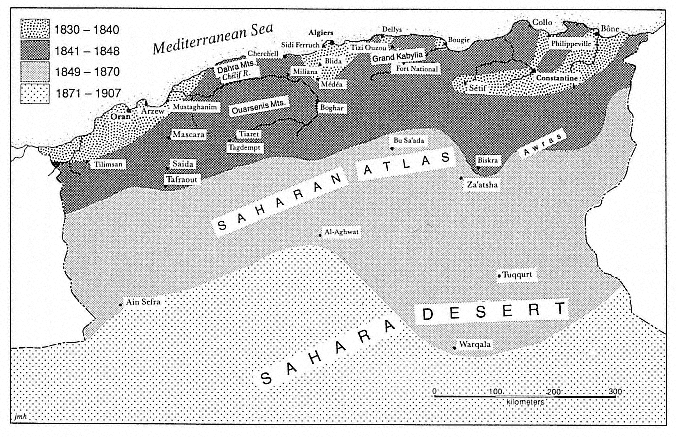
4.
The stages of French conquest. Reproduced from John Ruedy, Modern Algeria
(Bloomington: Indiana University Press, 1992), by permission of Indiana University Press.
compelling index of a state in crisis, the same evidence could be marshaled to argue that revolt was the response of communities striving to retain older traditional autonomy vis-à-vis a progressively more powerful center.
Rebellious activity was particularly fecund in the Oran, although the Kabylia and other parts of the Constantine also experienced local resistance. In both areas, insurgency was frequently led by militant religious figures, often of popular origins, who enjoyed tribal support. A case in point is the series of uprisings that shook western Algeria between 1783 and 1805. Initially tax revolts, these movements came under the headship of the nascent Darqawiyya sufi order (named after al-'Arabi al-Darqawi, died 1823) whose recruitment gave expression to the grievances of ordinary people in the countryside. By 1805, the stakes had been substantially transformed. The leader of the Darqawiyya in western Algeria, 'Abd al-Qadir b. al-Sharif, together with the major tribes, announced his intent of conquering the entire regency.[5] Only the energetic military intervention of Oran's newly appointed bey wrested the province from the insurgents, although the movement endured in one form or another until 1827—three years before the arrival of the French expedition.
While the Constantine was also the scene of periodic rural tax rebellions, the uprising of 1804–1807 was quite another matter for it had implicit mahdist undertones. Inspired by a Kabyle Darqawi sufi muqaddam, this full-scale revolt was greatly aided by a local Rahmaniyya shaykh, Zabbushi, from the region of Mila. Sidi 'Abd Allah Zabbushi mobilized large numbers of combatants, largely by appeal to Rahmaniyya tariqa loyalties; the rebels nearly succeeded in taking Constantine.[6] As significant were the undercurrents of millenarian fervor, particularly evident in this uprising. The tradition of collaboration between some rural sufi leaders and chiliastic figures, popularly regarded as saviors from injustice, would endure throughout the nineteenth century. Therefore traditional modes or styles of collective political action remained in force, in some cases until the early twentieth century.[7]
Before the Fall: The Pre-Sahara, c. 1800-1830
Peter von Sivers has emphasized the complexity and efficiency of the Turkish governmental apparatus, rather than its rudimentary nature, for it "was a complicated mechanism with at least five different levels of administration going from completely dominated, tribute-rendering populations to independent tribes authorized to trade in Turkish-held markets."[8] The pre-Sahara was no exception to this. In control of Biskra by the mid-sixteenth century, the central government employed the oasis as an advance post to achieve the submission, however tenuous, of more distant
desert cities. Biskra served as the seat of power for the shaykh al-'arab, whose fortified residence was situated on a hill commanding the principal irrigation canals bringing water into the gardens. Thus, the oasis, and the Ziban in general, marked the fluid limits between effective Turkish rule and that of Saharan princes and tribal strong men.[9] Moreover, here contests for power tended to coalesce around the position of shaykh al-'arab.
While the Mzabi cities jealously guarded political (if not economic) independence, al-Aghwat, Tuqqurt, and Warqala were within reach of military units dispatched from Biskra. Until the late eighteenth century, Algiers left these desert entrepôts to local dynasties that rendered tribute in exchange for trading rights in Turkish-held markets. The government traditionally employed market strategies to bring the recalcitrant to heel. Particularly vulnerable were the oases and mountains, places also serving as havens for fugitives, bandits, and rebels. A blockade of strategic markets brought temporary submission and the rendering of tribute or hostages. (The French army adopted similar market strategies in its pacification of both the Kabylia and pre-Sahara.)[10] In addition, periodic expeditions to the Ziban, Wadi Righ, and Warqala reminded the fractious Saharans of Turkish authority. Nevertheless, until the eighteenth century, the returns from military intervention in the desert were scarcely worth the investment in resources.[11]
Then the traditional arrangement of force in the pre-Sahara was profoundly altered as military and fiscal activity increased. This rearrangement was partially a response to dwindling revenues from privateering, which made the oases relatively more attractive sources of revenue. The years 1785, 1788, and 1826 witnessed tax-collecting forays into the area between Biskra and Warqala. Similar sorts of fiscal pressure were exerted upon the western Sahara, culminating in sieges of the Tijaniyya stronghold in 'Ayn Madi in 1788, 1820, 1822, and 1827. These assaults upon the Tijaniyya tariqa in the Oran shaped the later political stance of that sufi order's notables toward the colonial regime.[12]
In addition to the threat of force majeure and market manipulation, the political center employed other means to coax rebellious oases into yielding tribute. Military contingents might divert the water supply from gardens or destroy precious date-palm trees until the insurgents sued for peace. This same tactic was used by the French army in the 1849 Za'atsha conflict, although without achieving the desired effect.[13] In the Constantine, the beys intervened more directly into desert politics by sowing dissension among regional strongmen. In this scheme, the post of shaykh al-'arab afforded endless possibilities for meddling in local struggles.
Theoretically, the bey governed the entire province in the name of the dey of Algiers. However, the exercise of day-to-day authority in the pre-Sahara devolved upon the shaykh al-'arab, an official normally residing in Biskra. Under him were seven great Arab tribes; the shaykh also enjoyed administrative authority over sedentary oasis populations in the region stretching from the Ziban to Tuqqurt, some two hundred kilometers below Biskra. Along with this office went the lucrative privilege of leading the winter mahalla in its annual tax-collecting duties. In return, the shaykh remitted a variable proportion of the revenues extracted, which fluctuated in accordance with the makhzan's coercive force. As was true for the Tunisian Jarid, the mahalla coincided with the autumn months when transhumant tribes descended from the Tell to the desert to search for pasturage and participate in the date harvest.[14] From the middle of the sixteenth century, the office of shaykh al-'arab was monopolized by a single clan, the Bu 'Ukkaz, an Arab tribal elite claiming descent from the Banu Hillal; since the medieval period, they had provided secular shaykhs to the southern Constantine. To counter the clan's excessive power, Salah Bey elevated an upstart lineage, the Banu Ghana to the post of shaykh al-'arab. The Bu 'Ukkaz's fall from grace upset the age-old distribution of power and meant that "the history of the [eastern] Sahara was reduced to the struggles of these two families, which the Turks supported alternately in accordance with the principle of divide and rule."[15] Employing an economy of means to rule, the beys rarely mounted military expeditions against an incumbent fallen from favor. Instead they appointed a rival clan leader to the coveted position; whoever succeeded in holding the passages between desert and Tell during the tribal migrations was subsequently invested in office.
Predictably struggles over the position found expression in the play of two saffs, or political leagues. Fallout from the saff conflict shook the Ziban, the Suf, and even oases as far south as Tuqqurt and Warqala. Biskra's inhabitants deserted the older town to disperse into a number of small hamlets scattered in the palm gardens for protection. Interminable factional strife among the ruling clans of Tuqqurt (the Jallab dynasty) and Warqala (the Allahum family) also implicated these rich oases in the Banu Ghana-Bu 'Ukkaz quarrels. Their disputes even extended into the Suf, where one coalition of oases allied itself with Tuqqurt and the Banu Ghana, another with Tammasin and the Bu 'Ukkaz. From the late Turkish period until well into the colonial era, political contests in the pre-Sahara were shaped by the intense rivalry for the office of shaykh al-'arab expressed in the war of the saffs.[16]
Nevertheless, the incessant rivalry over this office, lasting well beyond the Turkish era, constituted a significant statement about "traditional" Algerian political culture. It reveals not chaos and anarchy—as later colonial commentators would have it—but rather that indigenous elites competed fiercely for a recognized station within the prevailing system of power. Indeed, the ancient prestige associated with the shaykh al-'arab was too firmly embedded in Saharan political behavior for either the Amir 'Abd al-Qadir or local religious notables, like Hasan b. 'Azzuz, to overcome—even when battling the French occupiers.[17]
However, as long as the binary principle was operative, strife could be more or less managed by professional neutrals, such as Rahmaniyya sufi notables or local saintly lineages. Once a third locus of power, the colonial army, was introduced after 1830—one outside of the system at first and thus unpredictable—the role of mediators became more complex, reconciliation more difficult to achieve.[18] Indeed, in 1842 Sidi 'Ali b. 'Umar, head of Tulqa's Rahmaniyya clan and the leading sufi shaykh of the Sahara, lost his life in a mediation attempt during a three-way struggle involving the saffs and their French opponents.
Fly Whisks and Empires: The Fall of Algiers
By the eve of the 1830 conquest, order had been restored and the rebellions put down, and political calm reigned for the most part in Turkish Algeria. The real danger was not so much from within but from neighbors across the sea. Despite muted calls by some French commercial interests to rid the Mediterranean of "Algerine piracy," few prior to 1827 in Europe or the Maghrib anticipated that France would soon acquire an African "département."[19] As the Napoleonic Wars ended, France's days as a global imperial power seemed to be waning. The loss of first Canada and then India during the Seven Years' War of 1756–1763 made France a second-rate colonial power, with only small commercial enclaves in Africa, Asia, and the West Indies.
Then the French stumbled into Algeria. Eventually the North African state represented an emblem of Great Power status, a measure of national and international dignity, regardless of Algeria's economic value or cultural compatibility with the Metropole.[20] Ultimately, the impetus for new colonial holdings, particularly in the Maghrib, the Sahara, and West Africa, was to no small degree dictated by the obsessive drive to defend the oldest of France's Afro-Mediterranean colonies. In reality, the Scramble for Africa was unleashed by an imprudent dey's fly whisk in 1827 and not, as some historians of imperialism claim, a half century later.[21] Yet France was imprudent as well. Compared with other imperial ventures, Algeria's sub-
jugation demanded the most lavish expenditure of men and materials—far greater than Britain's conquest of India. Prior to the expedition, it was calculated that no more than ten thousand troops would suffice to take Algeria; by 1847, one hundred thousand French soldiers were committed to the unfinished task of "pacifying" a population estimated at no more than three million.[22]
For obvious ideological reasons, colonial apologists maintained that the Algerian state, if indeed such existed, was tottering in 1830. Rather, the botched nature of the early French occupation, and the fierce resistance encountered, transformed Algeria into a contest state for decades.[23] Yet continuities in styles of rule and contestation persisted, principally because the French military consciously emulated their Turkish predecessors in erecting a system of domination for a country four times larger than France. The fall of Algiers was a rude shock not only to the capital's inhabitants but also to most in the regency, the Maghrib, and the Islamic world.[24] The dey's capitulation created a sauve qui peut mentality among traditional elites and notables, who scrambled to turn events to their own advantage. Collective opposition to the invaders was frequently combined with, or even overshadowed by, rebellions against the remnants of the Turkish ruling caste as well as ancient intraelite quarrels. The state was effectively up for grabs; yet paradoxically, those most absorbed in seizing the state were not at first the French invaders—or so it seemed to the Algerians. France's vacillations over the fate of its African prize were mirrored by military commanders in the field, whose equivocal proclamations, behavior, and policies betrayed a lack of resolve. Moreover, had not the Spanish been driven from Oran within recent memory? Could not the same destiny await the French?[25] Thus, the single most representative response on the part of many indigenous leaders was a wait-and-see position, an expression of bet hedging, which conferred considerable room for political manipulation and maneuvering. Gradually, two large-scale attempts at state building emerged: in the east, Ahmad Bey's effort to resurrect an Ottoman bureaucratic state; and in western Algeria, 'Abd al-Qadir's markedly different program of a classical tribal-based theocracy.
The Oran was the scene of the first concerted drive to right the toppled political order. Amir 'Abd al-Qadir's movement drew upon the religious legitimacy and organizational structure of the influential Qadiriyya sufi tariqa and the tribal traditions of the Eghris Plain near Mascara. Recognized in 1832 as sultan by the powerful Banu Hashim, the Banu 'Amir, and part of the Awlad Sidi Shaykh, the amir embarked upon a complex four-pronged program. First, he attacked French-held positions in Oran, while soliciting moral and material assistance from the Moroccan sultan, Mawlay 'Abd
al-Rahman. At the same time, he endeavored to bring to submission Algerian tribes refusing to render tribute and thus acknowledge his authority. In addition, 'Abd al-Qadir clearly saw that control of key trading ports and towns was critical for the economic health of his fledgling state; commercial channels with Europe had to remain open to obtain needed military supplies, particularly gunpowder and firearms. Finally, the amir's dealings with the French, both in Algeria and the Metropole, displayed remarkable sophistication. Through agents, he followed debates in France over Algeria's political future and sought to bargain with local French authorities when negotiations yielded more tangible gains than did outright confrontation.[26]
The amir's approach to diplomacy and collective action served as a template for the political behavior of both secular and religious elites elsewhere in Algeria. Indeed, in the early 1850s, the Sharif of Warqala emulated the amir, after paradoxically fighting against 'Abd al-Qadir on France's side.[27] The complexity of 'Abd al-Qadir's statecraft—apparent accommodation combined with stalwart resistance and behind-the-scenes maneuvering—served to keep French commanders off guard and conferred strategic advantage.[28] As 'Abd al-Qadir's jihad gained momentum in the Oran, other experiments in reconstructing the state occurred in eastern Algeria.
The startling news that Algiers had fallen into infidel hands stirred the people of Constantine to action. By then the city's populace, under the Banu al-Fakkun's leadership, had attained an advanced, perhaps new, level of political maturity. During the tumultuous era stretching from 1792 to 1830, religious notables assumed increasingly public roles in the political fortunes of the city and province. These decades were characterized by revolts (in 1792, 1808, and 1817) or by sieges successfully repulsed (in 1804 and 1807) which politicized even ordinary people as well as making the Banu al-Fakkun more powerful than ever. Soon after the invasion, the capital's notables reinvested Ahmad Bey, who had been in office since 1823, as their ruler under the terms of a charter, specifying obligations and taxation procedures; the charter was signed by the ulama, shaykhs, and amins of the corporations.[29] All in the city, humble and mighty alike, looked hopefully, if vainly, to Istanbul for assistance.
The support of urban notables and temporizing by the Porte, combined with the political void created by French bungling, encouraged Ahmad Bey to carve out his own kingdom. To do this, rivals had to be eliminated, particularly in the pre-Sahara, where struggles over the office of shaykh al-'arab continued unabated, and with mounting ferocity. Thus, one force for political continuity between the Turkish and colonial eras was the
persistence of these struggles. And the southern Constantine was one of the few regions where the two experiments in state formation, the amir's and Ahmad Bey's, collided.
The 1831 Siege of Za'atsha
The people of the Ziban are restless and turbulent in character and much inclined toward fanaticism; the beys were obliged on numerous occasions to resort to great severity in repressing revolts, which at times required the use of imposing force.[30]
Events in the north had an immediate resonance in the Ziban's oases. Yet politics in the desert were governed by the implicit principle of risk avoidance, which was dictated by the region's ecology, demographic realities, and the firepower available to indigenous leaders. There were limits to the amount of resources in men and materials any side would commit to a particular struggle; such was not, however, the case with the French army.
Ahmad Bey's nemesis, the Bu 'Ukkaz, led by Farhat b. Sa'id, employed the confusion of the 1831–1832 period to ensconce their forces in the Ziban, establishing headquarters in Tulqa. As always, the objective was to seize the post of shaykh al-'arab. The choice of Tulqa was also dictated by traditional strategic concerns. Holding this oasis conferred mastery over those tribes whose migratory regime traversed the Ziban and the gorge of al-Qantara. With Farhat b. Sa'id blocking the passages into the northern Constantine, the tribes had only one option—to fight with the Bu 'Ukkaz against the bey. Commanding superior forces with greater firepower, Ahmad Bey's forces, together with the Banu Ghana, chased most of the rebels out of the region for the moment. The victors then turned upon the unrepentant oasis of Za'atsha, which still sheltered tribal dissidents.[31]
Many small oases in the Zab Dahrawi—Tulqa, al-Burj, Za'atsha, and Lishana—were scarcely distinguishable from one another since their gardens abutted upon neighboring plantations; contiguity was frequently the source of bitter conflicts over shared water resources. Yet, during outbreaks of rebellion, as in 1831 and 1849, contiguity offered strategic advantage to villagers and tribal allies seeking to repulse outside forces. Like al-Burj, Za'atsha was surrounded by a water-filled moat and protected by sturdy walls surmounted by square towers pierced by narrow openings for firing upon assailants. Lost in a dense palm grove, the oasis was deemed impregnable by the Zab Dahrawi's inhabitants, who had always employed it as a fortified refuge. Moreover, the people of Za'atsha, who traditionally joined forces with adjoining Lishana, were regarded as intrepid warriors.[32]
While most of the Ziban's inhabitants, including the Awlad Ziyan of Tulqa, had sued Ahmad Bey for peace, Za'atsha and Lishana, feeling secure behind their walls, opted to fight. To test the rebels' resolve, the bey ordered his troops to cut down the date palms. This was not only a provocative but also a symbolically significant act. For the reaction elicited would reveal the depth and nature of grievances, signaling if mediation by religious leaders was probable. Rejecting arbitration, the two villages escalated the struggle, forcing the bey to lay a full-scale siege. Manipulating defense works effectively, the rebels inflicted such heavy losses upon the attackers that the siege was lifted. The investment in men and gunpowder was not worth the returns. As Ahmad Bey retreated north into the Tell, Farhat b. Sa'id, "the serpent of the desert," retook Biskra; the Ziban, the eastern Sahara, and the coveted post of shaykh al-'arab were his.[33]
The 1831 clash represents an important preface to the 1849 uprising because it was here that Bu Ziyan first earned a reputation for himself. Due to his energetic organization of oasis defenses, skills as a marksman, and leadership capabilities, Bu Ziyan proved instrumental in repulsing the attack. He would later draw upon the fund of prestige acquired in 1831 to advance claims as the mahdi, solicit public recognition by Rahmaniyya notables, and challenge the French colonial state. While this confrontation laid some of the groundwork for the later rebellion, it was principally a repeat performance of age-old clashes which tended to follow an established dramatic script. The Ahl b. 'Ali and Ghamara tribes, who owned the means of production in the small oasis, fought with the Bu 'Ukkaz league to repel the bey and his allies, the Banu Ghana.[34] Unlike the 1849 revolt, the 1831 resistance was a defensive type of collective political action whose main goal was to retain long cherished autonomy.
Between 1831 and 1849, however, the stakes changed drastically, although some of the traditional tactics and strategies endured. The earlier resistance lacked a religious basis, and local Rahmaniyya leaders were not involved in either the contest itself or its resolution; nor was there any hint of millenarian fervor on the part of the besieged. The 1849 movement was no longer solely defensive but was also offensive in its aims—to seize power and initiate the realm of justice as embodied by the mahdi. In the eighteen intervening years, traditions of oasis defense were gradually merged with mahdist ideology; bet hedging was no longer acceptable political behavior. If the 1831 clash created a local folk hero, Bu Ziyan, the next decade and a half undermined age-old mechanisms for managing conflict. The traditional alignments structuring the saff quarrels would eventually be upset by the entry of both the French army and the mahdi into the fray.
Unholy Alliances, 1831–1841
The history of the Biskra region is of great interest. By knowing the principal families of the area, their hatreds, their alliances, their vendettas, we are better able to govern them. An intimate knowledge of the history of a conquered country often aids the conqueror to avoid mishaps and disasters.[35]
Between 1832 and 1837, when the city of Constantine fell to General Valée's army, the saff-based struggles in the pre-Sahara became more complex. Disappointed by the wavering support of his protégé, Ahmad Bey broke with the Banu Ghana's chief, thus creating a triangular struggle for control of the Ziban.[36] In 1837 three important events transpired. One was the conquest and sack of Constantine, which had serious economic and political consequences for the entire province, north and south. Second, the leaders of the two leagues sent out feelers in 1837 to French authorities seeking military assistance against Ahmad Bey, according to the principle "the enemy of my enemy is my friend." At first these overtures encountered evasive response because of the colonial policy of limited occupation. Moreover, the governor-general, Valée, believed that the crucial theater of operations lay in western Algeria, where the Treaty of Tafna had been signed in 1837 between Amir 'Abd al-Qadir and the French government. Finally, that same year the amir attempted to extend his authority into the southern Constantine.[37]
The fall of Constantine was important for a number of reasons. Besieged by two French military expeditions in 1836 and 1837, resistance was organized and led by urban religious notables. When continued armed opposition became futile, the terms of defeat were negotiated by Shaykh al-Fakkun, the shaykh al-balad (head of the municipality). His son, Hammuda, was named qa'id (administrator) by the French and henceforth acted as a conduit between the city's Muslim inhabitants and its new masters.[38] Thus, for religious notables elsewhere, the city of Constantine represented one model for proper political behavior when coping with rapidly changing circumstances. Significant is the fact that popular protest was first mobilized and given shape by the city's leading religious families. Then, mutatis mutandis, as the wheel of fortune turned in a different direction, they agreed to negotiate with the occupiers; accommodation was surely viewed as a temporary expedient.[39] After 1837 collective hopes for redemption increasingly centered upon the great city by the Bosphorus.
Most Algerians, both ordinary and elite, looked to the Porte for deliverance. If the local Turkish oligarchy had been regarded as oppressive by
those outside of the small ruling circle, the Ottoman sultan represented the mightiest Muslim monarch and thus a potential savior. Prior to the siege of Constantine, rumors that an Ottoman fleet was headed for the Maghrib swept through Algeria. This news persuaded Ahmad Bey to suspend negotiations with the French over Constantine's political fate; Istanbul would rescue the country from the infidels. While the Ottoman navy was held off near Tripoli by a French naval squadron, the belief that military intervention by the Porte was forthcoming remained in force for much of the century. This belief also fed into the wellsprings of collective political action, encouraging resistance—or at least rumors about revolt.[40]
The misfortunes of 1837 convinced 'Abd al-Qadir that future prospects for peaceful coexistence with France were bleak. He used the reprieve created by the Treaty of Tafna to extend operations into eastern Algeria. At this juncture, the Bu 'Ukkaz's leader sought to induce the French to recognize his family's inherent rights to supremacy in the Ziban. Yet French military officials demurred, being acutely aware of their profound ignorance of the region's political geography. Failing at this, Farhat b. Sa'id then briefly threw in his lot with 'Abd al-Qadir. The amir seized this opportunity to gain a foothold in the pre-Sahara and appoint khalifas (deputies) to administer the population and collect taxes in his name.[41] Hasan b. 'Azzuz, whose family origins were in some respects similar to 'Abd al-Qadir's, was instrumental in persuading the amir to follow this course of action. From al-Burj, the warrior-saint corresponded with 'Abd al-Qadir, describing the injustices wrought upon the Ziban's inhabitants by Ahmad Bey and the Banu Ghana and pleading for a new master. Significantly, the amir, whose clan had long been Qadiriyya sufi notables, also became a member of the Rahmaniyya tariqa. While piety may have been one motivating factor, 'Abd al-Qadir's main objective in joining the eastern province's most powerful sufi order was to gain support from Rahmaniyya leaders and enroll their popular followings under his banner.[42]
In 1839, Hasan b. 'Azzuz visited 'Abd al-Qadir at his headquarters in Médéa and was named khalifa of the Zab Dahrawi; the amir arranged for a military escort to accompany 'Azzuz back to the Ziban and install him in office. At the same time, 'Abd al-Qadir chose Muhammad al-Saghir b. Ahmad b. al-Hajj, a scion of a privileged saintly lineage in the oasis of Sidi 'Uqba, as his representative in the Zab Sharqi. Muhammad al-Saghir hailed from a powerful religious house claiming descent from 'Uqba b. Nafi' and venerated as the most eminent of the Zab Sharqi's ashraf (plural of sharif; designates a descendant of the Prophet Muhammad's house).[43] The amir's choice of local religious notables to represent his cause was wholly consonant with administrative policies in Oran, where a tradition of combined
political and religious leadership had long existed.[44] However, such was less the case in the pre-Sahara, where the influence of the shaykh al-'arab—as either the focus of political loyalties or of contestation—was firmly embedded in local political culture. Moreover, the exercise of religious as opposed to political authority tended to be distinct in the Constantine.
As a result, neither Hasan b. 'Azzuz nor Muhammad al-Saghir was able to overcome the secular power of the Banu Ghana or the Bu 'Ukkaz in the eastern Sahara. Finally in 1840, 'Azzuz, lacking expertise as a military tactician, was roundly defeated near the strategic al-Wataya pass by forces loyal to the Banu Ghana. As always, the goal was to occupy the passages between Tell and desert which conferred mastery over migratory tribes and caravans laden with military stores and food supplies. The humiliating rout suffered by Hasan b. 'Azzuz seriously compromised 'Abd al-Qadir's jihad in the Ziban. More ominously, in 1841 General Bugeaud arrived back in Algeria as governor-general, and the earlier policy of limited occupation was discarded in favor of occupation totale; the era of French imperial uncertainty had ended.[45]
Despite Hasan b. 'Azzuz's short, unsuccessful tenure in office as a khalifa of the amir's fledgling state, the experiment was significant for its failure. It represented an effort, albeit a vain one, by a member of a prominent saintly lineage to fuse religious authority, political influence, and military might. However, 'Azzuz's demise was not merely the product of ineptness combined with the dominance of the saffs. Several incidents from the 1838–1840 period reveal the dilemma facing those who attempted to wield both sacred and profane power. Here some of the implicit and culturally constructed norms governing political behavior by religious notables are revealed.
In 1838 the Bu 'Aziz tribe, allied with the Banu Ghana, were trapped by Hasan b. 'Azzuz and his forces in the small oasis of al-'Amri. Al-'Amri was situated near al-Burj, seat of the Rahmaniyya zawiya administered by the 'Azzuz clan; most of the villagers were tariqa members and clients of the 'Azzuz. The Bu 'Aziz too were affiliated with the Rahmaniyya; many had been initiated into the sufi order by the great Shaykh Muhammad b. 'Azzuz or by his son Mustafa. Membership carried with it the right of protection and the duty of mutual assistance and respect. Had not the order's founder commanded the disciples in his sufi manual, al-Rahmaniyya , to "treat your [sufi] brothers well and serve them"?[46]
Caught between military concerns and the bonds of sufi kinship, 'Azzuz hesitated to attack the Bu 'Aziz. Into the impasse came the saint and Rahmaniyya shaykh of Tulqa, Sidi 'Ali b. 'Umar, who offered to arbitrate the conflict. In keeping with the tradition of the saint as mediator and
adjudicator, Sidi 'Ali effected a compromise agreeable to all parties. The Bu 'Aziz paid blood money to 'Azzuz to compensate for the loss of warriors and defected from the Banu Ghana's league. Further turmoil was avoided, the oasis was spared a siege, and 'Azzuz's prestige was maintained.[47] In this instance, sufi ties prevailed over saff allegiances. Since a consensus still existed regarding the terms of saintly negotiation, the Rahmaniyya shaykh of Tulqa was able to hammer out a truce.
Sidi 'Ali's intercession saved Hasan b. 'Azzuz, but the warrior-saint's salvation was short-lived. The use of unstinting force to subdue the Ziban's inhabitants ultimately provoked a bitter quarrel within the 'Azzuz clan itself, one implicating other religious clans as well. Ceding to his troop's demands for war booty in 1838, Hasan b. 'Azzuz attacked a tribal fraction which had opted for neutrality. In doing so, 'Azzuz alienated the influential shaykh of Sidi 'Uqba, Muhammad al-Saghir, a fellow khalifa serving 'Abd al-Qadir's cause. Muhammad al-Saghir opposed waging war against neutrals and publicly expressed his conviction.[48] Thus in southeastern Algeria, the amir's movement was beset by internal strains similar to those in the Oran.
Hasan's actions also drew the opprobrium of some members of his own family, who may have disapproved of the efforts to conflate strongman politics with religious authority. One of Hasan's brothers, Muhammad, at the time the Rahmaniyya shaykh of Sidi Khalid and later the head of the order's zawiya in al-Qayrawan in Tunisia, was an intimate of the Shaykh of Sidi 'Uqba. Muhammad b. 'Azzuz sided with Muhammad al-Saghir and a family quarrel ensued. Mustafa and Muhammad b. 'Azzuz, the clan's two most powerful Rahmaniyya leaders, broke with their brothers, Hasan and Mabruk. A heated discussion at the family zawiya in al-Burj led to an abortive assassination attempt by Mabruk against Muhammad.[49]
The eruption of violence at the heart of a prominent religious family was shocking to the communit; it left the 'Azzuz deeply divided when harmony among local notables was needed. Later Mabruk b. 'Azzuz, the youngest of Sidi Muhammad's eight sons, sought vengeance upon his brothers, particularly Mustafa. During the revolt of the Sharif of Warqala, Mabruk agreed to act as a paid French informant, providing information to military authorities in Algeria and Tunisia regarding his brother Mustafa's political activities in the Jarid.
Together these two incidents provide an unusual glimpse into sufi politics during a time of social turmoil and political uncertainty. They reveal the implicit codes of moral conduct incumbent upon religious figures, codes that conflicted with the dictates of profane contests for power. Hasan b. 'Azzuz's reluctance to wage battle against fellow Rahmaniyya members suggests that tariqa loyalties might override saff allegiances. If
attacking league opponents, who were also family clients by virtue of sufi ties, was morally repugnant, then battling neutral tribes under the patronage of revered religious figures, such as Muhammad al-Saghir, was perilous. Once he had forfeited the moral backing of the Ziban's leading notables, 'Azzuz's movement—and by extension the amir's—was doomed.
Moreover, armed aggression by one member of a privileged saintly lineage upon another was popularly viewed as a scandalous act. Intrafamily disputes may have compromised the 'Azzuzes' prestige among some of their clients in the region. It might also explain in part why the Rahmaniyya shaykhs of Tulqa eventually supplanted the divided 'Azzuz clan, although Mustafa b. 'Azzuz's departure for the Tunisian beylik in 1844 shifted Rahmaniyya leadership to Sidi 'Ali b. 'Uthman. Finally, while Shaykh Mustafa's departure was primarily motivated by the Islamic duty of hijra, family quarrels in al-Burj could have made emigration a more attractive course of action.
The Perils of Saintly Mediation
In 1842 as the tribes moved north to summer pasturage, two armed contingents met before Tulqa: on one side was the shaykh of Sidi 'Uqba, Muhammad al-Saghir, still serving the amir; against his forces were ranged those of the Banu Ghana.[50] Following the lead of Tulqa's Rahmaniyya notables, one half of the oasis's population had declared support for the Banu Ghana; the rest joined the other saff now under Muhammad al-Saghir's leadership. Those in the latter league were from the "ahl Tulqa," who had long been subjected to the dominance of the Awlad Ziyan. In fact, bitter strife among Algeria's great warrior families had sparked small-scale revolts all over the country against local potentates, like the Awlad Ziyan, as well. The "ahl Tulqa" publicly signaled their rejection of the political order by murdering their shaykh, a member of the Awlad Ziyan, as he made his way to the Rahmaniyya zawiya. Tulqa's rebellious have-nots then petitioned the shaykh of Sidi 'Uqba to rule them while those villagers in the opposite league joined the Banu Ghana in giving battle; numerous casualties ensued.[51]
Seeking to avoid further bloodshed, Sidi 'Ali b. 'Umar, then head shaykh of the Saharan Rahmaniyya, offered once again to mediate as he had earlier done for 'Azzuz in 1838. Followed by a solemn retinue of sufi notables and brothers, Sidi 'Ali emerged from the entrance of the Rahmaniyya center located near the town's central marketplace. This was the kharja , the ritual processing of a sufi notable and his retinue from the zawiya that inaugurated festive religious occasions. His religious clients bore the banners of Sidi 'Ali's family and the Rahmaniyya tariqa; the procession's ceremonial vocabulary was a symbolically charged component of the peacemaking
process. Yet the ritual of socioreligious reintegration was cut short. No sooner had the saint and sufi crossed the threshold of his zawiya then a stray bullet struck Sidi 'Ali in the breast, killing him instantly. Sidi 'Ali's murder was accidental; the bullet had been intended for the leader of the hated Awlad Ziyan. Terror stricken, the shaykh of Sidi 'Uqba ordered his forces to retreat immediately. To kill a sufi leader was to invite God's wrath; those responsible fled in panic. The battle for Tulqa was postponed, and the Banu Ghana subsequently took possession of the region by default. Sidi 'Ali b. 'Umar was buried in the family cemetery attached to the Rahmaniyya center.[52] His death brought a change in the order's leadership.
Following the pattern of alternating succession between the two leading Rahmaniyya families, the post of head shaykh reverted back to the 'Azzuz clan in 1842. That honor went to Sidi Muhammad b. 'Azzuz's favorite son, Mustafa, who had been tutored by Sidi 'Ali b. 'Umar at Tulqa, and who was the defunct saint's brother-in-law. Because of the baraka inherited both from his father and his spiritual preceptor, Mustafa b. 'Azzuz's headship of the Saharan Rahmaniyya, though short-lived, met with approval by the order's notables and rank and file. As the French officer investigating political conditions in the region after the seizure of Biskra in 1844 reported: "The Ben Azzouz [sic ] exert enormous influence over the populations in and nearby to the oasis [of al-Burj]."[53]
The Two Sieges of Biskra, 1844
Even before Hasan b. 'Azzuz had been eliminated from the political stage and prior to Sidi 'Ali's death, the leader of the Bu 'Ukkaz, Farhat b. Sa'id, had withdrawn his support for 'Abd al-Qadir; defecting to France's side in 1838, he was rewarded with the post of qa'id for the pre-Sahara. While this was as yet an empty office—the pre-Sahara was completely outside of French control—still the entry of the colonial army into the tangle of desert politics eventually brought the temporary collapse of the saff mechanism. The defection of some tribal elites to the French camp also spelled the doom of the amir's movement, although these desertions should be read as another expression of bet hedging. For tribal big men, like Farhat b. Sa'id, the aim was not so much to advance France's cause as to manipulate support from the French military to overcome local indigenous rivals.
By the end of 1843, 'Abd al-Qadir's jihad was faltering; he was forced to retreat into Moroccan territory, where he requested asylum. General Bugeaud's crusade for total occupation and his scorched-earth policy had shattered the amir's movement. From this period on, his partisans could only muster local solutions to the problem of local order. Moreover, the continual turmoil ravaging the pre-Sahara convinced French authorities in
Constantine that a military expedition to the Ziban was imperative. In 1844 for the first time a colonial army crossed through the Awras via the al-Qantara pass, arriving at the gateway to the Sahara in March; this represented the earliest direct French contact with desert peoples. Led by the Duc d'Aumale, several thousand soldiers took the oasis of Biskra after a brief siege; organized resistance was minimal since many had fled at the army's approach. Remaining in Biskra only two weeks, the duke hastily improvised a rudimentary administrative apparatus which drew consciously upon Turkish modes of control. The real exercise of power was conferred upon the Banu Ghana, who had solicited the office of shaykh al-'arab from the French. Believing the Ziban sufficiently pacified, the expeditionary force withdrew late in March 1844, leaving behind a handful of French officers commanding units of indigenous (tirailleurs ) troops.[54]
The political and administrative system devised by the Duc d'Aumale to govern the unruly pre-Sahara was modeled upon colonial practices in the north, where a resident Arab khalifa supervised a largely sedentary population of peasants and townspeople. Conditions in the desert, however, were quite different. The Duc d'Aumale's failure to appreciate those differences ultimately led to disaster.[55]
The Ziban was far from pacified. Two months later the entire French garrison—some 116 European soldiers—was massacred by the native troops, who mutinied. The soldiers then joined together with a contingent of rebels from the oasis of Sidi 'Uqba under Muhammad al-Saghir, whose large popular following in the pre-Sahara owed more to his family's ancient religious notoriety than to association with the amir. The mutiny and revolt brought a second siege of Biskra by a French army dispatched from the northern Constantine in May of 1844. Outnumbered and lacking artillery, the shaykh of Sidi 'Uqba and his forces prudently retreated into the Awras, which represented a no-man's-land that sheltered dissidents for decades to come. Fearing reprisals, a large number of Biskra's inhabitants followed Muhammad al-Saghir into exile. The next year, they left the Awras for Tunisia, seeking asylum with Shaykh Mustafa b. 'Azzuz at his Rahmaniyya zawiya in Nafta. Between 1845 and 1849, the shaykh of Sidi 'Uqba remained in the Jarid; once rumors of revolt reached him, he and his followers returned to the Ziban to take part in Bu Ziyan's movement.[56]
Learning a lesson from the 1844 debacle, the French army built a fort in Biskra on the site of the old Turkish garrison, created a permanent military presence for the pre-Sahara, and set up a customs office.[57] Three years later the oasis boasted a Bureau Arabe supervising some 125,000 people in the vast expanse between the southern Awras and Tuqqurt. Biskra became the chef-lieu of a cercle encompassing the eastern Sahara and
attached to the subdivision of Batna; a commanding officer governed largely through local indigenous chiefs and religious notables.[58] The heavy reliance upon Algerians—instead of Europeans—was due to the fact that prospects for settler colonization, based upon capitalist control of resources, were slim at best. What amounted to indirect colonial rule over an immense swatch of territory could be accomplished only by co-opting native cadres, a solution that offered advantages but carried perils as well. Between 1840 and the late 1850s, military authorities strove to fashion a loyal indigenous aristocracy in areas where Europeans declined to dwell. This failed to yield the expected fruits—easy pacification of traditionally unruly areas such as the mountains and desert. Instead the political instability and uncertainty created by this aristocracie manquée were decisive elements in repeated outbreaks of unrest, drawing France into local struggles for power deep in the Sahara and toward the borders with the two adjoining states.[59]
Emigration, Avoidance Protest, and Accommodation, 1843–1849
The responses of local religious elites to Biskra's occupation were far from monolithic, in part because repeated clashes among indigenous political actors had sowed dissension even before the French drive into the pre-Sahara. The diversity of reactions was molded by changing perceptions of the invaders and their intentions, by traditional relations between religious clans or between tribal leaders, by news and rumors from elsewhere, and by geographical location vis-à-vis Biskra, which at first represented but a tenuous colonial outpost.
In Tulqa, the Rahmaniyya shaykh Sidi 'Ali b. 'Umar had been characterized as "hostile" to France and to the colonial regime.[60] However, the shaykh's death in 1842 was traumatic for his clan and had unequivocally demonstrated the dangers inherent in acting as a power broker. In addition, the massacre of Biskra's garrison in March 1844 placed the saints of Tulqa in somewhat of a quandary. The only Frenchman to survive the disaster was Major Pelisse. Pelisse had been visiting prostitutes from the Awlad Na'il tribe in Biskra's red-light district when the surprise attack came and was spared; sensuality had its rewards. major Pelisse, together with the French-appointed qa'id of Biskra, a member of the Banu Ghana, sought asylum in Tulqa's Rahmaniyya zawiya. Because of the duty of protection, which sufi centers extended to all seeking refuge from harm, Shaykh 'Ali b. 'Uthman (the dead saint's nephew and successor) was obliged by custom to receive the two men.[61]
Sheltering the French officer may have represented a first, tentative gesture of accommodation by Tulqa's religious notables; the colonial re-
gime chose to read it as such. Once order had been restored in Biskra by May 1844, the Banu Ghana, longtime friends of Sidi 'Ali b. 'Uthman's family, received the coveted post of shaykh al-'arab. Thus, the politically circumspect stance of Tulqa's Rahmaniyya shaykhs toward their French masters, who in any case governed through local elites, emerged in this crucial period. The Bu Ziyan uprising and its destructive aftermath would only prove the wisdom of cultural survival through neutrality for the Rahmaniyya clan of Tulqa. Moreover, the contours of an implicit pact can also be detected—one establishing a quid pro quo relationship between local sufi notables and French military officers residing in nearby Biskra. As long as order was maintained, there was to be little colonial interference in the socioreligious activities of the sufi zawiya or its members.
Other religious lineages in Ziban followed suit; Sidi 'Abd al-Malik, head of Biskra's most powerful saintly clan, submitted to the French army in 1844 under circumstances similar to those obtaining in Constantine seven years earlier.[62] Sidi 'Abd al-Malik's extensive oasis properties may also have encouraged him to support (or not openly oppose) whoever appeared capable of restoring calm. As important was the Duc d'Aumale's appointment of his nephew to an administrative office.[63] Older religious quarrels were partially at work, too. Sidi 'Abd al-Malik's clan had long been spiritual rivals of Sidi 'Uqba's shurafa' headed by Muhammad al-Saghir; apparently rule by the Banu Ghana was preferable to that of saintly competitors. Finally, location played a not insignificant part in determining the political behavior of Muslim notables. If Biskra hosted a formidable French military presence, the rest of the Ziban was not yet fully subdued. Those outside of Biskra had a marked advantage in maneuverability over those residing within the oasis.
Biskra's fall provoked further splits within the 'Azzuz family of al-Burj; some elected to remain in the region; others chose avoidance protest as a course of action. After Sidi 'Ali b. 'Umar's death in 1842, Mustafa b. 'Azzuz acceded to the post of head Rahmaniyya shaykh. For political and religious reasons, Sidi Mustafa soon chose to abandon his homeland and his ancestor's zawiya. After the French army retook Biskra, he and a group of tariqa disciples emigrated to the Tunisian Jarid to seek the protection of the Husaynid Bey, Ahmad, and fulfill the Islamic duty of hijra from infidel-held lands. Based upon later participation in the 1849 revolt, other Rahmaniyya leaders, such as Shaykh al-Mukhtar of the Awlad Jallal, who stayed behind, were scarcely reconciled to the new political order of things.[64]
In Khanqa Sidi Naji, Shaykh 'Abd al-Hafiz chose neither flight to a neighboring Muslim country nor apparent accommodation. His form of avoidance protest was a mode of political behavior adopted by many in
Algeria and later in Tunisia after 1881—withdrawal. To escape contamination by the infidels, the shaykh retreated into the isolation of his zawiya in the Jabal Cherchar, where according to popular rumors, he had himself enclosed in a coffin. Here physical retreat gave expression to ritual norms concerning pollution and religious purity. Whether the rumor concerning the coffin was taken as fact by the shaykh's following, or rather interpreted metaphorically, his actions had immense symbolic meaning and may have done much to shape collective behavior. In effect he became a "social banner," signifying rejection of foreign rule. However, once Bu Ziyan unfurled another banner—that of the mahdi—Sidi 'Abd al-Hafiz would be compelled by his disciples to relinquish retreat as a stratagem for coping.[65]
What was the reaction of ordinary people to the arrival of the French on the desert's rim? If information for provincial religious authorities in this period is sparse, sources for nonelite responses, aside from rebellions, is even less abundant. It appears that ordinary people—cultivators and tribespeople—sought the counsel of their religious leaders in deciding upon a particular course of action. This was seen among Tijaniyya clients in the eastern Sahara. The shaykh of the Tijani zawiya in Tamalhat (near Tuqqurt) was Sidi 'Ali b. 'Isa (died 1844), then spiritual leader of the entire tariqa. As the Duc d'Aumale's army approached Biskra for the second assault, delegations from the Suf, Tuqqurt, and Biskra were sent to Sidi 'Ali b. 'Isa seeking his guidance. The Tijaniyya shaykh preached calm and submission, informing the delegations that "God gave Algeria to the French; it is He who protects their domination. Remain in a state of peace and do not make war. God has delivered you from your oppressors [the Turks] who observed no law but that of violence."[66]
Sidi 'Ali b. 'Isa died a few months later. His son and later head of the Tijaniyya order, Muhammad b. al-'Id (1814–1876), while outwardly reconciled to French rule, engaged in behind-the-scenes political activity against France during the Sharif of Warqala's revolt in the early 1850s.
Secular political leaders in the desert chose strategies similar to those of local religious notables. In the Wadi Righ, the sultan of the Banu Jallab also recognized French suzerainty in 1844. In exchange for the right to purchase grains in French-held markets, Tuqqurt's princes rendered a modest annual tribute. The terms of the agreement were almost identical to those customarily concluded with the Turks. Seen in retrospect, Tuqqurt's obeisance was an expedient device, imposed largely by economic necessity; in any case, the colonial regime's presence was scarcely perceptible south of Biskra.[67] The same was true for many tribal leaders in the Awras and other inaccessible parts of Algeria; infidel rule was temporarily accepted until the
strength and intentions of the conquerors could be tested.[68] Here, too, 'Abd al-Qadir's example of momentary acquiescence to superior forces may have had a determining influence. Another critical factor was risk avoidance, dictated not only by ecological and demographic realities but also by the availability of military supplies, particularly contraband gunpowder and European firearms. Finally, political behavior and decision making on the part of religious notables and secular leaders were influenced to no small degree by the kinds of information available to them. And Algeria reverberated with rumors.
Saharan Trade and Commerce in an Era of Uncertainty, 1830–1849
Nearly two decades of unrelieved strife in the pre-Sahara placed intolerable strains upon the already precarious agrarian and pastoral economies. The 1837 conquest of the eastern province's center, Constantine, brought further economic dislocation as well as outbreaks of cholera; in 1838 severe drought occurred. In 1846 an invasion of locusts devastated crops, and the "drought which visited the pre-Sahara during [the previous] winter . . . almost completely destroyed the harvest."[69] From the 1831 siege of Za'atsha until 1845, pitiless raids were inflicted upon oasis dwellers and pastoralists by the warring saffs. Thousands of date palms and fruit trees were destroyed; flocks and herds were lost as well. Even the villages of the distant Suf were not spared. Between 1835 and 1841, the princes of Tuqqurt mounted several military expeditions to the Suf, resulting in the partial destruction of gardens. When the French official, Prax, visited Al-Awad in 1847, he was struck by the devastation.[70] Finally, as first the Banu Ghana and then the Bu 'Ukkaz momentarily claimed the post of shaykh al-'arab, tribute was extracted from the hapless populace.
Taxation is a disputed element in debates over the causes for the Za'atsha uprising. Some colonial writers maintained that injudicious tampering with the ancient fiscal regime after 1844 was to blame for political discontents. Others categorically deny that taxation was a causal factor. What can be ascertained is that the new French-appointed qa'ids and their subalterns went about tax-collecting duties with unaccustomed energy; in some locales, the impositions were extraordinarily heavy.[71] Surplus extraction, which had earlier been a matter of bargaining and negotiation as well as contention, was now regularized. In addition, social groups traditionally exempt, particularly religious notables, were included on fiscal rolls, while others were arbitrarily granted exemptions. Moreover, French military officials in Biskra unwisely increased the tax assessed per date-palm tree by at least 50 percent and, worse still, applied this assessment uniformly
without consideration of productive capacity.[72] These measures forced some families to sell their plots—or the rights to the produce of the gardens—to meet the new more onerous fiscal obligations.[73]
Among the groups most adversely affected were the Ghamara, the chief property holders in Za'atsha. It was this lineage, part of a larger tribal fraction, which later formed the backbone of Bu Ziyan's rebellion; they provided combatants and provisions and pressured nearby pastoral nomads to join the revolt. By the eve of the insurrection, French-decreed changes in taxation had been integrated into the popular rumor mill; some rumors had it that the burdensome taxes would be repealed. The very fact that ordinary people were exchanging information on fiscal matters is significant and suggests that economic grievances were part and parcel of public opinion.[74]
Colonial policies also adversely affected local, regional, and transregional trade currents; while total occupation was the declared objective after 1840, the French military lacked the means to achieve that occupation. As discussed in chapter 1, the seasonal movements of the pastoralists between Tell and desert was, under the Turkish regime, a more or less orderly and strictly supervised operation. Turkish authorities would only permit the tribes to move down to their winter pasturage in the Sahara grouped together in units under the guidance of the shaykh al-'arab, whose task was to guarantee order. From 1830 on, that vast movement of peoples and herds was increasingly chaotic; struggles erupted among the tribes, migrating willy-nilly, which adversely affected all along the migratory route.[75]
Merchants are rarely risk takers but rather strive to minimize risks whenever feasible; one method for doing this is to devise alternative trade channels. In this period, trade, which had traditionally linked the oases of the Algerian pre-Sahara to the northern Constantine via Biskra, shifted to the Tunisian Jarid; that is, commodities previously procured from cities such as Algiers and Constantine were increasingly sought in Tunisian markets, to the benefit of traders and producers there. Continual unrest in the region between the northern Constantine and the Ziban discouraged commercial exchanges, encouraging the tribes of the southern Constantine to rely upon the Jarid to supply firearms, gunpowder, and other manufactured products.[76] The reliance upon southwestern Tunisia for products no longer readily available in parts of Algeria, as well as the emigration of Algerian tribal and religious leaders to the beylik, ultimately drew Tunisia into across-the-border politics and social movements.
Moreover, the older symbiotic relationship between oasis producers and pastoralists appears to have suffered a number of rude shocks between 1830 and 1849. Nomadic peoples had always served as intermediaries between
oasis producers and distant markets in northern Algeria, particularly for the triangular exchange of dates, textiles and raw wool, and wheat. The large numbers of soldiers in Algeria stimulated an insatiable demand for wool which was reflected in exceedingly high prices for woolen products. Attracted by the higher prices, some traders and pastoral groups preferred to sell wool in French-held markets rather than supply traditional customers—oasis or village weavers who used the proceeds from textile production to provide for household needs, for exchange, or to pay taxes and ensure subsistence.[77]
Equally ominous for all Muslims, but particularly for members of the ulama and the sufi turuq, were the decrees of 1843 and 1844, a product of increased European settlement and demands for land. These placed hubus lands, or pious endowments for the collective good of the Muslim community, under the administration of the Domaine, which then, by denying the inalienable legal status of these properties, made them available for purchase by settlers. The appropriation of the hubus was regarded as an attack upon Islam and upon the religious notables who had traditionally administered these properties.[78] In places like the Ziban, where hubus properties were numerous and characteristically held by the major sufi zawaya, when those properties were not seized they were subjected to taxation for the first time.[79]
In addition, changes in demography and the institution of slavery may have contributed to social disorder and created a sense of collective grievance. By the middle of the century, the slave trade through Algeria was languishing for a number of reasons; slaves from Bornu and Hausaland were mainly sent to Morocco and Tripolitania. Tunisia outlawed slavery and the slave trade by 1846 through a series of measures enacted by the bey.[80] In Algeria, slaves were predominantly female and employed mainly in domestic service by the great families. The number of slaves in the colony was relatively low—somewhere between eight thousand and eighteen thousand in the 1840s, compared with an indigenous population of about three million. Nevertheless, "the possession of slaves had more of a psychological than economic importance. The owning of slaves was an index of the master's wealth and increased his social standing."[81] Some of the Bureaux Arabes reports from the pre-Sahara observed that the abolition of slavery in April 1848 was an unpopular measure among local elites. Indeed, Bu Ziyan himself had been involved in a violent confrontation with French authorities over a female slave whom the authorities forcibly removed from his household.[82] Moreover, labor was in short supply in many parts of Algeria due to exceedingly high mortality rates, mainly provoked by military pacification, deteriorating health conditions, and disease and famine.
The pre-Sahara had suffered cruelly from the 1835 cholera epidemic that decimated much of the Constantine. The pandemic, which began as early as 1827 in Asia, may have been introduced to the Maghrib by merchants and pilgrims returning from the East. The French army was also beset by cholera; large-scale troop movements throughout Algeria spread the disease far and wide.[83] Its effects upon the densely populated oases was devastating. In some villages, like al-Burj, Za'atsha, and Lishana, many of the sedentary cultivators were carried off; in some places, pastoralists from the surrounding area took over abandoned gardens and houses. Demographic catastrophes had depleted the Ziban, which despite its ancient traditions of rebellion, made the region appear incapable of sustained resistance. According to Carette, writing in 1839, the population was "diminished to the point that they totally lack political potential and would be unable to fend off a French attack."[84]
So it seemed in the decade prior to the Za'atsha uprising. In the winter of 1849–1850, cholera reappeared in the southern Constantine in the wake of the French army's advance. For a while at least, the epidemic was a boon to the insurgents during the long bitter siege.
By the eve of Bu Ziyan's millenarian movement, many indigenous political actors had either been defeated, exiled from the country, co-opted by the colonial regime, or had withdrawn momentarily from politics. The bid by one member of the region's leading sufi clan, Hasan b. 'Azzuz, to conflate religious authority with secular power had failed singularly. Other religious notables had taken flight or retreated into temporizing and bet hedging. The ancient saff mechanism for managing conflict had been destabilized and political energies dissipated in endless struggles. For the most part, the French army had not been directly involved in these struggles, being preoccupied with the amir's jihad in western Algeria. Colonial authorities generally watched from the sidelines as native opponents slugged it out. French support was, however, offered to one side and then another, which was read by many Algerians as an index of colonial indecision at best, at worst as pusillanimity.[85] As one Bureau Arabe officer reported from Biskra in 1846:
It is better to provide ample support to the shaykh al-'arab since it is practically impossible for a French officer, no matter what support he has been given, to replace the influence of the shaykh which has been in place for centuries; it is dangerous to attempt to place our flag in the midst of conflicts and disorders that, for so long, have divided the tribes of the south.[86]
Then in December 1847, 'Abd al-Qadir surrendered to the Duc d'Aumale and was sent into exile with his partisans; the next year Ahmad Bey was
captured along the borders between Algeria and Tunisia by the French army and imprisoned.[87] Collective hopes for the re-creation of various kinds of Islamic states in eastern and western Algeria were extinguished. That same year, 1848, the Second Republic was proclaimed in Paris; the new constitution stated that Algeria had the special status of French territory unlike the rest of France's colonies. Nevertheless, the disorders accompanying the Second Republic's troubled birth in the Metropole had an immediate resonance in Algeria's cities, bringing uncertainty about France's intentions in North Africa; some Algerians interpreted the burst of pro-republican sentiments in Algiers as a sign that an immense shift was under way. The mahdi's path was clear.
Toward Za'atsha: The Master of the Age
By 1848 unbearable pressures had been brought to bear upon those regions of Algeria where colonial rule was not yet firmly implanted but indigenous governing institutions had been partially uprooted.[88] Moreover, popular traditions of protest gradually fused with elite disaffection; the removal of the tax-free status, traditionally enjoyed by religious notables, meant loss of privilege and income. As important, however, was the rapidity of the various changes imposed by the colonial regime without prior knowledge of local conditions. As Herbillon observed during the siege of Za'atsha: "We entered much too precipitously into the internal affairs of the peoples of the south."[89] Sudden, precipitous shocks to a social order and economic system are one of the preconditions of rebellion, particularly when "adaptive or survival strategies" no longer secure a morally grounded subsistence level.[90] And prophets (and rumors) tend to arise in periods of intense social disorder and chaos marked by a "pervasive sense of the unpredictable."[91]
Most of the Constantine's traditional secular leaders—the Muqrani of the Majana, Turkish officials, and leaders of the great saffs—had been compromised in nearly two decades of unrelieved fighting; their rivalries had inflicted material and moral duress upon the pre-Sahara. While contests for power in these decades were expressed in the vocabulary of the saff principle, as more contestants crowded the political stage, the conventional framework for politics was eroded, only to collapse just prior to Bu Ziyan's rebellion. Moreover, local conflicts had prompted some groups—such as the ahl Tulqa—to attempt to overthrow the traditional hierarchy.
The French military's erratic meddling in as yet unfamiliar political terrain intensified social turmoil, particularly the politique des notables . Hastily elaborated by French officers without consideration for customary practices, this policy only heightened administrative disorder. In some places obscure holy men, seduced by offers of minor posts, were elevated to positions of authority over autonomous tribal groups. Singularly un-
prepared to assume these duties, and lacking support, local saintly figures met with resistance. As one French military officer remarked in 1844 "the shaykhs of the tribal noblesse militaire in the Awras and Hodna feel humiliated by their political subjugation to the authority of a marabout appointed by the Duc d'Aumale."[92] The politique des notables was not only resoundingly unsuccessful in restoring a semblance of normality, it fueled further discontent, not only in the Ziban but also in the adjacent Awras and Hodna.[93] The very social order itself was at stake.
After fifteen years of French colonial rule, Algeria—or many of its regions—was more of a contest state than ever. This created a political environment conducive to radical kinds of solutions to the problem of social order and justice. And since the mahdi was from outside that contested state, collective hopes for salvation became riveted upon the Muslim redeemer. Popular millenarian traditions had long associated widespread chaos—the world turned upside down—with the mahdi's appearance. And in the eighteenth century, a powerful desert saint, Sidi al-Aghwati, had, through his prophecies devoted to the savior's appearance in time, fused the mahdi's advent with the degradation of infidel rule in the collective consciousness.
In many parts of Africa and Dar al-Islam, beliefs regarding the redeemer's imminent arrival heightened at the eighteenth century's close.[94] Moreover, these expectations were found both among the simple and the erudite; while they existed mainly in the rich oral traditions, they were also found in texts. As discussed in the previous chapter, this phenomenon can in part be linked to the onset of the thirteenth Muslim century. Nevertheless, the mahdi as a social actor has always been a vital, if at times subterranean, component of political life in North Africa. From roughly the time of al-Kurtubi (died 1272 A.D.), the Maghribi traditions held that the mahdi would first appear in the Sus region of southern Morocco, perhaps in the ribat of Massa, prior to his journey to Mecca to receive "a second oath of allegiance."[95] The privileged place accorded to the western Maghrib in eschatological lore concerning the mahdi is significant; until the present century, certain groups in North Africa still looked to Morocco or the Sahara as the site from whence the long awaited one would arise.[96]
Particularly influential in the Sahara were the prophecies of Sidi al-Aghwati, the venerated holy man from the oasis of al-Aghwat. In his writings and visions, the saint miraculously foresaw that the infidels would invade the Maghrib. After several decades of humiliation at the hands of the unbelievers, the mahdi would deliver the faithful from oppression and establish the realm of justice. According to Sidi al-Aghwati's widely believed predictions, the date of that event of cosmic significance was the year
1271 A.H./1854 A.D. The timing of the redeemer's arrival was inextricably linked with the degradation of infidel rule.[97] And Sidi al-Aghwati's prophecies were both read and disseminated by word of mouth well into the nineteenth century.[98]
Human and natural disasters, along with social and political upheaval, forged an overwhelming sense of the unpredictable among many North Africans. And collective expectations of the mahdi's imminent arrival—as well as rumors of such—appear to have intensified that sense of the unpredictable.