
Michel Deguy
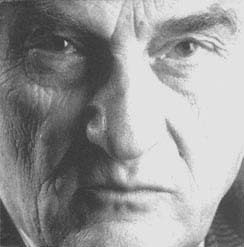
Michel Deguy was born in Paris in 1930. He is professeur des universités with a chair in aesthetics and literature and a past president of the Collège International de Philosophie. His publications include books of poetry: Fragment du cadastre (Paris: Gallimard, 1960), Tombeau de du Bellay (Gallimard, 1973), Donnant Donnant (Gallimard, 1981), Poèmes, 1970–1980 (Gallimard, 1986); and books of criticism: Figurations (Gallimard, 1969), La Poésie n'est pas seule (Paris: Seuil, 1987), Le Comité (Seyssel: Champ Vallon, 1988), L'Hexaméron (Seuil, 1990), Au sujet de Shoah (Paris: Belin, 1990). He has translated Heidegger and Paul Celan as well as, with Jacques Roubaud, edited and translated 21 poètes américains (Gallimard, 1980). Editor in chief of Po&Sie, he also directs the collection "L'Extrême contemporain" at Editions Belin and is on the editorial boards of Les Temps modernes, Critique , and Temps de la réflexion .
Selected Publications in English:
Given Giving: Selected Poems of Michel Deguy . Translated by Clayton Eshleman, with an Introduction by Kenneth Koch. Berkeley: University of California Press, 1984.
"O Great Apposition," "The Eyes," "Alluvium," "When the Wind," and "The Wall," translated by Clayton Eshleman; "You" and "It's Between Ourselves," translated by Anthony Rudolf. In The Random House Book of Twentieth-Century French Poetry , edited by Paul Auster, 506–13. New York: Random House, 1982.
"Sibyllaries," from Recumbent Figures . Translated by Jacques Servin and Wilson Baldridge, in collaboration with Deguy. In Violence of the White Page: Contemporary French Poetry , edited by Stacy Doris, Phillip Foss, and Emmanuel Hocquard. Special issue of Tyuonyi , no. 9/10 (1991): 56–58.
Serge Gavronsky: I often think of you as perhaps one of the greatest travelers in the world of letters! You have carried off something quite unique in maintaining that energy which is yours, whether you're writing poetry, literary criticism, or philosophic essays. As the founder and director of Po&Sie, you have also been committed to the translation of poetry from, let us say, all languages that have given rise to poetry. Could you talk about this continuing interest in translation, and perhaps in so doing connect it to your other activities?
Michel Deguy: First of all, it corresponds to a personal history and so requires a bit of autobiography—but only as relevant to the matter at hand! In my background, in my Bildung , philosophy, poetry, and translation clearly coexist as a triad without any order. What I mean is that there wasn't philosophy and poetry and, in parentheses, translation. This may appear slightly disconcerting, but for me, translation was not a more-or-less transparent middle position, a "go-between" [said in English], but was itself on a par with poetry and philosophy. In my past experience, philosophy consisted in a translational reading of German philosophy; poetry itself moved in translation toward philosophy while held within a linguistic relationship, that is to say, within literary works, making it simultaneously simple and difficult. Translation was there, on the same level, equally important. It was never in an ancillary position. Thus it assumed the strange status of an intermediary or a middle ground that is as much one of the terms of the relation as the relation itself. Perhaps, to take this notion further, it would be interesting to find out to what extent each of those terms is also the name of the relation between the two others—with philosophy playing the middle role between translation and poetry, and poetry between philosophy and translation. I think that's where my interest comes from!
Of course for us, when we were young, Latin and Greek were the languages that projected us into other languages; so translation was the experience of Greek and Latin, languages we call dead—and we should perhaps reconsider this label: after all, what is a "dead" language? That is where my experiences began, and then came Ger-
man and English. Thus, I'd have to point to some sort of archaeological relationship with "dead" languages. Could translation be another way of naming Greek and Latin? In my triad I call it translation, but I might as easily call it Greco-Latin before it became English/German. And here, unfortunately, I cannot add an et cetera , though I should note that in earlier years it might have been easier than I thought to enter into another language, especially a related language. I was seventeen when I first went to Spain. At that time I said I couldn't understand a thing, yet ten or twenty years later I read a Spanishlanguage newspaper without, obviously, having learned the language. At bottom there is a sort of familiarity with foreign languages, as long as they belong to the same family. That knowledge can function without any academic preparation.
So much for my own story! Now, as for the magazine, I can only say that at its source lies a relation between language and literature. Languages exist for writers only insofar as there are literary works in them—a literature within literary languages, let's say—and that can only come about when a language is able to welcome great literary works from other languages. Let us take an easy example (and I know some would not agree with me, but they're not here!): one could say that Breton is not a language or, rather, not a great language—but then again, perhaps here I'm only talking about so-called great languages. Breton? To the great despair of many, why is there no language here that might have allowed one to say, in the same breath, French, Breton, Provençal, etc.? Because, by my criterion, Breton is not a language. Well, it's a fact: Breton never welcomed a translation of Goethe, for instance, or Dante. A language-literature that has the capacity of receiving masterpieces of other languages is of one texture. It all goes together. It was in this light that the project for the magazine was sketched out.
Translation, therefore, is not an accident. It is, as you have said, the energy that emanates from the continued relation among languages, among great languages, through this obligation of receiving one another's literary works, past and present. That's the situation.
And what does it mean? It implies, especially at this moment, that is, at the decline of the twentieth century . . . I think a lot of writers feel this way, that all great languages are in a state of dangerous simplification. A certain menace is weighing on languages: a relation to English—not just to any English, but to a form of international English. What has happened to the sentence? What happens to the sentence when it becomes the little politicians' sentence or the screen sentence on computer terminals? What has happened to the sentence in all languages? Thus, something one might call conservation and defense has arisen. Of course, that's not the only concern, either of the magazine or of concerned writers. We are not merely conservationists in a conservatory, but I believe there is that aspect of a very deep commitment to conservation, or, if you will, of memorization, of rememorization. To confront a menace that is an attitude. This commitment is not, I should emphasize, reactionary, or even reactive; it is meant to protect—in a word, to shelter, as Heidegger would say. To maintain the language in its literary works: this is important because it leads us to the past of many languages. But I should be a bit more modest: the magazine's scope is limited to a few Indo-European languages belonging to the same family, although we have published some Chinese translations. It is not a closed magazine; for example, my friend Adonis, an Arab poet, has contributed a text to Po&Sie. We're open, but in fact in most cases, our texts are the roses of the languages of Paris, whose stems are those of our neighbors.
SG: Your choice of words, conservation and defense, alludes to Joachim du Bellay's Défense et illustration de la langue française (1549). You yourself have authored a work entitled Tombeau de du Bellay . Correct me if I'm wrong, but in your desire to emphasize the place of translation, both in your own thought and in the identity of the magazine, is there an ambition, similar to du Bellay's, of ornamenting the French language through the practice of translation? That is, of not only making French readers discover or rediscover texts of the Renaissance but also, through translation, proposing poems that, because of their difficulty, are examples of the densification of language and contrib-
ute to the reemergence of language, assuring its vitality. Translation there by becomes a means of perfecting the tools of language.
MD: In listening to you, it occurred to me that the defense we're talking about has nothing to do with the sixteenth century, as we shall see, since in that day the concept of defense was really a question of transforming the vernacular into a great language through the practice of imitation—paraphrasing du Bellay's "double bind" [said in English], he might have said: In order to imitate, I do not imitate; I do as the great authors of the past have done, and thus I stop imitating the greatest authors. Defense, today, has become more complicated! But what might be the most troubling and important topic is the "perfecting" that you have just mentioned. In fact, do we want to say that a language such as French, one of the ten languages that has produced masterpieces, has not achieved its perfection? Surely it has, since so many great works have been written in it and so many great works from other languages translated into it. One might then ask what the meaning of perfection is. Let me try to find an example. What strikes me is this: it's an equivocal situation. Some literary critics complain of the lexical or terminological wealth of a given writer. It is quite simple to accuse a literary person, for in France, literary is a pejorative term: "It's too literary!"
SG: Too rhetorical?
MD: Yes, it's too rhetorical to use rare and erudite words, but at the same time they fail to consider that nothing is as neologistic as socalled common journalistic language. What we're supposed to do today, with the greatest of ease, is invent signs, not words. Journalistic language is in ferment. It picks up capital letters and makes signs out of them; it gathers words from foreign-language newspapers—the director of a TV channel recently said, "L'avion a crashé." And what about people who say they're going to "tannize" themselves? We are in a state of fermented, corrupted lexicalization. But at the same time critics call attention to the fact that a writer uses such and such an old word, or uses a neologism in his poem in a rather erudite fashion, and this they condemn. In the end, everything is a struggle! Is that
perfection? I don't know, but there should be an attitude of vigilance against signmaking, the dangerous semiotization of language, as well as against language inventions founded on old forms—neologisms as they have always been practiced.
SG: In the final analysis, if a language is "great," if it is a living language (and thus does not merely duplicate the image of a dead language), isn't it always characterized by this particular dialectic—by the efforts of some to assimilate new terms or ideas and make of them new expressions and, simultaneously, the efforts of others to criticize such practices, bent on continuing their task of refining the language? If what you say is true, this condition might be seen as a very good sign, not as a moment of crisis! People are conscious: they react; they do not exclude foreign expressions; they do not seek to "Etiemblize" the language without, at some point, seeing they might thereby weaken it. Even if the writer-critic Etiemble has gone on the warpath against the Americanization of the French language, the language has always been enriched by this process of assimilation!
MD: That's true, but it's a question of reterritorialization, of reappropriating a foreign element that enters into the language. Here is an example: one of the actual menaces weighing on all languages is a form of desyntaxation. Conservation and literary invention would then imply an effort to reaffirm syntax, to play in its favor, to encourage syntactical complexity and obstacles. This is hardly a form of purism, of academic interest, because spoken speech, in the past—I think we must add that—was heavily syntaxed. Thus it's not a question of "correct" versus "incorrect" syntax, but of the use of certain locutions, such as "des fois que . . ." which used to be current and which are, as they're called, syncatégorèmes : subordinating words, syntactical pivots that go very well with the specificity of the language. What I mean is that one must fight for syntax within the spirit of the language in its popular state, and against a way of speaking that may be taking the upper hand and which, though some might call it "popular," is in fact not within the spirit of the popular medium. Thus the conservation of language would be joined with another motive, that of re-
maining within the order of the popular nature of language, in all its particularities, all the while noticing that it too tends to die out.
SG: Could you talk about the writing of poetry in France today? With everything you've just said, could one now characterize the way French poets react to language, without necessarily going into names or schools? How does this concept of reterritorialization affect contemporary writing?
MD: A current direction that is much bruited about goes something like this. "There's a return to . . ."That is to say, there is in the wind a return to the lyrical, even the elegiac.
SG: And the narrative?
MD: The narrative, too, yes; but then again that's a very complicated question since, quite simply, in the word narration there are two strands, one going in a certain American direction and the other going back to older modes, to a period, not that far gone, when the poem wrote itself as it told its story—let's say, Victor Hugo's "Légende des siècles," or autobiographies. I don't know whether there is a return to narrative; if there is, I don't know whether it has a future, because I don't believe that poetry can continue through a narrative direction. That doesn't mean theme—a thematic, a something about which one writes and thinks—is excluded, but I don't believe that narration—the telling of a story—on the poetic level, with names of people, or in the lyrical mode or the elegiac I mode, can be done today. To quote Mallarmé, "Nature takes place, and we cannot add to it."[*] Narrative poetry has been worked over; we can't really add to it. But in any case, it's in the wind.
I believe something has occurred: the various successive experimental movements have, to some extent, worn out poetry—that is, made the relation between reader and poetic text difficult, made the relation impossible. There was a movement that consisted in exterminating, in systematically excluding the thematic, the narrative, even
[*] "La Nature a lieu, on n'y ajoutera pas" (" La Musique et les lettres," in OEuvres[*] complètes , Pléiade ed. [Paris: Gallimard, 1945], 647).
the syntactical, the lyrical, even the rhythmical, since, after all, repetition, iteration—that which allowed us to recognize what was a poem, essentially a principle of rhythmical repetitions—had been eliminated. In the end, how does one recognize a poetic text? What kind of pleasure will there be in reading a poetic work? What will one find under the rubric of poetry that cannot be found elsewhere, whether this "elsewhere" is fiction or the literary pages of anthropology when, all of a sudden, an anthropologist speaks to us about death and desire? We must be very cautious here. The poem, as a form of linguistic acrobatics, must take shelter, even if by ruse, under something recognizable—a story, or something to do with action in time, something that has a narrative element to it. But I take that to be a pretext and an alibi. The poem might present itself as something "hanging," like a shirt on a clothesline; the narrative thread would then be this clothesline on which, attached by clothespins, lots of things would be hanging. I follow the line and find the poem, the surface, and then I go back to the line and pass to the next poem. Perhaps in that sense there must be a line, a return to rhetoric. After all, that is one of the ruses, a savoir faire , to make the poem readable again, to allow readers to listen once again to the French language. I don't know if that is indeed happening, but if it is, it's useful. As for a panorama of contemporary poetry, that's a more difficult question.
SG: Let me break in for a minute. Do you see, as a poet and as a professor of French literature, a particular mode of French poetic writing? A constant? When you talk or write about it, do you see something that has eliminated other possible poetic forms—as happened, for instance, with those historical poems of Alfred de Vigny's, after they gave way to Baudelaire? Do you think that French poetry today, and as it has been practiced through the mid-eighties, has somehow sealed its identity in relation to fiction?
MD: But the seal is complicated since, at the heart of it, the distinction between prose and verse was explicitly refused—or if not refused, at least forced to vanish. As Mallarmé noted, as soon as there is rhythm, there's verse. In that sense, listening to the dance of language, its
forward movement in prose, one already sees a poem passing by. That, too, Mallarmé taught us. But the same Mallarmé was still writing sonnets and regular verse and, at the same time, the so-called poèmes de circonstances that were also part of his oeuvre. Thus it's very difficult to isolate one as against the other. That said, there is something very simple concerning the situation today: not only are there no more genres in poetry—there are no more tragic poems, no more epic poems—perhaps there are also no more lyrical poems!
SG: No light verse? Satirical verse? Political poetry?
MD: No more satirical poems, no more political ones. The last grouping of poets as a school went under the label of surrealism, and that poetry, written by us, written by all of us (as Ducasse wrote), has also disappeared. In lieu of genres we have poetical works: we have Ponge's works, works by Michaux. There is Char, Saint-John Perse . . . there are also great individual texts that we call poetry. I've mentioned only the complete works of a poet and, in some cases, poems written by poets now dead. Would we say the same today? Yes; to skip a whole generation, we can say that there is poetry by Bonnefoy, by André du Bouchet. I don't know if we'll be able to continue this particular series. That's what troubles me.
SG: But this series has a subseries. There are generations, and while I don't want to compile an impossible anthology of poetry, there are poems by Char, du Bouchet, Dupin; and following them there will be, not to say imitators, but poets whose sensitivity will express itself in similar registers, compatible with previous ones.
MD: But then there will only be poetry if there is a great work written by a poet, by one of them, by someone. In the second half of this century, that is how poetry occurs. There are a few rare oeuvres of the French language that have wanted to be poetic works, that decided to be so, and for very complicated reasons—Ponge's motive is extremely complicated, but then again so is René Char's . . . and so on. This is rather worrisome. Should there no longer be a will on the part of the poet to write a great poetic oeuvre, there might no longer be any poetry in the language—I'm not saying forever, but for a long
time to come. In other words, what would be the conditions for a great poetic oeuvre? As far as I'm concerned, there's one that seems important: I would readily say that the poet is someone who, in some sense, must explain himself. I've always found it significant that when the works of a great poet are collected in a single edition—whether Leopardi's or Hölderlin's, to mention the classics—next to the poems, together with the poems, is the correspondence. Take the most recent example: the Pléiade edition of Saint-John Perse. Whatever was written down during the poet's lifetime in forms other than poetry is there: conferences, papers . . . There's a poetic oeuvre insofar as there is an "accompanying explanation," a multiple discourse to go along with it. Take the way Rimbaud has been presented in the Pléiade edition: two thirds is made up of what he didn't "write," that is, his letters from Ethiopia, etc. That is unquestionably a powerful reason to include nonpoetic works in a complete edition.
I might also formulate it in another way, using another theorem:Poetry is not alone. What counts are the relations it has with itself, and as a result of which it is. In relation to these confrontations, rivalries, jealousies, and comparisons that it has, for instance, with music, with philosophy, with painting. That is, everything that was once called ut pictura poesis, ut musica poesis . . . everything of that nature comes to mind when I say, "Poetry is not alone." That statement was also perfectly evident to the surrealists, with their intense relations with paintings, for example. Thus, the arts form a circle, a dance of the arts, which, fundamentally, one could see as the dance of the muses. One shouldn't lose sight of that. One should hold out one's hand to music and say: "What are you doing, you musicians who claim to be more musical than we? What does philosophy do in its own way? Perhaps here I shall try to elaborate. If there is a proximity between philosophy and poetry, each vast and enigmatic, each a realm of experience and work, it is perhaps because in its tissue, in its texture, in its linguistic material, philosophy is poetic. The rigor of its thought is such that it is in fact none other than a rhetorical rigor, a tropological or figured one. The question of figures or tropes; the
philosopher's language . . . Many have asserted this, including Jacques Derrida: the words, the sentences of the philosopher are tropical, tropological, figurative, deeply in their element, in that imaginative schema that Laurent Jenny, in his essay in Po&Sie , called the Figural.[*] Thus there is no distinctive conceptual logic of the Other, no words that would be in harmony with the mise-en-scène of Being, the figurants of Being. But indeed there is—and let's call it language!—and as a result we can read a philosophic work as we would a poetic one.
SG: You've just answered my question when you spoke of the constituent parts of an oeuvre. Clearly your parapoetic works figure in that definition, as well as your poetic works. But in listening to you, I was also made aware of the importance you attribute to pleasure, the pleasure we find as readers, going from shirt to shirt on that clothesline! The autonomy of language, brilliantly suggestive, fulfills numerous functions, one of which, for me at least, is pleasure. We are not engaged in the fabrication of a purely hermetic text, but one also influenced, from beginning to end, by that trinity you defined; and yet translation may be the code that allows an uninterrupted reading of your work. There we find translations, that is, movements in space, as well as on a metaphorical level. This leads to my next question. On the one hand, there were, in the fifteenth century, the grands rhétoriqueurs , Jean Lemaire de Belges and others; on the other, if I might simplify, there is the so-called oral American school, though it's not the only school to practice vocality within the rediscovery of narration. The oral quality, the spoken, plays a central role in American poetics. Unquestionably, that is not the only tendency—there is also a language influence at play among certain American poets—but from Walt Whitman to Allen Ginsberg, the factor of enunciation has been one of the bridges permitting the reader to accede to an undeniable pleasure. Is there, in France, a reinterpretation not only of the lyrical, of that narrative you have described, but also of an oral inscription?
[*] "L'Evénement figural", chap. I of his La Parole singulière (Paris: Belin, 1990), 13–41.
Or, put another way, is Heidegger's influence still predominant in contemporary French poetry?
MD: There I can't agree, for in a certain sense, there's nothing more vocal than a page taken from Heidegger! One might even imagine a public reading of many of his pages. This runs in the direction of orality, this vocality of language. But wait a moment . . . here things get complicated again! I believe there is a radical, inseparable vocalization of poetry, since it is a linguistic manifestation (I'll explain that in a minute), but on the other hand, when this vocalization or oralization becomes a performance, a certain staging of the gestural—I find that more questionable. The poem is deeply bound with a decision of quantity, space, time, accents—that is, a decision founded on diction. The poem's diction constitutes the poem's poetics. I'm convinced of that, and I once tried to show it in the case of Baudelaire,[*] where diction is effectively realized through prolongation. That is a constitutive part of the poem's poetics. That's one thing. But the oral, the vocal—that's in the poem of language; there's no doubt in my mind. I never shared the caricatural view that poetry was not made to be said, to be read out loud, to be heard. I don't believe that. And I have never believed it, but on the other hand, I'm not so sure that the festival moment, the regulated, preconceived moment of a vociferal act, itself operating within the field of a whole complex of technological apparatus—for isn't it a question, essentially, of a series of relays: the microphone, the recording session, the sound conditions for the audience on a given evening—should be considered part of the poem. I do believe that my own poems are meant to be heard . . .
SG: How then would you define the relation between poetic diction, performance, and sound conditions in your own work?
MD: What bothers me when I give readings are the technical conditions involved, the possible staging of an "act." I don't feel at ease going in that direction. But that doesn't stop me for one minute from believing that the diction of a poem makes up the poem. If there is a considerable
[*] See Deguy, "Esthétique de Baudelaire," in his Figurations , 203–30.
influence nowadays from that particular direction, it is undoubtedly an American influence, together with the despair that poetry, confronted with songs, should no longer find an audience. But the song is the place where we are trying to find poetry, and I have nothing against popular music. Language is also meant to be composed like a song, and it's by that route that the young will rediscover poetry, and in particular, assonance and rhyme, paronomasia, humor, story line, and satire. Popular songs have taken that up for themselves. And it's said there are many good songwriters and singers! Music is there too, as an accompaniment, as it was in the time of the troubadours and also in the time of the ancient Greeks. It has always been there. Such a tradition might also be a way of finding out where poetry might end up if it allows everything that belongs to it to be taken away, including a large public.
SG: You have been translated in the U.S.; you have given readings there—in fact, you and I read together over fifteen years ago at the Maison française, at New York University—how do you react when you hear yourself in English? What are the connections to that Other, in a way, whose name also happens to be Michel Deguy?
MD: It's quite simple! Sometimes, on certain pages, in certain stanzas, I say to myself, "That's very good; I'm sure it makes a poem in English." And sometimes, perhaps owing to the translator or perhaps too to the original poem, I say to myself, "That doesn't mean anything! It really doesn't make one think or sing in English." That's what it comes down to!
The Metronome
Which beats there
A phrase of the tongue
Playing in the wind
The meter's neume
The pendulum confides
Time to diction
Rhythm threshold a door
Of words must be
Open and closed
Long short and pause
Time passes
Will pass again
There is a like in being
A familial air a delicate air
The drafts of air
turn the pages
no folds here
but six
Hold a moment longer
Kind reader
Time for a naked word
Between two turns
What enchants me
folds
To the calibers of colors
We Remember Having Lived . . .
We remember having lived and like
Lesser mortals we laugh at the food that's left
The moon as a perfect round crowns prehistory
The ocean rises higher than the horizon
In a three-master the phantom of Golgotha goes by
Paris, Frimaire
To B.D.
The moon of the Lumière brothers
In black and white
passes over Beaubourg
Its silent version
Analphabeto subtitles
Translate in desperanto
Burger Burger King Macdo
Night's orchestra the Retro
Tell me Guillaume where are we now
The horrible chronometric sentence
Counts backwards the Millennium
3 5 0 0 5 7 2 7 5 7
But she, without horses, dogs, Eumenides
No ship no Pierrot guides her
But how can one be
So brilliant and so drunk
She so virginal and so full swells
Irresistibly uproots the antenna of antennae
Nothing can stop her from ditching
The Sound and Light commemo
And on her mirror pedestal
Above the great ancestor
Reverberates this time before those times when A-
Frica hadn't drifted away from Brazil
The Atlantic slowly widened
The Fountain once called the Innocents
The Fate of arrivals
And changing knickers amidst the tourists
Suddenly "closes" like the Cultural Center
Hanging Garden
You by my care trilobed I
Delicate stem in your hands
Breath requesting a word invaginating you
I is another I loving this one
By this one another I simulating semblance
To be a being qualified as a child
Edged with your mouth's attributes
Loving the supplication of moving tongues
Shutter of faces linked to a shuddering pain
Or grafted delights when your back looks at me
The left wrist emptying the groin
The pond naked of sweat freshened
Have I left you
I the axis of the core
You the hanging garden
To the Gulliver Society
Nothing is lost, all is created
Poetry, allowed to make her claims cultural , prefers to sneak away, vanish into nature—But nature has disappeared . . .
Who is she? Péguy would have called her a "parallel supplicant."
What does she do? She disjoins articulations.
Where is she going? You can hear her in language when her door is left swinging; a door must open and close. What door? The tongue itself as porter of language: swinging portal, thus she stamps the threshold; she allows it to be a threshold of immensity .
Where does she come from? By divagations she storms her way, sketches out her licentious regime, hollows out her bed so as not to sleep in it.
An Abbreviated Version of One's Complete Works
I. Section on Poetry and Criticism
The Racinian origins of the Narrator
or
Phèdre changed into Marcel:
"'/Marcel/' in the labyrinth with you descended
will have been lost and recaptured with you."
II. Section on Translation
A suggested translation for the incipit of the Tao Te Ching:
The issue is and is not the issue.
III. Section on Moral Maxims
That no person should be taken for life.
IV. Section on Political Science
The West has placed infinite value on the person?
Were it only that! We'll be able to take infinity as a hostage.
V. Section on Pragmatics and Sociology
There isn't any "and so forth" to the I-saw-myself-seeing-myself of Monsieur Teste. The regime of intersubjectivity is open and spaciously circumscribed by Socrates; the exchange is completed when, and if, I know that you know that I know-I-don't-know-anything. You will know when you know that I know that you know that I know that I know nothing.
VI. Section on Poetics
Philosophy can prepare one for poetry—
Still missing: The Critique of Poetical Reason.
At best the best is tropic.
Nature does not speak mathematics.
(to be continued)
Le Métronome
Qui bat là
Une phrase de langue
Au vent du jeu
Neume du mètre
Le balancier confie
Le temps à la diction
Rythme seuil il faut
Qu'une porte en mots
soit ouverte et fermée
Longue brève et pause
Le temps passe
Il repassera
Il y a du comme dans l'être
Un air de famille un air de rien
Le courant d'airs
tourne les pages
ça ne fait pas un pli
mais six
Encore un instant
Monsieur le lecteur
Le temps d'un mot nu
Entre deux tournes
Ce qui me chante
se plie
Aux calibres des couleurs
Nous Nous Souvenons D'avoir Vécu . . .
Nous nous souvenons d'avoir vécu et comme
De moins mortels nous rions sur la réserve des vivres
La lune en rond parfait comble la préhistoire
L'océan se soulève plus haut que l'horizon
En trois-mâts repasse le fantôme du Golgotha
Paris, Frimaire
à B.D.
La lune des Lumière
En noir et blanc repasse
sur Beaubourg
Sa version en muet
Les sous-titres analphabeto
Font de la traduction en désesperanto
Burger Burgerking et Macdo
C'est le bastringue de la nuit Rétro
Dis-moi Guillaume où donc en sommes-nous
L'horrible sentence chronométrique
Compte à rebours le Millénaire
3 5 0 0 5 7 2 7 5 7
Mais elle sans chevaux sans chiens sans Euménides
Aucun navire aucun pierrot ne guide
Mais comment peut-on être
Aussi brillante et aussi grise
Elle aussi vierge et aussi pleine gonfle
Irrésistiblement défonce l'antenne des antennes
Rien ne peut l'empêcher de plaquer
la commémo son & lumiére
Et sur sa tronche de miroir
En haut l'archiaïeule
Réverbère ce temps d'avant les temps quand l'A-
Frique n'avait pas dérivé du Brésil
L'Atlantique lentement s'élargit
La Fontaine qui fut des Innocents
Parque des arrivages
Et changeant ses culottes d'eau milieu des touristes
Elle «ferme» soudain comme le Centre Culturel
Le Jardin Suspendu
Etant donnée toi par mes soins trilobée Moi
tige soignée de tes mains
L'haleine requérant un mot qui t'invagine
Je est un autre je aimant celle-ci
Par celle-ci un autre je simulant le semblable
Etre un être qualifié comme un enfant
Bordé d'attributs de ta bouche
Aimant la supplication des langues remuantes
Le contrevent des faces liées à contresupplice
Ou la greffe de délices quand ton dos me regarde
Le poignet gauche évidait l'aine
L'étang nu de la sueur fraîchissait
T'ai-je abandonnée
Moi l'axe de l'assise
Toi le jardin suspendu
A La Société Gulliver
Rien ne se perd, tout se crée
La poésie, admise à faire valoir ses droits au culturel , préfère fausser compagnie, s'évanouir dans la nature—Mais la nature est évanouie . . .
Qui est-elle? Péguy l'aurait appelée une «suppliante parallèle».
Que fait-elle? Elle démet des articulations.
Où va-t-elle? On l'entend dans la langue quand sa porte bat; il faut qu'une porte s'ouvre et se ferme. Quelle porte? La langue elle-même en tant que porte langage: porte battante, elle marque donc un seuil; elle fait être un seuil de l'immensité .
D'où vient-elle? Par divagations elle force son cours, fraye son régime licencieux, se creuse un lit pour n'y pas dormir.
Abrégé Des oeuvres[*] Complètes
I. Section poésie et critique
Les origines raciniennes du Narrateur
ou
Phèdre changée en Marcel:
«'/Marcel/' au labyrinthe avec vous descendu Se sera avec vous perdu et retrouvé ».
II. Section Traduction
La proposition de traduction pour l'incipit du Tao Tö king:
L'issue est et n'est pas l'issue.
III. Section des maximes morales
Qu'il ne faut prendre personne en viager.
IV. Section Science politique
L'occident a mis la valeur infinie sur la personne?
Qu'à cela ne tienne! on va pouvoir prendre l'infini en otage.
V. Section pragmatique et sociologique
Il n'y a pas de «ainsi de suite» au je-me-voyais-me-voir de Mr. Teste. Le régime de l'intersubjectivité est ouvert et spacieusement circonscrit par Socrate; l'échange est accompli quand, et si, je sais que tu sais que je sais-que-je-ne-sais-rien. Tu sauras, quand tu sauras que je sais que tu sais que je sais que je ne sais rien.
VI. Section de la poétique
La philosophie peut disposer à la poésie—
Manque encore La Critique de la Raison Poétique.
A la rigueur il n'y a de rigueur que tropique.
La Nature ne parle pas mathématique.
(à suivre)