
Epilogue
In mid-July 1925 Heisenberg handed over his manuscript to Max Born, and before he heard Born's reaction, he left Göttingen for a trip to England. Born immediately perceived an important breakthrough, as may be judged from a letter to Einstein of July 15: "Heisenberg's new work, which appears
[348] Bohr 1925c, 852.
[349] Heisenberg 1929, 493; Born, Heisenberg, and Jordan 1926, 558.
soon, looks very mystical, but it is certainly right and profound." Four days later he met Pauli in a train from Göttingen to Hannover and asked him to collaborate on the new mechanics.[350]
Pauli was enthusiastic about Heisenberg's paper, as he reported to Kramers on 27 July:
I have greatly rejoiced in Heisenberg's bold attempts. . .. To be sure, one still is very far from saying something definitive, and we stand at the very beginning of things. However, what has pleased me so much in Heisenberg's considerations is the method of his procedure and the aspiration that graded him. On the whole I believe that I am now very close to Heisenberg in my scientific views and that our opinions agree in everything as much as is in general possible for two independently thinking men. I was also pleased to notice that Heisenberg has learned some philosophical thinking from Bohr in Copenhagen and takes a sharp turn away from purely formal methods. I therefore wish him success in his endeavors with all my heart.[351]
Not surprisingly, Pauli admired the "aspiration" of the work, which Heisenberg asserted to be the elimination of unobservable quantities. He also seems to have appreciated the way Heisenberg played down the positive part of his paper, as "fairly formal and meager." He nevertheless impertinently declined Born's offer, on the grounds that Göttingen's futile mathematics would "spoil" Heisenberg's physical ideas.[352]
This rejection failed to demoralize Born, who immediately set out to work with a more benevolent collaborator, Pascual Jordan. Progress was so fast that, even before Heisenberg's return from England, the two men had managed to put Heisenberg's ideas on a firm mathematical foundation, including a general proof of energy conservation. The resulting paper was received in late September and published in November 1925.[353]
Born and Jordan first noticed that Heisenberg's multiplication rule, somewhat obscured by the "n - t " notation derived from the correspondence principle, was nothing but the ordinary matrix product. The rule (281)

[350] Born to Einstein, 15 July 1924, in Einstein-Born 1969. On the train story see van der Waerden 1967, 37, and Born 1978, 118.
[351] Pauh to Kramers, 27 July 1925, PB , no. 97.
[352] Heisenberg to Pauli, 9 July 1925, PB , no. 96; van der Waerden 1967, 37, and Born 1978, 118. In a letter to Kronig of 9 Oct. 1925 (PB , no. 100), Pauli vilified "Göttinger formalen Gelehrsamkeitsschwall" (Göttingen's torrent of erudite formalism).
[353] Born and Jordan 1925c. About the relative roles of Born and Jordan, see van der Waerden 1967, 38-39.
just reads c = ab, if a is the matrix corresponding to the table a (n, m ) and so on. This prompted them to express every relation in Heisenberg's paper in terms of matrices.
First of all, the quantum rule (284) may be written

if q is the matrix corresponding to the table a (n, m )eiw (n, m)t, and p is the one defined as  . From this form Born guessed the more elegant[354]

where 1 is the unit matrix. For nondegenerate systems, Jordan managed to prove this remarkable relation in the following manner.
The classical equations of motion are first assumed, in the spirit of Heisenberg's paper, to give formal relations between matrices. In the Hamiltonian formulation of one-dimensional mechanics these equations read

The partial derivatives must be defined for a specific ordering of p and q in H(q, p), which Jordan managed to identify for any function H admitting a power-series development. For simplicity let us limit our considerations to a Hamiltonian

for which no ordering is necessary.
In this case the time derivative of pq - qp is easily seen to vanish from the identities
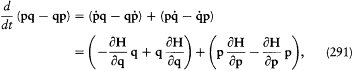
where the two last commutators vanish because  depends only on p, and
  only on q. Now, according to Heisenberg, the time dependence of any quantum-mechanical table gnm is given by

[354] Born and Jordan 1925c, 880.
or

In the nondegenerate case (for which  if
if  ), in order to be time-independent, g has to be diagonal. Consequently, pq -qp must be a diagonal matrix, the diagonal elements of which are given by Heisenberg's rule (287). This ends the proof of Born's conjecture.
Jordan went on to prove the conservation of energy d H/dt = 0, which Heisenberg had shown to hold only in particular cases. From the "strong" quantum condition (288) result the identities

for any function H(q, p) expressible in a power-series development. Combined with Hamilton's equations (289), this gives

and, more generally,

for any function g(q, p). The case g = H gives d H/dt = 0, as originally hoped by Heisenberg.
Finally, for the new scheme to be coherent, the above equation of motion (296) must be compatible with the one earlier assumed in (293). This is indeed the case, for (296) is equivalent to

The latter equation is identical with (293), as soon as the following relation holds:

which is identical with Bohr's frequency condition.
Born and Jordan commented: "It is in fact possible, starting with the basic premises given by Heisenberg, to build up a closed mathematical theory of quantum mechanics which displays strikingly close analogies with classical mechanics, but at the same time preserves the characteristic features of quantum phenomena."[355]
[355] Ibid., 858.
During the following months Heisenberg, Born, and Jordan joined their efforts to further develop the new mechanics. In November 1925 they sent to the Zeitschrift für Physik the soon famous "three-men paper," in which they widely extended previous methods and results. They dealt with the case of several degrees of freedom, treated continuous and mixed spectra, developed a perturbation theory analogous to the classical perturbation theory, showed the equivalence of the basic quantum-dynamic problem with Hermite's problem of diagonalizing infinite quadratic forms, and even quantized cavity radiation according to the new mechanics. Moreover, having overcome his initial disgust at Göttingen's formalism, Pauli solved the hydrogen atom with heavy matrix artillery.[356]
Enthusiasm for the new mechanics spread quickly from Göttingen and Germany. Even before the predictive power of the previous quantum theory could really be improved on, a fair number of theoreticians eventually mastered Heisenberg's new scheme and convinced themselves of its essential correctness. Among these pioneers was the young Paul Dirac of Cambridge. I will now turn to his approach to quantum mechanics, for it was the one that drew the best profit from the classical analogy.[357]