
Chapter III
Mount Kenya Traditions: Fragmentation and War
"We [Meru] approached the Kirimaara [Mount Kenya] like a line of spears, with each [clan] marching upward toward the forest. For Mukuruma and Michubu [age-sets] it was a time of ax and firestick and fear."[1]
Hezikiah M'Mukiri
Murungi age-set
Age: Eighties
The chronicles suggest that every segment of the now fragmented Ngaa (pre-Meru) migrants reached the base of Mount Kenya, the Nyambeni Mountains, and the Tigania Plain during the late 1730s–1740s (Mukuruma age-set). What they saw must have awed and frightened them, for the landscape was completely outside their collective experience. Then as now, Mount Kenya rears up out of the flat surrounding plain like a lion crouching silently in dust. Its ice-capped peaks stand more than 17,000 feet high, providing a shining crown that the approaching migrants may have seen from almost sixty miles away.
Below them the mountain slope consisted of several zones, each with a distinct ecology that posed new problems to the approaching clans. The peaks themselves were ringed between 11,000 and 12,000 feet by a single belt of open moor. Tufts of grass and flowers bloomed in the shallow bogs, but chilling mists and icy winds made it impossible to remain for any length of time.
Between 9,000 and 11,000 feet the moor gave way to a zone of bamboo. Although interspersed with trees, it provided a nearly impenetrable barrier to man. In some areas bamboo groves grew 24 feet high. In others older plants had fallen to form tangled barriers, through which younger shoots struggled to grow. Except for paths forced open by rhino, buffalo, or elephant, this zone was also barred to man.
At 9,000 feet, however, the bamboo gave way to a zone of montaine rain forest, known subsequently among the Meru as the "black" forest. Currently, the black forest zone extends downslope to 7,000 feet, al-
though originally it may have dipped nearly to the mountain's base. The trees were large, often 6 feet in diameter and 150 feet high. A thick canopy of branches shut out the sky, inhibiting undergrowth so that wild game slipped easily between the tree trunks.
To the Ngaa, however, the black forest contributed psychologically to the estrangement that had appeared between the core and fringe elements of the pre-Meru community. On one hand the forest offered A-Athi hunters hope of both honey and meat. On the other an annual rainfall of more than sixty inches, combined with months of chilling cold, made permanent habitation too difficult for mainstream cultivators and herders.
Below 7,000 feet, however, the black forest gave way to a narrow zone of bracken, a fern of no use to the migrants. Interspersed in this zone, however, occurring most often at 5,500 feet was a type of "sweet grass" that proved beneficial to cattle. Soil within this zone was unsuitable for cultivation, and the heavy rains and low temperatures deterred permanent residence. Nonetheless, this "bracken zone" was profitably used for dry-season grazing by people willing to live at a lower level.
Below 5,000 feet the bracken was replaced by a transitional forest of mixed deciduous and evergreen trees. Within this zone trees were smaller, ranging from 30 to 90 feet high. A thinner, more intermittent tree canopy permitted dense undergrowth, and the combination of adequate cover, moderate temperatures, and substantial rainfall attracted vast quantities of wildlife. These in turn drew hunters, and occasional glades of open grassland proved attractive both to herders and cultivators seeking grazing or agricultural sites.
Traditions suggest that earlier agriculturalists had cleared certain areas of this transitional forest prior to the migrants' arrival. At this elevation removal of the tree cover permitted the appearance of a second grass species, (star grass), indicative of highly fertile soil. This star-grass zone was narrow, occurring only between 4,000 and 5,000 feet. It combined adequate rainfall, fertile soil, and moderate temperatures with trees small enough to clear quickly away, however, thus permitting cultivation of an entire range of subsistence-level crops.
The star-grass zone was also characterized, however, by giant gorges, formed by the rivers that fanned radially out from Mount Kenya's peaks. Although the slope itself was gentle at this altitude, water runoffs from higher elevations had cut deep clefts through the bedrock. On reaching the star grass, many of these were 100 feet deep, with
slopes too steep to climb. Even the smaller gorges ran 30 feet down and became impassable in rain.
Occupants of the star-grass zone were influenced in several ways by the gorges' depth and impassability. Ecologically, their steep sides made irrigation impossible, forcing potential cultivators to rely wholly on rain. Socially, their presence also isolated settlers from one another, restricting both casual communication and feelings of shared destiny.
Thus the gorges became political as well as geographic boundaries. Migrants entering the star-grass area from lower altitudes inevitably ascended along the ridgetops, following (and clearing) those areas where the vegetation was least dense. In settling along the narrow spines between the gorges, they invariably established them as the outer limits of their land claims, preferring to advance upward (rather than outward) each time new areas were cleared. In the process each migrant band—usually several clans—became a social unit unto itself, steadily decreasing its contact with more distant segments of the other Meru-speaking peoples, causing their sense of shared identity to virtually disappear. No longer, at this point in time, do the chronicles speak of "the migrants" or "the Ngaa" or even subtribes such as the Imenti. Rather, the only names recalled are those of individual ridgetop communities—Mwiriga ya Kigene, Mwiriga ya Ngomante, and so forth—as these emerged to form the boundaries of the migrants' mental world.
Few settlers established homesteads below 4,000 feet. Below that altitude the star grass vanished, and the land could grow only limited crops of millet and beans. Where not cleared, the vegetation consisted of "woodlands," a zone of underbrush ("bush") and thorntrees dotting an open plain. Lack of rain meant little agriculture. Livestock could graze the grasslands, but below 2,000 feet they and those herding them were subject to attack by tsetse flies and mosquitoes, both of which carried diseases potentially fatal to humans and animals. In consequence the zone was mostly used by transients: honey hunters, passing herders, or women en route to scattered gardens.
From the perspective of approaching migrants the region below 2,000 feet was virtual wasteland. One exception was the Tigania Plain, which lay above a tongue of mountain lava and which was able to hold rainwater and thus allow the growth of head-high grass. Beyond that, however, the plains around Mount Kenya's base combined high temperatures, infrequent rain, and leached-out, fragile soils that permitted no more than bare subsistence. The peoples of Tharaka survived by
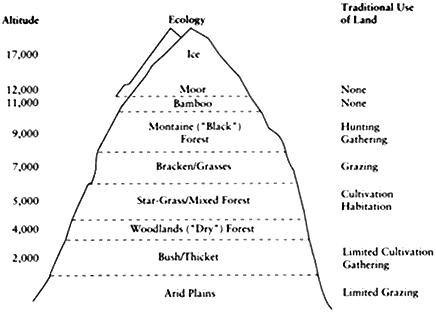
Figure 1
Ecological zones of Mount Kenya
keeping small herds of livestock and growing millet in a few more favored spots. Most of this area, however, was uninhabited.
Ax, Red Clay, And Firestick: Forming "Ridgetop" Communities
Meru traditions recall the era of the migrants' entry onto Mount Kenya as the time of ax and firestick. As each group of clans separated from the original migrant nucleus, it followed one of Mount Kenya's many riverlines up toward the lowest fringe of the mountain forest. The first to enter the forested zone were the hunters, armed only with small bows, axes, and iron knives. Traditions declare that no forest hunter of this era used either shield or spear. Instead they relied on magic to protect them, chanting protective curses to ward off harm.
On entering one section of the forest, each Mwathi (or Mu-Athi, "man of Athi," i.e., a hunter; pl.: A-Athi) marked off a specific hunting region, often adjacent to that of hunter neighbors from other clans. Using "ax, red clay, and firestick" to stake his claim, he and his companions then moved "west" (uphill) into the forest, seeking both meat and honey, but remaining always within their self-selected boundaries. If
their quest produced a surplus, one or more of them returned to the forest's lower edge to barter it with those cultivator-herders with whom they were kin.
At the same time, the cultivator-herders were staking their own claims along the forest's lower edge by clearing off whatever vegetation barred their way. Thereafter, exploitation of each zone followed a standard pattern. Small bands of kin-related hunters pushed steadily uphill along specific ridgelines, marking them with ax and firestick as they progressed. Behind them cultivators and herders exploited the forest in their turn, dividing the land among existing clans whose members also moved uphill as they exhausted grass and soil.
In theory the migration could have been reversed, because any clan member could have returned to land used by his ancestors. In practice the migrants continued "west," as they had done since leaving Mbwaa, for each uphill transition brought them into a cooler climate, virgin grazing, and untouched soil.
Informants compare this migration pattern to a line of spears moving in roughly parallel formation up the mountain's face. Its consequence was that each group of clans found itself master of one or more steeply sloping ridges, broad at the mountain's base then sharply narrowing as they rose upward. Boundaries between these units were imposed by the giant gorges and racing rivers that divided the fertile areas. The result was the creation of a series of long, narrow "ridgetop" communities (Miiriga; sing.: Mwiriga), each containing both hunters and cultivators who gradually extended the land under their control.
Each ridgetop community was ruled by a Kiama of its own elders that might embrace one large or several smaller clans. Each was defended by the elders' warrior sons, who were banded together in whatever numbers were necessary to provide security. When necessary, members of any two or more of these communities could combine into larger social units. These were usually military alliances, for which elders gathered from various ridgetops to adjudicate conflicts.
In theory several of the ridgetops could combine to form a region, such as the lower Mwimbi. In turn, two or more regions could unite to form a subtribe; for example, the clans of upper and lower Mwimbi might join together against a common foe. Such larger combinations rarely occurred, however, and they never endured. Traditions mention almost no instances in which entire regions joined together and none in which they remained allied. Rather, between the time these groups reached Mount Kenya (1730s–1740s) and the British conquest of 1907,
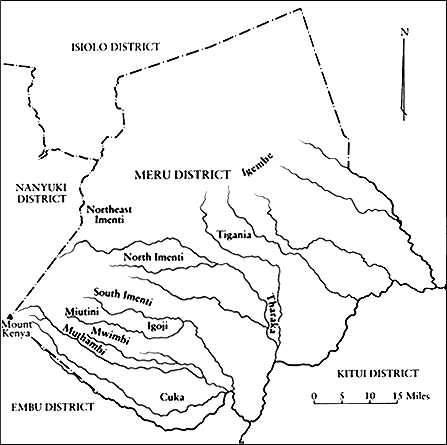
Map 4
Meru: major subgroups
communal interaction occurred solely at the ridgetop level. No war was ever waged, for instance, between the theoretical regions of Mwimbi and Imenti. Rather, hostilities would erupt between two ridgetops, each from different regions, and continue until resolved by elders from both sides. In war and peace the primary social unit was not the region but the ridgetop.
Men Of The Mainstream: Continued Fragmentation
The physical fragmentation imposed upon the migrants through the circumstance of Mount Kenya's geography was reflected by a corresponding social fragmentation, which occurred in at least three of the traditional institutions. Faced with the division of the Ngaa into progressively smaller units, the system of supernatural institutions seems to have fragmented as well.
This trend is most clearly illustrated by Rev. B. Bernardi's research into the institution of "Ugwe," through which the blessings of God and the ancestors were transmitted to the living.[2] Any Meru could hope for contact with the ancestors. Contact with God, however, was reserved to a single individual within each age-set, the Mugwe, or "transmitter of blessings."
The Mugwe was the most revered figure in Meru tradition, the man who stood closest to God. He appears as the central figure in the narrations of every age-set, always as the person to whom all others appeal in times of change or crisis. At such times his blessing was virtually required for the society to function, as tangible proof that both God and the ancestors approved of whatever changes had been made. Thus, no rising generation of warriors could seize power from their predecessors without approval from the Mugwe. No wars could be fought, no conflict settled, without his ritual blessing of all concerned.
Bernardi did his research on this institution in the 1950s. In Imenti and Igembe he found this function carried out, as expected, by a Mugwe. In Tigania, however, the traditional rituals had been divided between two figures, a "Mugwe" and a "Mukamia," each of whom served one-half of the Tiganian people. In Mwimbi, Muthambi, and Igoji, no Mugwe could be found. Instead, the same functions were performed by foretellers (Aroria; sing.: Muroria), although traditions in each region suggested that they had "known Mugwe" in the past. The pattern implies a prior period of fragmentation. Because it may have
proved impossible for every migrant band to include each type of ritualist, the required powers were probably transferred instead, passing from an originator to whatever type of ritualist proved most appropriate as the need arose.
The physical fragmentation of the Ngaa was also reflected in the system of Kiamas. As the segments split off from what had been the Ngaa core, they retained concepts of the council system, duplicating it once established in their new environments. In consequence Kiamas emerged everywhere along the mountain base, extending upward as the migrants climbed.
Soon, however, the need arose to form contacts between the elders' councils. While on the march, interclan and individual conflicts had been settled simply by calling spokesmen from each faction into council on a temporary basis. Now, as topography scattered the clans, the spokesmen-of-spokesmen concept took more permanent form. Beginning in Tigania after the 1740s (Michubu age-set), then spreading north to Igembe and more slowly thereafter into the southern regions, leading members of every elders' council withdrew from the gatherings of fellow elders to form more exclusive associations of their own.
In Tigania, and later in adjoining regions, these more exclusive units were called Njuri (secludedness, or the "councils of few"). Their initial purpose was to act as living repositories for the "secrets" now required for their communities to survive. Dissemination of such knowledge—always protected by oath—meant death.
Entry into an Njuri was restricted to elders already accepted as spokesmen for some larger group. Every lineage was represented, and a balance was maintained between both halves of the tribe (Kiruka and Ntiba) as well as between representatives of the black, red, and white clans. Large numbers of livestock were required to join, provided as "gifts" to form the basis of each candidate's initiation feast. Entry was thereby restricted to the wealthy. In Meru terms this meant that prestigious elders needed equally successful warrior sons, capable raiders who could supply their fathers with the livestock required for Njuri fees. Once achieved, however, membership was for life. A special walking stick served to identify its owner as a "man of Njuri" and thus one worthy of respect.
Inevitably, the concept of elitist councils was duplicated within younger age-sets of each community. Warriors, adolescents, and women are all known to have created corresponding councils, each with its inner circle of spokesmen or spokeswomen charged with protecting
| ||||||||||||||||||||
"secret knowledge" from all members of the opposite sex and those of their own sex younger than themselves. Even the smallest children imitated their elders, with members of their own "elite" meeting within the "secludedness" of grain storage bins to pass on whatever "secret knowledge" they had learned.
In consequence a Meru living through this period could expect to pass from Kiama to Kiama as he aged. At each level, if he proved distinguished, he might gain entry into the ranks of that council's Njuri. The names of the various elitist councils varied among the major Meru regions. Over time, however, it appears that three major subsystems emerged, initially in Tigania-Igembe, then spreading gradually south (table 4).
In theory, conflicts between ridgetop communities from different regions were settled by joining two or more Njuris into a committee of them all, a process that could ascend indefinitely until entire regions could convene through choosing spokesmen. In crisis, tradition states that Mwimbi and Muthambi joined as one and that the Njuri of Tigania resolved conflicts that extended into adjacent regions of Igembe. Nonetheless, like the Kiama system from which it sprang, Njuris functioned mainly in response to crisis, disbanding once each issue was resolved.
"Fringemen": The Evolution Of A-Athi
One of the major fringe communities was also affected by the migrants' ecological transition. The pre-Meru entry into Mount Kenya's forests left the cursing patterns used by ironsmiths essentially unchanged. Over time clans on each ridgetop located adequate supplies, both to perpet-
uate their craft and to retain their former supernatural methods of protecting them.
The magic available to meat and honey hunters, however, continued slowly to evolve. To a hunter the "black" forest belt initially meant fear, primarily of large animals such as buffalo, which could lie unmoving within a shadow until a Mwathi (single hunter) moved too near. Tradition declares that all hunting groups responded to the problem by adopting a number of defensive rituals, intended to create a zone of safety around them as they moved within the forest. One of these, perhaps the earliest, was known either as "blow" (ua ) or "bite" (uma ).
It could be prepared only by curse removers (Aga) who were also A-Athi (hunters). Initially, the curse remover gathered various combinations of herbs, roots, and the sap of a tree (Cacothanthera fresiorum ) known to be poisonous.[3] The materials were mixed with water, placed in a tightly sealed clay pot, and boiled for several days. Gradually, all the liquid evaporated, leaving a hard, black, waxy residue. This was either kept intact ("bite") or ground into fine powder ("blow"), then stored in tiny bamboo tubes, gourds, or animal horn. The contents were placed in a squared-off bag of antelope hide that A-Athi and all other Meru curse removers carried on one shoulder at all times.[4]
The magic substance within the containers was intended as a "gift" to other hunters. Tradition required, however, that it be "given" on request and that receivers reciprocate with specified amounts of honey, skins, horns (for use as containers), or meat. In this way both hunters and ritualist healers assured their economic survival.
Both bite and blow were transferred to recipients with precise instructions on their use. Blow, for example, was used at the beginning of each trek into the forest. On reaching an unknown or potentially dangerous area—such as a heavily tangled bamboo-edged glade that might conceal buffalo—the hunter would pause, uncap the powder, and blow it in all four directions. He would then chant: "Njira mno muthwa aki. Tukana gintu giku." (Only ants on the paths. We shall see no bad things.)[5] This ritual had the psychological effect of creating a moving zone of safety within which the hunter could carry on his work, protected from "seeing bad things," whether animal or human, that might harm him.
A-Athi traditions suggest that this concept was subsequently adopted for the creation of stationary zones of safety around the more permanent hunting encampments. These became increasingly isolated as individual hunters ventured higher and farther "westward" into the
forests. The magic used to guard these camps was known as "Nkima," a word that carries linguistic connotations of "stiffness," but which A-Athi translate as "skull."
In some regions Nkima was simply an antelope horn, filled with the black, waxy mixture previously described. In others, strips of buffalo, bushbuck, and antelope hide were coated with the substance and then interwoven into a rounded mass the size of a human skull. Whatever its shape, an Nkima hung prominently in the center of each hunting camp, psychologically creating a second zone of safety for those sleeping therein.
A-Athi traditions suggest that the concepts of "bite," "blow," and "skull" were adopted ("bought") from earlier hunting peoples whom the Meru encountered as they entered the forest. These were most likely Ogiek, who lived in scattered bands across the mountain and who had adapted totally to a hunting-and honey-based ecology.[6] The A-Athi, however, as forerunners of much larger groups of cultivator-herders, faced different problems. During the prior decades of migration, both meat and honey hunters had begun to reserve specific areas for exclusive use. They had responded to mainstream incursions by developing the traditional curse into an instrument of group protection.
Once on the mountain, however, the pressures were intensified. Within a given ridgetop all the areas initially used for hunting and gathering were eventually coveted and claimed by herders and cultivators, themselves forced uphill by the continued exhaustion of both grass and soil. Inevitably, their very presence dispersed the game. Thereafter, as the forest was cleared to provide cropland, the habitat needed for honey disappeared as well. In consequence both hunting and honey A-Athi from every region of the mountain found themselves forced steadily uphill in turn, into regions that grew progressively colder, steeper, and less favorable to both beehives and game.
Initially, A-Athi councils of elders reacted to agricultural encroachments with the traditional patterns of communally chanted curses that had served them throughout the migration. Within the forest, however, these were frequently robbed of their effectiveness by the hunters' inability to learn whether men of the mainstream had penetrated their regions and where. Dispersed wildlife and empty beehives told no tales.
Nor were the Meru cultivator-herders always aware of their transgressions. They saw the forests as vast, unknown, "black," and endless. They could therefore pass through A-Athi hunting zones, or even cultivate them, without experiencing the anxiety and guilt required for the traditional cursing system to work.
The earlier system of chanted curses, therefore, was supplemented at some point in the 1700s by a second concept, probably springing from the traditional "ax, red earth, and firestick" used by Meru everywhere to mark their land. The firestick was also used in slightly different fashion by the Ogiek hunting peoples with whom the A-Athi may have been in contact. Hunters from this culture traditionally notched their firesticks in highly personal fashion and set them at intervals along traditional hunting trails in such a manner as to advertise the identity of each hunter.[7]
Tradition suggests that the A-Athi adopted both concepts, reshaping their use of the traditional firesticks (Ndindi; sing.: Rurindi) to meet economic needs by intensifying the ritual associated with their use. Initially, A-Athi ritualists from several ridgetops gathered in a solemn Kiama. With great ceremony they selected several long sticks from the mwinkithia , a tree held sacred to the group. Unlike the traditional firesticks these were gradually hollowed out at one end, then sharpened at the other. The hollowed space was filled with black powder ("blow") or a grey ash created by burning a number of poisonous roots.
The opening was capped with feathers from the marabou stork, one of the largest and most aggressive of East Africa's carrion eaters. The meat-eating bird was intended to symbolize that the stick would "devour" those who angered it. Each stick was then carved with the markings of its Kiama, smeared with bright red ocher (clay) to enhance visibility, and communally cursed.[8]
The curse was delivered in traditional fashion. Members of the council, having prepared the firesticks, moved several times around them, jointly chanting the words required to give them power. Thus empowered, the "Ndindi" were no longer simple firesticks. To the A-Athi they became "bones," empowered automatically to impose the hunters' curse on every person who passed by. Anyone catching sight of Ndindi, by definition, had penetrated an A-Athi hunting or honey zone, and their simple realization of this allowed the cursing sequence to begin.
This supplementary cursing system had several advantages over its predecessor, each of which served to alleviate the hunters' problems over the use of land. One was its service as a warning system, since even the thought of bypassing Ndindi kept cultivators and herders away. A second lay in the element of doubt engendered by the cursing process. The forests were vast, but neither herders nor cultivators could penetrate them at any point without fear of supernatural retribution. Consequently, contact between the two communities diminished steadily, an isolation wholly welcomed by the hunters.
The system's third advantage was its automatic nature. Since imposition of a curse was automatic, hunters had no further need to guard their zones, nor did they have to tour herding and farming communities proclaiming general curses on those who might have caused them harm. Instead, under the Ndindi system victims worked the curse upon themselves, their anxiety and guilt at seeing the sticks proving sufficient to induce whatever physical, mental, or social calamities they believed must follow. The onset of these, in turn, left victims with no choice but to voluntarily disclose their transgressions to the A-Athi themselves, because only their ritualists could remove a hunter's curse.
People of the mainstream, however, faced economic pressures of their own. Livestock could destroy a grassy glade, exhausting it for future use. Once cleared, the mountain soil was porous and could be leached by heavy rains. Too often it also wore out, leaving the users no choice but to seek new lands uphill. Inevitably, the core communities moved upward, nibbling constantly at the lower fringe of every A-Athi zone. Women sought firewood. Boys sought grass for their goats. Warriors took shelter from potential enemies. Ritualists searched for the plants and parts of animals that were required to activate their magic. Every incursion, no matter how unwitting or innocent, worked to disperse the wild game.
Wherever possible the hunters struck back, developing new applications of the cursing system to halt the upward flow. Where Ndindi sticks were ineffective, A-Athi communities intensified the concept, resorting to the creation of a stick they called "Nguchua" (claw).[9]
The sticks of Nguchua were cut from the same sacred tree as the Ndindi. They were said to be eighteen inches long, one inch in diameter, and smeared with red ocher. Following much of the Ndindi ritual, the sticks were hollowed at one end, split at the other, then slowly heated on one side to make them curve into the shape of claws. They were then filled with the same types of powder or ash used in making Ndindi. The hole was blocked with the tail of a mongoose, then tied with cords made from a creeping tree vine.
The completed "claw" was activated in the same manner as Ndindi, with appropriate verbal incantations to empower it to curse. The Nguchua, however, were placed in the ground, claws up, before the huts of those known to have offended the A-Athi. Members of the hunting Kiama then circled the offender's homestead, chanting, for example: "Those who eat [the food of] A-Athi, let them now die." Thus warned, the intended victims discovered the "claw" and reacted appropriately,
developing physical symptoms that led to isolation by their own community and the need to seek out the A-Athi for reconciliation.
In more serious instances, however, entire agricultural and herding communities were propelled by their own needs into outright defiance of an A-Athi ban. Ridgetop traditions record dozens of instances in which whole clans fled upward into the forest, seeking shelter from locusts, drought, raiders, or exhausted soil. Communities placed in these circumstances usually tried to buy the goodwill of local hunting bands by giving gifts. If angered, however, A-Athi frequently responded with their most potent malediction, the ritual of kallai (gazelle).
"Gazelle" appears to have been an intensification of the practice of "claw." Instead of placing a stick before the homesteads of offenders, however, the entire A-Athi hunting band circled an offending cluster of homesteads, its leading members carrying the corpse of a freshly killed gazelle. The animal had been disemboweled, then hollowed out in the same fashion as the Ndindi and Nguchua to become a "stick" of flesh. The hollow was filled with the traditional magic powders, composed in this instance of ash from a newly cremated hyena cub, colobus monkey, and keiea , a parasitical vine that grew upon the hunters' sacred tree.[10]
While circling, the entire group chanted the curse in unison, thereby ritually intensifying its power. In theory the entire mainstream village then either sickened or reconciled with the hunters by giving gifts until the A-Athi ritualists decided to remove the curse.
At some point, however, the A-Athi added a new element to the rituals of curse removal. Unlike the rites used by curse removers of the Meru mainstream, A-Athi rituals of removal began not only to "lift" a communal curse but also to create additional conditions intended to prevent recurrence of the violation that induced it. This was achieved by imposing a "kinship clause" upon the transgressor. In Meru terms this meant that to complete the rituals of removal an A-Athi curse remover created a wholly artificial condition of kinship between the victim and every member of the hunters' Kiama concerned. In essence, an individual man of the mainstream, whether cultivator or herder, was forced to become the "brother" of every hunter in the region, as they all became "brothers" to him.
In theory the creation of such a relationship provided the basis for future harmony between cursers and victim, thereby neutralizing whatever hostility had been aroused by the initial conflict. In practice the oath of kinship bound each victim to the hunters' Kiama so that future submission to its authority was ensured.
Although permitted to remain a cultivator or herdsman, the victim of a hunter's curse was required to submit all future conflicts to the elders of an A-Athi Kiama (to the Kiama of his "kin") for resolution, rather than the council of elders that governed his ridgetop. At a more practical level, this also meant the contribution of livestock to the hunting Kiama's feasts. Because A-Athi taboos forbade consumption of either milk or meat from domestic livestock, the animals thus delivered were approximately renamed, the bulls becoming magara (an old word for buffalo) and goats, nkurungu , or bushbuck. Evasion of these obligations, or additional transgressions against A-Athi interests, led automatically to reimposition of the original curse, thereby reimposing the choice of further livestock levies as alternatives to calamity and threatened death.
However, the A-Athi system of supernatural manipulation continued to evolve along solely defensive lines. On one hand, each stage in its development, as with the system of the ironsmiths, reflected the efforts of a numerically insignificant ecological minority to protect their livelihoods from encroachers who sought however unintentionally to destroy it. On the other, the encroachers were kin, Meru who had entered a separate and often hostile ecological niche but with whom the hunters still shared common cultures, dialects, and ancestry. It does not seem surprising, therefore, that the smallest of the Meru fringe communities should have embraced the supernatural for protection against kin. Nor is it odd that the system that developed was designed first to neutralize and then incorporate transgressors rather than harm or kill them, despite the ferocity of the chanted curses themselves. By forcing cultivators to be kin, the curses made them subject to the A-Athi elders, thereby placing any violator in a position where no further transgressions could occur. At this stage in Meru history, therefore, the ultimate purpose of the dreaded "hunters' curse" was simply to impose a state of harmony upon those within the hunters' world.
Mount Kenya: Expulsion Of Earlier Occupants
The rate and direction of migration inevitably brought each of the major Meru subtribes into contact and conflict with earlier occupants of the Mount Kenya region.[11] The traditions emerging from this period are told almost wholly from the perspective of single clans, as they advanced upward into the forests or across the Tigania Plain. In every instance representatives of the Mukuruma, Michubu, and subsequent
age-sets (1730s–1860s) seem to have met with an initially bewildering variety of enemies, with whom they fought and over whom they won.
Existing evidence suggests, however, that most of these migrating communities encountered representatives of three non-Bantu cultures, scattered in small numbers along the mountain's lower slope and northeast into the adjacent Tigania Plain. Analysis of Meru traditions that spring from this area suggests the following patterns of occupation: (a ) small groups of Eastern Cushitic—speaking (Galla) peoples within the woodland zone, along the mountain's arid base and into the Tigania Plain; (b ) small groups of Kalenjin-speaking (Ogiek) peoples, inhabiting the higher star-grass zone and lower fringes of the montaine ("black") forest; (c ) somewhat larger communities of Maa-speaking (Maasai, Ogiek) peoples within the Tigania Plain and adjacent grasslands, north of the mountain itself.[12]
Cushitic Speakers: Mukuguru, Ukara, Muoko
Contact with Cushitic-speaking peoples occurred before the pre-Meru migrants had even reached the mountain. Informants recall these early occupants by names that vary among the major subtribes (table 5). Traditions from several regions and other evidence suggest that these groups belonged to one or more sections of the Oromo-speaking peoples (Galla-Boran, Oromo, etc.). Their language forms part of the Eastern Cushitic language cluster, which extends across the Horn of Africa into the Middle East.[13] Thus, Muthambi informants often pronounce "Ukara" as "Ugalla," blending the letters r and l into the intervocalic *d and g and k into a single sound. Mwimbi elders describe Ukara cattle, seized in warfare by their ancestors, as identical to those now herded by the Galla and Boran. Imenti traditions state that Ikara (or Agira) of that area were also known as Muoko (or mwoko).
Additional oral evidence is provided by descriptions of their burial customs. Traditions in each region describe Ukara, Agira, and Muoko (in various spellings) alike as having "buried their dead in a sitting position, covering each grave with stones." Pre-Meru found the custom both fascinating and repulsive, because their own tradition required that the dead be left for hyenas. The alien burial details became part of their fireside chronicles, thereby passing into oral history. After the British conquest an early colonial administrator confirmed the tradition by uncovering several alleged Muoko graves, pointed out to him by Meru elders, which substantiated the practice of burial in a sitting position.[14]
| ||||||||||||||||||||||||||||||
In the 1920s a Methodist missionary noted the similarity between the Muoko burials and those still practiced by the Tana River Galla.[15]
Physical descriptions also support this possibility. Informants describe each of the cattle-keeping peoples as "taller and more slender" than themselves. Their shields were small and narrow; their spears, short and tipped with the leaf-shaped blade once used by the GallaBoran. More conclusive, perhaps, is that no fewer than three of these groups are described as linked to groups of forest hunters, in the same manner as the early Tharaka and Cuka. In Mwimbi, for example, the forest hunters were called Mukoko or Mukuru and were joined with livestock-owning Ukara. In Imenti, they are recalled as Mukuguru or Mu-Uthiu and linked with cattle-keeping Ikara or Agira. Tiganians describe Mukuguru (or Aruguru) as allied to the Muoko herders of their region.
Existing evidence thus suggests that the names of every group within the forest zone are variants of the Mokogodo, a contemporary Ogiek people, whose original language was part of the Cushitic cluster. Because the plains-dwelling Oromo, Galla, and Boran also speak Cushitic dialects, both forest and plains dwellers may have been able to communicate. This overlap, in turn, may have led to the creation of an intermittent hunter-herder symbiosis, based on trade and intermarriage, that benefited both sides.
Early Galla history also supports the possibility of hunter-herder symbiosis. After 1500, Oromo-speaking peoples (Galla, Boran, Oromo, etc.) began to migrate south from the Ethiopian highlands. Following their herds, they had reached deep into Kenya by the 1700s. The Boran, in particular, had moved into grasslands on both sides of the Tana River, while other Cushitic-speaking herders may have even penetrated Tanganyika. Bands of these herders were therefore probably attracted first by sight of the mountain, then the grazing opportunities at its forest base. Thereafter, they may have wandered in small groups along the lowest forest fringes, in contact with the Mokogodo, until the pre-Meru appeared.
Tradition states that both Ukara and Mokogodo fled the slopes of Mount Kenya soon after the migrants arrived. Unable to defend themselves, they are said to have "turned into birds and flown away." On the Tigania Plain, however, the more numerous Muoko chose to fight. Tiganian narrations from this era describe how men of the Mukuruma age-set (mid-1730s), sent ahead of the migrants to examine the plain, returned to describe an entire "sea of grass filled with few people and many cows."[16]
To fulfill the prophecy that had sent them westward since the migration's beginning, their prophets ordered them to seize the herds. As the narration is retold today, Tiganian warriors took the Muoko by surprise, seizing "four great herds" in an initial skirmish, then moved livestock, women, children, and the aged into a single, defensible camp. The Muoko, perhaps initially outnumbered, reacted by barring the intruders from both water and salt, systematically burying salt licks and springs to prevent their discovery and use. The Muoko also had stabbing spears, a weapon Tiganians could not forge. They responded with bow and arrow, ambushing Muoko herders in the long grass ("they crept like rats" sang the Muoko of their foes) and stampeding their herds.
Tradition speaks of "decades" of war. More likely, there was a time of dry-season raiding on both sides. At some point the Tiganians mastered the art of forging spears. Thereafter, the Muoko found themselves forced steadily into the and northeast away from the fertile grassland region. In so doing, they evidently moved within the raiding range of the Il Tikirri (recalled in Tigania as Ngiithi) and Mumunyot (recalled as Rimunyo), two Maa-speaking (Maasai-speaking) Ogiek peoples who also herded—and coveted—cattle.
Both groups began to raid the Muoko from the north at the same time that Tiganian pressure intensified in the south. Consequently, Muoko communities gradually disintegrated as their herds were seized and absorbed by former foes. Early traditions record skirmishes between Muoko and Tiganian, Igembe, or even North Imenti warriors for many years. The later narrations, however, deal primarily with the seizure of Muoko children for Meru homesteads or the adoption of captive Muoko warriors into Tiganian clans.
The extent of such incorporation can never be known, because Meru elders swore oaths never to reveal that it occurred. Nonetheless, Mahner's (1970) research in Tigania suggests that the Muoko were incorporated into that region's "black" clans, the 11 Tikirri into the "red," and the original Meru (who trace their roots to Mbwaa) still predominated among the "white."[17] The absorption of former foes may have therefore significantly modified Tigania institutions and, indirectly, those of adjacent Meru regions as well.
Kalenjin Speakers: Umpua, Agumba
The expulsion of peoples from the regions near Mount Kenya's base was repeated higher up the slopes. The victims, who lived either in the
| ||||||||||||||||||||||||||||
star-grass zone or lower forest ranges, are remembered in traditions either as Agumba or Umpua. The Agumba form a segment of the folklore told by every tribe on Mount Kenya. They appear in tales of the Gikuyu, Embu, and Cuka peoples, as well as the chronicles of Meru. Among other tribes Agumba are described as "little people" (tuuji tukuru: old children) or shy, hairy dwarfs, who lived in the forests above the Bantu (Gikuyu, Embu, Cuka, etc.) settlements. Routledge, Kenyatta, Leakey, Lambert, Orde-Browne and, more recently, Mwaniki and Muriuki, have all collected "Gumba" (i.e., Agumba) oral traditions that describe them as Pygmy hunter-gatherers, who lived in "caves" into which they fled at the approach of Bantu migrant bands.[18]
The Meru also share traditions with the Cuka, Embu, and sections of Gikuyu that describe the "Agumba pits," large or squarish depressions, within which the Agumba (or Gumba) once lived. Within Meru the pits are located along a line that runs roughly along the zone at 7,000–7,500 feet which delineates the lowest edge of the forest from the highest point in the star-grass (populated) zone. Today they form an irregular line that can be followed from ridge to ridge, along a region that is largely farmland, but which two hundred years ago must have been thickly forested. The largest pits average 16 to 24 feet across.[19] Traditions from every area describe the pits as having "holes" into which the "little Gumba" would flee. The Agumba traditions, however, are shared by primarily two of the Meru subtribes, those closest to the Cuku-Embu-Gikuyu region, and who reside on Mount Kenya itself. Elders of Muthambi and Mwimbi recall peoples living in the forest as their respective ancestors arrived (table 6).
Igoji and Imenti informants, however, provide accounts of these groups that differ sharply from the traditions of their two southern neighbors. The majority of their narrations speak neither of dwarfs nor Agumba. Rather, they describe a tall, slender, cattle-keeping people recalled (with variations) as Umpua. The Umpua wore shoulder-length hair, plaited into braids. In contrast with Agumba traditions, they are not recalled as hairy or as having any of the physical traits attributed to either Pygmoid or Khoisan (Bushmen) cultures. Rather, they are said to have looked like the Meru themselves.
The Umpua are also remembered in tradition as herders, not hunters, guarding small numbers of cattle and goats and living solely from the milk and meat of their herds. At night, livestock were kept in pits, dug by the herders themselves, which were gradually deepened as mud was removed after the rains. The earth and dung were heaped next to the pit to form a mound, within which the Umpua are recalled as having placed their dead.
Only the Muthambi and Mwimbi differentiate between Umpua and Agumba. Their descriptions of the Umpua correspond with those of other Meru subtribes. Narrations of the Agumba, however, describe hunters. Beyond that, the physical descriptions of both groups are identical, as are descriptions of their weapons (triangular iron spears, arrowheads with barbs on both sides), their dwelling places ("pits," "holes," "caves"), and their flight at each Mwimbi or Muthambi approach. The puzzle may be resolved, however, by suggesting the prior occupation of both Mwimbi and Muthambi by two separate sections of one tribe, sharing portions of an iron-age material culture but diverging in their economic base in much the fashion suggested for the forest Mokogodo-and plains Oromo-speaking peoples. The barbed weapons, for example, are similar (identical?) to spear-and arrowheads used by related groups of forest hunters and grassland cattle herders among the Kalenjin-speaking Ogiek who now live west of Mount Kenya.[20]
Both of the names recalled by tradition also suggest Ogiek origins. Certainly, "Agumba," "Umpua," "Umbua," "Mbumbua," and "Lumbua" all sound like reasonable variations of the Maasai "Il Lumbua." The term, which means simply "cultivator" in the Maasai language, was once used by pastoral Maasai to denote those Maa-speaking peoples who had adopted agriculture.
Certain of these cultivators, however, were once Kalenjin-speaking Ogiek. In the course of their own history they had come so deeply under Maasai influence that they accepted the language and traditions of that
people as their own. One relevant example of this cultural transition can be found in the contemporary Il Mosiro, originally a Kalenjin-speaking Ogiek community, which has adopted both the language and material culture of Tanzania's pastoral Maasai. "Il Mosiro" is their name for themselves. Among their Maasai and Bantu neighbors, however, they are known as the Il Lumbua (in Maasai dialects) and Wahumbua (in Bantu dialects).[21] The similarity to Meru oral variants (i.e., Lumbua, Umbua, Umpua, Agumba), although not conclusive, certainly illustrates how Kalenjin-speaking peoples could once have been known as the Umpua or Agumba, the designation stemming from an era when at least one section cultivated and was in contact with Maasai.
Descriptions of the Umpua and Agumba "dwellings" (i.e., pits, caves) also suggest Ogiek origins, as well as the presence of two coexisting groups. Like the Gikuyu Gumba, both Umpua and Agumba are alleged to have lived in either pits, holes, or caves. More detailed investigations, however, have elicited two sharply different descriptions of the dwellings in which each people lived. One group is said to have lived in caves scooped from under the roots of trees. The second inhabited circular pits over which cow skins were laid to make roofs. Both patterns recur throughout Mwimbi-Muthambi. The association of cow hides in the second description suggests one possible function for each of the two types of Gumba pit. The large, square depressions may have been used to contain Umpua-Agumba herds, the smaller round ones to shelter herders.
Both dwelling patterns have, in fact, been found among Kalenjin speakers. Among the previously mentioned Il Mosiro (the Il Lumbua or Wahumbua of Tanzania), research completed in the 1940s described them as divided into two sections, each with its own ecology. One group lived within shallow depressions covered "by a rude shelter of skins," and the other section of the same community lived in "dugouts . . . scooped out beneath the roots of a suitable tree."[22] If this pattern of dual habitation was once typical for other Kalenjin-speaking Ogiek, it would seem possible to place Mount Kenya's Umpua and Agumba among their ancestors.
The most interesting evidence, however, comes through examination of what may be the last recorded fragment of the Umpua-Agumba language. No oral narrative in all Meru speaks of the Agumba dialect in any form. In Mwimbi, however, a single aged informant claimed to remember four "Umpua words" (for one and two , and two separate
| ||||||||||||||||||||||||
words for man ), which had been sung in songs about (the Umpua) when he was a child. These can be compared with independently collected word lists for two widely separated groups of Kalenjin-speaking Ogiek (table 7).[23]
The existing evidence suggests, therefore, that the Umpua (and Agumba?) of the mid-1700s may well have been ancestral to the Kalenjin-speaking Ogiek of today. At some time in their past, groups of them may have adopted the title of Il Lumbua (in Meru: Umbua) from pastoral Maasai. They may also have adopted Maasai military methods, to the extent required to seize the herds of cattle they are said to have possessed. In consequence they may have decided to abandon agriculture, moving instead to an economy based both on herding and a partial symbiosis with related groups of hunter-gatherers within Mount Kenya's forests.
Meru traditions barely suggest the existence of hunter-herder symbiosis between the two communities, merely noting that they "waged no war and . . . gave honey for milk." If true, the trading pattern is supported by Blackburn's investigation into the Ogiek honey culture.[24] Among Mau Ogiek, for example, he reported that the average hunter could collect two hundred pounds of surplus honey per year, above the two pounds per day gathered for personal consumption.
Traditionally, that surplus was exchanged with cattle peoples at the (Mau) forest's lower fringe. They would ferment it (as do the Ogiek) to create an intoxicating honey wine as well as a honeyed water that forms the essential ingredient of every ritual requiring contact with ancestral spirits. Without honey, no rituals could be performed. Without
ritual, no ancestral contact could be made. Without ancestral blessing, no actions could be taken, and human society would cease to function.
In consequence Ogiek hunters and those herders in Blackburn's research zone formed an interdependent relationship, based both on exchanging produce and intermarrying, in much the same manner suggested by Meru tradition for the Umpua and Agumba in the 1700s. Aside from economic benefit, both groups may have become psychologically dependent, seeking each other out to ritually, and therefore spiritually, survive.
If so, that pattern was shattered after the 1730s by the appearance of pre-Meru raiders on every section of the mountain. In Mwimbi, where traditions are representative of the whole, forest hunters from the ascending clans are said to have met peacefully with the Agumba, from whom they claim to have learned the use of magic. The Umpua, however, found their herds the targets of constant raids, as Mwimbi men of the mainstream sought both glory and cows.
A pattern of mutual warfare developed that lasted well over a decade, since warriors from at least two age-sets are recalled as having taken part. During that time, Umpua in every region were gradually forced up the mountain. Initially they attempted to shelter their herds in pits dug deep in the forests. When this no longer proved possible, they fled ("around the mountain, like birds") and disappeared.
The dates and directions of expulsion vary slightly among Meru regions. The Umbua of Imenti, for instance, are said to have been pushed northeast, onto Mount Kenya's northern plains, where they held out until scattered years later by raiding Maasai. The Umbua of Mwimbi are said to have fled south. Nonetheless, the pattern of conflict described in every region is identical: the Umpua fighting to preserve their herds, the migrants battling to seize them. In every case victory came through Meru numerical superiority, and by the end of the 1700s—except for children and captives adopted into Meru clans—the Agumba and Umpua were gone.
Maa Speakers: Il Tikirri, Il Maasai
Contact with the third non-Bantu language group, the Maa-speaking peoples, occurred during the warrior years of Githarie, Michubu, and Ratanya age-sets (1750s—1780s), after the pre-Meru clans had seized control of both Mount Kenya's lower forests and Tigania Plain. Contemporary Meru refer both to the Maa language and those who speak
it as Uru, a term including the pastoral Maasai proper, those among them who have adopted agriculture, and specific Ogiek groups that have adopted their linguistic, cattle-keeping, and military orientation. The Maasai themselves refer to those who share their language—currently six tribes—as Ol Maa (the Maa speakers). Within that community they classify all members as either pastoral (11 Maasai) or agricultural (Il Oikop).[25]
Detailed examination of Meru relations with both pastoral and agricultural Maasai communities is beyond this chapter's scope. Suffice to say that every Meru region came under intermittent attack from both types, as well as their Ogiek imitators, from the time the Ngaa reached Mount Kenya until the era of colonial control. Warriors of every age-set fought often with "fierce Uru," and descriptions of these battles make up the bulk of every oral history in the Meru region.
Notwithstanding, more detailed analysis suggests that these Uru raiders were not always Maasai proper, but Maa-speaking Ogiek. Traditions from Tigania, for instance, report first contacts with Maa-speaking raiders as early as the 1730s, when the men of the Mukuruma age-set fought the Muoko to possess the plain. In this instance their foes were the Il Tikirri and Mumunyot, who raided Muoko from the north at the same time Tiganians pressed them from the south.
The subsequent dissolution of the Muoko placed the three remaining peoples into contact, at a time when the Tiganians had absorbed the greater portion of the former Muoko herds. Because both sides valued cattle, conflict soon began. The first attacks by both Maa raiders were successful, causing great loss in the Tiganian herds. The Mumunyot, however, were unable to hold their ground, as a series of fierce Tigania raids drove them from the plain.
The Il Tikirri reacted differently, forming an alliance with several Tigania clans that prohibited mutual raiding. This brought a time of peace, broken by Tiganian warriors of the following age-set, who sought their own glory at the expense of 11 Tikirri herds. This pattern of alliance and attack may have recurred, for the 11 Tikirri also found themselves forced northward off the plain, and they retreated finally beyond the Oasu-Nyiro River to Tigania's north. Here they remained, however, a seasonal threat to Tiganian herds, thereby setting the pattern for Meru-Maa relations for decades to come.
Contact with the Maasai proper occurred some time in the mid-1700s, when "Ratanya and Githangaria [in Imenti] were warriors," (1760s—1780s?), when Meru moving uphill into the Katheri region of
contemporary North Imenti became aware of Uru on the other side of the forest that lay to their west. The evidence suggests that Maa-speaking groups of cultivators (11 Oikop) had occupied the grasslands of Northeast Imenti and were moving around a forest barrier that separated them from the advancing Meru.
The two sides fought with results comparable to those in Tigania. A period of raiding began, in which each side strove to seize the other's flocks and herds. Outnumbered, the Maasai were pushed off the grasslands and moved northeast onto the arid plain. There, however, they remained, regarding the Imenti as seasonal prey, in the same way the 11 Tikirri had viewed the Tigania. Each dry season they would appear to harry the herds, and every age-set fought them in its turn.
The Maasai, however, also came in times of peace, often sending women to exchange milk for sugarcane or millet. This led in turn to the exchange of brides and the emergence of kinship between certain Maasai and Meru clans. The Meru refer to this condition as gichiaro , or "birth," implying the birth of a relationship between two sides. The Maasai call it a seriani (peace), a condition that can occur only with groups with whom they have exchanged livestock and wives.[26] The exchange creates a condition of kinship that serves to prohibit further attacks, lest the blood of "brothers" be shed.
This kinship could also be created through adopting Maasai as "sons." Within Northeast Imenti, Igembe, and Tigania this occurred through capture. Warriors taken in battle were held until ransomed by kin. If no ransom was paid, they could be speared or adopted into their captor's clan. Adoption took place during every age-set, with significant numbers of Maasai joining clans in Tigania. Adoption was by oath, in which the captive became "son" to the warrior who captured him. Having become ritually absorbed into his "father's" age-set, he was free to raid any group with whom he had no ties, whether by blood or created by ritual.
In consequence many Maasai settled easily among the northern Meru subtribes. Their impact was particularly strong among the Tigania. Living on a lava grassland that offered no shelter from attack, Tiganians had no choice but to develop a system of continual preparedness if they were to survive. The Maasai model, based on circumcision, age-sets, a standing force of warriors, and ten years' duty in a war hut, fully met their needs.[27]
Warriors in every Meru region, however, adopted aspects of Maasai warfare: styles of dress, decoration, and weaponry, including long
spearheads, wooden clubs, and buffalo-skin shields. A more striking aspect of this adaptation, however, was how certain segments of the Meru began to see themselves. The change was sharpest in Tigania, particularly among clans settling in the regions of Kianjahi and perhaps Muthara. Over time warriors from these regions began to perceive themselves as Uru, and referred to the forest peoples of Igembe, Imenti, and all other regions to their south as kangiri (little diggers), a pejorative word for cultivator. In short, earlier feelings of common ancestry were steadily eroded, replaced by purely Maasai conceptions linking contempt for agriculture, pursuit of cattle, proof of manhood and personal honor to the waging of a seasonal, highly stylized method of war.
This same transformation took place, to a lesser degree, in every other Meru region that absorbed Maasai. In consequence, during the last half of the 1700s, a new dimension of war emerged in which the Meru did battle not only with raiders from outside their region but also with one another as well, seeking their neighbors' herds with the same courage and enthusiasm they had formerly reserved for foes. Gradually the entire region engaged in internecine warfare, governed by convention and limited in intensity, but so deeply rooted in the Meru way of life that it endured until the advent of colonialism.
It can be argued, on the basis of existing oral evidence, that contact with Maa-speaking peoples has proven one of the dominant events in Meru history, and one which requires additional investigation. The Maasai, for example, may have given the Meru-speaking peoples their contemporary name.[28] Imenti traditions suggest that the forests of their region were called Miru (or Meiru) by Maa-speaking peoples of the plains, a term that was also given to those who lived within them.
In the major Maasai dialects the word carries a double connotation: a place where people do not hear (speak) the Maasai language (and who are therefore deaf and dumb); and a cold place that is silent (dead) and still (i.e., a forest, which Maasai find repellent). When the earliest migrants entered the "silent and still" forests of Mount Kenya, they may simply have adopted the name given to the region by adjacent occupants of the plains. To the surrounding pastoral communities the Meiru would have become a forest people, "silent and still," in that they spoke no language heard upon the plains. This would certainly correspond to the pattern in which groups entering the three southern regions (-imbe, -ambe, -oji ) as well as Igembe (-mbe ) may each have adopted previously existing Tharaka designations for the areas they chose. It may also shed light on the origins of the Meru people of Tan-
zania, also a Bantu-speaking people living in a mountain forest, who may have accepted the term given to their region by the Maa-speaking Maasai and Arusha who lived at the mountain's base. In all events, only after years of contact with the Maasai raiders did the former migrants of Ngaa perceive themselves as Meru.