
5—
San Diego and Calexico:
The Frontera and Early Network Formalization
Once in the frontera region, many of the mining-circuit families crossed the border and settled in the United States. Settlement, like the migration north, was a long process. People moved between the towns of San Diego, Calexico, and Mexicali in their adjustment to the rapidly growing economy there. The frontera towns offered new jobs and life-styles different from the migrants' previous experiences on the peninsula. But Baja Californios not only adjusted to the towns, they created a total sociocultural world that became the basis for adaptation and settlement.
The arrival of Baja migrants in the frontera illustrates how families extended mutual help to kin ties to create a formal kin network along the border. The primary basis for this reciprocity was the institution of family sentiment, or parentesco , which along with compadrazgo (com-paternity) and marriage, was used to recruit and extend ties among frontera migrants. Although parentesco , like compadrazgo and marriage, was commonly practiced in Mexico, these institutions became the basis for cultural maintenance, social adaptation, and successful settlement in the border towns of the U.S. Unlike kin extensions in Mexico, the kin ties of the border were based on a parentesco that included the migration experience, the regional affiliation, the mining circuit, and settlement in the frontera.
In addition to the mining circuit migrants, other peninsular migrants arriving in towns on the border contributed to the family network. These others bypassed the mines and came north primarily by sea. Small groups had begun arriving in San Diego in the early 1900s
(1905–1915) and made up a strong contingent in the Californio community in that town. They arrived from the cape region via the regular steamship lines of the San Francisco and San Diego trade. Both the early miners and these early steamer migrants provided a major base for further growth and social solidification among the Baja Californio migrant population.
Another inducement and strength came from the second stream of migrants who began arriving in the 1920s. This second stream headed north via gulf steamers to the Colorado delta during the Mexicali cotton boom. Case studies of early steamer migrants and the second-stream migrants illustrate how regional and kin ties provided a basis for settlement in the frontera.
Parentesco:
A Regionally Based Kinship
Parentesco includes the recognition of kin ties between members of consanguinally extended kindreds, but the term can also be expanded to include nonkin as well. Baja Californios in particular extended the reciprocity usually reserved for recognized kin to nonkin who shared the migration experience and a historic bond associated with geographic origins. On the one hand, this sentiment was extended to migrants because of their mutual experiences and their knowledge of hometown and home region families. On the other hand, the institution of parentesco became a method of creating reciprocity and kinship solidarity among incoming families.
The nature of the small pueblos and close-knit populations in the south provided migrants with the social base for a potential web of interrelated kin from the southern peninsula. The small hometowns were associated with particular founders and specific families who had settled and intermarried over time. The geographic closeness of towns, as well as the isolation of the few pueblos, aided in the easy identification and association of towns and families within larger townships in the south. People in the south often traveled between their homes and the gulf, meeting other townspeople and creating friendship ties. These ties in turn often resulted in marriages that united families from different pueblos. When the individuals of this study began to move north, they recognized a wide web of southern town-family associations, which became a base for regional affiliation and the extension of familylike support on the border. In this case the close relationships of Baja
Californio families and the sturdy geographic and historical bonds between families created a base for the use of parentesco . But parentesco as used in the frontera was a broader concept than that understood in hometowns, where parentesco was reserved for kin; it could be expressed on the basis of regional affiliation, the migration experience, or mutual settlement in a foreign environment. Families were not just extending parentesco to other migrants; they were extending parentesco to families and individuals who shared a specific history in the southern peninsula. In this way parentesco acted to promote mutual aid and solidarity among Baja Californios.
The role of parentesco in the Baja network can be compared with the role of territorial descent groups in which membership is so defined. Goodenough's description (1970) of such descent groups in Kentucky sheds light on the use of parentesco among Baja California migrants. In Kentucky mountain towns, community members (as distinct from outsiders) were recognized as those individuals who had at least one parent who was a member and who also traced membership back to the original settlers from whom all members were now equally descended. In the case of Baja Californios membership in the frontera community was based on recognized descent in families from towns in a specific region of the peninsula. This recognition, along with the migration experience and the settlement in the border, provided a basis for a new expression of parentesco. Parentesco, like compadrazgo and marriage, became a mechanism for extending mutual help and reciprocity while solidifying the social relations for community along the border. The frontera zone with its particular cultural and social character also helped encourage the expression of regional and historic ties as well as the extension of kin institutions.
Parentesco here is not a description of the actual network links between families but rather a description of a process that brought individuals into a familial network; it is an expression of sentiment which provides support. When individuals were recognized as parientes, they were (and continue to be) incorporated into the social field of regional families.
My own recognition by all individuals I interviewed for this study is an example of the expression of parentesco . I was accepted immediately by various branches of families who were connected to the network of families in the frontera. Many of these families were actually related kin, but often they were not. On one occasion in 1975 I was talking with Chicho Hollman when he suggested we walk over to meet
another Baja Californio who had arrived in San Diego in the early decades of the century. When I was introduced to Señor Ramon Martinez, he immediately greeted me as a fellow Baja Californio because of my family's background and peninsular place of origin: "You're from Baja California and we're kin. I knew Ursino Alvarez and all the Alvarezes in San José del Cabo."
In this sense parentesco incorporates the idea of family as expressed by Larissa Lomnitz in her study of the Gomez family of Mexico City.
The "family" is not a kindred, though it might be defined as one segment of the kindred of an ego. It is not a lineage, though many of its members may be traced to a common ancestor. Membership in the "family" is conditioned on mutual recognition as such: it is expressed by a relatively high intensity of exchange of information, of goods and services, and in some cases women, i.e., endogamy (Lomnitz 1978:3; emphasis mine).
For Baja Californios in the towns of Calexico and San Diego a continuously existing network of relations was recognized. The existence of family social fields immediately provided membership in the network for any individual from included families. Knowledge of family, in-laws, godparents, and godchildren of close kin provided an open field in which family solidarity was expanded and called upon in the new environment of the frontera.
La Frontera:
A New Environment
Northern Baja California of 1900–1920 was a frontier territory characterized by rapid growth and an Anglo and Hispanic cultural interface. Tijuana was part of the municipality of Ensenada and, like Mexicali, was only a rural ranch area. San Diego and Calexico were bustling economic centers unlike any town on the peninsula. There was a prominent early Californio and Mexican population, and the Hispanic heritage of the Californias was evident everywhere. Yet the American ideology played a dominant role in the social environment.
San Diego was a metropolis of some 40,000 people. Activity on the port, new construction, road building, agricultural development,
and the general economic support such growth dictates provided a variety of different job opportunities throughout the county and supported a booming population. Unlike the mine towns, San Diego was no single-economy town. Capitalist ventures were wide ranging. The "new town" plan of San Diego's official founder, Alonzo Horton, and the Spreckles family real-estate and railroad plans became the driving force for the "city in motion."[1]
The Mexicano migrants found themselves in an Anglo-American society. It is true that San Diego was historically tied to the peninsula, but the Spanish and Mexicano populations had always been small and centralized in "old town," which by the turn of the century was only peripheral to the new wave of construction and growth. The majority of the population was Anglo-American. San Diego was made up of new settlers attracted by the real-estate booms, eastern capitalists eager to make their own city, port developers, and a variety of native and transient individuals wishing to partake in the obvious boom of the bustling port city. San Diego was the capitalist's dream—the gateway to Mexico, the South Pacific, Panama trade—and it boasted a wealth of natural resources. Fishing along the coast had attracted a colony of Chinese fishermen whose junk fleet was stationed in San Diego. English and German steam companies made San Diego a principal port of call, and agriculture was a prosperous business for the Chinese as well. Small mining booms of semiprecious ore were common in the surrounding country. San Diego was truly a frontier city marked by a rapidly changing population and physical profile. A new port, a connecting transcontinental line to Los Angeles, and a "new town" were built while a variety of small residential areas were being opened in and around San Diego.
The frontera was a new environment for the families of this study, but it was approachable. Peninsular Mexicans were familiar with border policy through family ties and experiences in the frontera of Southern California. For some migrants the move was doubtless a totally new venture, but even those individuals knew about the north through contact with friends and kin who had been in San Diego. The steamship lines of the northern mining companies and the regular trade routes from Alta to Baja California provided continuous exposure for the small pueblo dwellers of the cape and gulf. Periodic contact with family and friends who had migrated and the historical relations of the Californias were the basis of the regional bonds felt by twentieth-century migrants to the frontera. Furthermore, hometowns were relatively close. The
history of contact between the Californias and the proximity of peninsular pueblos to the border also reduced the threat of separation. Regular transportation made hometown regions accessible and migrant travel to the frontera and back to hometowns was not rare.
Although the actual crossing of the border was only a formality, settlement in San Diego and Calexico was qualitatively different from the settlements migrants made on their way through the peninsula. When the migrants left the mines and the southern peninsula, they were no longer to be thrust together in small geographically isolated communities where face-to-face meetings were daily experiences. Furthermare, the peninsulars were no longer part of the dominant population; they were a subordinate group participating in a new cultural interface. Moreover, families were often dispersed; they were not kept together by jobs in a small mining community. It was not uncommon to find migrant friends working together in the U.S., but on the whole migrants worked at various jobs and lived in various areas.
Another disparity appeared in the skills individuals brought with them and the employment they took in the U.S. Many migrants found their skills unmarketable in San Diego. Most migrants were faced with the prospect of new jobs in new fields. Skilled workers as well as ranchers and miners were no longer secure in their job experience. In the frontera many individuals were forced to undertake unskilled labor or jobs not directly related to their previous employment. All work in the small desert communities had been dependent on the mining economy, and individuals viewed their work as contributing to the success of the mines. But jobs in San Diego were often viewed as unimportant, requiring no real skill. Many of the early migrants worked in construction or picked crops, moving between jobs that often had no uniformity.
Baja mining migrants did have some preparation for the new environment. The mining experience had also presented them with a changing geographic and social environment. Individuals and their families had been conditioned by the boom-bust cycle to domestic change and adaptation to different communities. Although there had been continuity in the employment and social situations, families had participated in small, bustling economies in which Americans, English, and other non-Mexicans played a part. Many of these families, in fact, like the Smiths and Bolumes had genealogical ties to Europeans and Americans. Hence the face-to-face contact with the predominantly Anglo population in San Diego was not entirely foreign.
Individuals followed a specific pattern of entrance into the San Diego community, tracing kin and friends to their communities and then settling nearby. As in the migration to southern mining towns, miners and steamer migrants went first to the homes of their kin and compatriots, intending to settle close to these individuals. When close settlement was not possible, the assistance of the family and friends in finding jobs and support became a principal mechanism in fostering strong social relationships between peninsular migrants.
Along with the broad external forces influencing the migrants, such families in San Diego also experienced internal changes. The families themselves were in a state of transition. A new generation had been born along the mining circuit, and many had been socialized and enculturated into the life-style of the peninsula. While these individuals may have spent their formative years in the central desert, the youngest were now growing up in the frontera towns of the United States.
The Border and Immigration
Immigration laws in the first decades of the twentieth century allowed easy movement of Baja Californios into the United States. There was no border patrol, and the quotas and head taxes imposed on nonwestern immigrants did not apply to Mexican immigrants.[2] Crossing into the United States was a mere formality. Immigrants were required to register at an official port of entry. There were no other requirements. In 1917, along with registration, a head tax of $8 and photos were required of all incoming aliens. This fee was collected from heads of households, but children under sixteen were exempt when accompanied by a parent. This law, however, was interpreted loosely. The $8 fee often went uncollected, especially in the case of groups of contracted laborers headed to the northern regions of the United States.
In 1924 a number of legal changes affected the influx of Mexicans into the United States. Throughout the twenties, Congress debated the imposition of quotas and fees on immigrants entering the United States. The entrance of aliens had begun to draw attention because of the large numbers seeking employment in the developing industrial and agricultural regions north of the border during the decade after the Mexican revolution. In 1924 the border patrol was created, and in that same year immigration officials began strict interpretation of the 1917
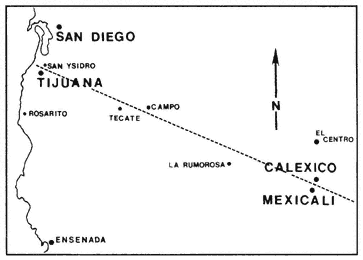
Map 6.
La Frontera
law. Mexican immigrants were refused visas in growing numbers, and the large influx of Mexicans was curtailed for a short period.[3]
The Baja Californios of this study entered the United States before this "crackdown" period. Most had arrived during the first two decades of the century when registration was the only requirement for legal entrance. There were no penalties for illegal entrance, no policing of the border, and any Mexicans apprehended for failure to register were merely told to register at official immigration stations (Hoffman 1974:11).
In the years immediately after 1924 loopholes in the law permitted entrance to some individuals. Entrance was usually allowed if immigrants had entered the U.S. previously or if they had relatives who were citizens and who could vouch for them. The interpretation of the laws was left to the discretion of immigration officers at the border. Baja Californios had a definite advantage because many had crossed earlier, most had family and friends living in the United States, and they understood the process of crossing the border.
This relatively flexible border policy reflected the regional ties between the Californias and the interrelations of the population residing
on both sides of the border. The many crossings of Baja Californios from the peninsula into the United States illustrate the mobility of individuals within the frontera zone which was fostered by U.S. immigration policy at the border. The flexibility and openness of the border encouraged a constant mobility between U.S. and Mexican towns as well as the settlement of individuals from the same families on both sides of the border.
Peninsular immigrants thus easily crossed the border and entered the United States legally in San Diego, Calexico (the major border station in California), or a number of small official stations located at interior points in the United States. When the Castellanos family returned to San Diego from Mexicali in 1920, Ursino Alvarez met them in San Ysidro. The immigration offices were closed, but the family was allowed to enter the United States, where they spent the night, and return to register at the border the following day. Such actions were common during the early crossings. Los Simpson arrived around 1910 from the mining circuit at the border near Campo, a small town some forty miles inland from San Diego and about ten miles into the United States. The family went inland to Jacumba where one Mexican official took care of their papers, then they continued on to Calexico. This was the only interior immigration check station. Immigrants were expected to report to the naturalization service there to register and pay the $8 entrance fee. At that time there was no station at Tecate, the present interior crossing point.
Crossings on the gulf side of Calexico were equally easy. Martina Mesa (sister of Apolonia Mesa de Smith), who arrived with her family and her sister's family in 1920, described the Mexican and American sides as "lo mismo" (the same). The crossing procedure at that time was to go first to the border station. From there individuals were directed to the Mexican consul in Calexico, where they were asked a variety of questions and registered. Then papers were arranged. In Señora Martina's case, she and her sister along with their children were told to return that same day with the papers filled out and with photos and the registration fee. In order to pay the fee they worked that same day picking cotton, then returned and registered as legal U.S. immigrants.
The Hollmans' crossing was similarly unrestricted. In November 1910, when the "revolutionaries" came into Mexicali, Marcos Hollman took his family (at night) into Calexico, fearing for their safety. There
was no immigration check, but the following day he registered the crossing with the U.S. immigration service.
Family settlement on both sides of the line also reflected early border policy. Many individuals lived in Calexico but worked in Mexicali. When the Castellanos first arrived in Calexico, Narcisso obtained a job with the Mexican government and commuted to Mexicali daily. Even Calexico advertisements for commerce and investment were directed at the growing Mexicali development.
These examples illustrate the geographic mobility of families living in the frontera zone as well as the open-border attitude expressed by the U.S. Immigration Service in the early decades of the twentieth century. Migrants approached the international line confident that they would cross the border, temporarily or permanently. Even when individuals did not have enough money to pay the fee, there was immediate work available, or family and friends residing on the U.S. side could provide assistance. I have recorded only one instance of a family's being refused entry into the United States, the cause being the severe illness of one family member. This open-border attitude greatly facilitated the continuing ties with hometowns and allowed a continuous influx of Baja families into the border zone of the United States.
The new cultural environment created an atmosphere that fostered the maintenance of kin networks and the establishment of new family interrelations. As migrants arrived in Calexico and San Diego, faced with new sociocultural conditions, they naturally sought out friends and attempted to maintain the institutions that were a part of their way of life. Stimulated by the presence and continuing arrival of other peninsulars who shared origins and migration experiences, migrants generated and extended traditional patterns of social organization. Confianza, compadrazgo, and marriage formed a set of kin institutions resulting in increased family interrelations. These relationships helped create an identifiable social organization of migrants in the U.S. The use of this set of kin institutions helped migrants maintain their cultural identity. The network formed a well-defined social field characterized by clear social-cultural boundaries. Family institutions became the principal mechanisms in the creation of a social kin network that provided successful cultural maintenance and adaptation in the frontera cities.
The network I am describing was not simply an extension of village networks but a more encompassing structure that was created along
the border, using traditional family institutions. Village networks among migrants are characterized by interrelations between extended kin and friends who share a specific hometown (Butterworth 1970; Bruner 1973; Doughty 1970; Friedl 1959, 1964; Lewis 1952, 1973; Mangin 1973). The Baja network on the frontera included migrants from a variety of peninsular towns; it was thus a regional network that included families from a large area of Baja California. Many of the families were unknown to one another before migration, unlike the pattern with village networks, but mutual aid and reciprocity between members became common in the frontera.
When cape families arrived in San Diego, many had kin and friends who extended the support often given only by kin. These kin interactions based on particular towns were maintained when possible by these early migrants and served to bring kin in a second-stream migration during the 1920s and 1930s.
Particular hometown networks did not remain isolated kinship structures tied to home villages. The stage migration fostered expanded interrelationships between families in which home kin networks were also mechanisms for growth. When migrants reached the border and began settling, friendships, confianza, and early compadrazgos were the base for continuing relations. The frontera environment encouraged the ongoing expression of confianza and the extension of family institutions between families. This resulted in marriage ties and finally in a succeeding generation of offspring who traced descent to a variety of peninsular villages. In the simplest outline, mutual aid and reciprocity led first to compadrazgo relationships and then to marriage ties among offspring of the mining pioneers and of the (early) Pacific and gulf migrants.
The beginning of formal relations between families can be clearly seen among the early steamer immigrants. The early steamer (and mining) migrants first arrived in San Diego and formed a nucleus of Baja Californios. As Calexico grew and attracted labor, many of these San Diego entrants traveled east to Calexico, where both old as well as new ties were established. A brief synopsis of the migration of Nicolás Ceseña, los Lieras, and los Hollman families reveals the pattern of previous family migrations, the settlement in the frontera, and the early friendships and marriages that led to the beginnings of a formal border network of family interrelations among Baja Californios.
San Diego, 1900–1920:
The Early Steamship Migrants
Nicolás Ceseña
The experience of Señor Ceseña and his family illustrates the continuous ties maintained by families as they moved from the south to the frontera region. Sr. Ceseña's migration within the border zone and his friendship and marriage within the migrant network typifies the pattern of settlement in the early decades of the twentieth century.
The Ceseña family has a long history of mobility in the Californias. Nicolas Ceseña's parents traveled frequently to Alta California. His mother (Jesus Castro) had lived several years in San Francisco before returning to the cape where she wed Eugenio Ceseña, who traveled often to the north doing business. He shipped citrus to San Francisco and imported apples from the north. In 1898, at the age of four, Nicolás, his siblings, and his parents boarded a steamer and headed to Ensenada, where a maternal uncle and maternal grandmother had settled. His mother's brother and other relatives who had migrated earlier were living in San Diego. Los Ceseña visited San Diego often during their years in Ensenada. In 1907, when Sr. Nicolás's parents died, he was sent to live in San Diego with his uncle. He returned twice to Baja California in the next eight years, staying long enough to lose his U.S. immigrant status. But he regained it when he went to work with the San Diego and Arizona Railroad. His railroad days lasted until 1925.
During his work with the railroad Sr. Ceseña (living in Tecate) frequently visited San Diego and became close to the Baja California families. In 1919 he wed Luisa Chavez, a direct descendant of los Smith of Comondú (Luisa's mother was a Smith). Their first son, Manuel, was born in Tecate in ]920. By 1922 they had settled among a set of Baja families, residing as a community, in Lemon Grove, just ten miles outside of San Diego.
The period just before settling down was one of transition for Sr. Ceseña. His pattern of movement along the frontera fluctuated like that of los Castellanos and Loreto Marquez. But during these years families were meeting and forming a new community in San Diego. These interrelations were not based solely on new acquaintances and kin ties. Hometown ties as well as knowledge of and friendships among nonre-
lated families also provided a strong basis for interrelations. The lives, migration, and marriage of Antonia Nuñez de Lieras and Pepe Lieras is one such example.
Los Lieras
In 1908 Señora Lieras and her father boarded a steamer at the small port of La Palmilla[4] in San José del Cabo and went directly to San Diego. During the next nine years Antonia Nuñez and her father lived in a variety of settlements around San Diego. She eventually settled in Lemon Grove with her husband, Pepe Lieras, another native of San José del Cabo.
Pepe Lieras had arrived in San Diego after Antonia Nuñez. He had spent his early years in San José del Cabo, where he had known a number of families whose members also came to San Diego. Among these families were los Alvarez and los Hollman.
The marriage of Pepe Lieras and Antonia Nuñez in 1917 was one of the early ties between Baja Californio families in San Diego. Among their earliest friends were Ramona Castellanos and Ursino Alvarez, who were both mining circuit migrants. Pepe had known Ursino's parents in San José and talked of them often in San Diego. This friendship resulted in compadrazgo relations as los Alvarez baptized one of the many Lieras offspring.
Los Lieras, through their offspring, provided a large base for the solidarity of the social relations among the first San Diego generation of Baja migrant families. Sra. Lieras gave birth to a total of seventeen children, of whom sixteen survived. Her offspring married into a number of Baja families. As a whole, los Lieras, parents and children, provided a series of connecting links when Lemon Grove became the geographic nexus of the network and the Californio community.
Los Hollman
The Hollman family history also reveals the patterns of mobility between the two Californias and the internal cohesion of family kin along the frontera. The Hollmans pattern of settlement in the frontera exemplifies the seeking out of other Baja Californios, the meeting of new friends and the links formed at this time between nonkin from Baja California. The chronological outline of their migration and settlement shows constant mobility over three generations between the Californias as well
as the movement between Calexico and San Diego that became a pattern for many of the early San Diego arrivals.
José Hollman originally emigrated from Berlin to South America. He then made his way to San José del Cabo, where he settled and married. His wife, Micaela Acosta, was a native San Joseña. The couple reared seven children and remained in the cape until José's death in the 1920s. Micaela then went north to San Diego where three of her offspring had migrated.
Marcos Hollman, son of José, had moved to San Diego in 1904 with his wife, Eulogia Gastelum, and two children, Bernardo and Josefa. They, like other natives of San José del Cabo, came north by steamer, disembarked in Ensenada and crossed the international line at San Ysidro. That year a daughter, Sarah, was born to the Hollmans in San Diego, but she died before the year was over. The following year Marcos went to Mexicali, while Eulogia and the children returned to San José, where they remained for about a year. They returned to San Diego again via steamer in late 1905. In 1907 they went to Calexico but crossed back into Baja California where they settled in Mexicali.
Los Hollman also illustrate the strong family networks that helped maintain a secure base for settlement along the border. Frequent visits to the south to see close kin, the arrival of close kin (maternal aunts and paternal kin), and the shared adoption of the Hollman children are obvious kin relations that fostered successful settlement in the towns of the frontera. During the next decade the Hollmans moved frequently across the border and in the peninsula. In 1910 Bernardo, the eldest son, returned to San José with a maternal aunt (who was living in San Diego) to visit his ailing grandmother. When Bernardo returned to Mexicali in 1910, revolutionary disturbances had begun to shake the town and the family crossed the border into Calexico. In 1919 both parents died, but other family members who had migrated earlier adopted the children.[5] First a maternal aunt who had married Narcisso Montejano (both natives of the cape) took the children (Bernardo, Josefa, Marcos, and Victor). Then in 1921 the children traveled to San Diego, where Josefa Gastelum de Ceseña, another maternal aunt, adopted them. Her husband, Daniel Ceseña, was also a cape native.
During these years the Hollmans also met a number of families with whom lifelong relationships were established. In Mexicali Bernardo met "Panchita," Juana, and all the Castellanos. There los Hollman also met los Salgado, another family that became incorporated into the growing Baja network. (Los Salgado are the family of my maternal
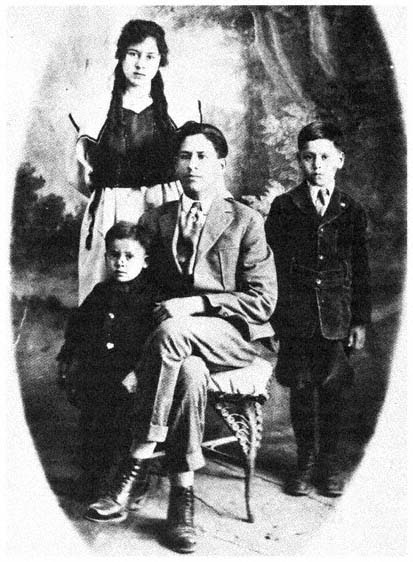
Josefa [standing], Victor, Bernardo [seated], and Marcos Hollman, c. 1917
grandmother, Dolores Salgado de Smith.) Bernardo and his family also knew los Smith in Calexico. These acquaintances fostered formal ties that would later pull a number of families into a tight social field around the San Diego area. In Calexico Marcos and Eulogia Hollman became compadres to the Salgados and Bareños (from Comondú) and in San Diego to the Alvarez and Smith families. Marriages between Hollmans and Salvatierras (also from the cape) occurred in the next decades. Such interfamily ties became common in the years following the initial period of settlement.
The Second Stream:
The Twenties and Thirties
The second stream of Baja Californios into the frontera provided not only an increase in numbers for the network but a strengthening of the ties between families already settled. These later migrants came as part of the large influx of Mexicanos who arrived to work in the cotton industry of Mexicali. But they arrived seeking family that had settled in earlier periods of immigration. Unlike previous migrants, these late arrivals came directly north in a classic second stream. Most of the families that arrived were kin to the previous migrants. In a well-practiced pattern, they sought refuge and aid in the homes of close kin. Extended kindred, like hometown networks, continued to provide family bonds and new outlets for the growth of family interrelations.
This second stream helped to perpetuate the regional ties of migrants to the peninsula. Incoming families and friends brought news of loved ones in the south and changes among kin in the hometowns. The recent arrivals encouraged reminiscences of the bygone days that earlier settlers knew could never be recaptured.
Through marriages in the south some of the couples in the second stream had united two extended families that had also become acquainted in the north. Such marriage partners had met in gulf or interior towns through resettlement, short labor migrations, or mutual family friends. Marriages between individuals from different towns followed a pattern to that of marriages in the frontera, for when these couples went north, they often became connecting links that helped to bring two extended kindred of the migrant population together. In the case of families that were already acquainted or tied through other
relations, these second-stream couples added a further link to interfamily solidarity.
When individuals came north, they were offered support by both kin and friends. Los Smith had kin living in San Diego who received them on their first arrival and provided them a place from which to survey San Diego for jobs and housing. Similarly, when Ceseñas came north, kin provided a home and adopted the young children when their parents passed away. Los Hollman, Alvarez, Becerra, and other families acted similarly. Friends often played an important role in extending support to arriving families. Los Castellanos had received los Marquez and provided a number of families with support on their arrival in San Diego.
The pattern of the second-stream migration paralleled that of the first phase of family entrance into the frontera. For this too was a family movement. In addition, the move was often prompted by the lack of economic alternatives in the hometown. The decision to leave the cape was sanctioned by existing kin in the north, and almost as a rule the migrants traveled either as nuclear families or family groups. Moreover, individuals headed directly to the border, cognizant of their destination. They knew they were going to the U.S., and this move, as a pattern, was not the slow process it had been in the case of the mining circuit migrants. This was a single move from points on the gulf to the north and the delta of the Colorado. Immigration was immediate, very often occurring within a few weeks of leaving the hometown in the south.
Unlike the previous migration, this twenties and thirties migration was part of a greater flow of Mexicanos into the developing sectors of the United States. It occurred at a time of mass immigration into the agricultural and industrial north of the United States. People were caught in the excitement of the rush north, stirred by stories of economic prosperity and employment. Steam travel was well developed by the third decade of the twentieth century, and the gulf became a highway of small vessels steaming into the northern ports of the Colorado delta to unload the enganchados (contracted labor; literally "the hooked") who were heading into the Mexicali and Imperial valleys of the Californias. While the majority of immigrants joined the labor circuit north into the San Joaquín Valley, the Baja Californio migrants remained along the frontera, with family and friends, within striking distance of the peninsula and hometowns in the south.
The increase in gulf travel developed as a consequence of the cotton boom in Mexicali. As the Mexicali valley grew, so too did the
numbers of labor seekers who went south in search of laborers for the new economy. The small vessels that came seeking individuals to contract for cotton work in the north provided a constant travel network between the cape and the north.[6] There was at the same time movement of peninsulars across the gulf and into the mainland.
The second-stream movements and the growth of linkages in the frontera are more clearly seen in the actual stories of migrants who left their hometowns in search of better economic but similar social life-styles. The following examples of los Bareño and los Romero illustrate the nature of the second migration and the internal patterns of relations that helped foster a network of formal social relations in the frontera.
Los Mesa–Romero and los Mesa–Bareño
In 1920 the families of Martina Mesa de Romero and her sister Berta Mesa de Bareño left the town of Loreto for the United States border. The Bareños decided to go north in search of work. Martina wanted to be with her sister, and the two discussed the possibility of seeing another sister, Apolonia Mesa de Smith, who had gone north via the mining circuit some twenty years before. Martina's reminiscence illustrates the importance of family connections in the decision to migrate: "We were doing very well in Loreto. But my sister, Berta, was coming here [the border]. She told Miguel, her husband, that she was going to come here. And I said 'I don't want to stay, I want to go with Berta, to see if we meet up with Apolonia.' We had word from Apolonia through Señor Olagos.[7] That's how we came here; with the message that Apolonia was here in Calexico."
The actual move out of Loreto was a joint family venture. Martina and her husband Olayo, their two children, along with Berta and Migue, and their six children boarded, one of the many steamers that was also taking enganchados to Mexicali.[8]
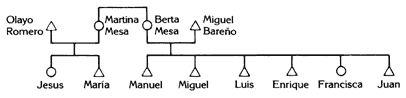
Diagram 6.
Los Mesa-Romero and los Mesa-Bareño when they left Loreto
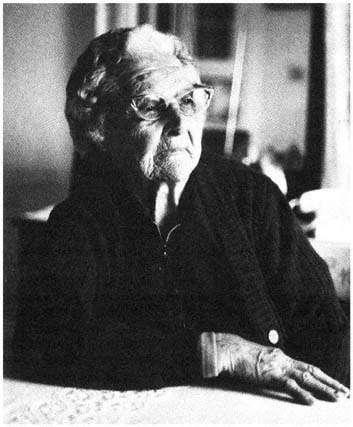
Martina Mesa de Romero, San Diego, 1976
The actual move of Martina and Olayo to the north had been preceded by a series of internal migrations. Martina had been born in 1888 in San Miguel de Comondú, but after her mother died she was adopted by the Las Rosas family and sent to live in Loreto. She was later taken across the gulf to Guaymas and on to the mining boom of Cananea. In Cananea Martina met many individuals from Baja California. Her own brother Levorio had gone there earlier to work the mines and it was there that she met her husband, Olayo Romero, who was originally from Loreto.
After their marriage los Mesa-Romero lived in Cananea for two
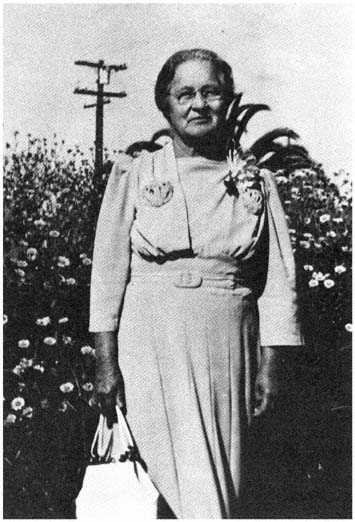
Apolonia Mesa de Smith in San Diego, c. 1945.
(Courtesy of María Smith Alvarez)
years but moved back to Loreto where they ranched and collected palo blanco[9] for about five years before deciding to accompany the Bareños north. Their decision to leave was also influenced by an earlier migra-
tion, that of Martina's younger brother Levorio, who had gone to Mexicali as a contracted laborer in 191.5. Moreover, the move north was prompted, at least for Martina, by her sister's leaving and the presence of Apolonia and Levorio in the north.
The Bareños went north for a variety of reasons, but new economic opportunities seemed to be the primary motive. Berta Mesa de Bareño and her husband Miguel had lived in Loreto. Miguel had had a variety of jobs in the region, including mailman, sheriff, and bayuquero (tavernkeeper). A son, Enrique, states that another reason for leaving was the revolution. The presence of Berta's sister Apolonia and her brother Levorio in the north were added inducements for migration.
The journey from Loreto to Mexicali took about a week. They boarded the steamer La Pasita, which stopped in Santa Rosalía, then made its way up the gulf to San Felipe. Passengers disembarked near the port of La Bomba and traveled the remaining hundred-odd miles by land to Mexicali. Once in Mexicali many families crossed directly into the United States.
Levorio Mesa was living in Mexicali when his sisters Berta and Martina arrived. Having had word from him, they found him easily. Levorio had already contacted his other sister, Apolonia Smith, in Calexico and had gone there regularly on weekends. Berta and Martina sent word to Apolonia that they had arrived and began the process of immigration immediately. The families had no trouble crossing the border and went directly to Apolonia's.
The joint migration of these two sisters and their families provided an immediate addition of kin for the Mesa extended family in the north and furthermore brought two extended lines—the Bareños and the Romeros—into the growing Calexico network. Both of these families became acquainted with other Baja Californios in Mexicali and Calexico and began to establish formal ties of their own with kin and peninsular friends.
The second-stream families became part of the northern network in a pattern similar to the development of relations among earlier migrants. Once in the north, couples produced children who were socialized along with the pioneer offspring on the border. Even the actual birth of children provided the extension of social relations. Guadalupe Salgado was a midwife and became close to many women because of this practice. In at least one instance it led to compadrazgo relationships. The mutual experiences of offspring in neighborhoods and schools provided another common bond between peninsulars.
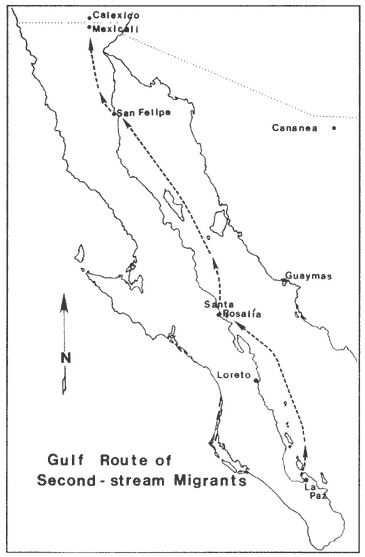
Map 7.
Close friendships were established through extended family members, and these relations often resulted in formal ties expressed in compadrazgo and marriage. This general pattern was a natural process of individuals' seeking out like individuals. It had occurred in the mining circuit and on the gulf and was now occurring for migrants in the frontera towns. Among both new and older migrant cohorts the normal life cycle of birth, compadrazgo, and marriage was given new importance by the hardships and cultural dissonance experienced in the new environment of the frontera.