
Issue Linkage
I refer to an "issue" as a single goal that has found its way onto a decision-making agenda, such as the cessation of nuclear testing or the establishment of a maximum sustainable yield for catching salmon in international waters. Agreement, or lack thereof, in the ensuing bargaining process will dispose of the single issue. "Issue linkage" refers to bargaining that involves more than one issue. Issue linkage is being attempted if the nuclear test ban is discussed in conjunction with limits on strategic weapons, or if the salmon catch is being negotiated in connection with the nutritional needs of the consumers. The attainment of interconnected and expanding goals is almost always accompanied by the attempt to link issues in negotiations.
We are attempting to understand how issues are linked in multilateral negotiations in international organizations, a bargaining process dominated by politicians who are aided by technical experts in national and international bureaucracies and urged on by other
experts associated with NGOs. In short, we must understand a bargaining process in which all styles of decision making operate. This requires a closer look at how experts persuade each other, how politicians bargain, and how experts interact with politicians.
There are three ways of persuasion. First, one can link issues by introducing into the agenda items that are not substantively or inherently connected. We call this "tactical linkage." The objective is simply to extract a concession not obtainable if the discussion remains confined to a single issue. For instance, deep-sea mining can be regulated without also worrying about the right of passage through straits. Yet in the UNCLOS III (Third U.N. Conference on the Law of the Sea) these issues were in fact linked by the Group of 77 because the weaker countries had no other way to force the stronger ones to internationalize deep-sea mining. Tactical linkages are commonly used by the weaker parties in bargaining. Since the issues linked are not considered inherently connected, the sacrifice of a secondary demand poses no problem as long as what is really wanted is accomplished. Tactical linkage describes the conduct of most international negotiations when politicians are left to themselves to bargain, when no effort is made to inform the negotiations with a changing consensus on causes and effects, or when experts make no attempt to transcend their separate professional perspectives.
Second, issue linkage may also proceed on the basis of causal understandings, or consensual knowledge applied to an agreed overarching social goal. This "substantive linkage" is of greatest concern to our efforts to understand collaboration. An item from the NIEO debate illustrates the pattern. Experts in the developing countries have come to regard technology transfer as an overarching concept instead of worrying separately about such matters as foreign capital inflows, obtaining patents for specific products, finding markets for their products, or building a certain type of factory. These things remain the issues, staying in people's minds even when they are combined and abstracted into a more comprehensive pattern. But instead of being ends in themselves, they become means toward a more complicated end—the achievement of technological self-reliance. Instead of being effects, they are reconceived as causes leading to more basic effects such as wealth, prestige, status, and autonomy. Substantive linkage is typical of
decision making not only by experts committed to consensual knowledge but also by politicians who profess interconnected-expanding goals informed by consensual knowledge.
Third and finally, issue linkage may also be attempted in situations where most of the political aspirations are issue specific, but where strong strands of causal understandings among issues also exist. Moreover, the bargaining situation demands that the negotiators maintain cohesive coalitions in the face of this mismatch between knowledge and interest. We call this "fragmented issue linkage." Each coalition is held together by a commitment to some overriding social goal, even though the politicians disagree with respect to the knowledge necessary to attain it, while the experts see eye to eye. Politicians may also disagree on the extent to which the issues in the package have interdependent anticipated effects. Uncertainty about outcomes is the glue that holds the coalitions together. Even though the linkers are uncertain about the joint gains promised by the issue package, it is safer to link because only by doing so can big concessions be obtained from the industrial countries. Moreover, because the relationship between relatively specific-static goals and increasingly consensual knowledge is by its very nature volatile, we can expect changing calculations of joint gains within and among coalitions. This changeability suggests the possibility of occasional elaborate agreements covering a variety of issues, but not a pattern of such agreements.
Even though bargaining that features tactical linkages does not depend on knowledge, whereas negotiations that conform to the fragmented linkage pattern do, both modes depend on the size of the "win-set." Win-sets, however, are irrelevant to bargaining in the substantive-linkage mode because the persuasiveness and acceptance of the consensual knowledge alone predict agreement.[4]
I have taken the idea of win-sets in two-tiered negotiations and the argument about the importance of large win-sets from Robert D. Putnam, "Diplomacy and Domestic Politics: The Logic of Two-level Games," International Organization 47 (Summer 1988): 427-60.
The notion of win-sets is intrinsic to international bargaining because international organizations are coalitions of coalitions. The negotiators in the organizations are tied to coalitions by virtue of their membership in blocs of states; they also have to "sell" any agreement to a domestic constituency made up of bureaucratic entities as well as of varying combinations of voluntary groups and political parties. The wise negotiator does not seek to reach agreement on the international level until he or she has some idea of the size of the domestic win-set required to assure acceptance of the international bargain.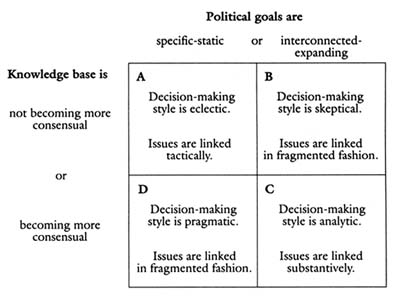
Figure 4. A typology of decision-making styles and issue linkage
in international organizations: how knowledge interacts with interest
In general, the larger the win-set the more likely that an acceptable international agreement will be concluded. Having a large win-set implies the inclusion of many groups of constituents into the bargaining process, which in turn implies a large number of interests to be represented and satisfied. A large basket of interests implies a large number of issues that call for linkage in order to become acceptable, at least for tactical linkage. The larger the issue packages, the greater the chance that the various proposals for an agreement offered by the international coalitions will overlap sufficiently to produce a general agreement. Conversely, small win-sets at home imply more restricted issue packages on a narrow range of issues, thus increasing the chances that the competing international formulas will not overlap.
We are now in a position to combine the typology of decision-making styles with our typology of issue linkage (Figure 4). We are still positing an organizational subunit as the decision-making entity, not an international bargaining session (even though our discussion of linkage was illustrated with episodes that occurred in international organizations).
Let us examine what each cell in this figure suggests. In cell A, neither
experts nor politicians are motivated by a growing body of consensual knowledge. Neither thinks of the conceptual unification of separate goals nor uses analytic techniques for conceptual integration. If this situation prevails in an organization, the linkage pattern among issues will remain purely tactical. Agreements persist only as long as the initial interests of the participants remain intact.
In cell B, the experts and politicians are committed to some new and ambitious goals that call for new causal theories. Yet they have no consensual knowledge to help them (though some experts and some politicians undoubtedly propound concepts that have not yet become consensual). Issue linkage is based on political demands alone. The situation is that of fragmented linkage. Agreements can be made, but they are subject to rapid obsolescence if new consensual knowledge develops.
In cell C, the analytic mode of decision making is supreme. All participants accept the expanding knowledge base and employ it in designing their ambitious social objectives. It is the perfect case of substantive issue linkage. The founders of UNEP had something like this in mind, as did the epistemic community and its political allies that dominate UNCTAD.
In cell D, finally, a more complicated situation prevails. The expert knowledge for more ambitious problem solving exists and is available to politicians, some of whom may even be persuaded by its relevance. Yet the definition of social objectives remains fragmented, though some politicians probably would wish to move in the direction of more conceptual complexity. Bargaining under such conditions will also show the fragmented-linkage pattern, with more pressures toward substantive linkage than in cell B. Agreements are subjected to the pressure to adapt in line with knowledge. But the unstable consensus on goals is likely to make the adaptations short-lived.