
Ostracism (Murahachibu)
Murahachihu, perhaps the best-known village-specific penal measure, was absent from lordly legislation. There were multiple ways of getting rid of undesirable community members—banishment, disinheritance, stripping of "civic status," and so on—all of which had to be sanctioned by supravillage authorities in the form of prior requests or at least post factum reporting. Ostracism, however, was purely a village affair. It was the result of a decision made "by the community" to sever all social intercourse with a member and cut the household off from almost all mutual assistance. According to one popular interpretation of the term (which literally means "eight parts [out of ten]"), those ostracized could count on community assistance only for two "parts" of community life, namely, fire and funerals, but not for the other eight: coming-of-age ceremonies, weddings, memorial services, births, sickness, floods, travel, building and repairs (e.g., roof thatching).[61] In addition, ostracized members would not he greeted and were not allowed to participate in meetings or festivals. In other words, it meant social and economic ruination.
In the following case we shall look at the process of ostracism and glimpse the tensions that crisscrossed village life. This case is unusual and of special interest because the victim initiated a suit with the bakufu
[60] Igeta, Ho[*] o miru , 95.
[61] Akutsu Muneji, "Mura gitei ni tsuite no ichi kosatsu[*] : toku ni seisai sadame no shojirei," Gunma-kenshi kenkyu[*] 25 (1986): 99.
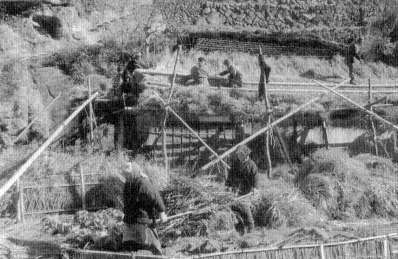
Plate 4.
Rethatching a Roof, Mera Village, Minami-Izu, Shizuoka Prefecture,
1964. Community assistance was needed for the work but was denied when the
household was ostracized. Photograph by Haga Hideo, courtesy of the Haga
Library, Tokyo.
authorities and the case was settled in court.[62] This incident took place in Sasaemon village in Musashi province, a medium-sized village of 1,000 koku with some seventy households (now part of the town of Sugito in the eastern part of Saitama prefecture), located along the highway to Nikko[*] in a large bakufu territory of over 110,000 koku, which an intendant administered from Edo. The incident started at the end of 1827/2 and was resolved with surprising speed—in just two months' time—at the intendant's office in Edo.
The plaintiff was one Chojiro[*] , who because of ill health was allowed to be represented by his son Kichitaro[*] . There were nineteen defendants, including the headman, kumi heads, and titled and nontitled peasants. Chojiro[*] was probably a well-established peasant; he even had a branch house, which was headed by Takejiro[*] , a kumi head in another village. Chojiro[*] belonged to the Terabori kumi but was closely related both
[62] Fuse Yaheiji, "Shiryo[*] : Mura hachibu no sosho[*] ," Nihon hogaku[*] 23, no. 3 (1957): 96- 109.
geographically and socially to two other kumi. The defendants were spread over Chojiro's[*] own kumi and a fourth one, the Tosho kumi, a sign that the community was probably divided.
At noon on 1827/2/23 three village members—Kyujiro[*] , Shigeshichi, and Seijiro[*] —visited Chojiro[*] at his home and insisted that he immediately repay them loans totaling more than five ryo[*] . Kyujiro[*] and Shigeshichi lived in Chojiro's[*] kumi, while Seijiro[*] lived in the Tosho kumi. Kyujiro[*] was "homeless" (mushuku) or not registered anywhere. He had been punished with medium banishment for some crime, which meant that his home and land had been confiscated and that he was not allowed to travel to or reside in any of a number of provinces, including the one where Sasaemon village was located. He was an illegal resident, an offense punishable by maximum banishment.[63] He lived with and worked for Shigeshichi's father. Seijiro[*] , who was registered in a village of another district, was married to Sen, daughter of the Tosho kumi's head. He and his wife had gone to live with his in-laws after causing some trouble with his own parents in his native village.
When he was confronted by the trio, Chojiro[*] expressed great surprise and did not recall anything about the loans. A quarrel ensued, and the three alleged creditors decided to help themselves to some bales of rice and other things. A fight broke out, and they started destroying tools and farming implements. One of Chojiro's[*] sons ran off to the branch house to alert Takejiro[*] . Soon after Takejiro[*] arrived on the scene, about a dozen peasants from Chojiro's[*] kumi appeared, led by the kumi head. Now negotiations started. Chojiro[*] was ready to pay off two of the three claimants, leaving the "homeless" out of the bargain. The headman, however, was adamant that Kyujiro[*] be part of the settlement negotiated by the whole gang of villagers. Thus Chojiro[*] was forced to pay over three ryo[*] , rather than the claimed full debt of five ryo[*] , a debt he never acknowledged. It was Takejiro[*] , from the branch house, who put up the money.
That was not the end, though. Two days later a gang of twelve young men from Chojiro's[*] kumi appeared at his doorway and shouted that he had been ostracized. When Chojiro[*] asked why, they did not
[63] Light banishment was accompanied by confiscation of land; medium banishment by confiscation of land and homestead; maximum banishment by confiscation of land, homestead, and household effects (see Tsukada Takashi, "Kinsei no keibatsu," NNS 5:97).
answer, but turned and left, hurling insults at him as they went out. Then the Tosho kumi head, Seijiro's[*] father-in-law, and three other members of that kumi came, and they also declared him ostracized. Chojiro[*] , now outlawed by two of the four village kumi, including his own, looked for mediation to the headman, one of whose main tasks was to settle intramural disputes before they became lawsuits. Once again, the headman stubbornly refused to intervene, which left Chojiro[*] only one recourse, namely, to lodge a suit with the intendant, even though his chances of receiving any response other than an order to settle the matter internally were slim.
The suit was drawn up according to the required format and presented a clever argument, which is why Fuse Yaheiji, the scholar who discovered it, thinks that Chojiro[*] may have relied on the legal expertise of a suit inn (kujiyado ) in Edo. The suit document acknowledged that matters such as these were usually settled out of court in order to avoid lawsuits but stated that the present issue was not a frivolous one, because the intendant's immediate interests were at stake. The main argument was that ostracism would prevent Chojiro[*] from producing tribute or from performing horse corvée on the Nikko[*] road (which was of particular importance to the bakufu, since it led to Ieyasu's shrine). The result was a quick summons for the defendants to appear by 10:00 A.M. on 3/28 at the intendant's office in Edo. They were to bring a written reply to the accusations (which would be read to the plaintiff) for a confrontation with the plaintiff; otherwise they would be found guilty and fined accordingly.
From the settlement document drafted a month later, we can reconstruct what happened at the hearing. First of all, the illegal "mura lien," Kyujiro[*] , was not included. There were a total of sixteen defendants with an unrelated village headman as their spokesman. Another village headman functioned as mediator between the defendants and the sole plaintiff, Chojiro's[*] son Kichitaro[*] . Kichitaro[*] maintained that the money dispute and the ostracism were related. The defendants not only denied such a link but also denied that any declaration of ostracism had ever taken place! Typically, the mediator forced both parties to acknowledge that they each were in the wrong. The mediator considered the money matter to have been resolved before the trial, since the debt had already been paid off, although not to the complete satisfaction of the three claimants. Therefore, the plaintiff withdrew his accusation of a linkage. The defendants admitted to the declarations of ostracism and agreed to
write an apology and reinstate the plaintiff as a fully privileged community member. As was customary at such settlements, both parties agreed that the suit had been settled and that no new suits would follow.
The affair had split the village into two camps, illustrating, perhaps, Oide's[*] thesis that while there were many instances of intravillage settlements made by extravillage authorities in the early period, toward the end of the Tokugawa period village divisions often ran so deep that recourse to outside authority became increasingly necessary.[64] That village ostracism was open to abuse is obvious, but it was not until the year after the case just discussed that the bakufu began to regulate it, forbidding young people to initiate it.[65] An indication, perhaps, of increased village strife, other cases must have drawn the bakufu's attention at the time. Ostracism, like banishment, was a solution that created more problems, producing bankrupt peasants, "homeless" types, and vagrants, which had been a serious concern of the authorities since the eighteenth century.
As far as the details of the above case are concerned, there are obscure areas that raise unanswerable questions. Chojiro[*] denied liability, and yet his branch house was willing to pay off the alleged debt. We do not know the reason for this turnabout or the nature of the pressure Chojiro[*] put on Takejiro[*] to forward the money. There are also overtones of gang behavior and extortion, perhaps fueled by the marginal members of the village, who seem to have received protection. Yet it is also unlikely that the three so-called creditors would have wholly fabricated their claims. They and their young supporters may have created an atmosphere of opportunity for Chojiro's[*] enemies within the village to settle old scores; the headman does not appear to figure among his friends.
Indeed, the headman deliberately allowed things to escalate, first by refusing to allow the illegal resident Kyujiro[*] to be excluded from the settlement negotiated at Chojiro's[*] doorstep and then by letting the ostracism stand. He did this even though he apparently lacked the support of half the village and he might get into trouble during the course
[64] See, e.g., Yamamoto Yukitoshi, "Kinsei shoki no ronsho to saikyo: Aizu-han o chushin[*] ni," Kinsei no shihai taisei to shakai kozo[*] , ed. Kitajima Masamoto (Yoshikawa kobunkan[*] , 1983), 79-127.
[65] Fuse, "Murahachibu," 107-9.
of the interrogations if the matter of Kyujiro's[*] status were to surface. He may have been responsible for the fact that no mention was made regarding Kyujiro[*] that might alert the intendant, which makes one wonder what he held over Chojiro[*] that kept the latter from playing that card: could it have been the threat to force payment of the remaining two ryo[*] ?
Ostracism was different from banishment (tsuiho[*] ), whereby one was expelled from the village; however, the two were similar in that ostracism was in effect intravillage banishment. Extravillage banishment could be triggered by a vote whereby someone was declared, without any material proof, to be the perpetrator of some crime. One case will illustrate this point.[66]
In Iwaya village (Tanba province), a certain Shohyoe[*] reported the theft of some of his belongings to the village officials, who decided to take a vote in the village on who the thief might be. The ballot pointed to Rokuzaemon, who lived across the street from the victim; Rokuzaemon, however, had absconded before he could be punished. He was sentenced in absentia to banishment of five ri (20 km) beyond the village, with the proviso that if he returned home and was reported, the father of the fugitive would not resist his whole family's banishment. Three years later the son returned secretly. When he was discovered and reported, a powerful village elder interceded with the village council on the man's behalf and succeeded in having the entire family's banishment suspended. The son, however, had to leave again.
After her son's second expulsion, the mother started slandering Shohyoe[*] , who, although a victim of a theft, had been the source of the family's suffering for a crime that had not even been proven. Again the family was reported to the village officials; an "investigation" was launched, and it was decided that the woman had become deranged and was thus not accountable for what she had been saying. A year and a half later (1717/5), however, Shohyoe[*] and his wife, finding life unbearable, moved to the other part of the village, which since 1664 had been divided between two jurisdictions. This example introduces another form of village justice, one based on the results of the ballot box.
[66] Taoka Koitsu[*] , "Murahachibu to tsuiho[*] ni tsuite," Chihoshi[*] kenkyu[*] 12 (1954): 4-6.