
1
Towns and Princes in Late Medieval Holland
This chapter provides a historical context for the political institutions of sixteenth-century Holland, with special reference to the relationship between the major towns and the Habsburg government. It will first be useful to show how the growth of towns in fourteenth-century Holland coincided with political circumstances that made successive ruling dynasties dependent on the towns for support. Philip the Good, Duke of Burgundy (d. 1467), had the backing of urban patrician oligarchies and laid the foundations for integrating the County of Holland into a larger territorial state, although much of what he accomplished was undone in a reaction following the death of his son Charles the Bold in 1477. In the last two decades of the fifteenth century, Holland went through a period of sharp economic decline, which proved to be only a temporary setback for towns linked to the dynamic seafaring trades, but the beginning of prolonged stagnation for towns primarily dependent on industry. As a consequence, the Habsburg successors of Holland's Burgundian rulers found that the seafaring towns, especially Amsterdam, were in the strongest position to bargain for what they wanted.
The Growth of Towns in Fourteenth-Century Holland
The inhabitants of the medieval Low Countries shaped their land by their own labor as few other peoples have done. Already in the eleventh century, Frisian- and Netherlandish-speaking communities were forming polder boards (heemraadschappen ) to
organize the diking of rivers and the drainage of swamps and bottom land. In the twelfth century, princes formed higher polder boards (Hoogheemraadschappen ) for the larger task of holding back the power of the sea. It was by placing themselves at the head of this reclamation movement that the counts of West Friesland consolidated their authority over districts lying between the IJ and the Maas, and formed what came to be known as the County of Holland, including West Friesland. By about 1300, Holland was protected by a network of drainage channels and dikes—including sea dikes along the Maas, the IJ, and the Zuider Zee—which must surely rank as one of medieval Europe's more impressive monuments to human collaboration and engineering skill.[1]
Holland's continuing struggle against storm and flood deserves to be better known to English-speaking readers, [2] and rural polder boards no doubt provided an appropriate symbol of the sturdy independence of village communities in this region.[3] But fourteenth-century Holland was remarkable also for another feature that is more important for the theme of this book: the relative importance of its towns. Unlike Flanders or Brabant, Holland had few towns of any consequence prior to the thirteenth century, but during the first half of the fourteenth century numerous small cities in Holland developed individual economic profiles and attracted migrants from the countryside. Dordrecht prospered as an entrepôt for the trade in German Rhine wine, whereas Rotterdam and Enkhuizen were important centers for the fishery that developed in Holland as schools of herring shifted their seasonal migrations from the Baltic to the North Sea. Leiden began importing the highly-valued English wool for its cloth industry around 1350, while Gouda, Haarlem, and Delft were already brewing the hopflavored beer that had been available only as an import from northern Germany. Amsterdam's intrepid seamen soon found that eastern Baltic cities, though members of the Hanseatic League, were eager for a direct connection with the Low Countries that would enable them to bypass Lübeck's traditional control of the Baltic trade. The late H.P.H. Jansen, the leading student of Holland's late Middle Ages, estimated that in 1350
the seven leading towns together counted some 40,000 people, about a fourth of the province's population.[4]
Moreover, the cities began in the same period to assume a political role commensurate with their economic position The dynasty of West Friesland, which had come to rule over the counties of Holland and Zeeland, died out in the direct line in 1299, and the fourteenth century witnessed transfers of power to two collateral lines: first the Avesnes counts of Hainaut (1299–1346), then the Wittelsbach dukes of Bavaria (1346–1428) In both cases, a succession crisis weakened comital authority and made the new rulers dependent on cooperation from assemblies of nobles and townsmen, similar to those forming all over Europe during the thirteenth and fourteenth centuries.[5] Unlike England or neighboring Brabant, Holland in the early fourteenth century did not as yet have a stable conception of parliamentary institutions Moreover, representation was not necessarily tied to the province as a distinct unit, for the same principle operated both at a local level where peasants in Kennemerland and West Friesland had a practice of electing deputies for discussions with the count, and at a dynastic or regional level, as when, under the house of Avesnes, deputies from Holland, Zeeland, and Hainaut were convened as a body Within this loosely defined framework, however, urban deputies gradually assumed a more prominent role, partly because the counts had need of the new urban wealth Holland's fourteenth-century rulers were especially interested in freeing the traditional bede or subsidy from customary restrictions that limited its use to certain occasions To do so, they needed the consent of the governed, and of the towns in particular.[6]
The role of the towns was decisive in what started as a family quarrel between the first ruler of the Wittelsbach dynasty, Count Willem V, and his mother, Margaret of Bavaria, and developed into a protracted civil war between two factions known as the Hoeks and Kabeljauws (Hooks and Codfish) The Hoeks, including most of Holland's noble families as well as the city of Dordrecht, backed Margaret, whereas Willem V and the Kabeljauws had the support of most towns, possibly because of their opposition to Dordrecht's "staple" privilege by which
goods passing up and down the rivers had to be offered for sale in its market.[7] But Willem V no sooner began to consolidate his power than he showed early signs of the madness that in 1358 led to his being confined for the rest of his life His younger brother Albert then governed for many years as ruwaard or protector, and was only recognized as Count of Holland after Willem's death in 1389 As Duke of Bavaria-Straubing, Albert was often absent from the Wittelsbach family's Netherlands possessions, but he effectively pacified Holland by appointing equal numbers of Hoek and Kabeljauw nobles to official posts and by reducing the dimensions of the Dordrecht staple.[8]
Under the balanced regime created by Duke Albert, Holland was an island of prosperity amid the general economic distress of Europe in the latter half of the fourteenth century By about 1350, Hollanders were bringing North Sea herring to Skäne, the traditional market center for Baltic herring Somewhat later, perhaps around 1400, they invented the bus , a vessel that permitted the catch to be cleaned and salted at sea while it was still fresh.[9] Amsterdam and other towns expanded their commercial interests from herring to wider contacts in the eastern Baltic, while the new industries of towns like Leiden (woolen cloth) and Gouda (brewing) flourished.[10] Since there was no comparable urban development in Hainaut, Duke Albert reversed the traditions of the house of Avesnes, and made The Hague the principal residence and administrative center for his Low Countries territories, while his son, Willem van Oosterbant, ruled in his name in Hainaut Albert's prestige on the wider European stage is evident in the double marriage he contracted in 1385 with Philip the Bold, Duke of Burgundy (d 1404), a younger son of the French royal house and ruler by marriage of Flanders and Franche Comté: Willem van Oosterbant wed Marguerite of Burgundy, and one of Albert's daughters married John the Fearless, the future Duke of Burgundy.[11]
Under Willem van Oosterbant or Willem VI (1404–1417), Holland faced yet another question of succession, since his only child, Jacoba of Bavaria, was a widow at the time of her father's death Initially there were several claimants for the Avesnes—Wittelsbach inheritance and for Jacoba's hand, but in the end Jacoba was left on her own to face the invasion of Holland
(1425) by Duke Philip the Good of Burgundy whose mother had been a sister of Count Willem VI For some time, Jacoba's supporters held out in Gouda and in the district around Alkmaar where peasants roamed through Kennemerland razing the castles of Kabeljauw nobles (This peasant revolt in favor of a ruler who counted on Hoek support, together with the hostility that urban craftsmen often displayed for Kabeljauw patrician governments, helped engender a patriotic reading of Holland's medieval history common in the later Republic when the Hoeks were seen as the party of Holland's common folk and its ancient liberties, and the Kabeljauws were viewed as lackeys of Burgundian overlordship, little better than a foretaste of Spanish tyranny) After three years of fighting, however, Jacoba bowed to the Duke of Burgundy and his Kabeljauw allies and signed a treaty acknowledging Philip the Good as her heir (1428) Holland thus became, as it had never quite been before, a province ruled from beyond its borders.[12]
Holland's Towns under Burgundian Rule
When Philip the Good succeeded his father John the Fearless as Duke of Burgundy (1419), his Low Countries possessions were limited to the counties of Flanders and Artois Within ten years, cashing in on opportunities arising from marriages arranged by his grandfather, he had added Brabant, Namur, Luxemburg, Holland, Zeeland, and Hainaut Only in Holland was armed struggle required to make good his claim In his newly won territories, the rule of this powerful prince witnessed the building of new institutions to bind them more closely together, but not a rude disruption of their separate identities To be sure, Philip imposed penalities on the peasants of Kennemerland, loyal to Jacoba of Bavaria till the bitter end, and he garrisoned castles in Holland with "foreign" troops (that is, Walloons from his French-speaking lands), a novelty that would later be remembered as ominous.[13] But neither Philip nor his advisers seem to have entertained the idea of quashing local privileges merely because they were inconvenient to his purposes The Duke asserted his will in this quasi-absolute manner only when confronted with rebellion, particularly rebellion by those of low
status like the peasants of Kennemerland with their communal traditions, or, more often, by the turbulent and powerful guilds of populous cities in Flanders and Brabant The revolt of the great city of Ghent (1451) was especially notable both for its gravity and for the severity with which it was suppressed.[14] But incidents of this kind had no bearing on Holland where (save at Dordrecht) craftsmen were not allowed to organize into guilds and had no formal voice in local government It was under Philip's rule that most of Holland's towns acquired the privilege of choosing a given number (twenty–four to forty) of their richest and most notable citizens to form a town council to advise the burgomasters and schepenen (aldermen) In time, the term vroedschap (wisdom) came to be widely applied to these bodies in which membership was for life and replacement was by cooptation Town councils of this type grew steadily more influential and were an important legacy of the era of cooperation between Philip the Good and Holland's Kabeljauw towns.[15]
Broadly speaking, Philip and his officials gave provincial institutions in Holland a more definite shape and brought them into closer conformity with prevailing practices in Flanders and Brabant In 1428 Philip created the Raad van Holland (Council of Holland) and gave it a form that was to continue in effect until the Dutch Revolt There were to be eight councillors, together with a presiding officer Some of them had to be of noble birth; others had to be schooled in the law since one of the Council's chief functions was to hear cases that came from lower courts (those of the sheriffs or schouten in the towns and of the bailiffs or baljuwen in rural districts), either on appeal or (in rare instances) on "evocation" by the Council itself.[16] Philip also put in place a more formal structure for the process of representation The treaty by which Jacoba recognized him as her heir (1428) is the first document to employ the term Staten van Holland, or States of Holland, a clear derivation from the French états (the provincial parliaments of the Low Countries will be discussed more fully in chap 2) Late medieval counts of Holland had to seek the consent of their subjects, rural as well as urban, on a number of important occasions; a new ruler had to be acclaimed at various prescribed locations throughout the territory, not just in the towns, and requests for taxation were
presented to rural as well as urban assemblies During the course of the fifteenth century, however, these earlier usages faded into obscurity, and the "States of Holland" came to be regarded as the one body that represented the entire province Within this body there was a definite tendency towards hierarchical organization Many smaller cities continued sending representatives to the States well into the sixteenth century, but by about 1500 it was clear that only seven votes counted: one for the nobles as a corporate body, and one each of the six "great cities" In the order in which they voted, these were Dordrecht, Leiden, Haarlem, Delft, Amsterdam, and Gouda.[17]
Meanwhile, Holland's institutions were integrated into the wider Burgundian world Philip the Good's interests were represented in Holland and Zeeland by a provincial governor or Stadtholder, usually chosen from among the great noble families of the French-speaking provinces—the same men for whom Philip created the Order of the Golden Fleece to bind them to one another as well as to their sovereign lord The Stadtholder usually had a residence in Brussels where he could serve as a bridge between the plain-speaking Netherlandish burghers of his province and the nuanced milieu of a francophone court aristocracy When residing in the territory assigned to him, the Stadtholder commanded the Duke's military forces, negotiated with the States on beden and other matters, and presided over the Raad van Holland.[18] It was also under Philip the Good that the existing monetary union between Flanders and Brabant became the basis for a common currency; thus, gold coins and monies of account throughout the Low Countries came to be reckoned in silver groats of Flanders or stuivers of Brabant—one stuiver was equal to two groats (For purposes of simplicity, sums mentioned in this book will be given in Holland pounds of forty groats, corresponding to the unit of account most commonly used in the sixteenth century) Finally, starting in 1463, the States of Holland and of other provinces were asked to send deputies to a larger assembly, the States General, at which taxes and other matters could be discussed.[19]
It was clear that Holland's incorporation into the Burgundian Netherlands would have important fiscal consequences Already in the latter half of the fourteenth century the bede
became simply an extraordinary subsidy which the prince requested as occasion demanded, without regard to the limits prescribed in feudal custom Under Philip the Good, it came to be known as the ordinarls bede, collectible every year on the basis of an assessment of wealth, the schiltal, which was renewed periodically In addition, extraordinaris beden were also requested for special needs (like the crusade Duke Philip swore in 1455 to undertake), though in this case the States had more latitude to reduce the amount or refuse altogether.[20] Higher levels of taxation did not go unnoticed, especially since town governments often met their quotas by raising the rates for the accijnsen or excises on beer, grain, and other items of common consumption, taxes which struck hardest at those least able to pay Moreover, even at this time, as later under Habsburg rule, Hollanders had a natural tendency to exaggerate the extent to which their contributions supported the Duke of Burgundy's luxurious court and his ambitious foreign policy, and to underestimate the advantages Holland derived from its inclusion in a state that was one of Europe's great powers
Perhaps the most interesting question along these lines concerns the role of the Burgundian state in the one external conflict that was of the greatest moment for Holland's economic future, the 1438–1441 naval war with the so-called Wendish cities of the Hanseatic League, that is, Lübeck and five of its neighbors Denmark at this time controlled both the Copenhagen and the Malmö sides of the Øresund, linking the Baltic to the North Sea, and the Sound Toll was the crown's principal source of revenue Lübeck, a major naval power, was strong enough to insist on exemption Hence the Hollanders, in their efforts to break into the Baltic trade despite the determined resistance of Lübeck, had a potential ally in the King of Denmark After a ten years' truce between Holland and the Wendish cities, war broke out again in late 1437, when Lübeck and her allies seized Holland's grain ships In regard to their main objective—to gain the right to trade at will in the Baltic—the Hollanders emerged victorious, mainly because they had supported Erik of Pomerania against rival claimants to the Danish throne.[21] The cost of fitting out warships during these years was borne entirely by Holland in a manner that shows the breadth of engagement by Holland's
towns and villages in the Baltic trade: on one occasion, twenty–two towns and a larger number of villages, mostly in northern Holland, were responsible for a total of sixty-eight warships Philip the Good's role was limited to a series of symbolic actions that clearly identified Holland's cause as his own, including appointing a commander of Holland's fleet and banning sailing to the Baltic by merchants from other Netherlands provinces He also empowered a deputation of leading Amsterdammers to back, in his name, whichever claimant to the Danish throne seemed most likely to win By sealing off trade between the Wendish cities and the southern Netherlands, Philip helped ensure Holland's victory The powerful merchant communities of Bruges and of the rising city of Antwerp, wealthier by far than Amsterdam, had long-standing connections with Lübeck and Hamburg, and it was scarcely in their interest to see these traditional trading partners undercut by competition from Holland When Philip banned merchant shipping to the Baltic, deputations from Bruges, Antwerp, and other cities requested that they be exempt and that the Hollanders be required to respect neutral shipping, including vessels from Hanseatic cities not directly involved in the fighting For their part Hollanders naturally opposed both requests Philip threaded his way between the conflicting interests of his territories by reiterating the ban on shipping to the Baltic, while warning the Hollanders that neutral shipping must be respected.[22] In the past, competing mercantile interests of various Low Countries principalities had often been a cause of war Henceforth, conflicts of this sort would be fought out in a struggle for influence at the ducal court
Within ten years of Philip the Good's death, the edifice of centralization carefully built up during his reign came crashing to the ground when Charles the Bold, in the last of his many campaigns, was slain in a desperate assault on the well-fortified town of Nancy in Lorraine Duke Charles (reigned 1467–1477) displayed tendencies that Richard Vaughan calls "absolutist or at any rate authoritarian," especially in regard to the claims of urban communes, both in the Netherlands and in other areas to which his territorial ambitions extended.[23] In the Netherlands, it was to be expected that a prince of Charles's temper would accel-
erate the formation of central institutions begun by his father In 1471, Charles created a standing army in imitation of the French model, the compagnies d'ordonnance, consisting initially of 1,250 "lances" of nine men each In 1473 he established a Parlement at Mechelen to hear cases from provincial courts like the Council of Holland, either on appeal or by evocation Under his firm hand, deputies from the several provinces were instructed not to communicate with each other at meetings of the States General, but only to give their answers to the Duke's requests.[24] Perhaps the most striking feature of his rule was a steep rise in the level of taxation, consistent with the needs of his wars against France, his conquest of the duchy of Guelders (1473), and his less successful campaigns along the Rhine During Charles's reign, expenses of the central government mounted from an annual average of 366,000 Holland pounds under Philip the Good to 693,000 pounds Initially (1468) he obtained from the States General a ten-year ordinaris bede for approximately 140,000 Holland pounds per year In 1473, this was replaced by a new levy of roughly 600,000 pounds per year Charles also breached the wall of privilege that had hitherto sheltered clerical goods from taxation Having conducted a census of ecclesiastical properties and the dates at which they were acquired, he ordered (1474) a five-percent levy on the value of all properties obtained in the last twenty years Many monasteries refused to pay, especially in Holland, but they yielded when the Parlement of Mechelen not only rejected their suit, but threatened confiscation if they appealed to the Pope The States General balked at Charles's demands only in 1476, when, contrary to promises that had been made, he requested another bede while the one approved in 1473 was still current.[25]
Despite Charles's autocratic tendencies and his record of conflict with towns elsewhere, his reign in Holland was remarkably tranquil When he was still known as Charles of Charolais, the future Duke was already a familiar figure in Holland where Philip had assigned to him as an appanage two island districts in the Maas estuary, Strijen and Putten Once he became Count of Holland in his own right, Charles showed remarkable patience with Dordrecht, which had for years refused to pay its assigned bede, but now was given a nominal reduction of its allotment and
allowed to make up the difference by amortizing arrears Amsterdam repeatedly raised large sums for the Duke through the sale of renten secured by domain revenues, while Holland and Zeeland together patiently bore a surprisingly high quota of 254 percent for the huge bede approved in 1473.[26] It may be that the prosperity of Holland's commerce under a pro-English regime made these heavy charges bearable But one may also note that Charles's hostility to towns was primarily directed against the guildsmen who had rights of participation in magistracies throughout the southern Netherlands (including the principality of Liège), and who often displayed the fiercest attachment to local autonomy Holland's town governments included no such troublesome elements (save at Dordrecht, where guild influence was waning), and the men of wealth and standing who made up the various vroedschappen could doubtless see some advantage in having a strong and vigorous prince.[27]
Reaction against Charles the Bold's wars and the taxes needed to sustain them began even before his sudden death on the field of battle In order to extract from the various states promises of assistance against France, Mary of Burgundy, Charles's daughter and heiress, was obliged to promulgate a "Great Privilege" incorporating many of the states' demands for greater provincial autonomy Among other things, the Parlement of Mechelen was abolished, the States General was given leave to convene at will, and Mary promised to make no war without consent of the States Still further concessions were necessary at the provincial level In Holland, for example, the six "great cities" were assured that none of them would have to pay any tax not approved by its own deputies; in other words, the principle of majority rule was abandoned The States were also given leave to convene at will, and the power of the Council of Holland to evoke cases from local courts was restricted.[28]
Meanwhile, civil war in Holland broke out again, as leading Hoeks rallied urban commoners against the burden of excise taxes (accijnsen ) decreed by their mostly Kabeljauw magistrates By 1481 the Hoeks were forced out of Holland, but they had gained the support of the powerful city of Utrecht, which had long played a part in Holland's factional wars Holland and the city of Utrecht now joined in a war (1481–1484) in which public
credit counted for as much as gunpowder Utrecht, the biggest city by far in the northern Low Countries, compelled its burghers again and again to subscribe to city annuities, or renten But the "great cities" of Holland carried the day by pooling their credit to raise 200,000 in renten issued by the States of Holland as a corporate body, backed by domain revenues that the prince had entrusted to the States.[29]
Maximilian of Habsburg, the future Holy Roman Emperor, became Mary's husband in 1478; when she died unexpectedly in 1484, he became Regent for the couple's young son, Archduke Philip the Fair Nourishing a quarrel of his own with France, Maximilian was eager to recover the lands that France had seized after the death of Charles the Bold (notably the Duchy of Burgundy), but the prospect of further war with France was unpopular in the Netherlands, especially in Flanders which had strong economic ties to France Maximilian twice lost control of Flanders, and just as he was about to reduce this important province to his obedience, the fires of revolt spread to Holland, first to Rotterdam, then to the villages and small towns of Kennemerland and West Friesland, a traditional reservoir of support for the anti-Burgundian Hoeks The insurgents, whose demand for "bread and cheese" gave the uprising a sobriquet, have been interpreted by one scholar as social rebels, and by another as marking the the final campaign in Holland's 150-year-old civil war.[30]
The most serious threat to Maximilian's position in the Netherlands developed farther to the east, in Guelders, where the young Duke Karel van Egmont, once ousted by Charles the Bold, returned in triumph, with French help Backed by French gold, an independent Guelders could choke off commerce on the great rivers and force the Netherlands government to open a second front in any war against France Maximilian recognized the danger at once, but he no longer had a free hand in the affairs of the Netherlands Philip the Fair, now fifteen, was old enough to be acclaimed as ruler in his own right, in the traditional ceremonies when the new prince visited each province and swore to uphold its privileges.[31] Philip's closest advisers were servants and prominent nobles from the French-speaking provinces, like Guillaume de
Croy, lord of Chièvres These men fully concurred with the States in their desire to avoid war with France—or with France's ally, the Duke of Guelders Other leading figures at court—chiefly from noble families in the Netherlandish-speaking provinces, like the Nassaus, the Egmonts, and the Bergens—were more sympathetic to Maximilian's desire to press the issue in Guelders Scholars disagree as to whether these differences represented a struggle between a "national" party (Chièvres and his allies) and Habsburg dynastic interest, or between groups of nobles who were, respectively, pro-French and pro-English, in keeping with the differing economic orientations of the French- and Netherlandish-speaking provinces.[32] In any case, once Philip's wife Juana became heiress to the kingdoms of Castile and Aragon (1501), owing to the unexpected deaths of two older siblings, even Maximilian had to admit that France must be placated in order to ensure a smooth Habsburg succession in the Spanish realms Philip was able to claim the inheritance of his late mother-in-law, Isabella of Castile, only to be carried off himself a few months later by sweating sickness (1506) The problem of Guelders was thus left to be resolved by Philip's sister, Margaret of Austria, whom Maximilian appointed as Regent for his young grandson, the future Charles V.[33]
Seafaring Towns and Industrial Towns
Holland during the reign of Charles the Bold seems to have attained a level of prosperity that was not to be equalled for some time The most hopeful economic development in fifteenth-century Holland had been the growth of the Baltic trade, centered in Amsterdam Although Netherlands ships had earlier sailed in ballast to the Baltic, for want of suitable cargo, Netherlands merchants were soon supplying sea captains with goods worth sending "east," that is, to the Baltic: sea salt from the Bay of Biscay, brought initially by Zeelanders to one of the ports on the island of Walcheren; English woolen cloth (or, to a lesser extent, cloths from Leiden and other Holland towns); wines from the Rhine and Bordeaux regions; and barrels of North Sea herring that had been cleaned and treated while still at sea, in
Holland's growing fleet of herring busses .[34] Trade created a demand for new ships, and by the later fifteenth century ship-carpenters had migrated from the estuaries and sand dunes of Holland to urban centers such as Haarlem, which in the 1480s was filling special orders for large ships from towns in neighboring provinces like Antwerp in Brabant Some merchants were now branching off from the Baltic for "northern" voyages, to Bergen in Norway, which offered a market for some of Holland's humbler products like cheese and beer and provided the tall timbers needed for masts.[35] From the Baltic came pitch for the shipyards, amber, and Russian furs, but mainly grain, especially rye, the bread of the common man Huge quantities of Baltic rye were stored in the attics of Amsterdam's patrician houses and traded in the open-air market on Warmoes Straat.[36] By 1497, the first year for which the Danish Sound toll register is extant, some two-thirds of the skippers paying the toll listed home ports in Holland, mostly in Amsterdam and in West Frisian ports like Enkhuizen and Hoorn.[37]
Other sectors of the economy were also profitable The herring fishery, for example, was strong enough to absorb much of the province's surplus rural population Although Flanders and Zeeland had herring fleets each with its own traditions, by 1477 Holland's was evidently the largest, having an estimated 250 busses and employing some 6,000 men.[38] Rural folk could also migrate to one of the "great cities," many of which had industries that were still growing through the early fifteenth century For much of this century, Leiden profited from the troubles of the older centers of woolen cloth manufacture in the Low Countries, particularly in Flanders Guilds of weavers and fullers were politically powerful in Ghent and other Flemish cities, but Leiden's cloth workers were never allowed to organize into guilds, which meant that wages remained relatively low, though still higher than in the countryside, since the urban cost of living was affected by accijnsen on beer and grain N. W. Posthumus, the historian of Leiden's woolen industry, finds that prosperity peaked in the third quarter of the fifteenth century.[39]
Brewing was the other great industry of the era Holland's brewing towns did not export to the Baltic, where north Ger-
man beers were well established, but they did find markets closer to home Haarlem shipped much of its beer to Zeeland, whereas Gouda and Delft, the other major brewing centers, concentrated on Flanders Haarlem's industry seems to have peaked in the 1430s, when there were 100 active brewers The industry in Gouda shows a similar pattern, while production in Delft continued on an upward curve for some time until the eve of the Dutch Revolt.[40]
The binnenlandvaart or inland waterway linked centers of domestic production to the seafaring trade The route that was officially sanctioned (by the placement of comital toll stations) ran up the IJ dike to Sparendam where locks gave access to the Spaarne, thence to Haarlem and the Haarlemmermeer, and from there by the Oude Rijn to the Gouwe; at Gouda ships and barges passed through another lock into the Hollandse IJssel and so reached the Maas Large caravels coming from the Baltic weighed anchor at Amsterdam where they were serviced by lighters that ferried goods to the city for transshipment on barges Smaller cog ships, having shipped their masts, could pass directly through the lock at Sparendam and make their way to the Maas along Holland's inland waterways F Ketner, an authority on the fifteenth-century binnenlandvaart, emphasizes the importance of moving goods to or from the Baltic In the 1430s merchants of the Hanseatic League began negotiating for group rates with masters of the comital toll stations, at Sparendam and Gouda for fresh water, and at Geervliet on the Maas for salt water The route through Holland was especially favored during the Hanseatic boycott of Bruges (1451–1456), and traffic soon exceeded levels that had been reached prior to Holland's war in the Baltic with Lübeck and her allies (1437–1441) As measured by the revenues of annual farm contracts for the Gouda toll, traffic roughly doubled from about 1441 to 1481, while the increase at Sparendam (though starting from a smaller base) was even greater.[41]
The surprisingly high quota that Holland paid in the beden of Charles the Bold's reign no doubt bears some relation to its prosperity For a bede of 500,000 pounds in 1473, Holland and Zeeland together were assessed for 254 percent, or as much as Flanders and more than Brabant In the sixteenth century, Hol-
land's quota was three times higher than that of Zeeland, so that if the same proportion obtained under Charles the Bold, Holland would have been responsible for 1905 percent of the total bede By contrast, Holland's quota for an extraordinaris bede of 1523 was 1333 percent, while the quotas for Flanders and especially Brabant were slightly higher than those under Charles the Bold.[42] The political influence of the various provinces at court was surely a factor in the determination of bede quotas, but one has to assume that government financial officials, in the 1470s as in the 1520s, had an accurate notion of the burden each province could bear
The clearest indication of the sharp economic decline that began around 1480 is provided by Leo Noordegraaf's study of prices and wages in Holland between 1450 and 1650 During this long period, the most dramatic increase in prices came between 1480 and 1482, when grain prices rose nearly 500 percent Noordegraaf notes that 1480 marked the beginning of a stretch of rainy years, as well as the beginning of renewed civil strife That poor weather conditions and political turmoil were responsible for the severe shortages in the period between 1477 and 1494 is indicated in both the price of goods and the testimony of chroniclers.[43] Indeed, the Utrecht War of 1481–1484 imposed an unprecedented strain on Holland's fiscal resources; the issue of renten for which the States of Holland stood surety—just over 200,000 pounds—was gigantic for a period in which the annual ordinaris bede was only 60,000 pounds.[44] Vil_ lages in Holland at this time had the capacity to contract corporate debts through sales of renten "on the common body of the village," and it seems that it was the fiscal pressure associated with the Utrecht War that first compelled many villages to enter the credit markets.[45] Certainly this war and its consequences for the regional economy are worthy of further study
Wars and bad harvests come and go, but the problems afflicting Holland's woolen cloth industry were enduring and deep-rooted The reputation of Leiden's cloth depended on the exclusive use of high-quality English wool, but after 1480 Leiden's drapers were denied access to the English wool staple at Calais because of their credit problems Eventually, the city
had to interpose its own credit, pledging (1493) its most important accijns revenues for repayment of what Leiden drapers owed at Calais Imports from Calais declined steeply during the 1490s Worse, by the time Leiden's debts were finally settled (1505), the supply of wool reaching Calais was beginning to be limited by English export restrictions since Tudor monarchs[46] were encouraging domestic production of woolen cloth Meanwhile, consumer taste was changed considerably by the introduction of lighter combination fabrics such as kerseys from England and says from Armentières and other towns in the southern Low Countries Thanks to the use of Spanish wool, production levels for Leiden cloth were maintained at the high levels of Charles the Bold's reign, or even slightly increased, until a steep decline set in after 1530 Already by about 1500, Leiden's drapers abandoned the expensive practice of making commercial voyages to the Baltic and resigned themselves to selling at cut rates to Amsterdam's Baltic exporters Leiden's cloth industry was not to recover its former prominence until the early years of the Revolt, when Protestant say-weavers from Hondschoote in Flanders migrated en masse to Leiden.[47]
Holland's export breweries also encountered new kinds of competition in the latter part of the fifteenth century For a time, towns like Haarlem and Delft profited by developing their own version of the strong beer imported from Germany, whereas Gouda specialized in a brew that was lighter and cheaper It was only a matter of time before other towns tried to capture the local market for themselves, in part by imposing higher excise taxes on beer from Gouda or Delft, just as these towns had done with German beers Because of such difficulties, Gouda's production gradually declined from a peak of 370,000 barrels in 1480 to only 47,000 in 1571, on the eve of the Revolt.[48] Delft's brewing industry seems to have done reasonably well into the middle decades of the sixteenth century In Haarlem, beer production reached 5,000 to 6,000 "brews" per year in the 1430s (each brew yielding thirty to forty barrels), and remained at this level until decline began in the 1530s Haarlem seems to have been more successful than Gouda at finding new markets for its beer, particularly in Waterland and
West Friesland But domestic consumption was falling during the second half of the fifteenth century, even though Haarlem's population was rising from an estimated 7,500 in 1398 to 12,213 in 1496 J C van Loenen believes that purchasing power in the city was falling mainly because of continuing increases in the accijnsen that the city government levied on both the production and the consumption of beer.[49] In turn, the accijnsen were being raised to keep up with higher beden under Charles the Bold and during the period of turmoil after his death Thus the costs of warfare were being passed on to urban commoners
The troubles of the cloth and brewing industries are documented in the Informatie or revision of the schiltal assessment for 1514 One has to take with a grain of salt information that local officials provided in order to reduce their bede quotas, but there seems no reason to doubt the reality of substantial decline in these areas, either in total production or in the number of producers, as reported by town after town Thus Haarlem reported seventy-five brewers, half as many as there had been ten or twelve years before, while Delft said there were forty brewers fewer than there had been only three years previously (Since production levels remained steady, one may assume a process of concentration in the brewing industries of both towns) As for woolens, Haarlem reported an annual production of 800 or 900 half-bolts, as opposed to about 2,000 ten years earlier, whereas Gouda's production declined during the same period from 1,050 to 700 cloths In smaller towns like Naarden or The Hague, which specialized in lighter or cheaper fabrics, the reported decline was much more precipitate.[50]
Towns engaged in the seafaring trades presented the commissioners with the same kinds of arguments used by other towns, in order to demonstrate their poverty Thus Dordrecht's Rhine wine trade had allegedly dwindled to insignificance because wine merchants farther up the Rhine had established branch offices in Antwerp, with which they now traded directly Enkhuizen reported that since 1497, conflicts in the Baltic had caused losses (in ships and goods) of 66,050 pounds; Hoorn reported losses of 12,000; and Amsterdam (counting the ships burned by a
Guelders army in 1512), 210,000 As to ocean-going vessels, Dordrecht had but two hulk-ships, as compared with eighteen or twenty some years previously, while Hoorn had only four or five ships sailing to the Baltic as compared with twelve or thirteen.[51] In these cases, however, the claim of poverty is belied by the financial picture that emerges as the commissioners examine city treasury records, where possible for a period of five years running The wars of the 1480s and 1490s had imposed a great fiscal burden that the towns (like the villages just mentioned) met by selling renten secured by the full faith and credit of the city treasury In 1494 all six of Holland's great cities obtained from Philip the Fair's government a one-year postponement for payment of interest on town renten But the Informatie indicates that some towns had regained solvency far more rapidly than others Leiden had more hearths than any other city in Holland (3,017), but of these only 1,113 were inhabited by persons able to contribute in the taxes whereby the city collected a small percentage of everyone's wealth (Levies of this kind were often made by town or village authorities, and the most common rate seems to have been one percent, or a hundredth penny) Leiden's annual income (26,672 pounds) was somewhat in excess of its annual renten charges (20,503), but the surplus vanished when one took into account other regular expenses, such as the ordinaris bede, and interest payments on the so-called "renten of the common land, " that is, those sold by the States of Holland during the Utrecht War Worst of all, Leiden had a staggering total of 128,130 pounds in old debts, mostly consisting of unpaid renten interest from former years No wonder, then, that the fiscal tutelage that all of the great cities had to accept during the 1490s was in Leiden continued right down to the time of the Revolt; unlike other towns, Leiden had to suffer the indignity of having its treasury records periodically examined by government commissioners in order to obtain yet another postponement for payment of some of its debts.[52]
Haarlem's financial position was not much better The city's population in 1514 (2,714 hearths) was greater than it had been in the prosperous years of Charles the Bold, but slightly over half its residences were either inhabited by people too
poor to pay taxes or empty altogether A hundredth-penny tax levied in 1496 indicated a taxable wealth of 433,400 pounds, but Haarlem's average annual income (19,390 pounds) was smaller than for any of the other great cities, and the level of annual renten interest (16,400) left little room for bede payments or for the ordinary expenses of running a city Its arrears amounted to 92,287 pounds Delft and Gouda were in slightly better shape Gouda's population had declined severely (1,694 hearths in 1514, as opposed to 2,800 in 1477), but its unpaid debts (23,386) were small in comparison to those of Leiden and Haarlem, and there was a comfortable margin between the annual income of the city treasury (23,377 pounds) and its obligations to pay annual renten interest (13,746) Delft had 2,733 hearths in 1514, second after Leiden, and the number of poor is not given Nothing is said about old debts, and income from a hundredth-penny tax levied in 1508 indicates 536,400 pounds in taxable wealth.[53]
In Dordrecht and especially Amsterdam, city officials were not able to conceal the fiscal sedimentation of a vigorous local economy Dordrecht had refused to participate in the previous revision of the schiltal, the Enqueste of 1496, so that there are no figures from earlier years for purposes of comparison For a town with a relatively small population (1,500 hearths), it had a large annual income (29,460 pounds), to go with the smallest total of renten interest reported for any of the great cities (12,060) Amsterdam's income was even larger (33,666 pounds), and its population had grown impressively since 1477, from 1,869 hearths to 2,532, of which only one-fourth are described as poor or clerical There were debts dating from prior to the city's reorganization of its finances in 1499, but the text gives a blank here instead of a figure Between 1505 and 1507 Amsterdam levied a thousandth-penny tax ten times, and the total income produced (equivalent to one hundredth-penny) indicates a taxable wealth of 1,018,200 pounds As if sensing that this figure would be out of line with what was reported for other towns, the burgermeesteren offered an explanation: in a merchant community like others, they said, citizens exaggerate their taxable wealth, in order to improve their credit.[54]
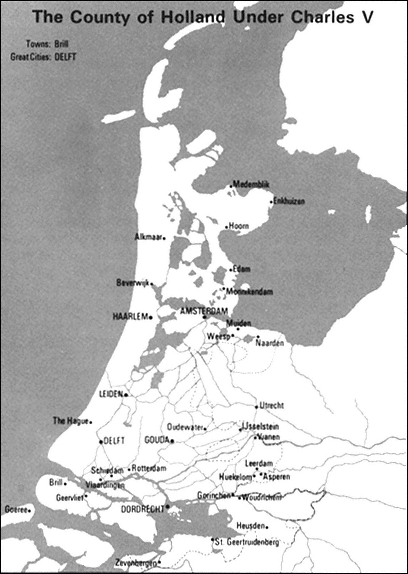
Map 1.
County of Holland under Charles V
The information just presented can be summarized in the following table:[55
]
| ||||||||||||||||||||||||||||||||||||||||||||||||||||||||
Participation in water-borne commerce seems to be the single most important difference between prosperous towns and those that are struggling Dordrecht's burgermeesteren in 1514 described the city as living from trade, even as they complained about the decline of the city's traditional trade in Rhine wine The Rhine wine trade for this period has not been studied, but it is clear that Dordrecht had a major role in the riverine trade, if not in the overseas trade Merchants from Dordrecht moved Rhineland grain to Flanders and North Sea herring to the Rhine-land; according to W S Unger, trade in foreign cloth (English) and beer (German) was much more important here than the corresponding local industries.[56] Through its port of Delfshaven, Delft had a share in the deep-sea trades Delfshaven was built in 1389, when the city obtained permission to dig a channel from the river Schie to the Maas, so as to have an outlet for its trade that would not be dependent on the rival towns of Schiedam and Rotterdam In 1514, the commissioners learned from the burgermeesteren of Rotterdam, not Delft, that Delfs-
haven was home to a respectable fleet of twenty herring busses. Through Delfshaven there were also Delft firms that traded in the Baltic, at least at a later date.[57] Amsterdam is clearly a case apart, since most of the Holland ships passing through the Sound were based either in Amsterdam itself or in the nearby regions of Waterland and West Friesland. Noordegraaf points out that revenues for the town crane, directly linked to the volume of goods brought to the wharves, increased by 400 percent between 1496 and 1514.[58]
Toward the other end of the fiscal scale, Gouda and Haarlem participated in the benefits of the seafaring trades only indirectly, because of the privileged position each enjoyed along the Holland binnenvaart . Leiden, which was not an obligatory port-of-call along the inland waterway (the route from Haarlem to Gouda entered the Oude Rijn upstream from Leiden), was the only city wholly dependent on manufacturing, and it was also the poorest of the great cities, despite having (in 1514) the largest population.
In sum, Holland was a province in which one-fourth of the population lived in towns in the fourteenth century; by 1514, it was more than half.[59] Neither figure is likely to have been exceeded in many other regions of Europe. Though numerous, towns were relatively small, and they also presented a relatively simple social structure since they were ruled by a self-perpetuating patrician elite, with little or no participation from craft guilds. Patrician governments owed their position, at least in part, to a tradition of loyal cooperation with the Wittelsbach and Burgundian dynasties, which in turn depended on the towns—especially the six with voting rights in the States—to meet the demands of a growing governing establishment and an increasingly ambitious foreign policy. Somewhat surprisingly, this pattern of cooperation was not disrupted by the imperious demands of the fisc under Charles the Bold, possibly because of Holland's underlying prosperity at the time. But as Holland was visited with severe economic difficulties in the last two decades of the fifteenth century, some of the great cities were rendered incapable of contributing materially to the government's needs, whereas those whose
economies remained vigorous found themselves in a much stronger position. Thus was established a pattern of fiscal negotiations with the States, which remained substantially in force until the time of the Revolt and which will be an important theme in subsequent chapters of this book. Simply put, Gouda and Leiden were concerned only to pay as little as possible, whereas Dordrecht and especially Amsterdam were wealthy enough to offer what the government asked and to bargain for what they wanted.