
Seven—
The Principia and its Relationship to On Motion :
A Reference Guide for the Reader
Just as the seven problems and four theorems of the tract On Motion far exceeded Halley's request in 1684 for a solution to the single problem of elliptical motion about a focal center of force, so the published text of the first edition of the Principia in 1687 far exceeded the contents of the original tract of 1684. Newton divided the work into three books: the first book is devoted to the analysis of motion in a nonresistive medium, the second book to the analysis of motion in resistive media, and the third book to the analysis of the data for celestial phenomena.
Book One of the Principia is concerned with motion in a medium devoid of resistance, as are the first four theorems and problems of the original 1684 tract On Motion . These theorems and problems from On Motion are contained in Sections 2 and 3 of Book One of the Principia . Section 2 starts with the demonstration of Theorem 1 from On Motion (Kepler's area law) and Section 3 finishes with the solution of Problem 4 from On Motion (the scale of the conic motion). Newton has inserted, however, four additional theorems and five additional problems between these original opening and closing points: what was Theorem 1 in On Motion still appears as Proposition 1 in the Principia ; but what was Problem 4 in On Motion now appears as Proposition 17 in the Principia . This enlarged version of the initial tract in Sections 2 and 3 is preceded by an extended set of definitions, laws of motion, and lemmas. Moreover, following Sections 2 and 3, Book One contains an additional thirty-one propositions divided into eleven sections that range in subject from finding the conic orbits from a given focus and finding the motions in a given orbit to an analysis of the motion of various pendula.
Book Two of the Principia is concerned with motion in a resistive medium. Whereas Problems 1 to 4 of the original 1684 tract On Motion are
concerned with celestial planetary paths, Problems 5 to 7 are concerned with terrestrial projectile paths. Projectile motion raises the subject of motion in a resistive medium. This subject, which was treated in the two final problems in the tract On Motion , grew in Book Two of the Principia into nine sections containing a total of fifty-three propositions. Book Two begins in Section 1 with the analysis of the motion of bodies for which the resistance is proportional to the velocity, and it ends in Section 9 with the analysis of the motion of bodies carried in a fluid vortex.
Book Three of the Principia treats a subject in detail that in On Motion is taken up only briefly: the analysis of celestial and terrestrial data. It begins with the analysis of the data concerning the motion of the moons of the planet Jupiter, discusses the complex data of the motion of the moon of the earth, and concludes with an extended discussion of the data concerning the motion of comets. In the introduction to Book Three, however, Newton advised the reader to begin with only selected sections of Book One and not to attempt to read all the material that precedes Book Three.
I do not want to suggest that anyone should read all of these Propositions—which appear there in great number—since they could present too great an obstacle even for readers skilled in mathematics. It would be sufficient for someone to read carefully the definitions, laws of motion, and the first three sections of the first book; then let [the reader] skip to this [third] book.[1]
My discussion of the 1684 tract On Motion in chapters 4, 5, and 6 contains a detailed commentary on almost every line of text. Taken in conjunction with the detailed commentary on the two pre-1669 tracts in chapter 3, these four chapters here provide a means for reading the first three sections of Book One of the Principia . An English translation from the Latin of the first three section of the 1687 edition of the Principia without additional commentary is given in the Appendix. This chapter provides a link between the text of the tract On Motion and the text of that translation from the first edition of the Principia .
Introduction
The title page of the Principia identifies Newton as the Lucasian Professor of Mathematics at Trinity College, Cambridge, and Samuel Pepys as President of the Royal Society. It is followed by a "Preface to the Reader" that opens with a reference to the ancients and closes with an appeal to the reader to look with patience upon Newton's "labors in a field so difficult." Next there is a dedicatory poem in honor of Newton by the editor, Edmund Halley, which may reveal more about Halley than about Newton. In it Halley compares the gift that Newton has given the world with the gifts of other great contributors, one being the gift of wine from one "who
pressed from grapes the mitigation of cares" (a reflection on the values of the socially active Halley rather than those of the reclusive Newton).
Definitions
The body of the text begins with a series of eight definitions and a long scholium that is an essay on absolute time, space, and motion. Only Definitions 3 and 5 have a counterpart in the original tract On Motion .
| ||||||||||||||
The following three definitions further refine Newton's view of a centripetal force by listing three specific quantities: the "absolute quantity," the "accelerative quantity," and the "motive quantity."
Principia : Definition 6. The absolute quantity of centripetal force is the measure of this force that is greater or less in proportion to the efficacy of the cause propagating it from the center through the surrounding regions .
Newton relates the absolute quantity of the force to "the center of force" itself, such as "the earth for the center of gravitational force." The more massive the earth, the greater the centripetal force that it will exert upon a unit mass.
Principia : Definition 7. The accelerative quantity of centripetal force is the measure of this force that is proportional to the velocity that it generates in a given time .
Newton relaStes the accelerative quantity of the force to "the place of the body," such as "the gravitating force is greater in valleys and less on the
peaks of high mountains." The more distant the center of force, the lesser the centripetal force that acts on a unit mass.
Principia : Definition 8. The motive quantity of centripetal force is the measure of this force proportional to the motion that it generates in a given time .
Newton relates the motive quantity of the force to "the body itself," such as the "propensity of the whole toward the center compounded of the propensities of all the parts." The motive quantity of a centripetal force is measured by the change in the quantity of motion (the change in the product of the velocity and quantity of matter) that it generates in a given time in a given mass. Newton stated that "for the sake of brevity, we may call these quantities of forces absolute, accelerative, and motive forces." It is important to note that the motive force depends upon the time required to generate the change in motion. When Newton gave his second law of motion, he stated that "a change in motion is proportional to the motive force impressed." If Law 2 implies that the change must be in a "given time," then Definition 8 confirms that implication. It has been argued, however, that Newton's concept of time as particulate permits quite a different reading of Law 2 (see the discussion on page 146).[2]
Principia : Scholium. Thus far it has seemed best to explain in what sense less familiar words should be taken in what follows. For time, space, place, and motion I do not define since they are very well known to all. But I should say that common opinion conceives of these quantities only in relation to perceivable objects. And hence certain preconceptions arise, and in order for these to be removed, it is useful to separate them into absolute and relative, true and apparent, and mathematical and common [opinions ].
1. Absolute, true, and mathematical time, in itself and by its own nature, flows . . .
2. Absolute space by its own nature and without reference to anything external . . .
3. Place is the part of space which a body occupies, and it is either absolute or relative . . .
4. Absolute motion is the translation of a body from an absolute place . . .
After some ten pages of detailed discussion of these topics, Newton concludes the scholium with the following statement:
In the following pages, however, it will be set forth more fully how to determine true motions from their causes, effects, and apparent differences, and, conversely, how to determine from motions, whether true or apparent, their causes and effects. To this end I have composed the following treatise .
This long scholium has deservedly occupied the attention of many Newtonian scholars. It is not reproduced in its entirety here: in part because it already has been the object of much attention, and in part because the goal of my work is to detail Newton's analysis, which I believe undergoes relatively little change, even if the concepts employed in it undergo a gradual clarification. The topics of time and space, however, are so central to
all of Newton's analyses, and to the worldview of those who follow, that a few comments on its role are in order.[3]
The key word is absolute : absolute time, absolute space, and absolute motion. The scholium represents Newton's attempt to explain visible relative motion by relating it to invisible absolute space and time. Attempts to understand the concepts of time and space can be found as early as the writings of Plato and Aristotle. For Plato, "time is a moving image of eternity," which refers to the eternal uniform circular motion of celestial bodies.[4] Aristotle amended Plato's view by identifying time with "the numerical aspect" of the motion of these material bodies, rather than with the motion itself.[5] Aristotle then defined space in terms of a material continuum and the place in such a space as "the outer limit of that contained."[6] In contrast to this Aristotelian concept of motion as fixed to visible matter, Newton's concept of motion is fixed to invisible space. Newton's view of absolute space and time ultimately was rejected by physics in the twentieth century, but it provided a basis for physics in the eighteenth and nineteenth centuries.
Newton built upon Galileo's analysis of motion. In support of the Copernican system, Galileo had to overcome the common belief that if the earth moved, then falling bodies would be left behind. He did so by arguing that one cannot demonstrate absolute rectilinear motion.[7] In Corollary 5 to the first law of motion (see the following), Newton states that the motion of bodies "are the same with respect to each other whether that space is at rest or moves uniformly in a straight line." Thus, it is impossible to construct an experiment to determine an absolute state of rest (though Newton will attempt to distinguish between a state of rotation and a state of rest in a discussion of the physics of a rotating bucket of water). Nevertheless, he postulates a space at absolute rest, perhaps with respect to the "fixed stars." Newton may have been motivated in part by his desire to refute Descartes's relativism of motion (and the complete denial of space by the Cartesian continuum of matter).[8] In any event, Newton sets forth in this scholium the view of space and time that supports his analysis of motion and that became the accepted, "obvious" basis for the very successful science of the eighteenth and nineteenth centuries. Only after extended analysis of the invariance of the laws of physics in the twentieth century did Einstein and others have reason to challenge Newton's received view of absolute space and time.[9] Julian Barbour neatly sums up the contribution of Newton's view to the development of dynamics:
The successes of the scholium speak for themselves. Within half a century or so Newtonian dynamics conquered the world. Men came to accept his concepts of absolute space and time—and they worked brilliantly. Descartes's confused notions were completely forgotten. You had to look quite hard to find the faults in the scholium .[10]
It is interesting that the change that comes about in the twentieth century—which requires the invariance of the laws of motion to be primary to any preconceived notion of absolute space and time—gives rise to an Einsteinian concept of space and time that is closer to the Aristotelian concept of motion (as fixed to visible matter) than to the Newtonian concept of motion (as fixed to invisible space).
Axioms or Laws of Motion
Following the opening list of definitions in both On Motion and the Principia , Newton presented a set of "Axioms or Laws of Motion." Some of these items appear under different titles in On Motion , but some were added for clarification.
| ||||||
See Definition 8 in which the "motive quantity of centripetal force" is, "for the sake of brevity," simply to be called the "motive force." Thus, the motive force is proportional to the change in the quantity of motion (the change in the product of the velocity and the quantity of matter) that it generates in a given time. Importantly, the element of time is explicit in this definition of motive force and hence the element of time is implicit in Law 2. Bernard Cohen has argued, however, that Newton conceived the element of time to be particulate, even though his concept of time was continuous. Thus, Law 2 stands on its own for Newton if seen in terms of impulse I = Dmv rather than in terms of force F = Dmv /Dt , because the element of time Dt as a constant is not relevant in ratios or proportions.[11]
| ||||||
Note that the measure of a force for Newton is always the displacement it produces in a given time. Hence, the parallel rule above applies to displacements: "is carried to the place" or "describes the sides."
Principia : Corollary 2. Obvious from this is the compounding of the direct force AD from any oblique forces AB and BD and, conversely, the resolving of any direct force AD into any oblique ones AB and BD whatsoever. The validity of this composition and resolution is, indeed, abundantly confirmed from mechanics .
Again, Newton intends the "compounding" or "resolving" of any "direct force" to mean the addition or resolutions of displacements produced by the force.
Principia : Corollary 3. The quantity of motion, which is determined by adding the motions made in one direction and subtracting the motions made in the opposite direction, is not changed by the action of bodies on one another .
Principia : Corollary 4. The common center of gravity of bodies does not by their interactions change its state of motion or of rest, and consequently the common center of gravity of all bodies acting mutually upon each other (excluding external actions and impediments ) either is at rest or moves uniformly straight forward .
Principia : Corollary 5. When bodies are confined in a given space, their motions are the same with respect to each other whether that space is at rest or moves uniformly in a straight line without any circular motion .
Principia : Corollary 6. If bodies move in any manner whatsoever with respect to each other and are urged on in parallel directions by equal accelerative forces, they will all proceed to move in the same manner with respect to each other, as if they had not been acted upon by those forces .
Principia : Scholium. Thus far I have set forth principles accepted by mathematicians and confirmed by a multiplicity of experiments. By means of the first two laws and their first two corollaries Galileo discovered that the descent of heavy bodies is in the doubled ratio of the time, and that the motion of projectiles takes place in a parabola, in agreement with experience, except insofar as those motions are slowed somewhat by the resistance of the air. From the same laws and corollaries depend what has been demonstrated regarding the periods of vibrating pendulums, supported by our daily experience of clocks. From these same ones again, along with the third law, Mr. Christopher Wren, Dr. John Wallis, and Mr. Christiaan Huygens—easily the principal geometers of the present age—separately derived rules for the collision and recoil of two bodies, communicating them almost about the same time to the Royal Society in forms exactly (in regard to these rules ) in agreement with each other. And Wallis was indeed the first to publish what had been discovered, and then Wren and Huygens. But it was Wren who confirmed the truth of these [rules ] publicly before the Royal Society by means of the experiment with pendulums, which the renowned Mariotte also thought worthy of an entire book soon afterward .
In this scholium Newton also gave the reason for setting out the following group of eleven lemmas, which he does before beginning his analysis of any particular problem:
[Scholium] Indeed I have placed these Lemmas first in order to avoid the tedium of deducing complicated proofs 'ad absurdum' in the manner of ancient geometers. For proofs are rendered more compact by the method of indivisibles. . . . Hence in what follows, . . . if for straight line segments I use minute curved ones , [then ] I want it understood . . . that the force of proofs must always be referred to the method of the preceding lemmas .
The final section of Newton's introductory material concludes with a long essay on experiments.
Section 1
Section 1. On the Method of first and last Ratios, with the help of which the following [lemmas ] are proved .
This set of lemmas provides a formal retrospective defense of the use of the limiting procedures that Newton had employed, with no formal defense, in the tract On Motion . His intention was to use these lemmas to provide a formal defense for the limiting procedures employed in the Principia . In the body of the propositions that follow in Sections 2 and 3, however, Newton rarely explicitly called upon the opening set of eleven lemmas that make up Section 1. As the editor of Newton's mathematical papers put it,
It would appear that his initial vision of presenting a logically tight exposition of the principles of motion under accelerative forces faded more and more when he came in detail to cast his arguments, and that he was happy after a while to lapse into the less rigorously justified mode of presentation which he largely exhibits in his published Principia . Once into the body of the proofs in the Principia , Newton reverted to the more intuitive mode of expression that he used in the tract On Motion (e.g., limiting processes, such as those in which an element of arc is reduced and is replaced by its chord). Newton employs these limiting processes without a specific formal defense, such as a reference to this initial set of lemmas.[12]
In what follows, I give abbreviated statements of the lemmas without their figures or justification in order to give an overview of Newton's argument. The full statements and demonstrations are given with figures in the translation in the Appendix. The exception is Lemma 11, which is discussed in some detail in this chapter.
Principia : Lemma 1. Quantities, as well as ratios of quantities, that constantly tend to equality in a given time, and in that way are able to approach each other more closely than for any given difference, come ultimately to be equal .
In contemporary terms, this lemma states that the "limit of a difference is the difference of the limits." Symbolically, if the limit of the difference [ f (x ) – g (x )] goes to zero as x goes to a given value a , then the limit of f (x ), as x goes to a , is equal to the limit of g (x ), as x goes to a . This lemma is used, for example, in Case 3 of Proposition 9 to argue that if two angles are "constructed by this law common to both and approach nearer to each other than for any assigned difference," then "by Lemma 1, [they] will ultimately be equal."
Principia : Lemma 2. If in any figure . . . there should be inscribed any number of parallelograms . . . and then the width of these parallelograms should be diminished, and the number should be increased indefinitely; I assert that the ultimate ratios that the inscribed figure . . . , the circumscribed [figures ] . . . , and the curvilinear [figure ] . . . , have to each other are ratios of equality .
Principia : Lemma 3. The same last ratios are also of equality when sides . . . of the parallelograms are unequal, and all are diminished indefinitely .
Principia : Lemma 4. If in two figures . . . there should be inscribed (as above ) two series of parallelograms, and if the number of both should be the same, and when the widths are diminished indefinitely, and the last ratios of parallelograms in one figure should be individually the same as the parallelograms in the other figure; [then ] I assert that the two figures . . . are in the same ratio to one another .
Principia : Lemma 5. [In ] similar figures, all sides which correspond to each other mutually, curvilinear as well as rectilinear, are proportional, and their areas are in the doubled ratio of their sides .
Principia : Lemma 6. If any arc AB given in position should be subtended by the chord AB, and [if ] at some point A in the middle of its continuous curvature, it should be touched by the straight line AD extended in either direction; then [if ] points A and B should approach each other and coalesce; I assert that the angle BAD [generated ] by the chord and tangent, would be diminished indefinitely and would ultimately vanish .
Principia : Lemma 7. With the same suppositions, I assert that the last ratio of the arc, chord, and tangent to each other is the ratio of equality .
Principia : Lemma 8. If the given straight lines AR and BR constitute with the arc AB, its chord AB and tangent AD the three triangles ARb, ARB, and ARD; and then [if ] the points A and B approach each other; I assert that the ultimate forms of the vanishing triangles is one of similarity, and the last ratio, of equality .
Principia : Lemma 9. If straight line AE and curve AC given in position mutually intersect at the given angle A, and [if ] BD and EC should be applied as ordinates to that straight line at any given angle, meeting the curve at B and C, and if the points B and C approach point A; [then ] I assert that the areas of triangles ADB and AEC will be ultimately to each other in the doubled ratio of the sides .
|
The opening statements of Lemma 10 and Hypothesis 4 are identical except that the more restrictive "centripetal force" has been changed to the unrestricted "standard force." In the first draft of On Motion , no text accompanies the statement of Hypothesis 4. In the second draft the hypothesis becomes a lemma and Newton provides a demonstration.
Lemma 11—
A Detailed Discussion
Principia : Lemma 11. The vanishing subtense of an angle of contact [the line BD] is ultimately in the doubled ratio of the subtense of the conterminous arc [the line AB].
Figure 7.1 is based upon the diagram that appears in the Principia . The lemma demonstrates that the line BD is proportional to the square of the line AB as the point B approaches the point A . In the 1687 edition of the Principia , Newton employs this result in the scholium to Proposition 4 on circular motion and in Proposition 9 on spiral motion. In the revised editions of the Principia , however, this result also plays a primary role in Proposition 6, in which the basic linear dynamics ratio is derived. The demonstration of this lemma makes reference to "the properties of circles," by which Newton means the existence of a unique circle of curvature at the general point A on the curve. Newton makes this reference clearer in the revised editions of the Principia when he inserts in the opening statement of the lemma the qualification, "in all curves which have finite curvature at the point of contact." In the 1687 edition, however, the reader has no advanced warning that the concept of curvature lies behind Newton's demonstration. The opening statement of the lemma is followed by three cases, which I discuss in detail.
Case 1. Let AB be the arc , AD its tangent , BD the subtense of the angle of contact perpendicular to the tangent, and AB the subtense of the arc. Perpendicular to the latter subtense AB and to the tangent AD, erect AG and BG, meeting at G; then let the points D, B, and G approach the points d, b, and g;
Here, the elements of the diagram in figure 7.1 are defined. A subtense is simply the chord that subtends a given angle or arc. The statement of Case 1 continues.
[Case 1] and let J be the intersection of the lines BG and AG, ultimately occurring when the points D and B approach up to A. It is obvious that the distance GJ can be less than any assigned one .
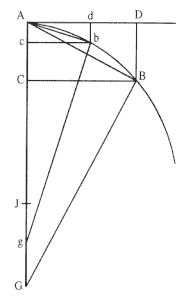
Figure 7.1
Based on Newton's diagram for
Lemma 11.
Figure 7.2 is the diagram based on Newton's original drawing into which has been added a set of three circles drawn tangent to the curve at point A . The two outer circles pass through the points B and b . The innermost circle represents the circle of curvature to the curve at point A and the line AJ is the given finite diameter of curvature. As the point B approaches the point A , the outer circles approach the circle of curvature and the diameters of those circles approach the diameter AJ . Thus, the point G approaches the point J in the limit as the point B approaches the point A and, as Newton states, "It is obvious that the distance GJ can be less than any assigned one."
[Case 1] Now ( from the nature of circles passing through points ABG and Abg) AB2is equal to AG × BD,
Critical to the demonstration of this lemma is the parenthetical expression: "(from the nature of circles . . . )." As the point B approaches the point A along the general curve AbB , then the set of circles drawn through the points ABG and Abg will approach the limiting circle of curvature drawn through the points A and J . This parenthetical expression is the only explicit reference to the underlying concept of curvature. Figure 7.3 gives the details of the circle drawn through the points A, B , and G . The line AC is perpendicular to the line BC by construction. The line AB is perpendicular to the line BG because AB and BG are chords of the circle ABG and hence, from Euclid's Elements , Book 3, Proposition 31, the angle between
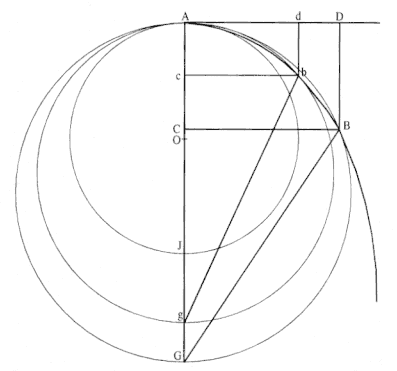
Figure 7.2
A revision of Newton's diagram for Lemma 11 with a set of three circles
drawn tangent to the curve at point A . The innermost circle AJ represents
the circle of curvature at point A .
chords drawn to a diameter is a right angle. Thus, triangles ABC and AGB are similar and AG / AB = AB / AC , where AC = BD by construction. Thus, AB2 = AG × BD as given above.
[Case 1] and Ab2is equal to Ag × bd, and hence the ratio AB2 to Ab2is composed of the ratios AG to Ag and BD to bd.
By a similar demonstration to that given above, Ab2 = (Ag ) (bd ) and the ratio of AB2 / Ab2 = (AG) (BD) / (Ag) (bd) = (AG / Ag) (BD / bd) or "the ratio AB2 to Ab2 is composed of the ratios AG to Ag and BD to bd ." Case 1 concludes with the following statement:
[Case 1] But since JG can be assumed less than any assigned length, it can be arranged that the ratio AG to Ag differs from the ratio of equality less than for any assigned difference, and thus as the ratio AB2to Ab2differs from the ratio BD to bd less than for any assigned difference. By Lemma 1 there is, therefore, the last ratio AB2to Ab2equal to the last ratio BD to bd. Which was to be proven.
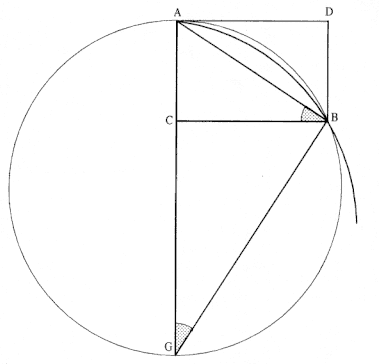
Figure 7.3
Details of the circle ABG from figure 7.2. The triangles ABC and AGB
are similar.
Since both of the diameters AG and Ag approach the given finite diameter AJ of the circle of curvature as the points B and b approach the point A , then the ratio AG / Ab approaches unity and the "last ratio" AB2 / Ab2 becomes equal to the "last ratio" BD / bd .
Case 2. Now let BD be inclined to AD at any given angle, and there will always be the same last ratio as before and hence also the same AB2to Ab2 , as was to be proven .
If the line BD were not perpendicular to the tangent line AD , then the perpendicular BD' would be BD' = BD cosq , where q is the given angle. The angle would be the same for bd as for BD and hence the ratio BD' / bd' = BD cosq /bd cosq = BD / bd and thus the last ratio will be unchanged.
Case 3. Moreover, although the angle D may not be given, [if BD converge to a given point, or be drawn according to any other law ] the angles D and d [constructed by this law common to both ] will always verge toward equality and approach nearer to each other than for any assigned difference, and hence, by Lemma 1, will ultimately be equal, and accordingly, the lines BD, bd will be in the same ratio to each other as before. Which was to be proven .
In the revised editions of the Principia , Newton enlarged this statement by inserting the qualifications given in brackets. Thus, if the inclination of BD is determined by its relationship to a given curve, as with the circle in Proposition 4 and the spiral in Proposition 9, then the last ratio remains the same and the relationship given in the lemma holds.
Section 2
Section 2. Of the invention of centripetal forces
In the first theorem in the tract On Motion , Newton derived Kepler's law of equal areas in equal times. That same demonstration, with minimal revisions, appears as Proposition 1 of the 1687 Principia . In the second theorem in On Motion , Newton discussed uniform circular motion and that topic is found in Proposition 4 of the 1687 Principia . The third theorem in On Motion contains the general paradigm for the solution of direct problems and that demonstration, with minimal revisions, appears as Proposition 6 in the 1687 Principia . Propositions 7 to 10 in the 1687 Principia give examples of how to apply that paradigm to specific orbits and centers of force, as did Problems 1 and 2 in On Motion .
|
Newton shifted from the active statement "orbiting bodies describe" in On Motion to the passive statement "bodies driven in orbit describe" in the Principia . He will make the same change in the problems to follow, where "a body orbits" becomes "let a body be orbited," and so on. The active expression is neutral, whereas the passive may imply an external mover of some sort. In Definition 8, however, Newton states that he considers "forces not physically, but only mathematically. Hence, let the reader beware lest because of words of this kind [attraction or impulse], they should think either that I am defining . . . a physical cause or reason, or that I am attributing forces truly and physically to centers (which are mathematical points)." Clearly, however, Newton considers something active, either internal or external, to be operating on the body in order to produce the given orbit.[13]
The revised opening statement of the Principia makes explicit that the center of force is stationary and that the areas lie in fixed (stationary) planes. Otherwise the text is little changed from the text in On Motion . The first seven sentences of the Principia , which carry one from the opening statement to the climactic statement, "in equal times, therefore, equal
areas are described," are identical word for word with the text in On Motion except for the inclusion of two parenthetical expressions, "(by Law I)" and "(by Corollary 1 of the Laws)." Newton revises the remainder of the text in order more carefully to qualify the result given in Theorem 1. The reader should refer to the detailed discussion of Theorem 1 in chapter 4 if questions arise in the reading of Proposition 1 in the 1687 Principia , which is given in the Appendix.
Principia : Proposition 2. Theorem 2. Every body that, when it is moved along some curved line with a radius having been constructed to a point [that is ] either stationary or advancing uniformly in a rectilinear motion, describes areas proportional to the times around that point, is urged on by a centripetal force being directed to the same point .
In Proposition 1 it was demonstrated that if a body is driven by a centripetal force, then the radius to the center of force sweeps out equal areas in equal times. In Proposition 2 it is the inverse theorem that is demonstrated: if the radius to the center of force sweeps out equal areas in equal times, then the body is driven by a centripetal force. This theorem does not appear in On Motion , but the type of analysis is similar to that employed in the detailed discussion of Theorem 1. One begins with equal triangles, and thus the deviation must be parallel to the line of force, and thus the force is centripetal.[14]
Principia : Proposition 3. Theorem 3. Every body that, with a radius having been constructed to the center of another arbitrarily moving body, describes areas proportional to the times around that center, is urged by a force compounded of the centripetal force being directed toward the other body, and of the whole accelerative force by which the other body is urged .
A planetary satellite, such as the moon, moves under the influence of two forces: a force directed toward the planet and a force directed toward the sun. The satellite is the "body" and the planet is the "other body." Proposition 3 extends the results from Proposition 2, with a fixed center of force, to the case of a moving center of force. This theorem does not appear in On Motion .
|
The expanded version of the opening statement in the Principia notes that the centripetal forces are directed toward the center of the circles, a point
only implicit in the earlier tract On Motion . The first halves of the texts are identical, word for word, with the exception of the phrase "distances CD " which becomes the "nascent intervals CD ." The second half of the revised text is expanded by reference to Theorem 2, Lemma 5, and Lemma 11. The reader who has worked through the detailed discussion of Theorem 2 in chapter 4 will be able to work through the revised demonstration of Proposition 4, which is given in the Appendix.
In the scholium to Proposition 4, Newton states that he has "decided to explain more fully" questions concerning the circular centripetal force. Following the opening demonstration of Proposition 4 in this scholium is a revised version of his pre-1669 discussion in the Waste Book of uniform circular motion using the polygonal approximation. Newton told Halley how he came across the earlier version "in turning over some old papers."[15] It has also been suggested "that Newton added this final paragraph to the scholium as a means of asserting his proper priority over Hooke."[16] In the pre-1669 version, Newton did not determine the nature of the force, but in the revised version for 1687 he does. Both versions have been discussed in detail in chapter 3.
Principia : Proposition 5. Problem 1. Given, in any places, a velocity by which a body describes a given figure by forces directed to any common center, to find that center .
Newton added this proposition just before the manuscript was sent to press. It has utility in the analysis of celestial observations in which the location of the center of force can be found from observations of the movement of a body, such as a comet. As such, it does not play a role in the analysis of direct problems that are of central interest here.
Principia : Proposition 6. Theorem 5. If a body P by revolving around the center S, should describe any curved line APQ, and if the straight line ZPR should touch that curve at any point P, and if to this tangent from any other point Q of the curve , QR should be drawn parallel to the distance SP, and if QT should be dropped perpendicular to the distance SP; [then ] I assert that the centripetal force would be reciprocally as the solid SP2 × QT2 / QR, provided that the quantity of that solid that ultimately occurs when the points P and Q coalesce is always taken .
The text of Proposition 6 in the Principia is identical with the text of Theorem 3 in On Motion with the exception of the following revisions. In the opening statement of the theorem "orbiting" (gyrando) is replaced by "revolving" (revolvendo) and the tangent is described as the "straight line ZPR " rather than the "straight line PR ." The first halves of the texts are identical, word for word, except for the insertion of "nascent" to modify the "line segment QR " and the inclusion of two parenthetical expressions, "(by Law 2)" and "(by Lemma 10)." The second half of the text is slightly revised to make explicit the substitution of the area SP × QT for the time
in the expression for the force. The reader should refer to the detailed discussion of Theorem 3 in chapter 4 if there are questions concerning Newton's demonstration of Proposition 6 of the 1687 Principia , which is given in the Appendix.
|
The opening statements are essentially unchanged, with the exception of the active "a body orbits" becoming the passive "let a body be orbited" (see the discussion of Proposition 1). Otherwise, the bodies of the texts are identical, word for word, except for three clarifications: (1) the "line SP " is now described as the "straight line SP ," (2) the parenthetical expression "(by the Corollary of Theorem 5)" is inserted, and (3) an explicit reference is made to the similarity of triangles that was only implicit in On Motion . (In fact, the figure is slightly revised by the addition of the point Z to clarify this relationship.) The reader should refer to the detailed discussion of Problem 1 in chapter 4 if there are questions concerning Proposition 7 of the 1687 Principia .
Principia : Proposition 8. Problem 3. Let a body be moved on a circle PQA: for this effect there is required the law of centripetal force being directed to a point at such a distance that all lines PS and RS constructed to it can be considered as parallels .
This solution is an extension of the problem considered in the previous proposition in which the force center was removed an indefinitely large distance. The scholium claims that the solution can also be applied to other conics but, according to Whiteside, that generalization is invalid.[17]
Proposition 9—
A Detailed Discussion
Principia : Proposition 9. Problem 4. Let a body be orbited on a spiral PQS intersecting all the radii SP, SQ etc. at a given angle; there is required the law of centripetal force being directed to the center of the spiral .
In the scholium to Problem 1 in the tract On Motion , Newton simply referred to the solution to this problem, "In a spiral which cuts all the radii at a given angle, the centripetal force being directed to the beginning of the spiral is reciprocally in the tripled ratio of the distance." He did not give a demonstration in On Motion , but he does give one in the Principia . I give the statement of the demonstration next and then follow it with a line-by-line analysis. Read the full statement to get an overview of the proposition before attempting to justify it, and then follow the details in the
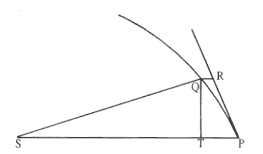
Figure 7.4
The diagram for Proposition 9. The line PQ
represents a spiral with its pole at the center of
force S .
line-by-line analysis. Figure 7.4 is similar to the drawing that appears in the Principia .[18]
Demonstration
Let there be given the indefinitely small angle PSQ, and, because all the angles have been given, the figure SPQRT will be given in species. The ratio QT / RQ is therefore given, and there is QT2 / QR as QT, that is, as SP.
Now let the angle PSQ be changed in whatever manner, and the straight line QR subtending the angle of contact QPR will be changed (by Lemma 11 ) in the doubled ratio of PR or QT. Therefore QT2 / QR will remain the same as before, that is, as SP.
For this reason , QT2 × SP2 / QR is as SP3 , that is (by the Corollary of Theorem 5 ) the centripetal force is [reciprocally ] as the cube of the distance SP. Which was to be done .
The demonstration is very brief and Newton appears to employ two properties of the spiral without explicitly stating them. The first property is that the angle of contact between the tangent PR and the radial distance SP is a constant (i.e., the spiral in question is an "equal angle spiral").[19] The second property is that the radius of curvature of the arc PQ is proportional to the radial distance of the pole SP .[20] Newton did not need to employ the concept of curvature directly in solutions to the problems he elected to demonstrate in the tract On Motion . Here in the Principia , however, curvature must be employed in the solution of this spiral/pole direct problem. In the following, the demonstration of the proposition is considered in detail.
[A] Let there be given the indefinitely small angle PSQ and, because all the angles have been given, the figure SPQRT will be given in species .
The demonstration begins with the assumption that angle PSQ be indefinitely small and that it initially be given. Later in the demonstration the
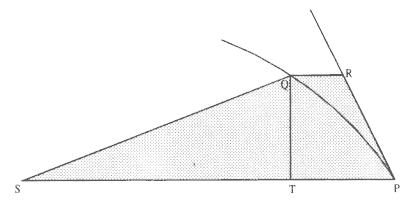
Figure 7.5
The shaded area is the figure SPQRT that is "given in species."
angle PSQ will be permitted to change but here as the proof begins it is fixed. Thus, (1) given the angle PSQ , (2) given the construction of QR parallel to SP , and (3) given the property of the equiangular spiral that the angle SPR is a constant, then all the angles in the figure SPQRT are given. The shaded area in figure 7.5 is the figure SPQRT . In general, the specification of all the angles of any figure is not sufficient to assure that the figure is "given in species" (i.e., the ratios of the sides of the figure are in a given ratio). The specification of all angles in a triangle would be sufficient, for example, to fix the ratio of its sides, but it would not be sufficient for a rectangle. Note, however, that Newton has specified that the given angle PSQ is "infinitely small." In that small limit, the arc of any curve in the vicinity of the point P can be represented by the arc of the circle of curvature at that point. The points P and Q , therefore, lie on the circumference of the circle of curvature and for a given small angle PSQ the sides QR, QS, RP , and SP of the figure SPQRT are proportional to the radius PC of that circle of curvature (i.e., the ratios QR / PC, QS / PC, RP / PC, SP / PC are given).[21]
That statement holds in general for any curve and for any such figure. The figure in question, however, is for an equiangular spiral where the point S is the pole of that spiral. The equiangular spiral has the special property that the pole distance SP is in a definite proportion to the radius of curvature PC , and hence each element in the figure is in a definite proportion to SP . Thus, the ratio of the sides of the figure is determined.[22] To display that relationship more clearly, the spiral PQS in figure 7.6 is extended into its pole S and the circle of curvature PVD is displayed. The chord PV of the circle of curvature drawn through the pole of the spiral is bisected by that pole.[23] Therefore, the angle SCP is equal to the constant angle SPR (since RPC = PSC = 90°) and thus SP = PC sin SPR . Now, the side
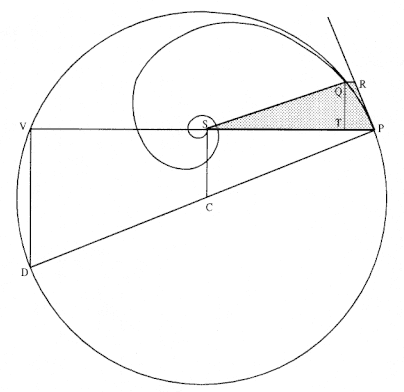
Figure 7.6
The diagram for Proposition 9 with the spiral PQS extended into its pole S and
the circle of curvature PVD displayed.
SP is given in addition to all the angles, and thus all the sides and all the ratios of the sides are given (for a given small angle PSQ ). As Proposition 9 states, therefore, for a given "small angle PSQ ," the quadrilateral figure SPQRT for an equiangular spiral is given "in species" (i.e., the ratios of the sides of the figure are in a given ratio).[24]
[B] The ratio QT / RQ is therefore given ,
From [A], for a given small angle PSQ the ratios of all the elements in the figure SPQRT are given.
[C] and there is QT2 / QR as QT, that is, as SP.
For a given small angle PSQ , the product of ratios (QT / QR ) (QT / SP ) is also given or what is the same, the ratio (QT2 / QR ) is proportional to SP .
[D] Now let the angle PSQ be changed in whatever manner, and the straight line QR subtending the angle of contact QPR will be changed (by Lemma 11 ) in the doubled ratio of PR or QT.
Now the angle PSQ remains indefinitely small but it is permitted to change. Lemma 11 establishes that the ratio QT2 / QR approaches a finite limit as the point Q approaches the point P (i.e., as the angle PSQ becomes "indefinitely small" as required in the statement of Proposition 9). See the preceding discussion of Lemma 11 in which the ratio is expressed as AB2 / BD , where (in Case 2) BD = QR and AB = PQ (the chord) or, in the limit, PR (the tangent). In the example of an equiangular spiral, QT = PR sinSPR , where SPR is the fixed angle of the spiral. Thus, the ratio AB2 / BD from Lemma 11 is given for Proposition 9 as the ratio QT 2 / QR . For all curves that have finite curvature at the point of contact P (a qualification that Newton later inserts in the revised statement of Lemma 11), the ratio QT2 / QR has a finite limit and hence in that limit QR is proportional to QT2 , or as Newton puts it, "the straight line QR . . . will be changed (by Lemma 11) in the doubled ratio of PR or QT ."
[E] Therefore QT2 / QR will remain the same as before, that is, as SP. For this reason , QT2 × SP2 / QR is as SP3 , that is (by the Corollary of Theorem 5 ) the centripetal force is [reciprocally ] as the cube of the distance SP. Which was to be done .
The force is inversely proportional to the linear dynamics ratio SP2 (QT2 / QR ) and the discriminate ratio (QT2 / QR ) is proportional to SP , thus the force is inversely proportional to SP3 , or as Newton states above, "the centripetal force is [reciprocally] as the cube of the distance SP . Which was to be done."
Lemma 12 and Proposition 10
Following the solution to Proposition 9, Newton inserted Lemma 12, a relationship that appeared as Lemma 1 in On Motion and that is required in the analysis of the direct problem that appears in Proposition 10.
|
This relationship is demonstrated in Book 7, Proposition 31 in the Conics of Apollonius.[25] Newton has added the reference to a hyperbola because in the 1687 Principia he discussed hyperbolic orbits as well as elliptical orbits. See the discussion and diagram for Lemma 1 in chapter 4.
|
The opening statements of this proposition in On Motion and in the Principia are almost identical, except for the change from the active, "a body orbits," to the passive, "let a body be orbited." The bodies of the texts differ only by the addition of three parenthetical expressions: "(from the Conics )," "(by Lemma 12)," and "(by the Corollary to Theorem 5)," and by the addition of a line of qualification concerning a set of propositions. Except for a slight rephrasing of one other line, the texts are identical, word for word. The reader should refer to the detailed discussion of Problem 2 in chapter 5 if there are questions concerning Proposition 10 of the 1687 Principia .
Section 3
Section 3. Of the motion of bodies in eccentric Conic Sections
The preceding section contains the solutions to the direct problems of a circular path with a center of force on the circumference, a spiral path with the center of force at its pole, and an elliptical path with the center of force at the center of the ellipse. These are preliminary examples of the application of the paradigm of Proposition 6. The direct Kepler problem commands much more respect than do these preliminary examples, however, and it is with Proposition 11 and the solution to that problem that Newton opens this new section. It provides the answer to the question raised by Halley on his visit to Newton, a question that set into motion the activity that eventually resulted in the publication of the Principia . As he concluded Proposition 11 Newton referred to "the dignity of the problem" and its place of honor at the beginning of a new section. He also gave the solutions to the other conic sections, the hyperbola and the parabola, as separate propositions rather than in a scholium to the proposition on elliptical motion, as he had done in On Motion .
|
The opening statements are essentially identical, as are the bodies of the text, except that the active statement "a body orbits" in On Motion is now the passive statement "let a body be revolved."[26] Newton has added to the demonstration in the Principia the following items: a description of a parallelogram, four parenthetical expressions, a qualification, and references to Lemma 8, Lemma 12, and Theorem 5. He has removed the auxiliary ratio of M to N that appeared in the original solution, and he has replaced the scholium with a closing statement. With these minor exceptions, the
texts are identical, word for word, and the reader should refer to the detailed discussion of Problem 3 in chapter 5 if there are questions concerning Proposition 11 of the 1687 Principia as it is given in the Appendix.
Principia : Proposition 12. Problem 7. Let a body be moved on a hyperbola; there is required the law of centripetal force being directed to a focus of the figure .
Newton did not present a separate demonstration for the solution to the direct problem of hyperbolic orbits in On Motion . In Proposition 12 of the Principia , however, he has very carefully constructed a demonstration of hyperbolic orbits that follows in detail the demonstration of elliptical orbits in Proposition 11. After the opening lines describing the figure, the construction follows the previous solution line for line with only the few necessary accommodations to the new figure. The reader should refer to the detailed discussion of Problem 3 in chapter 5 if there are questions concerning Proposition 12 of the 1687 Principia .
Principia : Lemma 13. The latus rectum of a parabola pertaining to any vertex is quadruple the distance of that vertex from the focus of the figure. This is evident from the Conics.[27]
Principia : Lemma 14. A perpendicular dropped from the focus of a parabola to its tangent is a mean proportional between the distance of the focus from the point of contact and the distance from the principal vertex of the figure .
These demonstrations of the properties of a parabola are required in the analysis of parabolic motion to follow in Proposition 13.[28]
Principia : Proposition 13. Problem 8. Let a body be moved on the perimeter of a parabola; there is required the law of centripetal force being directed to the focus of this figure .
Newton did not present a separate demonstration for the solution to the direct problem of parabolic orbits in On Motion , but he does in the Principia . Of particular interest is the first corollary to this proposition, in which Newton claims that solutions to the three direct problems also provide solutions to the inverse problem.
Principia : Proposition 13. Corollary 1. From the last three propositions it follows that if any body P should depart from position P along any straight line PR, with any velocity, and is at the same time acted upon by a centripetal force that is reciprocally proportional to the square of the distance from the center, this body will be moved in one of the sections of conics having a focus at the center of forces; and conversely .
Newton was criticized for failing to defend this assumption and he provided an outline of a defense in an expanded version of this corollary in the 1713 edition of the Principia . (The discussion of this point will be continued in chapter 10.) Whether Newton succeeded or failed in providing a satisfactory solution for the inverse problem has been the subject of
considerable scholarly debate from the late seventeenth century until the present.[29]
Principia : Proposition 14. Theorem 6. If several bodies should be revolved around a common center, and the centripetal force should decrease in the doubled ratio of the distances from the center, I say that the latera recta of orbits are in the doubled ratio of the areas that bodies describe by radii constructed to the center in the same time .
This relationship is required in the demonstration of Proposition 15 to follow.
|
The revised demonstration of Kepler's "three-halves power law" in the 1687 Principia , which is given in the Appendix, is much simpler than the demonstration in On Motion , which is discussed in detail in chapter 6.
Principia : Proposition 16. Theorem 8. With the same suppositions, and with straight lines drawn to bodies that touch the orbits in the same places, and with perpendiculars dropped to these tangents from a common focus, I say that the velocities of the bodies are in a ratio compounded of the ratio of perpendiculars inversely, and the half ratio of the latera recta directly .
The demonstration of this proposition is followed by nine corollaries in which the relationship of the speeds and latera recta of conic sections is explored. Specifically, Corollaries 1 and 3 are employed in the proposition to follow in which the nature of a particular type of conic (elliptical, hyperbolic, or parabolic) is given by the relative magnitude of its initial projection speed.
|
The opening statements in Problem 4 from On Motion and Proposition 17 from the Principia are identical except for a description of the general path as "a line" rather than "an ellipse" and the replacement of the word for "speed" (celeritate ) with the word for "velocity" (velocitate ). In the detailed statement of the text, however, Newton has made many changes, including changing the reference "circle" to "any orbit." He has not changed the proof in any substantive way, but clearly he was not satisfied with the presentation in On Motion . The interesting changes in the text are from the specific required "ellipse" for body P in On Motion to the more general required "line" in the Principia , and from the "a circle pq " for the reference body p in On Motion to the more general "any given orbit pq " in the Principia . Neither of these changes are more than cosmetic. In the revision for the Principia , Newton soon lets the body P "deflect under the compulsion of the centripetal force into the conic section PQ ." The "conic section" is still more general than a specific "ellipse," but it is still not a general "line." The shift from the reference "a circle pq " to "any given orbit pq " is simply the recognition that the reference circle is sufficient but not necessary: any orbit will do.[30]
Conclusion
Thus, the first three theorems and the first three problems of On Motion have provided the basis for the first seventeen propositions of the Principia . In Section 1 of Book One, Newton has added detailed definitions, set forth the laws of motion in an axiomatic fashion, and provided a number of lemmas designed to provide a formal background to the limiting procedures that he used in the earlier tract without a defense. Section 2 opens with a demonstration in Proposition 1 of the law of equal areas, which was the first theorem in On Motion , and Section 3 closes with the demonstration of Proposition 17, which was also the final problem on planetary motion in On Motion . Independent of the additional material, the core of the dynamics of the two works remains essentially unchanged. The basic paradigm for solving problems remains the linear dynamics ratio, which now appears as Proposition 6. Newton follows it with the same two preliminary problems given in On Motion plus the addition of a problem on spiral motion. The single method of Proposition 6 is applied to the three preliminary problems and then Newton presents the solution to the distinguished Kepler problem of elliptical/focal motion. In the revisions to follow, however, Newton introduces two other methods to solve the same problems.