
PART THREE—
THE REVISIONS AND EXTENSIONS TO NEWTON'S SOLUTION
Bust of Isaac Newton, by D. Le Marchand, currently located in the library of the Royal Society in London. It is a copy of the original of 1718, which is in the British Museum. Copyright © The Royal Society. Reproduced by permission.
Seven—
The Principia and its Relationship to On Motion :
A Reference Guide for the Reader
Just as the seven problems and four theorems of the tract On Motion far exceeded Halley's request in 1684 for a solution to the single problem of elliptical motion about a focal center of force, so the published text of the first edition of the Principia in 1687 far exceeded the contents of the original tract of 1684. Newton divided the work into three books: the first book is devoted to the analysis of motion in a nonresistive medium, the second book to the analysis of motion in resistive media, and the third book to the analysis of the data for celestial phenomena.
Book One of the Principia is concerned with motion in a medium devoid of resistance, as are the first four theorems and problems of the original 1684 tract On Motion . These theorems and problems from On Motion are contained in Sections 2 and 3 of Book One of the Principia . Section 2 starts with the demonstration of Theorem 1 from On Motion (Kepler's area law) and Section 3 finishes with the solution of Problem 4 from On Motion (the scale of the conic motion). Newton has inserted, however, four additional theorems and five additional problems between these original opening and closing points: what was Theorem 1 in On Motion still appears as Proposition 1 in the Principia ; but what was Problem 4 in On Motion now appears as Proposition 17 in the Principia . This enlarged version of the initial tract in Sections 2 and 3 is preceded by an extended set of definitions, laws of motion, and lemmas. Moreover, following Sections 2 and 3, Book One contains an additional thirty-one propositions divided into eleven sections that range in subject from finding the conic orbits from a given focus and finding the motions in a given orbit to an analysis of the motion of various pendula.
Book Two of the Principia is concerned with motion in a resistive medium. Whereas Problems 1 to 4 of the original 1684 tract On Motion are
concerned with celestial planetary paths, Problems 5 to 7 are concerned with terrestrial projectile paths. Projectile motion raises the subject of motion in a resistive medium. This subject, which was treated in the two final problems in the tract On Motion , grew in Book Two of the Principia into nine sections containing a total of fifty-three propositions. Book Two begins in Section 1 with the analysis of the motion of bodies for which the resistance is proportional to the velocity, and it ends in Section 9 with the analysis of the motion of bodies carried in a fluid vortex.
Book Three of the Principia treats a subject in detail that in On Motion is taken up only briefly: the analysis of celestial and terrestrial data. It begins with the analysis of the data concerning the motion of the moons of the planet Jupiter, discusses the complex data of the motion of the moon of the earth, and concludes with an extended discussion of the data concerning the motion of comets. In the introduction to Book Three, however, Newton advised the reader to begin with only selected sections of Book One and not to attempt to read all the material that precedes Book Three.
I do not want to suggest that anyone should read all of these Propositions—which appear there in great number—since they could present too great an obstacle even for readers skilled in mathematics. It would be sufficient for someone to read carefully the definitions, laws of motion, and the first three sections of the first book; then let [the reader] skip to this [third] book.[1]
My discussion of the 1684 tract On Motion in chapters 4, 5, and 6 contains a detailed commentary on almost every line of text. Taken in conjunction with the detailed commentary on the two pre-1669 tracts in chapter 3, these four chapters here provide a means for reading the first three sections of Book One of the Principia . An English translation from the Latin of the first three section of the 1687 edition of the Principia without additional commentary is given in the Appendix. This chapter provides a link between the text of the tract On Motion and the text of that translation from the first edition of the Principia .
Introduction
The title page of the Principia identifies Newton as the Lucasian Professor of Mathematics at Trinity College, Cambridge, and Samuel Pepys as President of the Royal Society. It is followed by a "Preface to the Reader" that opens with a reference to the ancients and closes with an appeal to the reader to look with patience upon Newton's "labors in a field so difficult." Next there is a dedicatory poem in honor of Newton by the editor, Edmund Halley, which may reveal more about Halley than about Newton. In it Halley compares the gift that Newton has given the world with the gifts of other great contributors, one being the gift of wine from one "who
pressed from grapes the mitigation of cares" (a reflection on the values of the socially active Halley rather than those of the reclusive Newton).
Definitions
The body of the text begins with a series of eight definitions and a long scholium that is an essay on absolute time, space, and motion. Only Definitions 3 and 5 have a counterpart in the original tract On Motion .
| ||||||||||||||
The following three definitions further refine Newton's view of a centripetal force by listing three specific quantities: the "absolute quantity," the "accelerative quantity," and the "motive quantity."
Principia : Definition 6. The absolute quantity of centripetal force is the measure of this force that is greater or less in proportion to the efficacy of the cause propagating it from the center through the surrounding regions .
Newton relates the absolute quantity of the force to "the center of force" itself, such as "the earth for the center of gravitational force." The more massive the earth, the greater the centripetal force that it will exert upon a unit mass.
Principia : Definition 7. The accelerative quantity of centripetal force is the measure of this force that is proportional to the velocity that it generates in a given time .
Newton relaStes the accelerative quantity of the force to "the place of the body," such as "the gravitating force is greater in valleys and less on the
peaks of high mountains." The more distant the center of force, the lesser the centripetal force that acts on a unit mass.
Principia : Definition 8. The motive quantity of centripetal force is the measure of this force proportional to the motion that it generates in a given time .
Newton relates the motive quantity of the force to "the body itself," such as the "propensity of the whole toward the center compounded of the propensities of all the parts." The motive quantity of a centripetal force is measured by the change in the quantity of motion (the change in the product of the velocity and quantity of matter) that it generates in a given time in a given mass. Newton stated that "for the sake of brevity, we may call these quantities of forces absolute, accelerative, and motive forces." It is important to note that the motive force depends upon the time required to generate the change in motion. When Newton gave his second law of motion, he stated that "a change in motion is proportional to the motive force impressed." If Law 2 implies that the change must be in a "given time," then Definition 8 confirms that implication. It has been argued, however, that Newton's concept of time as particulate permits quite a different reading of Law 2 (see the discussion on page 146).[2]
Principia : Scholium. Thus far it has seemed best to explain in what sense less familiar words should be taken in what follows. For time, space, place, and motion I do not define since they are very well known to all. But I should say that common opinion conceives of these quantities only in relation to perceivable objects. And hence certain preconceptions arise, and in order for these to be removed, it is useful to separate them into absolute and relative, true and apparent, and mathematical and common [opinions ].
1. Absolute, true, and mathematical time, in itself and by its own nature, flows . . .
2. Absolute space by its own nature and without reference to anything external . . .
3. Place is the part of space which a body occupies, and it is either absolute or relative . . .
4. Absolute motion is the translation of a body from an absolute place . . .
After some ten pages of detailed discussion of these topics, Newton concludes the scholium with the following statement:
In the following pages, however, it will be set forth more fully how to determine true motions from their causes, effects, and apparent differences, and, conversely, how to determine from motions, whether true or apparent, their causes and effects. To this end I have composed the following treatise .
This long scholium has deservedly occupied the attention of many Newtonian scholars. It is not reproduced in its entirety here: in part because it already has been the object of much attention, and in part because the goal of my work is to detail Newton's analysis, which I believe undergoes relatively little change, even if the concepts employed in it undergo a gradual clarification. The topics of time and space, however, are so central to
all of Newton's analyses, and to the worldview of those who follow, that a few comments on its role are in order.[3]
The key word is absolute : absolute time, absolute space, and absolute motion. The scholium represents Newton's attempt to explain visible relative motion by relating it to invisible absolute space and time. Attempts to understand the concepts of time and space can be found as early as the writings of Plato and Aristotle. For Plato, "time is a moving image of eternity," which refers to the eternal uniform circular motion of celestial bodies.[4] Aristotle amended Plato's view by identifying time with "the numerical aspect" of the motion of these material bodies, rather than with the motion itself.[5] Aristotle then defined space in terms of a material continuum and the place in such a space as "the outer limit of that contained."[6] In contrast to this Aristotelian concept of motion as fixed to visible matter, Newton's concept of motion is fixed to invisible space. Newton's view of absolute space and time ultimately was rejected by physics in the twentieth century, but it provided a basis for physics in the eighteenth and nineteenth centuries.
Newton built upon Galileo's analysis of motion. In support of the Copernican system, Galileo had to overcome the common belief that if the earth moved, then falling bodies would be left behind. He did so by arguing that one cannot demonstrate absolute rectilinear motion.[7] In Corollary 5 to the first law of motion (see the following), Newton states that the motion of bodies "are the same with respect to each other whether that space is at rest or moves uniformly in a straight line." Thus, it is impossible to construct an experiment to determine an absolute state of rest (though Newton will attempt to distinguish between a state of rotation and a state of rest in a discussion of the physics of a rotating bucket of water). Nevertheless, he postulates a space at absolute rest, perhaps with respect to the "fixed stars." Newton may have been motivated in part by his desire to refute Descartes's relativism of motion (and the complete denial of space by the Cartesian continuum of matter).[8] In any event, Newton sets forth in this scholium the view of space and time that supports his analysis of motion and that became the accepted, "obvious" basis for the very successful science of the eighteenth and nineteenth centuries. Only after extended analysis of the invariance of the laws of physics in the twentieth century did Einstein and others have reason to challenge Newton's received view of absolute space and time.[9] Julian Barbour neatly sums up the contribution of Newton's view to the development of dynamics:
The successes of the scholium speak for themselves. Within half a century or so Newtonian dynamics conquered the world. Men came to accept his concepts of absolute space and time—and they worked brilliantly. Descartes's confused notions were completely forgotten. You had to look quite hard to find the faults in the scholium .[10]
It is interesting that the change that comes about in the twentieth century—which requires the invariance of the laws of motion to be primary to any preconceived notion of absolute space and time—gives rise to an Einsteinian concept of space and time that is closer to the Aristotelian concept of motion (as fixed to visible matter) than to the Newtonian concept of motion (as fixed to invisible space).
Axioms or Laws of Motion
Following the opening list of definitions in both On Motion and the Principia , Newton presented a set of "Axioms or Laws of Motion." Some of these items appear under different titles in On Motion , but some were added for clarification.
| ||||||
See Definition 8 in which the "motive quantity of centripetal force" is, "for the sake of brevity," simply to be called the "motive force." Thus, the motive force is proportional to the change in the quantity of motion (the change in the product of the velocity and the quantity of matter) that it generates in a given time. Importantly, the element of time is explicit in this definition of motive force and hence the element of time is implicit in Law 2. Bernard Cohen has argued, however, that Newton conceived the element of time to be particulate, even though his concept of time was continuous. Thus, Law 2 stands on its own for Newton if seen in terms of impulse I = Dmv rather than in terms of force F = Dmv /Dt , because the element of time Dt as a constant is not relevant in ratios or proportions.[11]
| ||||||
Note that the measure of a force for Newton is always the displacement it produces in a given time. Hence, the parallel rule above applies to displacements: "is carried to the place" or "describes the sides."
Principia : Corollary 2. Obvious from this is the compounding of the direct force AD from any oblique forces AB and BD and, conversely, the resolving of any direct force AD into any oblique ones AB and BD whatsoever. The validity of this composition and resolution is, indeed, abundantly confirmed from mechanics .
Again, Newton intends the "compounding" or "resolving" of any "direct force" to mean the addition or resolutions of displacements produced by the force.
Principia : Corollary 3. The quantity of motion, which is determined by adding the motions made in one direction and subtracting the motions made in the opposite direction, is not changed by the action of bodies on one another .
Principia : Corollary 4. The common center of gravity of bodies does not by their interactions change its state of motion or of rest, and consequently the common center of gravity of all bodies acting mutually upon each other (excluding external actions and impediments ) either is at rest or moves uniformly straight forward .
Principia : Corollary 5. When bodies are confined in a given space, their motions are the same with respect to each other whether that space is at rest or moves uniformly in a straight line without any circular motion .
Principia : Corollary 6. If bodies move in any manner whatsoever with respect to each other and are urged on in parallel directions by equal accelerative forces, they will all proceed to move in the same manner with respect to each other, as if they had not been acted upon by those forces .
Principia : Scholium. Thus far I have set forth principles accepted by mathematicians and confirmed by a multiplicity of experiments. By means of the first two laws and their first two corollaries Galileo discovered that the descent of heavy bodies is in the doubled ratio of the time, and that the motion of projectiles takes place in a parabola, in agreement with experience, except insofar as those motions are slowed somewhat by the resistance of the air. From the same laws and corollaries depend what has been demonstrated regarding the periods of vibrating pendulums, supported by our daily experience of clocks. From these same ones again, along with the third law, Mr. Christopher Wren, Dr. John Wallis, and Mr. Christiaan Huygens—easily the principal geometers of the present age—separately derived rules for the collision and recoil of two bodies, communicating them almost about the same time to the Royal Society in forms exactly (in regard to these rules ) in agreement with each other. And Wallis was indeed the first to publish what had been discovered, and then Wren and Huygens. But it was Wren who confirmed the truth of these [rules ] publicly before the Royal Society by means of the experiment with pendulums, which the renowned Mariotte also thought worthy of an entire book soon afterward .
In this scholium Newton also gave the reason for setting out the following group of eleven lemmas, which he does before beginning his analysis of any particular problem:
[Scholium] Indeed I have placed these Lemmas first in order to avoid the tedium of deducing complicated proofs 'ad absurdum' in the manner of ancient geometers. For proofs are rendered more compact by the method of indivisibles. . . . Hence in what follows, . . . if for straight line segments I use minute curved ones , [then ] I want it understood . . . that the force of proofs must always be referred to the method of the preceding lemmas .
The final section of Newton's introductory material concludes with a long essay on experiments.
Section 1
Section 1. On the Method of first and last Ratios, with the help of which the following [lemmas ] are proved .
This set of lemmas provides a formal retrospective defense of the use of the limiting procedures that Newton had employed, with no formal defense, in the tract On Motion . His intention was to use these lemmas to provide a formal defense for the limiting procedures employed in the Principia . In the body of the propositions that follow in Sections 2 and 3, however, Newton rarely explicitly called upon the opening set of eleven lemmas that make up Section 1. As the editor of Newton's mathematical papers put it,
It would appear that his initial vision of presenting a logically tight exposition of the principles of motion under accelerative forces faded more and more when he came in detail to cast his arguments, and that he was happy after a while to lapse into the less rigorously justified mode of presentation which he largely exhibits in his published Principia . Once into the body of the proofs in the Principia , Newton reverted to the more intuitive mode of expression that he used in the tract On Motion (e.g., limiting processes, such as those in which an element of arc is reduced and is replaced by its chord). Newton employs these limiting processes without a specific formal defense, such as a reference to this initial set of lemmas.[12]
In what follows, I give abbreviated statements of the lemmas without their figures or justification in order to give an overview of Newton's argument. The full statements and demonstrations are given with figures in the translation in the Appendix. The exception is Lemma 11, which is discussed in some detail in this chapter.
Principia : Lemma 1. Quantities, as well as ratios of quantities, that constantly tend to equality in a given time, and in that way are able to approach each other more closely than for any given difference, come ultimately to be equal .
In contemporary terms, this lemma states that the "limit of a difference is the difference of the limits." Symbolically, if the limit of the difference [ f (x ) – g (x )] goes to zero as x goes to a given value a , then the limit of f (x ), as x goes to a , is equal to the limit of g (x ), as x goes to a . This lemma is used, for example, in Case 3 of Proposition 9 to argue that if two angles are "constructed by this law common to both and approach nearer to each other than for any assigned difference," then "by Lemma 1, [they] will ultimately be equal."
Principia : Lemma 2. If in any figure . . . there should be inscribed any number of parallelograms . . . and then the width of these parallelograms should be diminished, and the number should be increased indefinitely; I assert that the ultimate ratios that the inscribed figure . . . , the circumscribed [figures ] . . . , and the curvilinear [figure ] . . . , have to each other are ratios of equality .
Principia : Lemma 3. The same last ratios are also of equality when sides . . . of the parallelograms are unequal, and all are diminished indefinitely .
Principia : Lemma 4. If in two figures . . . there should be inscribed (as above ) two series of parallelograms, and if the number of both should be the same, and when the widths are diminished indefinitely, and the last ratios of parallelograms in one figure should be individually the same as the parallelograms in the other figure; [then ] I assert that the two figures . . . are in the same ratio to one another .
Principia : Lemma 5. [In ] similar figures, all sides which correspond to each other mutually, curvilinear as well as rectilinear, are proportional, and their areas are in the doubled ratio of their sides .
Principia : Lemma 6. If any arc AB given in position should be subtended by the chord AB, and [if ] at some point A in the middle of its continuous curvature, it should be touched by the straight line AD extended in either direction; then [if ] points A and B should approach each other and coalesce; I assert that the angle BAD [generated ] by the chord and tangent, would be diminished indefinitely and would ultimately vanish .
Principia : Lemma 7. With the same suppositions, I assert that the last ratio of the arc, chord, and tangent to each other is the ratio of equality .
Principia : Lemma 8. If the given straight lines AR and BR constitute with the arc AB, its chord AB and tangent AD the three triangles ARb, ARB, and ARD; and then [if ] the points A and B approach each other; I assert that the ultimate forms of the vanishing triangles is one of similarity, and the last ratio, of equality .
Principia : Lemma 9. If straight line AE and curve AC given in position mutually intersect at the given angle A, and [if ] BD and EC should be applied as ordinates to that straight line at any given angle, meeting the curve at B and C, and if the points B and C approach point A; [then ] I assert that the areas of triangles ADB and AEC will be ultimately to each other in the doubled ratio of the sides .
|
The opening statements of Lemma 10 and Hypothesis 4 are identical except that the more restrictive "centripetal force" has been changed to the unrestricted "standard force." In the first draft of On Motion , no text accompanies the statement of Hypothesis 4. In the second draft the hypothesis becomes a lemma and Newton provides a demonstration.
Lemma 11—
A Detailed Discussion
Principia : Lemma 11. The vanishing subtense of an angle of contact [the line BD] is ultimately in the doubled ratio of the subtense of the conterminous arc [the line AB].
Figure 7.1 is based upon the diagram that appears in the Principia . The lemma demonstrates that the line BD is proportional to the square of the line AB as the point B approaches the point A . In the 1687 edition of the Principia , Newton employs this result in the scholium to Proposition 4 on circular motion and in Proposition 9 on spiral motion. In the revised editions of the Principia , however, this result also plays a primary role in Proposition 6, in which the basic linear dynamics ratio is derived. The demonstration of this lemma makes reference to "the properties of circles," by which Newton means the existence of a unique circle of curvature at the general point A on the curve. Newton makes this reference clearer in the revised editions of the Principia when he inserts in the opening statement of the lemma the qualification, "in all curves which have finite curvature at the point of contact." In the 1687 edition, however, the reader has no advanced warning that the concept of curvature lies behind Newton's demonstration. The opening statement of the lemma is followed by three cases, which I discuss in detail.
Case 1. Let AB be the arc , AD its tangent , BD the subtense of the angle of contact perpendicular to the tangent, and AB the subtense of the arc. Perpendicular to the latter subtense AB and to the tangent AD, erect AG and BG, meeting at G; then let the points D, B, and G approach the points d, b, and g;
Here, the elements of the diagram in figure 7.1 are defined. A subtense is simply the chord that subtends a given angle or arc. The statement of Case 1 continues.
[Case 1] and let J be the intersection of the lines BG and AG, ultimately occurring when the points D and B approach up to A. It is obvious that the distance GJ can be less than any assigned one .
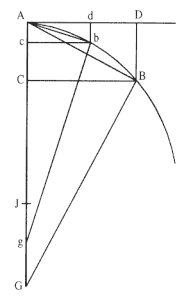
Figure 7.1
Based on Newton's diagram for
Lemma 11.
Figure 7.2 is the diagram based on Newton's original drawing into which has been added a set of three circles drawn tangent to the curve at point A . The two outer circles pass through the points B and b . The innermost circle represents the circle of curvature to the curve at point A and the line AJ is the given finite diameter of curvature. As the point B approaches the point A , the outer circles approach the circle of curvature and the diameters of those circles approach the diameter AJ . Thus, the point G approaches the point J in the limit as the point B approaches the point A and, as Newton states, "It is obvious that the distance GJ can be less than any assigned one."
[Case 1] Now ( from the nature of circles passing through points ABG and Abg) AB2is equal to AG × BD,
Critical to the demonstration of this lemma is the parenthetical expression: "(from the nature of circles . . . )." As the point B approaches the point A along the general curve AbB , then the set of circles drawn through the points ABG and Abg will approach the limiting circle of curvature drawn through the points A and J . This parenthetical expression is the only explicit reference to the underlying concept of curvature. Figure 7.3 gives the details of the circle drawn through the points A, B , and G . The line AC is perpendicular to the line BC by construction. The line AB is perpendicular to the line BG because AB and BG are chords of the circle ABG and hence, from Euclid's Elements , Book 3, Proposition 31, the angle between
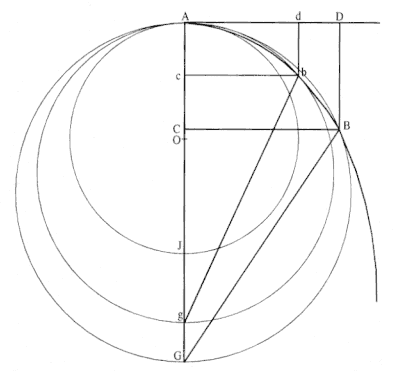
Figure 7.2
A revision of Newton's diagram for Lemma 11 with a set of three circles
drawn tangent to the curve at point A . The innermost circle AJ represents
the circle of curvature at point A .
chords drawn to a diameter is a right angle. Thus, triangles ABC and AGB are similar and AG / AB = AB / AC , where AC = BD by construction. Thus, AB2 = AG × BD as given above.
[Case 1] and Ab2is equal to Ag × bd, and hence the ratio AB2 to Ab2is composed of the ratios AG to Ag and BD to bd.
By a similar demonstration to that given above, Ab2 = (Ag ) (bd ) and the ratio of AB2 / Ab2 = (AG) (BD) / (Ag) (bd) = (AG / Ag) (BD / bd) or "the ratio AB2 to Ab2 is composed of the ratios AG to Ag and BD to bd ." Case 1 concludes with the following statement:
[Case 1] But since JG can be assumed less than any assigned length, it can be arranged that the ratio AG to Ag differs from the ratio of equality less than for any assigned difference, and thus as the ratio AB2to Ab2differs from the ratio BD to bd less than for any assigned difference. By Lemma 1 there is, therefore, the last ratio AB2to Ab2equal to the last ratio BD to bd. Which was to be proven.
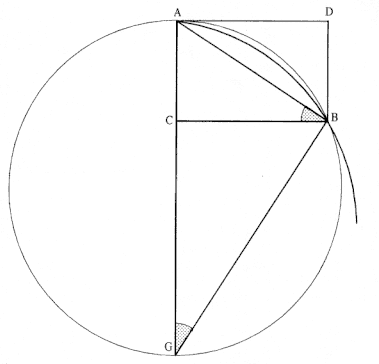
Figure 7.3
Details of the circle ABG from figure 7.2. The triangles ABC and AGB
are similar.
Since both of the diameters AG and Ag approach the given finite diameter AJ of the circle of curvature as the points B and b approach the point A , then the ratio AG / Ab approaches unity and the "last ratio" AB2 / Ab2 becomes equal to the "last ratio" BD / bd .
Case 2. Now let BD be inclined to AD at any given angle, and there will always be the same last ratio as before and hence also the same AB2to Ab2 , as was to be proven .
If the line BD were not perpendicular to the tangent line AD , then the perpendicular BD' would be BD' = BD cosq , where q is the given angle. The angle would be the same for bd as for BD and hence the ratio BD' / bd' = BD cosq /bd cosq = BD / bd and thus the last ratio will be unchanged.
Case 3. Moreover, although the angle D may not be given, [if BD converge to a given point, or be drawn according to any other law ] the angles D and d [constructed by this law common to both ] will always verge toward equality and approach nearer to each other than for any assigned difference, and hence, by Lemma 1, will ultimately be equal, and accordingly, the lines BD, bd will be in the same ratio to each other as before. Which was to be proven .
In the revised editions of the Principia , Newton enlarged this statement by inserting the qualifications given in brackets. Thus, if the inclination of BD is determined by its relationship to a given curve, as with the circle in Proposition 4 and the spiral in Proposition 9, then the last ratio remains the same and the relationship given in the lemma holds.
Section 2
Section 2. Of the invention of centripetal forces
In the first theorem in the tract On Motion , Newton derived Kepler's law of equal areas in equal times. That same demonstration, with minimal revisions, appears as Proposition 1 of the 1687 Principia . In the second theorem in On Motion , Newton discussed uniform circular motion and that topic is found in Proposition 4 of the 1687 Principia . The third theorem in On Motion contains the general paradigm for the solution of direct problems and that demonstration, with minimal revisions, appears as Proposition 6 in the 1687 Principia . Propositions 7 to 10 in the 1687 Principia give examples of how to apply that paradigm to specific orbits and centers of force, as did Problems 1 and 2 in On Motion .
|
Newton shifted from the active statement "orbiting bodies describe" in On Motion to the passive statement "bodies driven in orbit describe" in the Principia . He will make the same change in the problems to follow, where "a body orbits" becomes "let a body be orbited," and so on. The active expression is neutral, whereas the passive may imply an external mover of some sort. In Definition 8, however, Newton states that he considers "forces not physically, but only mathematically. Hence, let the reader beware lest because of words of this kind [attraction or impulse], they should think either that I am defining . . . a physical cause or reason, or that I am attributing forces truly and physically to centers (which are mathematical points)." Clearly, however, Newton considers something active, either internal or external, to be operating on the body in order to produce the given orbit.[13]
The revised opening statement of the Principia makes explicit that the center of force is stationary and that the areas lie in fixed (stationary) planes. Otherwise the text is little changed from the text in On Motion . The first seven sentences of the Principia , which carry one from the opening statement to the climactic statement, "in equal times, therefore, equal
areas are described," are identical word for word with the text in On Motion except for the inclusion of two parenthetical expressions, "(by Law I)" and "(by Corollary 1 of the Laws)." Newton revises the remainder of the text in order more carefully to qualify the result given in Theorem 1. The reader should refer to the detailed discussion of Theorem 1 in chapter 4 if questions arise in the reading of Proposition 1 in the 1687 Principia , which is given in the Appendix.
Principia : Proposition 2. Theorem 2. Every body that, when it is moved along some curved line with a radius having been constructed to a point [that is ] either stationary or advancing uniformly in a rectilinear motion, describes areas proportional to the times around that point, is urged on by a centripetal force being directed to the same point .
In Proposition 1 it was demonstrated that if a body is driven by a centripetal force, then the radius to the center of force sweeps out equal areas in equal times. In Proposition 2 it is the inverse theorem that is demonstrated: if the radius to the center of force sweeps out equal areas in equal times, then the body is driven by a centripetal force. This theorem does not appear in On Motion , but the type of analysis is similar to that employed in the detailed discussion of Theorem 1. One begins with equal triangles, and thus the deviation must be parallel to the line of force, and thus the force is centripetal.[14]
Principia : Proposition 3. Theorem 3. Every body that, with a radius having been constructed to the center of another arbitrarily moving body, describes areas proportional to the times around that center, is urged by a force compounded of the centripetal force being directed toward the other body, and of the whole accelerative force by which the other body is urged .
A planetary satellite, such as the moon, moves under the influence of two forces: a force directed toward the planet and a force directed toward the sun. The satellite is the "body" and the planet is the "other body." Proposition 3 extends the results from Proposition 2, with a fixed center of force, to the case of a moving center of force. This theorem does not appear in On Motion .
|
The expanded version of the opening statement in the Principia notes that the centripetal forces are directed toward the center of the circles, a point
only implicit in the earlier tract On Motion . The first halves of the texts are identical, word for word, with the exception of the phrase "distances CD " which becomes the "nascent intervals CD ." The second half of the revised text is expanded by reference to Theorem 2, Lemma 5, and Lemma 11. The reader who has worked through the detailed discussion of Theorem 2 in chapter 4 will be able to work through the revised demonstration of Proposition 4, which is given in the Appendix.
In the scholium to Proposition 4, Newton states that he has "decided to explain more fully" questions concerning the circular centripetal force. Following the opening demonstration of Proposition 4 in this scholium is a revised version of his pre-1669 discussion in the Waste Book of uniform circular motion using the polygonal approximation. Newton told Halley how he came across the earlier version "in turning over some old papers."[15] It has also been suggested "that Newton added this final paragraph to the scholium as a means of asserting his proper priority over Hooke."[16] In the pre-1669 version, Newton did not determine the nature of the force, but in the revised version for 1687 he does. Both versions have been discussed in detail in chapter 3.
Principia : Proposition 5. Problem 1. Given, in any places, a velocity by which a body describes a given figure by forces directed to any common center, to find that center .
Newton added this proposition just before the manuscript was sent to press. It has utility in the analysis of celestial observations in which the location of the center of force can be found from observations of the movement of a body, such as a comet. As such, it does not play a role in the analysis of direct problems that are of central interest here.
Principia : Proposition 6. Theorem 5. If a body P by revolving around the center S, should describe any curved line APQ, and if the straight line ZPR should touch that curve at any point P, and if to this tangent from any other point Q of the curve , QR should be drawn parallel to the distance SP, and if QT should be dropped perpendicular to the distance SP; [then ] I assert that the centripetal force would be reciprocally as the solid SP2 × QT2 / QR, provided that the quantity of that solid that ultimately occurs when the points P and Q coalesce is always taken .
The text of Proposition 6 in the Principia is identical with the text of Theorem 3 in On Motion with the exception of the following revisions. In the opening statement of the theorem "orbiting" (gyrando) is replaced by "revolving" (revolvendo) and the tangent is described as the "straight line ZPR " rather than the "straight line PR ." The first halves of the texts are identical, word for word, except for the insertion of "nascent" to modify the "line segment QR " and the inclusion of two parenthetical expressions, "(by Law 2)" and "(by Lemma 10)." The second half of the text is slightly revised to make explicit the substitution of the area SP × QT for the time
in the expression for the force. The reader should refer to the detailed discussion of Theorem 3 in chapter 4 if there are questions concerning Newton's demonstration of Proposition 6 of the 1687 Principia , which is given in the Appendix.
|
The opening statements are essentially unchanged, with the exception of the active "a body orbits" becoming the passive "let a body be orbited" (see the discussion of Proposition 1). Otherwise, the bodies of the texts are identical, word for word, except for three clarifications: (1) the "line SP " is now described as the "straight line SP ," (2) the parenthetical expression "(by the Corollary of Theorem 5)" is inserted, and (3) an explicit reference is made to the similarity of triangles that was only implicit in On Motion . (In fact, the figure is slightly revised by the addition of the point Z to clarify this relationship.) The reader should refer to the detailed discussion of Problem 1 in chapter 4 if there are questions concerning Proposition 7 of the 1687 Principia .
Principia : Proposition 8. Problem 3. Let a body be moved on a circle PQA: for this effect there is required the law of centripetal force being directed to a point at such a distance that all lines PS and RS constructed to it can be considered as parallels .
This solution is an extension of the problem considered in the previous proposition in which the force center was removed an indefinitely large distance. The scholium claims that the solution can also be applied to other conics but, according to Whiteside, that generalization is invalid.[17]
Proposition 9—
A Detailed Discussion
Principia : Proposition 9. Problem 4. Let a body be orbited on a spiral PQS intersecting all the radii SP, SQ etc. at a given angle; there is required the law of centripetal force being directed to the center of the spiral .
In the scholium to Problem 1 in the tract On Motion , Newton simply referred to the solution to this problem, "In a spiral which cuts all the radii at a given angle, the centripetal force being directed to the beginning of the spiral is reciprocally in the tripled ratio of the distance." He did not give a demonstration in On Motion , but he does give one in the Principia . I give the statement of the demonstration next and then follow it with a line-by-line analysis. Read the full statement to get an overview of the proposition before attempting to justify it, and then follow the details in the
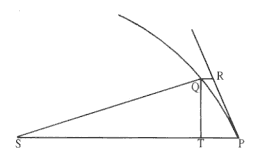
Figure 7.4
The diagram for Proposition 9. The line PQ
represents a spiral with its pole at the center of
force S .
line-by-line analysis. Figure 7.4 is similar to the drawing that appears in the Principia .[18]
Demonstration
Let there be given the indefinitely small angle PSQ, and, because all the angles have been given, the figure SPQRT will be given in species. The ratio QT / RQ is therefore given, and there is QT2 / QR as QT, that is, as SP.
Now let the angle PSQ be changed in whatever manner, and the straight line QR subtending the angle of contact QPR will be changed (by Lemma 11 ) in the doubled ratio of PR or QT. Therefore QT2 / QR will remain the same as before, that is, as SP.
For this reason , QT2 × SP2 / QR is as SP3 , that is (by the Corollary of Theorem 5 ) the centripetal force is [reciprocally ] as the cube of the distance SP. Which was to be done .
The demonstration is very brief and Newton appears to employ two properties of the spiral without explicitly stating them. The first property is that the angle of contact between the tangent PR and the radial distance SP is a constant (i.e., the spiral in question is an "equal angle spiral").[19] The second property is that the radius of curvature of the arc PQ is proportional to the radial distance of the pole SP .[20] Newton did not need to employ the concept of curvature directly in solutions to the problems he elected to demonstrate in the tract On Motion . Here in the Principia , however, curvature must be employed in the solution of this spiral/pole direct problem. In the following, the demonstration of the proposition is considered in detail.
[A] Let there be given the indefinitely small angle PSQ and, because all the angles have been given, the figure SPQRT will be given in species .
The demonstration begins with the assumption that angle PSQ be indefinitely small and that it initially be given. Later in the demonstration the
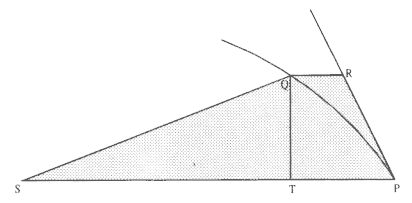
Figure 7.5
The shaded area is the figure SPQRT that is "given in species."
angle PSQ will be permitted to change but here as the proof begins it is fixed. Thus, (1) given the angle PSQ , (2) given the construction of QR parallel to SP , and (3) given the property of the equiangular spiral that the angle SPR is a constant, then all the angles in the figure SPQRT are given. The shaded area in figure 7.5 is the figure SPQRT . In general, the specification of all the angles of any figure is not sufficient to assure that the figure is "given in species" (i.e., the ratios of the sides of the figure are in a given ratio). The specification of all angles in a triangle would be sufficient, for example, to fix the ratio of its sides, but it would not be sufficient for a rectangle. Note, however, that Newton has specified that the given angle PSQ is "infinitely small." In that small limit, the arc of any curve in the vicinity of the point P can be represented by the arc of the circle of curvature at that point. The points P and Q , therefore, lie on the circumference of the circle of curvature and for a given small angle PSQ the sides QR, QS, RP , and SP of the figure SPQRT are proportional to the radius PC of that circle of curvature (i.e., the ratios QR / PC, QS / PC, RP / PC, SP / PC are given).[21]
That statement holds in general for any curve and for any such figure. The figure in question, however, is for an equiangular spiral where the point S is the pole of that spiral. The equiangular spiral has the special property that the pole distance SP is in a definite proportion to the radius of curvature PC , and hence each element in the figure is in a definite proportion to SP . Thus, the ratio of the sides of the figure is determined.[22] To display that relationship more clearly, the spiral PQS in figure 7.6 is extended into its pole S and the circle of curvature PVD is displayed. The chord PV of the circle of curvature drawn through the pole of the spiral is bisected by that pole.[23] Therefore, the angle SCP is equal to the constant angle SPR (since RPC = PSC = 90°) and thus SP = PC sin SPR . Now, the side
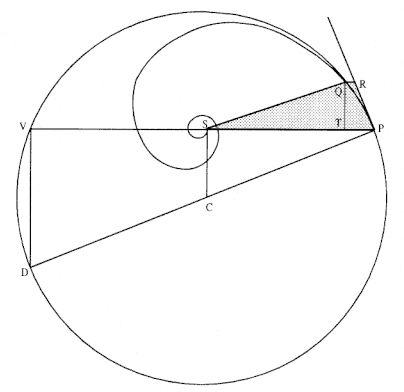
Figure 7.6
The diagram for Proposition 9 with the spiral PQS extended into its pole S and
the circle of curvature PVD displayed.
SP is given in addition to all the angles, and thus all the sides and all the ratios of the sides are given (for a given small angle PSQ ). As Proposition 9 states, therefore, for a given "small angle PSQ ," the quadrilateral figure SPQRT for an equiangular spiral is given "in species" (i.e., the ratios of the sides of the figure are in a given ratio).[24]
[B] The ratio QT / RQ is therefore given ,
From [A], for a given small angle PSQ the ratios of all the elements in the figure SPQRT are given.
[C] and there is QT2 / QR as QT, that is, as SP.
For a given small angle PSQ , the product of ratios (QT / QR ) (QT / SP ) is also given or what is the same, the ratio (QT2 / QR ) is proportional to SP .
[D] Now let the angle PSQ be changed in whatever manner, and the straight line QR subtending the angle of contact QPR will be changed (by Lemma 11 ) in the doubled ratio of PR or QT.
Now the angle PSQ remains indefinitely small but it is permitted to change. Lemma 11 establishes that the ratio QT2 / QR approaches a finite limit as the point Q approaches the point P (i.e., as the angle PSQ becomes "indefinitely small" as required in the statement of Proposition 9). See the preceding discussion of Lemma 11 in which the ratio is expressed as AB2 / BD , where (in Case 2) BD = QR and AB = PQ (the chord) or, in the limit, PR (the tangent). In the example of an equiangular spiral, QT = PR sinSPR , where SPR is the fixed angle of the spiral. Thus, the ratio AB2 / BD from Lemma 11 is given for Proposition 9 as the ratio QT 2 / QR . For all curves that have finite curvature at the point of contact P (a qualification that Newton later inserts in the revised statement of Lemma 11), the ratio QT2 / QR has a finite limit and hence in that limit QR is proportional to QT2 , or as Newton puts it, "the straight line QR . . . will be changed (by Lemma 11) in the doubled ratio of PR or QT ."
[E] Therefore QT2 / QR will remain the same as before, that is, as SP. For this reason , QT2 × SP2 / QR is as SP3 , that is (by the Corollary of Theorem 5 ) the centripetal force is [reciprocally ] as the cube of the distance SP. Which was to be done .
The force is inversely proportional to the linear dynamics ratio SP2 (QT2 / QR ) and the discriminate ratio (QT2 / QR ) is proportional to SP , thus the force is inversely proportional to SP3 , or as Newton states above, "the centripetal force is [reciprocally] as the cube of the distance SP . Which was to be done."
Lemma 12 and Proposition 10
Following the solution to Proposition 9, Newton inserted Lemma 12, a relationship that appeared as Lemma 1 in On Motion and that is required in the analysis of the direct problem that appears in Proposition 10.
|
This relationship is demonstrated in Book 7, Proposition 31 in the Conics of Apollonius.[25] Newton has added the reference to a hyperbola because in the 1687 Principia he discussed hyperbolic orbits as well as elliptical orbits. See the discussion and diagram for Lemma 1 in chapter 4.
|
The opening statements of this proposition in On Motion and in the Principia are almost identical, except for the change from the active, "a body orbits," to the passive, "let a body be orbited." The bodies of the texts differ only by the addition of three parenthetical expressions: "(from the Conics )," "(by Lemma 12)," and "(by the Corollary to Theorem 5)," and by the addition of a line of qualification concerning a set of propositions. Except for a slight rephrasing of one other line, the texts are identical, word for word. The reader should refer to the detailed discussion of Problem 2 in chapter 5 if there are questions concerning Proposition 10 of the 1687 Principia .
Section 3
Section 3. Of the motion of bodies in eccentric Conic Sections
The preceding section contains the solutions to the direct problems of a circular path with a center of force on the circumference, a spiral path with the center of force at its pole, and an elliptical path with the center of force at the center of the ellipse. These are preliminary examples of the application of the paradigm of Proposition 6. The direct Kepler problem commands much more respect than do these preliminary examples, however, and it is with Proposition 11 and the solution to that problem that Newton opens this new section. It provides the answer to the question raised by Halley on his visit to Newton, a question that set into motion the activity that eventually resulted in the publication of the Principia . As he concluded Proposition 11 Newton referred to "the dignity of the problem" and its place of honor at the beginning of a new section. He also gave the solutions to the other conic sections, the hyperbola and the parabola, as separate propositions rather than in a scholium to the proposition on elliptical motion, as he had done in On Motion .
|
The opening statements are essentially identical, as are the bodies of the text, except that the active statement "a body orbits" in On Motion is now the passive statement "let a body be revolved."[26] Newton has added to the demonstration in the Principia the following items: a description of a parallelogram, four parenthetical expressions, a qualification, and references to Lemma 8, Lemma 12, and Theorem 5. He has removed the auxiliary ratio of M to N that appeared in the original solution, and he has replaced the scholium with a closing statement. With these minor exceptions, the
texts are identical, word for word, and the reader should refer to the detailed discussion of Problem 3 in chapter 5 if there are questions concerning Proposition 11 of the 1687 Principia as it is given in the Appendix.
Principia : Proposition 12. Problem 7. Let a body be moved on a hyperbola; there is required the law of centripetal force being directed to a focus of the figure .
Newton did not present a separate demonstration for the solution to the direct problem of hyperbolic orbits in On Motion . In Proposition 12 of the Principia , however, he has very carefully constructed a demonstration of hyperbolic orbits that follows in detail the demonstration of elliptical orbits in Proposition 11. After the opening lines describing the figure, the construction follows the previous solution line for line with only the few necessary accommodations to the new figure. The reader should refer to the detailed discussion of Problem 3 in chapter 5 if there are questions concerning Proposition 12 of the 1687 Principia .
Principia : Lemma 13. The latus rectum of a parabola pertaining to any vertex is quadruple the distance of that vertex from the focus of the figure. This is evident from the Conics.[27]
Principia : Lemma 14. A perpendicular dropped from the focus of a parabola to its tangent is a mean proportional between the distance of the focus from the point of contact and the distance from the principal vertex of the figure .
These demonstrations of the properties of a parabola are required in the analysis of parabolic motion to follow in Proposition 13.[28]
Principia : Proposition 13. Problem 8. Let a body be moved on the perimeter of a parabola; there is required the law of centripetal force being directed to the focus of this figure .
Newton did not present a separate demonstration for the solution to the direct problem of parabolic orbits in On Motion , but he does in the Principia . Of particular interest is the first corollary to this proposition, in which Newton claims that solutions to the three direct problems also provide solutions to the inverse problem.
Principia : Proposition 13. Corollary 1. From the last three propositions it follows that if any body P should depart from position P along any straight line PR, with any velocity, and is at the same time acted upon by a centripetal force that is reciprocally proportional to the square of the distance from the center, this body will be moved in one of the sections of conics having a focus at the center of forces; and conversely .
Newton was criticized for failing to defend this assumption and he provided an outline of a defense in an expanded version of this corollary in the 1713 edition of the Principia . (The discussion of this point will be continued in chapter 10.) Whether Newton succeeded or failed in providing a satisfactory solution for the inverse problem has been the subject of
considerable scholarly debate from the late seventeenth century until the present.[29]
Principia : Proposition 14. Theorem 6. If several bodies should be revolved around a common center, and the centripetal force should decrease in the doubled ratio of the distances from the center, I say that the latera recta of orbits are in the doubled ratio of the areas that bodies describe by radii constructed to the center in the same time .
This relationship is required in the demonstration of Proposition 15 to follow.
|
The revised demonstration of Kepler's "three-halves power law" in the 1687 Principia , which is given in the Appendix, is much simpler than the demonstration in On Motion , which is discussed in detail in chapter 6.
Principia : Proposition 16. Theorem 8. With the same suppositions, and with straight lines drawn to bodies that touch the orbits in the same places, and with perpendiculars dropped to these tangents from a common focus, I say that the velocities of the bodies are in a ratio compounded of the ratio of perpendiculars inversely, and the half ratio of the latera recta directly .
The demonstration of this proposition is followed by nine corollaries in which the relationship of the speeds and latera recta of conic sections is explored. Specifically, Corollaries 1 and 3 are employed in the proposition to follow in which the nature of a particular type of conic (elliptical, hyperbolic, or parabolic) is given by the relative magnitude of its initial projection speed.
|
The opening statements in Problem 4 from On Motion and Proposition 17 from the Principia are identical except for a description of the general path as "a line" rather than "an ellipse" and the replacement of the word for "speed" (celeritate ) with the word for "velocity" (velocitate ). In the detailed statement of the text, however, Newton has made many changes, including changing the reference "circle" to "any orbit." He has not changed the proof in any substantive way, but clearly he was not satisfied with the presentation in On Motion . The interesting changes in the text are from the specific required "ellipse" for body P in On Motion to the more general required "line" in the Principia , and from the "a circle pq " for the reference body p in On Motion to the more general "any given orbit pq " in the Principia . Neither of these changes are more than cosmetic. In the revision for the Principia , Newton soon lets the body P "deflect under the compulsion of the centripetal force into the conic section PQ ." The "conic section" is still more general than a specific "ellipse," but it is still not a general "line." The shift from the reference "a circle pq " to "any given orbit pq " is simply the recognition that the reference circle is sufficient but not necessary: any orbit will do.[30]
Conclusion
Thus, the first three theorems and the first three problems of On Motion have provided the basis for the first seventeen propositions of the Principia . In Section 1 of Book One, Newton has added detailed definitions, set forth the laws of motion in an axiomatic fashion, and provided a number of lemmas designed to provide a formal background to the limiting procedures that he used in the earlier tract without a defense. Section 2 opens with a demonstration in Proposition 1 of the law of equal areas, which was the first theorem in On Motion , and Section 3 closes with the demonstration of Proposition 17, which was also the final problem on planetary motion in On Motion . Independent of the additional material, the core of the dynamics of the two works remains essentially unchanged. The basic paradigm for solving problems remains the linear dynamics ratio, which now appears as Proposition 6. Newton follows it with the same two preliminary problems given in On Motion plus the addition of a problem on spiral motion. The single method of Proposition 6 is applied to the three preliminary problems and then Newton presents the solution to the distinguished Kepler problem of elliptical/focal motion. In the revisions to follow, however, Newton introduces two other methods to solve the same problems.
Eight—
Newton's Unpublished Proposed Revisions:
Two New Methods Revealed
Following the publication of the first edition of the Principia in 1687, Newton began to make corrections in his working copy of the text and to propose revisions and additions for a possible second edition. When, twenty-six years later, in 1713, the second edition was published, many of these hand-written revisions were incorporated. Several revisions, however, never appeared in printed form. Of particular interest are the unpublished revisions of the fundamental dynamics of Sections 2 and 3 of Book One. These revisions, if published, would have provided a dramatically different format for these fundamental sections. They have been masterfully reconstructed by D. T. Whiteside, the editor of Newton's mathematical papers. Whiteside sets out the vision that Newton had of a revision for the 1687 Principia :
Newton came in the early 1690s to conceive a grand scheme of revision of the published Principia in which not only its particular verbal and mathematical errors were to be corrected but, much more radically, the redundant in its logical and expository framework was to be cut out and the flimsier portions of the remaining structure were to be strengthened and supported and (where necessary) completely rebuilt.[1]
Newton was not the only person to suggest corrections and revisions to the Principia following its publication. A select group of scholars, both in Britain and on the continent, struggled with the work and were eager to note its failures as well as its successes. The Scottish mathematician David Gregory had aspirations (unrequited) of having his notes on the work published in a revised edition or as a separate companion volume. During Gregory's visit to Cambridge in May 1694, Newton showed him the manuscript papers that contained the drafts of the proposed revisions. Whiteside notes
that Newton "proved unprecedentedly expansive regarding his intentions, elaborating for him [Gregory] a detailed overview of his plans for revision."[2] In a memorandum written in July 1694, Gregory summarized the revisions that Newton had discussed during his visit. Of particular interest to Newton's dynamics are the opening lines of Gregory's summary:
Many corrections are made near the beginning: some corollaries are added; the order of the propositions is changed and some of them are omitted and deleted. He [Newton] deduces the computation of the centripetal force of a body tending to the focus of a conic section from that of a centripetal force tending to the center, and this again from that of a constant centripetal force tending to the center of a circle; moreover the proofs given in propositions 7 to 13 inclusive now follow from it just like corollaries.[3]
Gregory went on to list other revisions proposed by Newton for Books Two and Three. It is the fundamental revisions to the opening sections of Book One, however, that command our interest.
Whiteside has called these proposed revisions of the 1690s "radical restructurings." In the 1687 edition of the Principia , Newton employed only the linear dynamics ratio as a measure of the force in producing solutions to the direct problems set in Sections 2 and 3 of Book One. In the proposed radical revision, however, he introduced two other related but distinct methods for generating such solutions: the circular dynamics ratio and the comparison theorem.
In the published revised editions of the Principia of 1713 and 1726, Newton retains the wording of the statements of the propositions of the 1687 edition with only minimal changes. In dramatic contrast, however, Newton considered major changes in the statements of the propositions in the proposed radical restructurings of the 1690s. He did not attempt in the unpublished radical revisions to conform to the general outline of the 1687 edition as he did in the revised editions that eventually were published in 1713 and 1726.
The statement of the proposed Proposition 1, Kepler's area law, remained in the unpublished revisions as it was in the 1687 edition, although six new corollaries were added. The statements of the next four propositions also remained unchanged. The statement of the proposed Proposition 6, however, underwent a dramatic revision. In the 1687 edition, Proposition 6 introduced the linear dynamics ratio and then was used to generate solutions for a series of direct problems in the following several propositions. The proposed revised Proposition 6 was the first of three new propositions that introduced a new technique for solving direct problems, the comparison theorem, which bore no resemblance to that used in the original Proposition 6. The linear dynamics ratio of the original Proposition 6 was transferred to the proposed Proposition 9, to which
was added yet another measure of force, the circular dynamics ratio. The proposed Proposition 10 provided a measure of force for motion in a conic directed to any point, and the proposed Proposition 11 produced yet another method of attack. In what follows, we look in some detail at the new method of the proposed Propositions 6, 7, and 8, and of the method outlined in the proposed Proposition 11. Only the revisions of the proposed Proposition 9 appear in the published revised editions; they will be discussed in detail in the chapter to follow.
Proposed Propositions 6, 7, and 8
An overview of the revisions that Newton considered making in the presentation of his basic dynamics follows. The center column is the location of the proposed propositions in the unpublished revisions that Newton generated after the publication of the 1687 edition (i.e., what Whiteside has called the "radical revisions"). The first and third columns give the location of the material in the 1687 edition and in the revised editions of 1713 and 1726, respectively.
|

|

|
The three specific basic revisions noted by Gregory in his summary statement are readily discernible in the comparison of the initial and proposed propositions:
1. "The computation of the centripetal force of a body tending to the focus of a conic section [is deduced] from that of a centripetal force tending to the center" [Proposed Proposition 8, Corollaries 2, 3, and 4].
2. "This [force toward the center of an ellipse] again from that of a constant centripetal force tending to the center of a circle" [Proposed Proposition 7, Corollary].
3. "The proofs given in Propositions 7 to 13 inclusive now follow from it just like corollaries" [Proposed Proposition 10, Corollaries 1, 2, 3, and 4].
The Three Techniques
As Gregory also noted, Newton has dramatically changed the order of the propositions. The difficulties involved in producing a revised edition so reordered may well be the reason that the "grand scheme of revision" was never carried to completion. In the preface of the 1687 edition, Newton notes, "Some things found out after the rest, I chose to insert in places less suitable, rather than to change the number of the propositions as well as the citations." In the revisions just given, Newton has drastically revised the number, order, and nature of the opening propositions. The extensive revision of citations in the remaining propositions, even those that were not to be changed, would have presented an enormous editorial challenge. In the 1713 edition, Newton chose to continue with his earlier practice of inserting the new material "in places less suitable." In 1694, however, he was still toying with the idea of a dramatic revision. Newton's proposed revision did more than shift his dynamical foundations from one proposition to another; it increased the number of basic methods for solving the direct problems. In place of the single method of the 1687 edition, New-
ton used in the radical revision three related but distinct methods of generating such solutions.
The first method, the linear dynamics ratio, is the initial measure of force that was introduced in Theorem 3 of On Motion and continued into Proposition 6 of the 1687 edition (i.e., QR / QT2 × SP2 ). This measure of the force appears as Corollary 1 of the proposed Proposition 9, and it could have been applied to the same direct problems (circle/circumference, spiral/pole, and conics) as in the 1687 edition. The draft of Proposition 9 does close with the promise to provide examples of the procedure in the problems to follow, but they are not given. Whiteside speculates that if it had been Newton's intention to reproduce them, then he would have done so in a more abbreviated form than he used for the solutions in the 1687 edition.[10]
The second method, the circular dynamics ratio, was the technique alluded to in his early writings on curvature in the Waste Book in late 1664 or early 1665 when he wrote the following:
If the body b moved in an Ellipsis then its force in each point (if its motion in that point bee given ) may bee found by a tangent circle of Equall crookednesse with that point of the Ellipsis .[11]
No examples of an application of curvature by Newton to the solution of elliptical motion have been found before the revisions of 1690. It is clear, however, that curvature played an important role in Newton's thoughts on dynamics, even here in 1664. It is tempting to speculate what use Newton did make of this suggestion before he developed the area law and the linear dynamics ratio in 1679. In 1690, the second measure of force, 1/SY2 × PV , appears in Corollary 3 of the proposed Proposition 9 and Newton employed it to develop an entire set of alternate solutions for the exemplary problems that followed the initial Proposition 6 in the Principia . In contrast to the parabolic approximation of the first measure, in which a vanishingly small arc of an arbitrary curve is replaced by a vanishingly small parabolic arc, the second measure arose from a circular approximation, in which a vanishingly small arc of an arbitrary curve is replaced by a vanishingly small arc of the circle of curvature at that point. In figure 8.1, the line segment SY is the normal from the tangent to the center of force S and the line segment PV is the chord of the circle of curvature at the point P through the center of force S . The proposed Lemma 12, which followed this proposed Proposition 9, is concerned with chords of circles of curvature in conics, and stands in contrast to the initial Lemma 12, which is concerned with circumscribed areas about conics. In the proposed Proposition 10, the results of the previous proposition and lemma are applied to the problems that were set in the initial Propositions 7, 8, 10, 11, 12, and 13, and the solutions appear as Corollaries 1, 2, 3, and 4
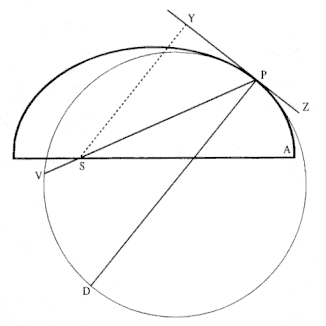
Figure 8.1
The circle DPV is the circle of curvature at point P of the
general curve AP . It defines the chord PV and the diameter
PD .
of the proposed Proposition 10, as Gregory noted when he wrote, "The proofs given in propositions 7 to 13 [of the 1687 Principia ] inclusive now follow from it [the proposed Proposition 10] just like corollaries."
The third method, the comparison theorem, is a measure of force that gives the ratio of forces to two different force centers for any given orbit. The proposed Propositions 6 and 7 consider two different orbits with a common center of force and provide the basis for the demonstration in the corollary to the proposed Proposition 8. In that corollary Newton obtained the force directed to the center of an ellipse from that of the force directed to the center of a circle, which Gregory had reported as "this [force to the center of an ellipse is found] again from that of a constant centripetal force tending to the center of a circle." The proposed Proposition 8 extends the comparison from two given orbits with a single force center to a single given orbit with two different force centers. Thus, as Gregory reported of Newton's proposed revisions, one could obtain "the centripetal force of a body tending to the focus of a conic section from that of a centripetal force tending to the center." In Corollaries 2, 3, and 4 of the proposed Proposition 8, Newton gave solutions to the problems set for conics in the initial Propositions 11, 12, and 13.
The first technique or method has been discussed in the analysis of Theorem 3 of On Motion in chapter 4 of this book and in the analysis of Proposition 6 in the 1687 edition in chapter 8. The second technique will be the subject of the analysis of the revised Proposition 6 in the 1713 and 1726 editions in chapter 9 to follow. The third technique, the new proposed Theorem 7, the comparison theorem, is the core of the proposed reconstruction, and it is carried forward to the revised published editions only in a disjointed form. To help the reader to identify it in its ultimate published but distorted form, it is presented below in the form Newton gave it in the proposed radical revision of the 1690s.
The Comparison Theorem
Figure 8.2A is based on the diagram for the new proposed Proposition 8, Theorem 7, in which Newton considers the ratio of the forces necessary to maintain motion in a single given orbit ANPM about two different centers of force, points S and R .[12] As with the linear dynamics ratio, the force is given as proportional to the ratio of the linear deviation and the square of the time. The two extracts from Newton's basic diagram in figure 8.2B show the deviations from the tangential motion as Pf = yN and Pe = xN (where the deviations yN and xN are parallel to the lines of force PS and PR ) and the times are proportional to the shaded areas SNM and RNM . Thus, the ratio of the forces is given as follows:

From similar triangles, Newton notes that the displacement Pf is proportional to the line PS and the displacement Pe is proportional to the line PT . Moreover, the area SNM is found to be proportional to PT2 and the area RNM to PR2 :

Thus, as the theorem states, the ratio of the forces is "as the product of the height of the first body SP and the square of the height of the second body PR . . . to the cube of the straight line PT " (i.e., FS / F R = SP × PR 2 / PT3 ).
The solution to the Kepler problem then follows in two short corollaries. In Corollary 1 the orbits are restricted to either circles or ellipses. Thus, if the force FS is directed to the center of the ellipse, then it is known from the corollary to the new proposed Theorem 6 that it is proportional to SP . Thus, the force FR directed to any other point is given by the following:

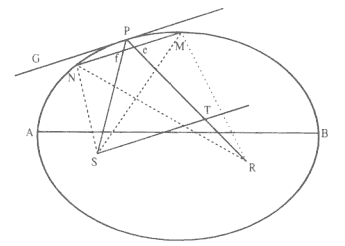
Figure 8.2A
Based on Newton's diagram for the proposed Proposition 8.
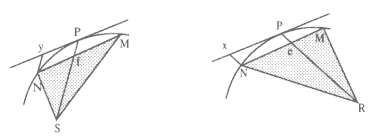
Figure 8.2B
The deviations Pf and Pe extracted from the diagram for the proposed
Proposition 8.
or

Thus, Newton obtained a general expression for the force FR required to maintain elliptical motion directed to any general point R .
Now in Corollary 2 of the new proposed Proposition 8, Theorem 7, Newton obtains the solution to the distinguished Kepler problem simply by noting that if the point R is a focus of the ellipse, then the distance PT is a constant of the ellipse.[13] That result is all that is required to demonstrate that the force FR is proportional to the inverse square of the distance from the body to the focal force center PR (i.e., FµPT3 / PR 2µ 1 / PR2 , since PT is a constant). The solution is simplicity itself, particularly when contrasted to the solution in the 1687 edition that employs the linear dy-
namics ratio. Corollaries 3 and 4 of the new proposed Proposition 8 extend the result to parabolic and hyperbolic paths.
Thus, the new proposed Theorems 5 and 6 demonstrate that the force to the center of an ellipse is directly proportional to the distance, and the new Theorem 7 extends the result to a focal point and to all the other conic sections. The basics of the theorems flow smoothly out of the parabolic approximation and the area law. The proposed revision is a paradigm of directness and compactness.
The Proposed Propositions 9 and 10
Newton was not satisfied in the projected revisions with simply giving the solution for the Kepler problem as obtained from the comparison ratio. In the first corollary of the new proposed Proposition 9 of the radical revision of 1694, he presents the original linear dynamics ratio of the initial Proposition 6 from the 1687 edition. Thus, he would have offered the solutions to the central and focal conic section direct problems that appeared in the 1687 edition as a second and complementary set of solutions to those provided by the new comparison theorem. More significant, however, is the appearance of a third set of solutions for the dynamic problems, the circular dynamics ratio, in the third and fifth corollary of the new proposed Proposition 9.
Following the new circular dynamics theorem of the proposed Proposition 9, Newton proposes a new Lemma 12. In all of the published editions Lemma 12 is concerned with the circumscribed area around an ellipse. The proposed version of Lemma 12, however, developed relationships between an ellipse and chords of its circle of curvature through the center and the focus of the ellipse. Both of these relationships are employed in the unpublished revisions to solve the series of problems concerned with circles and ellipses that appear in the first edition. In the published editions a separate proposition is used for each of the four problems concerning motion in a circle and in an ellipse that follow the basic dynamics theorem, Proposition 6. In the unpublished revisions, however, the solutions appear simply as four short corollaries to the new proposed Proposition 10. The charge of the proposed Proposition 10 is simply, "Let a body move in the perimeter of the conic PG : there is required the centripetal force tending to any given point S ."[14] In obtaining a general answer, Newton employs a corollary from the proposed Lemma 12 and the circular dynamics ratio 1/YS 2 × PV from the expanded version of the dynamics theorem, the proposed Proposition 9. These two results are combined quite simply to produce the same result that was found above as a corollary to the comparison theorem. Note here, however, that Newton does not need the solution of the central ellipse to obtain the solution for
the focal ellipse. The solutions for both the central and focal ellipses come directly out of the new ratio. The force FS , which is directed to any point S needed to maintain an ellipse, is given as follows:

where the line PE is that portion of the chord of the circle of curvature cut by the transverse diameter DK , and PS is the line of force. The published solutions to Problems 2, 3, 5, and 6 appeared as simple three- or four-line corollaries to this proposed Proposition 10.[15]
Moreover, the proposed revisions contain a scholium in which Newton develops a general fluxional measure of the centripetal force. Whiteside claims, however, that although Newton quite skillfully developed the measure, he "twice failed accurately to apply it to the particular case of a focal conic."[16] Nevertheless, with the revised solution, Newton may have appeared to be almost too successful. The problems are solved so simply that one tends to forget the magnitude of the initial challenge.
The Locke Solution
In addition to the proposed radical revisions discussed above, an alternate approach to the direct Kepler problem exists in yet another manuscript, one that surfaced in the early 1690s. As noted earlier, the English philosopher John Locke expressed interest in the newly published 1687 edition of the Principia while he was in exile in Holland. It would appear, however, that his command of mathematics was limited because he sought assurance from the Dutch mathematician Christiaan Huygens that the geometry of the Principia was to be trusted.[17] Upon his return to England in 1689, Locke made Newton's acquaintance and "asked if the truth of the two fundamental propositions, namely, Propositions 1 and 11 in Book One, could not be demonstrated in some more simple way."[18]
Newton formally honored Locke's request for a "simpler solution" to these two propositions by sending him in 1690 a copy of a tract titled A Demonstration that the Planets by their Gravity toward the Sun may move in Ellipses (hereafter, On Motion in Ellipses ).[19] It is difficult to see how the demonstration of Proposition 11 in this tract is simpler than the demonstration in the 1687 edition of the Principia . In fact, it appears that the tract is a copy of an earlier demonstration, and that Newton sent it to Locke rather than attempting to generate a simpler solution. If that surmise is correct, then there remains the question of the original source of the tract. Perhaps it was the version of the demonstration of the Kepler problem that Newton produced in 1679 prompted by his correspondence with Hooke on the topic of planetary motion (i.e., the elusive "lost solution of 1679") or perhaps it was the method alluded to in the early curvature
statements of 1664.[20] When Halley visited Newton in Cambridge in August of 1684 and inquired after a solution for the problem of elliptical motion, Newton is reported to have replied that he had had such a solution but that he could not find it and so he would redo it. Newton's report of the discussion comes secondhand from the French mathematician Abraham Demoivre who, after Newton's death in 1727, told of a conversation that he had with Newton. Regarding Halley's request in August of 1684 for the 1679 solution, Demoivre's memorandum records the following:
[Newton] looked among his papers but could not find it, but he promised him to renew it, & then to send it him. . . . In order to make good his promise he fell to work again, but he could not come to that conclusion Wch he thought he had before examined with care. However he attempted a new way which thou longer than the first, brought him again to his former conclusion, then he examined carefully what might be the reason why the calculation he had undertaken before did not prove right, & he found that having drawn an Ellipsis coarsely with his own hand, he had drawn two Axes of the Curve, instead of . . . two Diameters somewhat inclined to one another, whereby he might have fixed his imagination to any two conjugate diameters, which was requisite he should do. That being perceived, he made both his calculations agree together.[21]
Thus, following the "lost solution" as remembered by Demoivre, there is a "first way" and a "new way." The solution done the first way presupposes conjugate diameters "somewhat inclined to one another." This first attempt to reproduce the lost solution fails because, as Newton states, the conjugate diameters are drawn incorrectly, inclined at right angles one to another. The solution done the new way appears not to introduce the conjugate diameters, because it is only after Newton has successfully completed the new solution that he is encouraged to return to the first calculation and then to discover the faulty construction of the conjugate diameters. The earliest existing solution of the problem of elliptical motion is found in Newton's tract On Motion , which Newton sent to Halley in 1684. It is quite different from the solution found in the tract On Motion in Ellipses , a version of which Newton sent to Locke in 1690. The solution that explicitly employs conjugate diameters appears in the 1687 edition of the Principia . The solution that does not explicitly employ conjugate diameters, the one done the "new way," may well be the source of the tract sent to Locke in 1690.
Turn now to the solutions for the problem of elliptical motion built upon the two different approaches. Figure 8.3 illustrates the solution to the problem that Newton sent to Halley in London in November of 1684 and that was eventually to appear in the first edition of the Principia . According to Demoivre, this solution appears to be Newton's first attempt because it uses the conjugate diameters GP and DK , which Newton first
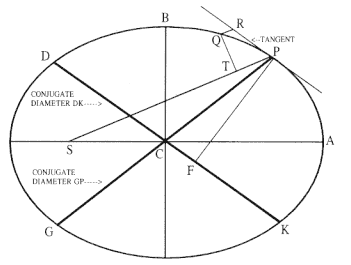
Figure 8.3
An ellipse ABDGK with conjugate diameters PG and DK .
drew incorrectly after Halley's visit. For any general point P on the ellipse, the diameter DK conjugate to PCG is constructed parallel to the tangent PR at the point P . In general, therefore, GP and DK will not be at right angles to each other. They must, as Newton noted, "be somewhat inclined to one another." The lines BC and AC are the two semi-axes of the curve and, in contrast to the conjugate diameters, must be at right angles. (It is the line PF that is at a right angle to DK , not PG .) Thus, the version sent to Halley shares with the first solution of 1684 and with the missing solution of 1679 an explicit dependence upon the conjugate diameters.
Consider now Newton's alternate solution of 1684, which employed the method "attempted in a new way" (i.e., the method that did not explicitly employ conjugate diameters). Only after "he attempted a new way which . . . brought him again to his former conclusion" did he "then examine carefully what might be the reason why the calculation he had undertaken before did not prove right." And it was then that he found his slip in drawing axes instead of conjugate diameters. Such an alternate solution, which is independent of the conjugate diameters, does not appear in the 1684 tract On Motion or in the 1687 edition of the Principia . It only appears in the solution given to Locke in 1690.
Consider first the special case given by Newton in Proposition 2 of the Locke solution.[22] Here Newton calculated the force of attraction at the two vertices of the ellipse's major axis. Inspection of the diagram in figure 8.4 will show that Newton makes no appeal to conjugate diameters. Note
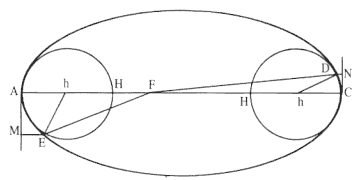
Figure 8.4
Based on Newton's diagram for Proposition 2 of the Locke solution.
that Newton's diagram contains only the axis, AC ; there is no explicit rendering of the conjugate diameters. I have added the two circles of curvature at the perihelion, point A , and at the aphelion, point C . In the course of the solution, Newton is to call upon these two circles of curvature by specifying the following:
because the Ellipsis is alike crooked at both ends those perpendiculars EM and DN will be to one another as the squares of the arches AE and CD.[23]
Now this statement is an echo of Newton's statement of 1664 found in his Waste Book .
If the body moved in an Ellipsis then its force in each point . . . may be found by a tangent circle of equal crookednesse with that point of the Ellipsis .
The "alike crooked" and the "equal crookednesse" in the two statements refer to the curvature of the ellipse. The statements differ in that the first refers to the circle of curvature only at perihelion and aphelion while the second refers more generally to the circle of curvature at any point. One should not allow that difference, however, to obscure the possible connection. Whether or not Newton in 1690 had in mind his insight of twenty-five years before, there can be no doubt that, because conjugate diameters are nowhere alluded to in it, this part of the Locke solution could not have been the first solution and could well have been the alternative one generated by Newton in 1684. It is of interest to note, however, that the center of force F in this special case need not be the focus of the ellipse, the proof holds for any point on the major axis.[24]
In Proposition 3, which follows the special case of elliptical motion at aphelion and perihelion discussed above, Newton treats the general case of elliptical motion at any point under a central force directed toward the focus. As it was for the diagram for Proposition 2 (see fig. 8.4), Newton's
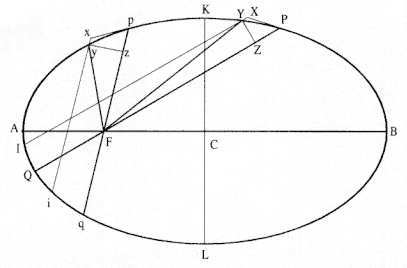
Figure 8.5
Based on Newton's diagram for Proposition 3 of the Locke solution.
diagram for Proposition 3 in figure 8.5 still does not contain an explicit rendering of the conjugate diameters. They do appear, however, in the diagram for Lemma 3 that precedes Proposition 3 and they are therefore employed in its solution. Thus, one can claim that Newton's demonstration of Proposition 3 is free of conjugate diameters only in the sense that he casts them out of the main frame of his argument of Proposition 3 and relegates them to his lemmatical subroutines. Thus, this solution lies somewhere between the solution in Proposition 2, which does not employ conjugate diameters in any fashion, and the solution in the first edition of the Principia , which employs them directly. If one accepts the testimony in Demoivre's memorandum, then Newton, following on Halley's visit to him in August 1684, could not find the solution of 1679 or, at first, even reproduce it. Instead he produced a variant solution that, unlike its predecessor, made no critical appeal to conjugate diameters. It is a solution that employs curvature as suggested in the statement of 1664, and may reflect Newton's thoughts on the problem long before his correspondence with Hooke in 1679.
Conclusion
The argument goes beyond the specific question of the nature of the lost solution of 1679. Far more interesting is the realization that Newton developed a number of interrelated but distinct methods of solving the Kepler
problem; that these methods had their roots in Newton's earliest thoughts on dynamics; and that they grew to maturity, side by side. Unfortunately, the clear and uncluttered presentation of these methods set out in the proposed radical revisions of the early 1690s was never published. Instead, Newton elected to incorporate many of the additions and revisions into the existing structure of the 1687 edition of the Principia , and to publish the revised editions of 1713 and 1726 in that somewhat convoluted format. These revised published editions are the subject of chapter 9.
Nine—
Newton's Published Recast Revisions:
Two New Methods Concealed
Two more editions of the Principia were published during Newton's life-time: the second edition appeared in 1713, twenty-six years after the first edition, and the third edition appeared in 1726, just one year before Newton died. Neither of these revised editions displays the radical restructuring of the propositions and lemmas that Newton had shown to the mathematician David Gregory in 1694. That proposed restructuring was set aside and Newton elected to retain the formal structure of the 1687 edition. All the propositions and lemmas of the revised editions retain their original headings with only minimal verbal changes. Many of the revised propositions, however, contain substantive additions to their text. In the revised editions, Newton tucked pieces of new theorems and new solutions into whatever existing nooks and crannies he could find in the formal structure of the 1687 edition. Thus, the jumbled published revision provides a much greater challenge to the reader than does the ordered unpublished revision discussed in chapter 8.
The key proposition for Newton's dynamics in all the published editions is Proposition 6, which sets out the basic paradigm for the solution of direct problems. In the 1687 edition, a single measure of the force was given in Proposition 6 by the linear dynamics ratio QR / QT2 × SP2 . In the proposed radical revisions of the 1690s, however, Newton offered two additional measures: the circular dynamics ratio, and the comparison theorem. The circular dynamics ratio 1 / SY2 × PV (where SY is the normal to the tangent through the center of force and PV is the chord of the circle of curvature through the center of force) appeared as Corollary 3 of Proposition 6 in the 1713 and 1726 editions and it was employed to provide alternate solutions for the direct problems in Propositions 7, 9, and 10. The alternate solution for the direct Kepler problem given in the
revised Proposition 11, however, was obtained with the comparison theorem that Newton outlined in the unpublished revisions of the 1690s. In those proposed revisions, that technique was given the status of an independent theorem in a separate proposition. In the published revisions, however, it appears as a corollary at the conclusion of the direct problem for a circular orbit with a center of force at a general point (i.e., a revised version of Proposition 7). This revision permits Newton to retain the initial numbering sequence of the proposition, but it does so at a price: A simple example of how to employ the basic paradigm to solve direct problems now becomes a confusing combination of a solution to a general problem with a theorem hidden away in its final corollary.
The hallmark of the alternate measure of force is curvature. Newton's early work on curvature appears in his bound notebook, the Waste Book , in late 1664.[1] He was concerned with the problem of normals, curvature, and tangents. By May 1665 he had developed the general formula for the radius of curvature for a function y = f (x ).[2] By the winter of 1670–1671, Newton was writing a treatise, now called Methods of Series and Fluxions , that included as Problem 5 the "Determination of the Curvature of a Curve at any Point" and as Problem 6 the "Quality of Curvature at a Point." In this treatise he again derived the general measure of curvature in Cartesian coordinates.[3] He also provided a series of examples in which he calculated the radius of curvature of various curves, including that of the three conic sections.[4] He concluded, "Since all geometrical curves . . . can be referred to right-angled ordinates, I believe I have done enough. Anyone who desires more will provide it without difficulty by his own efforts, especially if, as a bonus, in illustration of the point I add a method for spirals."[5] Then he developed an expression for the radius of curvature in polar coordinates, and he again offered a series of examples in which he demonstrated how the technique could be applied to specific curves.[6]
Newton did not employ any of the mathematical details of curvature in his revised dynamics. The concept of curvature, however, provided the very basis for the alternate measure of force. Just as the key to Newton's dynamics in the first edition is uniform rectilinear accelerated motion, so the key to his dynamics in the revised editions is uniform circular motion. In both of the revised published editions, the second edition of 1713 and the third edition of 1726, Newton retained the linear dynamics ratio QR / QT2 × SP2 (based on the parabolic approximation) as his fundamental device for solving the direct problem. But in the revised editions he extended Proposition 6 by the addition of a second method of analysis: a circular dynamics ratio, which is based on uniform circular motion. It stands in contrast to the linear dynamics ratio, which was based upon uniform linear motion.
Of the many revisions and additions that appear in the later editions of
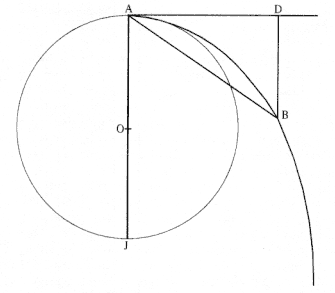
Figure 9.1
Lemma 11: the circle AJ represents the circle of curvature at point
A of the general curve AB .
the Principia , three are of particular importance in discussing Newton's dynamics: first, the revision of Lemma 11 by the insertion of a curvature qualification and the addition of two new corollaries; second, the revision of Proposition 1 by the addition of six corollaries (a defense of the polygonal approximation); and third, the revision of Proposition 6 by changing its basic time dependence from Lemma 10 (based on rectilinear motion) to Lemma 11 (based on circular motion) and the addition of the circular dynamics ratio.
The Revision of Lemma 11
Figure 9.1 is based upon Newton's diagram for Lemma 11, where the circle AJ represents the circle of curvature at point A on the general curve AB . The specific problem faced in Lemma 11 is the demonstration that the chord AB of the general curve AB is proportional to the square of the line segment BD and the assertion that the ratio BD2 / AB remains finite as point B approaches point A . If the motion of a body along an infinitesimal arc at point A on the general curve BA is represented by motion along an infinitesimal arc of its circle of curvature AJ at that point, then the assertion that ratio BD2 / AB remains finite means that the general curve has a
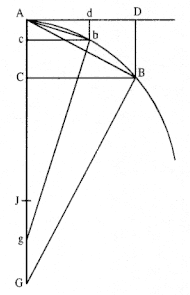
Figure 9.2
Based on Newton's diagram for
Lemma 11.
finite non-zero curvature at the point A (i.e., that the diameter AJ of the circle of curvature at the given point A is finite).
Figure 9.2 is based on Newton's diagram for Lemma 11 and it remained unchanged through the three editions of the Principia . In the 1687 edition Newton employed Lemma 11 in Propositions 4 and 9. The former derives the nature of the force directed to the center of the circle required to maintain uniform circular motion (force µ speed2 / SP ), and the latter derives the nature of the force in the direct spiral/pole problem (force µ 1/SP3 ).[7] In the revised editions, however, he no longer employed Lemma 11 in Proposition 4. Instead, he used the new corollaries that had been added to Proposition 1. He promoted Lemma 11, however, to the important role of establishing the dependence of the line segment QR upon the square of the time in the derivation of the original dynamics ratio in Proposition 6. Lemma 10, which served that function in the 1687 edition, was given a secondary role in the revised editions.
The statement of Lemma 11 as it appears in the revised editions is identical to the statement of the lemma that appears in the first edition, except that Newton added a qualifying phrase concerning the finite curvature.
[Lemma 11] The vanishing subtense of the angle of contact [the line BD], in all curves, which at the point of contact have a finite curvature, is ultimately in the doubled ratio of the subtense of the conterminate arc [the arc AB].
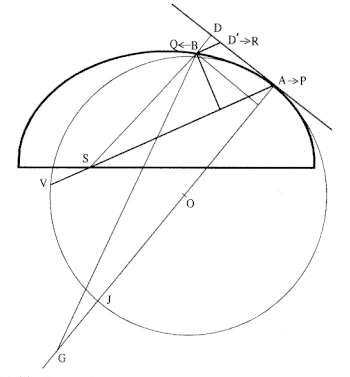
Figure 9.3
The diagram for Lemma 11 adapted to the diagram for Proposition 6.
More significant than the explicit reference to curvature, however, is Newton's addition of a qualification into Case 3 and the addition of two new corollaries. In both the first and the revised editions, Case 2 demonstrates that the ultimate ratio of the line BD to the square of the arc AB2 will be the same even if the line BD "be inclined to AD in any given angle." This result is important in Proposition 6 because the line segment DB is to become the inclined linear deviation QR that appears in the dynamics ratio, QR / QT 2 × SP2 . In addition to being inclined with respect to the tangent, however, the displacement QR changes along the curve as a function of the equation that generates the curve. To accommodate that behavior, Newton revises Lemma 11 by inserting in Case 3 the additional qualification that DB (and hence QR ) can be "determined by any other condition whatever."
Figure 9.3 is a revision of the diagram for Lemma 11 into the form that applies to Proposition 6. Thus, the inclined line BD ' is to become the displacement QR and the point A to become the point P . The new Corollary 2 states that the line AC will become as the line BD and hence, from the
opening proof, as the square of the arc AB . Now the new Corollary 3 will relate the arc AB to the time and hence will relate the line AC , and ultimately the inclined line BD ', to the square of the time. This dependence upon time, however, is inserted by Newton with very little warning.
Corollary 3. And therefore the versed sine[8] [the line AC] is in the doubled ratio of the time in which a body will describe the arc with a given velocity .
The "therefore" may require some reflection on the part of the reader. As Whiteside puts it, "The tacit assumption here made is that the small arcs AB and Ab may adequately be approximated by corresponding arcs of their osculating circles."[9] But this corollary goes beyond simply replacing the arc of a general curve by the arc of the circle of curvature; it replaces the general motion over the arc of the curve with uniform circular motion over the arc of the circle of curvature. The displacement BD ' is proportional to the square of the arc and if the "body will describe the arc with a given velocity" (i.e., if the body moves with uniform circular motion), then the arc is proportional to the time t , and hence the displacement BD ' is proportional to the square of the time. It is this corollary of Lemma 11 that Newton employs in the revised editions to establish both the linear and circular dynamics ratios.
The Revision of Proposition 1
The statement of Proposition 1 in the revised editions contains the added qualification that the center of force and the plane of the motion are fixed. Otherwise, the demonstration of the basic proposition for equal areas in equal times remains the same as in the 1687 edition. Newton dramatically revised, however, the number and content of the corollaries that follow the basic proposition. The 1687 edition contains only two corollaries and they set out the conditions under which the areas were not proportional to the times (i.e., motion under noncentral forces). In the revised editions, Newton replaces these two corollaries with six new and different corollaries.
The first three of the new corollaries at last provide a defense of Newton's basic use of the parallelogram rule (On Motion : Hypothesis 3; Principia : Corollary 1) in obtaining the fundamental measure for an impulsive force (i.e., the observed displacement is the diagonal of the parallelogram formed by the tangential displacement and the radial deviation).[10] Newton employs this technique in the polygonal approximation in his earliest analysis of circular motion, and he continued to employ it in the tract On Motion and in the 1687 Principia . Newton had not previously given a formal defense of it, although I have discussed it in considerable detail in
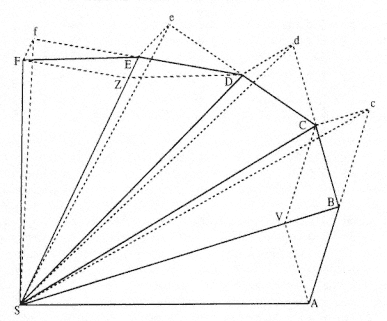
Figure 9.4
Based on Newton's diagram for Proposition 1 in the revised editions.
chapters 1, 2, and 4. The following are the new corollaries added to Proposition 1 in the revised editions of the Principia , and figure 9.4 is based on the figure for Proposition 1 that appears in the revised editions.
Corollary 1. In nonresisting spaces, the velocity of a body attracted to an immobile center is inversely as the perpendicular dropped from that center to the straight line which is tangent to the orbit. For the velocities in those places A, B, C, D, and E are respectively as the bases of the equal triangles AB, BC, CD, DE, and EF, and these bases are inversely as the perpendiculars dropped to them .
The equal areas of the triangles are given by the product of the base of the triangle, which is the velocity multiplied by the equal times, and the slant height of the triangle, which is the perpendicular to the tangent through the center of force. Thus, the product of the velocity and the tangent is equal to the given area divided by the given time and, thus, the velocity is inversely proportional to the perpendicular to the tangent Y (i.e., area µ base × height = velocity × time × Y, or velocity v µ area / time × Y, where the area / time is a constant of the motion).
Corollary 2. If chords AB and BC of two arcs successively described by the same body in equal times in nonresisting spaces are completed into the parallelogram ABCV, and diagonal BV (in the position that it ultimately has when those arcs are decreased indefinitely ) is produced in both directions, it will pass through the center of forces .
The line Bc is constructed equal in length to the line AB and the line Cc is constructed parallel to the line of force BS . Thus, the diagonal of the parallelogram ABCV will pass through the center of force S .
Corollary 3. If chords AB, BC and DE, EF of arcs described in equal times in nonresisting spaces are completed into parallelograms ABCV and DEFZ, then the forces at B and E are to each other in the ultimate ratio of the diagonals BV and EZ when the arcs are decreased indefinitely. For the motions BC and EF of the body are (by Corollary 1 of the laws) compounded of the motions Bc, BV and Ef, EZ; but in the proof of this proposition BV and EZ, equal to Cc and Ff, were generated by the impulses of the centripetal force at B and E, and thus are proportional to these impulses .
If there were no impulsive force at point B , then the body would make the displacement Bc by virtue of its velocity at B . If the body had no initial velocity at B , then it would make the displacement BV by virtue of the impulsive force at B . Thus, by "Corollary 1 of the laws" (i.e., the parallelogram rule) the displacement BC is "compounded of the motions Bc and BV ." The velocity increment Dv at B generated by the impulsive force is the product of the force FB and the extremely short time of the impulse dt . The displacement BV generated by that velocity increment is the product of the velocity increment D v and the time between impulses DT . Thus, BV = (Dv ) (DT ) = FB (dt ) (D T ) and the displacement EZ = FE (dt ) (DT ). The ratio of the displacements at points B and E is given by BV / EZ = FB (dt ) (D T ) / FE (dt ) (D T ) = FB / FE , or "the forces at B and E are to each other in the ultimate ratio of the diagonals BV and EZ ." This ratio of displacements as a measure of the ratio of forces has been fundamental to all of Newton's dynamics. In fact, it has been so fundamental that until this late date he appeared to think it was not necessary to defend it.
Corollary 4. The forces by which any bodies in nonresisting spaces are drawn back from rectilinear motions and are deflected into curved orbits are to one another as those sagittas of arcs described in equal times which converge to the center of forces and bisect the chords when the arcs are decreased indefinitely. For these sagittas are halves of the diagonals with which we dealt in Corollary 3 .
Figure 9.5 is fashioned after the drawing in Whiteside's discussion of these corollaries.[11] The "sagitta of arc" is the line segment Bx , where the sagitta is "the arrow in the bow" of the orbital arc ABC . In terms of the trigonometric functions of a unit circle, the sagitta is the versine (i.e., 1 – cosine).[12] The preceding corollary relates to impulsive forces, as employed in the polygonal approximation. This corollary relates to continuous forces (i.e., "when the arcs are decreased indefinitely"), as employed in the parabolic approximation. The revised Proposition 6, which demonstrates both the linear and circular dynamics ratio, makes specific reference to this new Corollary 4 of Proposition 1 in relating the force to the displacement (in contrast to the 1687 edition, which makes reference to the second law,
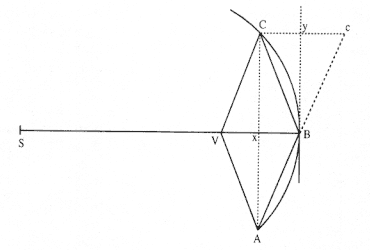
Figure 9.5
The sagitta of arc is the line segment Bx (the "arrow") in the arc ABC
(the "bow").
F = ma). The sagitta Bx is equal to the segment Cy and will become the deviation QR in the linear dynamics ratio.
Corollary 5. And therefore these forces are to the force of gravity as these sagittas are to the sagittas, perpendicular to the horizon, of the parabolic arcs that projectiles describe in the same time .
The body at point B has an initial velocity in the direction By and the impulsive force acts perpendicularly to that velocity and is directed toward the center of force S . In the limit of small arcs, the force is constant, as is the force of gravity near the surface of the earth. As projectiles fired horizontally move in parabolic arcs under the constant vertical force of gravity, so the arcs of these sagittas are parabolic under the constant force toward S . Here Newton makes explicit the parabolic approximation discussed here in chapter 2 and which he employed implicitly in much of On Motion and the first edition of the Principia .
Corollary 6. All the same things hold, by Corollary 5 of the laws, when the planes in which the bodies are moving, together with the centers of forces that are situated in those planes, are not at rest but move uniformly straight forward .
The Revision of Proposition 6
In the first edition Newton set out the nature of the deviation QR quite simply: "The nascent line segment QR is, given the time, as the centripetal
force (by Law 2), and, given the force, as the square of the time (by Lemma 10)." In the revised editions, however, Law 2 is replaced by a reference to the new corollary from Proposition 1, and Lemma 10 is replaced by a reference to Lemma 11.
|
Thus, the time squared dependence of the displacement QR (now called the "sagitta" or the "versine") stems directly from Corollary 3 of Lemma 11 (i.e., the circular approximation discussed above). When the proof of this statement was finished, Newton added the following statement: "The same thing is easily demonstrated by Corollary 4 of Lemma 10," which was the only reference given in the 1687 edition. He has now relegated the linear demonstration of Lemma 10 to a secondary position relative to the circular demonstration of Lemma 11.
Newton then continued to develop the linear dynamics ratio QR / QT2 × SP2 as in the first edition. In the revised editions, this ratio continues to serve as the primary method of solving the direct problems that follow Proposition 6, including the direct Kepler problem, as it did in the 1687 edition. It is significant, however, that in the revised version of Proposition 6 even the linear dynamics ratio rests upon the approximation to uniform circular motion given in Lemma 11.
But even more dramatic is the introduction of an entirely new and alternate dynamics ratio. Figure 9.6 is a comparison of the diagram from the 1687 edition with the new diagram that accompanies Proposition 6 in the revised editions. The most obvious change is the addition of the line YS , which passes through the force center S and is normal to the tangent
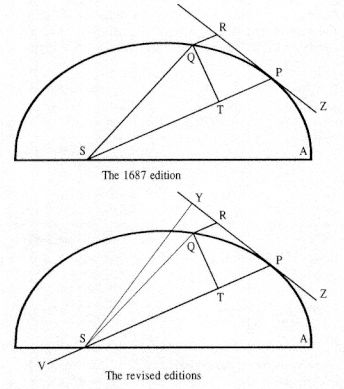
Figure 9.6
A comparison of Newton's diagrams for Proposition 6. In the
revised edition the line PS is extended to the point V and the
perpendicular to the tangent YS is added.
YZ . Newton has demonstrated in the first of the new corollaries added to Proposition 1 that the line YS is inversely proportional to the speed of the body at point P . A more subtle but significant change in the figure is the extension of the line of force SP through the force center S to a point V . This extended line PV is identified in the text as the chord of the circle of curvature at the point P that passes through the center of force S . When that circle is added to the diagram, as in figure 9.7, then the nature of the extension of the line of force to the point V is made clear. The new Corollary 3 to Proposition 6 relates the centripetal force to the chord of the circle of curvature PV and the perpendicular to the tangent SY as follows:
Corollary 3. If PV be a chord of this circle, drawn from the body through the center of force ; [then ] the centripetal force will be reciprocally as the solid SY2 × PV.
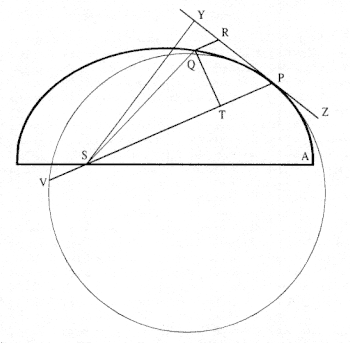
Figure 9.7
A revision of Newton's diagram for Proposition 6 with the circle
of curvature PQV added.
Thus, in the revised editions Newton introduced a second measure of the force, the circular dynamics ratio 1 / SY2 × PV , to complement the linear dynamics ratio, which is the only measure in the 1687 edition. The significant distinction between the linear and the circular version of the dynamics ratio is that the former was developed in part from considerations of uniform rectilinear motion, while the latter was developed from considerations of uniform circular motion. In the published version, the revision appears as a logical extension of the original. In the unpublished radical restructurings, however, the revision took on a much more significant role. There are indications, in fact, that Newton toyed with the idea of making the circular dynamics ratio the primary measure of force (i.e., reversing the order of presentation).[13] In the following, I give the entire revised Proposition 6 of the 1713 and 1726 editions. The details of the demonstration of the body of the proposition and the derivation of the linear dynamics ratio in Corollary 1 are similar to the analysis in the 1687 edition and in Theorem 3 of the tract On Motion , which I discussed in detail in chapter 4. I here restrict my detailed comments to the revised corollaries.
Proposition 6—
Theorem 5
Proposition 6. If a body in a nonresisting space should revolve in any orbit around an immobile center and should describe any just nascent arc in a minimal time, and if the sagitta of the arc should be understood to be drawn so that it would bisect the chord, and when produced, would pass through the center of the forces ; [then ] the force in the middle of the arc will be as the sagitta directly and the square of the time inversely .
For the sagitta in a given time is as the force (by Proposition 1, Corollary 4 ), and on increasing the time in any ratio, because the arc is increased in the same ratio, the sagitta is increased in that ratio doubled (by Corollaries 2 and 3 of Lemma 11 ), and thus it is as the force and the square of the time jointly. Let the doubled ratio of the time be taken away from each side, and the force will be as the sagitta directly and the square of the time inversely. Which was to be proven .
The same thing is easily demonstrated by Corollary 4 of Lemma 10 .
Corollary 1. If a body P by revolving around the center S, should describe any curved line APQ, and if the straight line ZPR should touch that curve at any point P, and if to this tangent from any other point Q of the curve , QR should be drawn parallel to the distance SP, and if QT should be dropped perpendicular to the distance SP; [then ] I assert that the centripetal force will be reciprocally as the solid SP2 × QT2 / QR, provided that the quantity of that solid that ultimately occurs when the points P and Q coalesce is always taken. For QR is equal to the sagitta of double the arc QP, in the middle of which is P, and the double of the triangle SQP, or SP × QT, is proportional to the time in which that double arc is described; and thus it can be written as an expression of the time .
Corollary 2. By the same argument the centripetal force is reciprocally as the solid SY2 × QP2 / QR, if only there is constructed the perpendicular SY dropped from the center of forces onto the tangent PR of the orbit. For the rectangles SY × QP and SP × QT are equal .
See figure 9.8. As the point Q approaches the point P , then the arc QP approaches the tangent segment RP . Thus, the triangles TQP and YSP become similar and therefore SY / SP = QT / QP or as Newton states it, "the rectangles SY × QP and SP × QT are equal." The linear dynamics ratio QR / (QT2 × SP2 ) thus can be written as QR / (SY2 × QP2 ).
Corollary 3. If the orbit is either a circle, or touches a circle concentrically, or cuts it concentrically, that is, contains the minimal angle of contact or of section, having the same curvature and the same radius of curvature at point P; and if there is constructed the chord PV of this circle, drawn from the body through the center of forces ; [then ] the centripetal force will be reciprocally as the solid SY2 × PV; for PV is QP2 / QR.
Figure 9.9A is a diagram based on Euclid, Book 3, Proposition 35, in which it is demonstrated that the products AE × EC and BE × ED of the segments of the chords of a circle are equal (or from Proposition 15, Book 1 of Apollonius's Conics ; see figure 5.12). Figure 9.9B is a diagram of that Euclidian proposition applied to the circle of curvature at a point P of a general
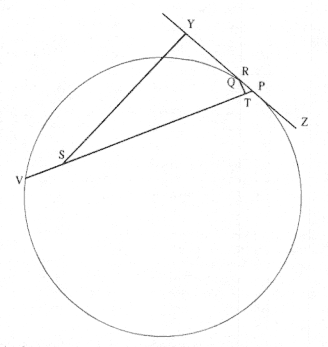
Figure 9.8
As the point Q approaches the point P the angle TQP approaches
the angle YSP , and triangles TQP and YSP are similar.
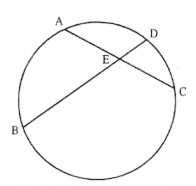
Figure 9.9A
Based on Proposition 35, Book 3 of
Euclid's Elements : AE × EC = BE × ED .
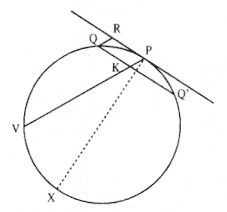
Figure 9.9B
Euclid's Proposition 35 applied to the
circle of curvature in Newton's Proposition 6:
QK × KQ' = VK × KP .
curve (not shown). Thus, QK × KQ' = PK × KP where KP = QR because PRQK is a parallelogram by construction. In the limit as the point Q approaches the point P , then PK approaches PV and QK approaches KQ' or QP . Thus, QP × QP = PV × QR or, as Newton states, "PV is as QP2 / QR ." Thus, the reciprocal measure of the force from Corollary 2, (SY2 × QP2 ) / QR , can be written as SY2 × (QP2 / QR ) or SY2 × PV .
Corollary 4. With the same suppositions, the centripetal force is as the square of the velocity directly and the chord inversely. For the velocity is reciprocally as the perpendicular SY, by Corollary 1 of Proposition 1 .
From Corollary 3, the force is proportional to 1 / SY2 × PV and from Corollary 1 of Proposition 1, the velocity v is inversely proportional to SY , the perpendicular to the tangent through the center of force S . Thus, the force is proportional to v2 / PV .
Corollary 5. Hence if any curvilinear figure APQ is given, and on it a point S is also given, toward which a centripetal force is perpetually directed, there can be found a law of centripetal force, whereby any body P, perpetually drawn back from a rectilinear course, will be confined in the perimeter of that figure and will describe it by its revolution. Of course there must be computed either the solid SP2 × QT2over QR or the solid SY2 × PV reciprocally proportional to this force. We shall give examples of this in the following problems .
In this demonstration of Proposition 6, the circular dynamics ratio is derived from the linear dynamics ratio. Newton has elsewhere reversed the procedure and obtained the circular dynamics ratio directly without any reference to the linear ratio.
A Rejected Revision of Proposition 6
Newton produced a number of variations of Proposition 6 that never appeared in print. In one draft, he crossed out the final corollaries and inserted the title "Prop VI." He then proceeded to derive the circular dynamics ration from first principles, without any reference to the linear dynamics ratio.[14] Figure 9.10 is a reconstruction of the small sketch that appears in that revised draft version of Proposition 6. The symbols are as in the published edition: P for the place of the body, R for a point beyond P on the orbit, and v and V for the terminal of the chords drawn from P through S of the two circles that touch the orbit at P . After much revision and deletion, Newton's draft of this version of Proposition 6 is as follows.
Proposition 6. If circles touch orbits concave to the bodies and if they are of the same curvature with the orbits on the points of contacts , [then ] the forces will be reciprocally as the solids comprised of the chords of the arcs of circles from bodies through the centers of forces and by the squares of the perpendiculars descending from the same centers on to the rectilinear tangents .
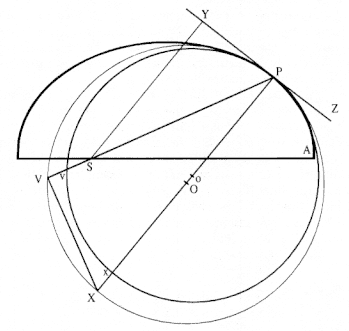
Figure 9.10
A reconstruction from Newton's sketch for the proposed revision
of Corollary 6 of Proposition 6.
Let S be the center of forces, the body P revolving on the orbit PR, the circle [s ] PVX [and Pvx] touch the orbit at P, at the concave parts of it; whichever [circle ] is of the same curvature with the orbit at the point of contact, the chord PV of this circle constructed from the body P through the center S; the straight line PY touching the orbit at P and SY perpendicular from the center S falling on this tangent: I say that the centripetal force of the revolving body is reciprocally as the solid SY2 × PV.[15]
Newton does not give details of the demonstration, but it is not difficult to reconstruct a version of one. The basic assumption is that the force FO (directed toward the center O ) is in proportion to the force FS (directed toward the center S ) as the chord of the circle of curvature PV drawn through the center S is in proportion to the diameter of the circle of curvature PX (i.e., FO / F S = PV / PX ).[16] From Proposition 4, the force FO required for uniform circular motion is directly proportional to the square of the speed (or inversely as the perpendicular SY ) at point P and inversely proportional to the radius (or the diameter PX ) of curvature, or FOµ (speed)2 / (radius). Thus, one has that FS = [FO ] (PX / PV ) µ [1 / (SY2 × PX )] (PX / PV ) = [1 / (SY2 × PV )], and thus, as Newton puts it "the centripetal force of the revolving body is reciprocally as the solid SY2 × PV ."[17]
Newton did not adopt such a radical revision, however, and in the
published editions the circular dynamics ratio is derived from the linear dynamics ratio rather than from first principles. The circular dynamics ratio appears as an alternate measure of force rather than as the primary measure. Thus, Newton names the solutions to the direct problems that employ it as "alternate solutions."
In the 1687 edition Newton fulfilled his promise to "give examples of this [the linear dynamics ratio] in the following problems" by considering three preliminary examples (circle/circumference, spiral/pole, and ellipse/center) before presenting the solution to the direct problem of motion in a conic with the center of force at a focus. In the revised editions he considers the same three preliminary examples as in the 1687 edition but now the antecedent of "this" in his statement refers to both the linear dynamics ratio and the circular dynamics ratio. The solutions employing the former are essentially unchanged from the versions that appear in the 1687 edition, and the solutions employing the latter follow each example as "alternate solutions."
The Revision of Proposition 7—
An Alternate Solution
The problem that immediately followed the general paradigm for solving direct problems in On Motion and in the first edition of the Principia was the direct problem of a circular orbit with the center of force on the circumference of the circle. The problem had no physical application, but it was a very simple and instructive example of how the paradigm was to be applied (see Problem 1 in chapter 5). In the revised edition, however, the nature of the problem changes: the force center is a general point and the solution to the original problem appears in a corollary. The statement of Proposition 7 in the first versus the revised editions is as follows:
|
The statement in the revised editions is a major departure from the statement in the 1687 edition; the force center is no longer restricted to a point on the circumference of the circle but may be located at any point . Moreover, in the first edition, Proposition 7 consisted of about a dozen lines in total. In the revised editions it has increased in length some fivefold. The en-
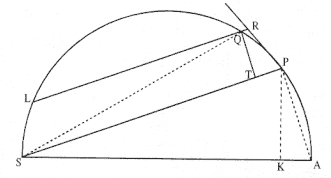
Figure 9.11A
Based on Newton's diagram for Proposition 7 in the 1687
Principia .
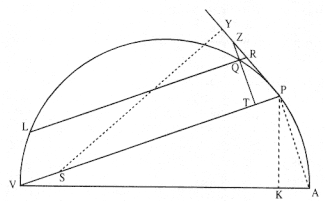
Figure 9.11B
Based on Newton's diagram for Proposition 7 in the revised
Principia .
larged proposition still presents a solution using the linear dynamics ratio, but Newton has added an alternate solution using the circular dynamics ratio. Newton also has added three corollaries: the first corollary gives the solution to the circle/circumference problem that appears as Corollary 1; the second corollary gives the ratio of forces directed toward two different centers of force for the same given circular orbit; and the third corollary extends that result for a given circular orbit to any given orbit.
Figure 9.11A is based on Newton's diagram that accompanies Proposition 7 in the 1687 edition, and Figure 9.11B is based on his diagram for Proposition 7 in the revised editions. Again, the most obvious change is the addition of the line YS , the normal to the tangent that is employed in the circular dynamics ratio. One notes also that the center of force S has shifted from a point restricted to the circumference of the circle to some
general point, as is dictated by the revised statement of the problem. Finally, the line of force from point P has been extended through the force center S to the circle at a point V . In this very special problem of a circular orbit, the orbit is identical with its circle of curvature. Thus, PV is the chord of the circle of curvature, as required in the circular dynamics ratio. The radius of the circle, OP , should be added to Newton's figure to aid in the analysis where O is the midpoint of VA .
Just as the procedure for solving the direct problems with the linear dynamics ratio can be reduced to a series of three simple steps, so can the procedure using the circular dynamics ratio be reduced to the following simple paradigm:
Step 1 Seek out an expression for the perpendicular to the tangent SY ,
Step 2 Seek out an expression for the chord of the circle of curvature PV , and
Step 3 Combine them in the revised dynamics ratio 1 / SY2 × PV to obtain the force.
Note that one need no longer submit the circular dynamics ratio to a limiting procedure as was necessary with the linear dynamics ratio. In passing from the parabolic approximation to the circular approximation, Newton has already invoked an effective limiting operation. The force is given directly by the chord PV and the square of the perpendicular YS as they exist in the diagram. The alternate solution for Problem 2 requires only a few lines to complete the paradigm.
Step 1. Find "SY." From the similarity of triangles SYP and VPA in figure 9.11, Newton obtains the following relationship:[18]

Step 2. Find "PV." The expression for the chord PV already exists in the expression for the normal SY in Step One.
Step 3. Find "the ratio ." Thus, if one squares both sides of the expression above and multiplies by PV , then the circular dynamics ratio provides the following expression:

where AV is the diameter of the circle and hence a given constant. But the solution for the new problem (i.e., Fµ 1 / SP2 × PV3 ) is not expressed in terms of the line of force SP alone, as are all of the other solutions of direct problems. The different type of result for the revised Proposition 7 occurs because the force is directed to any point, not simply to a specific point, as in the earlier version of the problem (specifically, a point on the circumference of the circle).
Newton extends the general nature of the solution for the circular orbit in Proposition 7 farther by adding new corollaries. In Corollary 1 he notes that as the general point S moves to the circumference of the circle, the chord PV is equal to the line of force SP , and hence the result is that the force goes directly as the fifth power of SP , as he demonstrated in the version of the problem that appeared in the first edition. In Corollary 2 Newton extends the scope of the problem by calculating the ratio of the forces directed toward any two arbitrary points that will maintain the circular orbit.
Corollary 2. The force by which the body P in the circle APTV revolves about the center of force S is to the force by which the same body P may revolve in the same circle and the same periodic time about any other center of force R . . .
Corollary 3 makes the final extension: the circular orbit becomes any orbit.
Corollary 3. The force by which the body P in any orbit revolves about the center of force S, is to the force by which the same body may revolve in the same orbit, and the same periodic time about any other center of force R, as the solid SP × RP2 .
The final line of the corollary provides Newton's only formal defense for extending the solution for a problem in circular motion into a dynamics theorem for general motion.
[Corollary 3] For the force in this orbit at any point P is the same as in a circle of the same curvature .
Thus, the conclusion of Proposition 7 provides yet another alternative source of solutions for dynamic problems, the comparison dynamics ratio. In the proposed revision of the 1690s it appeared prominently as Theorem 7 in the proposed Proposition 8. In the published revisions, it is tucked away as a corollary to Problem 2 in Proposition 7. The comparison dynamics ratio is a result that rests upon the circular approximation of Lemma 11 but it is a variation of the revised version that appears in Theorem 5. Corollary 3 itself is worthy of the title "theorem," but it appears simply as an extension of a problem. Note that Newton cannot use the comparison dynamics ratio of Corollary 3, Proposition 7, to solve the problems that directly follow it in Section 2 (i.e., the spiral/pole of Proposition 9 and the ellipse/center of Proposition 10) because he does not have a comparison solution for them as he did for Proposition 11. In Propositions 9 and 10 he employs the circular dynamics ratio from Proposition 6 to produce the alternate solution. Newton employs the unheralded comparison dynamics ratio, however, in the alternate solution of the direct Kepler problem in Proposition 11 when he compares the solution of the ellipse/center (Proposition 10) to the solution of the ellipse/focus (Proposition 11).
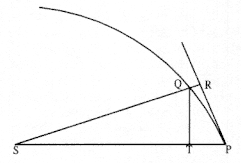
Figure 9.12A
Based on Newton's diagram for Proposition 9
in the 1687 Principia .
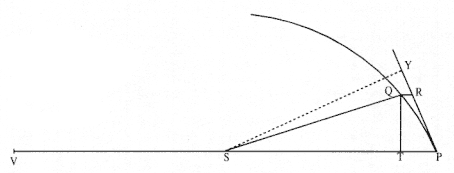
Figure 9.12B
Based on Newton's diagram for Proposition 9 in the revised Principia .
The Revision of Proposition 9—
An Alternate Solution
In this direct problem, the orbit is an equal angle spiral and the center of force is located at the pole of the spiral. The statement of the problem and the solution employing the linear dynamics ratio remain as they were in the 1687 edition. That initial solution is brief compared to the solutions of the other problems that followed it. (See chapter 8 for a full discussion of the initial solution.) The alternate solution employing the circular dynamics ratio, however, is even more brief, requiring only the following few lines.
Proposition 9. The perpendicular SY dropped to the tangent, and the chord PV of the circle cutting the spiral concentrically are to the distance SP in given ratios; and thus SP3 is as SY2 × PV, that is (by Proposition 6, Corollaries 3 and 5 ), reciprocally as the centripetal force .
Figures 9.12A and 9.12B compare Newton's diagrams for Proposition 9 in the 1687 edition and the revised editions. The normal to the tangent
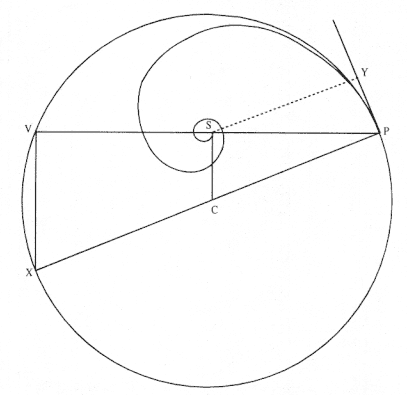
Figure 9.13
The diagram for Proposition 9 with the spiral extended from the point P into
its pole S and the circle of curvature PVX displayed.
through the center of force SY has been added. Moreover, the line of force PS has been extended to a point V , where the distance PV is the chord of the circle of curvature at point P . This relationship is made explicit in the extended version of the diagram shown in figure 9.13, where PVX is the circle of curvature at the point P of the spiral whose pole is at the center of force S . Note that the chord of curvature PV through the pole S is bisected by the pole.
Step 1 . Find "SY." Note from the figure that the angle SPY is the given constant angle of the spiral. Thus, SY = PS cos (SPY ) and therefore SY and SP are "in a given ratio."
Step 2 . Find "PV." As has been argued in the discussion of the initial solution in chapter 8, Newton uses without demonstration the relationship that the chord PV of the circle of curvature drawn through the pole of the spiral is equal to twice the pole distance SP . Thus, PV = 2 SP and therefore PV and SP are "in a given ratio."
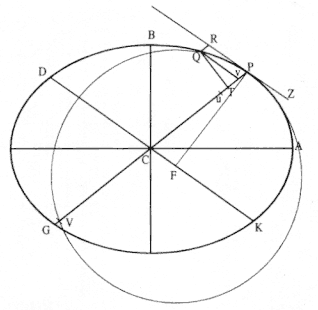
Figure 9.14
A revision of Newton's diagram for Proposition 10 in the
1713 Principia with the circle of curvature PV added.
Step 3. Find the circular dynamics ratio . Substituting SY and PV from Steps 1 and 2 directly into the circular dynamics ratio 1 / SY 2 × PV , the force is found to be proportional to 1 / SP3 .
The Revision of Proposition 10—
An Alternate Solution
The first major test of the revised dynamics ratio is set out in Proposition 10: an elliptical orbit with the force center located at the center of the ellipse. Figure 9.14 is the diagram that accompanies Proposition 10 in the revised editions. In contrast to the 1687 edition, separate diagrams are provided in the revised edition for Proposition 10 and in Proposition 11. The important change to note is the addition of the letter V in the lower left-hand section, which defines the chord of the circle of curvature through the center of the ellipse. The circle shown in figure 9.14 does not appear explicitly in Newton's diagram.
Step 1 . Find "SY." Note in the diagram that the perpendicular SY that is required is not explicitly shown. In this example, however, the line SY is equal to the line PF , which is constructed perpendicular to the conjugate diameter DK and hence perpendicular to the tangent PR .[19]
Step 2. Find "PV." The line PV is the chord of the circle of curvature to be employed in the circular solution. The first nine lines of the circular solution are devoted to demonstrating the following relationship:
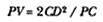
which is a property of an ellipse, where PV is the chord of the circle of curvature drawn through the center of the ellipse.[20]
Step 3. Find "the ratio ." Thus, the two elements PV and SY that are required for the circular solution are known, and the force F is given as follows:

where PF × CD is a circumscribed area that is a constant for any ellipse (Lemma 12). Hence, the force F is directly proportional to the distance PC .
The Revision of Proposition 11—
Alternate Solutions
Newton does not employ the same technique for the alternate solution of the direct problem in Proposition 11 as he did in Proposition 10. This difference is made manifest in the diagram that accompanies Proposition 11 in the revised editions. The diagram for Proposition 10 was revised, but the diagram for Proposition 11 is almost identical to the diagram given in the first edition.[21] Note, therefore, that the points V and Y , which appear in the diagrams for Propositions 9 and 10, are missing for this diagram. Thus, the perpendicular SY and the chord of the circle of curvature PV are not indicated, either explicitly or implicitly. Figure 9.15 is a diagram for Proposition 11 that does show the normal SY and the chord PV . The direct Kepler problem that opens Section 3 was not solved following the paradigm established in Proposition 10 but it could have been, as it was in the unpublished proposed revisions. The following is such a solution:
An Unpublished Alternate Solution
Step 1. Find "SY." From the similar triangles YSP and FPE one has the following:
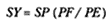
Step 2. Find "PV." From a similar proof to that which appears in Proposition 10, the chord PV of the circle of curvature that passes through a focus of an ellipse (in contrast to passing through a center) is as follows:
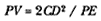
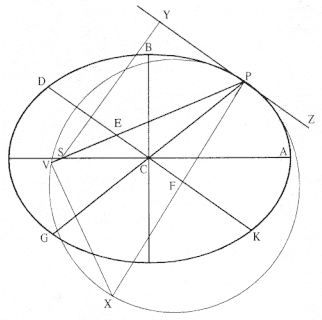
Figure 9.15
A version of the diagram for Proposition 11 with the circle of
curvature PVX and the perpendicular YS added.
Newton obtained this result in the proposed revisions that were discussed in chapter 8.
Step 3. Find "the ratio." Thus, again the two elements PV and SP are known and the force F is given as follows:

And from the additional knowledge that PE = CA (a constant), from the relationships in Lemma 12 (PF = CA × CB / CD ), and from the definition of the constant latus rectum L of an ellipse (L = 2CB2 / CA ), the force is given as inversely proportional to the square of the line of force SP .

But Newton did not elect to publish this solution to the Kepler problem, even though it is clear in his unpublished revisions of the 1690s that he could produce such a solution. Instead, he elected to use the comparison theorem that appears in Corollary 3 of Proposition 7 rather than the direct application of the circular dynamics ratio just given. The statement of the alternate method that appears in the revised editions is as follows:
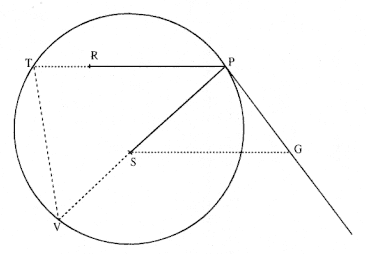
Figure 9.16
Based on Newton's figure for Corollary 2 of Proposition 7 in the
revised Principia .
The Published Alternate Solution
Proposition 11. Being directed to the center of an ellipse, a force by which a body P can be revolved on that ellipse would be (by Proposition 10, Corollary 1 ) as the distance CP of the body from the center C of the ellipse; let CE be drawn parallel to the tangent PR of the ellipse; and the force by which the same body P can be revolved around any other point S of the ellipse, if CE and PS should meet at E, will be as PE3 / SP2 (by Proposition 7, Corollary 3 ); that is if point S should be the focus of the ellipse, and thus PE should be given, [then ] the force will be as SP2reciprocally. Which was to be found .
Figure 9.16 is the drawing that accompanies Corollary 2 of Proposition 7 in which Newton demonstrated that the ratio of the forces FS / FR (forces that are directed to any two different points S and R , and that will maintain the same body moving along the same circle PTV ) is given by the comparison dynamics ratio (i.e., F S / FR = SP × RP2 / SG3 , where SG is parallel to RP ). In Corollary 3, Newton extended the results given in Corollary 2 for a "circular orbit" to "any orbit" simply by noting in the final sentence, "For the force in this orbit at any point P is the same as in a circle of the same curvature."
Figure 9.17 shows a portion of the drawing that Newton provided for Proposition 11 with my addition of the line CG ' corresponding to the line SG in the diagram for Corollary 3 in figure 9.16. The two general points S and R from the diagram for Corollary 3 become the points for the center of the ellipse C and the focus of the ellipse S (i.e., FC / FS = CP × SP2 /
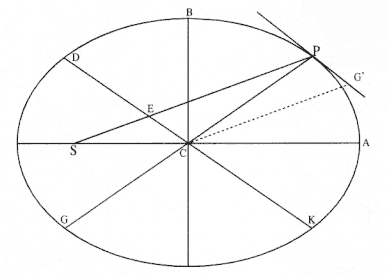
Figure 9.17
A restricted version of Newton's diagram for Proposition 11 with the line
CG' from Corollary 2 of Proposition 7 added.
CG3 ), where S (in Proposition 7) becomes C (in Proposition 11) and R (in Proposition 7) becomes S (in Proposition 11). In Proposition 10, which precedes the Kepler problem, Newton has determined that the force FC required to maintain an elliptical orbit, when the force is directed to the center C of the ellipse, is given by FC µCP . Substitution of that result into the comparison dynamics ratio gives the force to the focal point S as FSµCG 3 / SP2 . From the figure, CG = PE because the diameter DK is parallel to the tangent PG . Further, Newton has demonstrated earlier in Proposition 11 that PE = AC , where 2AC is the major axis, a constant of the ellipse. Thus, FSµ 1/SP 2 , as required. It is an efficient solution but one that leads the reader on a tortuous trail as he or she traces back through Proposition 7 to its first principles in Proposition 6, Theorem 5. When Newton completes this solution, he makes the following observation at the close of Proposition 11:
[Proposition 11] With the same brevity with which we reduced the fifth Problem to the parabola, and hyperbola, we might do the like here: But because of the dignity of the problem and its use in what follows, I shall confirm the other cases by particular demonstrations .
Newton is not as expansive, however, in his efficient but indirect presentation of the comparison theorem as he is in the extended presentation of the Kepler problem. The reasons for his choice of this restricted type of
presentation in the published editions lie buried in his unpublished revisions. There he demonstrated each of his three methods of solution in a new and independent proposition. Here he must fold the three methods into the existing structure of the first edition of the Principia .
Conclusion
Thus, the reader of the revised published editions of the Principia is presented with new insights into the basic dynamics of planetary motion, but that information is hidden in a labyrinth not present in the first edition. In the first edition, the basic linear dynamics ratio is developed in Proposition 6 and applied in sequence to a series of five problems, each problem presented in a separate proposition and clearly labeled as a problem. In the revised published editions, Proposition 6 contains two basic dynamics ratios that provide alternate solutions for the first four of the exemplar problems that follow it. In Proposition 7, the direct problem of a circular orbit with a center of force on the circumference of the first edition is extended in its published revised format to include any general force center for a circular orbit; then it is extended to provide the ratio of the forces for two different centers; and then that result is further extended in the final corollary of the problem to include any orbit whatsoever (i.e., the comparison theorem). In the unpublished revision, this ratio is the premier theorem and is set forth clearly as the primary method of solving all the problems of the conic sections. In the published revised editions, it is hidden away as a corollary to a problem in Proposition 7.
In the unpublished revisions, the new Lemma 12 provides the basis for employing the chords of the circles of curvature to ellipses to produce a general dynamics ratio for ellipses from the circular dynamics ratio. Further, it gives the specific chords of the circle of curvature required in the solution of the specific problems of focal and central force centers for ellipses. In the published revised editions the problem of the central ellipse (Proposition 10) is solved in this fashion but the alternate solution for the problem of the focal ellipse (Proposition 11) is not solved by the logical extension of the technique. Rather, the alternate solution is produced using the comparison ratio from Proposition 7 and the alternate solution for a central ellipse from Proposition 6.
Why did Newton give up the eloquent and graceful development of the basic dynamics of the unpublished revisions for the patchwork labyrinth of the published revisions? Rather than three complete and complementary sets of solutions for the direct problems of circular and elliptical motion with their fundamental theorems clearly set forth, the published revision presents a mixture of solutions with theorems appearing in problem
solutions of other theorems. In discussing a proposed revision of all the lemmas to accompany the proposed revision of the propositions, Whiteside states that "inertia prevailed and in the revised second edition (and in all subsequent editions thereafter) the lemmas of the 1687 edition of the Principia all reappear unchanged in location and with only minimal alterations in their verbal text."[22] And, presumably, the same "inertia" explains Newton's failure to revise the location and description of the propositions. It would have been a Herculean task to seek out all the references to earlier lemmas and propositions, revise them, and then renumber them. Rather, he contented himself with tucking pieces of the new theorems and solutions into whatever existing nooks and crannies he could find. And thus, the general comparison theorem appears as a corollary of a problem on circular motion and not as an independent theorem.
It is regrettable that the full revision was not done. The published primary solution to the direct Kepler problem cloaks its linear dynamics in a heavy overlay of mathematics, and the revised published alternate solution wanders back through the labyrinth of the hidden comparison ratio in Proposition 7 and ultimately to the revised Proposition 6. In contrast, the three unpublished solutions to the direct Kepler problem follow in a clear and simple fashion from three separate and clearly identified dynamics theorems.
Ten—
Newton's Dynamics in Modern Mathematical Dress:
The Orbital Equation and the Dynamics Ratios
Throughout this book I have attempted to view Newton's creative process in terms of the dynamics and mathematics that preceded his analysis, rather than to view it with hindsight from a modern perspective. In this closing chapter, however, I reverse the procedure and express Newton's dynamic measures of force in current mathematical notation. Contemporary textbooks in physics present a second-order differential equation called "Newton's Second Law" in the familiar form of F = ma . For motion in one dimension x , this equation has only one component equation: F(x) = m (d2x / dt2 ). The force function F(x) is equal to the product of the mass m and the second derivative of distance x with respect to the time t (i.e., the acceleration (d2x / dt2 )). For motion in two dimensions, there must be two such equations: one in x and one in y . Motion under a force directed toward a fixed center, such as gravitational force acting toward the sun, is confined to a plane and thus requires only two such equations.[1] If these equations are expressed in terms of the polar coordinates (radius r and angle q ) instead of the Cartesian coordinates (x and y ), then the two component equations can be written as follows:[2]

The force in the radial direction Fr is given as a function F (r ) of the polar radius r alone. The angular force F q is zero, because the force is directed only toward the center along the radius r and thus it has no angular component.
Given the force function F r , one can solve the equations of motion for the path of the particle as a function of time. It is possible, however, to
eliminate time t as a parameter in these two equations and to write the following expression for the force in terms of the radius r and the angle q : the polar orbital equation .

where K is a constant, and the derivative is expressed in the more compact form in terms of r-1 (i.e., the inverse of the radius).[3] Thus, if the path of the particle r = r (q ) is given (i.e., if the polar radius r is known as a function of the polar angle q ), then the force Fr can be found as a function of the radius r simply by taking the second derivative d2 (r -1 ) / dq2 and substituting it into the polar orbital equation. Problems of this sort—find the force from a given path and center of force—are the direct problems that Newton solved in the opening sections of the Principia .
As an example of the application of the polar orbital equation, consider the direct problem given in Proposition 9 of the Principia : find the force required to maintain an orbit that is an equiangular spiral with the center of force located at the pole of the spiral. The equation of the spiral path is given by r = r (q ) = Aeq , where A is a constant, and the reciprocal r-1 is Ae-q . The second derivative of Ae-q with respect to q is simply Ae-q , which is equal to r-1 , and the polar orbital equation gives the following functional dependence of the force Fr on the radius r :

Thus, as Newton has demonstrated in his solution to the spiral/pole direct problem in Proposition 9, the force is inversely proportional to the cube of the radius.
The solution to the distinguished Kepler ellipse / focus problem of Proposition 11 can be solved in a similar fashion. The equation of an ellipse relative to an origin fixed in a focus is given by r-1 = [A + B cos(q )] and the second derivative d2 (r-1 ) / d q2 is simply – B cos(q ). Thus, the polar orbital equation gives the following functional dependence of the force Fr on the radius r :

The force Fr is inversely proportional to the square of the radius r , as Newton has demonstrated in his solution to this problem in Proposition 11. If one has mastered a first course in calculus, then the solution of the polar orbital equation appears to be much simpler than Newton's solution in Proposition 11 using the linear dynamics ratio. That apparent simplicity is deceptive, however, for whereas Newton's analysis clearly sets out the basic principles in terms of the parabolic approximation, much of the dynamics of the orbital solution is hidden in the algorithms of the calculus.
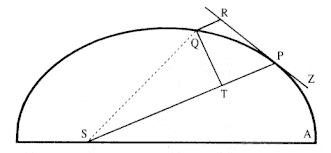
Figure 10.1
Based on Newton's diagram for Proposition 6 of the 1687
Principia .
The Orbital Equation and Curvature
The polar orbital equation can be written in an alternate form as the curvature orbital equation, Fr = K 2 / (r2r sin3 (a )), where r is the radius of curvature and a is the angle between the tangent to the curve and the radius r . The demonstration of the equivalence of the two equations is based upon three analytical elements: Newton's demonstration of Kepler's area law, Newton's circular approximation, and Newton's original work on curvature.
The first relationship is an expression of Newton's Proposition 1, Kepler's law of equal areas in equal times. Figure 10.1 is based upon the diagram for Proposition 6 in the 1687 edition of the Principia . The general curve is APQ , the tangent to the curve is ZPR , and the center of force is S . The area A of the triangle SPQ is equal to (1/2) SP × QT , or what is equivalent, (1/2) SP × PR sin (a ), where a is the angle SPR between the radius SP and the tangent ZPR . If the radius SP is written as r and the tangential velocity at P as v , then in a given time Dt , the line segment PR is equal to vDt , and the area A is given by r vDt sin (a ). Thus, the rate at which twice the area A is swept out is given as follows:

where K is a constant proportional to the area swept out per unit time. This relationship is mathematically equivalent to the modern law of conservation of angular momentum, where K is the angular momentum per unit mass.
The second relationship is an expression of Newton's circular approximation: the replacement of motion along an incremental arc of the general curve at point P with uniform circular motion along an incremental arc of the circle of curvature at the same point. Figure 10.2 is based upon the diagram for Proposition 6 in the 1713 edition of the Principia . In his revised diagram, Newton added the normal to the tangent through the center of force YS and extended the line PS to the point V to display the
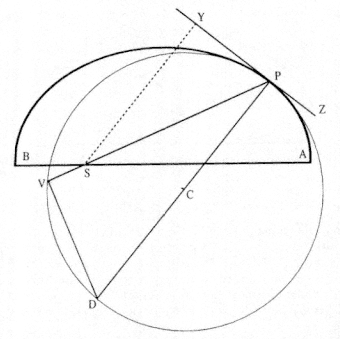
Figure 10.2
Based on Newton's diagram for Proposition 6 of the 1713
Principia .
chord of curvature through the center of force S . I have removed the points Q, R , and T , and I have explicitly displayed the circle of curvature PVD at the point P , where the center of the circle of curvature is at C and the diameter of curvature is PD (i.e., 2r ). The angle PVD between the chord and diameter of the circle is a right angle and a is the angle SPY (equal to the angle SPR in figure 10.1). The component of force FC directed toward the center of curvature C is given by

where FS is the force per unit mass directed toward the center of force S , and r is the radius of curvature. The force FC directed toward the center of curvature C provides the centripetal circular acceleration v2 / r as required in Proposition 4 of the Principia . Newton has explicitly employed this uniform circular replacement in Lemma 11, Corollary 3 and in Proposition 7, Corollary 5; and he has implicitly employed it in other discussions. Combining the two relationships, the force FS directed toward the center of force S can be written as:

The third relationship concerns Newton's original work on curvature, which was extensive. It contains in detail what appears in the Principia only in outline. Central to the analysis is Newton's expression for the radius of curvature r in polar coordinates (r , q ), which he developed in the early 1670s. Newton expressed it in the following form:[4]

where z' is dz /dq and z is the slope of the curve (1 / r ) (dr / dq ) = ctn (a ). It can be demonstrated that (1 + z2 )3/2 = sin-3 (a ), where a is the angle between the radius r and the tangent to the curve, and that [(1 + z2 ) – z' ] = r (r-1 + d2 (r -1 ) / dq2 ).[5] Thus, the expression for the radius of curvature r can be written also as follows:

If this expression is solved for (r-1 + d 2 (r-1 ) / dq2 ), then the polar orbital equation can be written in an alternate form as a function of r , r , and a : the curvature orbital equation.

The curvature orbital equation, expressed in terms of the radius r , the radius of curvature r , and the angle between the tangent and the radius a (i.e., F r = K2 / (r2r sin3 (a ))), echoes Newton's cryptic statement of 1664, in which he argued that the force (Fr ) for elliptical motion at a point (r ) can be found by the curvature (r ) at that point, if the motion (v and a ) at that point is given (i.e., FS = v2 / (r sin(a ))).[6]
The Dynamics Ratios and the Orbital Equation
The linear dynamics ratio QR / (QT2 × SP2 ), which Newton derives in Proposition 6, is the functional equivalent of the contemporary orbital measure. Whiteside has demonstrated the relationship by expanding the geometric terms SP, QT , and QR in a power series, holding terms to the second order of the differential angle dq , and expressing them as a function of the analytic terms r , q , and their derivatives.[7] It is also possible to use Lemma 11 to demonstrate the same result. Figure 10.3 is a revision of the diagram for Lemma 11 into the form that applies to Proposition 6. Lemma 11 states that AB2 / BD = AG and if B approaches A , then AG approaches AJ , the diameter of the circle of curvature 2r . Written in terms of the elements of Proposition 6, AB ®QT / sin(a ), BD®QR × sin(a ), and AG ® 2r . Thus, the limiting value of the ratio AB2 / BD is given by the following expression:

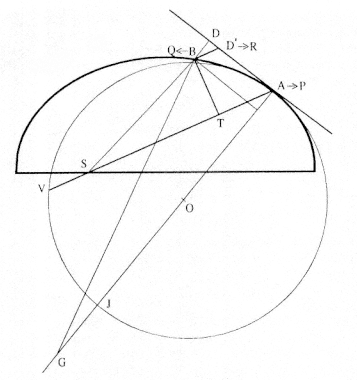
Figure 10.3
Newton's diagram for Lemma 11 adapted to the diagram for
Proposition 6.
which may be solved for the discriminate QR / QT2 = 1 / (2r sin3 (a )). Thus, the linear dynamics ratio QR / (QT2 × SP2 ) is equal to twice the curvature orbital measure 1 / (r 2r sin3 (a )).
The circular dynamics ratio 1 / (SY2 × PV ), which Newton introduced into the revised edition, also is identical with the curvature orbital measure. From figure 10.2 (given previously), the angle SPY is equal to the angle PDV or a (in fig. 10.2, both YS and PD are normal to the tangent YPZ and the angles PVD and YPD are right angles). The chord of the circle of curvature through the center of force PV is equal to PD sin(a ) or 2r sin(a ) and the normal to the tangent SY is equal to SP sin(a ) or r sin(a ). Thus, the circular dynamics ratio 1 / (SY2 × PV ) also is equal to twice the curvature orbital measure 1 / [r2r sin3 (a )].[8]
If the force is expressed in terms of the curvature orbital measure, then the solutions to the direct problems that Newton selected for the 1687 Principia fall into an interesting pattern.
|
For Propositions 7 and 9, the solution is simplicity itself because r and a are respectively constant. For both Propositions 10 and 11, however, one must note that the product PF2 × CD2 is proportional to the area of the ellipse, a constant, and for Proposition 11 that PE is equal to the semi-major axis of the ellipse, also a constant.
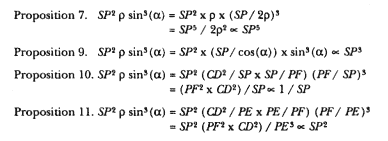
The choice of the orbit and focal center for Proposition 11 in 1684 was dictated by the physical problem of the planets, but the choice of the other examples was arbitrary. They may have been suggested by the work on curvature, which Newton began as early as 1664.[9] In his Methods of Series and Fluxions of 1671, Newton calculated the radius of curvature for a number of examples, including conic sections and spirals.[10] Newton's statement of 1664 indicated that he intended to use his work on curvature to solve direct problems of orbital motion. Whatever method he had in mind when he made the statement in 1664, however, it may not have been in the form of the curvature orbital measure 1 / (r2r sin3 (a )), because that measure entails the area law, which Newton did not discover before 1679.
Michael Nauenberg has suggested that before the discovery of the area law Newton could have employed a numerical method based on curvature to evaluate orbits. Nauenberg demonstrates an iterative computational method to reproduce the figure for the orbit of a body subject to a constant central force such as Newton sent to Hooke in 1679.[11] Moreover, Nauenberg suggests that Newton could have used the material in his 1671 Methods of Series and Fluxions to produce an analytical measure of the force, independent of the area law, to solve direct problems.[12] There is no evidence that Newton actually carried out such calculations, but Nauenberg
argues that there is considerable circumstantial evidence. For example, in the same letter of 13 December 1679 in which Newton sent Hooke the drawing of an orbit obtained by a numerical method for a constant force, Newton also noted that if the force increased as the distance decreased, then the body may "by an infinite number of spiral revolutions descend continually till it cross the center."[13] Nauenberg suggests that Newton knew that the reciprocal cube force generated the constant angle spiral (logarithmic spiral). He notes that Newton's observation of "an infinite number of spiral revolutions" into the center cannot be deduced from a numerical solution of orbital motion, because that technique can provide only a finite number of revolutions in approaching the center. Nauenberg also points to Newton's choice of the constant angle spiral produced by a reciprocal cube force directed to the pole of the spiral as an example in the Principia for both the spiral / pole direct problem in Proposition 9 and the reciprocal cube inverse problem in Proposition 31.
It is also noteworthy that later in the Principia , Newton uses as an example the 1 / r3 force law, rather than the physically more interesting 1 / r2 case, to solve explicitly the inverse problem, given the force law obtain the orbit (Book One, Proposition 31, Corollary 3).[14]
Nauenberg argues that Newton could have solved various direct problems before 1679, and he challenges the received opinion that Newton could not have done so until after his discovery of the area law in 1679. In addition to this new debate over a solution for the direct problem, there is a long-standing debate over the outline for a solution to the inverse problem that Newton added to the 1713 Principia and extended in 1726.
The Revision of Corollary 1 of Proposition 13
In Corollary 1 of Proposition 13 in the 1687 Principia . Newton assumed that the solutions to the conic/focus direct problems given in Proposition 11, 12, and 13 also constituted a solution to the reciprocal square inverse problem.
From the last three propositions it follows that if any body P should depart from position P along any straight line PR, with any velocity, and is at the same time acted upon by a centripetal force that is reciprocally proportional to the square of the distance from the center, [then ] this body will be moved in one of the sections of conics having a focus at the center of forces; and conversely .
This statement is an improvement over the initial version in On Motion sent to Halley in 1684, in which only the solution to the ellipse/focus direct problem was presented and the other two conic sections were not discussed. Nevertheless, even as it stands in the 1687 Principia , this statement is unsatisfactory, and was criticized by Johann Bernoulli before the publi-
cation of the 1713 Principia .[15] Newton's solution to the direct problem of conic / focal motion in the "last three propositions" (i.e., Propositions 11, 12, and 13) does not by itself constitute a solution for the reciprocal square force inverse problem. As Whiteside puts it,
The hidden assumption here made that no curve other than a conic may, in an inverse-square force-field centered on S , satisfy all possibilities of motion at P wants—for all its manifest plausibility—an explicit, rigorous justification, and Newton was later fairly criticized by Johann Bernoulli for merely presupposing its truth without demonstration.[16]
Newton himself recognized the need to justify his assumption in the 1687 Principia of a solution to the inverse problem. In 1709, as the revised edition of the Principia was being prepared, Newton wrote to his editor Roger Cotes and requested that he add the following statement to Corollary 1 of Proposition 13 (Newton added the words in brackets to the 1726 Principia ).
Corollary 1. And the contrary. For the focus, the point of contact, and the position of the tangent being given, a conic section may be described, which at that point shall have a given curvature. But the curvature is given from the given centripetal force [and the body's velocity]: and two orbits mutually touching one the other, cannot be described by the same centripetal force [and the same velocity] .[17]
Newton intended this extension to serve as an outline for the solution to the inverse problem, and evidently it satisfied Johann Bernoulli, for in 1719 he wrote to Newton as follows:
Gladly I believe what you say about the addition to Corollary 1, Proposition 13, Book One of your incomparable work, the Principia , that this was certainly done before these disputes began, nor have I any doubts that the demonstration of the inverse proposition, which you have merely stated in the first edition of the work, was yours; I only said something against the form of that assertion, and wished that someone would give an analysis that led a priori to the truth of the inverse [proposition] and without supposing the direct [proposition] to be already known. This indeed, which I would not have said to your displeasure, I think was first put forward by me, at least so far as I know at present.[18]
Whiteside argues that Newton could have employed a general polar curve with given curvature to produce a solution for the reciprocal square force inverse problem without assuming the solution to the conic/focal direct problem.[19] Newton did not, however, explicitly produce that solution (as he did for the reciprocal cube inverse problem in Proposition 31). Moreover, the validity of the outline of the solution of the inverse problem given in Corollary 1 of Proposition 13 in the 1726 Principia , which does assume the solution to the direct problem, continues to receive an occasional challenge. But now, as in the past, every challenger produces a number of
defenders. One recent challenger has claimed that Newton's solution, even as given in outline in the corollary, is radically flawed and contains a gross, irreparable fallacy. Another critic allowed that a gap may exist in the logic of Newton's outline, but argued that the gap is intuitively easy to fill. Other defenders argued that no gap of any sort exists.[20] The Russian mathematician V. I. Arnol'd, however, saw no real basis for such a discussion. He argued, "The spirit of modern mathematics has penetrated to a number of physicists . . . and they have begun to worry about questions that earlier nobody would have talked about seriously." He arrives at the following conclusion:
In fact, all this argument is based on a profound delusion. Modern mathematicians actually distinguish existence theorems and uniqueness theorems for differential equations and even given examples of equations for which the existence theorem is satisfied but the uniqueness theorem is not. . . . Thus, in general, uniqueness does not follow from the existence of a solution, but everything will be in order if the solution produced depends smoothly on the initial condition. . . . For each initial condition [Proposition 17] Newton produced a solution, described it, and from this description it became obvious straight away that the solution depends smoothly on the initial condition. . . . Of course, one could raise the objection that Newton did not know this theorem. . . . But he certainly knew it in essence.[21]
It is of interest to note that in the outlined solution of Corollary 1 of Proposition 13, as elsewhere in the Principia , Newton assumed on the part of the reader a background in the mathematics of curvature. In Lemma 11, the reference to curvature appeared only in a parenthetical expression, even though curvature was primary to the relationship developed in the lemma. In the final corollary to Proposition 7, the extension of the analysis on circular motion to the comparison theorem and general motion was defended by a final single sentence that called upon curvature. In Proposition 13, Newton again called upon his extensive work on curvature without an elaboration.
A Detailed Solution of the Inverse Problem
I now produce a solution to the inverse problem using Newton's equation for curvature that does not explicitly employ the solution to the direct problem (i.e., Propositions 11, 12, and 13).[22] Instead, the solution employs Newton's work on curvature expressed in contemporary notation. There is no evidence that Newton actually produced such a solution for the inverse problem for gravitational force, but Whiteside argues that he was capable of doing so.[23] The expression for the force obtained from the area law and the circular approximation is given by the curvature orbital equation as follows:

Newton's original expression for r = r (1 + z2 )3/2 / [(1 + z2 ) – z '] can be expressed in terms of (1 + z2 ) as follows:[24]

Moreover, I have demonstrated that sin3 (a ) = (1 + z2 )3/2 . If r and sin(a ) are written in terms of (1 + z2 ), then the expression for the force FS can be rearranged and expressed as follows:

If the force F is given as c / r2 , and (1 + z2 ) is written as the function f (r ), then the equation reduces to:

where A = c / K2 . This equation is a first-order linear differential equation whose complementary solution fc satisfies the equation dfc / dr – 2 fc / r = 0 and is given by fc = Cr2 , where C is an arbitrary constant. The particular solution, fp , is given by 2Ar , and thus the full solution f is:
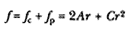
Substituting (1 + z2 ) for f (as defined) and (B 2 – A2 ) for C (where B is arbitrary and A is given), and solving for z (defined as (r-1 ) dr / dq ), the following relationship results:

Solving for the differential angle d q and integrating, one obtains the following relationship:

where e is a constant of integration. If that equation is solved for r -1 , then the polar equation of the general conic is given as follows:

Thus, as Newton argued in the statement he added to Proposition 13 in the revised Principia , the path is uniquely determined given the initial position and the curvature from the force and velocity.
Conclusion
Newton's contribution to dynamics must be measured not in terms of its correspondence with modern standards or modern methods, but rather in terms of the innovative and ingenious insights revealed in his initial
analysis. As early as 1665, and certainly before 1669, Newton had laid the foundations for his mature mathematical and dynamical analysis. Both the polygonal approximation and the parabolic approximation appeared in his pre-1669 analysis of uniform circular motion, and they were carried forward into his analysis of noncircular motion after 1679 following his demonstration of Kepler's area law. The circular approximation used in the alternate solutions of the 1713 Principia was based upon his work in 1664 on curvature. The solution to the direct Kepler problem, which is the hallmark of the 1687 Principia , had its roots in his statement of 1664.
If the body b moved in an Ellipsis then its force in each point (if its motion in that point bee given ) may bee found by a tangent circle of Equall crookednesse with that point of the Ellipsis .[25]
That statement reached its fruition in the curvature orbital measure of force 1 /(r2r sin3 (a )), which has been demonstrated to be an alternate form of Newton's linear dynamics ratio of the 1687 Principia , his circular dynamics ratio of the 1713 Principia , and the modern polar orbital equation. If any single measure deserves the title of the key to Newton's dynamics, it is the curvature measure. To appreciate Newton's work on dynamics fully is to appreciate how it began in 1664 in the Waste Book , how it matured in the Principia , and how it relates to contemporary expressions of dynamics.