
Chapter Three
The Landscape of Premodern Performance
The community life of late medieval North India was enlivened by a number of performance traditions of a mainly local and oral character. Many of these arts, including those of a theatrical nature, went into eclipse during the period of cultural redefinition and reform that occurred in the late nineteenth and early twentieth centuries.[1] More recently, shifts in historical method together with cultural and political processes at work in India have stimulated a reassessment of the pre-modern cultural landscape and sparked an effort to restore it to Indian social history. This chapter contributes to that process by examining significant traditions of theatre and performance predating the emergence of Nautanki in the late nineteenth century. My endeavor is to describe a "community of forms," to adopt Raymond Williams's phrase, a historically specific set of practices located in an evolving social environment.[2] In the process I hope to refurbish some dim corners of North Indian culture and challenge some earlier preconceptions.
Before the twentieth century, the theatre now identified as Nautanki was known as Svang. This term is still used to refer to the art of mimicry and impersonation in general as well as to specific skits. The word svang and its variant sang are related to sangit , a term employed from the midnineteenth century onward as a generic marker for the libretto or musically rendered dramatic script. "Nautanki," originally the name of a heroine and the musical stage play based on her story, came into wide parlance replacing the term Svang around 1920. "Svang" is even now
the label applied to the Nautanki form by its practitioners in the Hathras-Braj region, and it is a widely understood synonym for Nautanki among scholars of Indian theatre.
A recognizable Svang folk theatre appears in the midnineteenth-century Sangit texts, lodged in the India Office and British Library collections. Early dramas like Prahlad sangit (fig. 4) and Gopichand raja ka sang (fig. 5) contain the thematic and metrical seeds that later flowered into the full bloom of the Hathras and Kanpur styles of Nautanki. Scholars in India have shown some reluctance to push the theatre's historical narrative further back. The predominant opinion is that drama was sadly missing for the many centuries between the decline of Sanskrit drama around A.D. 1000 and the appearance of nineteenth-century urban drama. Shrikrishna Lal, for example, declares that there was an "absence of Hindi dramas" before those of Bharatendu Harishchandra, the "father" of modern Hindi drama.[3] Following Somnath Gupta and influential earlier critics Shyam Sundar Das and Ramchandra Shukla, he posits reasons for this assumed absence, ranging from Muslim rulers' theological disapproval of dramatic representation to the overwhelming popularity of bhakti poetry. To the extent that Lal and other authors acknowledge folk theatre, they identify it with the Lila spectacles of religious pageantry. Accordingly, when Svang emerges as a secular folk theatre, they attribute to it the same religious roots as the Lilas, namely medieval devotionalism.
Collating information from a variety of colonial, literary, and ethnographic sources, I propose to demonstrate that the Svang stage constituted an incremental development in a preexisting arena of public entertainments, influenced both by evolving folk traditions and by court-based and urban performance styles. In the first part of this chapter, I look specifically at the twin theses of indebtedness to the Lila traditions and the "absence" of performed dramas before 1850. I then consider several folk streams that enriched the early Svang, including the Khyal folk stage of Rajasthan, an agonistic verbal art called Turra-Kalagi, and the narrative corpus of minstrel mendicants of the Nath sect. In the second section, I examine the contributions of Indo-Islamic court culture, which entered the popular milieu through the intermediary of Urdu drama. Finally I turn to the urban Parsi theatre, a pan-Indian commercial network, to trace its role in the evolution of the performance practice called Nautanki.
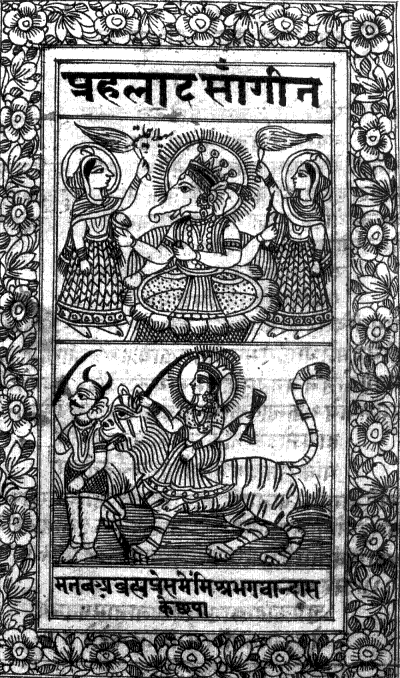
Fig. 4.
Title page of Prahlad sangit by Lakshman Singh (Delhi, 1866). By
permission of the British Library.
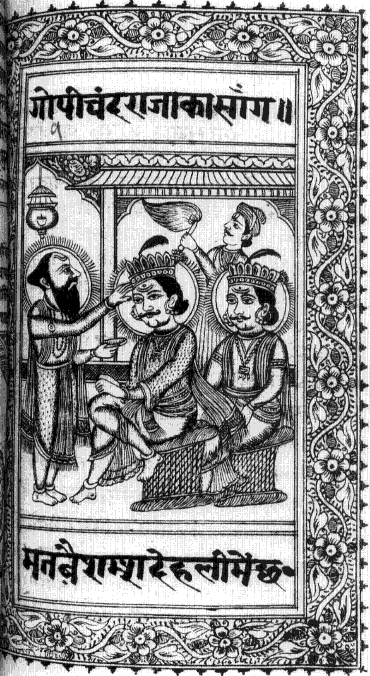
Fig. 5.
Title page of Gopichand raja ka sang by Lakshman Singh (Delhi,
1877). By permission of the British Library.
Devotional Drama in Hindi
Two folk traditions of religious drama, the Ram Lila and Ras Lila, developed in North India some time before the secular Svang. Dedicated to the sectarian deities Ram and Krishna, the Lila theatres likely originated with impersonations of the gods at annual festivals. Their current forms date from the bhakti period of Hindi literature, when vernacular devotional poetry found a home in the hearts of the Hindu population. The Lila dramas wed episodic enactment of the lives of Ram and Krishna with the singing, dancing, and recitation of poems from this newly flowered literature.
The Ram Lila is based upon Tulsidas's narrative of Ram's adventures, the Ramcharitmanas , a long poem composed in the Awadhi dialect.[4] Chanted passages from Tulsidas's text intersperse with song, drama, and pageantry to explicate the story. This form of the Ram Lila began soon after Tulsidas's death in 1624 and, according to legend, was first enacted by his disciple Megha Bhagat. In the nineteenth century the royal house of Banaras undertook sponsorship of the Ram Lila at Ramnagar on a massive scale, employing large numbers of actors and specific locations in the city to represent the story's geographical settings. This grand Lila is performed over a period of days, culminating in the festival of Dashahara, when Ram finally defeats the forces of evil. It is attended by hundreds of thousands of spectators who follow the procession as an itinerant audience of worshipers.
Whereas the most famous Ram Lila is linked with the geography and people of Banaras, the Ras Lila's homeland is Vrindavan and the Braj area, where pilgrims come to worship Krishna, born among its simple village people.[5] Temple courtyards and pavilions form stages for dozens of Ras Lila shows held every year at Krishna's birthday. The performances are bipartite, comprising circle dances (ras ) by boys playing female devotees (gopis ) and dramatic episodes (lilas ) from Krishna's life. As foci of religious emotion and musical embellishment, the verses of poets like Surdas and Nanddas, written in the Braj dialect, punctuate these incidents. The Ras Lila may have achieved this form as early as the sixteenth century.
Alongside these celebrated Lilas, scores of less elaborate representations of the Ram and Krishna stories are performed by wandering drama companies and residents of city neighborhoods. The artists who play in these rustic shows are not dogmatic about the difference between devotion and entertainment, and the deity's story is intermixed with much
singing, dancing, and comic improvisation.[6] These folk Lilas provide an important avenue of access to devotional Hinduism for people all over northern India.
The Lila theatres, particularly in their village and neighborhood forms, established a practice of popular drama that in a general sense created a foundation for the later Svang and Nautanki Common conventions such as open-air performance, use of music and dance, and mythological story material link these theatres, but a more explicit genetic relationship at the regional level is difficult to verify.[7] Indeed, a set of contrasts distinguishes the theatre of devotion from its secular counterpart. On the one hand, the Lila plays are meant to inspire reverence and love for God, and they often produce audience emotion approaching rapture; the actors, prepubescent Brahmin boys, are worshiped as divine incarnations (svarup ). On the other hand, Svang and Nautanki shows evoke merriment, lust, wonder, even fear; their performers are considered outcastes and prostitutes. The Lilas function within a religious matrix presided over by priests, patrons, and high-status interpreters. Nautanki relies on its commercial appeal, offering diversion in exchange for a price. The language of the Lilas is elevated and literary, whereas Nautanki is composed in the spoken tongue, accessible to all.[8]
The Lila traditions may therefore be considered precursors of Svang to the extent that they created a receptive climate for dramatic performance, accustoming viewers to theatrical representation. Since theatre was well established in India in ancient times but appeared to lapse when the use of Sanskrit for literary composition declined, we may more aptly state that the Lila theatres perpetuated the folk stage in an era of transition. Under the guise of devotional religion, the Lilas kept the traditions of folk theatre performance alive, until altered circumstances in the eighteenth and nineteenth centuries gave rise to a new secular drama.
Early References to Svang
Popular entertainments of a nondevotional sort were not absent in the fifteenth through the eighteenth centuries. References to a variety of public diversions abound in the literature of the period. The sayings attributed to Kabir, who probably lived in the second half of the fifteenth century, contain many allusions (mostly derogatory) to dramatic entertainments termed tamasha (show), svang (skit, mime), and khel (play, game).[9] In the Acin-e-akbari Abul Fazl describes a group of per-
formers termed bhagatiya who dress in disguise, sing, and "exhibit extraordinary mimicry."[10] In Maulana Ganimat's masnavi Naurang-e-ishq (1685), an extended description occurs of a group of bhagatbaz artists who play instruments and perform impersonations.[11] Other sources suggest that mimics, actors, and acrobats (bhands, naqals, nats , and others) informally circulated throughout the region.[12]
Controversial evidence also exists in the form of about three dozen texts composed between the early seventeenth and midnineteenth centuries in Braj Bhasha. Several of these are original compositions on epic and religious themes, but most are translations from Sanskrit.[13] Most texts style themselves nataka , the Sanskrit dramaturgical term for "serious drama." Nonetheless, much disagreement exists over whether the texts should be viewed as poems or as dramas. Bharatendu Harishchandra, Ramchandra Shukla, Shyam Sundar Das, and Somnath Gupta consider them poetic compositions, citing the lack of divisions into acts and scenes, conventions for stage entrances and exits, and prose dialogues. Gopinath Tivari, breaking with received wisdom, holds that the texts were modeled on folk drama styles and were actually performed.[14] He cites internal evidence from the texts, such as mention of the curtain and backstage area, references to the stage director (sutradhar or kavi ), instructions regarding dance and physical movement, mention of vocal projection, and details regarding historical occasions of performance. Tivari's argument seems quite convincing, but it would be impossible to verify without study of his manuscript sources.
According to Tivari, the word svang first appears in Hindi dramatic literature in these plays.[15] Possibly the first text to term itself svang is the Braj Bhasha Hasyarnava written between 1686 and 1689 by Rasarup.[16] An eighteenth-century example is the Madhava vinoda by Somnath Chaturvedi (1752).[17] The word svang occurs in two lines in the play.[18] Other references to svang occur in the many versions of Prabodha chandrodaya .[19] The Braj Bhasha dramas differ from nineteenth-century folk Svangs in several ways: their language is literary Braj, the meters are doha, chaupai , and savaiya , and the performances most likely occurred in court, not on a public stage. The word svang thus apparently refers to dramatic art in general; later it came to signify a specific genre of folk theatre. Nonetheless, these early plays point to the presence of secular dramatic poetry that nats and other professionals probably performed well before the nineteenth century.
Khyal Theatre of Rajasthan
The same group of Braj Bhasha dramas also contain the word khyal referring to drama. The word khyal is polysemous within the context of the performance arts of North India. At least three discrete fields are now designated by the term: the classical Hindustani vocal genre, in vogue since the seventeenth century;[20] the folk theatre of Rajasthan and its texts, written in Marwari and other dialects; and the Hindustani folk poetry composed extempore and sung in the genre lavani . At an earlier time, these fields perhaps overlapped: the khyal poetic style possibly became associated with a type of singing that in turn influenced the classical musical form (or vice versa); the folk theatres may have adopted khyal poetry, or the poetry may have come to be dramatically performed. The issue is complicated by the several etymologies available for the word. Derived from Arabic Khayal
Leaving aside the Khyal form of classical music, let us look further at the Khyal theatre and khyal folk poetry. Somnath Chaturvedi in Madhava vinoda was perhaps the first to use the term khyal in reference to his play.[22] Another early use of the term is in Dhonkal Mishra's Prabodha chandrodaya , dated 1799.[23] The term khyal thus appears to have been in circulation in the eighteenth century among poet-playwrights writing in Braj Bhasha. This usage connects these plays to a larger group of dramatic texts called khyal , performed by folk troupes in Rajasthan and elsewhere in the late eighteenth and nineteenth centuries.
The earliest description of this Khyal folk theatre was published by John Robson in 1866.
In the principal cities and towns of that country, during the weeks following the Holi crowds assemble night after night around elevated spots of ground or chabutras , which supply a ready-made stage, and on which rude attempts at scenery are erected, and the players continue acting and singing accompanied by an orchestra of tom toms, on till late at night, or early in the morning, and for weeks and months afterwards, the favourite refrains and passages may be heard sung in the streets and markets.[24]
Robson reproduces five short plays in the Devanagari script with information on their history and performance.[25] He collected the manuscripts from actors' handwritten scripts, supplemented by transcrip-
tions from commissioned recitation. Citing the local view that the khyals are "not ... literature at all," he asserts, "Yet there can be no doubt that, for good or for evil, they do constitute a literature, the most popular in Rajputana at the present day." Further, "[these khyals ] show us an indigenous drama, in the course of formation, rude and imperfect, but original and containing all the elements of growth."[26]
Perceptively linking this drama with the martial and romantic ballads of Rajputana, Robson refers to an anecdote regarding its origin.
The brave and accomplished, but unfortunate, Ram Singh, King of Jodhpur for a short time in the middle of the last century, had a great fancy for hearing the recitals of the bards and other poets at his court. Among them was a Pokurn Brahman, called Jasu Lal, who was especially distinguished for the spirit of his compositions. One day, when reciting one of his pieces, he dressed in the character which he described and accompanied his declamation with appropriate action. This pleased the prince greatly, and he desired that it should be repeated. On the next occasion Jasu appeared in one character and a companion of his in another; and between them they recited and acted a dialogue. To listen to this became a favorite amusement with Ram Singh, though not with his nobles, who often found themselves the butt of Jasu's pleasantry and of the King's laughter; and, if we may believe tradition, this had not a little to do in estranging them and causing them to transfer their allegiance to Bhakta.[27]
This passage implies that the Khyal began in Rajasthan around 1750, and another reference to "hundreds" of khyals that had been previously composed suggests a tradition with substantial development behind it by the middle of the nineteenth century.[28] According to Robson, the "ballad parentage" remains visible in the style of dialogue and singing. Most of the singing was done by one individual or by a pair who alternated stanzas.[29] This structure is congruent with the question-answer format of the Turra-Kalagi tradition prevalent at the same time.
Robson's collection contains the first record of a folk theatre based in rural Rajasthan dating to the mideighteenth century. Other authors confirm these suppositions about the age of Khyal.[30] Soon after Robson's handpenned manuscript was published in 1866, Khyal librettos started being printed by local Indian presses. Numerous Khyals in Devanagari type dating from the 1870s are contained in the British Library and India Office Library.[31] These documents illustrate the further development of the Khyal theatre. Published from Bombay, Poona, Delhi, Banaras, and especially Calcutta, the Khyal texts appear to have followed movements of theatrical personnel across western and northern India.[32] The titles, however, indicate Rajasthani origins for most of the plays, being primarily based on local romances (Dhola maru, Panna
biramde , and Sadabrachh salangya ) as well as martial (i.e., Rajput) stories (Rana ratan simh, Dungar simh ). Some titles are synonymous with nineteenth-century Svang themes: Gopichand bharatari, Benazir badr-e-munir, Puranmal , and Harishchandra .
The Khyal tradition of folk theatre continues to the present. Now a regional form distinguished by the use of Marwari and other Rajasthani dialects, particular meters, distinctive costuming, and specific story material, it possesses several subvarieties. Nanulal Rana of Chidava (1858-1900), the most prolific playwright in the British library collections, originated the Shekhawati style. His contemporaries in the same school in eastern Rajasthan included Prahlad Ray Purohit, Ujiram Teli, Jhaliram Nirmal, and Bhan Kavi. Lachhiram of Kuchaman (1867-1937) established the Kuchaman style based near Jodhpur.[33] One of the most knowledgeable researchers of Khyal reports that two hundred printed dramas have come to light, and the oldest is purported to go back three hundred or four hundred years.[34]Khyals performed in the area neighboring the Braj region share certain characteristics of Svang and Nautanki: playing of the nagara drum and meters such. as chaubola, bahr-e-tavil , and lavani .[35]
Some scholars suggest that the Agra-Bharatpur region, on the border between Uttar Pradesh and Rajasthan, was the original home of Khyal theatre, and that Khyal spread throughout the north in the late eighteenth and nineteenth centuries, undergoing linguistic changes in the respective regions it entered.[36] According to this diffusionist hypothesis, as the commercial structure of the folk theatres developed and the cultural and linguistic identity of each region solidified, the separate character of the theatres evolved to the point where the Khyal of Rajasthan, the Nautanki of Uttar Pradesh, the Sang of Haryana, and the Mach of Madhya Pradesh are now considered discrete genres. This argument requires modification, however, when we incorporate the evidence of the poetic tradition, also called khyal , which came to inhabit the same territory in roughly the same period. Although the Khyal theatre based in Rajasthan set the stage for the emergence of Svang to the east, traditions from the south had been at work too, strengthening the foundations of folk expression.
Lavani Poetry and the Turra-Kalagi Akharas
While the Khyal theatre grew out of bardic recitations, the poetic tradition of khyal developed from philosophical exchanges between heterodox religious sects. The ancient practices of public debate of scrip-
ture (shastrarth ), extemporaneous poetic composition (samasyapurti ), and musical dialogue (saval-javab ) are all visible in the unique Turra-Kalagi tradition. In it, two opposing groups direct questions and answers to each other, using the song type lavani or khyal , accompanied by the drums dholak and chang . The Turra is commonly described as advocating the Shaivite position and the Kalagi as arguing for the supremacy of Shakti. Each group is organized as an akhara , wears a distinctive color, and exhibits its ensign on its drum in the form of a crest (kalagi and turra both refer to the crest or plume affixed to a turban). The competition or contest between the parties is known as dangal .[37]
Turra-Kalagi apparently originated in Maharashtra and became a prominent form of popular poetry in the eighteenth and nineteenth centuries. Various theories have been espoused concerning its origins;[38] accounts indicate that a range of religious topics may have informed the poetry of this genre. The dispute turned on dualities not limited to Shiva versus Shakti; it would typically oppose purush and prakriti, brahm and maya , or nirgun and sagun .[39] Debates that began as metaphysical exchange would often end in verbal abuse and even physical violence. The dialogue form of religious discourse occurred even earlier in a type of Marathi folk poetry known as gondhal . This too is a recitational tradition using two opposing sides, performed originally to propitiate the goddess Amba and to enact Puranic incidents and heroic ballads.[40] Both the gondhal and the Turra-Kalagi traditions fed into the Tamasha folk theatre of Maharashtra, which reached its height in the late eighteenth and early nineteenth centuries. In Tamasha performances, a serious philosophical discussion between Shiva and Parvati generally occurs using question-answer lavani singing, following the erotic female dance known as gaulan . Showing the clear influence of Turra-Kalagi, this section is known as jhagra (fight) or saval-javab (question-answer).[41] Performers of Tamasha identify themselves by their allegiance to the Turra or Kalagi parties.
In Bengal a similar performance practice known as Kabi or Kavi flourished. "The Kavi is sung between two parties, and there are wit-combats between the two parties relating to Sakti, Siva, Krishna and other mythical topics. One party sings after the conclusion of the other."[42] Here too the Kabiwalas had connections with the theatrical traditions of Jatra, and by the midnineteenth century they had established a substantial following among the affluent in urban Calcutta as well as in the hinterland. The Calcutta Review of 1851 noted the tendency toward obscenity: "The animus of the Kavis is rivalry. Two bands under differ-
ent leaders are with each other in winning the applause of the audience. ... They indulge in the songs of the most wanton licentiousness and to crown the whole [sic ] with calling each other bad names."[43]
It is assumed that the Turra-Kalagi troupes and their lavanis traveled northward from Maharashtra, possibly when entertainers followed the camps of the Maratha army in the eighteenth century. Turra-Kalagi was taken up in Madhya Pradesh, where it is still practiced as a folk song form.[44] The institution eventually reached northern India. In Saharanpur in Uttar Pradesh, Turra-Kalagi troupes and their competitions were described by Chaube in 1910.[45] At some time between 1750 and 1850, Turra-Kalagi further developed its dramatic potential and moved its performances to a raised stage, with costumes, incidental singing and dancing, and new story material. In Madhya Pradesh this folk stage was known as Mach or Manch (from Hindi manch , "stage").[46]
In Rajasthan Turra-Kalagi became associated with the Khyal folk theatre, where it led to a separate style called Turra-Kalagi Khyal centered in Chitor and Ghosunda. Its performances focused on story material found in the oral traditions of the region, and the organization of performers into rival akharas under the Turra and Kalagi symbols and the dangal competition continued. When one group presented its latest play, its opponent attempted to obstruct the performance and then started up its own drama on the same theme as soon as the first group had finished.[47]
As the Svang folk theatre evolved, it absorbed the social organization and competitive character of Turra-Kalagi.[48] In Sangit texts, the poet's affiliation with a Turra or Kalagi akhara is referred to in invocatory or colophon verses. Thus, "We bear the guise of the Turra faction"; "Nattha the Brahmin and Madan enter the arena with the crest on their drum (chang )"; "Maharaj says, Raghuna leads the party in the dangal. / Flaunting the crest on the drum, he deals blows to the pride of the enemy."[49] The boasting typical of the Turra-Kalagi style is also evident here: "No one has achieved victory over those who wear the turra "; "The enemy's claims turn to water, / The drums are played forcefully, / Chhitarmal's clamor reigns supreme—in the dangal .[50] The poets often sought supernatural protection to survive the poetic combat. The famous Hathras poet Indarman invokes the goddess Bhavani thus: "Come sit in my throat, goddess, and sing 3,600 ragas ... / Protect the honor of your servant. / Drink the blood of the wicked. / Be gracious to me now, / Uphold my respect today in the assembly."[51]
The term khyal was used by Hathras poet-playwrights of the late
nineteenth century as a synonym for sangit, svang , and sang .[52] The signature doha that came to adorn the covers of Chiranjilal's and Natharam's Sangits reads, "Gentlemen seeking the authentic khyals of Indarman should buy and read those with the name of Chiranjilal."[53] Similarly, another akhara's poet says at the end of his play: "This khyal was sung by Vaidya Chiranjilal. In seven days he composed this svang ."[54] These uses of khyal indicate the assimilation of the Turra-Kalagi conventions to the Svang theatre, and they show how khyal poetry had by now merged with a relatively undifferentiated theatre known by the same name, Khyal.
Another legacy of the Turra-Kalagi tradition was the mode of dramatic discourse found in all the related forms—Svang, Sang, Bhagat, Khyal, and Mach. Typically only two actors appear on the stage at once, and they engage in sung dialogue in question-and-answer form.[55] The influence of Turra-Kalagi is also apparent in the growing popularity of lavani poetry. As a result of the dispersal of Marathi folk artists throughout the subcontinent, poets of Gujarati, Rajasthani, Hindi, and even Tamil came under their influence and adopted the lavani form. Though in Marathi the lavani 's character was predominantly erotic and lyrical, it was adapted in these languages to new uses. The use of the lavani for nondramatic Hindi poetry had become well established by the second half of the nineteenth century.[56] The cover illustration of one of the popular lavani chapbooks is shown in figure 6. Such collections contained verses by Hindu and Muslim poets on devotional Krishnaite themes and on Indo-Islamic topics, for example, the love between ashiq and mashuq (lover and beloved).[57] The activities of khyal and lavani poets in nineteenth-century Lucknow are also described by Sharar.[58] Bharatendu Harishchandra, the father of modem Hindi drama, was very fond of this form and would sit on the pavement with lavani singers to learn their compositions; his own lavanis were published as well.[59] This folk style of poetic composition is still extant.[60]
It is clear then that during the nineteenth century the popular stream of lavani poetry was incorporated into several North Indian theatres: Khyal in Rajasthan, Mach in Madhya Pradesh, and Svang in Uttar Pradesh. Many varieties of lavani meters appear in Sangit texts beginning in the 1890s. The rich lavani tradition fertilized the developing Svang, particularly as it established itself around Hathras in the late nineteenth century. Lavani continues to be an important category of verse composition in twentieth-century Nautankis.
The discussion so far shows that a secular folk theatre existed across
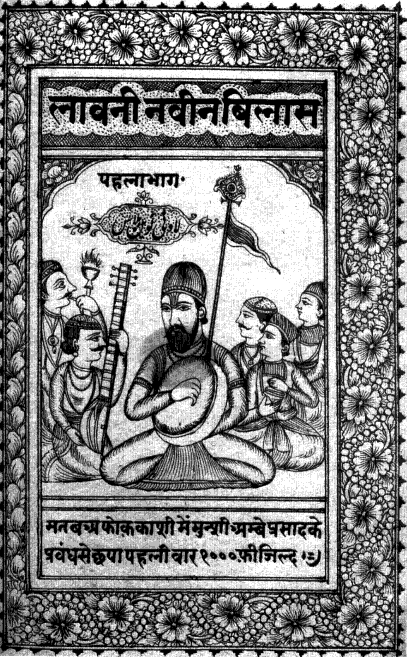
Fig. 6.
Title page of Lavani navin bilas by Nanhu Lal (Banaras, ca. 1873). The
group leader plays a large tambourine (daf ) and holds the akhara 's banner. He
is accompanied by musicians playing the sitar and cymbals while an enthusiast
smokes a pipe (chilam ). By permission of the British Library.
a broad sweep of territory in North India from at least the mideighteenth century on. Known under various names (Khyal, Mach, Svang, Sang), this folk stage was related (and perhaps directly indebted) to a tradition of spontaneous poetic composition, initially disseminated by followers of non-Brahmanical religious cults. While the poetry of the Turra and Kalagi parties became more overtly dramatic, the emerging stage preserved the aesthetics of competition, improvisation, and partisanship typical of secular performance art, in contrast to the devotional drama that canonized the words of medieval saint-poets and inculcated surrender to religious emotion. We turn now to other sources of the early Svang, which confirm the notion that the religious roots of Svang and Nautanki, such as they were, lay not in devotionalism but in the iconoclastic teachings of Yoga, Tantra, and Shaktism.
Nath Yogis and Narrative Folklore
Along with the bards of Rajasthan and the Shaiva and Shakta lavani singers, another unusual population contributed to the early Svang theatre. The ascetics known as sadhus , especially the followers of Guru Gorakhnath in the Punjab, originated several frequently told Svang tales, principally Gopichand (see fig. 5) and Puranmal (fig. 7). In contrast to the Lilas focusing on divine heroes incarnate in flesh and blood, the Nath yogis stressed faith in ascetic renunciation, magical beliefs, and Tantric mysticism. The Nath yogis (naths, yogis , or jogis ) are followers of saint Gorakhnath. Because of the initiatory rite of inserting a heavy earring (mudra ) into the pierced cartilage of each ear, they are known as kanphata (having split ears). Tales such as Gopichand's embody their beliefs: emphasis on conquering death and achieving immortality of the physical body, and rejection of sensual pleasure, especially congress with women.[61] They worship Gorakhnath as one of the nine Naths (lords, masters) and reckon Gopichand as one of the eighty-four Siddhas (adepts).[62]
The Naths were largely responsible for spreading Tantric beliefs and terminology among the masses of northern and central India, through their popular sayings or Gorakh bani . Yogis of the Nath sect established a formidable reputation among the villagers as curers, magicians, and masters of the occult. Most important for our purposes, they also functioned as singers, musicians, and popular entertainers. Through songs and stories such as that of Gopichand, they elaborated a redoubtable body of folklore to spread their sectarian message. Nath oral traditions
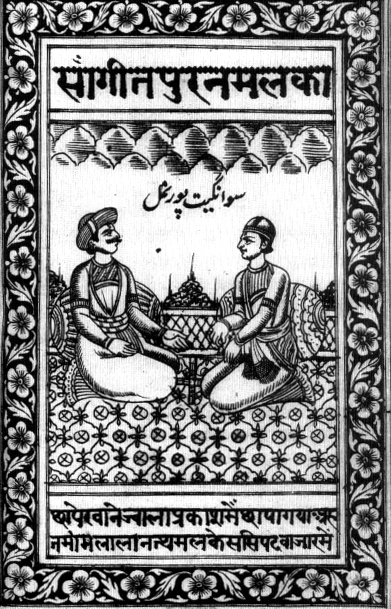
Fig. 7.
Title page of Sangit puranmal ka by Ramlal (Meerut, 1879). By per-
mission of the British Library.
are one of the main sources of the early Svang stories, and the yogis themselves may have been a primary conduit to the popular stage.
The Nath community had a substantial geographic reach. Its chief pilgrimage sites and monastic centers ranged from Hing Laj in Baluchistan, to Dhinodhar in Gujarat, Tilla in Punjab, and sites in Nepal, Bengal, and Bombay.[63] Nath yogis lived in settled caste units as well as in monasteries, and they also traveled in bands. Toward the end of the eighteenth century, these bands gained an unusual degree of political and economic clout in the absence of a strong central authority. Ascetic orders were heavily involved as mercenaries and traded, lent money, and owned property.[64] The proportion of religious mendicants in the population has been estimated by Bayly to be 5 percent around 1880 and significantly larger a century earlier. Briggs, reviewing census figures for the late nineteenth and early twentieth centuries, concludes, "simply, Kanphatas are very widely scattered and are exceedingly numerous."[65]
Not all Naths were bards, but the evidence from various caste groups suggests the sizable domain of their storytelling art. Briggs notes the involvement of many jogi groups in playing musical instruments, singing ballads, and preserving religious songs.[66] Raghunathji describes a Bombay beggar caste known as gopichandas engaged in the same activities.[67] In Banaras in the nineteenth century, Sherring mentions the bhartharis , "a sect of devotees who ... carry a musical instrument in their hands, on which they play, while they sing the exploits of Raja Bhart."[68] Recently, jogis in Meerut district, Uttar Pradesh, have been noted as singers of the oral epic of Guga , while in Rajasthan members of a Nath householder caste preserve the epic of Raja Gopichand.[69] Other authors document the important role played by jogis in the singing of ballads and transmission of folklore in North India.[70]
Although jogis have been professional raconteurs perhaps for centuries, there is no explicit evidence of their organization into dramatic troupes in the nineteenth century or earlier. The number of Svang stories of the period featuring the character of Guru Gorakhnath do indicate a substantial assimilation of Nath yogi lore, either through their direct involvement or through an intermediate agency. The measure of the Nath yogi contribution can be glimpsed in the first ethnographic account of the Svang stage, Richard Carnac Temple's Legends of the Panjab , which includes four complete Svang texts, three of them on Nath themes. Temple, a captain in the Bengal Staff Corps, collected an impressive body of folklore from the Punjab in the late 1870s and early
1880s. His three-volume work, published in 1884, contains the Svangs Raja Gopi Chand, Guru Gugga, Sila Dai , and Raja Nal , all composed by one Bansi Lal. He also includes metered texts of The Song of Puran Bhagat and The Marriage of Hir and Ranjha and a prose version of The Adventures of Raja Rasalu —all stories based on Nath lore.
Other nineteenth-century collectors like Abbott, Crooke, Steel, and Swynnerton attest to the popularity of Nath folklore and its particular association with the Punjab in their versions of Guga, Rasalu, Hir Ranjha , and Puran .[71] Further documentation of the staging of Gopichand and other Nath themes is provided by Pandit Hiranand Sastri, who describes performances in the Punjab on the "modern and mundane" heroes Gopichand and Puran.[72] The Gopichand story is called "the greatest favourite," and the manner of singing calls to mind the Turra-Kalagi tradition, with "two parties, each sitting on the tops of two different houses and there singing songs in turn by way of dialogue about midnight."[73] These colonial accounts go a long way toward filling the historical gap in our knowledge of Svang and Nautanki. They identify the recitational and performative practices that converged to enrich the early Svang stage and document the prevalence of a secular theatrical art in place in various locales by the midnineteenth century.
To recapitulate, this theatre did not spring suddenly from northern Indian soil: there was no dearth of indigenous theatrical entertainments—no critical "absence of dramas"—before the introduction of Western theatre under the British Raj. Nor was the Svang theatre an outgrowth of medieval devotionalism. On the contrary, secular antecedents of Svang carry its history well back into the eighteenth century and suggest an independent line of evolution. Chief among these was the flourishing folk stage of western Uttar Pradesh and Rajasthan termed Khyal, whose librettos predate the earliest known Sangit texts. The emerging Svang stage was also heir to the spontaneous poetry tradition of Turra-Kalagi and lavani , as well as to the narrative lore of the Naths, a prominent yogic order in northern India. These little-known performance arts all contributed to the formative stage of Svang.
Court Theatre and the Indarsabha
The folk antecedents for Svang were augmented by midnineteenth-century theatrical developments in the princely establishments of the ruling elite, as well as in the urban centers where British-bred bourgeois culture was forming. The court and city as cultural loci were not isolated
from the rural-based traditions already surveyed, but each lent to theatrical performance a unique set of conditions and conventions. It is only in examining each tradition separately that the panorama of pre-modern theatre comes to life, and the emergent and combinatory nature of Svang and Nautanki takes on comprehensible shape.
Theatre was a principal pursuit of a number of kings across northern India in the period from 1600 to 1850, and they patronized theatrical performances held in their palaces as well as in public to amuse and edify the populace. Passing reference has been made to Braj dramas such as Hasyarnava and Madhava vinoda commissioned by or performed in the presence of royalty; the legendary connection between the Rajput courts and the early Khyal theatre has also been noted. The exact relation of court performances to the local drama traditions and available vernacular texts is a topic requiring research beyond the scope of this book. It would be particularly useful to know more about performance styles and their affinities to the secular folk traditions. For the present, we scan the range of court-related theatre, culminating in the appearance of Urdu drama in association with the midnineteenth-century court of Lucknow.
A flourishing court theatre based upon the Vaishnava movement was patronized by the ruling dynasties of Mithila, Nepal, Bundelkhand, and Assam from the fifteenth to the nineteenth centuries.[74] About a hundred plays were written by thirty-five dramatists during these four centuries, inspired in the main by the devotional songs of Vidyapati and Chandidas and traceable ultimately to Jayadeva's Gita govinda , written at the end of the twelfth century. Suniti Kumar Chatterji describes these dramas as "elementary dialogues of two or more actors accompanied by songs," and they appeared first in Bengal and northern Bihar (Mithila), spreading thence to Assam, Orissa, and Nepal.[75] The themes came from the Sanskrit epics and Puranas but also included the folk epics of eastern India, such as Raja gopichandra .[76]
The Malla kings of Nepal were great patrons of drama from whose courts in Patan, Bhatgaon, and Kathmandu come many of the surviving play texts. Although the Mallas' native language was Newari, a Tibeto-Burman tongue, various Indo-Aryan languages spoken in the vicinity were widely understood. The plays contain a mixture of dialects: stage directions in Newari; prose conversations in Bengali, Maithili, Kosali, or Awadhi; and songs in Maithili and other dialects.[77] One of these plays, Harishchandra nrityam , was written in 1651 by Ramabhadra Sarman for performance. in the Indrayatra, a large festival held in the
streets and squares of Kathmandu. Cassiano Beligatti, a padre en route to Tibet, wrote an extensive account of Indrayatra performances he witnessed between 1725 and 1750. Although he mentioned no specific titles, his description corresponds to the features inferred from the Harishchandra nrityam and other manuscript sources.[78]
Another Kathmandu manuscript, Krishnacharitopakhyan natakam , dated 1835, was enacted during the Indrayatra for nine days, by a troupe of 238 Newari performers. It was put on at the British residency before a mixed audience of Nepali court officials, Indians, and Britishers. The familiar Krishna lila from the tenth book of the Bhagavat purana formed the story. This play is written in Khari Boli Hindi, and Shardadevi Vedalankar claims it to be the earliest extant manuscript of a performed drama written in the modern vernacular.[79]
In the Bundelkhand region of Madhya Pradesh, theatre prospered at the court of Gangadhar Rao (reigned 1835-1853), husband of Lakshmibai, Rani of Jhansi. A man of sophisticated taste, Gangadhar Rao was a patron of theatre and made stage appearances himself on occasion.[80]Shakuntala and Harishchandra were two of the dramas exhibited in his court; the names of female dancers and scene painters have been preserved from the period. The plays were full of instrumental music, singing, and dancing, with conversations spoken in prose. This theatre survived until the end of the nineteenth century, when the noted Hindi novelist Vrindavan Lal Varma viewed some of its plays.[81] We do not know whether any texts were preserved from the Jhansi court theatre.
The last of the Nawabs of Lucknow, Wajid Ali Shah (reigned 1847-1856), ranks among the preeminent royal patrons of the arts in nineteenth-century India. Seated on the throne at the time of the British takeover of Awadh, Wajid All has been alternately praised for his magnificent court with its aesthetic refinement and condemned for his moral decadence and inattention to administration.[82] Several important performance genres such as the Kathak style of dance and the light classical song form thumri received his early support, and a host of minor forms thrived too.[83] In the theatrical realm, the Nawab encouraged the Radha-Krishna themes found in other North Indian courts. Attracted to song and dance from childhood, he established a rahaskhana

skit, Radha kanhaiya ka qissa , first played in Huzur Bagh in 1843.[85] Upon ascending the throne, he adapted several Persian-style romances for the stage and sponsored performances of them in Qaisar Bagh.[86]
During the reign of Wajid Ali, a drama by Aga Hasan Amanat entitled Indarsabha was staged in Lucknow. This play has long been considered the first written in the Urdu language. Opinions differ regarding the circumstances of its debut. Ram Babu Saksena, Somnath Gupta, and Annemarie Schimmel assert that Amanat was a courtier of Wajid All, and that he was commissioned to write Indarsabha for a court performance. Saksena and Gupta also cite the oral tradition that the Nawab played the title role of Indra for the opening.[87] Masud Hasan Rizvi ("Adib"), however, attempts to disprove Amanat's association with Wajid Ali Shah, maintaining that Amanat was never present at court owing to paralysis of his vocal chords. He recounts Amanat's own story, namely that the play was written at the suggestion of friends as an exercise in poetic virtuosity. Adib postulates that the Indarsabha was intended for a popular stage and was premiered before the common citizens of Lucknow, although Amanat may have imitated the king's rahas performances.[88]
Another controversy concerns European influence on the Indarsabha . Given the absence of antecedents for theatre in the Indo-Islamic tradition, several Urdu literary historians have opined that the Indarsabha was based on Western opera, introduced into Lucknow's court by visiting European musicians.[89] John Pemble notes that European music was in general not popular at court, and he concludes that operatic influence "does seem far-fetched."[90] From another perspective, Hindi literary historians have linked the Indarsabha to the Indian folk traditions, claiming Amanat's play as a vital bridge between ancient Sanskrit dramatic works and more recent regional theatre.[91]
Regardless of whether it was ever produced in court, the Indarsabha set a new standard for popular drama in North India. The work fuses Hindu and Muslim elements of plot, meter, and language in a form more indicative of its Indian and Awadhi origins than anything European. The events take place in the court of the mythic Indra, king of the gods, who sits in state encircled by fairies. Sabz Pari (emerald fairy) has been smitten by love for Gulfam, an earthly prince. Through the intervention of Kala Dev (black genie), she smuggles Gulfam into Indra's heaven. Displeased at this infraction, Indra casts Gulfam into a well and clips the wings of Sabz Pari. The pari , however, is undaunted and, sing-
ing irresistible songs in the disguise of a jogin (female mendicant), eventually earns her lover's release. Indra grants his blessings to the couple, and the lovers are reunited.
Replete with pageantry, fantasy, and romance, the Indarsabha was a multimedia piece incorporating narrative, poetry, dance, and music within the visually opulent setting of Indra's heaven. King Indra, originally a Vedic deity, had by late medieval times become an emblem of the lordly human monarch, particularly in his hedonistic aspect. He was often depicted surrounded by a harem of beautiful dancing girls.[92] This Hindu icon, with its popular symbolic relevance to India's Muslim kings, is wedded in the Indarsabha to a story of Islamic origin. The paris and devs belong to the dastan storytelling tradition imported from Persia.[93] Specific motifs seem to be imitated from several Urdu romances, including Mir Hasan's Sihr-ul-bayan and the Gulzar-e-nasim .[94]
Whereas Gopichand was the favorite nineteenth-century drama of folk derivation, the Indarsabha achieved pride of place in the newly spawned Indo-Muslim theatre. It earned immediate fame and soon appeared on stages all over India. The manuscript became a runaway bestseller. The first edition was published in Kanpur in 1853 (fig. 8).[95] The publishing peak occurred in the 1870s; during that decade, thirty-three editions were published from major cities in Uttar Pradesh and Bihar, as well as Lahore, Bombay, Calcutta, and Madras. The title Indarsabha was stolen by several imitators, the most successful being Madarilal.[96] Many Urdu dramas on the theme of a fairy succumbing to love for a mortal were written, using the word sabha or majlis (referring to the "aerial assembly") in the title.[97] Bharatendu Harishchandra even wrote a one-act parody entitled Bandar sabha (The monkey assembly).[98] The reputation of the work spread to Europe; it was translated into German by Friedrich Rosen in 1892.[99]
The Indarsabha phenomenon dominated the theatrical world until the era of the talking cinema. Henceforth, aristocratic Islamic prototypes of costume, scenery, language, music, and story matter were widely emulated. The fact that Muslim rule in India virtually ended three years after the play appeared added to rather than detracted from its prestige, for the image of Indra with his delight-inducing assembly came to represent the precolonial past in all its splendor and carefreeness. The emerging Indian elite may have scorned this nostalgic attitude as reactionary, defeatist, and decadent, but for the less sophisticated audience of popular theatre, the Indo-Muslim monarchy signified power and
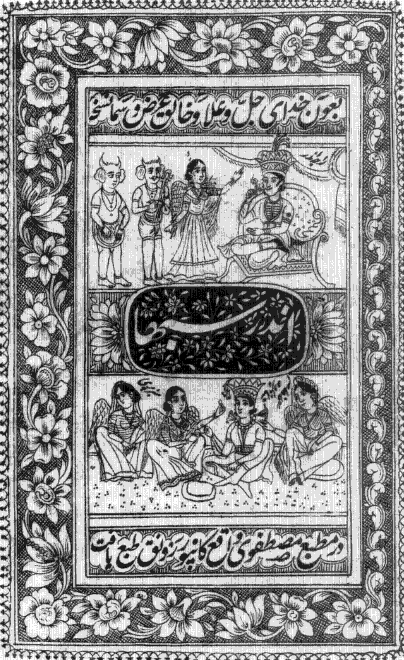
Fig. 8.
Title page of the first edition of Indarsabha by Amanat (Kanpur, 1853).
By permission of the British Library.
privilege. Feudal attachments remained strong, and they continued to dominate the popular culture of North India even as the first signs of a postfeudal reformist ethic in playwriting emerged.
After the Indarsabha , the Svang theatre became heavily imbued with Islamic flavor. Backdrop curtains painted with palace arches and pillars conjured up the courtly ambience, as did Nawabi styles of dress, head-wear, and ornaments. The aristocratic tone of the Indarsabha was imitated by adopting Urdu diction and modes of address. The folk vocatives betaji or pyareji (son, dear) used in early Sangit texts gave way to flourishes like lakht-e-jigar (piece of my liver, i.e., son or daughter) or jan-e-man (beloved of my heart). Stories based on Islamic materials, Syahposh, Benazir badr-e-munir, Laila majnun , and others, became more frequent Svang topics. These influences are clearly visible in the Hathras Sangit texts from the turn of the century.
The Indarsabha in this manner accelerated a process that transplanted court-based styles of music, dance, and poetry to a popular milieu. The perennial movements of exchange between refined and folk forms accelerated in the rapid breakdown of the patronage structure after the annexation of Awadh. Performers in search of employment must have turned to the rapidly growing theatrical sphere for survival. In consequence, styles such as Kathak, thumri , and ghazal were transplanted to the popular performance sphere, where they met less discriminating but not unenthusiastic patrons and audiences. By the same token, poetic meters and song forms moved from the court to the public milieu. The Indarsabha text contains the earliest instances of the chaubola meter, the six-line chhand that became the standard doha plus chaubola of Svang, as well as a variety of ghazal verses and many types of folk songs (basant, holi, dadra, savan , and bihag ). This metrical and musical diversity went hand in hand with the new style in stagecraft, and it stimulated the Svang poets in Hathras to incorporate a greater variety of verse types into their plays—a trend quite marked by 1900.
Urban Theatre and the Parsi Stage
With the proliferation of Urdu dramatic activity following the success of the Indarsabha , Indo-Muslim manners and messages—vestiges of feudal privilege—became embedded in the North Indian theatrical vocabulary. Yet the court as a social institution had collapsed, and the means of sustaining dramatic activity became concentrated instead in the economic networks for entertainment developing in the cities. Fore-
most among these was the so-called Parsi stage, a broadbased commercial theatre whose appeal and influence extended far beyond the ethnic group from which it took its name.[100] It developed around 1850 from Parsi-organized amateur groups in Bombay like the Elphinstone Club, which were active in presenting English and Indian drama classics.[101] Soon full-fledged professional companies were being floated by Parsi businessmen who were themselves theatre buffs. Many of the leading actors, also Parsis, held shares in these companies; several of them went on to form their own companies. Khurshedji Balliwala, the famous comic, founded the Victoria Theatrical Company in Delhi in 1877, while in the same year Khawasji Khatau, the "Irving of India," established the rival Alfred Theatrical Company.[102] Dozens of companies sprang up across the subcontinent, attaching the phrase "of Bombay" to their names to associate themselves with the prestigious urban theatre.[103] Muslims, Anglo-Indians, and a certain number of Hindus joined the companies, but the organizational reins remained largely in Parsi hands.
In a short time the demand for Parsi theatrical fare spread to all parts of India. The major companies routinely toured between Bombay, Lahore, Karachi, Peshawar, Delhi and the Gangetic plain, Calcutta, and Madras. Balliwala and his troupe ventured as far as Rangoon, Singapore, and London.[104] Parsi shows were the primary form of dramatic entertainment consistently available to urban audiences in greater India for almost a century. In consequence, the influence wrought by this stage on the development of modern drama and theatrical practice, and on the folk styles of performance, has been substantial. The Parsi stage exerted a major impact on the emerging Marathi and Gujarati theatres, as well as on new drama in Hindi, Bengali, Tamil, and other regional languages.[105]
Much of the initial inspiration for the Parsi stage came from British-sponsored dramatic efforts in their colony. English-style playhouses were erected in Bombay and Calcutta in the late eighteenth century, and the native elite was invited to attend English-produced performances from time to time and even to act in selected roles. Later the Parsi companies played in the same halls and took over the material culture of European theatre: the proscenium arch with its backdrop and curtains, Western furniture and other props, costumes, and a variety of mechanical devices for staging special effects. Artists from Europe were commissioned to paint the scenery, and the latest in "elaborate appliances" were regularly ordered from England, so as to achieve "the wonderful stage effects of storms, seas or rivers in commotion, castles, sieges, steamers,
aerial movements and the like."[106] The British example also influenced advertising and scheduling. Playbills boasting the latest Saturday evening performance were distributed throughout the city, and in the auditorium, spectators perused the "opera book" or program containing the lyrics of the latest songs.[107] This eager embrace of things European was characteristic of the Parsi process of assimilation to Western culture in the nineteenth century—a process in which the Parsis, aided by economic prosperity, a nonhierarchical social structure, and lack of religious taboos, were considerably ahead of their Hindu and Muslim compatriots.[108]
The early playwrights of the Parsi stage, K. N. Kavraji, E. J. Khori, and N. R. Ranina, were themselves Parsis. Gujarati being their mother tongue, it became the first language of the Parsi theatre.[109] By the 1870s the large companies had adopted the practice of hiring Muslim munshis (scribes) as part of their permanent staff, and Urdu became the principal language of the stage. Zarif and Raunaq were prolific authors who worked for the Original Theatrical Company of Bombay in the 1870s and 1880s.[110] The renowned companies of Delhi, the Victoria and the Alfred, engaged two Hindu authors, Vinayak Prasad ("Talib") and Narayan Prasad ("Betab") respectively, who continued the practice of writing in Urdu but also put into Hindi a certain number of plays (Harishchandra, Gopichand, Ramayana, Mahabharata ).[111] The most prominent author associated with the New Alfred Company was Aga Hashra Kashmiri, an Urdu playwright best known for his reworking of Shakespeare's tragedies; he later turned to composition in Hindi.[112] Radheyshyam Kathavachak was an important Hindi writer also employed by the New Alfred. He composed epic-based works such as Vir abhimanyu and Prahlad .[113] The Parsi stage was never a bastion of linguistic purity. Urdu and Hindi, the two literary forms of the North Indian lingua franca, were most accessible to the largest number in the audience and were therefore the most widely employed. However, productions in non-Hindi-speaking areas freely drew on other regional languages—Gujarati, Marathi, and Bengali—for comic skits, improvised interludes, and songs.
In important respects aside from language, the Parsi theatre revealed its distinctive Indian character: it employed Indian subject matter and included a great deal of music and dance. These characteristics were a natural legacy of the Indian dramatic tradition; the existing folk drama much influenced the Parsi theatre while it exerted a countereffect on indigenous theatre. The first Indian-produced dramatic performance in Bombay is said to have been a Hindustani version of Raja gopichandra ,
written and directed by Vishnudas Bhave in 1853. Composed in Hindustani mixed with Gujarati and Marathi, this production provided the impetus to Parsi groups to adopt songs, dances, and mythological subject matter in the style of the folk theatre.[114]
Hindu epic heroes and heroines—Harishchandra, Prahlad, Nala and Damayanti, Savitri, and Shakuntala—were extremely common on the Parsi stage. It is likely that the dramatists, rather than looking to Sanskrit literature for their inspiration, knew the versions of these stories current in popular culture and based their plays on them. At the same time, Urdu playwrights brought the stock Islamic romances to the fore: Shirin farhad, Laila majnun, Benazir badr-e-munir , and Gul bakavali were common titles here. Fairy-mortal romances, modeled on the Indarsabha , were also extremely popular. The Parsi theatre's sizable repertoire of mythological and legendary plays thus drew on the same stratum of North Indian popular culture as the nineteenth-century folk theatre and with equal alacrity embraced non-Indian subject matter side by side. Shakespeare provided a rich store of plots, and the prestige of the bard's name went unsurpassed on the Parsi stage. The Shakespearean stories were heavily Indianized, characters being reassigned names, castes, and communities, geographical settings transferred to Asia, and motivations and story lines adjusted to fit the Indo-Muslim environment.[115]
The music and dance of Parsi theatre, although difficult to document, appear to have been liberal in measure and hybrid in manner. The "orchestra" often consisted of harmonium and tabla , played by accompanists who, seated in the wings or pit, "also in many cases do duty as prompters."[116] The use of a chorus for the opening invocation is described by Yajnik in a colorful passage:
In the midst of the noise and bustle of the Urdu theatre, opened an hour before the performance, one hears three bells at short intervals and with the third bell a thundering gun shot is heard as the drop-curtain, gorgeously painted with mythological legends, goes up. The chorus girls sing a prayer or a "welcome" to the accompaniment of the harmonium and rhythmic drum beats. This song ends with an offering of flowers to the distinguished patrons and with garlanding the portraits of the pioneers of the respective company or of deities. Then the action commences.[117]
This ceremonial opening parallels the preliminary rituals of Sanskrit drama and traditional folk theatres. The Kanpur style of Nautanki inherited the practice of employing a chorus for the mangalacharan , as seen in Shrikrishna Khatri Pahalvan's plays.
The musical style has been variously described: "tuned to the tradi-
tional modes (Ragas)" and "in the chaste classical style," or as consisting of "slipshod Parsi and semi-European tunes."[118] Partial manuscripts of two plays, Jahangir shah aur gauhar of unknown authorship and Raunaq's Benazir badr-e-munir , contain the names of classical and semiclassical ragas such as Bhairavi, Sorath, Desh, Pilu, Kalingara, and Kalyan. at the headings of the thumris, ghazals , and other songs. An initial phrase occurs in quotes, the opening line from an already well-known song, as an indication of the tune to follow.[119] Actual practice may have considerably undermined this classical basis in favor of novelty and catchiness. Theatre tunes were easy to memorize and circulated freely in the bazaars in the period before sound films, filling the place now occupied by Hindi film songs.[120]
When women were admitted to the Parsi stage around 1880, an innovation commonly credited to Balliwala, they were recruited primarily from the ranks of professional singers and dancers. Their crowd-pleasing tactics were a big draw, and solo dancers "were rewarded by the audience with currency notes and coins amidst shouts of 'Encore.'"[121] The better-known actresses, Khurshed, Mehtab, and Mary Fenton, achieved their fame as least partly on the basis of genuine talent. Boy actors gifted with sweet voices, good looks, and physical graces were also employed by many professional companies to play the heroines' roles and perform dance items, and "boy companies" became a popular item in certain regions.[122]
Available scripts show that a typical scene in a Parsi stage play consisted of a variety of songs and verses (in forms such as thumri, ghazal, lavani, sher, musaddas, mukhammas, savaiya , or simply gana ) connected by prose dialogues. In early plays, dialogues were composed in rhymed metrical lines; actors spoke them with great emphasis to project the lines to the back of the hall. Later prose became predominant, although rhyme at the end of sentences remained. In such stylistic matters much mutual influence is visible between the North Indian folk theatre forms such as Svang and the Parsi theatre in this period.
Although the Indian elite saw in the Parsi theatre vulgarity, sensationalism, and lack of aesthetic standards, the humbler sections of society thrilled to the mystique of English company names like the Corinthian, the Victoria, and the New Alfred. The sumptuous fittings of the Parsi stage, replete with elaborate painted scenery, fine costumes, exotic Anglo-Indian actresses, and tricks of stagecraft augmented the allure. Such shows may have been commonplace in the numerous theatrical houses of the big cities, but in the provincial towns the spectacles
no doubt overawed the populace. No wonder then that the Bombay companies were eagerly sought as the purveyors of all that was current and stylish in theatre. They were widely emulated wherever they performed, particularly in the cities of Uttar Pradesh such as Banaras, Lucknow, and Kanpur, where they enjoyed an enthusiastic following.
The exchange between the urban Parsi theatre and the simpler, more rustic Svang and Nautanki operated in both directions. Stories, songs, and stage techniques moved back and forth at different times. Early on, the Parsi theatre drew from the themes and conventions of the folk theatre. A common core of stories is found in both theatres in the period from 1850 to 1900.[123] Once the Parsi theatre's popularity was established, this process reversed itself. An old story like Harishchandra , known first in folk legend, was adapted for the Parsi stage and gained a tremendous following in the nineteenth century. Its new prestige fed back into the folk theatre, where in the Nautanki of the early twentieth century a dozen versions of the story suddenly appeared.[124] Similarly, the Ramayana story and selected episodes from the Mahabharata , like Vir abhimanyu and Shravan kumar , were not originally part of the repertoire but became common Nautanki themes after Betab's and Radheyshyam's plays succeeded in the Parsi companies.
The Kanpur Nautanki of Shrikrishna Khatri exhibited this influence from the Parsi theatre. Many of Shrikrishna's plays contained a comic subplot and focused on contemporary social themes. Formal features such as the use of the chorus and the large proportion of prose showed movement away from the all-verse, individualistic Hathras style, as did its imitation of the Parsi vogue in curtains, painted scenery, costuming, music, and dance. In this way the Parsi theatre acted as a barometer of cultural change, showing the folk theatres new directions of proven popular appeal. After 1920 the Bombay cinema not only inherited the personnel, sensibility, and repertoire of the Parsi stage but took over the modeling role as well, supplying innovation to the Nautanki stage.
In reviewing the material presented here we see clearly that the world of North Indian theatre in the nineteenth century was crisscrossed by a number of intersecting performing practices. These practices, developed in the context of specific socioeconomic conditions and the cultural systems associated with them, may be distinguished as folk, courtly, and urban. Yet the mutual exchange and imitation that occurred among them obliterated clear lines of difference. From this swirl of transformed tradition, the Svang theatre distilled its own singular identity. The Khyal folk stage and the competitive arenas of improvised folk
poetry framed its formal parameters and agonistic ethos. Nath yogi lore as well as Rajput chivalric and romantic legends and popular Indo-Islamic tales supplied its narrative substratum. In its performance praxis, it incorporated the visual symbolism, stagecraft, and linguistic resonance of both the Urdu drama and Parsi stage. These multiple streams collided and competed and, as they did, Svang and Nautanki continued to absorb and blend them. In the next chapter we pursue the historical narrative through the subsequent phases of development, using as source material the large Sangit literature of the last hundred years.