
Chapter Two
New Festivals for Old
Reinvented Festivals
A great many academic and popular texts have been published in Japan over the past fifteen years on things "traditional," from regional cuisines to matsuri, or festivals. Several of these texts are cited in this chapter. In addition, the "Leisure Wide" column in the Asahi shinbun, as well as other leading dailies, provides a listing of current festivals under the heading matsuri. Television stations regularly cover local festivals and broadcast special reports on "traditional" pastimes. For urbanites wishing to enjoy their leisure in a matsuri frame of mind, the Furusato Information Center provides detailed information on regional festivals and "traditional" events accessible to domestic tourists.
The revival and invention of matsuri as authentically Japanese modes of group entertainment have, in turn, occasioned the traditionalization of the novel, such as kodomo mikoshi ("child" shrines).[1] "Traditional" (dentoteki ) imbues whatever it is used to signify with positive and edifying value and cultural authenticity regardless of the actual history, vintage, or derivation of the thing or concept in question. The "traditional culture" (dentoteki bunka ) boom, as it is referred to in the Japanese mass media, is further evident in the inauguration of wholly new matsuri, such as the Kodaira citizens' festival (shimin matsuri ). Like other city festivals, it is modeled after shrine matsuri, with the ostensible purpose of creating an "old village" ambience within the suburban bedroom
town. The Kodaira citizens' festival was inaugurated by and is conducted under the auspices of city hall and not a shrine, although local shrines lend the paraphernalia necessary to "authenticate" the event. The highlight of the festival is a parade of citizens new and old, who narrate literally and symbolically the historical development of Kodaira and its present social texture.
Citizens' festivals, generally speaking, are staged in cities throughout Japan as a conscious effort on the part of municipal governments to reclaim from inexorable urbanization the "old village" within the city. "Village" here is equated with the purported historical and affective core of a given city, evident today in metonymic terms: a thatched-roof farmhouse; a generations-old local product, such as a type of noodle or a handicraft; a stand of trees; an irrigation canal; matsuri; and so forth—all of which now evoke a past- and place-affirming nostalgia. Matsuri are perceived as a particularly cogent symbol of and condition for an "authentic" community.[2]
The Kodaira citizens' festival was inaugurated as an efficacious way for interested parties to occasion, maintain, and control the affective bases of social interaction, and not as the result of collective sentiments (cf. Smith 1975, 7). Moreover, as in the case of Kodaira City, this social interaction provokes and reinforces sectoral differences, which are cast in high relief in the citizens' festival parade. The parade is a social drama, which has "a habit of activating…'classificatory oppositions'" (Turner 1982, 11); it is a dynamic juxtaposition—a dialectic—of native and newcomer. Therefore, unlike Inoue and his associates (1979), I do not regard Shinto shrine festivals as an ideal-type norm to which city festivals do not (or cannot) measure up. Whereas the majority of studies in English on Japanese urban ceremonial are about microlocal events (e.g., Bestor 1985; Littleton 1986; Sadler 1972), this chapter deals with a citywide festival. An analysis of the Kodaira citizens' festival contributes to an understanding of the rationale for the incorporation of affect and "tradition" in city-planning strategies.
Reclaiming the "Old Village" in the City
Matsuri are generally defined in the ethnographic literature as Shinto shrine-centered festivals, planned and performed by a
given shrine's parishioner households (ujiko ). Shinto shrine events gyoji ) formed the affective core of farm village society through the postwar period, an arrangement amplified by the Meiji government. Villages and shrines were amalgamated at the turn of the century to form shrine-centered administrative villages, in a concerted effort to centralize government policy and foster national spiritual unity (Fridell 1973). Shrine festivals also formed the affective nexus of castle-town (joka-machi ) society during the Edo period. In fact, the prototypes of the consumer-oriented urban citizens' festivals of today may be traced to the matsuri staged in the newly created capital city of Edo, where the de facto power of the merchant class was demonstrated in a variety of festive spectacles, from fantastical processions of licensed courtesans and their pimps to the rambunctious parades of elaborate palanquin shrines (mikoshi ).
Although matsuri probably were originally performed quietly and at night (see Yanagita 1985, 41–52), Edo festivals were staged in the broad daylight in fairlike settings. A festival offered townspeople a chance to display and purchase new fashions and to consume great quantities of special dishes and alcoholic drinks. Today specialized matsuri garb itself is considered fashionable,[3] and the word matsuri figures prominently as a commercial signifier. The mass media provide countless examples of "used-book matsuri, " "furniture matsuri, " and "imported-wine matsuri, " among others. There are also "family sports matsuri, " and "hydrangea matsuri, " in addition to "citizens' matsuri. " Clearly, the word matsuri imbues used-book sales and sporting events with an extraordinary value previously associated with shrine ceremonies in particular. Moreover, matsuri, in a way reminiscent of the case with furusato, has been divorced from its primary referent and is now used in a connotative capacity.
What are the sociohistorical premises of the citizens' festival? In Kodaira, furusato-zukuri formally was initiated with the promulgation of the Kodaira citizens' charter (shimin kensho ) in 1972, on the occasion of the tenth anniversary of cityhood. The five-article charter, termed a "roadmap of civic life," begins with a preamble celebrating the pioneer spirit of the first settlers.
Three hundred years ago, the pioneers first put a spade to this then wasteland. We, the citizens of Kodaira, native and newcomer alike, have inherited their intrepid pioneering spirit. This charter was conceived to carry on, in that spirit, the making of Kodaira into a cheerful residential city.
1. Let's build a verdant city to which small birds will flock.
2. Let's build a city full of compassion and empathy toward the young and old alike.
3. Let's build a city characterized by punctuality and clockwork orderliness.
4. Let's build, smiling as we work, a city bursting with health.
5. Let's join together in enjoying civic life.
About the same time the charter was implemented, city hall began referring to the city as Furusato Kodaira, a name coined to imbue the suburban bedroom town with folkish familiarity.
In September 1975, three years after the charter was promulgated, the Council to Actualize the Citizens' Charter was organized by city hall to enforce the civic manifesto. The council consists of five "special sections," each named after the article of the charter it is responsible for bringing to fruition. The key activity overseen by the section in charge of the fifth article—the goals of which include the recovery of local history and the promotion of furusato-zukuri —is the annual citizens' festival.
According to city hall, the explicit purpose of the citizens' festival is to foster, among the city's diverse residents, camaraderie of the sort that presumably infused Shinto shrine festivals in the original seven villages. From the outset, the citizens' festival was ballyhooed as an occasion to "intertwine the hearts of 150,000 residents" and bring to experiential fullness Furusato Kodaira.
By the mid-1970s. Kodaira's administrators had decided that both concrete and symbolic actions were needed to unify the city's diverse population. Newcomers, who by 1976 constituted nearly 98 percent of the total population, allegedly lacked a sense of affinity with Kodaira, for only a little over 50 percent of newcomer households had definite plans to put down roots in the city. With the decline of big spending programs precipitated by the oil shocks, local self-sufficiency became a necessary pragmatic concern as well as an ideological position. A large permanent, and growing, population would ensure a tax base adequate to maintain and improve the standard of civic life in Kodaira City.
A sense of insideness among newcomers was also retarded by a simmering tension between them and the natives. In 1967 the tension finally erupted as a public issue that was widely reported in the city newspaper. The occasion was a round-table discussion that spring between four residents and newly elected Mayor Oshima, who retired in 1983. One newcomer, a sarariiman, broached the matter by pointing
out that there was bad blood between natives and newcomers, and he recommended that "citizens' forums" be inaugurated to enable both sides to communicate more constructively with each other (KSH, 20 May, 1 October 1967).
Oshima, perhaps in acknowledgment of the political influence of the native sector, emphasized that his first priority was to implement a comprehensive agricultural policy in order to balance urbanization with the preservation of farmland. He added that he already had asked various women's organizations to include in their social agendas activities to help smooth out relations between natives and newcomers. Apparently, the mayor believed that native-newcomer antinomy was expressed primarily between men and that women were more capable of negotiating differences among themselves. The fact that Oshima himself was not Kodaira born and raised may have increased his sensitivity toward the needs of the native sector.
As an example of the discord between the two sectors, the sarariiman brought to the mayor's attention the matter of fire drills. Although the fire brigade was short of hands, only natives were allowed to join; newcomers were excluded even from fire drills. Historically, households ostracized from village life were allowed to take part in fire-fighting and funeral services. In postwar Kodaira, however, the exclusion of newcomers from the fire brigade and from participation in fire drills suggests symbolically that they are not part of a community, since in a "real" community even ostracized households have access to fire prevention measures. The mayor countered by insisting that the newcomer had it all wrong; that natives, rather, were disappointed by the newcomers' lack of interest in these exercises. Many newcomers did want to participate, the sarariiman retorted, but they were not informed of when and where the drills would be held. Crucial information, in short, systematically had been withheld from newcomers by natives. Since then, fire drills have been conducted by the larger of the 380 neighborhood associations (jichikai ) in Kodaira.
As I bring up again in subsequent chapters, the native sector's sense of its nativeness was stimulated, initially at least, mainly by the reactions of the adversarial newcomer sector (cf. Kamishima 1978; Suttles 1972, 53–65). Newcomers were similarly defined. Since the initiation of furusato-zukuri in the mid-1970s, however, nativeness—and not newcomerness—has been legitimated by city hall as a highly desirable identity in its own right. The concept of furusato-zukuri was introduced
in part to foster, in newcomers especially, an emotional commitment to Kodaira, but city hall actually has exacerbated the antinomy between the two sectors. Even as city hall appropriates the native sector in its quest to locate the "old village" in the city, natives, on the other hand, feel constrained to reclaim, as a reparative strategy, the "really real" furusato within Furusato Kodaira. New publications lauding the achievements of Kodaira natives and their ancestors are widely distributed, and commemorative steles and signboards designating historical landmarks, including shrines and temples, help to magnify the natives' past in the present landscape. Once again, at the same time, these displays of nativeness are appropriated by city hall toward furusato-zukuri as examples of Kodaira's "living history."
In the Edo period, newcomers to Kodaira (that is, to one of the seven shinden villages) occupied a temporary status category that changed automatically to "old-timer" after certain communal services were rendered and several years of residence completed. Since the postwar period, "newcomer" has become a permanent status category. While newcomers eventually may come to feel "as if" they were natives, or express a local-place consciousness, nomenclature effectively has frozen the dichotomy. The 53 percent of newcomers who have expressed a desire to settle permanently in the city are called kodairakko, or "children of Kodaira," while natives are called tochikko, or "children of the soil." Placeness for newcomers resides in citizenship, but for natives it is grounded, like crops, in the land itself—or so these labels (in the local literature) presume to establish.
Natives not only have resented the "intruders" and the resultant urban sprawl—although they have been selling land to developers since the early 1920s—but have continued to exclude them from parish membership in Shinto shrines and Buddhist temples. The exclusion of newcomers was made clear to me in interviews with the head priests of the oldest religious institutions in Kodaira; it also was evident in their organizational structure. Unlike Kodaira's shrine festivals, which are limited essentially to native parishioners, the citizens' festival was conceived as an all-inclusive event staged on a citywide scale. The exclusive nature of local shrine festivals affected the public's initial reception of the citizens' festival: newcomers mistakenly thought that it too was a closed affair. Notices for the first several shimin matsuri therefore emphasized that the event was open to all residents regardless of seniority.
Scripting the Citizens' Festival
Prior to the actual staging of the citizens' festival, the city's thirty-two assemblypersons held a number of meetings to discuss the desirable form and content of the event. One Japanese Socialist Party (JSP) member took the initiative in raising both pragmatic and philosophical questions. First was the matter of sponsorship. Was the festival to be wholly subsidized by city hall, or should commercial and private funds be solicited? Next was the matter of its content. Should the festival encompass a hodgepodge of exhibits and activities? Should it epitomize a self-conscious localism? What sort of concept or vision of Kodaira was to be presented? What sort of place should the citizens' festival ideally occupy in the lives of Kodaira's residents? (KGR, September 1976, 137)
A native assemblyperson, who later served as speaker, replied that the citizens' festival would provide a means of fostering local patriotism. He remarked that the oil shocks several years earlier had sparked a positive revaluation of "traditional" (dentoteki ) lifestyles and seasonal events. Moreover, there was a pressing need to raise a new generation of residents who would feel an attachment to Kodaira. A citizens' festival, he felt, would serve as the basis for the generation of a "consciousness of interconnectedness" (rentai ishiki ). And for the benefit of bedridden elderly residents and members of Kodaira households living elsewhere in Japan, he, with the mayor's help, planned to negotiate with a television station to have the festival filmed and eventually broadcast.[4] Through the mass media, local patriotism could be nurtured and civic consciousness raised, and the city would become widely known (KGR, September 1976, 139–40). While the Kodaira citizens' festival has yet to be televised, videos are made of each one, and a rotating exhibition of festival pictures taken by local photographers is held each year.
The superintendent of schools added that the plan to inaugurate a citizens' festival was based on the interest expressed by certain (unnamed) groups over the past several years. A citizens' festival, he declared, would not be merely an entertainment but, in its capacity as a "public place for interpersonal exchange" (koryu no hiroba ), would effectively help to forge affective links between natives and newcomers (KGR, September 1976, 142-43). Koryu no hiroba is one of the many variations on a theme of ba, or public place. A more colloquial version
is the cliché fureai no hiroba.Fureai implies actual contact—touching, brushing—between people, whereas koryu is the more technical term for exchange or interchange. According to Nakane, a ba, or "frame," "sets a boundary and gives a common basis to a set of individuals who are located or involved in it" (1973, 1). Her definition, however, essentially is limited to the physical boundaries demarcating groups within (literally) concrete institutions, such as large companies and universities. As exemplified by the Kodaira citizens' festival, ba boundaries may also be fluid, temporary, and affective in nature.
The logistics of the first citizens' festival were almost casual in comparison to the hierarchy of bureaucratic tasks that characterized the ninth. The first three festivals were administered by the Culture Division of the Social Education Department. Then, in 1981, the Civic Life Department was created, and a committee under its jurisdiction, the Citizens' Festival Executive Committee, was established to emphasize the festival's importance as a civic event. The remaining conflict of interest between the league and the committee was resolved in 1982, when it was agreed that the chair of the Culture Division would serve concurrently as head of the executive committee.
Six years after the citizens' festival was inaugurated, several assemblypersons professed to remain unclear about its administration and purpose. One assemblyperson, a member of the Democratic Socialist Party (DSP), for example, was curious about the division of labor between the Culture Division and the executive committee, since he had just discovered that both were chaired by the same individual. He demanded an itemized account of how the nearly 4,000,000 yen budgeted for the eighth festival—four times the amount budgeted for the first festival—had been disbursed. Were funds for the portable toilets, telephones, electricity, and police patrol included in the budget? The DSP assemblyperson advocated an increased festival budget. His rationale was along "socialist" lines; that is, he adamantly opposed the recently proposed idea of turning the citizens' festival into a profit-making venture. It would not be fair, he argued, to extend support to the business sector while admonishing the people to fund their own events in the name of spontaneous populism. A matusri by his definition was not a commercial operation (KGR, December 1982, 236-39).[5]
Responding to the DSP assemblyperson, Mayor Oshima ran through a list of key festival expenditures. They included substantial honoraria to local landlords for the use of their property; funds for programs and posters; and remunerations to construction, sewage,
electrical, and communications agencies. The festival budget for that year also included prize money awarded to the winner of the "Kodaira Citizens' Festival Song" contest.[6] Oshima acknowledged that some financial support was necessary to popularize the annual event; but, he added, since public participation was "supposed to be spontaneous" ("spontaneous" being a euphemism for voluntary), each group should bear its own costs (KGR, December 1982, 237). The groups in question primarily are neighborhood associations, whose leaders appropriate members' dues toward funding the citizens' festival.
Unless they have read the proceedings of the assembly, the 150,000 residents whose solidarity the citizens' festival was designed to promote are unaware of the backstage politicking. For most, the shimin matsuri is an occasion to browse and munch on fried noodles, candied apples, okonomi-yaki ("omelettes"), and other typical festival fare. Apart from the "festival headquarters," staffed by members of the planning committees on hand to distribute programs and to comfort lost children, the only other visible presence of city hall is the appearance of city officials in the third segment of the parade. One native assemblyperson proposed, in 1981, that all thirty-two assemblypersons should parade together to emphasize the city's seriousness in promoting furusato-zukuri (KGR, September 1981, 128). His proposal was voted down. The invisible presence of city hall is everywhere, however, from the festival's site along city-owned Akashia (Acacia) Road to the flea market sponsored by the welfare center. And, of course, the festival itself is an annual creation of city hall.
Before I proceed to an analysis of the ninth citizens' festival, a brief review of the construction of the eighth one (1983) is instructive.[7] The executive committee met officially twice prior to the festival and once after the event to reflect on its successes and its shortcomings. Representatives from each of the participating groups also attended these meetings. In addition, a temporary steering committee was established, and its members met before and after the festival. The division of labor between the executive and steering committees may be summarized as follows: the executive committee articulates the concept of the citizens' festival, elects officers, decides on a date, and attends to advertisements; the steering committee supervises the election of section chiefs, prepares budget estimates, and arranges safety provisions.
City hall budgeted 3,800,000 yen for the 1983 citizens' festival, which was augmented by 335,000 yen in contributions from the
Kodaira Rotary Club and other philanthropic societies. Monies allotted toward the festival by the neighborhood associations varied according to the size of the association and the extent of its members' participation in the event. The city's largest association, with over 1,800 members, earmarked 133,800 yen, which was used to provide two children's groups with costumes and art supplies (Gakuen Nishi-chokai 1983; KSH, 1 October 1983).
Kodaira's Ninth: The 1984 Citizens' Festival
The highlight of the annual citizens' festival is a fourpart parade staged along a one-kilometer stretch of Akashia Road. In addition to the parade, on which I focus exclusively, the festival consists of numerous "corners," as ad hoc exhibits and stalls are called. The 1984 event, held on Sunday, 21 October, included an all-day local talent show, as well as a karaoke (sing-along cassette tape) competition; a blood donation corner; a children's forum featuring arts and crafts demonstrations, a singing-in-sign-language stage, and a sketching corner where youngsters were encouraged to draw pictures of the event for the annual citizens' festival art exhibition; a horticultural and bonsai fair, and a fresh-produce market; a rice-pounding demonstration; a Chamber of Commerce corner stocked with electrical devices and other manufactured goods; food, candy, and toy stalls; and a one-day zoo consisting of a gravel lot filled with small caged animals and one Shetland pony.
It is the parade, however, that is the subject of my description and analysis. The parade of the ninth citizens' festival was divided into four parts: children's groups, women folkdancers, Western-style marching bands, and a "traditional" palanquin shrine procession. (This four-part division also characterized the preceding eight festival parades.) It began at the intersection of Oume Road, along which the first homesteads were founded, and terminated at the Kodaira Danchi, a high-rise complex constructed in 1965 to accommodate the growing newcomer population (see the program guide, fig. 3). The parade along Akashia Road symbolically reenacts or emplots the making of Kodaira, a continuous process initiated by the Edo-period land reclamation programs and currently maintained in the name of furusato-zukuri.
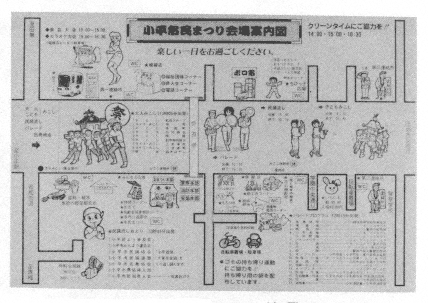
Fig. 3.
Ninth Kodaira citizens' festival program guide. The four-part division of the
parade is clearly indicated.
"Child" Shrines
The 1984 parade, which opened to the boom and crackle of fireworks, was several hours in duration. In the lead were children's groups, whose members shouldered handmade palanquin shrines called kodamo mikoshi, or "child" shrines. Real mikoshi —"adult" shrines, in citizens' festival jargon—are elaborate constructions. Carried on a framework of poles, the shrines, which usually weigh hundreds of kilograms, are built of lacquered wood decorated with shiny metal fittings, elegant brocades, and colorful tassels, and are commonly topped by a golden phoenix.
Over a thousand children officially took part in the 1984 procession; all were clad in happi (short wrap-around jackets) and most wore a colorful headband. Each "child" shrine was preceded by a sign bearer identifying the group by club, neighborhood association, or school district. A few of the kodomo mikoshi were of a conventional shape, albeit constructed from milk boxes and juice cans and painted in rainbow colors. Most were effigies of cartoon characters; three "child" shrines were likenesses of that perennially endearing rodent Mickey Mouse. Two groups had fashioned "shrines" in the shape of the Australian
frilled lizard, a creature appearing widely in television commercials that year (fig. 4). There was also a pink elephant mikoshi, a local tribute to the two baby elephants presented to a Japanese zoo by the Indian government. Parents (mostly mothers) and club directors clustered solicitously around the "child" shrines, urging on their young charges with shouts, shrill whistles, and flailing arms. While not all the adults who joined in hoisting the "child" shrines were newcomers, the only palanquin shrines that newcomers are allowed to carry are the "child" shrines, an issue I will return to when discussing "adult" shrines. Regardless of their novelty, these effigies are still referred to as mikoshi, for the festival's organizers maintain that novelty is quite acceptable in the service of tradition, in this case shrine bearing. Significantly, a sign carried by a children's group representing a largely white-collar neighborhood was inscribed with the slogan "Let's make a furusato for ourselves."
That the citizens' festival parade should begin with a "child" shrine procession is not fortuitous. The primary beneficiaries of the "new furusato " symbolized by the festival are the city's children, especially the (post—oil shock) Kodaira-born among them. They are the youngest kodairakko. A poem entitled "Kodairakko," which was published in the 1975 New Year's edition of the city newspaper, marks the first appearance of the term. Its three verses celebrate the "fighting spirit" of the city's youngsters.
Kodairakko
Hey, come on! Get together, kodairakko!
It's time to go for a run.
A brisk wind is blowing from Chichibu,
But hard as it blows, we won't give up.
Fight! Fight! That's how we'll run.
The branches of the chestnut trees are waving,
The branches of the nashi are waving too.
The tops of the zelkovas are waving.
Fight! Fight! That's what they yell,
Those energetic kodairakko!
Fight! Fight! Hearing that yell,
The buds sprout, the flowers bloom;
They grow abundantly and bear fruit.
A dream that kodairakko will flourish.
A dream that kodairakko will thrive.
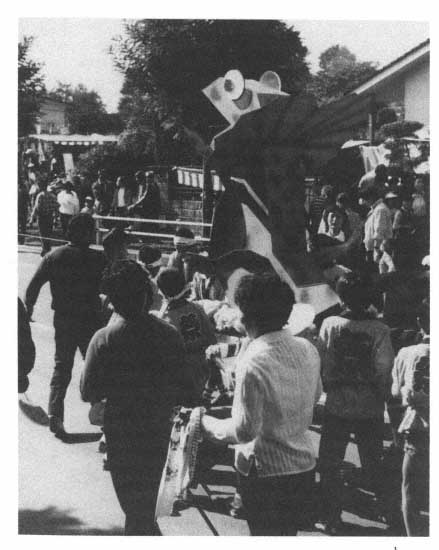
Fig. 4.
A "child" shrine in the shape of an Australian frilled lizard. (Photo by author)
Youthfulness is celebrated not for its own sake but as a product of a healthful family life. The theme of forging a "new furusato " is conjoined with the aim of eradicating juvenile delinquency through the recreation of a holistic social life grounded in the ideal of danran, which means "happy and harmonious home circle." Between August and October of 1984, a total of 1,882 juvenile delinquents were apprehended for drug (i.e., stimulants) abuse, shoplifting, vandalism, and vagrancy. This figure represents about 7 percent of the 26,581 youths (fourteen to nineteen years old) in Tokyo metropolitan prefecture taken into custody that year (KBH 1984; TSK 1985). The prevention of juvenile delinquency was a much emphasized theme in the third segment of the parade. Like children, Furusato Kodaira must be carefully nurtured to a healthy maturity. Sloganized, this administrative policy might be rendered "kodairakko energy, tochikko values" or, from a more practical perspective, "kodairakko taxes, tochikko stability."
Dancing Mothers and Kodaira Ethnics
Following the "child" shrines were six blocks of female folkdancers moving forward rhythmically to the alternating strains of the "Kodaira Onda " and the "Greater Tokyo Ondo, " which were broad-cast throughout the day as well.[8]
Kodaira Ondo
Ha-aa. Long ago in Musashino was Ogawa village, you know.
A post station along an avenue of zelkovas. (As for now,)
Now there are seven: Kami-Naka-Shimojuku, Kubo Slope—hey now!
(Throngs of people)
Enjoying a cool moonlit eve in Misono.
(Kodaira is a good, fine place!) You bet!
(Kodaira is.)
Ha-aa. Come now, let's sing; make a circle and dance, you know.
Flower of Koganei, along the canal. (As for fragrance,)
Fragrant are Gakuen, Tsuda College, Arts College, Hitotsubashi.
(Now then), Shinmei-gu.
The Seibu line carries your dreams.
(Kodaira is a good, fine place!) You bet!
(Kodaira is.)
Ha-aa. Come now, let's sing; make a circle and dance, you know.
To the east, Tsukuba; to the west, Mt. Fuji. (And in between,)
(Now then), avenue of buildings.
Strike up the ondo and build up the town.
(Kodaira is a good, fine place!) You bet!
(Kodaira is.)
( ) = chorus
Lyrics: Yokozawa Chiaki
Music: Hayama Taro
The six groups averaged between 70 and 150 members, mostly women between forty and sixty-five years of age for whom folkdancing was a weekly pastime. I recognized among the dancers several of the clerks at a local supermarket. One of them later told me that her group practiced once a week and also performed at various festivals and functions elsewhere in Tokyo. For over an hour, row after row of dancers clad in decorative kimonos filed by, swaying and stepping in perfect unison. Their expressions were sober, crinkling into brief smiles only at the sight of an acquaintance among the appreciative spectators (fig. 5).
Trailing a slight distance behind these six groups was a seventh, the women of the Niigata prefectural association, dancing the "Sado okesa, " a style of folkdancing that originated in Sado Island. They had not participated in the past several festivals. Whereas the other groups were identified by modest hand-carried signs, the Niigata women announced their presence in a bold way. They were preceded by a sound truck outfitted with several large white panels, bordered with colorful pom-poms, on which was brushed the name of their association in giant red characters.
When each group of dancers reached the end of the parade route, they broke rank. A few fell back to mingle with their friends, who graciously "oohed" and "aahed" over their performance and enviously fingered the dancers' festive kimonos.
It is fitting symbolically that the "child" shrine procession should be followed by one featuring older women. In the first place, females—wives and mothers especially—are regarded by city hall as a "class" of resident and are acknowledged collectively as the nexus between the private household and the public neighborhood or society at large. They are also regarded as mediating between past and present, "tradition" and "modernity." Wives and mothers negotiate these counterposed domains through their husbands and or children. Women's groups, to a certain idealistic degree, function as extensions of the household, as the ancestors' festival dance (obon ) in Kodaira illustrates.
The obon dance, jointly organized by the women's and youth groups
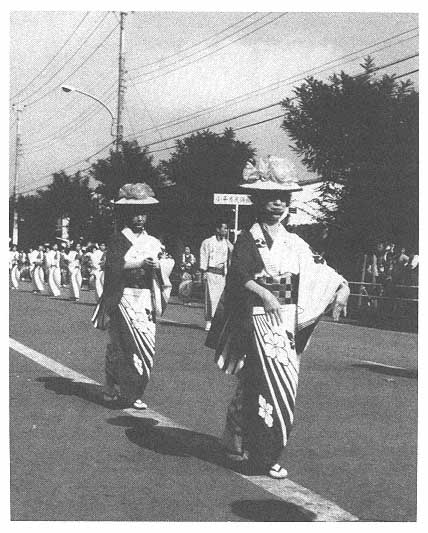
Fig. 5.
Female folkdancers. (Photo by author)
of participating neighborhood associations, is highly valued as an opportunity to instill in youngsters an appreciation for "traditional" entertainment. Rehearsals are held, for sloppy dancing on the two nights of the festival would "exert a bad influence on the impressionable youngsters" (KCH, 1 July 1958). Similarly, groups of mothers are made responsible for collecting and publishing local lore and folktales,
which are considered to be of socially redeeming value for children. In the context of the citizens' festival, the polished female folkdancers collectively are idealized as the civic materfamilias of kodairakko and, as such, symbolize the operations and consequences of the dominant ideology of the "family system."
The "family system"—which refers to the tendency to extol the patriarchal household as the center of state, national, corporate, and social structures (cf. Maruyama 1969, 36)—relies on the social import and utility of the mediational role of wives and mothers. This system does not accord females qua females high status; rather, it is the "female" gender role of mediation that is acknowledged. Not rights and respect but, instead, service to the patriarchal household and, by extension, to the state is the subtext here. Although the "male:public::female:private" equation has been roundly critiqued and dismantled by feminist theorists,[9] it nevertheless informs the dominant representation in Japan of men's and women's social spaces, and so it is in reference to this equation that I explore the sex-gender dynamics of the "family system."
The private/public distinction is usefully regarded as a "culturally constructed continuum which gives rise to different patterns of male power and control" (Brittan and Maynard 1984, 130). "Male power and control" refers to a man's potentially unlimited access to manifold public spheres of interest, as well as to a private household. Contrarily, the housebound married woman is triply circumscribed by the "female" gender roles of "mother," "housewife," and "wife," and their respective activities of childraising; cooking, cleaning, and washing; and sexual services. However complementary the private/female and public/male domains appear or are presumed to be, the actual relationship between the two domains is neither symmetrical nor equal. From a man's perspective, the continuum is continuous, but from a woman's perspective, it is discontinuous. A husband has the opportunity to take on domestic chores, but a wife cannot assume at will her husband's work, although the quality of her wifely role can affect the quality of his work and, by extension, the social standing of the household. The implication is that the work married women do in their homes is invisible and becomes apparent only when it is not completed or is managed improperly. It is only when something goes wrong with the system—increased incidences of school vandalism, drug abuse, juvenile delinquency, and so on—that the mediational role of wives and mothers is acknowledged (Atsumi 1988; Brittan and Maynard 1984, 131; Japan Times, 31 December 1983). Significantly, during his tenure, Mayor Oshima attrib-
uted to women a greater capability than men to negotiate differences, and he asked various women's organizations to help mediate strained relations between natives and newcomers. As I pointed out in chapter 1, the gender ideology informing furusato-zukuri projects supports the practice of gender-role segregation, whereby married women, in the capacity of wives and mothers, are to nurture "old village" consciousness within their families.
Some of the female folkdancers represented another aspect of furusato-zukuri in Kodaira, that of "prefectural ethnicity." The Niigata women danced to their own tune, as it were, at the ninth citizens' festival, a reminder of the residents' diverse backgrounds and the we/they dichotomy at work. Their dance, the "Sado okesa, " may be construed as a symbolic expression of their "ethnic" identity, the boundaries of which are drawn, for the sake of convenience, at the prefectural level. It is an expression that is at once condoned and moderated—condoned in the sense that the citizens' festival was designed as a forum for interpersonal exchange, and moderated in that the ultimate purpose of such commingling is the creation of Furusato Kodaira. The diverse ethnicities of nonnatives are celebrated not for their own sake but as resources to be assimilated and appropriated toward the task of furusato-zukuri. Along with native-newcomer, another dialectical relationship complicating the narrativity of the festival parade is Kodaira-prefecture ethnicity.[10] Thus, the female folkdancers qualified themselves as members of Kodaira's Niigata Prefectural Association.
The several prefectural associations in Kodaira were established in the 1970s by concerned "ethnics" as one expression of the localism accompanying the post—oil shock revaluation of regional folkways. Prefectural associations offer to newcomers what parishes and consociations offer to natives; namely, support and camaraderie. Although members of these associations come from different cities, towns, and villages within a given prefecture, it is from their position as Kodaira residents that the prefecture itself is regarded as a local place in common. Logistically, too, the prefecture is a desirable boundary. Many of the associations are involved in interprefectural trade and tourism, the efficiency of which would be hindered were ethnic boundaries drawn on a smaller scale.
Beginning with the first citizens' festival, stalls stocked with prefectural specialties have been set up in a "corner" devoted to "specialty shops of the prefectural associations."[11] As explained in the city newspaper, "The main theme of this first citizens' festival is: Let's build
ourselves afurusato! Seizing the opportunity to mingle constructively and positively, members of the prefectural associations will perform regional dances and sell regional products" (KSH, 1 October 1976).
As Mayor Oshima declared in a Tokyo shinbun interview at the time, "Our plan is to build a unique furusato enriched by the local color of the prefectural associations." In that same article, the chair of the Fukui prefectural association proudly affirmed his pride in that prefecture and expressed a desire to "introduce the songs of Fukui packhorse drivers to all Kodaira residents." His gang of seven horse riders performed at the second citizens' festival, and he recalled thinking at the time, as the horses pranced up Akashia Road, "What a real furusato -style adventure it would be if the horses bolted!"
These are among the ways in which the affective compass of Furusato Kodaira is stretched to assimilate the different prefectures. The citizens' festival not only is an occasion to "intertwine 150,000 hearts" but also provides an opportunity to redraw affective boundaries—so that Kodaira ethnics can demonstrate their prefectural affinities without slighting their Kodaira identity. Although these affective boundaries transcend the city's administrative borders, the territory encompassed is none other than Furusato Kodaira.
One other ethnic participant in the citizens' festival since 1978 has been Obira, Kodaira's sister-city in Hokkaido. Obira, a town on the northwest coast of Hokkaido, briefly enjoyed the limelight in June 1984, when the hull of the Taito-maru was discovered by salvagers. In 1945 the ship was sunk by an unidentified submarine while en route to Japan from Sakhalin with a cargo of seven hundred expatriates. Radio, television, and English newspaper reports of the discovery consistently referred to "Kodaira," and, indeed, local legend has it that sister-city relations between Kodaira and Obira were initiated because they share the same name characters.
The population of Obira, which became a town in 1978, has been declining steadily at a rate of about 10 percent a year; in April 1984, it totaled 6,163 persons. That same year, Obira's administrators came up with the slogan "Obira is where Kodaira's dreams can come true." Their intention was to make Obira the giant-sized backyard of Kodaira, and a program has been under way since the early 1980s to encourage their urban counterparts to invest in forestland named "Kodaira's/Obira's forest" (Obira, April—May 1984). This is only one of the many similar "furusato reforestation" schemes jointly implemented by urban and rural sister-cities throughout Japan.
A dearth of eligible women has prompted the young men of Obira to seek brides from Kodaira. In this connection, it was significant symbolically that during the ninth citizens' festival the Obira town flag was carried by a group of girl scouts. After all, eligible young women from Kodaira have been urged to wear the Obira colors, so to speak.
The executive committee's report on the 1983 festival notes that the Obira sales corner turned a several-million-yen profit. Although the report cites only the figures for Obira, the same success probably was not enjoyed by the prefectural associations, as hinted by a prefectural association member and a DSP assemblyperson, who remarked that the associations operated in the red but "did not expect to profit anyway, since profit mongering is contrary to a festival spirit" (KGR, December 1982, 239). It seems that, whereas the participation of Obira is acknowledged and supported officially, the presence of the prefectural associations is taken for granted, despite Mayor Oshima's enthusiastic rhetoric during the first citizens' festival.
Western-Style Marching Bands
The novel "child" shrines ushered in the folkdancers in the first half of the festival; a Western-style parade preceded the "adult" shrines and opened the second half. Making their first appearance in the citizens' festival, the Konjo High School brass band led off the hour-long parade of marchers with the rousing tune of the "Kodaira Citizens' Festival Song."
Kodaira Citizens' Festival Song
Gather, everyone! Gather,
At the glorious festival site;
Even the blue sky is aglitter.
The Kodaira people's, the Kodaira people's;
The Kodaira people's joyful cheering.
Everyone is happy; linking arms,
Living peacefully—this merry site.
Flutes, and drums, and dancing too.
The Kodaira people's, the Kodaira people's;
The Kodaira people's footsteps ringing.
Dreams are big in Kodaira;
All of ours together, this festival site.
Hope is winging toward tomorrow.
The Kodaira people's, the Kodaira people's;
The Kodaira people's forward marching.
Music: Morikoshi Kazuko
Lyrics: Kodama Yukiko
The horn players, in their well-tailored red, white, and blue uniforms, were followed by a troop of boy scouts and their den fathers, dressed for a jamboree. Equally well turned out were the four mounted police officers on their huge, gleaming thoroughbreds. Next was another boy scout troop, this one bearing the Kodaira flag, and behind them the girl scouts, in baby-blue shifts and bobby sox, with the Obira flag.
My favorites were a smart-stepping drill team who billed themselves, enigmatically, as a "rhythm baton" and moved on down the road to a peppy Beatles' medley. The coed troop of fifty, outfitted in tennis gear and Stetson hats, had seemed more inspired the year before, when they tittupped to the beat of the American rock song "Gimme Some Love." Like the Niigata dancers, they came equipped with their own sound system: two giant speakers mounted on the luggage rack of a Mitsubishi van. They performed fifth in line, enlivening the rather tedious string of boy and girl scout troops preceding and following them.
Next came the police officers' drum corps, the women dazzling in their bone-white miniskirts and go-go boots, tricolors snapping in the persistent Musashino breeze. Right behind them was the shiny red Nissan convertible carrying the mayors of Kodaira and Obira and the speaker and chair of the city assembly. The Kodaira officials wore green happi trimmed in blue, and the Obira mayor wore a blue one bordered in green. In view of the constant and explicit symbolic counterpointing throughout the citizens' festival—from its express theme of joining natives and newcomers, to the alternation of novel and "traditional" performances—this color reversal clearly was intentional.
Sandwiched between the red car and a white convertible carrying Miss Kodaira were a troop of cub scouts, a drum-and-fife corps from a local elementary school, and the Kosei Group's[12] cheerleading squad. Miss Kodaira and her "court"—the former Miss Kodaira and the 1984 runner-up—were swathed in scarlet robes and wore crowns the size of busbies (fig. 6). They were all smiles as they waved politely to the spectators. When a couple of young men yelled out, "Bijin da!" (Hey, beauties!), the three women blushed and looked the other way. Meanwhile, I continued to ignore the constant "haro, haro" (hello, hello) from the thronging children.
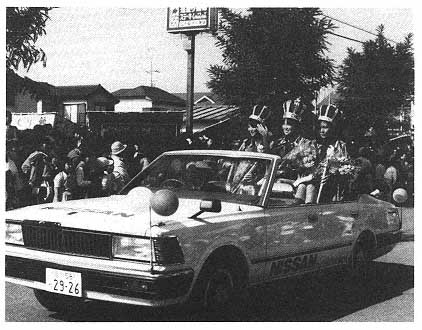
Fig. 6.
Miss Kodaira and her "court." (Photo by author)
Behind the "royal coach" filed another large group of kodairakko: the traffic safety unit and the Young Misses, the latter a girls' club making its festival debut. The youngsters were followed by a squadron of Toyota sedans, adorned with pink and purple pom-poms, ferrying members of the Kodaira fathers' and mothers' associations. They exploited the publicity by broadcasting crime-prevention slogans, singling out in particular the vexatious motorcycle gangs (bosozoku ) whose one thrill in life, it seems, is to roar through sleeping neighborhoods on mufflerless motorcycles.[13] Trailing behind the sedans was a "reformed" delinquent on a tame Honda 50 bedecked with paper flowers and balloons. The sign fixed to the back of his leather jacket read, "Banish motorcycle gangs."
The parade of more than one thousand marchers ended with a fleet of fire trucks rumbling down Akashia Road. Affixed to the ladder of the lead truck was a large golden globe. When the massive vehicle reached the festival headquarters, it stopped and its telescoping ladder was raised as high as it could go, whereupon the globe burst open, showering the delighted onlookers with confetti and rainbow stream-
ers. Once the fire trucks had rumbled on, the crowds poured back into the street, using the intermission before the onset of the "adult" shrines to bargain and browse.
The image of cityhood extolled in the third segment of the parade is distinctly Western, in contradistinction to the preceding "child" shrines and folkdancers and to the "adult" shrines that follow. It is also a noncivilian image, given the dominating presence of the police force, crime-prevention associations, girl and boy scouts, and fire fighters. Only the participation of the Self-Defense Forces was missing, although their brass band had marched in the first several citizens' festivals. Two weeks earlier, the forces had held a festival to celebrate the thirtieth year of their Kodaira base. The highlight of this festival was a mock battle replete with percussion bombs and flamethrowers. Afterward, their appetites whetted, the youngsters among the spectators were treated to a display of heavy artillery, over which they clambered delightedly.
When Kodaira earned city status in 1962, the local headlines proclaimed that "Kodaira City is born!"—as though an entirely new entity suddenly had appeared. Awesome powers were imputed to the new suffix shi (city). The addition of shi to Kodaira meant that residents "could soon look forward to the best in welfare facilities, obstetric clinics, day-care centers, trash disposal, and water, sewage, and gas systems." Moreover, "only as a city can Kodaira begin to forge its own identity and spearhead development in the North Tama district" (KCH, 25 January 1962). The initial theme of cityhood was sloganized as "A city that must think of the future and not dwell on the past" (KSH, 1 October 1962). But by the mid-1970s, when the citizens' festival was inaugurated, the desirability of rooting the present and locating the future in a newly revalued and reclaimed past took precedence, as revealed by the festival's twofold theme of restoring furusato to Kodaira and Kodaira to furusato (KSH, 20 June 1976).
Cityhood officially was celebrated on 1 October 1962, with speeches by the home affairs minister and the governor of Tokyo. Later in the afternoon, a parade of fifty "float cars," led by the Air Self-Defense Force band, traveled the length of Oume Road, looping briefly to traverse, and thereby incorporate into cityhood, the other main, historical thoroughfares. This quasi-military celebration contrasted sharply with the ceremony marking townhood on 1 November 1944. Instead of a military band, the featured entertainment was "traditional" and included manzai, or witty dialogues; ryokyoku, musical tales; rakugo,
comic stories; and kayokyoku, popular songs. It was, reportedly, "a peaceful day during a time of war" (KC 1959, 457).
From the start, then, the conceptualization of cityhood has been permeated with noncivilian and even military elements that have been carried over and incorporated into the citizens' festival parade. That the townhood ceremony was such a relaxed affair, and the cityhood celebration so formal and strictly coordinated, may be interpreted as follows. Townhood was granted during a tense period of national mobilization, to facilitate the dissemination and implementation of central authority (KC 1959, 543). Law and order were not problematic then; peace was, and "a peaceful day" is what the townhood ceremony offered. Cityhood, on the other hand, accompanied rapid population and industrial growth, and a resultant impersonal urban sprawl, to which was attributed "lawlessness," identified in the city newspaper as amphetamine abuse, high blood pressure, tardiness (i.e., "Kodaira Time"), juvenile delinquency, traffic violations, and environmental pollution. The new city was perceived as needing law and order. Thus, the citizens' festival parade—with its mounted police; fire trucks; multitude of obedient, uniformed girls and boys; crime-prevention and traffic-safety squads; and token, reformed juvenile delinquent—both epitomizes and promotes civil discipline and law-abidingness. Significantly, the "Kodaira Citizens' Festival Song," introduced at the seventh festival, contains no references to Kodaira's past but, rather, eulogizes the concepts of citizen (shimin ) and public place (hiroba ).
Finally, there is Miss Kodaira, the city's anthropomorphic emblem. Its logotypic emblem (fig. 7) was created in 1959.[14] Among other things, Miss Kodaira symbolizes Kodaira's spatial articulation with Tokyo metropolitan prefecture; for, after winning the city crown, she goes on to compete in the Miss Tokyo contest. She is the brainchild of the Chamber of Commerce, which sponsors the competition in co-

Fig. 7.
Kodaira's logotypic emblem:
The design is based on the
two characters for Kodaira,


operation with city hall and the Tokyo shinbun. The first contest, held in October 1977, attracted seven contestants; by 1981 there were twenty-two aspirants. The young women, many of them students at prestigious Tsuda Women's College, and most—like newcomer residents in general—blithely ignorant about Kodaira, are "judged" on the basis of looks, character, and intelligence—in that order. In contrast to women's appearance at the more internationally renowned "cattle auctions," the Kodaira women pose in coordinated jogging outfits. During her year-long reign. Miss Kodaira is obliged to pay a visit to sister-city Obira, appear in the citizens' festival, and graciously host various city functions. Here too is evident the perception of females as diplomatic mediators.
That Miss Kodaira rides in a white car and the city officials in a red one is of some significance. Red and white are the standard colors of dynamic opposition in Japan, a convention popularly attributed to the protracted Genpei wars in the twelfth century, in which the ultimately victorious Genji clan fought under a white banner and the vanquished Taira under a red one. Thus, for example, the annual star-studded singing contest televised on New Year's Day is divided into red and white teams. In the context of citizens' festival rhetoric, the counterposition of red and white symbolizes not conflictive opposition but, rather, dynamic interaction—most prominently, that between the administration (red) and residents (white), on the one hand, and natives (red) and newcomers (white), on the other.
Dynamic interaction, in fact, was the much-evoked theme of the Oshima administration, during which the citizens' festival was inaugurated. Soon after his election in 1967, Mayor Oshima announced his intention to "govern in accord with the people's will." Toward this end, he created a "Letters to the Mayor" column in the city newspaper and convened regular meetings with members of the public. He also bicycled around Kodaira to observe firsthand the progress of utility and other municipal projects. Oshima at one time even authored his own newspaper column, through which the former Chinese classics scholar imparted his hybrid "Confucian-progressive" political philosophy.
"Adult" Shrines
Last in the parade came the palanquin shrines shouldered boisterously by tochikko (fig. 8). The cavalcade of natives began with an oharai, or purification ritual, for which a local Shinto priest was
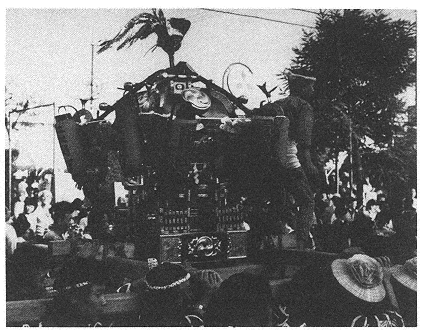
Fig. 8.
An "adult" shrine. (Photo by author)
hired to wave a wand of gohei (folded strips of sacred white paper) in front of the parked shrines. A similar ritual was conducted for the "child" shrines. Performed at both the outset of the parade and prior to the "adult" shrine procession, the oharai signified the "traditionality" and "authenticity" of the citizens' festival and served as its chartering enactment—signified but not sanctified; for the absence, as I will discuss, of Shinto deities from even the natives' portion of the festival precluded the religious legitimation of the event. The civic legitimation of the festival, on the other hand, was signified by the inclusion of city officials riding high in a red convertible.
The natives' parade alternated between palanquin shrines and drums (taiko ) mounted on wheeled platforms. The drums served as figured bass to the contrapuntal "wasshoi, wasshoi" (heave ho, heave ho) of the shrine bearers. No shrill whistles and harried shouting here. Unlike the preceding three processions, the native shrine bearers took an interminable time wending up Akashia Road, mostly on account of the nature of shrine bearing: one step forward, two backward, and ninety-seven side-ways! Whether it was the great weight of the elaborate shrines, or the
bearers' inebriation, or both, the natives were the most expressive performers in the parade. The crowd loved the heaving, squashing, groaning, grimacing, laughing, carousing, yelling, and shoving. But the best was yet to come. Instead of melting, one by one, to a finish, the shrine bearers deliberately caused a crushing pileup, sending the delighted bystanders fleeing to the safety of the guardrailed sidewalk with the shrines in reckless pursuit. The spectators were thrilled by the display of festival mayhem (matsuri sawagi ). This was more like a "really real" festival, raucous and rambunctious! As I groped my way out of the pulsing rush-hour throngs, I overheard one adventurous elderly woman exclaim, as she pushed and shoved and clutched indiscriminately, "You don't know whose hand you'll come out holding!"
The natives' shrines, as I have noted, are referred to as otona mikoshi, or "adult" shrines. They are not called such outside the context of the citizens' festival—the context necessitates the naming. The prefix otona, or adult, signifies both "real thingness" (as opposed to pink elephants and Mickey Mouse) and "native" (as opposed to newcomer). Adult newcomers may help shoulder only the "child" shrines. The portable "adult" shrines are the property of natives. Each one of the taiko and mikoshi is inscribed with the name of the parish or native coterie to which it belongs.[15] Lent by the natives to the city for a day, the giant drums and palanquin shrines imbued the ninth citizens' festival with verve, a "traditional" ambience, and sensorial authenticity.
"Newcomer" Shrines
A mikoshi is the temporary abode of a given shrine's deity (kami ), and in a shrine festival it is carried through the parish territory so that the mobilized deity may purify the area. ("Deity" is an inadequate but convenient translation of kami, the generic term for both ancestral spirits and the vital essence infusing animate and inanimate phenomena alike.) A given shrine's deity guards and blesses its own parish territory exclusively. Akashia Road is not included within a native parish; therefore, the "adult" shrines featured at the citizens' festival do not house a shintai, or kami -body. Similarly, the purification ritual at the outset only simulated the oharai performed at a Shin-to shrine or in the presence of kami evoked for that ceremony.
Kodaira natives are aware of the deities' absence from the mikoshi and consequently refer to the citizens' festival as bereft of authenticity, the implication being that a "real" (shrine) festival is contingent upon a
supernatural presence. One participant interviewed at a shrine festival remarked that "without kamigakari, festivals are no fun" (Matsudaira 1980, 98). (Kamigakari refers to both the process of becoming possessed by a kami and the individual possessed.) The same person also remarked that one "can't kamigakari at city hall—sponsored festivals" because the deity is not present. At the Kodaira citizens' festival, the countless cans of beer quaffed by the bearers at the two half-hour rest stops apparently compensated for the absence of kami. Historically, alcohol (sake has been a standard feature at festivals, especially at the social gatherings following a mikoshi procession. City hall apparently had considered banning alcoholic beverages but realized that without beer the "adult" shrine procession in particular would lack the essential zest.
None of the dozen or so newcomers I queried at the 1984 citizens' festival were aware that the "adult" shrines were kami -less. Generally speaking, deities and shrine structures tend to be conflated in Japan, but in this instance a clear distinction was made between the two. This distinction was dispensed with altogether in a 1985 editorial in the Asahi shinbun (14 July) addressing the issue of portable shrines without kami. Evidently the popularity of shrine bearing in city festivals throughout Japan has created a demand by urban newcomers for mikoshi rentals, despite exorbitant rates ranging from 600,000 yen to 12 million yen for several days' use. (According to a recent advertisement, mikoshi kits are also available, enabling interested groups, as opposed to specialist carpenters, to construct their own shrine for about 53,000 yen [Asahi shinbun, 16 July 1986].) "We Japanese thrive on festivals," the editorial closes, "and so it is a good thing that rental shrines are available. Since the kami are invisible in traditional shrine festivals anyway, their absence from rental shrines does not diminish the joys of shouldering mikoshi. "
Shrine kits and rentals signify not only the popular construction and commodification of "tradition" per se but also the virtual expropriation by city halls and newcomers of "tradition" hitherto maintained by exclusively local native parishes or coteries. It has been remarked, in fact, that "traditions" such as the making and carrying of mikoshi "henceforth will be perpetuated by all interested parties" (Asahi shinbun, 16 July 1987). In Kodaira the "adult" shrine segment of the parade is so popular that city hall is considering the feasibility of providing newcomers with a mikoshi of their own—possibly a rental—to shoulder in the annual citizens' festival. Should the administration follow through on
this plan, city hall would, symbolically, approximate a shrine with a citywide parish consisting of newcomers. According to this logic, newcomers would be carrying the city's palanquin shrine, in a festival financed and managed by city hall, as an outward expression of their kodairakko identity and commitment to the making of Furusato Kodaira. This potential development bears similarity to the ancient concept of saisei itchi, or fusion of Shinto rites and government, revived by the Meiji government and maintained until 1945. Symbolically at least, a city hall mikoshi would be comparable to a confluence of creed and civic-mindedness. The public relations director[16] of the Kodaira citizens' festival mentioned that the controversial implications of this symbolism have figured largely in postponing the acquisition of a newcomers' mikoshi.
In Kodaira the natives&rsquo: domination of the most "traditional" event in the citizens' festival was underscored by the participation as shrine bearers of natives from neighboring cities. (That they are indeed from outside Kodaira was evident from the place-names printed on the lapels and backs of their jackets.) Apparently the festival's organizers—a committee consisting of a majority of natives—did not perceive the presence of these outsiders as contradictory to the aim and purpose of the event, which was to "intertwine the hearts of 150,000 residents" and "make Kodaira a place newcomers can call furusato. " The festival's public relations director, himself a tochikko, told me that outside natives are invited because the festival's organizers want to make sure that there will be enough (native) bodies to parade the mikoshi in a properly rambunctious style. Kodaira's newcomers are not regarded as suitable candidates for this task. The "adult"/"child" distinction between natives and newcomers pertains here as well in a figurative sense, suitability implying "adult" (native) status.
Evident as well is the natives' reluctance to share participation in "their" local practices. Parish exclusivity and even token religious activity—as in the case of the kami -less "adult" shrines—are the most effective means at their disposal for (re)defining their distinctive if diminished place within the city. Like the fire brigade incident over a decade earlier, the citizens' festival occasions the exposure, in high relief, of antinomy between natives and newcomers. Significantly, a fire brigade was included in the 1985 lineup to mark the tenth anniversary of the citizens' festival. The Kita-tama shobo-mutsumi, an all-male native coterie from the northern part of Tokyo metropolitan prefecture, was hired to perform the acrobatic stunts historically associated with fire
fighters. The team, which practices these stunts as a hobby, performed twice: before and after the Western-style marching bands. The public relations director explained that the acrobats deepened the "traditional" ambience and "authenticity" of the citizens' festival. But given the frictional exchange between natives and newcomers in the past over the issue of fire fighting, the presence of the fire brigade also symbolically deepened the divide between Kodaira's two main sectors.
Whatever civic camaraderie is occasioned by the festival is predicated not on the blurring of differences between natives and newcomers but on the display and recognition of those differences. The citizens' festival parade symbolizes the city's demographic topography. The signs and labels carried and worn by the performers ensure that each group is not abstracted from geography but, rather, is more precisely identified with a specific social sector and/or geographic location. Tochikko parishes and coteries are identified by inscribed drums and shrines; kodairakko associations and clubs, by the signs carried by children. What is emphasized in the parade is the social and status classification of each participating group. The official public relations media for the festival hint as much, for the image of civic camaraderie is one of "intertwined hearts," as opposed to "fused hearts" or other references to oneness. Administrators draw attention to Kodaira's native sector as a "living historical" culture, in an attempt to portray the bedroom town as a palatable "new furusato " for the newcomer majority, whose permanent residence is necessary for the city's socioeconomic stability. The hearts of 150,000 residents notwithstanding, the citizens' festival, and by extension Furusato Kodaira, is predicated on the dynamic interaction of the native and newcomer sectors.
Ceremonial Precedents and Legacies
A comparative review of the ill-fated townspeople's festival staged during the 1950s effectively illustrates the importance of both the furusato rhetoric and the native-newcomer antinomy motivating the citizens' festival. Articles in the town newspaper describe the townspeople's festival (chomin matsuri ) as plagued from the start by erratic planning and competitive strife. Dubbed the "first such event in Kodaira," the townspeople's festival was a tripartite affair divided into (1) a cultural exhibition, at which local historical materials were dis-
played along with the works of Kodaira's litterateurs and artists; (2) an industrial exhibition, featuring agricultural products and handbooks of farm household management; and (3) a sports meet. This last event, which I will focus on, most corresponds to the citizens' festival parade, while the the first two correspond to the various "corners" and exhibitions that impart a fairlike character to the citizens' festival as a whole. Held in November at a junior high school, the sports meet included track-and-field events and tugs-of-war between rival school teams, neighborhood associations, and groups of natives representing the Edo-period village divisions. Prior to the redistricting of Kodaira in 1962, the town's districts were based upon the internal organization of the original seven villages. Only Ogawa-mura, the oldest village, has retained its geographic integrity, as the new districts were simply superimposed upon the village's existing structures.
The sports meet apparently exacerbated a parochial conceit which ultimately undermined the pan-Kodaira identity that town hall had intended it to foster. In retrospect, it seems clear that the townspeople's festival lacked a powerful symbolic topos, such as furusato-zukuri. Also missing was the dynamic interaction of native and newcomer that motivated the citizens' festival. Kodaira's population in 1951, when the townspeople's festival was inaugurated, was one-sixth of that in 1976, when the citizens' festival got under way; and the town's internal boundaries still coincided with those of the seven villages. Farmers, who comprised 30 percent of the population in 1951, had yet to feel threatened by newcomers, whose entry peaked in 1963. By 1976 farm households made up only 2 percent of the population, and the rationalization of boundaries had significantly undermined the geographic basis for parochial rivalries. Instead, occasioned by the pervasive furusato rhetoric, nativeness itself emerged as a transcendent common identity, and its expression has become a means by which Kodaira's indigenes have attempted to control the circumstances of their minority existence.
One of the reasons given for terminating the townspeople's festival in 1954 actually served to forge a common identity among the native population. This was the central government's plan, launched nationwide in the fall of 1953, to merge small towns into larger administrative units. Kodaira and the neighboring towns of Koganei and Kokubunji were selected for amalgamation. The main obstacle to the proposed merger was the opposition of the agricultural sectors of Kodaira and Kokubunji, which organized a vociferous lobby and eventually succeeded in preventing the amalgamation. As described at the time, "the
planned merger fell through on account of the natives' town patriotism" (KC 1959, 689-95; KCH, 9 May 1954; KHS, 1 January 1981). Although local patriotism today is condoned and praised as a virtuous attitude, in the 1950s it was disparaged as "rustic conservatism," and attention was drawn to the fact that all but the native (farm household) sector were in favor of the amalgamation (KCH, 9 May 1954). Thus, the merger dispute occasioned a crisis provoking Kodaira's natives to mobilize and act in unison against those who favored the merger. The consequent climate of divisiveness thwarted the resumption of the townspeople's festival, and the we/they dichotomy between natives and newcomers has persisted to the present day.
Conclusion: Toward Festival-Mindedness
Most but not all residents are as enthusiastic as city hall about the citizens' festival. Among the criticisms of the annual event uncovered in a 1982 survey published in the city newspaper was the complaint that the event was "not all that it is made out to be; namely, a festival for all to participate in" (KSH, 20 December 1982). One respondent substantiated this charge by noting, "[My] neighbors never talk about the citizens' festival and [I] only found out about it through the city newspaper." Partly to encourage residents to talk about the festival, city hall has included as a postfestival event an exhibition (at the central citizens' hall) of drawings and photographs of the shimin masuri. The drawings are by children who participated in the "sketching corner," using paper and crayons provided by city hall. The photographs are submitted by the city's amateur photographers, and city hall staff members also make a video film of each year's citizens' festival. Ideally, preparation for the exhibition, and for the matsuri as a whole, and participation in both the exhibition and the matsuri deepen the residents'—native and newcomer alike—sense of place by inducing popular memories. The place ostensibly occasioned in this fashion is Furusato Kodaira, a mnemonic landscape inhabited by harmonious families and compatible neighbors.
City hall recognizes the potential of matsuri to occasion furusato -mindedness and apparently is aware of the destructive capacity of festivals as well. Apart from natives' opposition and the saisei itchi implications, city administrators are reluctant to introduce a newcomers'
mikoshi because of the often dangerous rowdiness accompanying their presentation. As early as the eighth century, palanquin shrine bearing has been associated with protest riots, and in recent history "wasshoi, wasshoi" has been adopted as the chant of student and labor demonstrators. An incident at the 1976 Kobe festival illustrates the danger that can turn a matsuri into a tragic event. A newspaper photographer was killed in the mayhem that erupted at the mikoshi terminus. Youths from a Kobe gang, "who were looking for great outbursts of energy and experiences of mass elation," were held responsible for instigating the homicidal turmoil on that occasion (Inoue et al. 1979, 181). The mikoshi in the Kodaira citizens' festival are paraded by natives exclusively, whose raucous behavior is counterbalanced by their seniority, community responsibility, and local patriotism. Newcomers in general, on the other hand, are believed to lack these tempering attributes.
Although the furusato rhetoric enwreathing the citizens' festival is not unique to Kodaira, historical and contemporary circumstances have made furusato-zukuri a particularly cogent topos in that city. The reclamation of the original seven villages from barren land is cause for the celebration of the pioneering spirit of the first settlers and the encouragement of the second reclamation of Kodaira by postwar newcomers. The tenacity of the native sector, in the wake of the massive influx of newcomers since the 1950s, has enabled city hall to appropriate Kodaira's "living history" as part of its program to make the city a more palatable "new furusato " for newcomers.
There are other festivals held throughout the year in Kodaira, ranging from local shrine matsuri for parishioners to cho (district)-level festivals held at citizens' halls for, primarily, mothers and their children. Only the citizens' festival, however, is advertised as the affective core of Furusato Kodaira, a community constructed from the dynamic interaction of old and new, and perpetually in the making. Activities and ambiences that were formerly the province of natives alone are now administered by natives, albeit under the auspices of city hall, for the collective benefit of all Kodaira residents. In Kodaira City, the tenacity of the native sector in particular and the viability of furusato rhetoric in general have made possible the interdependence and the relative autonomy of natives and newcomers. This is precisely the sort of "new" community of and for which the Kodaira citizens' festival is a model.
In 1962, when Kodaira attained city status, all eyes were focused on the immediate present; Kodaira was envisioned as a modern city of high-rise buildings and paved roads. No one then would have guessed
that less than twenty years later city hall and Kodaira residents would look nostalgically to the agrarian past in search of inspiration for an "authentic" community.
An exploration of the citizens' festival and the symbolic terrain of Furusato Kodaira provokes curiosity about how shinden -village society, from which their inspiration was drawn, was constructed and organized. That is the subject of chapter 3, which deals with "Kodaira's" beginnings in the seventeenth century as a cluster of newly reclaimed farm villages. A review of the area's historical patterns of settlement, moreover, will yield a deeper understanding of the present texture of the city and the basis for the postwar antinomy between natives and newcomers.