
The Slope of the Years
Toward the end of Golden Arm, when the police are looking for Frankie because he has killed Nifty Louie and run off with Molly Novotny and what is left of the neighborhood is collapsing around her, Sophie Majcinek goes completely mad. Waking in the "low, sad light" of her room in the mental hospital "'at the end of the Irving Park [El] line"' (322), Sophie tries to work back along the path of her mental collapse to a sense of order. Figuratively, she tries to take the Irving Park El back to the old neighborhood. She tells herself that the "low animal moaning" from the next room is "that Drunkie John beating that poor hide of a Molly Novotny again" and draws a neighborhood moral: "'If he loves her, what are a few blows?' Sophie thought with a sudden clarity. 'If a man tells you you're his—what are a few slaps to that?' " (313). The superimposition of her rooming house neighbors on the mental hospital's terrain provides "sudden clarity." She further pursues clarity by telling the nurse "all the
names she knew," running through the novel's main characters, supporting cast, and a few others we never meet. These last—Chester from Conveyor, Shudefski from Viaduct—suggest that the catalogue extends out into an entire industrial neighborhood order: a people living among conveyor belts and railroad viaducts. Last on the list comes "'Francis Majcinek. We got married in church'" (313), a church we know to be Old St. Stephen's. Closing her catalogue with Old St. Stephen's, the centerpiece of both her rhapsodic neighborhood nostalgia and the closing-time scenario in which church bells toll a requiem for her people, Sophie discovers with regretful clarity that even the neighborhood of feeling she constructs in her mind has arrived at the end of the line.
The same might be said of Algren's literary-historical situation as he understood it. Sophie's "neighbors" include not only the people of the changing Milwaukee Avenue corridor who provided Algren with material for his literary work but also Studs Lonigan, Bigger Thomas, Jurgis Rudkus, Carrie Meeber, and the other citizens of his Chicago tradition's composite city of feeling. This latter group of fictional characters forms a kind of shadow contingent continuous with the list of neighborhood characters Sophie recites in the madhouse, and their stories similarly form a shadow text continuous with her "Scrapbook of Fatal Accidence": Native Son's grisly and titillating interracial murder, The Jungle's horror stories about the meatpacking business, Sister Carrie's tale of embezzlement, adultery, and suicide involving a well-known actress, and so on. Perhaps the most illuminating relation is between Golden Arm and Sister Carrie. these two texts form end points of the tradition that Algren and others had in mind when they wrote about "Chicago" writers and novels, and especially when they thought of Algren as the last of the Chicago writers. Golden Arm plays out to their conclusions a set of logics put in motion in Sister Carrie, suggesting that the Chicago tradition, like West Division Street, is reaching the terminus of its period with the aging and transformation of industrial Chicago.
Golden Arm shares a set of narrative contours with Sister Carrie. Their stories are by no means identical, but a rough common narrative bridges their differences, and in this sense they can be said to tell the "same" story. In this common narrative, a man (Hurstwood, Frankie) escapes an unsatisfying marriage to be with a younger woman (Carrie, Molly) temporarily allied to a weak paramour (Drouet, Drunkie John). The man spends most of his time in a particular bar (Fitzgerald and Moy's, Antek's), which provides an alternative to an increasingly suffocating and embattled domestic space (the Hurstwoods' stylish house near Lincoln Park on the North Side; the Majcineks' furnished room on the Near Northwest Side). The younger woman trades on her looks and sexual attractiveness to make a living (Carrie accepts lodging and money from Drouet; Molly hustles drinks and probably turns tricks). The crisis comes when the man
semi-unintentionally commits a serious crime (Hurstwood steals from his employers; Frankie kills his dealer), precipitating a drastic break with his home life as he flees with his mistress. Once formed, the illicit couple moves to the limits of the novel's world (New York, the Lake Street ghetto) and sets up housekeeping. The woman goes onto the stage to make a living (Carrie rising in the theater; Molly eking out a living in a strip joint), while the man, at loose ends and increasingly exposed as brittle and unfitted for survival in the streets, wanders about and eventually drifts into more trouble. The man's suicide in a flophouse forms the story's dramatic climax, the arc of his descent into ruin contrasting with the stronger woman's survival.
The two novels place very different systems of emphasis on the narrative elements they do share, so that even the most strikingly similar elements have dissimilar contexts, but the existence of a common narrative serves as a jumping-off-place in comparing two diegeses, two urban worlds. The common narrative schematized above provides a spine along which to begin arranging a reading of Golden Arm together with Sister Carrie. That reading could take many different forms and could indeed expand to great length in comparing the language, spatial and temporal plots, historical moments, and provenance of the two novels. Dreiser and Algren speak to one another in many different ways, from their interlocking plottings of naturalist decline to their shared tendency to mix journalistic-sociological reportage with the languages of melodrama and the urban surreal. The character systems of the two novels also suggest a wealth of comparisons, especially the matched sets of Carrie-Hurstwood-Mrs. Hurstwood and Molly-Frankie-Sophie. What follows, though, is a limited, preliminary comparison intended to establish the two novels as end points for Algren's Chicago tradition. This discussion centers on the novels' complementary landscapes, which, read together, tell a story of decline that plots on the grand scale the flat, unerring line of descent Dreiser calls "the slope of the years." The plotting of Carrie's rise and Hurstwood's fall tells the story in miniature; the plotting of Carrie's rise and Frankie's fall tells it against the backdrop of industrial Chicago's period, from golden age to the end of the line, as defined by midcentury stories of decline told by Algren and others.[8]
Arriving by train in the traditional manner in 1889, Carrie enters the prospective, expanding landscape of an industrial city on the make: "They were nearing Chicago. Signs were everywhere numerous. Trains flashed by them. Across wide stretches of flat, open prairie they could see lines of telegraph poles stalking across the fields toward the great city. . . . Frequently there were two-story frame houses standing out in the open fields, without fence or trees, lone outposts of the approaching army of homes."[9] That city is organized around its industrial infrastructure, indicated here by the converging rail lines that arrange the view. The processes of growth, exchange, and speculation
shape the spokes of development radiating out from the region's central place. The city is organized, as well, around the promise of growing into its role as the model city of industrial modernity, in which all aspects of urban life derive from the city's central function of collecting resources for processing into finished products to be circulated and consumed. Among those raw materials flowing from the hinterland into the city is Carrie, whose small-town training has made her a kind of half-baked urbanite aspiring to bigger things. Philip Fisher has traced the parallels between Carrie's prospects and those of Chicago, which are readable from the train window in the landscape of the developing West Side that offers "a gigantic sketch of its own future":
The Chicago that Dreiser describes is a mediating term. It is simultaneously a synecdoche for America, of which it is the most compact and representative part; and, on the other hand, it is a metonymy for Carrie whose small, future-oriented self with its plans and expectations extending out into reality like trolley tracks and strings of gas lamps, the surrounding city magnifies and gives expression to. . . . [T]he miniaturization of social and political fact is superimposed on the magnification of deeply interior psychological states.[10]
Reaching Chicago, Carrie enters the complex of social, economic, and cultural orders that characterize industrial urbanism. Having executed a kind of introductory pas de deux with the salesman Drouet during the train ride from Wisconsin to Chicago, during which the two establish the understanding that will underlie their affair, Carrie is crossing a boundary into ways of being that Dreiser presents as emblematic of industrial urbanism. She will learn to finesse the grinding processes of production and consumption as she moves from the "lean and narrow" constrictions of wage labor and neighborhood life to the "walled city" of privilege downtown, and she will do so by making both a more valuable commodity and a more efficient company of herself. She learns to bank on her unspoiled youth (a species of futures trading), to capitalize on the sentimental appeal of the "emotional greatness" she projects on the stage as an actress, to preserve her worth as she trades Drouet for Hurstwood and then drops Hurstwood when he runs out of money and desire. As Carrie and Drouet approach Chicago in the novel's opening chapter, they exchange addresses: that is, they place themselves in relation to the landscape through which they are passing, thus offering an account of relations between themselves and the circulation of resources and meaning in the city. They are "nearing Chicago" in the fullest sense of the phrase, a Chicago growing into its role as America's type of the modern industrial metropolis. The rail lines form the bones and arteries of a growing body, still awkward but still on the upslope of its development: "It was a city of over 500,000, with the ambition, the daring, the activity of a metropolis of a million" (13-14).
This is the opposite of Golden Arm's Chicago, which is narrowing rather than expanding, aging rather than maturing, contained and exhausted by its rail lines rather than extended by them into a richly prospective future. If Carrie's story runs on deterministic tracks toward her entrance into the "walled city" of privilege and money, those tracks provide access to an expanding terrain: Chicago, Montreal, New York; department stores, the stage, Broadway. Frankie's story, like Hurstwood's, runs on tracks toward an ever-narrowing vanishing point. The second line of junkie's "tracks" running down Frankie's arm underscores the distance between the prematurely aged morphine addict and the "future-oriented" Carrie, two personifications of Chicago. Even the space momentarily opened up to Frankie by travel along the tracks made by the injection of morphine, which "hit[s] the heart like a runaway locomotive" (Golden Arm, 58), narrows into a "terrible pit" between "glacial walls" (57) as the euphoria of the high gives way to the addict's need for more. The train lines in Sister Carrie have, in Golden Arm, bent back upon themselves into an impassable boundary enclosing a narrow and airless terrain. Looking upon it from her window (one of Carrie's most characteristic positions), Sophie can "scarcely breathe."
Sophie's perception of an obscure threat of annihilation in the streetscape has roots in the earlier novel: Sister Carrie initiates and Golden Arm completes the Chicago tradition's movement to the street, parallel to but distinct from its movement to the neighborhoods. The move to the neighborhoods, linked to the emergence in American letters of the urban industrial order and especially of the white-ethnic immigrant groups who dominated its laboring classes in cities like Chicago, reaches an end point in the imagined disappearance of industrial workers and the world they made. The Chicago tradition's move to the street comes to fruition in Golden Arm's variegated catalogues of hustlers, drifters, drunks, operators, hoods, and other types who collect at the lower margins of the neighborhood order where it verges on the street life. To be "out in the street"—a combined physical and experiential condition—is to encounter the city without buffers. In Sister Carrie, Hurstwood gradually moves from well-buffered interiors like Fitzgerald and Moy's and his home into the street, where he is utterly destroyed; but Carrie and most of the other characters maneuver to remain in or near the "walled city" of privilege, insulated by wealth, social placement, and mastery of urban technique. When she has no money and little familiarity with urban technique, the streets of Chicago become a place of menace where she fears she cannot mediate or influence the forces acting upon her, the concatenation of desires that make the city go. She experiences moments of vertiginous terror in the streets, feeling "a sense of helplessness amid so much evidence of power and force" (15) during her search for employment, the period when she begins to see that she might be consumed by the city—forced into the kind of hardscrabble existence pursued by her sister Minnie, menaced
with the fate awaiting Hurstwood. In New York, insulated by money and position and a better grasp of urban technique, Carrie promenades on Broadway as if on a stage, protected even on the streets by invisible buffers of privilege.
In Golden Arm, conversely, everyone is always in the street. Some characters are better equipped to maneuver in and around the annihilating structure of the El, like the cats who pervade the novel, but the street extends everywhere. There is no walled city, and the unraveling of neighborhood orders breaks down even the modest buffers of community evolved by the industrial village. The "guttercolored" light of the rooming house suggests a continuity between interior and exterior, and the constant intrusion of the El confirms that continuity. Passing Els rattle Frankie and Sophie's latch, as if city-structuring forces were demonstrating their access to the meanest furnished room. Upstairs at Vi's, the approaching Garfield Park Express sounds as if it "were running straight through the house" (130). The Loop-bound El roaring overhead makes Molly's curtain billow stiffly, "passionately and white" before it "slowly fell and went limp" (I 12), as Frankie and Molly sleep together, so that the El superimposes itself on their union and makes of it another show of the white flag of surrender to the city.
Golden Arm marks out as its key social terrain the line where the neighborhood order gives out onto the street life, something at once very old (like Hurstwood's Bowery) and very new—like the inner-city milieu of junkies that would become an object of fascination in the 1960s. In drifting below that line, as so many of the novel's characters are irrevocably doing, Golden Arm imagines as well a drift below the level of mass culture, which was introduced as a constitutive element of modern urbanism in Sister Carrie and vigorously critiqued as such by the neighborhood novels.
Carrie swims in a sea of urban mass culture as it takes form around her in the late nineteenth century, and her speedy acculturation opens the gate to the walled city. Clothes in the department store speak to her, helping her to finesse Drouet's attentions; the stage and its satellite world of newspaper coverage provide her with a model of behavior and a profession; she comes to understand the play of desires eddying around her as a young woman in the street, an actress, an urbanite. The department store's interior space expands infinitely in her subjective experience of it, presenting her with goods that represent the building blocks of a persona with access to an entire way of life and thus with access to a particular urban landscape—the residential hotels, Broadway promenades, and stage life of New York. Passing from the street to the store, she passes from anxiety to a sense of "relief from distress": "the whole fabric of doubt and impossibility had slipped from her mind" (Sister Carrie, 63-64).
The neighborhood novels of Farrell, Wright, and Algren (before Golden Arm) together launch a critique of exactly this numbing, easing effect of mass culture, arguing for the cultural impoverishment of the industrial proletariat
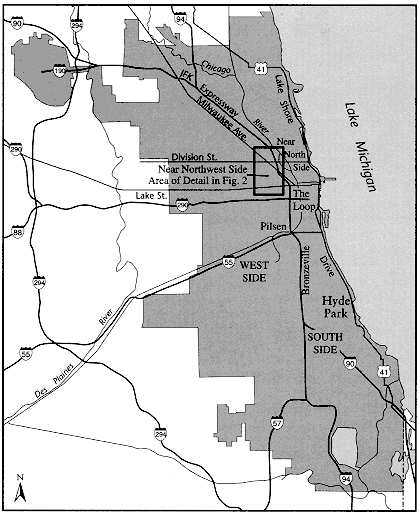
Figure 1.
Chicago. University of Wisconsin Cartographic Laboratory.
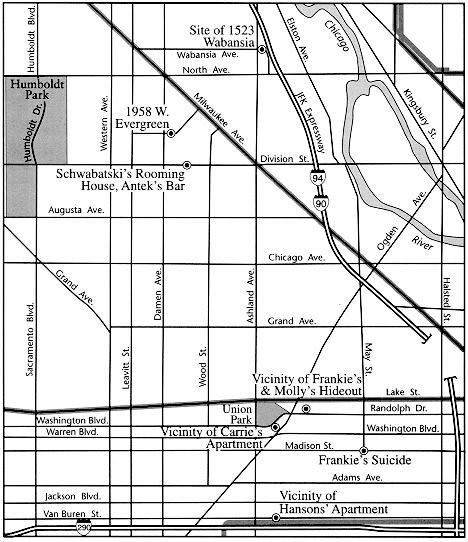
Figure 2.
Detail map of Near Northwest Side and Near West Side, Chicago.
University of Wisconsin Cartographic Laboratory.
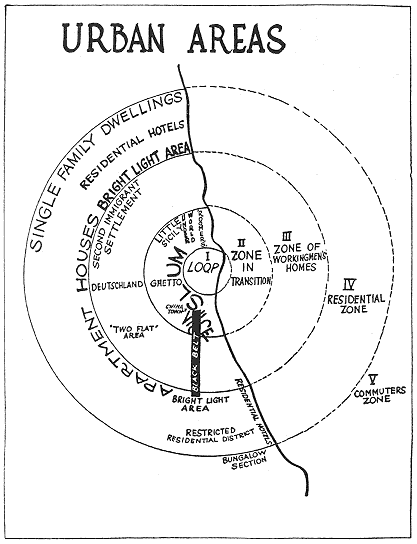
The anatomy of the City.—The above chart discloses the gross anatomy of the city, the
typical zones into which every city segregates as it expands. The chart shows, further, the
segregation of typical cultural areas of Chicago within these zones (chart after Burgess).
Figure 3.
Ernest Burgess's scheme of "urban areas," with caption, summarizes an "ecological" overview
of the industrial city that the Chicago School's studies sought to flesh out in detail. Algren's
Near Northwest Side would fall across zone II (rooming-house district and underworld) and
zone III (workingmen's homes, second immigrant settlement). (From Harvey Warren, Zorbaugh,
The Gold Coast and the Slum, p. 230.) Copyright 1929, 1976, by The University of Chicago Press.
All rights reserved. Reprinted with permission.
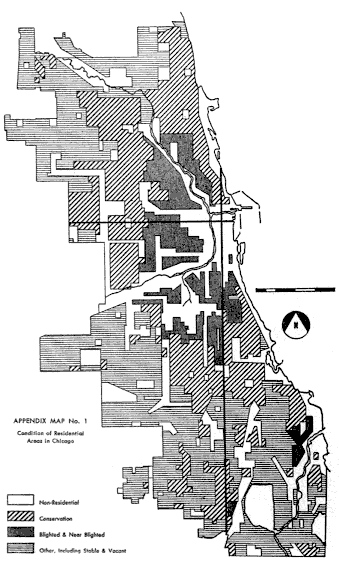
Figure 4.
Chicago Plan Commission's overview of blight in Chicago, ca. 1950.
Note the concentration of blighted, near-blighted, and industrial areas
around the core. The commission identified "conservation" areas as
neighborhoods that could be saved from blight through government
intervention. (From Martin Meyerson and Edward Banfield, Politics,
Planning, and the Public Interest, p. 331.) Copyright © 1955 by The
Free Press; copyright renewed 1983 by Martin D. Meyerson and
Edward C, Banfield. Reprinted with permission of The Free Press,
a Division of Simon and Schuster.
inhabiting the neighborhood order. They present department stores, movies, advertisements, radio, newspapers, and magazines as promising escape from a sense of one's immediate situation while reinforcing the circumscription of opportunity that ushers their young protagonists down narrowing paths to early destruction. "Most of us 20th century Americans are reluctant to admit the tragically low quality of experiences of the broad American masses," asserted Wright in his introduction to Algren's Never Come Morning.[11] Thus, the neighborhood novels typically contain extended descriptions of invented movies that illustrate the impoverishment of mass-cultural formulas; characters develop extravagantly circumscribed fantasies of power or fulfillment based on the repertoires made available to them by billboards, radio jingles, and movies.[12] The limits of mass culture double the tightly defined geographies of the neighborhoods, narrowing the neighborhood characters' sense of the world and what it has to offer, and those characters respond with ignorance to opinions and impulses external to their cultural repertoires. The constriction of cultural avenues available to people on the street and in the neighborhoods creates dissonance with the inchoate desires for more and different life fostered by mass culture. That dissonance motivates Carrie to upward mobility, which she accomplishes by exploiting the frustrated desire of urban theatergoers for more and different sentimental life, but in the neighborhood novels the dissonance makes for a violent and confused set of dispossessed young men-Bigger Thomas, Studs Lonigan, Cass McKay (Somebody in Boots ), Bruno Bicek (Never Come Morning ).
Golden Arm posits the exhaustion of this dissonance. Frankie has a dwindling and quickly expended supply of frustrated violence left in him. Describing Frankie's fellow inmates during a stretch in jail, Golden Arm describes the condition to which the inmates of the novel's "open-roofed jail" of a city are sinking. Not only are they "the ones who just wouldn't work" (as discussed earlier), but "they were the ones who had never learned to want. . . . They were secretly afraid of being alive and the less they desired the closer they came to death" (208). The engine of desire that drives Carrie's world, making its trains run and ordering its social strata, has wound down to a near-standstill. So has the neighborhood novel's cultural critique: three paragraphs later, the observation that these people without desire "didn't even read comic books" carries no particular charge. What can one say about the cultural impoverishment of people sliding below the threshold of culture as Algren and the neighborhood novel understood it? Similarly, Frankie and the others are sliding below the level of politics. Antek tells Frankie, who is being hotly pursued by the police for the murder of a universally despised drug dealer, that the police are acting on the orders of a machine politician who wants to appear tough on crime; Frankie tells Antek to "skip the politics" (321). Pressed so closely by the law, Frankie does not have the luxury to consider the reasons for his dire situation.
Preoccupied with their ceaseless subsistence-level hustling, then, Frankie and his associates are falling into a world below both politics and mass culture, which were two of Chicago realism's favored contexts for evaluating the situation of the industrial working classes. The characters in Golden Arm move behind and beneath the billboards that indicate how power and meaning are arranged in the inner city. Fleeing back to his hideout after visiting the old neighborhood to gather information, Frankie hurriedly passes a billboard that begs "shamelessly in five-foot letters: VOTE FOR UNCLE MIKE" (324), the man behind the manhunt. The barflies at Antek's drink beneath a row of liquor ads depicting alien beings in alien landscapes: "some usurer togged out in woodsman's gear . . . in a clean green land of night-blue lakes and birch trees so straight and tall they looked like ivory-tipped cues"; "a pink-cheeked, overstuffed illiterate" in a private library. "This freshly blooded race bred by the better advertising agencies looked down upon the barflies of the Tug & Maul, trying to understand how it was that these battered wrecks could look as though not one of them had ever seen a land of night-blue lakes with poolroom cues for trees. Nor any man's private library at all. They appeared not even to have discovered the public ones" (233). Like Hurstwood reading about Carrie in the papers, Sophie receives fragments of information from the world of mass culture and struggles to make sense of them by pasting them into her scrapbook. Sophie has yet some stirrings of desire—for a golden age receding into the past, for a real family with a real dog (as opposed to the flatulent Rumdum, given to her by Frankie), for order and clarity on the old neighborhood's model—which help to drive her mad. Many of the others are sinking toward the fate of Hurstwood, who loses access to any reserve of desire as he slides toward skid row and then suicide, asking, "'What's the use?"' (Sister Carrie, 458), a question that vitiates the impulse to consume on which mass culture depends. Frankie and Sparrow go to Gold's department store on Milwaukee Avenue to half-heartedly steal the period's novel consumer items (like ""lectric eyerons"'), not to shop or to refine their consumer personae. Rather than opening up a vista of cultural repertoires, these expeditions deliver Frankie and Sparrow directly into the narrowest landscape of all: they are routinely caught and put in prison.
Drained of desire, Hurstwood and Frankie arrive at remarkably similar places in the final narrowing of their worlds to nothing. Moving within a "disgruntled mass" of Bowery characters "pouring in between bleak walls" into a flophouse, Hurstwood finds himself in a dingy cubicle—"wooden, dusty, hard" (Sister Carrie, 457). Wounded and dying for a fix, Frankie goes to ground in a flophouse on Madison Street, in a little alcove roofed with chicken wire. The two men take very different routes to arrive at this anonymous suicide hotel. Sister Carrie deflects the story of Hurstwood and its distinctly October-city conclusion away from Chicago in the springtime of its golden age to the "old
world" of New York City. Hurstwood rides a series of trains across America to New York, then a series of streetcars through Brooklyn during his stint as a strikebreaker, before the tracks deliver him onto skid row. During that passage, he falls from the upper middle class into anonymous drifterhood, from the walled city into street life—in short, he falls into Nelson Algren's track-bound October city. Frankie never leaves it, riding the closed system of Els and streetcars back and forth, around and around the inner rim of the novel's "constant boundaries," until the final chase delivers him onto Chicago's most notorious skid row with no options left to him.
Frankie hangs himself in a hotel on Madison just east of Racine—within a few blocks of Carrie Meeber's first place in Chicago, the home of her sister Minnie. Minnie and her husband Hanson, a hard—working immigrant ethnic of Swedish parentage, lead a "clean, saving" life, paying "monthly instalments on two lots far out on the West Side" (Sister Carrie, 10 ). Like Vi and Jailer, they have little margin of error separating them from the street: if they both work hard, save, and do not weaken or suffer bad luck, they might eventually own a home in the developing neighborhoods of the West Side. Sickness, bad judgment, or a failure of thrift, on the other hand, will start them on the long downward slope toward the world of The Jungle's Jurgis Rudkus or of Frankie and Sophie. Entering their home, Carrie instantly grasps this precarious situation: "She felt the drag of a lean and narrow life" (11). Minnie and Hanson, with a baby and a hope to own some property, are staving off the process of narrowing that has for the most part run its course in Golden Arm. Vi and Jailer constitute the heavily ironized exceptions to the rule: everyone else in the rooming house at 1860 West Division Street, childless and without prospects, exists far below the possibility of owning or even wanting anything, and in particular of owning a home. The bums in the lockup, the ones whose world has gone down the drain and who expect their own blood to follow, are privy to "the great, secret and special American guilt of owning nothing, nothing at all," a guilt that, fittingly, lies "crouched behind every billboard" (Golden Arm, 17).
When Carrie and Hurstwood flee to the edge of the world, they run to New York; when Frankie and Molly flee to the edge of the world, they go a few blocks down the El line to "where the dark people live, drinking cheaper beer" (127) in the Lake Street ghetto at the base of Milwaukee Avenue, where they take up residence in a tenement apartment on Maypole Street. The Lake Street ghetto resembles Polish Division Street, with its own bars, its own beer, its own Saturday night dancing and music, and its own domestic landscape of furnished rooms under the shadow of the Lake Street El. Even though Golden Arm does not understand the ghetto to present an explanation of decline—as opposed to Lait and Mortimer, who regard racial succession as a principal engine driving Chicago's decline—the ghetto serves to figure the terminal future of Frankie's world. Hurstwood and Carrie's flight to New York clarifies Sister Carrie's com-
posite urban landscape: there are two cities representing two ranges of possibility, the walled city and the Bowery. Fleeing from the white-ethnic inner city into the black inner city, Frankie and Molly discover that they have only narrowed their options a little further—only the faces and the music have changed.
Golden Arm imagines only one city, the October city under the El. It is almost springtime in Golden Arm's expanding ghetto, but, as City on the Make declares, Chicago is "an October sort of city even in spring": "across the littered Negro yard next door . . . February's first touch of thaw was glinting along the rubbled earth. A wheelless, one-fendered chassis of something that might once have been a Chalmers or an Overland stood there with little puddles along its single fender. How many wheelless, one-fendered years it had rusted there no neighbor could have told" (Golden Arm, 315). The ruined machine—an avatar of City on the Make's "rusty iron heart"—constitutes black Chicago's inheritance, what Frankie's people have left to turn over to their successors. Algren was taken with Carl Sandburg's reading of Chicago's race riots of 1919—"The slums take their revenge"—which he repeats in City on the Make.[13] Not only do the slums take their revenge on their inhabitants, but that revenge extends to cover all those living in Chicago's inner city after the industrial city has reached the end of time prophesied in City on the Make. Black Southerners poured into Chicago during the 1940s, 1950s, and 1960s, drawn in great part by precisely those industrial jobs that were leaving the inner city during this period (or would leave soon after). If Golden Arm does not speak directly to this linkage between industrial transformation and folk migration that helped to form the second ghetto, it does so indirectly by putting the ghetto in the shadow of the El and the "rusty iron heart" as the novel brings the October city down the course of "wheelless, one-fendered years" to a final winding-down.
Resonances between Golden Arm and City on the Make, like those between Golden Arm and Sister Carrie, suggest a larger story coded into Golden Arm's claustrophobic landscape and narrative. In retrospect, City on the Make reads like a historical concordance to Golden Arm, providing precisely the big picture that Frankie and Sophie never quite grasp: the undefined doom hanging over their neighborhood is the decline of industrial urbanism that embraces both the urban village and Algren's literary tradition. Golden Arm, in turn, explores in rich and local detail the world of those people subsisting below the threshold of City on the Make's historical imagination. Seen in one of City on the Make's aerial passes, Chicago gives the viewer a "pang," a feeling that "something priceless is being left behind in the forest of furnished rooms, beneath the miles and miles of lights and lights" (76), but City on the Make cannot work down from the level of overview at which it operates (100 years of history and a large cast of famous Chicagoans in perhaps 20,000 words) to make a sustained examination of ordinary human figures moving at street level in the neighborhoods. City on the Make, outlining the story of decline, argues that the Chicago real-
ist tradition must fall with industrial urbanism; Golden Arm aspires to be that tradition's culminative masterpiece, "the last of the Chicago novels" by "the last of the Chicago novelists."
City on the Make is a slim poetic survey, following the model of Sandburg's Chicago Poems and The People, Yes (and dedicated to Sandburg); Golden Arm is a thick realist novel, the Chicago realist tradition's principal literary form.[14] But the two books, both assembled in part from material Algren wrote in the 1930s, contain one another in shared figures and bits of language. Among other things, they share an autumnal mood and an El-enclosed landscape: they both map the October city. City on the Make's landscape, extending much further in space (including the South Side, the Loop, and the suburbs) and in time (from early nineteenth-century prairie through the golden age to the rusting ruins of the future), contains the drastically narrowed midcentury neighborhood terrain of Golden Arm. One epithet for the El in particular, "the constant boundaries of the night," appears repeatedly in both texts, suggesting that the El runs between them, joining microcosm (the landscape of Golden Arm) to big picture (the landscape of City on the Make) as it joined past to present in City on the Make's survey of industrial Chicago's history. The story of Chicago and the story of Frankie Machine take place in one composite landscape defined by the El, positioning the narrative of Frankie's decline and fall to double and condense that of Chicago.
The sense of regret pervading this landscape operates at both scales—primarily traced to a series of citywide failures and historical windings-down in City on the Make, traced to a series of intensely local and personal defeats in Golden Arm. City on the Make argues that there are "no more giants," by which it primarily means that a set of heroic historical figures—writers, reform intellectuals, political leaders, star athletes—active in shaping the city's golden age have no successors in the contemporary city. In Golden Arm, the corpses of anonymous drifters collect in a basement morgue until carpenters come to build coffins for them, "clean pine boxes" all in one size because "there were not many giants any more" (18). Appearing in Golden Arm, the notion of the giants' passing floats free of the frame of reference provided for it in City on the Make. Without sufficient reference to put the line in a suitably outsize narrative frame, this kind of mock-epic diction—"no more giants," "'God has forgotten us all,"' the tendency toward unanimity and ubiquity—grates against the inability of the characters to account for the Atlantean world in which they move. How could one car crash have made everyone everywhere afraid of closing time?
The events that form the history of Golden Arm's world are intensely personal or essentially mythic—a car crash, the withdrawal of neighborhood gods—but these sub- or nonhistorical explanation systems gain much of their literary power precisely from their inadequacy. The pall over the neighborhood
suggests an incomprehensible, annihilating process beyond the grasp of the novel's characters. The car crash, not deindustrialization and suburbanization, is therefore responsible for Sophie's highly developed apocalyptic sense. But the resonances between the city she sees from her window and the models on which it is based—the Chicago outside Nelson Algren's window and the Chicago tradition's Chicago as found in literary antecedents like Sister Carrie —allow a relatively concise, finite, discrete event like the car crash to figure the messy, complex, open-ended, and only intermittently visible transformations of urban life and literature under way in midcentury Chicago. The intertextualities binding Golden Arm to City on the Make and Sister Carrie encourage us in this project of extending Sophie's sense of ultimacy into a historical and literary realm beyond her horizons of understanding. If we read City on the Make together with Golden Arm, City on the Make's sweeping decline seems to grow out of the story of Frankie Machine and his associates, who move through a world supercharged with ultimacy by the decline of industrial urbanism—a story too metropolitan and generational in scale to be articulated by such a relentlessly local-minded novel. Only Sophie can see the fall of industrial urbanism encoded in the world of Golden Arm, and that insight lands her in an asylum.
If Sophie Majcinek, neighborhood type and mythographer of decline, serves as a figure of urban intellectuals like Algren—living in the industrial city of fact and in a city of feeling that drew upon it for sustenance and order—then her conviction of imminent apocalypse begins to make sense. The entangling of neighborhood order and Algren's Chicago realist tradition begins to account for Golden Arm's pervasive ultimacy and extremity. One of Golden Arm's most jarring qualities is its willingness to imagine the industrial neighborhood order, still extensive and thriving in the late 1940s, on its last legs. Similarly, one of City on the Make's most jarring qualities is its willingness to imagine the "monstrous forges" of heavy industry standing like a "rusty iron heart" in a landscape going back to prairie, a vista that did not become standard in depictions of Chicago until the 1970s, when the city's remaining heavy industry went through a highly visible latter phase of deindustrialization. Nelson Algren was not predicting the future, nor was he ready to believe that the phase of his most productive engagement with Chicago was at an end, but when we read Golden Arm as his last Chicago novel it becomes an elegy for industrial urbanism, the way of living in cities represented by both smokestacks and Sister Carrie.