
Three—
Aristotelian Natures and the Modern Experimental Method
Nancy Cartwright
1—
Historical Background
One of the great achievements of the scientific revolution, according to its adherents, was the banishment from modern science of the Aristotelian schemes of explanation which had dominated Scholastic studies. Aristotle was derided as a cuttlefish, a squid: the ink he discharged cast everything into obscurity. Consider one typical case, Pierre Gassendi in his Exercises against the Aristotelians (1624). Gassendi complains that Aristotelian explanations fail to explain. About the definition of motion as "the act of being in potentiality insofar as it is in potentiality," he remarks: "Great God! Is there any stomach strong enough to digest that? The explanation of a rather familiar thing was requested, but this is so complicated that nothing is clear anymore . . . The need for definitions of the words in the definitions will go on ad infinitum " (book 2, exercise 4, article 4).
The scientific revolutionaries favored the certainty of mathematics to the ambiguity of Scholastic accounts. Mathematics was "built on clear and settled signification of names, which admit of no ambiguity." This remark comes from Joseph Glanvill, whose defense of modern thought in Scepsis Scientifica earned him a place in the Royal Society in 1664. On Glanvill's account, Aristotle was exactly the opposite: "Peripatetic philosophy is litigious"; its accounts are "circular"; and its terms are "empty," "ambiguous," and lacking "settled, constant signification." The science of the Scholastics was involved in endless quarrels about words and very little actual investigation, in large part because it tried to explain the behavior of things by reference to their natures. But knowledge of natures, according to the new empiricists of the scientific revolution, is forever beyond our grasp; it is divine, not human. As Gassendi argues, it is not possible for mere humans to know "that something is by nature and in
itself, and as a result of basic, necessary infallible causes, constituted in a certain way" (book 6, article 1). Rather, "it can only be known how a thing appears to one or another" (book 6, article 6).
It is on account of this twofold fact that the Aristotelians got into useless debates over meanings: on the one hand, natures stood at the core of explanation for them; on the other, these natures were intrinsically unknowable. According to the empiricists, then, the Aristotelians inevitably resolved things into qualities that were occult; they could never be genuinely understood but only grasped by definition. Invariably this leads to a total circularity of explanation. The favored example is that of gravity. Glanvill tells us:
That heavy bodies descend by gravity is no better account than we would expect from a rustic; that gravity is a quality whereby a heavy body descends, is an impertinent circle, and teaches nothing. (Scepsis Scientifica , chap. 20)
For the empiricists, we must throw over this attempt to found science on occult natures and instead base everything on the kinds of qualities that appear to us in experience. Even here there is a danger that we may become too ambitious, and Glanvill warns: "If we follow manifest qualities beyond the empty signification of their names, we shall find them as occult as those which are professedly so" (Scepsis Scientifica , chap. 20).
Most modern accounts in the philosophy of science take it that the attempts of the scientific revolution to banish natures from science were successful. The idea of natures operating in things to determine their behaviors was replaced by the concept of a law of nature. Here is a short history, told by a modern-day empiricist, to illustrate:
Aquinas was at pains to contest a preceding scholastic view that everything which happens, does so because it is directly and individually willed by God. This would seem to make science a pointless enterprise; according to Aquinas it also denigrates creation. Yet theology points to God as ultimate cause. The reconciliation Aquinas offered was this: to explain why phenomena happen as they do, requires showing why they must; this necessity however derives from the natures of the individual substances involved—which themselves are as they are because of God's original design. Thus the necessity does derive ultimately from God's decrees for the world as a whole, made at the point of creation—but derives proximately from the local conditions and characters in the Aristotelian pattern . . .
. . . if we look more closely at the seventeenth century we see an insistence, even more adamant than Aquinas', upon the autonomy of physics from theology. Descartes insists on it most stringently . . .
The Drang nach Autonomie of physics, even as developed by such theological thinkers as Descartes, Newton, and Leibniz, needed an intermediate link between God's decree and nature. Aquinas had needed such a link to explain proximate causation, and found it in the Aristotelian substantial forms (individ-
ual natures). For the seventeenth century another kind was needed, one that could impose a global constraint on the world process. In general terms, this link was provided by the idea that nature has its inner necessities, which are not mere facts, but constrain all mere facts into a unified whole. The theological analogy and dying metaphor of law provided the language in which the idea could be couched. (Bas van Fraassen, Laws and Symmetry [Oxford: Clarendon Press, 1989], 4–6)
My thesis here is that this story is distorted (at least as it applies to modern experimental science). We have not replaced natures by laws of nature . For laws of nature are typically about natures, and what they produce. Rather, what we have done is to replace occult powers by powers that are visible, though it may take a very fancy experiment to see them. This is already apparent in Francis Bacon. Bacon still employs the Aristotelian idea of natures or essences, but for him these are not hidden. Bacon looks for the explanatory essences, but he looks for them among qualities that are observable. Consider his hunt for the essence of heat. He makes large tables of situations in which heat occurs, in which it is absent, and in which it varies by degrees. "Instances agreeing in the Form of Heat" (Novum Organum , 1620) include, for instance, rays of the sun; damp, hot weather; flames; horse dung; strong vinegar; and so forth. Then he looks to see what other quality is always present when heat is present, and always absent when heat is lacking. In this way, he finds the true, simple nature that consitutes heat: motion. The point is that Bacon still hopes to find the nature of heat, but among visible, not occult, qualities.
Modern explanation similarly relies on natures, I will argue; the modern natures are like Bacon's and unlike those of the Scholastics, in that they are attributed to observable structures and qualities. Generally they differ from Bacon's in that they do not lie on the surface and are not to be observed with the naked eye. Rather, we often need very subtle and elaborate experiments in order to see them. Modern science insists that we found explanation on experimentally identifiable and verifiable structures and qualities. But, I maintain, what we learn about these structures and qualities is what it is in their natures to do.
What we have done in modern science, as I see it, is to break the connection between what the explanatory nature is—what it is, in and of itself—and what it does. An atom in its excited state, when agitated, emits photons and produces light. It is, I say, in the nature of an excited atom to produce light. Here the explanatory feature—an atom's being in the excited state—is a structural feature of the atom, which is defined and experimentally identified independently of the particular nature that is attributed to it in this case.[1] It is in the nature of the excited atom to emit light, but that is not what it is to be an atom in an excited state. For modern science, what something really is—how it is defined and identified—and what it is in its nature to do are quite separate things. So even a perfect and complete modern theory would never have the
closed, deductive structure that the Aristotelians envisaged. Still, I maintain, the use of Aristotelian-style natures is central to the modern explanatory program. We, like Aristotle, are looking for "a cause and principle of change and stasis in the thing in which it primarily subsists" (Physics 2.1.192b22), and we, too, assume that this principle will be "in this thing of itself and not per accidens ."
Yet, even at this very cursory level of description, we differ from Aristotle in three important ways. First, as in my example of an atom in an excited state, we assign natures not to substances but rather to collections or configurations of properties, or to structures. Second, like the early empiricists and the mechanical philosophers of the scientific revolution, modern physics supposes that the "springs of motion" are hidden behind the phenomena and that what appears on the surface is a result of the complex interaction of natures. We no longer expect that the natures that are fundamental for physics will exhibit themselves directly in the regular or typical behavior of observable phenomena. It takes the highly controlled environment of an experiment to reveal them. Third, having made the empiricist turn, we no longer identify natures with essences. As I have described in this section, in modern science we separate our definition of a property from our characterization of what kind of change it naturally produces. Still, when we associate a particular principle of change with a given structure or characteristic, we expect that association to be permanent, to last so long as the structure is what it is. Indeed, it is this permanence of association that I will underline by claiming that modern science still studies Aristotelian-style natures. Of course, these are not really Aristotelian natures. For one thing, we seem to share none of the concerns about substance and individuation in which Aristotle's concept was embedded. There are a number of other differences as well. Nevertheless, I call them "Aristotelian" because of the inheritance through the Scholastics to the "New Philosophy" of Galileo, Bacon, and Descartes.
What I will do in the remainder of this paper is: first, explain in more detail what this claim amounts to by contrasting it with a more standard empiricist account of laws of nature; and second, provide one argument in favor of the thesis—an argument that says that one cannot make sense of modern experimental method unless one assumes that laws are basically about natures. The basic point of view I urge here is similar to that which I have written about at length in Nature's Capacities and Their Measurement (Oxford: Oxford University Press, 1989), but the fundamental argument is new.
2—
Natures and the Analytic Method
In defending natures, I take my principal antagonist to be the modern empiricist account of laws which rests on a distinction crucial to the thought of Locke, Berkeley, and Hume: the distinction between powers and sensible
qualities. According to Hume, powers are not accessible to us through our senses, and hence must be excluded from science. Nowadays, the distinction takes a slightly different form, between the power things have to behave in certain ways, on the one hand, and the actually exhibited behaviors, on the other. But modern empiricists in the Hume tradition remain just as eager as Hume himself to reject powers. Laws of nature, they insist, are about what things do . I want to maintain, by contrast, that fundamental laws are generally not about what things do but what it is in their nature to do. Consider Coulomb's law of electrostatic attraction and repulsion. Coulomb's law says that the force between two objects of charge q1 and q2 is equal to q1q 2 /r2 . Yet, this is not the force the bodies experience; they are also subject to the law of gravity. We say that Coulomb's law gives the force due to their charge. But this is no concept for an empiricist: Coulomb's is not the force that actually occurs; rather, it is a hypothetical power hidden away in the actual force.
I think the best account we can give is in terms of natures. Coulomb's law tells not what force charged particles experience but rather what it is in their nature, qua charged, to experience. Natures are something like powers. To say it is in their nature to experience a force of q1 q2 /r2 is to say at least that they can experience this force if only the right conditions occur for the power to exercise itself; for instance, if they have very small masses so that gravitational effects are negligible. It is also to say that their tendency to experience it persists, even when the conditions are not right; for instance, when gravity becomes important. Qua charged, they tend to experience a mutual force q1q2 /r 2 ; qua massive, they tend to experience a different force (Gm1m2 /r 2 ). What particles that are both massive and charged actually experience will be a function of what they experience qua charged and what they experience qua massive.
It is to mark this fact, the fact that charge always "contributes" the same force, that I use the Aristotelian notion of nature. But, as I remarked in referring to Bacon, these modern natures differ from Aristotle's in one very central respect. Although it is in the nature of charge to be subject to a force of q1q2 /r 2 , in the sense that this is what particles experience qua charged, this nature does not in any proper Aristotelian way reveal the essence of charge. What charge is depends on a lot of factors independent of Coulomb's law. As Gerd Buchdahl puts it, there is a mere "brute-fact connection" between what charge is and how charged particles behave qua charged (Metaphysics and the Philosophy of Science [Oxford: Blackwell, 1969]).
One customary response that Humeans make to the kinds of problems I am raising is to resort to counterfactuals. They talk not in terms of actually exhibited qualities and behavior but in terms of possible qualities and behaviors. Coulomb's law gives the force two bodies would experience if their masses were equal to zero. From an empiricist point of view this is a peculiar kind of counterfactual to find at the foundation of our study of motion, for it is one whose antecedent can never be instantiated. But that is not my principal concern.
Instead, I want to point out two other nonempiricist elements that are concealed in this account. The first comes to light when we ask, "Why do we want the masses to go to zero?" The answer: "Because we want to find out what the total force would be, were there no other forces at work." It is the "at work" that one should notice. Put in this blunt fashion, it suggests that the counterfactual account itself is grounded in ideas about powers and their operation, as no good Humean would allow. So the counterfactual antecedent "were the masses equal to zero" is used instead.
My second concern becomes apparent when one asks the obvious next question, "Why do we want to know what the force between charged bodies would be were no other forces at work?" This case is just one particular case among all conceivable ones, and a peculiarly inconvenient one at that. Why, then, are these circumstances so special? They are special because these are the circumstances in which all the hindrances are stripped away so that we can find out what charged particles do "on their own"—that is, what they do by virtue of being charged. This is how they would attract or repel one another were "only" charge at work; and it is how they try to behave even when other factors impede them.
We discover the nature of electrostatic interaction between charges by looking in some very special circumstances. But the charge interaction carries that nature with it, from one circumstance to another. That is why what we call the analytic method in physics works: to understand what happens in the world, we take things apart into their fundamental pieces; to control a situation we reassemble the pieces, we reorder them so they will work together to make things happen as we will. You carry the pieces from place to place, assembling them together in new ways and new contexts. But you always assume that they will try to behave in new arrangements as they have tried to behave in others. They will, in each case, act in accordance with their nature.[2]
The talk of pieces and assembly is a metaphor. How do the behaviors dictated by different natures combine when they are constrained to operate together? There is no general receipt; the answer is, at best, subject-specific. In mechanics, a total force is constructed by vectoral addition from the forces that each component tries separately to create. In the simultaneous-equation models of econometrics, the natural behavior of each independent mechanism is represented in a different equation; when a number of mechanisms work together, all the equations must be satisfied at once. The way in which literal mechanical pieces function together is different again. We employ the method of analysis and synthesis to make predictions and to shape behavior to our own wishes. In each case, we exploit the fact that the pieces when assembled together each continue to "contribute" in accord with their natures. What actually results in a specific case is fixed not only by the natures of the parts but also by the rules that dictate what happens in that domain when natures act together.
The analytic method is closely associated with what we often call Galilean idealization. Together idealization and abstraction form a familiar two-tiered process that lies at the heart of modern scientific inquiry. First, we try to find out by a combination of experimentation, calculation, and inference how the feature under study behaves, or would behave, in a particular, highly specific situation. By controlling for, or calculating away, the gravitational effects, we try to find out how two charged bodies would interact if their masses were zero. But this is just a stage; in itself this information is quite uninteresting. The ultimate aim is to find out how the charged bodies interact not when their masses are zero, nor under any other specific set of circumstances, but rather how they interact qua charged. That is the second stage of the inquiry: we abstract the nature of the charge interaction from how charges behave in these specially selected "ideal" circumstances.
The key here is the concept "ideal." On the one hand, we use this term to mark the fact that the circumstances in question are not real or, at least, that they seldom obtain naturally but require a great deal of contrivance even to approximate. On the other, the "ideal" circumstances are the "right" ones—right for inferring what the nature of the behavior is, in itself. Focusing on the first aspect by itself downplays our problems. We tend to think that the chief difficulties come from the small departures from the ideal that will always be involved in any real experiment: however small we choose the masses in tests of Coulomb's law, we never totally eliminate the gravitational interaction between them; in Galilean experiments on inertia, the plane is never perfectly smooth nor the air resistance equal to zero; we may send our experiments deep into space, but the effect of the large massive bodies in the universe can never be entirely eliminated; and we can perform them at cryogenic temperatures, but the conditions will never, in fact, reach the ideal.
The problem I am concerned with is not whether we can get the system into circumstances where it can operate on its own but rather: what does it mean when we say that the circumstances are ideal, or that the system is operating "on its own"? What is it that dictates which other effects are to be minimized, set equal to zero, or calculated away? This is the question, I maintain, that cannot be answered given the conventional empiricist account of laws. No doubt, in any particular experiment, the equipment we move about, the circumstances we contrive, and the properties we calculate away, are ones that can be described without mentioning natures. But in each case, what makes that arrangement of equipment in those particular circumstances "ideal" is the fact that these are the circumstances where the feature under study operates, as Galileo taught, without hindrance or impediment, so that its nature is revealed in its behavior. Until we are prepared to talk in this way about natures and their operations, to fix some circumstances as felicitous for a nature to express itself, and others as impediments, we will have no way of determining which
principle is tested by which experiment. It is this argument that I want to develop in the rest of this paper.
3—
How Do We Know What We Are Testing?
For anyone who believes that induction provides the primary building tool for empirical knowledge, the methods of modern experimental physics must seem unfathomable. Usually the inductive base for the principles under test is slim indeed, and in the best experimental designs, where we have sufficient control of the materials and our knowledge of the requisite background assumptions is secure, one single instance can be enough. The inference, of course, is never certain, nor irrevocable. Still, we proceed with a high degree of confidence, and indeed, a degree of confidence that is unmatched in large-scale studies in the social sciences, where we do set out from information about a very great number of instances. Clearly, in these physics experiments we are prepared to assume that the situation before us is of a very special kind: it is a situation in which the behavior that occurs is repeatable. Whatever happens in this situation can be generalized.
This peculiar kind of repeatability that we assume for physics experiments requires a kind of permanence of behavior across varying external conditions that is comparable to that of an essence, although not as strong. For example, we measure, successfully we think, the charge or mass of an electron in a given experiment. Now we think we know the charge or mass of all electrons; we need not go on, measuring hundreds of thousands. In so doing, we are making what looks to be a kind of essentialist assumption: the charge or mass of a fundamental particle is not a variable quantity but is characteristic of the particle so long as it continues to be the particle it is.
In most experiments we do not investigate just the basic properties of systems such as charge, but rather more complicated trains of behavior. Diagrammatically, we may think of Galileo's attempts to study the motions of balls rolling down inclined planes; or, entirely at the opposite end of the historical spectrum, the attempts in Stanford's Gravity-Probe-B experiment to trace the precession of four gyroscopes in space, to see how they are affected by the space-time curvature relativistically induced by the earth. Here, too, some very strong assumptions must back our willingness to draw a general conclusion from a very special case. On the surface, it may seem that the license to generalize in these cases can be put in very local terms that need no reference to natures. We require only the assumption that all systems so situated as the one in hand will behave identically. But I think on closer inspection we can see that this is not enough.
We may begin to see why by considering Hume himself. Hume maintained the principle "same cause, same effect." For him, every occurrence is an exem-
plar of a general principle. It is simply a general fact about the world, albeit one we can have no sure warrant for, that identically situated systems behave identically. Hence for Hume, the license to generalize was universal. But not for us. We cannot so easily subscribe to the idea that the same cause will always be succeeded by the same effect. Hume assumed the principle to be true, though not provable. He worried that principles like this one could only be circularly founded, because they could have no evidence that is not inductive. But nowadays we question not just whether our belief in them can be well-founded but whether they are true. Even if we were content with merely inductive warrant, in what direction does our evidence point? The planetary motions seem regular, as do the successions of the seasons, but in general, Nature in the mundane world seems obstinately chaotic. Outside the supervision of a laboratory or the closed casement of a factory-made module, what happens in one instance is rarely a guide to what will happen in others. Situations that lend themselves to generalization are very special, and it is these special kinds of situations that we aim to create, both in our experiments and in our technology. My central thesis here is that what makes these situations special is that they are situations that permit a stable display of the nature of the process under study, or the stable display of the interaction of several different natures.
The case is especially strong when we turn from fictional considerations of ideal reasoning to considerations of actual methodology. Here questions of true identity of circumstance drop away. We never treat complete descriptions; rather we deal with salient characteristics and relevant similarities . This is a familiar point. You do not have to specify everything. If the right combination of factors is fixed, you are in a position to generalize. Yet what makes a specific combination a right one? What is the criterion that makes one similarity relevant and another irrelevant? Case by case, after the fact, it seems we can avoid an answer. We need only say, "In this case, we have picked thus-and-so set of factors; and we assume that so long as this particular set of factors is fixed, the behavior that obtains will be general."
This is the position we arrived at a few paragraphs ago. It provides a defense, of kinds, one by one, of each generalization that we are willing to make on the basis of an experimental study. But it provides no account of what we do. Experiments are designed with intense care and precision. They take hard work, and hard thought, and enormous creative imagination. The Gravity-Probe experiment which I mentioned above is an exaggerated example. It will only be set running twenty years—twenty years of fairly continuous effort—after it was initiated, and it will have involved teams from thirty or forty different locations, each solving some separate problem of design and implementation.
What can account for our effort to make the experimental apparatus just so and no other way? Take the Gravity Probe as a case in point. Each effort is directed to solve a specific problem. One of the very first in the Gravity Probe
involved choosing the material for the gyroscopes. In the end, they are to be made of fused quartz, since fused quartz can be manufactured to be homogeneous to more than one part in 106 . The homogeneity is crucial. Any differences in density will introduce additional precessions, which can be neither precisely controlled nor reliably calculated, and these would obscure the nature of the general-relativistic precession that the experiment aims to learn about.
In this case, we can imagine that the physicists designing the experiment worked from the dictum, which can be formulated without explicit reference to natures, "If you want to see the relativistic precession, you had better make the gyroscope as homogeneous as possible," and they wanted to do that because they wanted to eliminate other sources of precession. But more than that is necessary. The total design of the experiment must take account not only of what else might cause precession but also of what kinds of features would interfere with the relativistic precession, what kinds of factors could inhibit it, and what is necessary to ensure that it will, in the end, exhibit itself in some systematic way. When all these factors are properly treated, we should have an experiment that shows what the nature of relativistic precession is. That is the form, I maintain, that the ultimate conclusion will take.
But that is not the immediate point I want to make. What I want to urge is that, by designing the experiment to ensure that the nature of relativistic precession can manifest itself in some clear sign, by blocking any interference and by opening a clear route for the relativistic coupling to operate unimpeded—according to its own nature—by doing just this, the Gravity-Probe team will create an experiment from which it is possible to infer a general law. At the moment, the form of this law is not my chief concern. Rather, what is at stake is the question, "What must be true of the experiment if a general law of any form is to be inferred from it?" I claim that the experiment must succeed at revealing the nature of the process (or some stable consequence of the interaction of natures) and that the design of the experiment requires a robust sense of what will impede and what will facilitate this. The facts about an experiment that make that experiment generalizable are not facts that exist in a purely Humean world.
It is, of course, not really true that my thesis about the correct form of natural laws is irrelevant to my argument. Put in the most simple-minded terms, what I point out is the apparent fact that we can generalize from a single observation in an experimental context just because that context is one in which all the relevant sources of variation have been taken into account. Then, after all, what I claim is that it is laws in the form I commend—that is, laws about natures—that determine what is and what is not relevant. This sets the obvious strategy for the Humean reply: laws, in the sense of universal or probabilistic generalizations, determine the relevant factors an experiment must control to ensure that it is repeatable. I will discuss this strategy briefly in
the next section. Before turning to it, though, I want to make some clarifications about the concept of generalizability.
I have been using the term 'generalizable' and the term 'repeatable'. Both can be taken in two senses in this discussion. I claim that the Gravity Probe aims to establish a general law about the nature of the coupling of a spinning gyroscope to curved space-time and thereby to learn something about the truth of the general theory of relativity. But along the way, as a by-product, the experiment will reveal, or instantiate, another considerably less abstract law, a law that can far more readily be cast into the conventional form of a universal generalization. This is a law to the effect that any fused-quartz gyroscope of just this kind—electromagnetically suspended, coated uniformly with a very, very thin layer of superfluid, read by a SQUID detector, housed in a cryogenic dewar, constructed just so . . . and spinning deep in space—will precess at the rate predicted. We expect a law like this to obtain because we expect the experiment to establish a stable environment in which whatever happens would happen regularly; that is, we expect the experimental results to be repeatable.
This is a sense of repeatability internal to the experiment itself: given that the experiment is a good one, if it were to be rerun in the same way with the same apparatus, it should teach the same lesson. We need not demand that the regularity instantiated be expressible in some particular language—or in any language, for that matter; nor, as Harry Collins stresses (Changing Order [London: Sage Publications, 1985]), need we insist that the knowledge of how to build the apparatus be explicit knowledge that could be read from the experimenter's notebooks or that could be written in a "how-to-build-it" manual.[3] Yet, if the experiment is to bear on the more general conclusion which we, in the end, want to establish, we do want to insist on the regularity. For part of what is meant by the hypothesis that the coupling between the gyroscope and the curvature has a special nature that bears on the truth of general relativity is that there is a proper, predictable way in which it will behave on its own, if only the circumstances are propitious. To the degree that we doubt that the experiment is repeatable, to that degree at least must we doubt that the behavior we see is a sign of the nature we want to discover.
Although the general (albeit low-level) law that expresses this first kind of repeatability is, it seems, a universal generalization of the conventional form, still the argument I want to make for the necessity of some nonstandard forms in the background bears on it just as forcefully as on the more abstract law that seems directly to describe natures. As with the higher-level law, so too, with the lower-level: if we want to understand why we are entitled to accept this law on such a thin inductive base as the Gravity Probe's four gyroscopes, and if we want to understand the painstaking details of design the experimenters labor over to produce the conditions of the law, we will have to use the idea of a nature, or some related non-Humean notion.
Indeed, I want to make a fairly strong claim here. In the order of generality, the low-level generalization about what happens in just this kind of experimental setup comes first, and the more abstract claim about the general nature of the coupling comes second. We tend to think that the order of warrant is parallel: the low-level generalization comes first and is most secure; the more abstract law derives what warrant it gets from the acceptance of the generalization. I want to urge that there is an aspect of warranting for which this picture is upside down. It is just to the extent that we acknowledge that the experiment is well designed to find out the natures of the interaction, described in the higher-level law, that we are entitled to accept the low-level generalization on the basis of the experimental results.[4]
This is the central argument with which this section began. But it bears repeating now that the distinction between low-level laws, in the form of generalizations, and high-level abstractions has been drawn. Most situations do not give rise to regular behavior. But we can make ones that do. To do so, we deploy facts about the stable natures of the processes we manipulate, and the circumstances that will allow these natures either to act unimpeded or to suffer only impediments that can have a stable and predictable effect. When we have such a situation, we are entitled to generalize from even a single case.[5]
The philosophical underpinning that supports these claims is a more radical shift from the picture in which the conventional view of laws is embedded than I have admitted so far. The conventional view sees laws as universal generalizations and thus takes regularities as given in Nature, as the things that Nature sets, by law. I want to urge that not only must we admit natures into our scientific world picture, contrary to Humean predilections, but in a sense we must eliminate regularities. These are, after all, very rare—at least when we focus on quantitatively exact behavior of the kind we study in physics[6] —and when they occur, either naturally or as a result of human contrivance, they can very plausibly be seen as the consequence of particularly fortunate arrangements that allow the processes involved to play out their stable natures in their occurrent behavior.
Return now to the two senses of repeatability. The first sense is internal to the specific experiment and bears on the low-level generalization that is instanced there. The second sense crosses experiments and bears on the high-level, abstract principle that is established: the results of an experiment should be repeatable in the sense that the high-level principles inferred from a particular experiment should be borne out in different experiments of different kinds. In Nature's Capacities and Their Measurement , this kind of repeatability played a central role in arguing for the abstract character of our high-level laws in physics and for the claim that these abstract laws describe what I here call "natures."[7] Low-level generalization is not enough. It is too tied to the specific details of the particular experiment; a generalization about what occurs there simply does not cover what occurs elsewhere.
We might think that the problem arises merely from the fact that the language of these low-level laws is not abstract enough: we should not be talking about what happens to a spherically homogeneous ball of fused quartz, coated with a superconductor and spinning, electromagnetically suspended, in midair. Rather, we should talk about a gyroscope, and how it precesses. Still the move to more abstract language will not permit us to retain the simple, unproblematic form of a universal generalization. For we do not want to record what all gyroscopes facing a significant space-time curvature do . Rather, we want to record what part the curvature-coupling contributes to how a gyroscope precesses, no matter what, in the end, various and differently situated gyroscopes do. As I described in section 2, that is the core of the analytic method. The point is that we want to learn something from an experiment that is transportable to entirely new situations where quite different circumstances obtain. We do that not by constructing super-abstract generalizations but rather by learning the nature of the pieces from which the new situations are built.
I will not dwell on this argument. More about it can be found in Nature's Capacities . The argument I have wanted to make here is different. In Nature's Capacities , I argue that we need something like natures if we are to generalize in the second sense—to infer from the results of one experiment some kind of law that can cover other situations as well. Here, I want to urge that we need the notion of natures to generalize in the first sense as well—to infer from the results of the experiment some general law that describes what happens, just in this experimental situation, whenever the experiment is run again. Returning to the remarks at the beginning of this section, I may put the point another way. How do we know which generalization, in this low-level sense, the experiment is testing? Not every feature of it is necessary to ensure its repeatability. The answer requires the notion of natures: the features that are necessary are exactly those which, in this very specific concrete situation, allow the nature of the process under study to express itself in some readable way. No weaker account will do. Without the concept of natures we have no way of knowing what it is that we are testing.
4—
Two Objections
I have been arguing that in order to understand what makes experiments special, what ensures that we can generalize from them, we must employ concepts repugnant to a Humean, such as nature, power, impediment, operation. The most obvious responses for a Humean to make would be either that the job can be equally well done by referring only to "occurrent properties" and their regular associations or else that this is a job that does not need to be done.
a . Consider the first objection. We want to figure out what factors are relevant—what factors need to be controlled in a given experiment if that ex-
periment is to be replicable. Imagine, for the sake of argument, that we have available an entire register of all lawlike regularities and that we are not going to quibble about the fact that most of these are as foreign to our world as unicorns. How are we to deploy them? What do we do to determine from this register whether a given factor in our experiment is relevant or not, and needs to be controlled? I suppose the procedure envisaged by the Humean is, very roughly, this: take all those laws whose consequents describe the same kind of behavior (for example, precessing in a gyroscope) as that of the law we wish to infer from our experiment; any factor that appears in the antecedents of one of these laws is a relevant factor—that is, a factor that must be controlled in any experiment to test the law at hand. But at which level of law are we to conduct our search?
At the lower level, there are a very great number of laws indeed. Gyroscopes of all shapes and materials and forms can precess, or fail to precess, in an inconceivable number of different determinate ways in a plentitude of different circumstances. The conditions are too numerous. They give us too many factors to control. Our experiments would be undoable, and the laws they entitle would be narrowed in scope beyond all recognition. But there is a deeper problem: how are these laws to be read? For the Humean, they must be the source of information about not only what factors are to be controlled but in exactly what way. Yet they cannot tell us that, for how a factor operates, at this very concrete level, is far too context-dependent. I give some examples of this kind of context dependence elsewhere.[8]
But I think the point is easy to see. To know exactly what to do with the superconducting coating in the Gravity Probe, one needs to know about the detailed construction of that particular experiment; and the laws one wants to look at are not more laws about precessions but rather laws about superconductors. The point is not whether these further laws are Humean in form or not but rather, how is the Humean to know to look at them? What is the prescription that sorts from among all the factors that appear in all the universal generalizations true in the world, which ones are to be fixed, and how, in this particular experiment?
Perhaps the answer comes one level up. Here I think is where we get the idea that there might be a relatively small number of fixed, probably articulable, factors that are relevant. We may think in terms of forces, how few in kind they are; or of long lists of causes and preventives. What is crucial is that at the abstract level, context seems irrelevant. Either it is or it is not the case that magnetic fields deflect charged particles; or that, as quantum mechanics teaches, an inversion in a population of molecules can cause lasing. Perhaps we can even find a sufficiently abstract law so that the problem seems to evaporate. For example, if we are thinking of an experiment where the effect we look for involves particle motions, we turn to the law F = ma, and that tells us that we must control all sources of force. In the gyroscope experiment, the law of
choice in this case would be

which gives the drift rate

The difficulty with this advice is that it does not justify the replicability we expect unless we join to it a commitment to stable powers of the kind I have been calling natures, or something very much like them. To see why, imagine a single successful run of the experiment, successful in the sense that first, we have indeed managed to set the total net torque, barring that due to relativistic coupling, equal to zero—or, as the Gravity Probe hopes to do, at least to an order of magnitude lower than that predicted for the relativistic effect; and second, it turns out that the observed precession is just that predicted. We seem to have succeeded in giving a purely Humean receipt for when to generalize, and this case fits. Roughly, we can generalize the quantitative relation we see between a designated input (here the relativistic coupling) and the precession actually observed in a given situation if that situation sets the remaining net torque equal to zero (or, more realistically, calculates it away), where the rationale for picking net torque = 0 as the relevant feature comes from the "Humean association" recorded in the functional law that describes the size of precessions.
The problem is that this does not get us the detailed generalization we expect (at the first, lower level). The Gravity-Probe team has worked hard to set the total net torque extremely low, by a large number of specific hard-won designs; and they are entitled to think that the results are replicable in that experimental design. What the Humean prescription entitles them to is weaker. It gives them the right to expect only that on any occasion when the net nonrelativistic torque is zero, the precession will be the value predicted from the general theory of relativity. But we expect the more concrete general claim to hold as well.
Consider the table of design requirements for the gyroscope experiment (diagram 1). The table tells how controlled each foreseeable source of torque must be in order for the total extraneous precession to be an order of magnitude smaller than that predicted from the relativistic coupling. Each such source—rotor homogeneity, rotor sphericity, housing sphericity, optimum preload, and so on—presents a special design problem; and for each, the experiment has a special solution. Using fused quartz to get maximum rotor homogeneity is, for example, the starting point for the solution of the first problem. What all this careful planning, honing, and calculation entitles us to is a far more concrete generalization than the one above about (near) zero
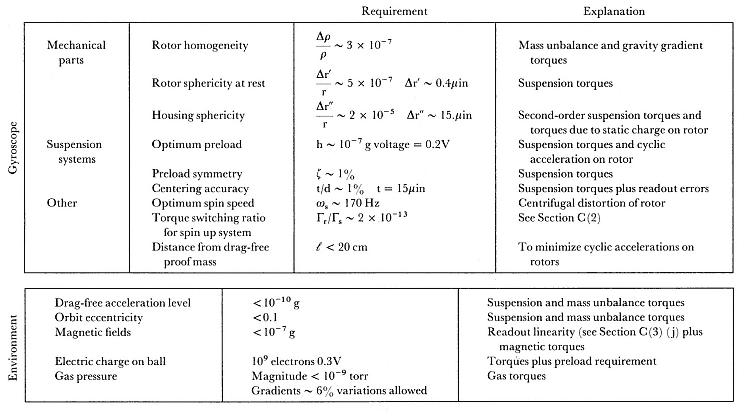
Diagram 3.1
Design Requirements for a Relativity Gyroscope with Limiting Accuracy of 0.5 × 10⁻¹⁶ rad/sec (0.3 milliarc-sec/year) (From C. W. F.
Everitt, coordinator, Report an a Program to Develop a Gyro Test of General Relativity [Stanford, Calif.: W. W. Hansen Laboratories,
Stanford University, 1980].)
external torque. We are entitled to infer from a successful run that in any experiment of this very specific design, the observed precession should be that predicted by the general theory of relativity.[9]
The table of requirements highlights the analytic nature of this kind of experiment, which I discussed in section 2. What happens if something goes wrong with the rotor housing as it was originally planned, and the fault cannot be repaired? With a lot of effort, the Probe team will make a new design and slot it into the old general scheme, making appropriate changes. Because we are working in a domain where we trust analytic methods, a peculiar kind of sideways induction is warranted: from the successful run with the original design plus our confidence in the new rotor housing and its placement, we are entitled to infer a second, highly specific "low-level" generalization to the effect that the precession in situations meeting the new design will be that predicted for relativistic coupling as well. Again, the new situation will indeed be one that falls under the "Humean" generalization involving zero torques. What is missing is the connection. The new situation is one of very small extraneous torque; but the expectation that it should be cannot be read from the regularities of nature.
The regularity theorist is thus faced with a dilemma. In low-level, highly concrete generalizations, the factors are too intertwined to teach us what will and what will not be relevant in a new design. That job is properly done in physics using far more abstract characterizations. The trouble is that once we have climbed up into this abstract level of law, we have no device within a pure regularity account to climb back down again.
b . The second argument is a more transcendental one. It does not attempt to show how it is possible to fix relevance in a world without natures but rather that it must be possible to do so. I borrow the form from arguments made by Bas van Fraassen and by Arthur Fine in debating more general questions of scientific realism. The argument presupposes that we can make available a pure data base, cleansed of natures and their non-Humean relatives. The objection goes like this: "You, Cartwright, will defend the design of a given experiment by talking about what impedes and what facilitates the expression of the nature in question. I take it this is not idle faith but that in each case you will have reasons for that judgment. These reasons must ultimately be based not in facts about natures, which you cannot observe, but in facts about actual behavior, which you can. Once you have told me these reasons, I should be able to avoid the digression through natures and move directly to the appropriate conclusions about relevance. Talk of natures may provide a convenient way to encode information about behaviors, but so long as we insist that scientific claims be grounded in what can be observed, this talk cannot contribute any new information."
But what about this decontaminated data base? Where is it in our experi-
ence? It is a philosophical construction, a piece of metaphysics, a way to interpret the world. Of course, we cannot do without interpretation. But this construction is far more removed from our everyday experience of the world as we interact with it and describe it to others than are homely truths about triggering mechanisms, precipitating factors, impediments, and the like which mark out the domain of natures. Consider an adaptation of van Fraassen's objection to causes, which is a version of essentially the same argument. The objection proceeds from the assumption that there is some defensible notion of a sensible property which is conceptually and logically distinct from any ideas connected with natures. We are then confronted with a challenge to explain what difference natures make: "Imagine a world identical with our own in all occurrences of its sensible qualities throughout its history. How would that world differ from our world?"
On one reading, this argument may be about sequences not of properties in the world but of our experiences of the world. These sequences are to remain the same, but we are to imagine that they are not caused in the usual way by what is going on in the world around us. This reading cannot be the one intended, though, since it does not cut in the right way, revealing special virtues for descriptions like 'is red' or 'is a jet-stream trail' in contrast with ones like 'has the power to relieve headaches' or 'attracts others, qua charged'.
I might further be invited to inspect my experiences and to notice that they are "really" experiences of successions of color patches, say, with powers nowhere to be found. The philosophical dialogue along this line is well rehearsed; I merely point in the familiar directions. My experiences are of people and houses and pinchings and aspirins, all things which I understand, in large part, in terms of their natures. I do not have any raw experience of a house as a patchwork of colors. Even with respect to colors, my experience is of properties like red, whose nature it is to look specific ways in specific circumstances. Sense data, or the given , are metaphysical constructs which, unlike natures, play no role in testable scientific claims. Once there was a hope to mark out among experience some raw pieces by using an epistemological yardstick: the "real" experiences were the infallible ones. After a great deal of debate it is not clear whether this criterion even lets in claims about felt pains; but it surely does not distinguish claims like 'The stripes are red' from 'Your pinching makes my arm hurt'.
The contemporary version of this argument tends, for these reasons, not to be in terms of sense experiences but in terms of sensible properties. But here there is a very simple reply. A world with all the same sensible properties as ours would already be a world with natures. As I remarked above, redness is the property whose nature, among other things, is to look just this way in normal circumstances, and to look systematically different when the circumstances are systematically varied.
Perhaps we are misled here by carrying over the conclusions of an earlier
metaphysics, conclusions for which the premises have been discarded. These premises involve the doctrine of impressions and ideas. In the immediately post-Cartesian philosophy of the British empiricists, sensible properties could be picked out because they looked like their impressions. Gaze at the first stripe on the American flag: redness is the property that looks like that . We do not have this copy theory; so we do not have properties that are identified like that. Correlatively, we can no longer make the same distinction separating powers and their properties as did these seventeenth-century empiricists. On their doctrine, the way things looked could get copied in the perceiver's impressions of them; but the various powers of a property could not. Since their ideas were copies of their impressions, necessarily their world, as imaged, had only inert properties. But we do not have the copy theory of impressions, nor do we adopt this simple theory of concept formation. For us, there are properties, and all properties have powers. (Perhaps, following Sydney Shoemaker, they are all just conglomerates of powers: cf. Identity, Cause, and Mind [Cambridge: Cambridge University Press, 1984], chap. 10.) What they are is given not by how they look but by what they do. When we use a particular power word to describe a property, we focus on one specific aspect of what it can accomplish. When we use an "occurrent" or "sensible" predicate, we refer to the property without highlighting any one thing it does, or any one particular way of identifying it. That is only a very rough characterization of the rules of use. But it points to the fact I want to stress: the distinction is one in language and in what we want to accomplish on specific occasions by using that language. Predicates can be roughly divided into types; but properties and powers are not separable in that way. The question of "How does the Hume world differ from ours?" may have made sense for Locke, Berkeley, and Hume; but without the copy theory of impressions and the related associationist theory of concept formation, nowadays it has an entirely trivial answer.
5—
A Historical Illustration
So far, I have couched the discussion in terms of making inductions from paltry samples, and that is because induction is the method that Humeans should favor for confirming laws. I think, though, that the process is far better understood as one of deduction; we accept laws on apparently slim experimental bases exactly when we can take for granted such strong background assumptions that (given these assumptions) the data plus the description of the experimental setup deductively imply the law to be established. Probably the most prominent advocate of a deductive method in reasoning from experiment to law is Isaac Newton. I think it will be helpful to look briefly at Newton's use of the "crucial experiment" in his theory of light and colors, and more particularly at Goethe's criticisms of it.
Newton's experimentum crucis is described in his first letter in 1671 to the
Royal Society in which he introduces his theory that white light consists of diverse rays of different refrangibility (that is, they are bent by different amounts when the light passes through a prism) and that color is a property of the ray which depends on its refrangibility. The work reported in the letter is generally taken as a model of scientific reasoning. Thomas Kuhn, for instance, claims that "Newton's experimental documentation of his theory is a classic in its simplicity." According to Kuhn, the opposition view might eventually have accounted for some of the data that appeared to refute it, "but how could they have evaded the implications of the experimentum crucis ? An innovator in the sciences has never stood on surer ground" ("Newton's Optical Papers," in Isaac Newton's Papers and Letters , ed. I. B. Cohen [Cambridge, Mass.: Harvard University Press, 1958], 36).
It is important to keep in mind that Newton believed that his claims were proved by his experiments. He claims "the Theory, which I propounded, was evinced by me, not inferring tis thus because not otherwise, that is, not by deducing it only from a confutation of contrary suppositions but by deriving it from experiments concluding positively and directly." Or, "If the Experiments, which I urge, be defective, it cannot be difficult to show the defects; but if valid, then by proving the theory they must render all objections invalid." One last remark to illustrate the steadfastness of Newton's views on the role of the experimentum crucis in proving this claim appears in Newton's letter of 1676, four years after his initial report to the Royal Society. This letter concerned the difficulties Anthony Lucas had reported in trying to duplicate Newton's experiments and also some of Lucas's own results that contradicted Newton's claims. Newton replies, "Yet it will conduce to his more speedy and full satisfaction if he a little change the method he has propounded, and instead of a multitude of things try only the Experimentum Crucis . For it is not number of experiments, but weight to be regarded; and where one will do, what need many?"
Goethe's point of view is entirely opposite to Newton's: "As worthwhile as each individual experiment may be, it receives its real value only when united or combined with other experiments . . . I would venture to say that we cannot prove anything by one experiment or even several experiments together" ("The Experiment as Mediator between Object and Subject," in Johann Wolfgang von Goethe, Scientific Studies , ed. and tr. Douglas Miller [New York: Suhrkamp, 1988]). For Goethe, all phenomena are connected together, and it is essential to follow through from each experiment to another that "lies next to it or derives directly from it." According to Goethe, "To follow every single experiment through its variations is the real task of the scientific researcher." This is illustrated in his own work in optics where he produces long series of "contiguous" experiments, each of which is suggested by the one before it. The point is not to find some single set of circumstances that are special but rather to lay out all the variations in the phenomena as the circumstances change in a
systematic way. Then one must come to see all the interrelated experiments together and understand them as a whole, "a single piece of experimental evidence explored in its manifold variations."
Goethe is sharp in his criticisms of Newton. Two different kinds of criticism are most relevant here. The first is that Newton's theory fails to account for all the phenomena it should, and that that is no surprise since Newton failed to look at the phenomena under a sufficient range of variation of circumstance. Second, Newton's inferences from the experiments he did make were not valid; the experimentum crucis is a case in point. The chief fault which Goethe finds with Newton's inferences is one that could not arise in Goethe's method. Newton selects a single revealing experiment to theorize from; since he does not see how the phenomena change through Goethe's long sequence of experiments, he does not recognize how variation in circumstance affects the outcome: "[Newton's] chief error consisted in too quickly and hastily setting aside and denying those questions that chiefly relate to whether external conditions cooperate in the appearance of color, without looking more exactly into the proximate circumstances" (Dennis L. Sepper, Goethe contra Newton [Cambridge: Cambridge University Press, 1988], 144).
The crucial experiment involves refracting a beam of light through a prism, which elongates the initial narrow beam and "breaks" it into a colored band—violet at the top, red at the bottom. Then differently colored portions of the elongated beam are refracted through a second prism. Consider diagram 2, which is taken from Dennis L. Sepper's study, Goethe contra Newton . In all cases, the color is preserved, but at one end of the elongated beam the second refracted beam is elongated more than it is at the other. In each case, there is no difference in the way in which the light falls on the prism for the second refraction. Newton immediately concludes, "And so the true cause of the length of the image was detected to be no other than that light consists of rays differently refrangible " (Newton's first letter to the Royal Society, 1671).
We should think about this inference in the context of my earlier cursory description of the modern version of the deductive method, called bootstrapping by Clark Glymour, who has been its champion in recent debates. In the bootstrapping account, we infer from an experimental outcome to a scientific law, as Newton does, but only against a backdrop of rather strong assumptions. Some of these assumptions will be factual ones about the specific arrangements made—for example, that the angle of the prism was 63°; some will be more general claims about how the experimental apparatus works—the theory of condensation in a cloud chamber, for instance; some will be more general claims still—for example, all motions are produced by forces; and some will be metaphysical, such as the "same cause, same effect" principle mentioned in section 3. The same is true of Newton's inference. It may be a perfectly valid inference, but there are repressed premises. It is the repressed premises that Goethe does not like. On Goethe's view of nature, they are not
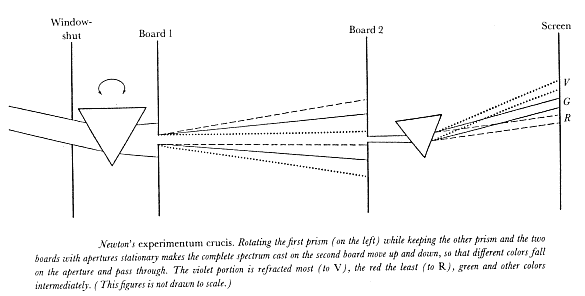
Diagram 3.2
(From Dennis L. Sepper Goethe contra Newton
[(Cambridge: Cambridge University Press, 1988].)
only badly supported by the evidence; they are false. Colors, like all else in Goethe's world,[10] are a consequence of the action of opposites, in this case light and darkness:
We see on the one side light, the bright; on the other darkness, the dark; we bring what is turbid between the two [such as a prism or a semitransparent sheet of paper], and out of these opposites, with the help of this mediation, there develop, likewise in an opposition, colors. (Theory of Colors , didactic part, paragraph 175)
Newton's argument requires, by contrast, the assumption that the tendency to produce colors is entirely in the nature of the light, and that is why this dispute is of relevance to my point here. As Sepper says, for Newton "the cause is to be sought only in the light itself."
Let us turn to Newton's reasoning. The argument is plausible, so long as one is not looking for deductive certainty. From Newton's point of view (though not from that of Goethe, who imagines a far richer set of possibilities), the two hypotheses to be decided between are: (a) something that happens involving white light in the prism produces colored light; or (b) colored light is already entering the prism in the first place. We can see the force of the argument by thinking in terms of inputs and outputs. Look at what happens to, say, the violet light in the second prism (diagram 3):
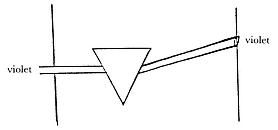
Diagram 3.3.
Compare this with the production of violet light in the first prism (diagram 4):
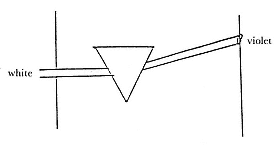
Diagram 3.4.
In both cases, the outputs are the same. The simplest account seems to be that the prism functions in the same way in both cases: it just transports the colored light through, bending it in accord with its fixed degree of refrangibility.
Consider an analogous case. You observe a large, low building. Colored cars drive through. Cars of different colors have different fixed turning radii. You observe for each color that there is a fixed and color-dependent angle between the trajectory on which the car enters the building, and the trajectory on which it exits; moreover, this is just the angle to be expected if the cars were driven through the building with steering wheels locked to the far left. Besides cars, other vehicles enter the building, covered; and each time a covered vehicle enters, a colored car exits shortly afterward. It exits at just that angle that would be appropriate had the original incoming vehicle been a car of the same color driven through with its steering wheel locked. Two hypotheses are offered about what goes on inside the building. Both hypotheses treat the incoming colored cars in the same way: on entering the building, their steering wheels get locked and then they are driven through. The two hypotheses differ, however, about the covered vehicles. The first hypothesis assumes that these, too, are colored cars. Inside the building they get unwrapped, and then they are treated just like all the other colored cars. The second hypothesis is more ambitious. It envisages that the low building contains an entire car factory. The covered vehicles contain raw material, and inside the building there are not only people who lock steering wheels, but a whole crew of Fiat workers and machinery turning raw materials into cars.
Obviously, the first hypothesis is simpler, but it has more in its favor than that. For so far, the second hypothesis has not explained why the manufactured cars exit at the angle they do, relative to their incoming raw materials; and there seems to be no immediate natural account to give on the second story. True, the cars are manufactured with fixed turning radii, but why should they leave the factory at just the same angle relative to the cart that carries in their raw materials as a drive-through does relative to its line of entry? After all, the manufactured car has come to exist only somewhere within the factory, and even if its steering wheel is locked, it seems a peculiar coincidence should that result in just the right exit point to yield the required angle vis-à-vis the raw materials. In this case, barring other information, the first, Newtonian, hypothesis seems the superior. The caveat, "barring other information," is central, of course, to Goethe's attack. For, as I have already remarked, Goethe was appalled at the small amount of information that Newton collected, and he argued that Newton's claim was in no way adequate to cover the totality of the phenomena. What looks to be the best hypothesis in a single case can certainly look very different when a whole array of different cases have to be considered.
The principal point to notice, for my purpose, is that the argument is not at all deductive. It can only become so if we already presuppose that we are looking for some fixed feature in light itself that will account for what comes
out of the prism—something, as I would say, in the nature of light. Any assumption like this is deeply contrary to Goethe's point of view. The first few paragraphs of Newton's letter, before the introduction of the crucial experiment, give some grounds for such an assumption on his part; Goethe makes fun of them:
It is a fact that under those circumstances that Newton exactly specifies, the image of the sun is five times as long as it is wide, and that this elongated image appears entirely in colors. Every observer can repeatedly witness this phenomenon without any great effort.
Newton himself tells us how he went to work in order to convince himself that no external cause can bring this elongation and coloration of the image. This treatment of his will, as already was mentioned above, be subjected to criticism for we can raise many questions and investigate with exactness, whether he went to work properly and to what extent his proof is in every sense complete.
If one analyzes his reasons, they have the following form:
When the ray is refracted the image is longer than it should be according to the laws of refraction.
Now I have tried everything and thereby convinced myself that no external cause is responsible for this elongation.
Therefore it is an inner cause, and this we find in the divisibility of light. For since it takes up a larger space than before, it must divided, thrown asunder; and since we see the sundered light in colors, the different parts of it must be colored.
How much there is to object to immediately in this rationale! [Goethe, 1793; quoted from Sepper, p. 101]
The contrast that I want to highlight is between Newton's postulation of an inner cause in light versus Goethe's long and many-faceted row of experiments. Goethe often remarks that he and Newton both claim to be concerned with colors ; Newton after all labels his account in the 1671 letter his "new theory of light and colors." But, in actuality, Goethe points out, Newton's work is almost entirely about the behavior of rays—that is, about the inner nature of light. Goethe's experiments often involve light, but it is not light that he studies. The experiments describe entire interacting complexes, such as evening light entering a room through a hole in a white blind on which a candle throws light ("snow seen through the opening will then appear perfectly blue, because the paper is tinged with warm yellow by the candlelight" [Theory of Colors , didactic part, paragraph 79]), or sunlight shining into a diving bell (in this case "everything is seen in a red light . . . while the shadows appear green" [Theory of Colors , didactic part, paragraph 78]), or a particularly exemplary case for the existence of colored shadows, a pencil placed on a sheet of white paper between a short, lighted candle and a window so that the twilight from the window illuminates the pencil's shadow from the candle ("the shadow will appear of the most beautiful blue" [Theory of Colors , didactic part, paragraph 65]). Even when described from the point of view of Goethe's final account of color forma-
tion, in the prism experiments Goethe is not looking at light but rather at light (or darkness) -in-interaction-with-a-turbid-medium.
Newton focuses on his one special experiment and maintains that the account of the phenomena in that experiment will pinpoint an explanation that is generalizable. The feature that explains the phenomena in that situation will explain phenomena in other situations; hence he looks to a feature that is part of the inner constitution of light itself. To place it in the inner constitution is to cast it not as an observable property characteristic of light but rather as a power that reveals itself, if at all, in appropriately structured circumstances. To describe it as part of light's constitution is to ascribe a kind of permanence to the association: light retains this power across a wide variation in circumstance—indeed, probably so long as it remains light. That is, I maintain, to treat it as an Aristotelian-style nature. This is why Newton, unlike Goethe, can downplay the experimental context. The context is there to elicit the nature of light; it is not an essential ingredient in the ultimate structure of the phenomenon.
6—
Conclusion
My argument in this paper hinges on a not surprising connection between methodology and ontology. If you want to find out how a scientific discipline pictures the world, you can study its laws, its theories, its models, and its claims—you can listen to what it says about the world. But you can also consider not just what is said but what is done. How we choose to look at the world is just as sure a clue to what we think the world is like as what we say about it. Modern experimental physics looks at the world under precisely controlled or highly contrived circumstances; and in the best of cases, one look is enough. That, I claim, is just how one looks for natures, and not how one looks for information about what things do.
Goethe criticizes Newton for this same kind of procedure that we use nowadays, and the dispute between them illustrates my point. Newton's conclusions in his letter of 1671, as well as throughout his later work in optics, are about the inner constitution of light. I claim that this study of the inner constitution is a study of an Aristotelian-style nature and that Newton's use of experiment is suited to just that kind of enterprise, where the experimentum crucis is an especially striking case. The colored rays, with their different degrees of refrangibility, cannot be immediately seen in white light. But through the experiment with the two prisms, the underlying nature expresses itself in a clearly visible behavior: the colors are there to be seen, and the purely dispositional property, degree-of-refrangibility , is manifested in the actual angle through which the light is bent. The experiment is brilliantly constructed: the connection between the natures and the behavior that is supposed to reveal them is so tight that Newton takes it to be deductive.
Goethe derides Newton for surveying so little evidence, and his worries are not merely questions of experimental design: perhaps Newton miscalculated, or mistakenly assumed that the second prism was identical in structure with the first, or Newton takes as simple what is not . . . Goethe's disagreement with Newton is not a matter of mere epistemological uncertainty. It is rather a reflection of deep ontological differences. For Goethe, all phenomena are the consequence of interaction between polar opposites. There is nothing in light to be isolated, no inner nature to be revealed. No experiment can show in a single behavior what light does qua light, for by itself there is nothing, no special single thing that it is in the nature of light to do. The empiricists of the scientific revolution wanted to oust Aristotle entirely from the new learning. I have argued that they did no such thing. Goethe, by contrast, did dispense with natures; there are none in his world picture. But there are, I maintain, in ours.