
The Royal House and the Abbey of Saint-Denis:
A Shared History
The impetus toward self-promotion characteristic of commissions sponsored by the abbey of Saint-Denis explains the presence of one rare miniature in this Grandes Chroniques . The illustration for the first book of the life of Charlemagne comprises two scenes (Fig. 15). In the lower register, Childeric III, the last Merovingian king, is deposed and forced to enter a monastery.[59] Above this scene Pope Stephen II crowns Pepin, the first Carolingian ruler. Perhaps in an attempt to feature the coronation at Saint-Denis in which the pope took part, the composition in this miniature inverts the narrative structure common to every other multitiered miniature, in which the story unfolds from left to right and from top to bottom. This is therefore a specially tailored image whose subject does not recur in any later cycles.[60]
Although dynastic interests account in part for the inclusion of the miniature of Pepin's coronation, the history of Saint-Denis may explain its prominence. Because the ceremony took place at Saint-Denis, it was as much a part of the history of the abbey that produced the text as it was of the king who received the manuscript.[61] The illustration of Pepin's coronation served as a reminder to the king of the intertwined history of the abbey and the French royal house.
Philip III's Grandes Chroniques is a carefully crafted text decorated by illustrations that clarify the chronicle's dynastic and Dionysian content. Primat's French
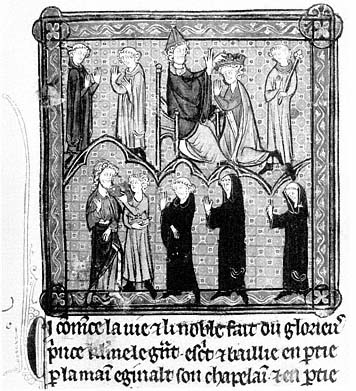
Figure 15
Pope Stephen II crowns Pepin; Childeric III deposed. Grandes
Chroniques de France . Bibliothèque Sainte-Geneviève, Ms. 782,
fol. 107. Photograph: Bibliothèque Sainte-Geneviève, Paris.
text is more than a translation from the Latin; Primat rearranged the structure of his Latin model to focus more attention on Charlemagne and Philip Augustus, and he appended a prologue and a poetic colophon that together shaped the text as a Mirror of Princes.
Pictures reinforce many of Primat's innovations. The historiated initial at the prologue and the large miniature at the end of the manuscript strengthen this interpretation of the text, and the density of the cycles and scale of illustration promote the importance of Charlemagne and Philip Augustus as royal models. In addition, miniatures betray the circumstances of the book's production, stressing the concerns with dynastic legitimacy, which were important to royalty, as well as the historical ties between the French crown and the abbey, which were so evident in Dionysian commissions. These observations may explain why this pictorial cycle spawned no progeny despite its presence in the royal library at the Louvre.[62] Because Philip's Grandes Chroniques was commissioned for a special audience at a particular time, its pictures tailor the reading of the text to suit the needs of both Philip III and the abbey of Saint-Denis.