
Phase Velocities and Energy Scattering
Numerical analysis of the finite-element models (see fig. 2) gives the complex displacement of all the nodal points and the amplitudes and phases of all the reflected and transmitted Love or Rayleigh modes for a given incident Love or Rayleigh mode at a particular frequency. The mode shapes of the reflected and transmitted Love or Rayleigh waves are normalized so that the energy carried by each of them is proportional to the product of the mode frequency and wave number (Lysmer and Drake, 1972; Waas, 1972).
Phase velocities of the fundamental Rayleigh mode at periods from 60 s down to 10 s across the finite-element models of the section AA' in figure 1 are tabulated in table 3 and shown in figure 3. They are compared with the phase velocities in the regions at the ends of the models. The phase velocities in these regions were calculated by both the method of Haskell (1953) and Dunkin (1965; shear velocity in the ocean water = 0) and the finite-element method. For both the Berkeley and oceanic regions, at periods down to 20 s,
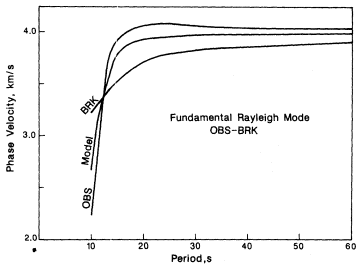
Figure 3
Phase velocity of the fundamental Rayleigh mode across
the continental boundary compared with the phase velocities
of the fundamental Rayleigh mode at the ocean site A in
figure 1 and at Berkeley.
| ||||||||||||||||||||||||||||||||||||||||||||||||||||||||||||||||||||||||||||||||||||||||||||||||||||||||
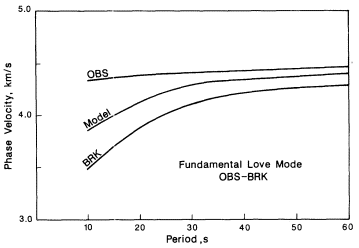
Figure 4
Phase velocity of the fundamental Love mode across the continental
boundary compared with the phase velocities of the fundamental
Love mode at the ocean site A in figure 1 and at Berkeley.
the difference is less than or equal to approximately one part in a thousand. For the ocean region, at a period of 15 s, the difference is approximately one part in 350; at a period of 10 s, the difference is approximately one part in eighty (later reduced by reducing the rigidity of the water in the finite-element calculation) . The mean phase velocities tabulated toward the right of table 3 are the means of the phase velocities of the fundamental Rayleigh mode in the oceanic and Berkeley regions, found by the method of Haskell and Dunkin. The finite-element model phase velocities, tabulated further to the right of table 3, are slightly greater than the mean phase velocities, except at a period of 10s. Mean slowness corresponds to a lower velocity than mean velocity. The high finite-element model velocities almost certainly arise because most of the finite-element model is of oceanic structure and, except at a period of 10 s, the oceanic phase velocity of the fundamental Rayleigh mode is higher than the phase velocity in the region of Berkeley.
Similar values for the propagation of the fundamental Love mode from the oceanic region to Berkeley are recalled from Drake and Bolt (1980; for that paper the width of the finite element model was 200 km). These values are tabulated in table 4 and shown in figure 4. Again, at the shorter periods the finite-element model phase velocity is lower than the mean of the phase velocities found for the regions at the ends of the model by the method of Haskell. This time, however, the phase velocity of the fundamental Love mode in the oceanic region exceeds the corresponding phase velocity at Berkeley. At a period of 10 s, for a path two-thirds oceanic, the travel time for the finite-
| ||||||||||||||||||||||||||||||||||||||||||||||||||||||||||||||||||||||||||||||||||||||||||||||||||
element model for the fundamental Love mode exceeds the expected travel time by one part in twenty-five. Hence, at periods of approximately 10 s, structure appears to cause a slight phase delay for the fundamental Love mode (little energy is transmitted; see table 5).
The normalized amplitudes of the horizontal and vertical displacements of the fundamental Rayleigh mode at a period of 15 s for the oceanic region at the WSW end of section AA' of figure 1 are shown in figure 5. A rigidity of 1 bar was assumed for the ocean layer. The potential for the horizontal and vertical displacements of a single propagating Rayleigh mode in a perfectly elastic fluid at the surface of a half-space can be written as

where A is a source term, K is

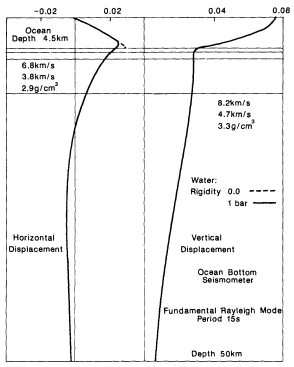
Figure 5
Normalized amplitudes of horizontal and vertical
displacement of the fundamental Rayleigh mode
at the ocean site in figure 1 for a period of 15 s,
with and without a horizontal displacement
discontinuity at the ocean bottom.
the short dashed line in figure 5. The normalized amplitude of the horizontal component near the surface and below the base of the fluid layer, and the normalized amplitude of the vertical component are shown by the continuous lines for the very slightly rigid model in figure 5.
The percentages of energy reflected and transmitted for incident motion from the ocean side of the fundamental Love and Rayleigh modes at the continental boundary near Berkeley at periods from 60 s down to 10 s are tabulated in table 5. The transmitted energy percentages are subdivided into that for the fundamental mode and the total for the remaining higher modes. The values for Love waves are recalled from Drake and Bolt (1980). The percentages of energy in the transmitted fundamental Love and Rayleigh modes are shown in figure 6. The comparatively unhindered passage of the fundamental Rayleigh mode at periods of approximately 20 s across the continental boundary, compared with the almost total absorption of the fundamental Love mode at the same periods, suggests why it is preferable to use Rayleigh rather than Love waves for the measurement of the magnitudes of
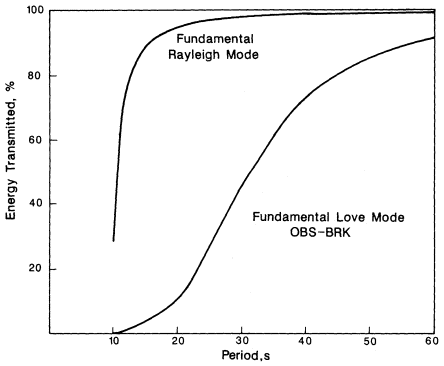
Figure 6
Energy transmitted (percent) for the fundamental Love and Rayleigh
modes from the ocean site A in figure 1 to Berkeley (A').
shallow teleseisms. Also, at periods of approximately 10 s, most of the Love wave energy is scattered forward, while most of the Rayleigh wave energy is scattered back.