
Thickness
In measuring thicknesses, all mappable sub-divisions (eruption unit, member, or formation) and all textural subunits are noted.
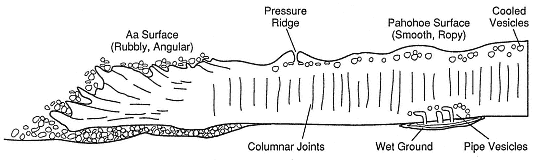
Fig. A.7
Cross section of a generic basaltic lava flow, showing some of the basic structural features
that should be described when mapping flows. Flow surfaces, if preserved, present
a variety of textures that range from smooth, ropy pahoehoe to spiny, rubbly aa lavas.
Flow interiors exhibit variations in structure such as different types of columnar joints,
vesicle concentrations, and lava tubes; the presence of these features often depends
on flow thickness and viscosity. Pipe vesicles are formed within flows as they cross
wet ground; rising steam leaves vesicle trains or small tubes that are bent by flow
(a good indicator of flow direction). Lava blocks spalled or extruded from the toe of
an aa lava flow leave lava rubble beneath and in front of the flow.
Thickness is measured from the base of a unit to the level of some significant textural change.