
Precontact Era
The aboriginal territory of the Yurok people encompassed riparian lands along the lower forty miles of the Klamath River, from its confluence with the Trinity River, its major tributary, to the Pacific Ocean. It also included coastal lands from a few miles north of the river's month south to Trinidad. The Yurok people have lived and fished on the Klamath River from time immemorial. The river was their world. North, south, east, and west did not exist for them. The only directions were upriver or downriver. The center of their world was Qu'-nek, where the Klamath joins the Trinity.
As the Yurok world centered on the river, the peoples' lives centered on its fish. Salmon especially, but also steelhead, lamprey,
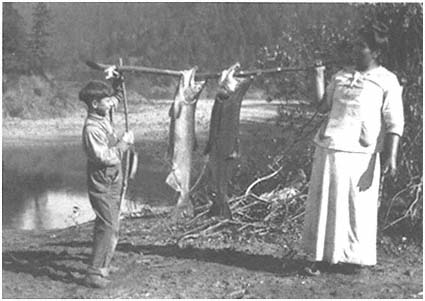
Anthropologists termed it "primitive affluence." The chinook salmon
held by this Indian woman and boy were an important element in
the coastal Indians' "food bank."
(Peter Palmquist collection)
and sturgeon, were the mainstay of Yurok subsistence. The awesome, cyclical nature of the salmon's yearly migrations over the centuries influenced almost every aspect of Yurok life. Religion, lore, law, and tribal technology all evolved from the Indians' relationship with their fishery resources.
Such dependence on salmon required conservation measures to assure that the bounty would continue. The downriver Yuroks had to let enough salmon escape to perpetuate future generations and to meet subsistence needs of upriver tribes, the Hupas and Karoks. These two needs, biological and social, for an adequate salmon escapement were met with many rituals and laws that tempered the salmon harvest.
To the aboriginal Yurok, fishing sites were (and to a great extent still are) considered privately owned. The right to fish at a particular site was transferable and governed by complex rules and laws. Rights could be loaned for a portion of the harvest. Owners of the
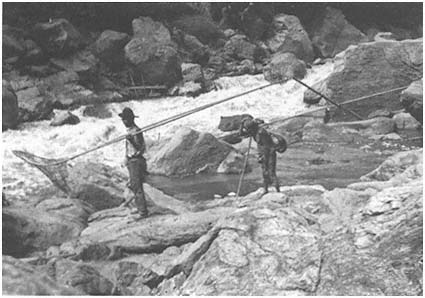
Indian property. Elderly Indian couple at a "usual and accustomed"
fishing site on the Klamath River. Such sites were held and
controlled by Indian families.
(Peter Palmquist collection)
best sites were generally the "aristocrat" families of the tribes. Fishing techniques varied with the topography of the site and the type of fish being sought. Several types of nets, woven with twine made from iris leaf fibers, were used for salmon. Private ownership of restricted net fishing sites, however, could not ensure adequate subsistence for all Yuroks, so communal fish dams were temporarily built at selected sites. These weirs, constructed of log frames and a latticework of slats or poles that completely crossed the stream, blocked upstream fish migration. Sections could be opened to allow fish passage. Trapped fish were removed by dipnets and other means.
Possibly the most advanced accomplishment of California Indian cultures was the fish dam on the Klamath at Kepel. Several hundred people were involved in the annual construction of this dam. Every aspect of its construction and use was highly ritualized: it consisted of exactly ten panels, was built in ten days, and was fished for only ten days. This community project ensured that subsistence needs of all river tribes would be met, and salmon runs perpetuated.
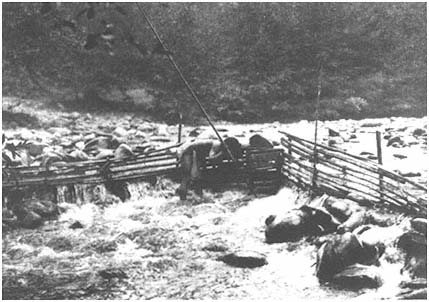
Weirs such as this on the Klamath River were commonly used to intercept
migrating adult salmon. Yurok Indians observed complex rituals
associated with the annual construction and operation of much
larger community weirs on the lower Klamath.
(Peter Palmquist collection)
Neither net nor weir fishing could begin until the "first salmon" ceremony took place at Welkwaw, at the mouth of the Klamath River. The tribal formulist, after complex ceremonial rites, would ritually "spear" the first salmon. No person could eat salmon until this ceremony was completed.
Aboriginal Klamath fishers faced basic fishery management problems like those of today: how to cope with natural fluctuations in resources, how to control harvest while maintaining a viable economy. The Indians needed fish to survive. Clearly, as historian Arthur McEvoy has noted, Indian communities, over the centuries, learned how to "balance their harvest of fish with their environments' capacity to yield them." Salmon runs continued. Settlers of the 1850s reported that the Klamath was "alive with the finny tribe." Such was the Yurok world when the first major immigration of non-Indians arrived at the Klamath River.