
Long-Term Price Histories
By "price history," I mean the history of fluctuations in price levels over the 147 years of Delian independence. Since transient monthly variations are not at issue here, I use for each available year a mean price constructed from all available monthly prices. The base data for these mean prices are very uneven. Some years have twelve or more monthly prices, while for others we depend on three, two, or even a single price. Despite the possibility of distortion, I have preferred to keep these data as at least partly representative of the price level for their years. I have, however, rejected data from inscriptions so poorly dated that they might fall on either side of a securely dated inscription (for instance, IG XI 2.275 of 259 B.C. or 256–251 B.C. ) and from inscriptions whose dates might vary by more than two or three years (for instance, IG XI 2.147, dated only 296–290 B.C. ). To inscriptions imperfectly dated but ranging over only two or three consecutive
[54] Meadows, Dynamics of Commodity Production Cycles, 39. Modern management techniques allow for wide variation in age at weaning; see Krider, Conrad, and Carroll, Swine Production , 248–49.
years, I have arbitrarily assigned the earliest possible date; e.g., ID 314 is treated as 233 B.C. , not 232. Since the range in no case exceeds three years (e.g., ID 459), the convenience in handling and analyzing the data more than compensates for any slight error that may creep into the time series.
The purpose here is to identify long-term price trends for our three Delian commodities and to try to account for these trends. One method used both here and in chapter 6 to analyze the data is regression analysis. Regressions give information about the degree of correlation between two or more variables and a sense of how likely or unlikely it is that such correlations are due to chance. The reality of apparent trends can be tested quite readily by regression analysis; for instance, the supposed long-term decline in olive oil prices after ca. 270 B.C. proves chimerical. Such analyses may also be designed to test a hypothesis about the relationship between changes in prices and outside factors; regression strikingly confirms the reality of a deep fall in rents for Apollo's estates in 290 B.C. (chapter 6). Regressions may also suggest relationships or trends not previously suspected, such as the link between firewood and pig prices after ca. 220 B.C. However, regression analysis alone cannot either guarantee or explain a causal connection between purely statistical correlations. For that, we must depend on our understanding of the natural history of the products studied, the operation of the economy, the impact of social practices, and the role of historical circumstances and developments, such as the effect of military activity on the local economy. For example, whereas the link between firewood and pig prices can be explained by the ways in which pigs were raised and fed, the strikingly low prices for several goods in 250 B.C. , while statistically valid, have no readily apparent explanation. Throughout I have tried to bear in mind the limitations of both the data and the method. It should also be clear that the obscurities of the history of independent Delos and of its Kykladic neighbors set limits of their own; I have tried to respect them.[55]
In searching for hypotheses, I have also tried to stand by the principle enunciated and justified in chapter 3 of looking first and foremost for local causes. The hierarchy of preference for purchase of goods runs always from indigenous suppliers (Delians or resident metics) through neighbors, first close (Rheneia, Mykonos) then farther away (Tenos, Paros, Andros,
[55] Readers unfamiliar with regression analysis, or to whom tables 5.6 through 5.9 say nothing, may wish to consult the brief explanation in Appendix II. For a good, cautionary introduction to the pitfalls and value of correlation analysis, see Stephen Jay Gould, The Mismeasure of Man (New York, 1981), 239–55.
| |||||||||||||||||||||||||||||||||||||||||||||||||||||||||||||||||||||||||||||||||||||||||||||||||||||||||||||||||||||||||||||||||||||||||||||||||||||||||||||||||||||||||||||||
Naxos), to distant sources. Since, as I have argued, local sources generally satisfied most of Delos's needs, local causes for unusual events should first be investigated and eliminated before appeal to distant happenings like the closure of the straits.[56]
[56] For instance, it is appealing to attribute the high prices of firewood in 173 B.C. to the impact of Perseus's expedition to Byzantion, usually dated to aboutthat year (Livy 42.13.7, 40.6, 42.4; App. Mak. 11.1; cf. Will II 267). With Delos under Rhodian tutelage, and Rhodos allied with Rome and Pergamon, politics may have favored cancellation of deliveries from Makedon even if Perseus's activities did not close the straits. But in fact (1) nothing proves that Delos depended on Makedon for firewood; (2) nothing shows any Delian dependence on suppliers north of the straits; (3) Perseus would have found it very difficult indeed to stop shipments to specific buyers; and (4) our knowledge of the king's activity derives entirely from one reference (going back ultimately to Polybios) in the litany of complaints Attalos delivered before the Roman Senate in 173 B.C. , the repetition of the charge by a Roman envoy, and Perseus's apologia. See further discussion below.
One final preliminary matter. As I have repeatedly emphasized, the price series are frustratingly lacunose. Were they treated, for purposes of analysis, as regular time series, most years would show missing data (see table 5.5). To avoid this problem, I have treated the data as if contiguous, and compensated by creating data sets for time in which the time value of each datum point represents the actual time elapsed since the next earlier datum. Thus for olive oil the first price value, 278.2, of the year 304 B.C. , corresponds to the time value "11" (from 315 to 304); the next price value, of 281 B.C. , corresponds to the time value "34" (these time values are given in the column headed "Adj[usted] Year" in table 5.5). In this way the actual chronology of the data is preserved. The main consequence is to moderate the degree of change over time; it does not affect the character or significance of the relations. The mean prices used in the following sections are given in table 5.5.
The Price History of Olive Oil A glance at a graph of mean annual olive oil prices over time (fig. 5.1) immediately suggests that oil prices declined steadily and significantly over the years from 304 to 279 B.C. and thereafter fluctuated within bounds provided by the prices of 279 and 173 B.C. A second decline from 194 to 173 and the rise thereafter to 169 are exceptional and require comment, but pale compared to the much higher price levels before 279, and nothing indicates that the high value for 169 B.C. marks the beginning of an extraordinary new upward trend.[57] A dummy variable constructed to distinguish the data before and after 279 B.C. confirms this hypothesis (table 5.6), which accounts for fully 80 percent of the variation in oil prices. No other hypothesis or combination of hypotheses comes near this success.
The results of the analysis suggest that the history of oil prices on Delos falls into two broad periods: (1) high but declining prices from the begin-
[57] Contra Heichelheim, Wirt. Sch., 48–56; Larsen, 388–90. Local military events and an exceptionally harsh winter suffice to explain it; see p. 169 below.
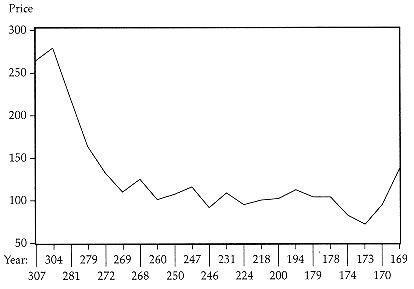
Figure 5.1.
Indexed Olive Oil Prices, Delos, 304-169 B.C.
ning of the evidence in 307 B.C. to 279 B.C. , and (2) a long period of fluctuating, but steady, prices thereafter. Within the second period, three possible subperiods may be distinguished: (a) 279–224 B.C. , marked by sharp rises and declines covering up to about a decade; (b) a slow but steady rise from 224 to 194 B.C. ; and (c) a rapid decline from 178 to 173 B.C. The price of 170 B.C. looks like a return to rising prices, while the high price of 169 B.C. —higher than any price in 110 years—is an anomaly owing to transient local conditions.
| ||||||||||||||||||||||||||||||||||||||||||||||||||||||
Period 1. The declining prices of 307–279 B.C. have not escaped attention.[58] An interpretation first offered by Fritz Heichelheim attributes these high prices to Alexander's conquest of the East. One facet of this view—that a general inflation swamped the old Greek world as gold and silver captured from the Persians made its way west[59] —cannot be sustained from the Delian evidence, which flatly contradicts it.[60] The other facet is more plausible. It argues that as the Greeks established themselves in the East, demand grew for traditional Greek products not available locally. Chief among these were olive oil and wine, whose prices rose in the entire Greek world, Delos included. In time, the new settlers planted olive orchards and vineyards and the pressure on Greek products relented. The response was a general decline in prices, to which the Delian data attest.
This view depends on a number of assumptions about the economy of the early Hellenistic world. It requires a unified world market in staple goods, which could draw on the production of all important agricultural centers. It assumes prices set universally by a universal market, so that olive oil prices on Delos would represent the cost of oil—without additional transportation expenses, of course—anywhere in the Hellenistic world. Even quite local transactions—the sale, for instance, of wine produced on the Delian estate of Epistheneia on the market in Delos—would be modulated through this universal market. It presupposes a very sophisticated transport system, capable of moving enormous quantities of goods over long distances (including a good deal of land transport for the Greek settlements in the old Persian Empire).
This model of the Hellenistic economy has come in for a great deal of criticism in the past fifty years; it is now generally discredited, although some scholars have recently begun a retreat from the more radical version of the "primitivist" economy erected in its place.[61] Yet the specifics of Heichelheim's argument about oil and wine prices still command adherents, who have evidently not considered that the presupposition that there
[58] Gustave Glotz, Journal des Savants 11 (1913): 20–21, 29; Heichelheim, Wirt. Sch., 53 (cf. 55); Larsen, 389 (cf. 388–90, 380–83); Rostovtzeff, 158–59, although his remark (at 235) that "The general tendency of prices in the first period [ca. 310–270 B.C. ] is upwards" is generally wrong. He discusses Delos at 190–91, 230–36, with notes.
[59] Heichelheim, Wirt. Sch., 55–56; Larsen, 380; H. Michell, Canadian Journal of Economics and Political Science 12 (1946): 1–17; Bruno Cavagnola, Istituto lombardo (rend. lett.) 107 (1973): 538–40. Cf. Will I , 35.
[60] See chapter 7, pp. 250–52 below.
[61] For discussion and some basic bibliography, see chapter 3, pp. 75–82, above, with nn. 103–4, 106, 107, 109.
was a unified world economy, at least in staples, undergirds his interpretation of the data.[62]
Not all the Delian data can be accounted for easily by this model, however. The oil price of 112.5 for Bouphonion 304 B.C. , coming just before the harvest, when oil should have been particularly scarce, fits comfortably with oil prices common after the 270s. A single low price in a time of high price levels might merely be an anomaly, but the Heichelheim model (for want of a better expression) cannot easily account for such anomalies; and the appearance of this low price in the very year that provides the highest attested oil prices is especially troubling. The oil price of 307–305 B.C. also presents a problem. On Heichelheim's model, prices should decline over time, yet this price is almost 30 percent lower than the prices of 304 (discounting the price of Bouphonion).
Finally, Heichelheim's model offers no account of the timing of oil price stabilization in the 270s. The date seems arbitrary. Alexander's settlements had been established by 323 B.C. At his death, twenty thousand of the settlers who had hoped to return to Greece were massacred at Babylon, and thereafter the settlements were permanent. Presumably, the survivors would have begun to plant olives and vines then, assuming they had not done so before; Alexander had seen to it that his colonies had both sufficient agricultural territory and the labor to till it. New vineyards require about seven years to become productive, olive orchards ten to twenty. Even on the most pessimistic assumptions, plantings put in in ca. 320 B.C. would have begun to produce by the end of the fourth century, or by the 290s at the very latest.[63] On the other hand, the creation of new cities (or settlements) in the East did not stop with Alexander; his Seleukid successors pursued the policy vigorously, and well beyond 270 B.C. If Alexander's settlers had needed Greek goods, the same should have held for their Seleukid counterparts, yet oil prices fell by 272 to levels that persisted through the rest of the century.[64]
[62] See Will I , 34–35; Vial, 283–84, 330; Cavagnola, Istituto lombardo (rend. lett.) 107 (1973): 538–40; Robin Osborne, Chiron 18 (1988): 301; perhaps also Meiggs, 455. D. W. Rathbone, in Eighth International Economic History Congress, Budapest 1982, ser. B12 (Budapest, 1982), 44–51, at 48, suggests that price changes were linked to the price of wheat, which was declining owing to the introduction of cheap Ptolemaic wheat into the Aegean market.
[63] Diod. 18.7.1 (massacre); Arr. 4.22.5; Q. Curt. 7.6.25–27, Arr. 4.4.1; Q. Curt. 7.10.15, 11.29, Arr. 4.16.3. See the convenient recent summary in A. B. Bosworth, Conquest and Empire: The Reign of Alexander the Great (Cambridge, 1988), 245–50; and on the revolt, see now Paul Bernard, BCH 114 (1990): 529–31 (preliminary version in CRAI 1989: 301–2), with further references.
It is possible, in my view, to account for the prices of 304 B.C. and the trend of 307–279 B.C. without appeal to eastern demand and the theoretical substructure it supposes. The responsiveness of olive oil prices to the sailing season has shown that Delos imported much of its oil. On the assumption that before 314 B.C. , Athens was the main source, the price history of olive oil can be interpreted as the replacement of Athens by Rhodos until Delos could develop local sources in the neighboring islands that guaranteed a stable price and replaced Rhodian imports.
In the sixth and fifth centuries, Athens exported olive oil and wine.Solon's legislation had encouraged the expansion of olive culture, and a rental contract for a parcel of land dated to 418/7 B.C. confirms the owner's interest in expanding production of olives.[65] The importance of oil exports for the Athenian economy persisted throughout the fourth century. Even if the Peloponnesian War had interrupted production—and Victor Hanson has shown the difficulties attendant on "economic warfare," particularly against olives—any damage caused by the war was repaired within a decade or two, and no one doubts that, down to the end of the century, oil remained an important Athenian export.[66] Especially after the Social War,
[65] A French, The Growth of the Athenian Economy (New York, 1964), 123–24, 131; Plut. Solon 24.1. Peter Garnsey and Ian Morris argue in Bad Year Economics, 103, that if the Solonian law is genuine, "it is best interpreted in the same way as the Teian regulation" (Meiggs-Lewis 30, ca. 470 B.C. ), "as an attempt by the state to limit the power of the large landowners to dispose of their food surplus overseas in circumstances in which the inevitable harvest fluctuations periodically exposed many domestic consumers to hunger"; this view considers only the ban on other agricultural exports, however, not the positive support for olive oil export; IG I 84.33–34 (= IG I 94). Isager-Skydsgaard, 201, with references to studies of the SOS amphoras.
[66] Victor Davis Hanson, Warfare and Agriculture in Classical Greece (Pisa, 1983), 47–56, 113–43; Paul Harvey, Athenaeum 64 (1986): 205–18. Barry S. Strauss, Athens after the Peloponnesian War (Ithaca, N.Y., 1986), 44–45, exhibits some skepticism: "There was, however, a serious depression, if not a universal one, in the post-war / Corinthian War period. . . . A small number of olive trees wouldhave sustained partial damage, in some cases enough to interrupt production for seven or more years." On the importance of oil to the Athenian economy, see, e.g., Hans Lohmann in Agriculture in Ancient Greece, 42, 51–56; Sallares, 304–9; Josiah Ober, Fortress Attica (Leiden, 1985), 27–28; Claude Mossé, La Fin de la démocratie athénienne (Paris, 1962), 63–65. V. F. Gajdukevic[*] , Das bosporanische Reich (Berlin, 1971), 57, 103, documents Athenian olive oil exports to the Black Sea in the fourth century. The tendency for oil from Sinope to predominate after ca. 350 B.C. (ibid., 104, 182 n. 37) should perhaps be attributed to Athens's declining position after the Social War (cf. ibid., 89).
Athens became even more dependent on income from trade; Euboulos and other Athenian officials strove to increase the attractiveness of the city to merchants by expanding the docks and instituting the

As we have seen, Delos needed imported oil, since local production was never sufficient to cover demand. From 394 to 386 and 377 to 314 B.C. , the Athenians controlled the temple of Apollo on Delos, which they ran through an amphiktyonia that sometimes included Andrians, but from which Delians were excluded (ID 97.5; 97bis1, 2; 98A63, 64, 75, 96; 100.7, 8, 10). They integrated themselves deeply into Delos's economy. There is good evidence that they either dominated or controlled a good share of the estate and house rentals on the island, and in the 370s B.C. , they freely lent temple funds to many Kykladic states. Delians enjoyed borrowing privileges from the temple, but so did private persons from Andros, Tenos, Karystos on Euboia, Syros, and perhaps Seriphos.[69] Given stable De-
[67] Edmund M. Burke, Classical Antiquity 9 (1990): 1–13, and TAPA 114 (1984): 111–20; Claude Mossé in Trade in the Ancient Economy (Berkeley, 1983), 53–63. The driving force behind all of this was of course the growing Athenian dependence on imported grain, on which now see Garnsey, 134–64.
[68] Panos Valavanis, Recherches sur les amphores grecques (Paris, 1986), 453–60; G. R. Edwards, Hesperia 26 (1957): 320–21.
[69] ID 98A11–15, B1–10 (= IG II 1635); ID 100.15–17; ID 104–9.7–10(= IG II 1637); loans to individuals, ID 98A15–24, 50–56, 78–94, B10–23. Tréheux, "Dernières années," 1020–22; Jack Cargill, The Second Athenian League (Berkeley, 1981), 37–38; J. Coupry in Atti del terzio congresso (Rome, 1959), 65–66.
lian demand, continuing Athenian export of oil, and Athenian control of Apollo's temple, Athenian citizens and metics must have been perfectly aware of local sacred and profane requirements for oil. Delos would have offered an ideal nearby market for the disposal of exported Athenian oil.
The Delians chafed at foreign control of Apollo's patrimony. The city had remained Delian, and Delian officials participated to some extent in the administration of the temple, but without representation on the Amphiktyonia. For a few years early in the fourth century (386–378 B.C. ), they regained authority over the temple, only to lose it again. In 377/6 B.C. , a group of wealthy, prominent Delians struck the Athenian amphiktyonic officials and chased them from the temple. The offenders were punished with fines of 10,000 drachmas each, permanent exile, and (probably) the confiscation of their property. After 367 the Athenians became more imperious in administration of the temple, although the details remain obscure. In 345/4 B.C. , the Athenians won a case put before the Delphic Amphiktyone, which confirmed their rights over the temple; the next year, the Delian Peisitheides, forced to flee Delos under a death threat, was awarded Athenian citizenship for his support of Athens and granted a pension of a drachma a day "so that he would not lack food" until he could return to Delos. No doubt he had lost his property on Delos.[70] When Antigonos granted Delos its freedom and returned control of their temple to the Delians in September of 314 B.C. , they immediately cancelled leases in force on the estates and the


[70] Delian officials under the Amphiktyonia, ID 98A97, 104–26bis B8 (hieropoioi), 104.1–7 ("the boule of the Delians and hieropoioi " witnessing transfer of temple treasures from one board of Amphiktyones to its successor); 98B24–30: attack, fine, exile, B31–52 for confiscations. For increasing imperiousness after 367 B.C. , see Coupry, Atti, 61; for difficulties, ID 104–22, with comm.,pp. 89–90, 104–26C, perhaps 104–19A1–6; case before Delphic Amphiktyonia, Demos. 22.134, Hypereides fr. 13, cf. Th. Homolle, BCH 15 (1891): 153, W. A. Laidlaw, A History of Delos (Oxford, 1933), 84–85, Athens had retained Delos "by force": William Scott Ferguson, Hellenistic Athens (London, 1911), 50; Peisitheides, IG II 2.2.2. Cf. also Choix, 12, for some "national" feeling.
gested that they also confiscated the oikos of the Andrians as punishment for Andrian cooperation in the Athenian administration.[71]
It would not be surprising if the reaction against the Athenians included the search for non-Athenian sources for necessary imports, including olive oil, after 314 B.C.[72] The Rhodians, whose increasing penetration of Aegean trade in the late fourth and early third centuries has been well documented,[73] would no doubt have been only too happy to step in. Rhodos produced and exported olive oil from its own territory and from the Peraia. Rhodos also had a hand in the transshipment of goods from other parts of the Greek world; we know of shipments of Samian oil through its port.[74]
Dependence on Rhodos in the early period could also explain the shortage of 304 B.C. , for that was the second and final year of the famous siege that earned Demetrios his epithet "Poliorketes."[75] Economic disruption played a large part in the war, in part because of Rhodos's close economic ties to Egypt (Diod. 20.81.4), and in part because of the requirements of
[71] Tréheux, "Dernières années," 1008–32; id., BCH 68–69 (1944–45): 293 ("il serait difficile de concevoir qu'une administration purement délienne, fière de son indépendance recouvrée, eût continué longtemps à se fonder, pour la gestion des biens du dieu, sur une ordonnance athènienne"); id. in Stemmata, 386, and cf. the confiscation by the Athenians of the oikos of the Karystians after 167 B.C. , which Tréheux attributes to the good relations of the Karystians with the Delians (ibid., 389–90 n. 78, 387 n. 53).
[72] If this suggestion is right, it might help to account for the apparent collapse of the rural economy of the Attic deme Atene at the end of the fourth century: cf. Lohmann in Agriculture in Ancient Greece, 56.
[73] Lyk. Leok. 14–15, 18; [Demos.] 56.3–13, esp. 10; Diod. 20.81.4. Cf. Berthold, 44–45, 47–50 (at 59–60 he suggests that Rhodos avoided the Lamian War partly in hopes that a defeat might cripple an economic rival); Erich Ziebarth in Mélanges Gustave Glotz (Paris, 1932), 2: 912–13; Michael Rostovtzeff in CAH, VIII (Cambridge, 1930), 622–23; Rostovtzeff, 169–73; H. van Gelder, Geschichte der alten Rhodier (The Hague, 1900), 101–3; on the Rhodians' commercial relations with Egypt, Will I , 180–200 (passim).
[74] Local production: [Aiskhines], Ep. 5.2, who found Rhodian oil slightly less desirable than Athenian; Athen. 67a on Karian oil (fourth century B.C. ); Milet I.3, 149.18–20 (182 B.C. ?), oil at Pidassa; cf. David Magie, Roman Rule in Asia Minor (Princeton, 1950), I.50; F. Hiller von Gaertringen, RE suppl. 5 (1931), s.v. "Rhodos," 736–37; van Gelder, Geschichte, 427 (whose reference to Pollux 1.105 has, however, nothing to do with Rhodian oil). For Rhodos as a transshipment point for Samian oil (praised at Athen. 67a), cf . P. Cair. Zen. 59012–015, with Rostovtzeff, 229, and Michael Rostovtzeff, Klio 30 (1937): 1–7; Claire Préaux, Le Monde hellénistique (Paris, 1978), 495; Rostovtzeff, 1268. For ateliers of amphora manufacturers, see J.-Y. Empereur and N. Tuna, BCH 113 (1989): 277–99.
[75] Diod. 20.81–88, 91–100.4; Will I , 70, 73–74. For the date of IG XI 2.144, see Jacques Tréheux in CICG, 30.
besieging an island state. Antigonos had provoked the war in part by seizure of merchant ships (Diod. 20.81.2), and according to Polyainos (4.16.6) made every effort to prevent Rhodian traders in the East from returning home. As soon as Demetrios put in on Rhodos, he dispatched pirates to raid by land and sea (Diod. 20.83.3). During the siege the Rhodians sent out men and ships to raid and harass local merchant shipping (Diod. 20.93.5,

From a Delian point of view, dependence on Rhodos would have been as undesirable as dependence on Athens, if freighted with fewer political overtones. Still better would have been sufficient and reliable local supplies. High local prices should have encouraged local Kykladic plantings (and indeed the gradual price decline can be interpreted as evidence that they did). Because olives take many years to produce their first crop, planting a new orchard one year could not affect prices the following year. High prices would continue to encourage plantings year after year until the first new orchards began to contribute to the supply and to drive prices down. Prices should have fallen gradually as orchards planted in previous years began to bear. Eventually an equilibrium would be achieved, prices would stabilize, and the need for long-distance imports would dry up.
Data for Rhodian stamped amphorae from Delos support this interpretation. J.-Y. Empereur has recently warned of the dangers of marshaling amphora data as evidence for economic developments without due consideration of the chronology of the amphorae and of the excavations that produced them, the relation between numbers of stamped and unstamped handles, and the relation between number of handles and number of complete
[76] Diod. 20.95.4–5, 98.2, 99.3; on the Knidian embassy, see Berthold, 74 n. 32: "with its territory adjoining the Rhodian Peraea and its economy employing the Rhodian standard since 400 . . ., Cnidus was completely in the Rhodian economic sphere and must have suffered considerable economic difficulties during the siege."
jars;[77] but cautious use of only data available for Rhodian handles on Delos as compiled by Empereur may suggest some trends. Of the stamped and dated Rhodian handles so far published, 53 belong to about 331-275 B.C. (0.95 handles/yr) and 32 to about 275(?)-220 B.C. , or a little later (0.58 handles/yr).[78] If these figures represent the real relative abundance of Rhodian handles on Delos for these two time periods—not an unreasonable assumption, given that continuing excavation on Delos has not modified the relative proportions of handles very much,[79] and that one would expect to migrate into later contexts more handles from more recent third-century levels than from late-fourth-/early-third-century levels—then we may posit a drop of about 40 percent in stamped Rhodian handles on Delos over this period. This may mean that Rhodian imports were relatively more important before about 275 B.C. than after. The change suggests a decline in demand for Rhodian products after the first quarter of the third century. In the absence of full publication—which can only follow much further excavation—these results can only be regarded as preliminary but suggestive.
The insufficiency of Delian production of olive oil to meet local demand is clear from the relative absence of olive trees on the island (discounting of course the single tree owned by Apollo and any trees that may have graced private farms) and the large size of the population compared to the island's limited arable surface. But the same cannot be said for its Kykladic neighbors (excluding, of course, Rheneia), which certainly must have produced at least some oil; indeed, the model I propose to account for the price history of olive oil after the 270s demands increased Kykladic production. This raises several important questions: why did Delos not import olive oil from its immediate neighbors, rather than from Athens, in the fourth cen-
[77] J.-Y. Empereur, BCH 106 (1982): 222–33, 225; cf. Etienne, 213–15.
[78] Virginia R. Grace and Maria Savvatianou-Pétropoulako in L'llot de la Maison des comédiens (Paris, 1970), ch. 14, with corrections at Virginia Grace, Ath. Mitt. 89 (1974): 200; cf. also Virginia Grace, BCH 76 (1952): 514–40; John H. Kent in Studies Presented to David Moore Robinson (St. Louis, 1953), 2: 127–34; Empereur, BCH 106 (1982): 219–33; GD 97–98.
[79] Empereur, BCH 106 (1982): 223 n. 19. Cf. Y. Garlan in Trade in the Ancient Economy (Berkeley, 1983), 185 n. 19: "Brashinsky [cf. Y. Garlan, DHA 8 (1982): 145–52] has shown convincingly that conclusions derived from a sample are generally not seriously undermined by further work. From my own experience, even simple surface finds are often representative enough of buried material." See further Susan Alcock, Graecia Capta (Cambridge, 1993), 52 with 238 n. 30. Etienne, 216, fig. 4, does not seem to correspond with Empereur's figures; I have preferred Empereur. Etienne promises (217 n. 46) a treatment of Rhodian amphorae in a forthcoming MBAH.
tury? What local changes could have driven an increase in Kykladic production sufficient to meet local Delian demand and drive Rhodian imports out of the market? Why did the hieropoioi not plant olives on the estates to take advantage of the high prices and heavy unsatisfied demand for oil in the late fourth and early third centuries? It is not possible to give definitive responses to any of these questions, but we must consider some hypotheses, if only to test the plausibility of the larger model.
For the Kyklades, it will not suffice to cite the oft-repeated observation that the islands were too windy for olives. Variation in topography provides niches today for olive culture on most islands, even the smallest, and olives and oil certainly were produced in antiquity as well.[80] There are really two separate questions here. The Kyklades may simply not have produced enough local surplus to satisfy Delian demand; in this case, new plantings would have been necessary if the islanders did indeed take over from the Rhodians in the 270s and 260s. For Paros and Naxos, some evidence points toward increased production of amphorae in the third and second centuries.[81] On the other hand, the problem may have been one of organization rather than production. If the Athenians controlled Delos in the fourth century as tightly as I have argued they did, then there may have been little room for islanders to operate. Despite the Andrians' occasional benefits from their association with the Athenians and Apollo's loans to the rest of the Kyklades, there is very little evidence to suggest any economic activity by the islanders on Delos. When the expulsion of the Athenian masters in 314 B.C. afforded the Delians the opportunity to look elsewhere for their supplies, the islanders may have lacked both the tradition and the organization for harvesting, collecting, and exporting surpluses to their nearby neighbor. It would have required time for the necessary economic and social structures to evolve; the Rhodians, better organized, stepped into the breech.
Two further factors may have been at work. Before 314 B.C. , the Kyklades do not seem to have functioned as a single economic unit. Especially the western islands, including Keos, Andros, and Melos, enjoyed strong ties with Athens and the cities of Euboia. These ties dropped off markedly after the end of the fourth century, only to resume from about the middle of the second century. The same years saw growing contact between the islands and Delos. It is no coincidence that this period corresponds roughly
[80] Amouretti in Agriculture in Ancient Greece, 78. For modern olive production, see E. Y. Kolodny, La Population des îles de la Grèce (Aix-en-Provence, 1974), 71–72, 77, 85–92; S EE 1937: 112, 1938: 113, 1939: 113.
[81] J.-Y. Empereur and M. Picon, BCH 110 (1986): 495–510, 647–53.
to the years of Delian independence, for it was (in my view) the concomitant formation of the Nesiotic League that first tied the Kyklades together into a region focused on Delos.[82] The emergence of a regional outlook in political and military life should have fostered new economic ties, which helped promote Delos as the local exchange center for Kykladic products, and, not incidentally, permitted the Delians to reap the benefits of the local surpluses of their neighbors.
Second, it may be that the Kyklades themselves depended to some degree on imported oil in the fourth century. Recent archaeological survey work in both the southern Argolid and the Athenian deme of Atene has revealed a period of prosperity in the fourth century. In both cases, this prosperity has been attributed to the production of olive oil for an export market.[83] This notion has come in for some severe criticism, focused especially on its failure to consider other factors that might account for population change in the rural landscape and for its reliance on too simplistic a "modernizing" model of economic activity based on the exploitation of export markets.[84] The latter criticism, at least, is justified, especially as against an inclusive and sufficient explanation for economic growth in the southern Argolid from the Neolithic to modern times. Yet the presence, both there and in Atene, of olive processing equipment in fourth-century contexts lends some credibility to the suggestion that; for that period alone, rising oil production may have contributed to local prosperity. Ties especially of the western Kyklades to Athens and Euboia suggest a western orientation for these islands in the fourth century; this in turn might reflect the existence of an economic region incorporating the Attic peninsula, the southern Argolid, and the western islands, and thus of a natural (and nearby) market for locally produced surpluses. Such a model does not require a massive, centralized economic organization; individual merchants operating independently and on a small scale would suffice, especially given the relatively small amounts involved (annual Delian olive oil demand, for example, would fill only 2–4 ships, as we have seen). These reflections must remain speculative, but they do suggest avenues for further explora-
[82] G. Reger in Proceedings of the VII International Conference on Boiotian Studies (Amsterdam, 1994), forthcoming.
[83] For the southern Argolid, the view is expressed most clearly in Tjeerd H. van Andel and Curtis Runnels, Beyond the Acropolis (Stanford, 1987), 105–9, but see also Curtis N. Runnels and Tjeerd H. van Andel, Hesperia 56 (1987): 326–27, and Tjeerd H. van Andel, Curtis N. Runnels, and Kevin O. Pope, Hesperia 55 (1986): 117–18. On Atene, see Hans Lohmann in Agriculture in Ancient Greece, 56, with further references.
[84] Sallares, 103–5, but cf. the comments of Alcock, Graecia Capta, 243 n. 84. Thomas W. Gallant, CJ 86. (1990–91): 184–86.
tion; if they turn out to be right, they would shed welcome light on the transformation of the economic scene in Greece during the early Hellenistic period.
It may also seem somewhat surprising that the Delians did not do more to increase supplies of oil on Delos itself. The island has spots sheltered from the winds, and as I have argued above, there can be no doubt that there was some local production in antiquity, although it has left frustratingly little trace. In the case of the sacred estates, a reason lies to hand for the failure to plant olives: the short lease period. Renters restricted to ten-year leases (and even shorter terms before 300 B.C. ) had no motivation whatsoever to plant trees that would not yield at all for seven to ten years, and required much longer still to return the initial investment. If Apollo decided to plant olives himself, he would have had to make the investment out of his own funds without hope of recouping them in rent, since the renters, who bid for the estates in a closed auction and had no hope of benefiting from the plantings, would not bid enough to compensate his outlays.[85] Since the hieropoioi were in office only one year, during which their main aim was to show at the end of their term of office that they had been faithful stewards of Apollo's patrimony, they had no incentive to tie up the god's money in a long-term, expensive investment either. It is certainly telling that, with the single exception of the extirpation of some vines on Nikou Khoros between 180 and 178 B.C. (ID 445.16–24), the hieropoioi made no improvements of any kind to the estates over the century and a half of independence.
These considerations did not apply private landowners, and I remain convinced that some of them anyway must have planted olives. There may, however, have been factors working to discourage them, even in the face of high prices. The long lead time for the first crop meant that only those wealthy enough to tolerate a very postponed return could afford to plant olives. Demand may well also have encouraged landowners to plant other crops whose return could be realized in a season. Grain stands naturally at the head of the list; far less expensive to produce, grains were ready in a few months and in very high demand. Indeed, since olive oil may have been something of a luxury, making up far less of the diet than grain, it would always have been more reliably profitable to have produced barley or wheat. Livestock are another commodity that may have squeezed out olives. While the extent of herding on sacred estates has been exaggerated (see chapter 6), virtually every one of Apollo's estates had facilities for sheep or goats; stock raising must have had an important role on the island
[85] Details in chapter 6.
and certainly occurred on private farms.[86] Like grains, pigs and sheep are ready for market within a year or less, and so repay the initial investment far faster than olives. In the eighteenth and nineteenth centuries, the island of Keos was remarkably devoid of olives, producing generally only enough to satisfy local peasant household demand. The reason was perhaps that concentration on velanidia (acorns), which were used for curing and dyeing leather, squeezed olives off the landscape.[87] Something analogous may have helped prevent Delos from planting the olives she needed to supply her own demand. Local production from other islands ultimately made it up.
This model has some more general implications as well. The Athenians clearly understood and exploited the economic possibilities their control of Delos offered. The men who served there as administrators in the fourth century all came from the upper reaches of Athenian society; it would be naive to suppose that these opportunities would have escaped men who derived income from mining in Attike or shipping, not to mention ordinary landowning.[88] This is not to say that there was a simple and direct connection between politics and trade; rather, the Athenians simply acted to gain what they could. The same pattern recurs in the rental of sacred estates, as we shall see in chapter 6.
The model I have advanced is plausible but hardly sure. In the current state of the evidence, it cannot be tested. Some research that might help to support or disprove it:
1. Careful study of the countryside of Delos. Preliminary reports from a survey on Delos reveal the existence of widespread terracing, which the investigator dates from the late fourth century on. This might be consistent with the planting of new orchards.[89]
2. Full publication of Delian amphorae. Such a study would help us decide whether the very preliminary results adduced here reflect the reality of imports.
3. Surveys of the countryside of other Kykladic islands. A recent survey of Keos has revealed extremely interesting changes in the patterns of rural settlement that could correspond to changes in land-use practices;
[86] See Brunet, 141–42, on Patinioti.
[87] See n. 24 above.
[88] Epikrates son of Menestratos of Pallene (ID 98A10–11, 62–63; J. F. Davies, Athenian Propertied Families [Oxford, 1971], 4909A + B), mining interests, Hesperia 10 (1941): 14, no. 1, II. 70–71. Demades (I) son of Demeas (I) of Paiane may have been a naukleros or emporos: ID 104–33B9, Davies, 3263.
[89] See now O. Rackham and J. Moody in Agriculture in Ancient Greece, 124–25.
greater olive culture could have had a profound impact on the character of the countryside, since olive planting is capital-intensive and requires owners able to absorb many years without return before the first crop.
Period 2. The second period encompasses the years 279–169 B.C. On the model for Delian oil trade elaborated above, it is fairly easy to account for the post-272 prices. Their history suggests a nicely balanced market, with supply and demand in equilibrium, and shortages or surpluses, although perhaps common, never extreme. The rise and fall of average prices over time around a stable center may reflect olives' natural tendency to produce bigger crops every other year. Given a relatively stable body of trees, and a relatively stable (and confined) geographic area for the sources, the average of the whole would eventually have found its own rhythm of yield.
Such a local rhythm perhaps accounts for the prices of the two subperiods of 224–194 and 178–173 B.C. The apparently climbing prices of the first of these periods are an illusion. Chance has preserved data only from those years regulated by a poor harvest: it is not surprising that they show generally higher prices, and it is more important that the average prices are perfectly typical for the whole period after 272 B.C. The second subperiod is more interesting, for it does show a genuine price drop. This decline, which seems to span about five years (178–173 B.C. ), ends abruptly by 170 B.C. with a return of price to an entirely typical level. In my view, these low prices probably represent a happy coincidence of several good harvests. The good harvest inferred above for 175 may be an element: perhaps the regional rhythm in oil yields (even years = good; odd years = poor) was changing, and a series of abundant harvests were a side effect?
Following Larsen, I would attribute the clearly anomalous price of 169 B.C. (which depends particularly on high prices at the end of the year) to a poor harvest that fall. Inspectors from Rome who visited the Roman fleet at its winter quarters at Khalkis and Oleos on Euboia reported that the winter had been so harsh that part of the crews had succumbed to disease and others had gone home.[90]
The temple may have enjoyed the additional benefit of "captive" producers. In 237 B.C. , the god acquired two estates on Mykonos: Thaleon, which supported 147 olive trees (



[90] Livy 44.20; Larsen, 390, who, however, doubts the high end-of-year prices.
bility of the later period, which had been achieved much earlier; rather the acquisition may have been a consequence of that stability. If the grafts and the wild olives on Thaleon indicate a new planting, the owner may have decided that the estate would not produce enough income in the current market, and so have deeded it (perhaps by testament) to Apollo. An alternative explanation, that it was put up as guarantee for a loan and reverted to Apollo after a default, is not very likely.[92]
It is possible to estimate, very roughly, the productivity of Thaleon.[93] The Melian harvest of 1973 is estimated to have produced about 17.5 kg/tree; in the 1960s in Messenia, yields/tree ranged from 50 kg for a "large mature tree" to 15–20 kg for a tree 30–40 years old and 7–15 kg for a young tree. Fifteen to 20 kg of fruit yield conservatively 4 kg of oil, roughly 1.4 khoes.[94] Given a young orchard in Thaleon, yields might have fallen in the range of 600 khoes: not even 2 percent of Delian demand. This is apparently a trivial figure. However, Melos in 1971 supported 19,910 olives,[95] which would yield roughly 79,640 kg of oil/yr, which falls within the estimated range of total Delian demand (ca. 57,000–192,000 kg/yr). It is therefore not unlikely that Delian needs beyond local production could have been supplied from the marginal exportable surplus of many nearby neighbors.
It is also important to consider how, in this model, olive oil from outside Delos might have arrived there. In general, I see two broad possibilities. Merchants from outside Delos may have brought oil in either because prices were grossly high compared to nearby markets, virtually guaranteeing easy sale and high profit; or they may have shipped the oil on speculation, hoping to find a good price on Delos, and willing to try elsewhere if
[92] Kent, 286–88, does not speculate on how these estates came into Apollo's hands; on defaults see Kent, 256–58, but if by default the acquisition of Thaleon would be unique after ca. 290–280 B.C. ; cf. Brunet, 50–54 and chapter 6, pp. 220–30. I thank Lin Foxhall for discussion on the character of the plantings.
[93] The production of Dorion-Khersonesos must have been low; moreover, we do not know how many trees it supported. See Kent, 288.
[94] Wagstaff and Augustson in Island Polity, 132; Aschenbrenner in MME, 54, table 4–2; Amouretti, Pain, 204; D. J. Mattingly, J. of Roman Arch. 1 (1988): 160. Modern extra-virgin Greek olive oil from Kalamata runs about 1.08 1/kg.
[95] Wagstaff and Augustson in Island Polity, 111, table 10.8.
not. The first case would have occurred most commonly during severe local shortages. If the high price of 169 B.C. was indeed the result of a bad winter, then presumably it would have attracted sellers from around the Aegean. To this extent, there was something like an "international" market for staples like oil, but only, as I have stressed (see chapter 3), under transient conditions of localized shortage. Substantial price differentials between regions can persist over long periods only if markets are local and relatively decoupled. In the case of Delos, the smallness of its demand also acted against it. Since the arrival of even two shiploads of oil simultaneously, or roughly simultaneously, would have swamped the market, it was a very bold merchant who would sail into the harbor of the island with oil for sale. Centers of greater demand, where prices were likely to have been more stable (although even Athens could have problems in this regard, as we saw in chapter 3), drew merchants away from more hazardous markets like Delos. This helps to explain why higher prices persisted on Delos for several decades instead of being equalized by the movement of goods.
Oil might also be supplied by merchants living on Delos or in the Kyklades who purposefully went out seeking it elsewhere to sell at home, whether on their own volition or with public support (as in the case of grain, which could be sold to the public sitonia fund after 209 B.C. ). These merchants were in a rather different position to the outsiders. Experienced in the local market, they must have had some sense of the typical fluctuations in price, the arrival times of shipments, and other factors that affected profit. They also knew local tastes. Since Delians resented the Athenians—as they clearly did, at least in the early years of independence[96] —these men would have known to seek goods needed on Delos elsewhere than in Athens. It was they, presumably, who headed to Rhodos, and, later, moved oil and other goods around the Kyklades, through the local exchange center for the archipelago that Delos became.
The Price History of Firewood Mean annual prices for firewood appear in figure 5.2. It is obvious that mean prices fluctuated considerably. Two aspects of figure 5.2, however, stand out. Prices seem to fluctuate around a mean lower before than after 218 B.C. , and the prices of the 250s, especially of 250 itself, are strikingly low. A model constructed on these observations accounts fairly well for the data (table 5.7).
This model picks out nicely the highly anomalous prices of 250 B.C. , which average 61 units (about 2.4 obols) lower than all other prices. Prices after 218 B.C. average 42 units (about 1.7 obols) higher than those before
[96] See further chapter 6, p. 217.
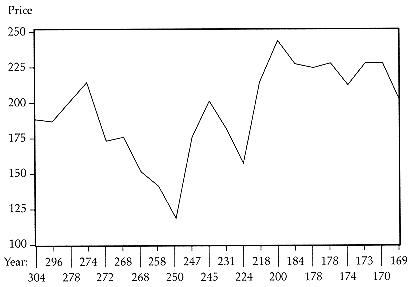
Figure 5.2.
Indexed Firewood Prices, Delos, 304–169 B.C.
the break. These results give a general picture of the price history of firewood. Price behavior displayed the same general volatile behavior throughout Delian history, but prices fluctuated around a lower average level before 218 than after. The year 250 B.C. showed unusually low prices. Nothing in the model lends support to the view that prices were higher in
| ||||||||||||||||||||||||||||||||||||||||||||||||||||||
the late fourth and early third centuries. It remains to account for these results.
Assuming for the moment that the wood supply is likely to have been relatively stable from year to year, variation ought to have come from demand, which would depend especially on the severity of winters. Because of the restrictions of the sailing season, demand ought to affect prices with a lag: after a mild winter, supplies would be larger and demand lower; after a bad winter, supplies would be depleted and demand high. (It would be very interesting to have a wood price for the severe winter of 168 B.C. [Livy 44.20].) If this hypothesis is correct, it could account for the behavior of prices apparent in figure 5.2.
The change in price structure ca. 218 B.C. requires more consideration. Even discounting the low price of 250 B.C. and the high one of 173 B.C. , the average of all prices before 218 is 40 price units lower than for prices after 218, representing a 22 percent rise. I would like to consider three possible explanations.
Sometime between 250 and 200 B.C. , but most likely between 235 and 220 or a little later, the Delians passed an important law regulating the import and pricing of wood and wood products, including charcoal.[97] Among other things, the law forbids importers to sell wood products—


[97] ID 509 = SIG 975. On the date, see H. W. Pleket, Epigraphica (Leiden, 1964), 18; ID comm., p. 325.
[99] Larsen, 353–54; Philippe Gauthier, BCH 101 (1977): 207: "Le législateur veut protéger les consommateurs" and "Le but est d'assurer aux consommateurs les prix moins élevés possible (les législateurs sont les consommateurs)"; and Meiggs, 453 (evidently without benefit of Gauthier's article): "This [regulation] is a gallant attempt to protect the consumer"; Déonna, Vie privée, 39, says the law "assure la stabilité du prix . . . [et] cherche à empêcher l'accaparement par l'achat en gros"; John Perlin, A Forest Journey (New York, 1989), 96–97. Generally, Isager-Skydsgaard, 146.
[100] Cf., e.g., Larsen, 354. The passage from the comic poet Alexis quoted by Athenaios (6.226a–b), which appears comparable at first glance, arises out of differ-ent circumstances: fish go bad, so sellers may be inclined to reduce prices as the day goes on.
In my view, the law was intended to guarantee the full collection of the pentekoste (5 percent tax) on imported wood. The regulations require importers to use public wood scales, which prevented under- or overweighing (II. 1–2). A dealer who bought wood was not allowed to resell it (II. 2–3), which would have resulted in a transaction on which no tax was paid. Sale directly from the ship, which would have made use of the public scales impossible, was prohibited (II. 3–4). Possibilities of fraud were reduced by requiring sellers to register on their own behalf (II. 4–5). Philippe Gauthier has shown that the next clause forbade persons who had bought wood sold by the state to resell it (II. 5–8).[101] The clause preventing sale at prices higher or lower than declared, which follows, must be understood in this context: such sales might allow merchants to circumvent the prohibition of resale by claiming that the different price proved that the lot of wood was different from that declared, even if its variety and weight were identical. (It is easy to imagine two merchants colluding to declare a purposefully high price on a lot that was then resold for less, with the second merchant reimbursing his coconspirator for the excess tax. If suspected, they could always argue that no one would intentionally overpay a tax!)[102]
Such a regulation might well have had an adverse impact on the price of wood on Delos. Since importers were required to make a declaration of value before they could offer their goods for sale (II. 11–14), they must often have done so without a clear notion of the current market. (We have seen both from monthly and from annual prices how widely prices could fluctuate.) Sellers would therefore prefer to set prices high. And since sale at lower than declared prices was not allowed, buyers would have little recourse but to pay the higher prices. Delian officials in charge of enforcing the regulations would be little concerned, since high prices meant greater tax income.
It might be objected that since the Delian government was in the hands of its citizens, they would surely not have tolerated a regulation that damaged their interests as consumers. Aside from the anachronism built into
[101] Philippe Gauthier, BCH 101 (1977): 206–7, translating as "Il est interdit (à l'importeur) de vendre, après en avoir été déclaré acquéreur, des marchandises (bois et charbons) vendue aux enchères publiques."
[102] This law would probably have had a dampening effect on any transit trade, since it essentially forbade the development of middlemen to buy imported wood and store it for later resale to exporters. This casts a rather different light on some claims about the Delian desire to encourage trade and the development of an entrepôt, which is explored further in chapter 7.
this notion of "consumers," several points deserve to be made. First, the causal connection between law and price was probably not obvious; it would not have been apparent without careful study of a long set of price data, since transient annual or monthly fluctuations would often have swamped long-term trends. Second, Delians engaged in trade (although they may have been few)[103] would have benefited and seen no need to oppose the law. Third, the Delian magistracies were in the hands of the wealthier strata of Delian society, who were less likely to be troubled by moderate price rises. Fourth, the period of time over which the rise occurred was long. Fifth, other factors (as I shall argue) were also working to push up wood prices.
It would be nice to be able to test this view against the prices of wood for construction, but unfortunately the accounts rarely provide enough information. A few prices for oak (see Meiggs, 455–56) may show price increases for ten-foot pieces from 9 dr in 246 B.C. to 10 dr 2 ob in 189 B.C. (ID 290.211, 403.23), and for eight-foot pieces from 7 dr 1 ob in 246 to 7 dr 3 ob in 207 and 9 dr 4.5 ob in 189 (ID 290.221, 336A38, 403.24), if some assumptions are made. The trend is right but the data are very slim indeed.
The reason for the passage of the law is not known directly, but one possibility connects with the second possible explanation for the rise in firewood prices. The wood-product import regulation imposes heavy penalties on violators, including a 50 dr fine (II. 14–16), equivalent to 37.5 talents of firewood at the prevailing price in 218 B.C. of 1 dr 2 ob. The state clearly believed it was losing money on wood undervalued at declaration, which suggests that upward pressure on wood prices had already begun.
This pressure could be associated with some other evidence from Delos and its neighbors for a period of economic expansion in the 230s, 220s, and 210s. We have already seen that a local transit business in grains is first attested in these years. Other indicators include a rise in the number of Rhodian amphorae; expansion of the docks; new construction north of the temenos of Apollo; and issuance of new coinage by Paros, Naxos, Tenos, and Andros. If this activity, which on Delos is largely confined to the port, led to increased building (of warehouses, for instance), the rising demand for wood for construction could have pulled up the prices of all wood products. This "new prosperity" is not universally attested in the evidence—oil prices do not rise, and neither, as we shall see, do rents for most of Apollo's estates—and therefore demands further discussion, which it will receive in chapter 7.[104]
[103] See Claude Vial in L'Origine des richesses dépensées dans la ville antique (Aix-en-Provence, 1985), 47–53; Vial, 317–56.
[104] Chapter 7, pp. 257–64.
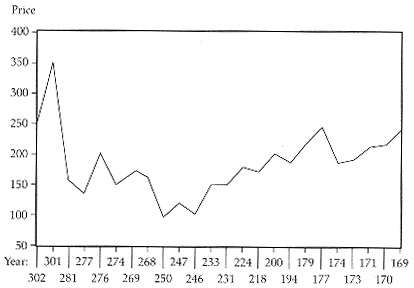
Figure 5.3.
Indexed Pig Prices, Delos, 302–169 B.C.
Finally, it is possible that firewood prices were responding to deforestation on the immediately neighboring islands. This is a difficult topic, where research is in its infancy; but it is already clear that different islands may have had very different histories, depending on microclimate, geology, soil type, land use, settlement patterns, and numerous other factors. The modern visitor soon notices the contrast between largely denuded Tenos and Keos and the relatively abundant scrub of Andros and especially Naxos.[105] Some threshold may have been reached toward the end of the third century that required wider search for or greater import of firewood; but much basic research needs doing before such a hypothesis can be adequately evaluated.
The Price History of Pigs Mean annual prices for pigs appear in figure 5.3. The curve resembles that for wood prices: fluctuation from year to year around a low mean before 200 B.C. and a higher mean thereafter. Two anomalies come in 302 and 301 B.C. , when prices were extraordinarily high.
[105] On deforestation in general, see Meiggs, 371–403, and John L. Bintliff, Natural Environment and Human Settlement in Prehistoric Greece (Oxford, 1977), I.59–86. Malcolm Wagstaff and Clive Gamble in Island Polity, 97, reckon that Melos was basically treeless by the fifth century B.C. , whereas Naxos still had woods into the nineteenth century. Rhodos still had wood to cut in 305 B.C. (Diod. 20.83.4). Rackham gives much useful information about the Kyklades in Archaeological Aspects of Woodland Economy, 177–97, and Greek City, 85–111.
| ||||||||||||||||||||||||||||||||||||||||||||||||||||||
A model based on two dummy variables set to capture (1) the years 302 and 301 B.C. and (2) the years from 200 offers an excellent account of these prices (table 5.8). The prices of 302/1 B.C. are almost 150 units (about 3 dr) above typical levels for the rest of the era of Delian independence. The change at 200 B.C. of 60 units (about 1.2 dr) is strong and clear, parallel to that for firewood of some years earlier.[106]
The history of pig prices must therefore address three questions: (1) why should prices for 302 and 301 B.C. be so much higher than those for any other year; (2) what accounts for the change in average price level around 200 B.C. ; and (3) is there a causal connection between higher firewood prices after 218 and higher pig prices after 200 B.C. ?
The high pig prices of 302 and 301 B.C. appear at first glance to support the view advanced by Heichelheim and others of inflated prices in the Aegean after Alexander's conquest of the East. In fact, however, there is a clear, transient local phenomenon that can account easily for prices in both years: the presence of troops.
In 302 Demetrios Poliorketes, who had been in Athens since 304, was recalled to Asia Minor by his father, Antigonos, in preparation for the conflict that would culminate in the battle of Ipsos. Demetrios passed with full army and fleet directly through the Kyklades. The following year, 301 B.C. , after the defeat at Ipsos, as he fled back to Athens through the islands, he
[106] While prices respond to a model postulating a change in 218 B.C. , the results are far better for 200 B.C.
stopped at Delos with an army of 9,000 men; he stayed long enough, probably residing in the temple of Apollo itself, to receive ambassadors from Athens. Additional evidence for economic strain in 301 comes in the form of a loan of 1,000 dr the Delians took out to buy grain (IG XI 2.146A20–21); if loans for grain purchase early in the third century imply periods of stressed price, then this loan adds to the evidence that 301 was a bad year for Delos.[107]
Although there is no direct statement in any of our sources that Demetrios's presence entailed economic problems, the conclusion is nevertheless inescapable. The passage of armies always brought local economic strain, and in this case the presence of perhaps 10,000 troops, a body of persons at least as large again as the entire population of Delos, must have devoured local food supplies and sent prices skyrocketing. The two extraordinary pig prices of 302 and 301 B.C. attest eloquently to the impact of armies on the market balance of local economies.[108]
Since firewood prices (but not oil prices) show a clear jump around 218 B.C. , there is reason to suspect other goods might show the same behavior; this suspicion is now confirmed. Moreover, like firewood, pig prices on either side of the threshold are fairly stable; there is no indication of a trend up or down with respect to time. The mean annual price for pigs in 302–218 B.C. is 141.6, or 120.5 excluding 302–301 B.C. , the same mean price from after 200 B.C. is 211.1, an increase of 50 or 75 percent.
Furthermore, pig and firewood prices generally behave in a similar fashion: both fluctuate around mean levels but show no particular tendency to rise or fall except for the striking and rapid adjustment at about 218 and 200 B.C. A graph of prices only from those years that have both pigs and wood reinforces this impression (fig. 5.4). Figure 5.4 also suggests a lag between the prices—that is to say, pig prices moved in the same direction as wood prices from year to year, but only after a delay. A regression to test this impression gives good results (table 5.9). This lag indicates that it was not pig but firewood prices that drove the system; the rise in mean pig prices after 200 seems to be only a response to high wood prices.
What could account for the conjunction of pig and firewood prices?
[108] See further pp. 181–87 on the impact of military presence.
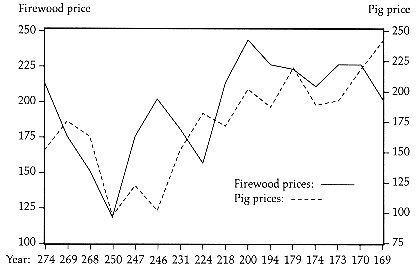
Figure 5.4.
Indexed Firewood and Pig Prices, Delos, 274–169 B.C.
| ||||||||||||||||||||||||||||||||||||||||||||||||||||||
Pigs "take care of themselves, day and night," writes a modern observer; they are "self-feeders."[109] Aristotle and other ancient commentators were no less aware of their virtues, which included heartiness, adaptability, and
[109] Verlyn Klinkenborg, Making Hay (New York, 1986), 48. Cf. Burford, Land and Labor, 146–47.
fecundity.[110] In the matter of feeding, ancient agricultural writers recognize pigs' appetite for almost anything, but Columella recommends they be driven into "groves" (nemora) that provide a wide variety of trees and bushes or, less desirably, ground cover (terrenum pabulum, 7.9.7). He recommends storage of mast (glans) against periods when there is little forage outside, presumably winter. Varro too favors summer pasturing.[111]
This method of feeding pigs, to which Homer and other ancient sources attest,[112] is called "pannage" and has been practiced since the Neolithic. In a highly developed form, it created the tight bond between pig raising and forest management that has been a predominant aspect of the rural economy in southwestern Spain and Portugal.[113] On the assumption that pannage figured among the approaches to raising pigs in the Kyklades, it is possible to offer a tentative account of the connection between pig and firewood prices. As the mechanisms already discussed exerted pressure on wood prices, coppices and other woodlots in the Kyklades would have been more intensively worked. But this would have reduced the acreage available for pannage, making raising pigs more expensive and forcing prices up. Since pigs can eat a wide variety of foods, not just the acorns from Kykladic oaks and other woodlot forage, the impact would be delayed and moderated.[114] The result would be rising or falling average pig prices that trailed
[110] Arist. Hist. anim. 8.6.2; see esp. Columella 7.9, passim.
[112] Hom. Od. 14.5–22, 24–26, 409–12, 524–33. Cf. Phereklides fr. 186, Amphis fr. 38 (CAF, vol. 1, 145; vol. 2, 236); Polyb. 2.15.2–3 on Italy; Longus Daphnis and Khloe 3.3.
[113] James J. Parsons, Geographical Review 52 (1962): 211–35; Caroline Grigson in Archaeological Aspects of Woodland Ecology, 279–315; J. G. Lewthwaite in ibid., 217–30 (I am indebted to Oliver Rackham for directing my attention to this article). For a slightly different view, see Michael H. Jameson in Pastoral Economies in Classical Antiquity (Cambridge, 1988), 98–99.
[114] Oaks are among the commonest trees in the Kyklades today and in the few pollen analyses conducted for the past. See Rackham in Archaeological Aspects of Woodland Ecology, 182–83, 189, 192, 193–94. Rackham cautions, however,against assuming too great a connection between woodlots and pigs (per. comm., 31 December 1989).
the changes in wood price levels. I should emphasize that this mechanism accounts for the long-term connection between wood and pig prices, not for short-term fluctuations, which as we have seen and shall see further below, are better accounted for by other means.
There is no significant relationship between pig and oil prices or between oil and firewood prices.
The Impact of Military Operations
The Greeks were quite aware that military operations in the vicinity of a city could raise prices.[115] The most obvious circumstance was, of course, the direct siege of a city by an enemy; as an example it will suffice to cite Plutarch's report of prices of 40 dr/med for salt and 300 dr/med for wheat during Demetrios's siege of Athens in 295/4 (Dem. 33.6). Less direct mechanisms were also familiar. In the fourth century, Lampsakos in Asia Minor raised prices for alphita and oil from 4 to 6 dr/med and from 3 to 4.5 dr/kh in anticipation of the arrival of a fleet of enemy triremes; the city pocketed the difference between the market and the inflated price. When the city of Herakleia Pontika commenced naval operations against the Bosporus, it effectively commandeered "all the grain and the oil and the wine and other goods" in the hands of merchants. In 366–365 B.C. , Timotheos of Athens, besieging the Samians, sold them the crops in the fields to raise money to pay his soldiers; he also found large numbers of soldiers gathered in a camp so difficult to provision that shortages arose and the sale of foodstuffs had to be regulated. Feeding soldiers off the crops of the enemy was, of course, standard practice, which could not help but raise prices for the victims. Military commanders might also impose new or higher taxes on the local population to cover war costs, like Khabrias in Egypt in the 360s B.C.[116]
The presence of foreign troops, whether in the form of a garrison, as on Andros in the third century, or simply awaiting operations elsewhere, as in Epidauros before the Kretan War (IG XII 5.714; IG IV2 1 66), could also
[115] See general remarks by Luigi Moretti in Storia e civilità dei Greci, vol. 4, La società ellenistica, pt. 8, Economia, diritto, religione (Milan, 1977), 358–59. Launey, II.724–812, has scattered information but no analysis from this point of view. On the occasional advantages of having troops quartered nearby, see Burford, Land and Labor, 191–92.
[116] [Arist.] Oik. 2.7, 1347a32–b2; 2.8, 1347b3–16; 2.25a, 1350b33–1351a12; 2.23c, 1350b4–7; 2.23d, 1350b7–15; 2.24a, 1350b15–16. Cf. B. A. van Groningen, Aristote: Le Second Livre de l'Economique (Leiden, 1933), passim.
drive up prices. SIG3 495. 176–79 directly links wars and shortage: "all those in the city were doing badly on account of the wars and the shortages" (


Raiders often targeted crops in the fields or rural habitations, as in Mylasa during the war with Labienus in 40 B.C. : "both concerning the land, which had been plundered, and the farmsteads, which had been burned, so that in all matters you had been unlucky" (



A number of difficulties plague the investigation of possible relations between military activity and price trends on Delos. The testimony for military and political activity in the islands is exceptionally poor, especially for the third century. The other problems stem from the exiguousness of the prices themselves. It is not always easy to say that a price is "unusual." The variations of season, sailing schedules, harvests, shipwrecks, piracy, and natural disasters may have forced prices up without any military
[117] Luigi Moretti, Rivista di filologia e di istruzione classica 108 (1980): 36–47, II. 3–4, 12–14, and on the source of the wine, 40–41; IG XII suppl. 116; Denis Knoepfler, BCH 114 (1990): 491; cf. also L. Moretti, ISE, I.64, p. 162, who prefers the war against Antiokhos.
[118] IK 34 Mylasa I.602.17–20 (= SIG 768), cf. Strabo 14.2.24 (C660), Dio Cassius 48.26.3–4. Another example: Polyb. 4.3.10.
[119] Diod. 20.81.2, 82.5, 83.3, 84.5, 93.2–3; Plut. Dem. 33.5; IG XI 4.751 (= Choix, 67).
| ||||||||||||||||||||||||||||||||||||||||||
presence at all, or may have conspired with a military presence to raise prices. Disentangling the responsibility of the various causes is virtually impossible.
In general, I have identified prices as unusual if they meet two criteria: (1) they must be substantially above both the mean and mode prices for that commodity during the period in question, and (2) other explanations—closure of the sailing season, poor harvest, and so forth—must be excluded. For example, the olive oil prices of 272 or 271 B.C. are about 25 percent above the mean and mode for the period (110.1, 100–109), but they fall at the end of the long decline to ca. 270 B.C. , which may mean they were simply the end of that trend; furthermore, the two prices occur in Lenaion after a presumed poor harvest (for 273 B.C. ) and in Bouphonion (?), when supplies in any case should be shortest and pressure of the approaching end of the sailing season greatest. Even though the First Syrian War, which has left some evidence on Krete and may have involved operations in the Bosporus,[120] was raging in these years, the presence of other potential explanations precludes invoking a military one for these prices.
The mean, mode, and range of prices are set out in table 5.10.