
Characteristics of Pyroclastic and Epiclastic Rocks
Pyroclastic rocks can be classified by their textural and mineralogical characteristics (see Appendix B). Complete descriptions include important details about thickness, grain size, pyroclast types, bedding sets, grading, clast orientation, flow features, induration and welding, and thermal remanent magnetization. This information is further supplemented by sampling representative clastic rock units for laboratory analysis.
Thickness
Pyroclastic units show thickness variations that are indicative of vent location, deposit type (for instance, fallout, flow, and surge), and the effects of paleotopography (Fisher and Schmincke, 1984). Even where pyroclastic units are not fully exposed, maximum exposed thicknesses can be used in constructing isopach maps. In some cases, thicknesses are estimated from topographic constraints such as scarp heights and bedding dips.
Grain Size
Field estimates of grain size can be made using the Fisher (1961) classification, which parallels the Folk (1966) classification of clastic sediments; both of these can be done with a scale and charts. Actual measurements will be done by sample sieving or thin-section studies in the laboratory, but visual estimates are sufficient for measured sections in the field. Coarser materials, including pumice and lithic clasts, can either be sieved in the field with coarse (>4-cm) sieves or measured and described at an outcrop within a designated area outlined on the rock surface (usually ~1 m2 ). These observations are especially useful in studies of lithic clasts within pyroclastic units. Another technique for recording the textural variations within an eruption unit is to measure the lengths of the five largest lithic clasts and those of the five largest pumices.
Pyroclasts
Most of this detailed work will be done within the laboratory, however, it is helpful while in the field to note pyroclast and lithic
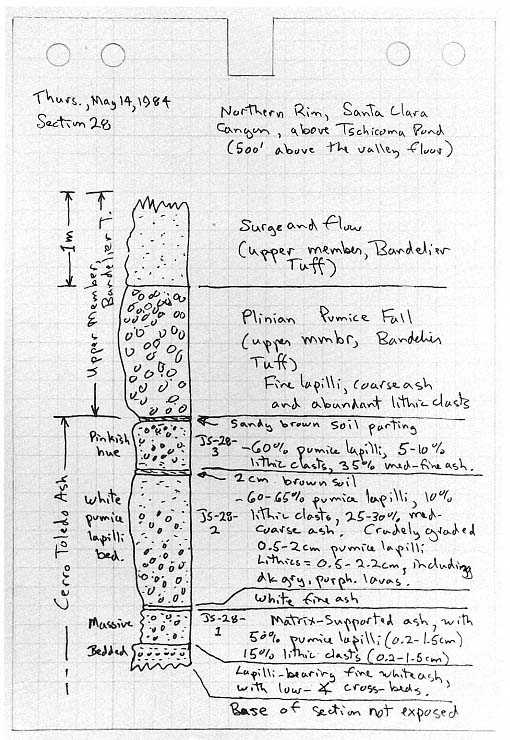
Fig. A.5
An example of notes taken during measurement of a pyroclastic rock sequence.
Field notes should be as complete as possible, including the date, location,
thorough rock descriptions, thicknesses of individual units, and location and numbers
of the samples collected for later laboratory analysis.
clast characteristics that can be used later to identify a specific formation or member: color, shape, percentage of phenocrysts, phenocryst types, and variety of lithic clasts. Lithic clasts include those of lag breccias, mesobreccias, and megabreccias (the two latter types are related to catastrophic collapses such as avalanches from a sector collapse in a volcano or wall collapse within a caldera).
Bedding
Bedform identification is helpful for interpreting the origin of a pyroclastic deposits. Fisher and Schmincke (1984) discussed various bedforms that can be related to different types of eruptions (such as Plinian, hydroclastic, Strombolian), as well as the emplacement mechanism. Where a pyroclastic deposit shows a sequence of bedforms as a coherent unit (bedding set), the sequence can be used with other observations to identify a mappable unit in the field. For example, a specific member might consist of a fine-grained ash fallout bed overlain by a surge bed, two pyroclastic flow deposits, and a volcanic mudflow breccia. Although the thicknesses and degree of compaction and welding within the pyroclastic flow deposits might vary, if the sequence appears to be unique, it can be helpful for correlating units.
Grading
The character of grading in pyroclastic deposits is also indicative of origin. The field geologist should determine whether a bed is massive, normally graded, or reversely graded.
Clast Orientation
Within surge deposits and pyroclastic flows, there may be elongate clasts or accidental debris, such as fossil tree trunks, that can be used to determine flow directions. The orientations of the long axes of as many elongate clasts as possible should be measured and averaged for each field location.
Flow Features
Many surge deposits are characterized by dunes or antidunes. Measurements of implied current directions, descriptions of types of cross-bedding, and estimates of the magnitude of the cross-beds are all useful for evaluating eruption types and processes and for locating vent areas. In pyroclastic flow deposits, flow features should be noted, including thickening in paleovalleys and shadow areas behind paleotopographic high areas where the flow is relatively thin.
Induration and Welding
To establish whether a rock is welded, partly welded, or nonwelded, bulk sample density can be compared to that of a nonvesicular lava of similar composition; welded tuffs have densities similar to those of equivalent lavas, nonwelded tuffs have densities less than half of those for equivalent lavas, and nonwelded tuffs have intermediate densities. To determine if the rock has been indurated or cemented by post-depositional processes, one should look for vapor-phase alteration within pyroclastic flow deposits, matrix cementation by diagenesis or weathering, and secondary clays from hydrothermal activity. Other evidence of induration might be found in the form of fossil fumaroles (pipe-like zones cemented with vapor phase minerals) and compaction features such as vertical concentrations of small lithic clasts (segregation pipes).
Thermal Remanent Magnetization
Most welded tuffs have high magnetic stability and exhibit uniform thermal remanent magnetization (TRM) directions. Polarity determinations of welded ignimbrites can be made in the field with a portable magnetometer (Lipman, 1975).
Sampling
For each distinct unit (but not necessarily from all measured stratigraphic sections),
field geologists collect a sample that is representative of that unit. If the tephra are unconsolidated and coarse grained, they are sieved, the size fractions are weighed, and chunks of the pumice are collected (in addition to a split of the <1-mm fraction that is kept for laboratory sieving). The various lithic clasts are described and samples of each lithic type are collected for thin-section study. If it is appropriate, samples are chosen for radiometric dating and chemical analysis: pyroclastic flows often show subtle compositional stratification that can be related to magma chamber evolution; fallout layers provide widespread time-stratigraphic units; organic matter such as buried tree trunks are very helpful in dating young pyroclastic deposits—these types of samples are always particularly valuable.