
Nature Forms
A great wealth of economic and aesthetic material is found by the Indian in the plants and trees that grow on every side. Roots, stems, leaves, and fruit give variously of food, medicines, and clothing. Certain of the initiated are believed to be blessed with the power to communicate with the plant world. Many plants are held sacred, "for some of them were dropped to the earth by the Star People; some were human beings before they became plants; others were the property of the gods and all, even those from the heavens, are the offspring of the Earth Mother, for it was she who gave the plants to the Star People before they left the world and became celestial beings."[82]
Fir, oak, cottonwood, corn, and squash supply names for clans and individuals. In the clanless villages where the two-moiety division is found, "Squash" is applied to the group of Summer people and "Turquoise"
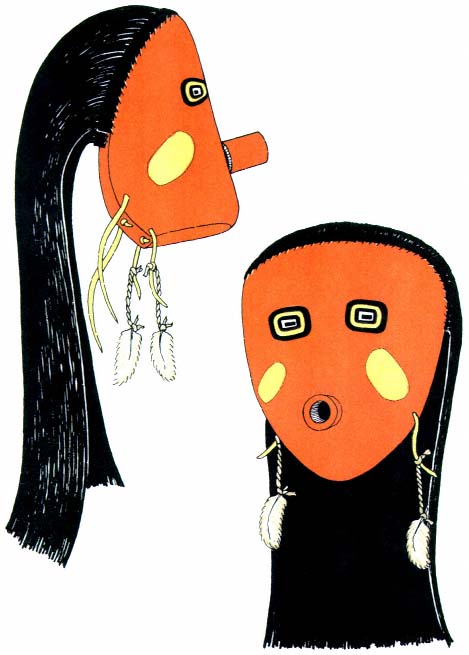
Plate 12.
Face mask. The nearest approach to realism.
to the Winter people: the one suggesting summer sun and growth; the other, winter cold and storms from the sky.
In order to satisfy his aesthetic urge, man has always bedecked himself in season with blossom, fruit, or leaf as the form or color has pleased his eye or enhanced his beauty. No discussion of the costumes of the Pueblo Indian would be complete without reference to these nature forms, which, though as used may be in either the fresh or the cured state, have come originally from living plants and trees.
Evergreen.
—The most conspicuous nature form, and that regarded with the greatest reverence, is the spruce tree and its branches. In special rain ceremonies the Rain priests and the dancers who personate the Rain Makers address the spruce trees, invoking them to extend their arms (referring to the branches) and water the earth. The breath from the gods of the undermost world is supposed to ascend through the trunks of these trees and form clouds behind which the Rain Makers work.[83] The Douglas spruce is the most desired[84] and great effort is often made to obtain it from the deep canyons of the mountainous country where it grows. Among the Tewa, officials go out the day before the ceremony to bring back its branches. In some of the performances small trees are set up in the plaza after midnight and the next day are worked into the dance pattern. At Hopi, spruce is more difficult to obtain. A runner is sent to bring it from the mountains, and this takes from early morning till late at night. At Hopi, also, the branches are planted and the children are amazed, when they awaken, to find "trees" growing in the plaza—a phenomenon explained as one which accompanies the supernaturals who are about to dance there.
Performers wear sprigs of spruce stuck in the belt, and in arm bands, and sprigs are carried in the hands. Small branches are tied together with yucca cord to form anklets (pl. 6) and great collars (pl. 4). Occasionally, spruce forms part of a headdress or fills in the back of a mask. Spruce branches are never thrown promiscuously about after ceremonial use;
they are dropped over the cliff or into the river, or are buried in the sands at the river's edge to be washed downstream with the next floodwater.
Used on the ceremonial costume in the summer dances, evergreen is the symbol of life. Green yarns embroidered on kilts and ceremonial blankets have the same connotation.
If spruce cannot be obtained, juniper may be substituted as an evergreen. Firebrands are made from juniper bark, since it burns very slowly and thus is a good means of transporting live coals. Torches of juniper are carried in night ceremonies. At Santa Clara and at Hopi a special Old Man is impersonated by the wearing of a juniper-bark cap or headdress.
Gourds.
—The gourd was one of the aboriginal plants cultivated by the Pueblo Indian before the advent of the Spaniards. It has an important place in both their ceremonial and domestic lives. The gourd, in fact, is indispensable to the Pueblo Indian; it is a bucket, a dipper, or a bowl as the need arises. Several species were grown. Some were small, some were long-necked, and others grew flat or round. By running the vine on a pole so that the green fruit hung down it was possible to develop extremely long, thin gourds; and it was possible to flatten them out by placing a weight on one side. Under stimulating conditions very large gourds have been grown. There are two masks made of gourds in the Museum of the American Indian, Heye Foundation.[85] One of them is large enough for a man to wear. With the lower end cut off, it would go over his head and rest upon his shoulders. There were holes for eyes and mouth. A smaller gourd made the snout, and the features were painted on. The other mask could have been worn by a boy.
The shell of the gourd is scraped clean of seeds and pulp and then thoroughly dried. As the gourd is a material more easily worked than wood, and, for the Hopi and the ZuÑi, much more easily available, it is made into snouts and beaks and ear bobs for masks. A large number of these are kept on hand at all times, to be available for any dance ceremonies. Rarely, two gourds will grow so much alike that the necks can
be used as horns on an animal mask. When several are found of the same size and shape, they are carved into flowers to decorate a headdress or arm bands. The heads of the sacred Plumed Serpents are made of gourds.[86] The mouth is cut to show two rows of teeth, between which a red leather tongue is allowed to dangle. Gourds are made into rattles, round or fiat, with the necks serving as handles (fig. 20, p. 146). Certain phallic devices are made of the long variety of gourds and these symbolize fructification.[87]
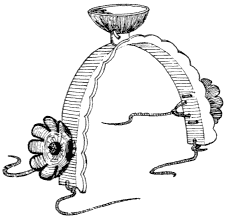
Figure 13.
Headdress with flowers made of grounds.
Yucca.
—Yucca, or Spanish bayonet, is a low-growing desert shrub. Its sharp, pointed leaves branch out stiffly from a single stem. The blossoms are white and appear in a cluster on a shoot several feet above the leaves. This plant is called "soapweed," and because it produces an excellent lather it is indispensable to the desert Indian. The roots are crushed or pounded with a stone and put into cold water to steep. Within a few moments a thick lather can be produced by brisk stirring. The fibrous parts are removed and the shampoo or laundry is ready. The glossy black hair which is a source of great pride to every Indian man, woman, and child is washed as often as once a week with this soap lather. No ceremony is complete without hair washing. Among the Hopi every infant when it is named, every girl on her marriage day, every boy upon initiation into a secret fraternity or a medicine society—all must have their hair washed. Before a public entertainment every dancer, and indeed every person in the village, is expected to wash his hair. At the conclusion of a ceremony every impersonator is discharmed—that is, the supernatural spirit which he has assumed is washed away in the shampoo and he becomes human once more. In all these ceremonies the yucca suds represent
clouds. Ceremonial bowls full of suds are often found on the altars; they are imitation magic denoting that clouds are wanted to bring rain.
The long, flat leaves of the giant yucca are carried by warriors and whipping impersonators (pls. 5, 6, 35, 36).[88] Initiates are purified by whipping.[89]
The costumes of certain kachinas of the Hopi have skirts made of stiff yucca leaves.
Corn.
—Everything connected with corn is sacred. For the Pueblo Indian, life itself depends upon the growth of corn. Since the beginning of time it has been his greatest source of food. Directly and indirectly his entire existence is related to the culture of corn. Land is owned by individual or tribal group, but wealth depends upon the production of corn. Soil and water are of prime importance because they make possible its growth. The Pueblo Indian believes that rain and snow are sent by the supernaturals and can be obtained only by prayer and ceremony, and thus have come into being the Weather Control groups which form the underlying structure of Pueblo life.
As the staple food, corn is eaten fresh or is dried and stored for the future. The need of safe storage space has had its influence upon the structure of house and village. As the basis of Pueblo life is corn, it is not surprising to find it a conspicuous feature of the ceremonial life. The perfect ear, with its special covering, is the life fetish of each individual, and is often placed upon the society altars or worn secreted in the belts of the dancers. Ears of appropriate colors are laid around the medicine bowl before the altar. The bowl represents the center and the corn the six cardinal directions.
White corn meal, finely ground, is the women's special offering, equivalent to the prayer plume of the men. However, both men and women sprinkle corn meal on the dancers. The priest sprinkles a 'road' into the dance plaza for the impersonators to follow, or with meal he designates
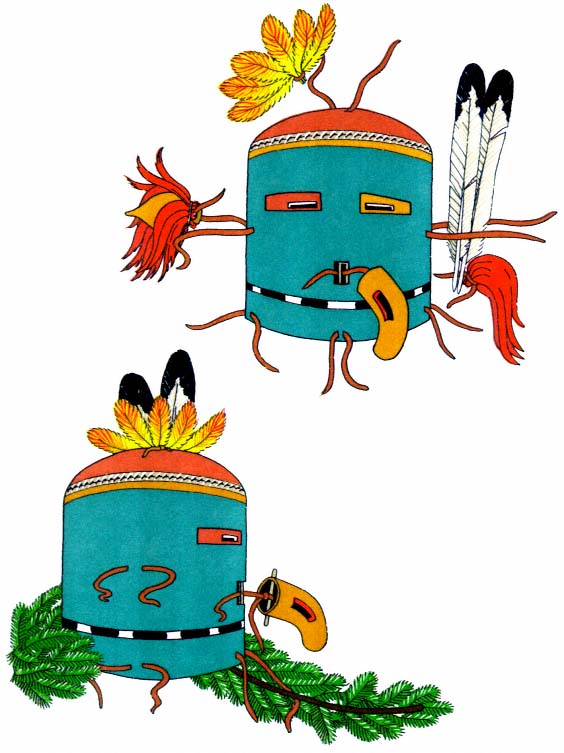
Plate 13.
Helmet mask, Hopi Pawika. Occult symmetry
achieved through fixing of ornaments.
the 'way' to the edge of the village, where the populace go to offer prayers to the Sun. At the end of the Hopi Snake Dance the women describe a great circle with corn meal. The snakes used in the dance are heaped in the center of this circle; then, after another prayer and a sprinkling of meal, each member of the Snake Dance group grasps as many of the wriggling reptiles as he can and dashes away in one of the cardinal directions
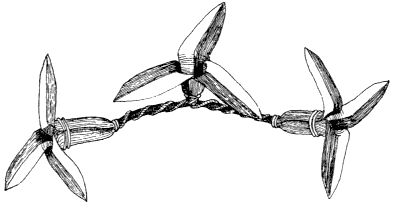
Figure 14.
Cornhusk flowers worn by
Powamu dancers, Hopi.
to deposit his burden far out on the desert, whence it is to return to the world below carrying to the gods the prayers for rain.
Corn in various forms is carried or worn by the dancers. Sometimes it is the actual ear, sometimes the symbolic representation of it—both three-dimensional and painted. Cornhusks are used, and even the cob. The whole grains are always carried somewhere on a dancer's person to symbolize prayers which accompany the dance. The knobs of the masks worn by the clown Mudheads have corn and other seeds tied in them.
Ears of corn are often carried by impersonators and women dancers as an accessory to their parts, or they are attached to the tablita worn by the maidens. The Sio Shalako mana, the Zuñi Shalako Maiden of Hopi, is shown with a stylized ear of corn on the forehead (pl. 18). Painted representations are found on masks, head boards, and tablets which are carried in each hand. The corncob is useful as a holder into which the feather
quills are stuck, thus forming a feather bouquet. I have seen an example of a curved cob, stained from black at one end to red at the other, used as a beak on a mask.[90]
The dried husk is a useful part of the corn. It is slit into ribbons and used to decorate the hair (pl.39) and caps of the clowns.[91] Balls of husk are covered with cotton cord at the head of the long fringe on the plaited ceremonial sash,[92] representing corn and rain and the desire for bountiful crops. Tightly twisted cornhusks form the framework and mounts for feathers in many ornaments. Cornhusks wound into a circlet may be worn on the head to support wooden symbols of lightning and clouds.[93] Skillful arrangements of cornhusks simulate teeth and mouths on masks. Cornhusks are rolled into cones and used as earbobs, or are fashioned into collars at the bottom of masks. Erna Fergusson colorfully describes the manufacture of gay cornhusk flowers: "They smoothed the pale gold husks on their knees, tore them into the right shape, and then, dipping twisted yucca fiber into shallow pottery bowls, they applied a light-red paint to one half of each leaf. The work was apparently negligently done, while conversation went on, but the results were beautiful. Soon four petals were ready, and then they were quickly twisted into the shape of a big open flower, like a squash blossom, tied, and laid aside. Without any apparent effort or hurry each man soon had beside him a pile of pale-gold and red blossoms."[94]
Cotton.
—I have discussed the spinning and weaving of cotton into fabric, but with the Indian its ceremonial use does not stop there. It has a place in almost every ritual. The Zuñi name for unspun cotton is "down," and down, as I have said, is the sacred feather of life, the breath of the supernatural. It symbolizes clouds[95] and snow and is often stuck on the horsehair beards in place of eagle down. The tops of certain masks are covered with raw cotton to indicate that those gods are associated with rainmaking. Handmade cotton cord is always used in prayer plumes and for the purpose of fastening together feathers used for ornaments on the
ceremonial costumes. It is placed across a road leading into the village to indicate that a ceremony is taking place. We often find the loosely twisted cord hanging from the crown of a wig in definite contrast to the black hair (pls. 3, 17).
Herbs and flowers.
—The Pueblo plant forms are limited to those which will grow in a land of much sunshine and little rain. However, these are numerous. And since it was not always possible to travel great distances for herbs and leaves, the Indian was forced to employ that which was near at hand.
In wide desert spaces, colors and plant forms, flower and leaf, stand out in brighter shapes and make a more poignant appeal to the aesthetic sense. The sagebrush, the sunflower, are not homely, commonplace; they are vivid and beautiful. I remember the blanket-wrapped form of a young man who impulsively rushed out of the sacred dance room to pluck the sunflowers across the barbed wire fence and carried them back into the shadow of the dark kiva. When the dancers emerged a few minutes later to take their places in the dance pattern, each carried with the sprig of evergreen the nodding, golden heads of the sunflower. This was not a conventional part of the paraphernalia of the dance; it was evidence of that fundamental, primal thing which those who live close to nature so readily feel. The feathery pigweed may be carried and tossed to the spectators who line the edge of the plaza. Sagebrush adds a soft gray-green to the hand tablet of the Corn Maidens, and sand grass gives a brittle edge to tablita and wand. Mouse-leaf blossoms mixed with ocher earth will color bodies yellow, and crushed barberries give them a purple hue. To each dancer, after he has dressed, are given the powdered flowers of the wild buckwheat in order to assure him grace. White primrose blossoms are rubbed over the necks and arms of those who impersonate the Zuñi Corn Maidens, so that they may dance well and please the "white shell mother of the Sun Father" who will surely send rains to moisten the earth and make the corn grow.