
SIR ALEXANDER CRICHTON (1763-1856): THE MAN AND HIS WORK
We can easily imagine Pinel’s surprise and pleasure when he read the Introduction to Crichton's Inquiry. He discovered a self-assured innovator equally impatient with ancient and modern models: Crichton proposed to practice observation and follow the analytic method including, we are amazed to read, "abstracting his own mind from himself, and placing it before him as it were, so as to examine it with the freedom and with the impartiality of a natural historian."[106] (This attempt at self-analysis seems to foreshadow Sigmund Freud.)[107] Crichton discarded traditional nosologists, even Linnaeus, as "generally and justly neglected."[108] The mainstream of new knowledge, for Crichton, flowed from Germany, that "learned nation."[109] His enthusiasm for Germany
[106] Crichton, Inquiry, Preface, x.
[107] R. Hunter and I. Macalpine suggest the comparison. See Three Hundred Years of Psychiatry, 1535-1860: A History Presented in Selected English Texts (Hartsdale, N.Y.: Carlisle, 1982), 559.
[108] Crichton, Inquiry, Preface, xxvii.
[109] Ibid., iii.
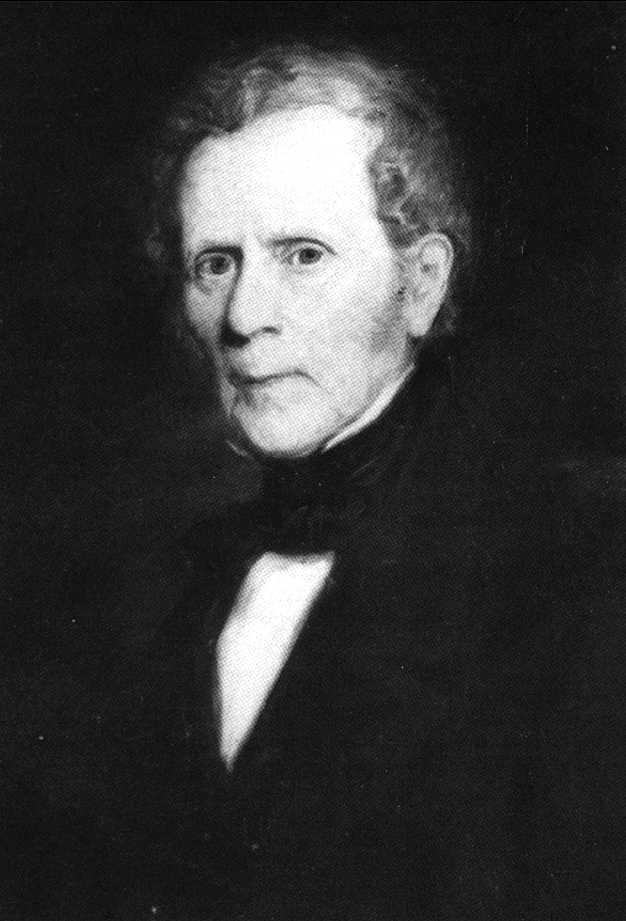
Pl. 17. Portrait of Sir Alexander Crichton attributed to C. H. Harlow (no date).
set him apart from his British medical colleagues whose travels to the Continent had long taken them to Leiden and Paris, and then to Italy and perhaps Vienna. Stuttgart, Halle, and Berlin were unusual places to visit, but Crichton did not mind taking a different track than his colleagues: he did not even mention the large group of British medical practitioners who recorded their experience with mentally ill patients in books during the last third of the eighteenth century.[110] The exception is Dr. Thomas Arnold, whose book Crichton lambastes repeatedly in his Introduction, and quite justifiably so. But Crichton spent little time on a critique of his colleagues—he was so convinced of being an innovator that he preferred to look ahead rather than backward.
He earned lavish praise from Pinel in the Introduction to the Traité of 1800. After heaping scorn on most contemporary writers on the subject, Pinel continued:
I except the research of Crichton, a profound work full of new observations based on the principles of modern physiology. It focuses on the pathogenesis of mental alienation rather than on its history or therapy. I believe I should now give an exact idea of the origins, development, and effects of the human passions on the animal economy, as this author has presented them, and as they should be known, namely as the most usual cause of derangement of our psychologic functions.[111]
Pinel then proceeded to an eighteen-page paraphrase and analysis of History of the Passions and Their Effects. It is strange indeed that until now no one has explored the relationship of Pinel to Crichton.[112] This relationship might have blossomed had Dr. F. R. Bidauh de Villas (1775-1824) carried out his intention of publishing a translation of Crichton's book, a project revealed in a manuscript at the Wellcome Institute, London. Instead, Bidauh wrote a close textual analysis and synopsis of Crichton's book but stopped short of part 3, On the Passions, the most novel and important section. He sent his work to his friend A. A. Royer-Collard, who eventually published it in his Bibliothèque médicale, but only in 1816-1817. By that time, the nascent psychiatry was turning its atten-
[110] See n. 80 above.
[111] Pinel, Traité, Introduction, xxi-xxii.
[112] Swain voices the opinion that Crichton was of great importance to Pinel, but she does not pursue this insight (Gauchet and Swain, La pratique de l'esprit, 347-349). Goldstein argues that Pinel "sought guidance" from Crichton (Console and Classify, 95). Yet when Pinel read Crichton's book, his own was already being printed. 1 incline to argue for a meeting of minds.
tion increasingly to brains, not the mind, and thus interest in the work of Pinel and Crichton was on the wane.[113]
Who, then, was Crichton? There are only two monographic studies on Crichton in the literature,[114] and only a few historians of medical psychology acknowledge his work.[115] And yet Crichton, eventually Sir Alexander Crichton, born in Edinburgh in 1763, dead at the age of ninety-three at Seven Oaks, Kent, F.R.S., F.L.S., F.G.S., and a licentiate of the Royal College of Physicians, not only wrote an important early book on psychiatry but served two tsars with distinction as head of the Russian civilian medical department for fifteen years, and then lived in London for another third of a century as a respected member of his profession.[116] Crichton's education was broadly based, and his published writings are heterogeneous.[117] He had studied at the Edinburgh medical faculty with Joseph Black, Alexander Monro, secundus, and especially James Gregory (1753-1821), who influenced him deeply. Indeed, a comparison of the topics and opinions in Gregory's Conspectus medicinae theoreticae reveals striking analogies to Crichton's Inquiry.[118] But theory
[113] See Wellcome Institute, London, MS. 1164, dossier 29, and F. T. Bidault de Villiers, "Recherches sur la nature et le principe de l'aliénation mentale par A. Crichton," in Bibliothéque médicale; ou, Recueil périodique d'extraits des medleurs ouvrages de médecine et chirurgie 53 (1816): 30-67; 54(1816): 289-324; 55 (1817): 289-331. Bidault's essay on Crichton is not included in a collection of his Œ uvres posthumes (Paris: Veret, 1828), whose editor comments that "M. Bidault de Villiers seems to have given up that translation and limited himself to a detailed analysis... published in 1816-1817" (ix).
[114] See Hopf, Leben and Werk, and Tansey, "Life and Works;" for full citations see n. 7 above. Tansey gives a detailed account of Crichton's Scottish background and lifelong connections. She also offers some new information on his London practice and on his Continental experience.
[115] The best among these are A. Boldt, Über die Stellung und Bedeutung der "Rhapsodieen über die Anwendung der psychischen Curmethode auf Geisteszerrüttung" von Johann Christian Red (1759-1813) in der Ceschichte der Psychiatric, Abhandlungen zur Geschichte der Medizin und der Naturwissenschaften, Heft 12 (Berlin: Ebering, 1936), 45-51; Hunter and Macalpine, Three Hundred Years of Psychiatry, especially 559-564; R. Hoeldtke, "The History of Associationism and British Medical Psychology," Medical History 11 (1967): 46-65; Schrenk, "Pathoiogie der Passionen" (n. 12 above) and idem, Über den Umgang mit Geistesltranken (n. 12 above), 123-124.
[116] Crichton was decorated by Tsar Alexander I with the order of St. Vladimir, Knight Grand Cross, second class, in 1814, and by King Frederick William III of Prussia with the Grand Cross of the Red Eagle, second class, in 1820. He was knighted by King George IV in 1821 and honored with the Grand Cross of St. Anne by Tsar Nicholas I in 1830.
[117] See Appendix, Biobibliographic Note 2.
[118] J. Gregory, Conspectus medicinae theoreticae; or, A View on the Theory of Medicine (Edinburgh: Stirling and Shade, 1823). It was first published in 1780-1782, at the very time when Crichton was a medical student in Edinburgh. A much earlier edition was translated into German as Übersicht der theoretischen Arzneiwissenschaft, 2 vols. (Leipzig: Fritsch, 1784-1785).
did not predominate in Crichton's training: he served an apprenticeship with the surgeon Alexander Wood and undoubtedly also "walked the wards" of the Royal Infirmary of Edinburgh.[119] Moving to London at the age of twenty-one, he spent one year with another surgeon, William Fordyce, while also attending the hospitals. By the time he reached maturity, Crichton had absorbed three deeply influential British traditions, Baconian empiricism, Lockean Associationist psychology, and Scottish "Common Sense" philosophy. This was so obvious to Crichton that he wrote in his Introduction to the Inquiry; "The most useful of these authors, and their works, I shall now enumerate.... Those of our British Psychologists, such as Locke, Hartley, Reid, Priestley, Stewart and Kaims [sic ] need not be mentioned."[120] And indeed Crichton incorporated these authors' ideas into his work in a casual and familiar manner.
The inductive method was basic to Crichton's approach: that is why he, like Pinel, set so much store by detailed case histories reported without reference to any preestablished "system." The absence of innate ideas and moral values—the tabula rasa —was another essential prerequisite for Crichton's Inquiry. A passage in History of the Passions that Pinel commented on with admiration reads:
The passions are to be considered, in a medical point of view, as a part of our constitution, which is to be examined with the eye of a natural historian, and the spirit and impartiality of a philosopher. It is of no consequence in this work whether passions be esteemed natural or unnatural, or moral or immoral affections. They are mere phenomena, the natural causes of which are to be inquired into.[121]
Further, Crichton mentions the association of ideas as if this were a generally recognized and adopted truth: David Hartley's conclusions had by Crichton's time become obvious assumptions for the nascent psychi-
[119] G. B. Risse confirms that surgeons lectured there, beginning in 1770, and their students were admitted to clinical rounds and to surgical procedures: see Hospital Life in Enlightenment Scotland: Care and Teaching at the Royal Infirmary of Edinburgh (Cambridge: Cambridge University Press, 1986), 266-271.
[120] Crichton, An Inquiry, Preface, xxvii.
[121] Ibid., book 11, 98-99.
atric specialty.[122] For Hartley, association was a material process caused by the vibration and gravitation of particles in a fluid acting on the brain. Crichton combined this explanation with faculty psychology. According to this theory, a defective association acting on a mental faculty such as attention, will, memory, reason, or imagination will result in "derangement."[123] Crichton's ideas of faculty psychology stemmed from Dugald Stewart (1753-1828), with whom he undoubtedly studied at Edinburgh, thus absorbing the ideas of Thomas Reid (1710-1796).[124] Their "Common Sense" approach was of course more serviceable for a physician than the more famous contemporary Scottish philosophy, the skepticism of David Hume. Nor does Crichton mention the Theory of Moral Sentimerits (1759) by another Scottish philosopher, Adam Smith (1723-1790), while a French translation of the work by the marquis de Condorcet's widow stood in Pinel's library, and he mentions it in the Introduction to his Traité.[125]
A Scottish education and training in surgery and medicine both in Edinburgh and London did not leave an inquisitive and ambitious young gentleman with the feeling that his preparation for a career was complete: he needed to undertake a tour of the Continent. Crichton spent four years, from 1785 to 1788, traveling abroad, and for our purposes this is the most intriguing part of his intellectual biography. One month sufficed to obtain the M.D. degree at Leiden, on 29 July, 1785, with a thesis De vermibus intestinorum. It is a mere eighteen pages long and—curious for a thesis in medicine—dedicated to the surgeons Alexander Wood and William Fordyce, his teachers.[126] The season 1785-
[122] I have used D. Hartley, Observations on Man, His Frame, His Duty, and His Expectations, 4th ed.,3 vols. (London: J. Johnson, 180l). The book was first published in 1749 and translated into French by the abbé R. A. C. Sicard, De l'homme, de ses facultés physiques et intellectuelles, de scs devoirs, et de ses espérances, 2 vols. (Paris: Ducauroy, 1802). There is also a French version of Hartley's earlier Various Conjectures on Perception, Motion, and Generation of Ideas, published in 1746, translated by the abbé Jurain as Explication physique des sens, des idées, et des mouvementa rant volontaires qu'involontaires, 2vols. (Reims: Delaistre-Godet, 1755).
[123] For a good overview, see Hoeldtke, "The History of Associationism."
[124] Stewart served as professor of mathematics at Edinburgh from 1775 to 1785, and as professor of philosophy from 1785 to 1810. Reid's most influential books, popular at the time of Crichton's studies, were Inquiry into the Human Mind on the Principles of Common Sense (1764), Essays on the Intellectual Powers of Man (1785), and Essays on the Active Powers of Man (1788).
[125] Pinel, Traité, Introduction, xxvii.
[126] A minor indication of how blurred the boundaries between medicine and surgery had become by 1785.
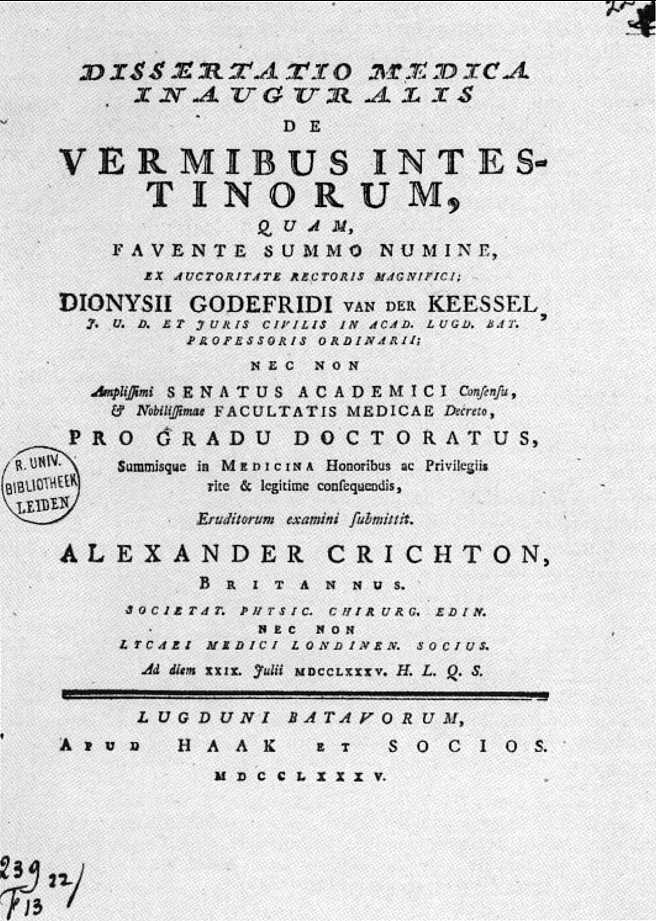
Pl. 18. Title page of Sir Alexander Crichton's M.D. thesis, De vermibus intestinorum (On the worms of the intestines).
1786, spent in Paris, left no noticeable traces in Crichton's writings (nor have I found any track of his presence in France)[127] However, soon after the publication of his Inquiry, we find "Crickton de Londres" among the foreign associates of the official Société de médecine de Paris, and on 24 February 1835 he was one of 234 foreign corresponding members elected by the Paris Academy of Medicine.[128] Crichton does mention, in Commentaries on Some Doctrines published in 1842, that he "had the honor" of "knowing Pinel personally."[129] (That meeting must have occurred in the winter of 1785-86, when Pinel served as editor of the Gazette de santé. Likely places for an encounter were the Jardin du roi, where Pinel studied, the Helvétius salon, the surgeon Pierre Desault's rounds at the Hôtel-Dieu, or lectures at the Collège de France or the Sorbonne.)
Then followed Crichton's three Wanderjahre, spent at Stuttgart, Vienna, Halle, Berlin, and Gtttingen. Late in 1788, he returned to England. On 7 May 1789 Crichton joined the Corporation of Surgeons in London but disfranchised himself after two years because, say his biographers, he "never liked the operative part of the profession." Rather, he joined the Royal College of Physicians as licentiate on 1 June 1791 and worked at a dispensary in Holborn where he gave clinical lectures "upon a plan similar to that of Götingen University." In 1794 he was elected physician to Westminster Hospital, where he taught "The Theory and Practice of Physic," as we learn from an advertisement in the London Times.[130] Despite this title he actually taught a course in psychiatry since he tells us in the Preface to the Inquiry that he wrote the book for his students. One can indeed imagine each of the three parts as notes for a course: part 1, on the nature and origins of mental derangement; part 2, on the physiology and pathology of the human mind; part 3, on the passions and their effects. The volumes consist of five, eight, and six chapters respectively—each chapter could well have formed the subject matter for one classroom presentation. Crichton lectured at the Westminster throughout the 1790s: we can assume that he interviewed
[127] Contrary to the comments of Tansey, "Life and Works," Paris was not yet "in the throes of a revolution in medical teaching," nor had the Charité Hospital been, as yet, "newly established" (243).
[128] Applicants petitioned for this honor, and thus there must have been correspondence between Crichton and the academy's secretariat. That documentation lies in some of the one hundred uninventoried—and, I believe, virtually untouched—boxes stored at the Académie nationale de médecine, 16, rue Bonaparte, Paris.
[129] A. Crichton, Commentaries on some Doctrines (London: Churchill, 1842) 180.
[130] 15 April 1794, 17 September 1794, and 15 September 1797.
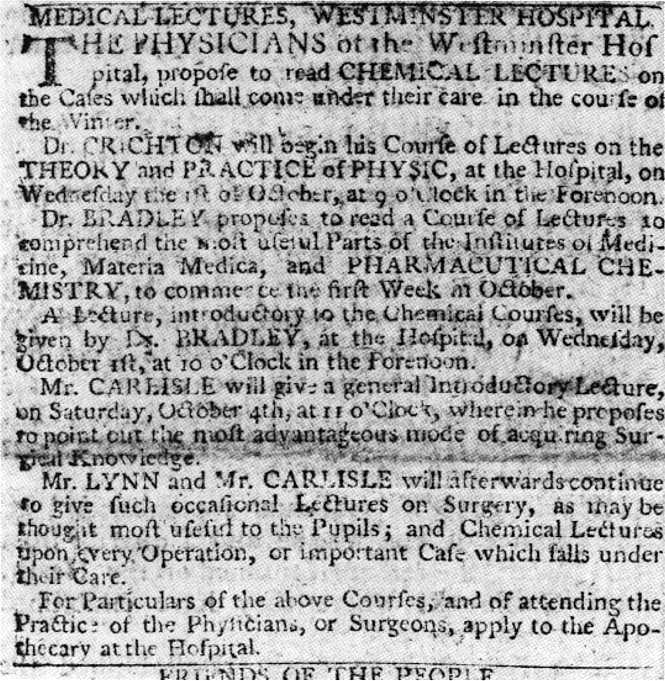
Pl. 19. Advertisement on the front page of The Times (London) of 17 September 1794. The advertisement reads as follows:
MEDICAL LECTURES, WESTMINSTER HOSPITAL
THE PHYSICIANS of the Westminster Hospital, propose to read CHEMICAL LECTURES on the Cases which shall come under their care in the course of the Winter.
Dr. CRICHTON will begin his Course of Lectures on the THEORY and PRACTICE of PHYSIC, at the Hospital, on Wednesday the 1st of October, at 9 o'clock in the Forenoon.
Dr. BRADLEY proposes to read a Course of Lectures to comprehend the most useful Parts of the Institutes of Medicine, Materia Medica, and PHARMACEUTICAL CHEMISTRY, to commence the first Week in October.
A Lecture, introductory to the Chemical Courses, will be given by Dr. BRADLEY, at the Hospital, on Wednesday, October 1st, at 10 o'clock in the Forenoon.
Mr. CARLISLE will give a general introductory Lecture, on Saturday, October 4th, at 11 o'clock, wherein he proposes to point out the most advantageous mode of acquiring Surgical Knowledge.
Mr. LYNN and Mr. CARLISLE will afterwards continue to give such occasional Lectures on Surgery, as may be thought most useful to the Pupils; and Chemical Lectures upon every Operation, or important Case which falls under their Care.
For Particulars of the above Courses, and of attending the Practice of the Physicians, or Surgeons, apply to the Apothecary at the Hospital.
the mentally ill patients in front of his students—for indeed these patients were regularly admitted to his hospital in small numbers—and that he drew the students' attention to the psychologic manifestations of somatic illness.[131] Owing to his book he was asked to testify regarding the sanity of James Hadfield, the madman who attempted to assassinate King George III in 1800. The next year, Crichton became a consulting physician at the Westminster and retained that position to the end of his life.
In 1800, Crichton married and shortly thereafter was appointed physician to Adolphus Frederick, duke of Cambridge (1774-1850), the tenth child and seventh son of King George III. New family connections smoothed his path, or he may have met the young man at Gõttingen, where three of the royal princes were sent for their education in 1786. Being now a courtier, he came to the attention of emissaries from the Russian tsar, who lured him to St. Petersburg in 1804. Were one to pur sue research on Crichton, one would go to Edinburgh, as Tansey has done, but mainly to St. Petersburg, for Crichton spent fifteen years in the service of the tsar. In a pamphlet published in 1817, he describes himself as
Physician-in-ordinary to their imperial majesties the Emperor and Dow ager Empress of Russia; Physician-in-chief of the Civil Department of the Empire; Knight of the Order of St. Vladimir; Honorary member of the Imperial Academy of Sciences of St. Petersburg.[132]
[131] The Medical and Physical Journal published monthly admissions figures to LondonHospitals. From December 1799 to May 1800, for example, the "Diseases admitted under the care of the physicians of the Westminster" included the following cases that may will have had psychologic concomitants:
Dec | Jan | Feb | Mch | Apr | May | |
amenorrhoea | 3 | 5 | 4 | 5 | 4 | 7 |
asthma | 2 | 9 | 2 | 5 | 1 | |
hypochondriasis | 1 | 1 | 1 | |||
hysteria | 2 | 2 | ||||
dyspepsia | 2 | |||||
epilepsy | 2 | 1 | 2 | |||
convulsions | 2 | 2 | ||||
palpitations | 1 |
Medical and Physical Journal 3 (1800): 16, 112, 208, 303-304, 408-409, 505-506.
[132] A. Crichton, An Account of Some Experiments Made with the Vapour of Boiling Tar in the Cure of Pulmonary Consumption (Edinburhg: Manners and Miller, 1817).
He published a Pharmacopoeia pauperum while in Russia and coedited a short-lived journal, Russische Sammlung für Naturwissemchaft und Heilkunde.[133] (The Leningrad Archives would undoubtedly reveal more publications.) Unfortunately the Sammlung contains no entries signed by Crichton, though plentiful comment by the editors collectively. This indicates much curiosity about the geology, fauna, and flora of Asiatic Russia and China, which may well reflect Crichton's avocations, and a great deal of interest in southeastern Russia, where a cholera epidemic ravaged the population. Indeed, Crichton's medals were undoubtedly rewards for his efforts in fighting this epidemic.
In connection with a subsequent typhus epidemic, Crichton established an essay prize with thoughtful guidelines. He donated a thousand rubles for the best essay on indigenous remedies, and five hundred rubles for the best description of typhus. The instructions to candidates reveal Crichton's interest in susceptibility to the disease. Candidates should take the emotions into account, and inquire
what were the forms and characteristics of the disease among the inhabitants as the enemy came ever nearer to their homes, and later, when national enthusiasm rose to great heights, and finally, when total success rewarded the efforts of the fatherland?
And how did the disease manifest itself among the enemy, first, when he was still blinded by the illusion of victory (an illusion that remained alive among prisoners), and later, when he found himself toppled from glittering heights into abject disgrace?
It might also be worth examining national differences, Crichton continues, between Europeans and Asians, with regard to typhus.
Are there observations indicating that individuals in one nation fall ill more quickly and in larger numbers? are some more resistant to damaging influences or to contagion? or did the illness among them take on special characteristics or curious symptoms?[134]
These questions indicate an astonishing sensitivity to what we would call psychosomatic parameters of illness. Crichton's contribution of a substantial prize, and the deferential tone in which his coeditors thanked him, suggest that this personal physician to the imperial family held a well-paid and favored position at the Russian court.[135] Though eager to
[133] 2 vols., ed. A. Crichton, J. Rehmann, and K. F. Burdach (Riga and Leipzig: Hartmann, 1815-1817).
[134] Ibid., 2:x-xi.
[135] Tansey suggests another possible motivation for the prize: Crichton had devised a new method for refining vegetable oil, together with the apothecary Konstantin Kirchoff. Their factory, on Aptekarskiy Island in St. Petersburg, produced 4,400 pounds of oil a day. Crichton's monetary benefits from this invention must have aroused considerable envy, and he may have decided to give away some of the money to allay these feelings. See Tansey, "Life and Works," 248, and Dictionary of Scientific Biography, s.v. "Kirchoff."
come home in 1809, he did not obtain the tsar's permission until 1819, and we know little about the remaining third-of-a-century in Crichton's life. He became a respected member of the medical community, with an office in Harley Street, and was a member of the Royal, Geological, and Linnaean Societies of London. Interesting as a biographic investigation might be, we must now focus on the references, ideas, attitudes, and mainly the ideas he transmitted to Pinel and Esquirol about German anthropology, natural history, physiology, and religion, as they affected mental alienation.