
Images of Gods and Men in a Changing Society:
Self-identity in Hellenistic Religion
Folkert van Straten
Self-identity or self-definition in religion is, I think, about the place a person assigns himself in relation to the gods he worships.[1] It is about the nature of the relationship between gods and men as perceived by the worshipers, and it will take account of such questions as: Is this relationship primarily a personal one, between the individual worshiper and his god, or is religion rather looked upon as a matter of the community, in which the individual partakes only, or mainly, by virtue of his membership in that community?
To study this aspect of Hellenistic religiosity, we might examine its expression in literature. I shall not do that, for a couple of reasons. The first has at least a semblance of respectability: in ancient literature the ideas and beliefs of a pretty thin layer of society are rather overrepresented. The second reason is that I do not feel in the least qualified to pursue that subject. So I shall leave literature aside. Someone like Aelius Aristides may not take kindly to being left out of the discussion altogether; therefore I may mention him once or twice, but otherwise I shall focus on another class of evidence.
For self-identity in Hellenistic religion did not find expression exclusively in words; it also manifested itself visually, in images . In the archaeological material we find numerous representations of men and gods. Among these, representations on votive reliefs, which have an explicit religious content, showing gods and men together in a context of worship, may best lend themselves to our purpose. The archaeological
[1] The drawings for figs. 1, 2, 4, 8, 14, 15, 16, 18, 19, 20, 29, 30, 31 were made by Margreet Wesseling.
evidence brings us into contact with broader layers of the population, with the common people, so to speak; and it may have the additional advantage that self-definition here is perhaps on the whole less self-conscious than in our literary authors.
Inscriptions, especially votive inscriptions, are an indispensable complement to the votive reliefs. For the present, however, though keeping an eye open for relevant epigraphical data, I will concentrate mainly on the representational evidence.
To round off the introductory self-definition of this paper: Hellenistic religion, as I see it, in Greece and the more or less Hellenized parts of Asia Minor continued through the Roman period. The most typical traits of Hellenistic votive reliefs may best be brought out by comparing, or contrasting, them with similar monuments of another period, such as their Classical predecessors.
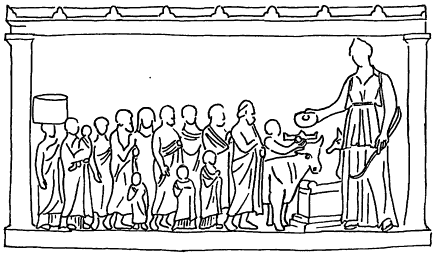
A typical (if better than average) Attic votive relief of the fourth century BC comes from the sanctuary of Artemis at Brauron (fig. 1).[2] It is of the usual rectangular shape, more wide than it is high, and wide enough to accommodate all the figures, divine and human, that the dedicator wanted represented. According to the inscription on the architrave the relief was set up, in accordance with a prayer, by Aristonike, wife of Antiphates from the deme Thorai. We see Aristonike together with her extensive family approaching Artemis, who is standing on the right. A number of children of various ages are present (Artemis Brauronia was especially invoked in connection with pregnancy, childbirth, and child care). In front of the family procession there is a bovine sacrificial victim, restrained at the altar by a servant who holds the kanoun . In the rear, a maid is carrying the kiste on her head. The goddess is much taller than her worshipers, but all figures are standing on the same level, close together, sharing one architecturally framed space.
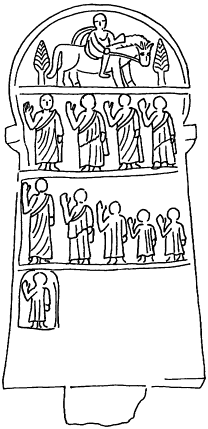
Let us compare this with a late votive stele from Kula in Lydia Katakekaumene (fig. 2).[3] An inscription informs us that the relief was set up by one Erastros, together with his spouse and their children, in accordance with a prayer to Theos Hosios kai Dikaios . The stele has the upright format that is typical of the later East Greek votive reliefs, and the fig-
[2] Brauron 1151 (5): A. K. Orlandos, "Brauron," Ergon (1958): 35, fig. 37; I. Kontes, "Artemis Brauronia," AD 22, A' (1967): 195, pl. 104a; S. Karouzou, "Bemalte attische Weihreliefs," in Studies in Classical Art and Archaeology: A Tribute to Peter Heinrich yon Blanckenhagen , ed. Gunter Kopcke and Mary B. Moore (Locust Valley, N.Y., 1979), 111-116, pl. 33.2; LIMC "Artemis," no. 974.
[3] Manisa 1944: P. Herrmann and K. Z. Polatkan, "Das Testament des Epikrates und andere neue Inschriften aus dem Museum yon Manisa," SBWien 265.1 (1969): 50, no. 7, fig. 14; TAM 5.1 (1981): 85, no. 248.
ures are arranged on four different levels. In the top panel, in a world all of his own, the God Holy and Righteous is represented on horseback. The dedicator and his family, all depicted frontally, occupy the lower levels. The god too presents a frontal face. One might say that, in contrast with the horizontal relationship between man and god in the Classical relief from Brauron, we have here a vertical relationship. But it would perhaps be more accurate to say that in this relief the composition suggests very little relationship at all.
I would not be surprised if a sneaking suspicion has crept upon the reader that by the choice of these two monuments I may have prejudiced or at least unduly simplified the issue. To try to sketch a more nuanced picture let us retrace our steps and look at the votive reliefs of the Classical period and their development in the Hellenistic age in more detail.
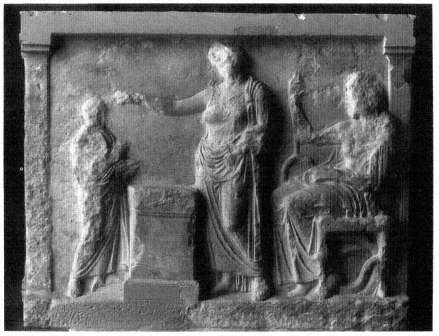
It is easily ascertained that the closeness between goddess and worshipers which attracted our attention on the relief from Brauron is in no way exceptional in the Classical period. Indeed examples of an even closer proximity are not hard to find. On an early Classical relief from the Athenian Akropolis a craftsman sitting behind his workbench is seen handing his aparche to Athena, who appears to be physically present in his workshop.[4] A late fifth- or early fourth-century relief from the Athenian Asklepieion shows Hygieia extending her hand and touching, or almost touching, the head of a man standing on the left (fig. 3).[5] In this case there is a large altar between the worshiper and his god, clearly marking, one might think, the boundary between the human and divine worlds. The altar, however, in view of its function, should probably be regarded as a link rather than a demarcation point. And anyway, in many instances no altar-is represented, so gods and men move even closer together, as on the modest votive relief of a haulier from the same Asklepieion.[6]
On another relief of unknown provenance there is also no altar be-
[4] Athens AkrM 577: G. Dickins, Catalogue of the Acropolis Museum (Cambridge, 1912) 1:117. E. Mitropoulou, Corpus I: Attic Votive Reliefs of the Sixth and Fifth Centuries BC (Athens, 1977), no. 29, fig. 48; F. T. van Straten, "Gifts for the Gods, " in Faith, Hope, and Worship: Aspects of Religious Mentality in the Ancient World , ed. H. S. Versnel (Leiden, 1981), 93, fig. 32.
[5] Athens NM 1338: J. N. Svoronos, Dos Athener Nationalmuseum (Athens, 1908-37), 257f., pl. 38.3; K. Sudhoff, "Handanlegung des Heilgottes auf attischen Weihetafeln," Archiv für Geschichte der Medizin 18 (1926): 238, pl. 10.5; H. K. Süsserott, Griechische Plastik des 4. Jahrhunderts v. C.: Untersuchungen zur Zeitbestimmung (Frankfurt, 1938), 108f., pl. 16.2; U. Hausmann, Kunst und Heiltum: Untersuchungen zu den griechischen Asklepiosreliefs (Potsdam, 1948), 176, no. 127; Karouzou, "Bemalte attische Weihreliefs," 111-116, pl. 33.1.
[6] Athens NM 1341 + : L. Beschi, "Rilievi votivi attici ricomposti," ASAA 47/48 (1969/ 1970): 86ff., fig. 1.
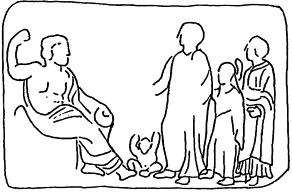
tween the god seated on the left (he may be Zeus Meilichios or some similar deity) and the worshipers approaching from the right (fig. 4).[7] Here, right at the god's feet, a baby is crouching on the ground, reaching up his tiny hands. This visually direct and effective way of commending a child to the god's care by putting him in front of the other worshipers, immediately before the god, recurs in several other votive reliefs.[8]
As we saw earlier, fourth-century votive reliefs often have an architectural frame consisting of a bottom ledge, two antae, and an architrave topped by something like the lateral edge of a tiled roof. It has been suggested that this type of frame reflects the stoa which formed part of so many sanctuaries.[9] This opinion seems to find support in a curious votive monument from the Athenian Asklepieion, which has been treated in depth by Professor Ridgway.[10] It was carved out of a single block of marble and consists of a relief depicting the usual procession of worshipers in an architectural frame and, attached to it, at fight angles on the left, a higher naiskos containing the deities. It may be that the sculptor of this monument was exceptionally literal-minded, and that in general we should not take the conventional architectural frame as reflecting any specific type of building. However that may be, the frame does have the effect of binding together the figures enclosed within it
In votive reliefs to the Nymphs the same effect may be achieved by an irregular frame suggesting the rocky mouth of a cave. The piece from Ekali in Attika illustrated here (fig. 5),[11] dating from around 300 BC , shows a group of worshipers on the left of a rustic altar and the three Nymphs and Acheloos on the right, all inside the cave.
It is interesting to compare this with a Hellenistic votive relief from Thessaly (fig. 6, second century BC ?).[12] Here we have, to the fight of an altar, Artemis, Apollo, and, sitting on a rock, probably Bendis. Four wor-
[7] Padua MC 820: F. Ghedini, Sculpture greche e romane del Museo Civico di Padova (Rome, 1980), 18ff., no. 2.
[8] O. Walter, "Die heilige Familie yon Eleusis," ÖJh 30 (1937): 60; idem, "Die Reliefs aus dem Heiligtum der Echeliden in Neu-Pharleron," AE (1937): 1.103; van Straten, "Gifts for the Gods," 89ff.
[9] G. Neumann, Probleme des griechischen Weihreliefs , Tübinger Studien zur Archaeologie und Kunstgeschichte 3 (Tübingen, 1979), 5of.; see also Karouzou, "Bemalte attische Weihreliefs," 111-116.
[10] Athens NM 1377: Svoronos, Athener Nationalmuseum , 294, pl. 48; Hausmann, Kunst und Heiltum , 167, no. 11; B. S. Ridgway, "Painterly and Pictorial in Greek Relief Sculpture," in Ancient Greek Art and Iconography , ed. W. G. Moon (Madison, 1983), 193-208, figs. 13.4a-b.
[11] Athens NM 3874: W. Fuchs, "Attische Nymphenreliefs," MDAI(A) 77 (1962): 246, Beil. 66. 1; C. M. Edwards, "Greek Votive Reliefs to Pan and the Nymphs" (Diss., New York, 1985), 703ff., no. 71. I am not convinced by Edwards's argument for a later date.
[12] Volos 573: Einzelaufnahmen 3401b; LIMC "Apollon," no. 959.
shipers stand on the left. The sculptor somewhat illogically combined a sort of cave frame, familiar from the Nymph reliefs, with the conventional architectural frame. But in contrast to the previous relief, only the three deities are included within the cave: the worshipers are outside.
Some gods on Classical votive reliefs may occasionally appear in non-human shape. Zeus Meilichios in particular is portrayed as a snake in more than one instance.[13] But even then care is taken to dispose the figures in such a way that the theriomorphic god and the human worshipers are close together, facing each other directly.
In exceptionally distressing circumstances, for urgent prayers, Greek worshipers would sometimes kneel before their gods in the traditional attitude of the supplicant (hiketes, hiketis ). A fourth-century relief from Piraeus (fig. 7) is one of a series featuring a kneeling female worshiper.[14] It strikes me that the predominant impression this scene makes is not one of prostration and self-humiliation, but rather one of extreme closeness. That this is intentional may be inferred from the fact that the boy servant leading the sacrificial animal, who would normally be in front of the worshipers, has been moved to the rear, in order that the woman may kneel immediately in front of the god and reach out and touch his knees.
Later votive reliefs with kneeling worshipers are very rare. There is one in the Usak[*] museum, belonging to the class of the confessional stelai, as is clear from the inscription (fig. 8).[15] Two female worshipers are represented, one of whom is kneeling. But no gods are there to be touched.
Now let us return for a moment to the end of the Classical period and try to trace the development of votive reliefs from then onward in a little more detail. On some late fourth- or early third-century reliefs the gods seem to be slightly more aloof. On a votive relief from the Athenian Asklepieion (fig. 9), Hygieia, though standing nearest to the worshipers, is not facing them.[16] And the same was probably true of Demeter on a relief from Eleusis (fig. 10).[17] It would be stretching the evidence, I
[13] E.g., Athens NM 3329: S. Karouzou, National Archaeological Museum, Collection of Sculpture: A Catalogue , Archaeological Guides of the General Direction of Antiquities and Restoration 15 (Athens, 1968), 147; E. Mitropoulou, "Attic Workshops," AAA 8 (1975): 122, no. 4, fig. 4.
[14] Athens NM 1408: Svoronos, Athener Nationalmuseum , 357f., pl. 65; O. Walter, "Kniende Adoranten auf attischen Reliefs," ÖJh 13 Beibl. (1910): 233; van Straten, "Did the Greeks Kneel before Their Gods?" BABesch 49 (1974): 159-189, no. 1, fig. 1.
[15] Usak[*] 1.3.74: unpublished.
[16] Paris Louvre 755: Süsserott, Griechische Plastik , 123, pl. 25.4; Hausmann, Kunst und Heiltum , 178, no. 146, fig. 5; J. Charbonneaux, La sculpture grecqut et romaine au Musée du Louvre (Paris, 1963), 119; van Straten, "Gifts for the Gods;" 84f., fig. 16.
[17] Eleusis: Süsserott, Griechische Plastik , 123f., pl. 25.1; G. E. Mylonas, Eleusis and the Eleusinian Mysteries (Princeton, 1961), 195, fig. 74; A. Peschlow-Bindokat, "Demeter und Persephone in der attischen Kunst des 6. bis 4. Jahrhunderts," JDAI 87 (1972): 152 R47; G. Schwarz, Triptolemos: Ikonographie einer Agrar- und Mysteriengottheit , Grazer Beiträge, Supplementband 2 (Graz, 1987), 201 R9, fig. 32.
think, to call this a general tendency of the period, but in the light of what follows it is worthwhile to note that the phenomenon occurs.
Unfortunately the study of succeeding developments is hampered by a certain discontinuity in our material. The rich flow of votive reliefs produced in Athens from the later fifth through the fourth centuries dries up almost entirely around 300 BC . Why this should have happened is not quite clear, but there may be a connection with the prohibition of grave reliefs by Demetrios of Phaleron in 317-316 or shortly afterward.[18] We might imagine that votive reliefs were produced as a sort of sideline by workshops whose main income depended on the sale of grave reliefs. When these were no longer in demand, the bottom fell out of their business, and then within one generation Attic votive reliefs practically came to an end as well.[19] Hereafter in Greece proper, votive reliefs are deplorably thin on the ground.
The thread may be picked up, however, one or two centuries later in the northwestern part of Asia Minor. A considerable number of votive reliefs of later Hellenistic and Roman date survive, especially from Kyzikos and Byzantium and surrounding areas. Let us look at a few examples.
A relief from Kyzikos now in Copenhagen (fig. I l) was dedicated, so we read in the inscription, by Pytheas son of Dionysios, on behalf of himself and his wife and children, to Theos Patroa in accordance with a prayer.[20] The monument is in the form of an upright stele. only part of which is occupied by the rectangular relief panel. From the left, four worshipers and a boy leading the sacrificial sheep approach the altar. In the background, behind the altar, there is a tree. The goddess, Meter, is seated on the right. She is represented frontally, not facing her worshipers.
Another relief (fig. 12), also from the Kyzikos area, is dedicated to
[18] K. Friis Johansen, The Attic Grave-Reliefs of the Classical Period: An Essay in Interpretation (Copenhagen, 1951), 13.
[19] The reemergence and increase in production of Attic grave reliefs (and votive reliefs) in the late fifth century BC may be explained along similar lines; see e.g., M. Robertson, A History of Greek Art (Cambridge, 1975), 364f.
[20] Copenhagen NM 4763. This relief appears to have been overlooked by E. Schwertheim, "Denkmäler zur Meterverehrung in Bithynien und Mysien," in Studien zur Religion und Kultur Kleinasiens: Festschrift für Friedrich Karl Dörner , ed. Sencer Sahin, Elmar Schwertheim, and Jorg Wagner (Leiden, 1978) 2:791-837, and by M. J. Vermaseren, Corpus Cultus Cybelae Attidisque , vol. 1, Asia Minor (Leiden, 1987).
Apollo Krateanos, and there are two sheep, but otherwise the monument has the same components arranged in a similar way.[21]
A votive relief from a sanctuary near Apameia on the Propontis (fig. 13) depicts Zeus, and again he is rendered in full frontal view.[22] His eagle perches on a branch of the now familiar tree behind the altar. On the left there is one worshiper, who must be the priest Asklepiades mentioned in the inscription; a maid carrying a rather flat basket or tray on her head and holding a pitcher in her right hand; and a boy with a sheep. The date of this stele is given in the inscription as the year 174, which may be either 123 BC or 89 AD , depending on whether the Bithynian or the Sullan era is meant, or even somewhere in between.[23]
The same pattern recurs in another Mysian relief, dedicated to Zeus Aithrios, which was tentatively dated to the second century BC by Robert.[24] Here, however, the upright format of the stele is taken advantage of in order to add another relief panel underneath, showing a second sacrificial animal: a bull whose head is forced to the ground by means of a rope fastened to its horns and passed through a ring which is visible in the bottom left corner.
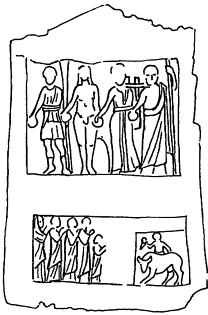
The next stele, which may be slightly later, again displays two relief panels (fig. 14).[25] But there is a significant difference in the disposition of the figures. The upper panel is now entirely taken up by the gods. They are identified by the inscription as Zeus Megistos (on the right), Apollo Bathylimeneites (who is represented twice, in the type of an Archaic kouros and in more contemporary form), and Artemis (on the left). The human worshipers are now relegated to the lower panel, together with the sacrificial bull, which is about to be stabbed to death.
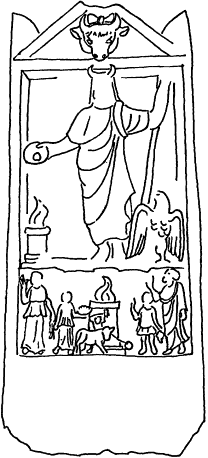
This near allocation of separate relief panels to human and divine figures, though it was never a general rule, is found in many other reliefs from the same area. In one, dedicated to Zeus Olbios by the priest Euodion, the altar is represented twice, thus constituting a link between the
[21] Vienna 1439: L. Robert, "Apollons de Mysie: Apollon Krateanos," in Hellenica , vol. 10 (Limoges, 1955), 137ff., pl. 152; R. Noll, Griechische und lateinische Inschriften der Wiener Antikensammlung (Vienna, 1962), 27f., no. 31.
[22] Athens NM 1486: Svoronos, Athener Nationalmuseum , pl. 112; T. Corsten, Die Inschriften yon Apameia (Bithynien) und Pylai (Bonn, 1987), 47ff., no. 33. On its provenance from Triglia near ancient Apameia on the Propontis, see P. Perdrizet, "Reliefs mysiens," BCH a3 (1899): 592-599, no. III, and L. Robert, "Inscriptions de la région de Yalova en Bithynie," in Hellenica , vol. 7 (Limoges, 1949), 42f.
[23] On the various possible chronologies, see Robert, "Inscriptions," and Corsten, Inschriften .
[24] L. Robert, "Documents d'Asie Mineure," BCH 107 (1983): 545ff., fig. l: "hellénis-tique, on dirait du lie siècle a.C."
[25] Instanbul inv. 4407: L. Robert, "Apollon Bathylimenitès," Hellenica , vol. 10 (Limoges, 1955), 125-133, no. 25, pls. 19.3, 38.2.
upper panel, occupied by Zeus, and the lower panel, where Euodion and his family and assistants are sacrificing a bull (fig. 15).[26] This dedication was made at the god's own command (kathos ekeleusen ), so we should be careful not to jump to conclusions and take the arrangement in separate relief panels as an indication that all direct contact between gods and men was lost. But there is distinctly less feeling of nearness.
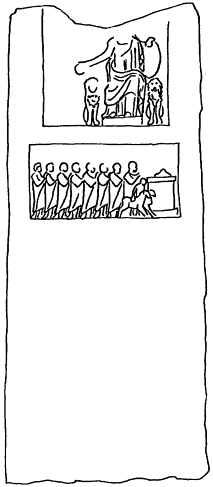
Meter Tolypiané is depicted in the top panel of a stele now in Istanbul (fig. 16).[27] Underneath we see eight male worshipers, members of some sort of club; and a servant leading two sheep to a large altar.
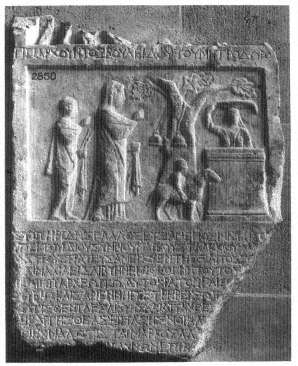
An incomplete relief in the Louvre must have displayed a similar arrangement (fig. 17).[28] Very little remains of the top panel, which again was occupied by a Meter figure: Meter Kotiané, according to the inscription. In the surviving lower panel Meter's cymbals are seen hanging from a tree next to the altar. In the background, behind the altar, is the maid, carrying the flat basket or tray on her head. From the left approach the sacrificial servant with a sheep, a worshiper in woman's clothes, and a slightly smaller figure holding a double flute. My colleagues generally insist on describing the worshiper in woman's clothes as a woman.[29] The inscription, however, which incidentally fixes the date of the monument at 46 BC , informs us that it was dedicated by a certain Soterides, who was a gallos of Meter, and as such may be expected to wear female attire.[30] Soterides offered the stele to Meter for the safety of his companion Markos Stlakkios, who had sailed to Libya as a member of the contingent sent by Kyzikos to help Caesar against the Pompeians and had been made a prisoner of war. Then the goddess appeared to
[26] Istanbul inv. 1909, from Kavak: Edhem Bey, "Relief votif du Musée Impérial Ottoman," BCH 32 (1908): 521-528, pls. 5-6; G. Mendel, Catalogue des sculptures grecques, romaines et byzantines , vol. 3 (Constantinople, 1914), no. 836; L. Robert, "Reliefs votifs de Derkoz," Hellenica , vol. 10 (Limoges, 1955), 45; van Straten, "Daikrates' Dream: A Votive Relief from Kos and Some Other Kat'onar Dedications," BABesch 51 (1976): 11, figs. 20-21.
[27] Istanbul inv. 676, from Deble Köy/Bandirma: Mendel, Catalogue des sculptures , no. 850; A. Schober, "Vom griechischen zum römische Relief," ÖJh 27 (1931): 52, fig. 73; Schwertheim, "Denkmäler zur Meterverehrung," 817, no. II A 11, pl. 194.27; Vermaseren, Corpus Cultus 1:95, no. 389, pl. 63.
[28] Paris Louvre 2850, from Kyzikos: Charbonneaux, Muséc du Louvre , 76; Syll 763; Schwertheim, "Denkmäler zur Meterverehrung," 810f., no. II A 3, pl. 192.23; M. J. Vermaseren, Cybele and Attis: The Myth and the Cult (London, 1977), 29, fig. 15; idem, Corpus Cultus 1:94, no. 287, pl. 62.
[29] E.g., Charbonneaux, Musée du Louvre ; Schwertheim, "Denkmäler zur Meterverehrung"; Vermaseren, Cybele and Attis ; idem, Corpus Cultus .
[30] See van Straten, "Daikrates' Dream," 11f., fig. 22; compare also a self-dedication of a gallos from Pisidia, inscribed Menéas gállos heautón , depicting a long, robed figure: G. E. Bean, "Notes and Inscriptions from Pisidia," AS 9 (1959): 71, no. 5, pl. 15a.
her gallos in a dream and informed him that Markos had been taken prisoner but could be saved from serious danger by invoking the goddess. Here the inscription breaks off, but I do not think we should feel too worried about Markos, for the existence of the votive offering proves that his story had a happy ending.
In the Mysian votive reliefs we have seen so far, the Classical Greek tradition is still fairly strong, although we could observe some interesting shifts in man's perception of his relationship with the gods. We encounter a more diluted version of the Classical heritage when we travel farther inland in Lydia and Phrygia. These regions have yielded considerable series of votive reliefs, mostly of the second and third centuries As.
A relief from Kula in the Katakekaumene (fig. 18), dated to 257/8 AD , shows Theos Hosios kai Dikaios on the upper level and underneath three worshipers at an altar.[31] The arrangement is strictly paratactical, and all figures are rendered in full frontal view. Here we are back at the point where we were earlier, and where very little expression of any close relationship between man and god is evident.
Perhaps someone would object that this is merely a matter of style and that not too much meaning should be read into it. I readily concede that we are constantly at risk of overinterpreting this sort of thing, but in the present case there may be some corroborative evidence for the contention that these compositional characteristics are meaningful.
In a Lydian stele of the second century AD (fig. 19), for instance, which is dedicated to the Great Men (Megas Meis Axiottenos Tarsi basileuon ), the small figure of a human worshiper might easily have been accommodated on the same level as the god.[32] There, a cloak is represented, about the theft and recovery of which the inscription informs us. The poor sinner, however, is relegated to a specially prepared box in the basement.
And there is another point. Among this class of late Lydian (and Phrygian) votive reliefs we find an increasing number where either the god or the worshipers are not represented at all.
An example of worshipers and no gods (something that is extremely rare on Classical Greek votive reliefs), is provided by a stele, also from Kula, dated at 196/7 AD (fig. 20).[33] It was dedicated to Artemis Anaeitis
[31] Manisa 1945: Herrmann and Polatkan, "Testament des Epikrates," 50, no. 8, fig. 16; TAM 5.1 (1981): 85, no. 247.
[32] Reported to have been found near Köleköy), dated at 164/5 AD : P. Herrmann, "Ergebnisse einer Reise in Nordostlydien," Denkschriften Wien 80 (1962): 30, no. 21; E. Lane, Corpus Monumentorum Religionis Dei Menis , vol. 1 (Leiden, 1971), no. 69; TAM 5.1 (1981): 50, no. 159.
[33] Boston MFA 94.14: Lane, Corpus Monumentorum , vol. 1, no. 63; C. Vermeule, "Dated Monuments of Hellenistic and Graeco-Roman Popular Art in Asia Minor: Ionia, Lydia, and Phrygia," in Mélanges Mansel (Ankara, 1974) l:119-126, pl. 61; I. Diakonoff, "Artemidi Anaeiti Anestesen: The Anaeitis-Dedications in the Rijksmuseum van Oudheden at Leyden and Related Material," BABesch 54 (1979): 151, no. 32, fig. 19; TAM 5.1 (1981): 104, no. 319.
and Men Tiamou. The dedicator and his wife and two children are represented in frontal pose, the right hand raised in the familiar gesture of worship. They face the viewer or, in a broader sense, they face the world, testifying to and proclaiming the omnipotence of the gods: mar-tyrountes tas dynam(e)is ton theon , as the inscription states with a phrase that recurs regularly in this class of stelai.
The counterpart to this type of representation may be illustrated by one of a series of reliefs from Phrygia dedicated to Zeus Ampelites (fig. 21).[34] The god is portrayed as a frontal bust, with a powerful hand, and the cattle, tahyparchonta , for the sake of which the dedication was made, are quite literally placed under his protection. But the dedicators themselves are absent.
So much for a general sketch of the development of the expression of self-identity on Classical Greek and later Greek and less and less Greek votive reliefs. Before we go on to some special categories, we should perhaps at this point take a moment to consider whether the development sketched above may in fact be taken as a continuous line of development in any real sense.[35] The material, examples of which have been presented so far, falls more or less naturally into three classes: (l) votive reliefs of the Classical period (mostly Attic, but other parts of Greece have produced similar monuments); (2) votive reliefs from the Greek cities of northwest Asia Minor (Byzantium, Kyzikos, etc.) and their surrounding areas; iconographically these form a reasonably coherent series, starting in the Hellenistic age and continuing into the Roman imperial period; and (3) late votive reliefs from sanctuaries in Lydia and Phrygia, dating from the imperial period.
The first two groups may certainly be looked upon as representatives of the same tradition (with regard both to their iconography and to the religiosity of which they are the visual expression), if for the purpose of this survey we loosely think in terms of Greek religion in general, ignoring its rich local and regional diversity. To understand the iconographic link between the first and the second group, we should, of course, be aware of the fact that votive representations of worshipers and gods oc-
[34] Van Straten, "Gifts for the Cods," 104, fig. 48; see Robert, "Documents d'Asie Mineure," 529-542: "Zeus Ampélitès," for a series of similar reliefs.
[35] I thank Professor Henrichs for his suggestion that some clarification of my position on this point might be useful.
curred not only on stone reliefs but also, and in far greater quantities, on painted wooden votive plaques and on small metal reliefs.[36] We may envisage these common votive representations, very few of which survive, as a constant undercurrent of votive iconography.
Linking the third class of votive reliefs (which in itself is rather loosely knit anyway) to the second is more of a problem. Religion as practiced in the sanctuaries of Lydia and Phrygia in the second to third centuries AD was certainly not in the mainstream of later Hellenistic religion. Therefore, although it may be interesting to observe that some of the developments seen in votive reliefs of the second group continue to a more extreme degree in the third, we should remember that this may be only part of the picture.
By way of addendum I would like to add a few remarks on dedications of some special categories of people, for whom a closer than average bond with the gods may be expected: the sick, dreamers in general, and founders of sanctuaries.
For the Classical period we have an abundance of data regarding the specific cult practices and the expressions of private religiosity in sanctuaries of healing deities such as Asklepios and Amphiaraos. I need only mention Aristophanes' Ploutos , the Iamata inscriptions from Epidauros, and the votive reliefs from the Asklepieia in Piraeus and Athens and the Amphiareia in Oropos and Rhamnous.
Figure 22, a relief from the Athenian Asklepieion, is one of a series showing the patient reclining on a couch, in the enkoimeterion perhaps, and being visited during his sleep by an apparition of the healing god.[37] Here one deity, probably Asklepios himself, is sitting at his bedside, and one of Asklepios' sons is standing at the patient's head, on the right. The patient, in his dream vision, stretches out his hand, acknowledging the presence of the gods. In sickness, when the personal need for the gods is felt most poignantly, their nearness may be experienced most clearly. After the Classical period, reliefs of this kind are hardly to be found.[38] But that does not mean that the experience they illustrate no longer occurred. Asklepieia flourished throughout the Hellenistic and Roman ages, and we may easily bridge the centuries by using this relief to illus-
[36] For some literary testimonia on less durable votives, see van Straten, "Gifts for the Gods," 78ff.
[37] Athens NM 1841: Svoronos, Athener Nationalmuseum , pl. 133; Sudhoff, "Handan-legung des Heilgottes," 237, pl. 11.4; R. Herzog, Die Wunderheilungen yon Epidauros: Ein Beitrag zur Geschichte der Medizin und der Religion , Philologus Suppl. 22.3 (Lepizig, 1931), 79, n. 27; Hausmann, Kunst und Heiltum , 178, no. 151; van Straten, "Daikrates' Dream," 3, fig. 8; Mitropoulou, Attic Votive Reliefs , 71, no. 143, fig. 203.
[38] A rare example from the second century AD : van Straten, "Gifts for the Gods," 98, fig. 42.
trate the description of an apparition of Asklepios as given more than half a millennium later by Aelius Aristides:
It was revealed in the clearest way possible, just as countless other things also made the presence of the god manifest. For I seemed almost to touch him and to perceive that he himself was coming, and to be halfway between sleep and waking and to want to get the power of vision and to be anxious lest he depart beforehand, and to have turned my ears to listen, sometimes as in a dream, sometimes as in a waking vision.[39]
Dedications made on the strength of a dream vision were not, of course, restricted to the cult of Asklepios. Many other gods appeared in person to their worshipers and, judging from the inscriptions, with increasing frequency during the Hellenistic and Roman periods. In the terminology of these inscriptions the worshipers often present their gods as powerful absolute rulers who give explicit commands (epitage, prostagma, keleusis , etc.).[40]
Founders of sanctuaries, one would expect, may also display a rather special personal relationship with their gods. Founding a sanctuary might well be a deciding factor in determining one's religious identity. Let us meet some founders. First, Telemachos of Acharnai, who was portrayed on the monument which commemorated his foundation of the Athenian Asklepieion in 420/19 BC and which has been painstakingly reconstructed from its disjecta membra by L. Beschi.[41] The two sides of this amphiglyphon show the interior and the exterior of the newly founded sanctuary, and on one side there is also an indication of the Asklepieion in Piraeus, whence Asklepios had come to Athens. Telemachos himself, however, is in no way different from any other worshiper on any other votive relief of the same period. In the inscription on the pillar supporting this relief, though it is extremely succinct and matter-of-fact, we may perhaps detect a certain amount of self-confidence and pride. Telemachos declares, and he emphatically repeats it in another inscription,[42] that he was the first to found the sanctuary of Asklepios and Hygieia and the sons and daughters of Asklepios.
Not much later in Phaleron we encounter a female founder of a sanctuary in a small way: Xenokrateia, who dedicated a shrine to Kephisos and the gods who shared his altar (xunbomoi theoi ).[43] The relief (fig. 23)
[39] Aelius Aristides Sacred Tales 2:31f., trans. Edelstein.
[40] See van Straten, "Daikrates' Dream," 12-13 and App.
[41] L. Beschi, "Il monumento di Telemachos, fondatore dell' Asklepieion Ateniese," ASAA 45/46 (1967/1968): 381-436; idem, "Il rilievo di Telemachos ricompletato," AAA 15 (1982): 31-43.
[42] IG 2 .4355.
[43] Athens N M 2756: Svoronos, Athener Nationalmuseum , 493ff., pl. 181; Walter, "Reliefs aus dem Heiligtum der Echeliden," 1.97-119; Süsserott, Griechische Plastik , 97ff.; Hausmann, Griechische Weihreliefs (1960), 63f., fig. 33; A. Linfert, "Die Deutung des Xenokrateiareliefs," MDAI(A ) 82 (1967): 149-157; M. Guarducci, "L'offerta di Xenokrateia nel santuario di Cefiso al Falero," in Photos: Tribute to B. D. Meritt , ed. D. W. Bradeen and M. F. McGregor (Locust Valley, N.Y., 1974), 57-66; Mitropoulou, Attic Votive Reliefs , no. 65.
shows Xenokrateia and her young son Xeniades in the midst of these gods, and in very dose contact with Kephisos, who is attentively bending over toward her. Here Xenokrateia's special status seems to be expressed in the somewhat exceptional iconography of the relief.
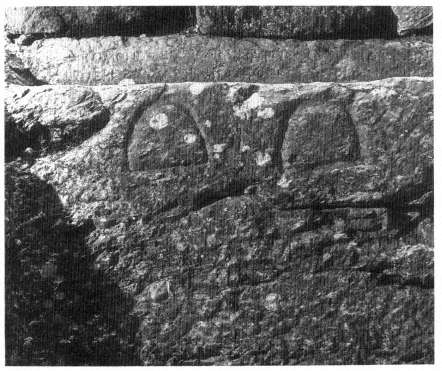
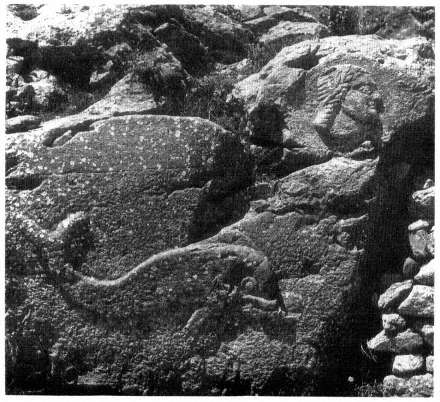
A fascinating founder in the Hellenistic age is Artemidoros of Perge. He had served in Egypt under the first Ptolemy and later retired to the island of Thera, where he founded a complex of altars and sanctuaries near the main gate of the town.[44] Reliefs were carved in the living rock, showing animals and attributes of the gods. The altar in figure 24 is inscribed: "Of Homonoia. Artemidoros son of Apollonios from Perge, in accordance with a dream." And then, in verse: "The immortal altar of Homonoia was founded here for the city in accordance with a dream by Artemidoros who hails from Perge."[45] Next to the eagle, on the right in figure 25, we read: "To Zeus Olympios. The high-flying eagle, messenger of Zeus, an everlasting foundation by Artemidoros for the city and the immortal gods." Underneath is a more general statement: "Imperishable, immortal, ageless, and everlasting are the altars of all the gods for whom Artemidoros as priest founded a sanctuary."[46] The lion (on the left in figure 25) is dedicated Apolloni Stephanephoroi , and the verse inscription reads: "The lion, dear to the gods, was made by Artemidoros in the holy precinct, a monument of the city."[47] Over the piloi and stars (fig. 26), attributes of the Dioscuri, is written: "An altar for the Dioscuri, savior gods who come to the aid of those who invoke them, was made by Artemidoros of Perge."[48] The dolphin (fig. 27), of course, belongs to Poseidon (Poseidoni Pelagioi ): "In the untiring rock Artemidoros made a dolphin for the gods, men's best friend."[49]
In these and numerous other inscriptions Artemidoros is establishing his self-identity in no small way. His name is mentioned in every dedication, often twice over. He insists that the altars and reliefs are everlasting (ageratos, athanatos, aenaos, aphthitos ). With some of the gods Artemi-
[44] IG 12.3.421-422, 863, 1333-1348; Thera 3.89ff.; U. von Wilarnowitz-Moellendorff, Der Glaube der Hellenen , vol. 2 (repr. Basel, 1973), 16, 176, 382ff.; M. P. Nilsson, Geschichte der griechischen Religion , 3d ed., vol. 2 (Munich, 1974), 189ff.; van Straten, "Daikrates' Dream," 18, figs. 23-26.
[45] IG 12.3.1336.
[46] IG 12.3.1345.
[47] IG 12.3.1346.
[48] IG 12.3.1333.
[49] IG 12.3.1347.
doros' relationship seems to have been a very direct one. Homonoia, as we saw, made her will known to him through a dream. And Artemis Pergaia, together with Pronoia, personally saw to it that he lived to a very old age (probably ninety-three).[50] Artemidoros' religiosity was of a distinctly individual nature, but his foundations were not a merely private matter. Like a real euergetes he founded his sanctuaries for the city (tei polei ), as he repeatedly assures us.
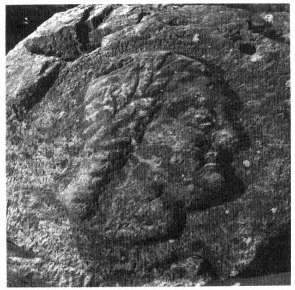
Among the reliefs we find Artemidoros' own portrait (fig. 28), which is curiously reminiscent of coin portraits of Ptolemy I.[51] Around it, in his rather imperfect poetry, he has written: "A monument for Thera, and as long as stars rise in the sky and the foundation of the earth remains, Artemidoros' name is not forsaken."[52]
Now that we have tried to look into the visual expressions of religious self-identity of the common people, and of some not so common people, I would like to broach one final subject: the question of individual versus communal religiosity. Signs of increasing individualism have been recognized in Hellenistic religion, and earlier, in the late fifth and fourth century BC .[53] Can we detect such symptoms in the archaeological material?
One might be tempted to point to the fact that the Classical votive reliefs, which are so numerous especially in fourth-century Athens, are all, with very few exceptions indeed, private dedications. At first sight that would seem to indicate a strong individualistic tendency in the religiosity of that period. But I think we should look again. In the first place, as we have seen, the votive reliefs often do not show one individual worshiper, but whole families, even if according to the inscription the dedication was made by only one person. So they are private, but not so very individual. Secondly, at the same time that so many private votive reliefs were produced in Athens, several sacred laws were inscribed on stone. These laws contained cult regulations and sacrificial calendars for the state as a whole, or for individual demes, the Marathonian tetrapolis, and so on, and bore witness to a vivid interest in the communal, civil aspect of religion. Both aspects of religion, the communal and the private, flourished. Both aspects are already mentioned, and distinguished, in Drakon's law: "People should worship the gods and the local heroes, communally (en koinoi ) in accordance with the ancestral laws, privately (idiai ) according to their means."[54] A similar distinction between communal and private religious observances is seen in a sacred law from
[50] IG 12.3.1350.
[51] E.g., G. K. Jenkins, Ancient Greek Coins (New York, 1972), figs. 556, 562.
[52] IG 12.3.1348.
[53] E.g., Nilsson, Geschichte der griechischen Religion , 3d ed., 1:804ff., 2:250.
[54] Porphyry De abstinentia 4.22.
Thasos of the fourth century BC ,[55] which prescribes the sacrifice of specific animals to Dionysos and then adds: "and private worshipers whatever they want (hoi de idi [otai hoti an ]: thelos [in ])." And later even such a typically civic affair as Hellenistic ruler cult had its private aspects too, as Louis Robert has shown in his classic study, "Sur un décret d'Ilion et sur un papyrus concernant des cultes royaux."[56]
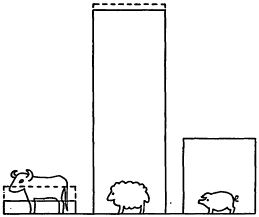
In the Classical period the distinction between communal and private cult is interestingly reflected in the relative frequency of various species of sacrificial animals. In fourth-century Attic sacrificial calendars (fig. 29) there is a distinct preponderance of sheep: 57 to 58.4 percent of all sacrifices recorded, compared to 20.8 percent pigs or piglets and 3.5 to 7.4 percent cows and bulls. In the contemporary votive reliefs with sacrificial representations (fig. 30) the pigs and piglets score much higher: 49.5 to 50.5 percent, as against 28.5 to 32.5 percent sheep and 9.5 to 13.5 percent cows and bulls. I have argued elsewhere that the explanation for these different patterns is to be found in the prices of the victims.[57] The animals for the communal sacrifices mentioned in the sacrificial calendars are, on the average, more expensive than the private sacrifices of the votive reliefs.
How do the later votive reliefs from Asia Minor compare with these patterns? They are rather surprising. Among the sacrificial victims on these reliefs (fig. 31) pigs or piglets appear to be entirely absent, and sheep and cows or bulls each account for approximately 50 percent of the total. In other words, the sacrificial victims on these reliefs are, on the average, far more expensive than the private, or even the communal sacrifices of Classical Athens. This probably reflects the greater affluence of the region, though there may be other contributing factors.
So far we have somewhat shortsightedly concentrated on the opposition between the private individual and the civic community. There is, however, a third category: the smaller social group or club with a religious objective. Such groups might be loosely or more tightly organized. One may think, on the one hand, of the people who accompanied Sostratos' mother to the shrine of the Nymphs near Phyle, in Menander's Dyskolos . Mattresses are provided and hampers with food, and the sacri-
[55] F. Sokolowski, Lois sacrées des cités grecques: Supplément , École française d'Athènes, Travaux et mémoires 11 (Paris, 196a), no. 67.
[56] L. Robert, "Sur un décret d'Ilion et sur un papyrus concernant des cultes royaux," in Essays in Honor of C. Bradford Welles , ed. A. E. Samuel, American Studies in Papyrology 1 (New Haven, 1966), 175-210; P. Frisch, Die Inschriften von Ilion (Bonn, 1975), 84-91, no. 32.
[57] Van Straten, "Greek Sacrificial Representations: Livestock Prices and Religious Mentality," in Gifts to the Gods: Proceedings of the Uppsala Symposium, 1985 , ed. T. Linders and G. Nordquist = Boreas 15 (1987): 159-170.
fice is depicted as quite a social happening. Too much so, in fact, for the taste of the fretful neighbor.
More strictly organized, on the other hand, were the religious associations of orgeones , usually dedicated to the cult of one deity or hero.[58] A votive relief in the Louvre, with a hero and heroine at banquet, may present a rare picture of such an association of orgeones consisting of (at least) fourteen bearded men in two rows.[59]
As Nilsson put it, "Vereine und Klubs hat es immer gegeben. . . . Die Blütezeit des Vereinswesens aber war die hellenistische Zeit."[60] And indeed, among the later Hellenistic votive reliefs from northwest Asia Minor, dedications of social or religious associations seem to form a distinctly higher percentage than in Classical Greece. Occasionally this enhanced social aspect of religion is also expressed in the relief representations.
A stele from Apameia on the Propontis (fig. 32), dated either 119 BC or 93 AD ,[61] was dedicated to Apollo and Meter Kybele by a group of thiasitai and thiasitides . The upper panel shows the familiar sacrificial scene. Underneath, the members of the thiasos are enjoying a festive banquet, enlivened by musicians and a dancer, and with a copious supply of drink and souvlakia.[62]
To sum up. To draw general conclusions from our observations would probably not be wise, in view of the rather one-sided concentration on the archaeological evidence. With this reservation, however, we may note that the worshipers in the course of the Hellenistic period seemed to experience an increasing verticality in their relationship with the gods,
[58] W. S. Ferguson, "The Attic Orgeones," HThR 37 (1944): 62-140; idem, "Orgeonika," Hesperia Suppl. 8 (1949): 130-163.
[59] Paris Louvre 956: J.-M. Dentzer, Le motif du banquet couché dans le proche-orient et le monde grec du Vile au IVe siècle avant J.-C ., Bibliothèque des Écoles françaises d'Athènes et de Rome 246 (Paris and Rome, 1982), 622 R472, fig. 693.
[60] Nilsson, Geschichte der griechischen Religion 2: 117. Also, of course, F. Poland, Geschichte des griechischen Vereinswesens (Leipzig, 1909), esp. 514-534, "Geschichdiche Überblick."
[61] See n. 22, above.
[62] Athens NM 1485, from Triglia near ancient Apameia: Svoronos, Athener National-museum , pl. 112; Perdrizet, "Reliefs mysiens," no. II; Robert, "Inscriptions," 3o-44; Schwertheim, "Denkmäler zur Meterverehrung," 119f., no. II A 13; LIMC "Apollon," no. 964; Corsten, Inschriften , 47-56, no. 35; Vermaseren, Corpus Cultus , 81, no. 252, pls. 50-51. See also the votive relief London BM 817, from the Kyzikos area: A. H. Smith, A Catalogue of Sculpture in the Department of Greek and Rmnan Antiquities, British Museum , vol. l (London, 1892), no. 817; Perdrizet, "Reliefs mysiens," pl. 4; GrInscrBM 4.2.1007; A. Bélis, "L'aulos phrygien," RA (1986): 31, fig. 9; idem, "Kroupezai, scabellum," BCH 112 (1988): 325 (in both articles by Bélis the relief is curiously misrepresented as a "stèle funéraire"). The illustrations of the Athens and London reliefs are confused in Nilsson, Geschichte der griechischen Religion 2:666, pl. 14.
not unlike the position of subjects to an absolute ruler. The same phenomenon has been observed by scholars who have studied the epigraphical and literary evidence, and it has been explained as a reflection of the contemporary society.[63] At the same time, at the lower end of this vertical relationship, on the human level, horizontal relationships in the form of socioreligious clubs became more and more important.
[63] See, e.g., H. W. Pleket, "Religious History as the History of Mentality: The 'Believer' as Servant of the Deity in the Greek World," in Faith, Hope, and Worship , ed. Versnel, 152-192. For a different approach, see P. Veyne, "Une évolution du paganisme gréco-romain: Injustice et piété des dieux, leurs ordres ou 'oracles,'" Latomus 45 (1986): 259-283. See also B. Gladigow, "Der Sinn der Götter," in Gottesvorstellung und Gesellschaftsent-wicklung , ed. P. Eicher (Munich, 1979), 41-62.
1.
Brauron 1151 (5): votive relief from Brauron.
2.
Manisa 1944: votive relief from Kula (Lydia).
3.
Athens NM 1338: votive relief from the Asklepieion in Athens. Courtesy of the National Archaeological Museum, Athens.
4.
Padua MC 820: Greek votive relief.
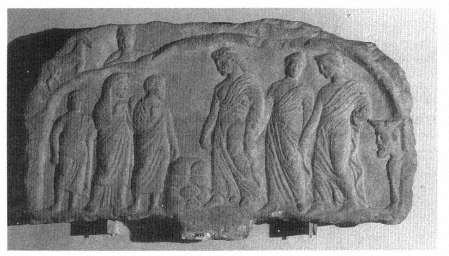
5.
Athens NM 3874: votive relief from Ekali (Attika). Courtesy of the National Archaeological Museum, Athens.
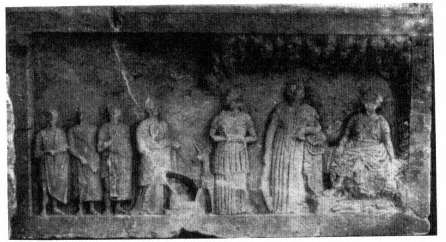
6.
Volos 573: votive relief from Thessaly.

7.
Athens NM 1408: votive relief from Piraeus. Courtesy of the National Archaeological Museum, Athens.
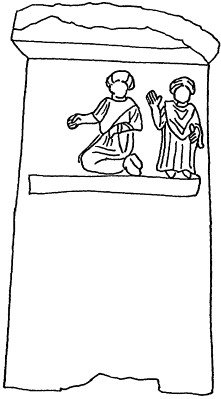
8.
Usak[*] 1.3.74: votive relief.
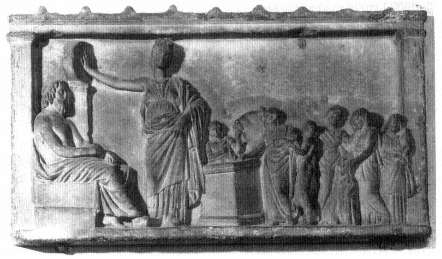
9.
Paris, Louvre 755: votive relief from the Asklepieion in Athens. Courtesy of the Musée du Louvre, Paris.
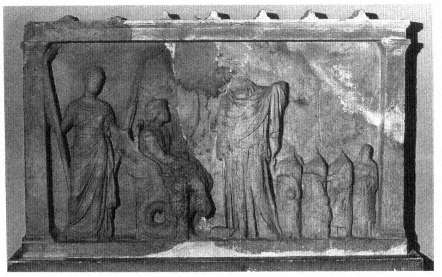
10.
Eleusis: votive relief from Eleusis.
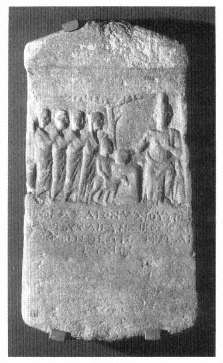
11.
Copenhagen NM 4763: votive relief from Kyzikos.
Courtesy of the National Museum, Copenhagen.
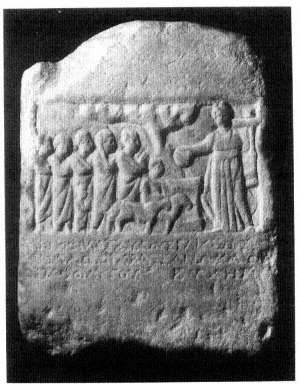
12.
Vienna Kunsthistorisches Museum 1439: votive relief from Mysia.
Courtesy of the Kunsthistorisches Museum, Vienna.
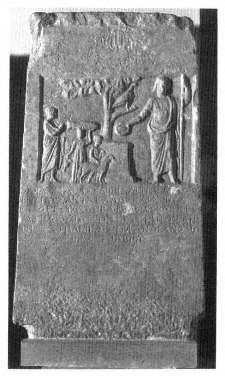
13.
Athens NM 1486: votive relief from Apameia on the Propontis.
Courtesy of the National Archaeological Museum, Athens.
14.
Instanbul inv. 4407: votive relief from Mysia.
15.
Istanbul inv. 1909: votive relief from Mysia.
16.
Istanbul inv. 676: votive relief from Mysia.
17.
Paris, Louvre 2850: votive relief from Kyzikos. Courtesy of the Musée du Louvre, Paris.
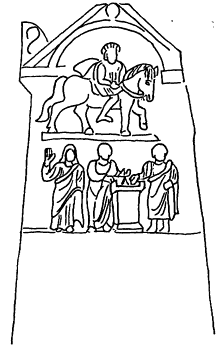
18.
Manisa 1945: votive relief from Kula (Lydia).
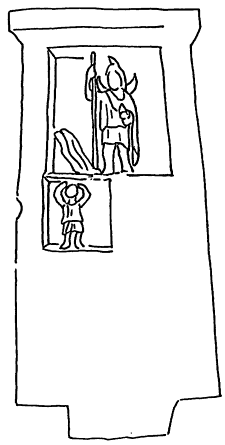
19.
Votive relief from Köleköy (Lydia).
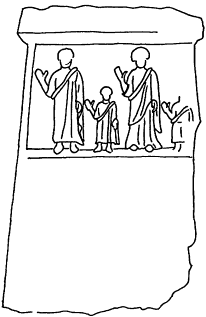
20.
Boston MFA 94.14: votive relief from Kula (Lydia).
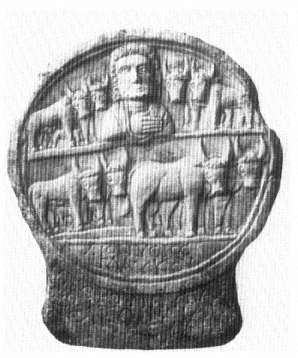
21.
Votive relief from Phrygia.
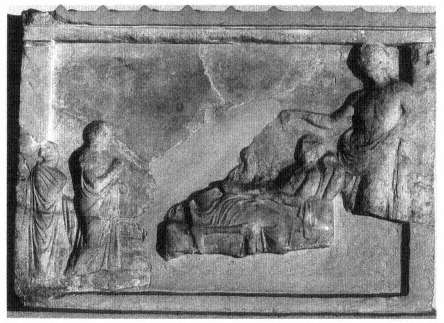
22.
Athens NM 1841: votive relief from the Asklepieion in Athens. Courtesy of the National Archaeological Museum, Athens.
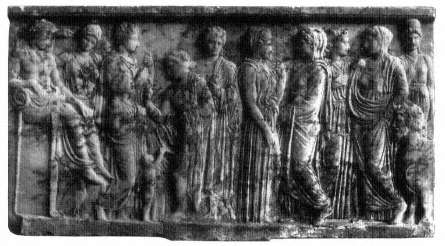
23.
Athens NM 2756: votive relief from Phaleron (Attika). Courtesy of the National Archaeological Museum, Athens.
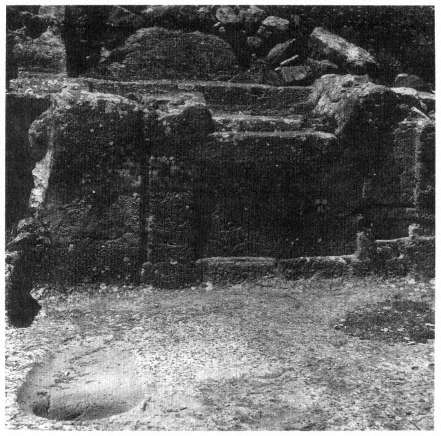
24.
Altar of Homonoia, sanctuary of Artemidoros of Perge, Theta.
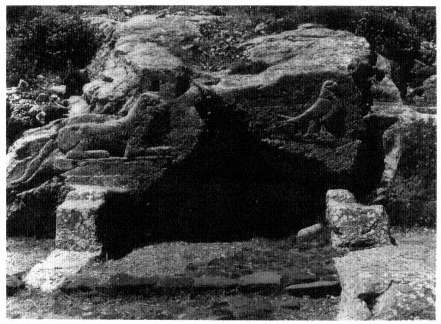
25.
Altar of Zeus Olympios, sanctuary of Artemidoros of Perge, Thera.
26.
Altar of the Dioscuri, sanctuary of Artemidoros of Perge, Thera.
27.
Dolphin of Poseidon, sanctuary of Artemidoros of Perge, Thera.
28.
Portrait of Artemidoros, sanctuary of Artemidoros of Perge, Thera.
29-31.
Relative frequency of sacrificial animals. 29.
Frequency in Attic sacrificial calendars (Classical period).
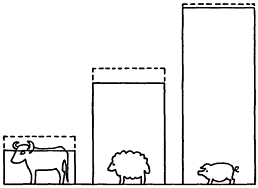
30.
Frequency in votive reliefs from mainland Greece (Classical period).
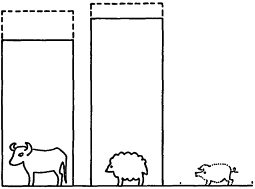
31.
Frequency in votive reliefs from Asia Minor (Hellenistic-Roman period).
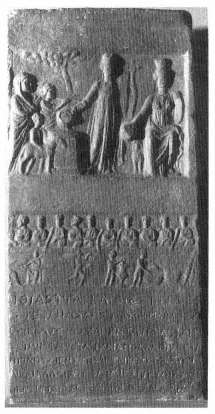
32.
Athens NM 1485: votive relief from Apameia on the Propontis.
Courtesy of the National Archaeological Museum, Athens.