
PART FOUR
SELF-IDENTITY IN POLITICS AND RELIGION
Introduction
Anthony Bulloch
Apollonius writing to his brother Ptolemaeus in Egypt in the mid-second century BC curses at him for his profound belief in divine revelation through dreams at the Serapeum (P. Par . 47 = A. S. Hunt and C. C. Edgar, Select Papyri: Non-Literary Selections 100): "You are full of lies, and your gods likewise, for they have cast us into a great forest where we could die. . . . I can never hold up my head in Tricomia again for shame." A little more than a century later Marc Antony processed into Ephesus as Dionysus, with a full retinue of bacchants, satyrs, and Pans, equipped with ivy, thyrsoi , and the musical instruments of the god (Plutarch Antony 24); meanwhile King Antiochus I of Commagene set up his great monument on top of the wild Taurus Mountains with cult images of Zeus-Oromasdes, Apollo-Mithras-Helios-Hermes, and Artagnes-Heracles-Ares and a long text commending piety and ancestral worship (including sacrifice and festivals) to his children and grandchildren (Dittenberger, OGIS 383). Religion and social identity in the Hellenistic period can seem almost bewilderingly complex and confusing, and the papers in this section attempt to clarify the issues by focusing on people's relation to the gods, the central social and civic values of the time, and the extent to which "religion" included a sense of political community.
Folkert van Straten counsels caution in interpreting the votive material, which is patchy and partial as evidence. Certainly the geographical distribution of the surviving record is skewed in favor of particular areas in Asia Minor, and we could do with more continuous and representative remains from Egypt and the mainland, but the evidence does lead van Straten to some clear and convincing conclusions. He observes an increasing separation of worshiper and deity in the iconography of the reliefs, and an increasing verticality in their relationship. Now it may be
true that votive reliefs provide more direct contact with ordinary people than the literary texts that have survived from the period, but even these monuments could be afforded only by people above a certain economic level, and we have always to allow for the use of conventional collections of designs provided by the sculptors. In any case, a coincidence of outlook between the votive reliefs and literary texts may well be significant, and there are some telling parallels to be observed.
For example, in Apollonius Rhodius' Argonautica the gods are generally absent by contrast to epic works from the Archaic period, just as some of the votive reliefs from the Hellenistic period now omit representation of the gods altogether. And when the gods are present, there is a qualitative difference in the Argonautica . In Book 2.669ff., for example, Apollo appears unexpectedly to the Argonauts when they are on the island of Thynias: he comes suddenly from the outside, sweeping through the air and passing on without stopping, and his epiphany offers no intimacy between god and men but merely brings disruption, an earthquake on the island, scaring all of the heroes into averting their gaze as the god passes through. This is, to be sure, a distant god, as "vertical" in his relationship to the Argonauts as any divinity on the votive reliefs. Again, the fine vignette describing the departure of the ship Argo from Pagasae (1.519-558), a thoroughly "pregnant" moment in the epic, and one charged with significance, explicitly places the gods above the whole scene, looking down from the heavens (547), with the nymphs observing from the superior heights of Mount Pelion (549f.), even while Jason, leader and captain, stands amidships (the fact that he is compared at this point to the god Apollo [536ff.] serves only to underscore the distance between the men and the real gods).
The social world of the Argonautica is one that is very disturbed at several fundamental points, and from time to time modern readers have been tempted to see this as a reflection of the alienation of life in the modern Hellenistic cities, and the difficulty that men and women had establishing a true sense of identity and purpose in their communities. There may be something to this, but it is as well to be reminded by Adalberto Giovannini's analytical survey that at the civic level, at any rate, there was an extended sense of community identity with the polis, and a sense of commonwealth, with great emphasis on international collaboration, among communities. The pleasant sociability of the gymnasium and the theater, and the sense of cultural identity which participation in them imparted, are a long way from the despairing isolation of the Argonautic heroes huddled separately in the sand and waiting to die when they lose their way in the North African Syrtes (4.1259ff.), and although Apollonius' vision, repeatedly expressed in the Argonautica , of a lonely and fractured society may have had a lot of personal validity
to it, it is precisely an individual poetic vision and not a documentary report. Few poetic texts correlate simply with the societies from which they come.
The durability of the political, religious, and social institutions of the Hellenistic period was impressive, as both Adalberto Giovannini and Albrecht Dihle point out, and a source of personal stability as well as identity. Giovannini stresses the social dimension, Dihle the political, and the difference is partly illustrative of the need for further research on the key documents, especially the epigraphical; but in part it is a difference of emphasis, made possible by the very flexibility which Hellenistic communities could offer their inhabitants. In Homeric times, a Phoenix exiled from his oikos was essentially cut off from his very identity (Iliad 9.434ff.) and was extraordinarily fortunate to find even a partial refuge with some security; by the third century BC Thyonichus can actually recommend his lovesick friend Aeschinas to move from mainland Greece to Ptolemy's Egypt (Theocritus 14.55ff.), and the move will be in search of opportunity and self-betterment. This difference is a profound one, as Dihle stresses, for it betrays a definition of the self which has shifted radically in comparison to the Archaic period, and this marks a profound change in the political conditions of society; but at the same time, through all the religious ferment, it is the old gods that endure. When Antiochus I set up his monument to piety high in the wild range of Nimrud-Dagh, it was Zeus, Apollo, Hermes, and Ares to whom he turned.
Images of Gods and Men in a Changing Society:
Self-identity in Hellenistic Religion
Folkert van Straten
Self-identity or self-definition in religion is, I think, about the place a person assigns himself in relation to the gods he worships.[1] It is about the nature of the relationship between gods and men as perceived by the worshipers, and it will take account of such questions as: Is this relationship primarily a personal one, between the individual worshiper and his god, or is religion rather looked upon as a matter of the community, in which the individual partakes only, or mainly, by virtue of his membership in that community?
To study this aspect of Hellenistic religiosity, we might examine its expression in literature. I shall not do that, for a couple of reasons. The first has at least a semblance of respectability: in ancient literature the ideas and beliefs of a pretty thin layer of society are rather overrepresented. The second reason is that I do not feel in the least qualified to pursue that subject. So I shall leave literature aside. Someone like Aelius Aristides may not take kindly to being left out of the discussion altogether; therefore I may mention him once or twice, but otherwise I shall focus on another class of evidence.
For self-identity in Hellenistic religion did not find expression exclusively in words; it also manifested itself visually, in images . In the archaeological material we find numerous representations of men and gods. Among these, representations on votive reliefs, which have an explicit religious content, showing gods and men together in a context of worship, may best lend themselves to our purpose. The archaeological
[1] The drawings for figs. 1, 2, 4, 8, 14, 15, 16, 18, 19, 20, 29, 30, 31 were made by Margreet Wesseling.
evidence brings us into contact with broader layers of the population, with the common people, so to speak; and it may have the additional advantage that self-definition here is perhaps on the whole less self-conscious than in our literary authors.
Inscriptions, especially votive inscriptions, are an indispensable complement to the votive reliefs. For the present, however, though keeping an eye open for relevant epigraphical data, I will concentrate mainly on the representational evidence.
To round off the introductory self-definition of this paper: Hellenistic religion, as I see it, in Greece and the more or less Hellenized parts of Asia Minor continued through the Roman period. The most typical traits of Hellenistic votive reliefs may best be brought out by comparing, or contrasting, them with similar monuments of another period, such as their Classical predecessors.
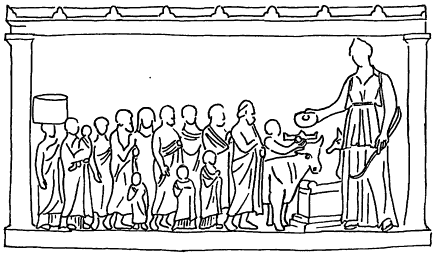
A typical (if better than average) Attic votive relief of the fourth century BC comes from the sanctuary of Artemis at Brauron (fig. 1).[2] It is of the usual rectangular shape, more wide than it is high, and wide enough to accommodate all the figures, divine and human, that the dedicator wanted represented. According to the inscription on the architrave the relief was set up, in accordance with a prayer, by Aristonike, wife of Antiphates from the deme Thorai. We see Aristonike together with her extensive family approaching Artemis, who is standing on the right. A number of children of various ages are present (Artemis Brauronia was especially invoked in connection with pregnancy, childbirth, and child care). In front of the family procession there is a bovine sacrificial victim, restrained at the altar by a servant who holds the kanoun . In the rear, a maid is carrying the kiste on her head. The goddess is much taller than her worshipers, but all figures are standing on the same level, close together, sharing one architecturally framed space.
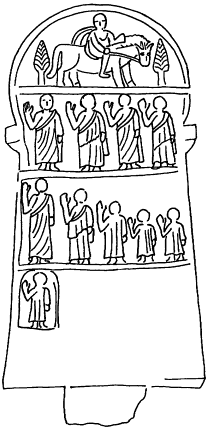
Let us compare this with a late votive stele from Kula in Lydia Katakekaumene (fig. 2).[3] An inscription informs us that the relief was set up by one Erastros, together with his spouse and their children, in accordance with a prayer to Theos Hosios kai Dikaios . The stele has the upright format that is typical of the later East Greek votive reliefs, and the fig-
[2] Brauron 1151 (5): A. K. Orlandos, "Brauron," Ergon (1958): 35, fig. 37; I. Kontes, "Artemis Brauronia," AD 22, A' (1967): 195, pl. 104a; S. Karouzou, "Bemalte attische Weihreliefs," in Studies in Classical Art and Archaeology: A Tribute to Peter Heinrich yon Blanckenhagen , ed. Gunter Kopcke and Mary B. Moore (Locust Valley, N.Y., 1979), 111-116, pl. 33.2; LIMC "Artemis," no. 974.
[3] Manisa 1944: P. Herrmann and K. Z. Polatkan, "Das Testament des Epikrates und andere neue Inschriften aus dem Museum yon Manisa," SBWien 265.1 (1969): 50, no. 7, fig. 14; TAM 5.1 (1981): 85, no. 248.
ures are arranged on four different levels. In the top panel, in a world all of his own, the God Holy and Righteous is represented on horseback. The dedicator and his family, all depicted frontally, occupy the lower levels. The god too presents a frontal face. One might say that, in contrast with the horizontal relationship between man and god in the Classical relief from Brauron, we have here a vertical relationship. But it would perhaps be more accurate to say that in this relief the composition suggests very little relationship at all.
I would not be surprised if a sneaking suspicion has crept upon the reader that by the choice of these two monuments I may have prejudiced or at least unduly simplified the issue. To try to sketch a more nuanced picture let us retrace our steps and look at the votive reliefs of the Classical period and their development in the Hellenistic age in more detail.
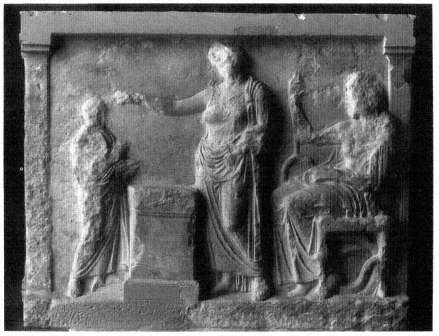
It is easily ascertained that the closeness between goddess and worshipers which attracted our attention on the relief from Brauron is in no way exceptional in the Classical period. Indeed examples of an even closer proximity are not hard to find. On an early Classical relief from the Athenian Akropolis a craftsman sitting behind his workbench is seen handing his aparche to Athena, who appears to be physically present in his workshop.[4] A late fifth- or early fourth-century relief from the Athenian Asklepieion shows Hygieia extending her hand and touching, or almost touching, the head of a man standing on the left (fig. 3).[5] In this case there is a large altar between the worshiper and his god, clearly marking, one might think, the boundary between the human and divine worlds. The altar, however, in view of its function, should probably be regarded as a link rather than a demarcation point. And anyway, in many instances no altar-is represented, so gods and men move even closer together, as on the modest votive relief of a haulier from the same Asklepieion.[6]
On another relief of unknown provenance there is also no altar be-
[4] Athens AkrM 577: G. Dickins, Catalogue of the Acropolis Museum (Cambridge, 1912) 1:117. E. Mitropoulou, Corpus I: Attic Votive Reliefs of the Sixth and Fifth Centuries BC (Athens, 1977), no. 29, fig. 48; F. T. van Straten, "Gifts for the Gods, " in Faith, Hope, and Worship: Aspects of Religious Mentality in the Ancient World , ed. H. S. Versnel (Leiden, 1981), 93, fig. 32.
[5] Athens NM 1338: J. N. Svoronos, Dos Athener Nationalmuseum (Athens, 1908-37), 257f., pl. 38.3; K. Sudhoff, "Handanlegung des Heilgottes auf attischen Weihetafeln," Archiv für Geschichte der Medizin 18 (1926): 238, pl. 10.5; H. K. Süsserott, Griechische Plastik des 4. Jahrhunderts v. C.: Untersuchungen zur Zeitbestimmung (Frankfurt, 1938), 108f., pl. 16.2; U. Hausmann, Kunst und Heiltum: Untersuchungen zu den griechischen Asklepiosreliefs (Potsdam, 1948), 176, no. 127; Karouzou, "Bemalte attische Weihreliefs," 111-116, pl. 33.1.
[6] Athens NM 1341 + : L. Beschi, "Rilievi votivi attici ricomposti," ASAA 47/48 (1969/ 1970): 86ff., fig. 1.
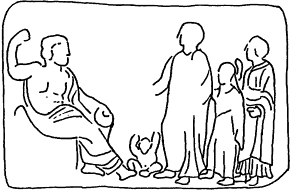
tween the god seated on the left (he may be Zeus Meilichios or some similar deity) and the worshipers approaching from the right (fig. 4).[7] Here, right at the god's feet, a baby is crouching on the ground, reaching up his tiny hands. This visually direct and effective way of commending a child to the god's care by putting him in front of the other worshipers, immediately before the god, recurs in several other votive reliefs.[8]
As we saw earlier, fourth-century votive reliefs often have an architectural frame consisting of a bottom ledge, two antae, and an architrave topped by something like the lateral edge of a tiled roof. It has been suggested that this type of frame reflects the stoa which formed part of so many sanctuaries.[9] This opinion seems to find support in a curious votive monument from the Athenian Asklepieion, which has been treated in depth by Professor Ridgway.[10] It was carved out of a single block of marble and consists of a relief depicting the usual procession of worshipers in an architectural frame and, attached to it, at fight angles on the left, a higher naiskos containing the deities. It may be that the sculptor of this monument was exceptionally literal-minded, and that in general we should not take the conventional architectural frame as reflecting any specific type of building. However that may be, the frame does have the effect of binding together the figures enclosed within it
In votive reliefs to the Nymphs the same effect may be achieved by an irregular frame suggesting the rocky mouth of a cave. The piece from Ekali in Attika illustrated here (fig. 5),[11] dating from around 300 BC , shows a group of worshipers on the left of a rustic altar and the three Nymphs and Acheloos on the right, all inside the cave.
It is interesting to compare this with a Hellenistic votive relief from Thessaly (fig. 6, second century BC ?).[12] Here we have, to the fight of an altar, Artemis, Apollo, and, sitting on a rock, probably Bendis. Four wor-
[7] Padua MC 820: F. Ghedini, Sculpture greche e romane del Museo Civico di Padova (Rome, 1980), 18ff., no. 2.
[8] O. Walter, "Die heilige Familie yon Eleusis," ÖJh 30 (1937): 60; idem, "Die Reliefs aus dem Heiligtum der Echeliden in Neu-Pharleron," AE (1937): 1.103; van Straten, "Gifts for the Gods," 89ff.
[9] G. Neumann, Probleme des griechischen Weihreliefs , Tübinger Studien zur Archaeologie und Kunstgeschichte 3 (Tübingen, 1979), 5of.; see also Karouzou, "Bemalte attische Weihreliefs," 111-116.
[10] Athens NM 1377: Svoronos, Athener Nationalmuseum , 294, pl. 48; Hausmann, Kunst und Heiltum , 167, no. 11; B. S. Ridgway, "Painterly and Pictorial in Greek Relief Sculpture," in Ancient Greek Art and Iconography , ed. W. G. Moon (Madison, 1983), 193-208, figs. 13.4a-b.
[11] Athens NM 3874: W. Fuchs, "Attische Nymphenreliefs," MDAI(A) 77 (1962): 246, Beil. 66. 1; C. M. Edwards, "Greek Votive Reliefs to Pan and the Nymphs" (Diss., New York, 1985), 703ff., no. 71. I am not convinced by Edwards's argument for a later date.
[12] Volos 573: Einzelaufnahmen 3401b; LIMC "Apollon," no. 959.
shipers stand on the left. The sculptor somewhat illogically combined a sort of cave frame, familiar from the Nymph reliefs, with the conventional architectural frame. But in contrast to the previous relief, only the three deities are included within the cave: the worshipers are outside.
Some gods on Classical votive reliefs may occasionally appear in non-human shape. Zeus Meilichios in particular is portrayed as a snake in more than one instance.[13] But even then care is taken to dispose the figures in such a way that the theriomorphic god and the human worshipers are close together, facing each other directly.
In exceptionally distressing circumstances, for urgent prayers, Greek worshipers would sometimes kneel before their gods in the traditional attitude of the supplicant (hiketes, hiketis ). A fourth-century relief from Piraeus (fig. 7) is one of a series featuring a kneeling female worshiper.[14] It strikes me that the predominant impression this scene makes is not one of prostration and self-humiliation, but rather one of extreme closeness. That this is intentional may be inferred from the fact that the boy servant leading the sacrificial animal, who would normally be in front of the worshipers, has been moved to the rear, in order that the woman may kneel immediately in front of the god and reach out and touch his knees.
Later votive reliefs with kneeling worshipers are very rare. There is one in the Usak[*] museum, belonging to the class of the confessional stelai, as is clear from the inscription (fig. 8).[15] Two female worshipers are represented, one of whom is kneeling. But no gods are there to be touched.
Now let us return for a moment to the end of the Classical period and try to trace the development of votive reliefs from then onward in a little more detail. On some late fourth- or early third-century reliefs the gods seem to be slightly more aloof. On a votive relief from the Athenian Asklepieion (fig. 9), Hygieia, though standing nearest to the worshipers, is not facing them.[16] And the same was probably true of Demeter on a relief from Eleusis (fig. 10).[17] It would be stretching the evidence, I
[13] E.g., Athens NM 3329: S. Karouzou, National Archaeological Museum, Collection of Sculpture: A Catalogue , Archaeological Guides of the General Direction of Antiquities and Restoration 15 (Athens, 1968), 147; E. Mitropoulou, "Attic Workshops," AAA 8 (1975): 122, no. 4, fig. 4.
[14] Athens NM 1408: Svoronos, Athener Nationalmuseum , 357f., pl. 65; O. Walter, "Kniende Adoranten auf attischen Reliefs," ÖJh 13 Beibl. (1910): 233; van Straten, "Did the Greeks Kneel before Their Gods?" BABesch 49 (1974): 159-189, no. 1, fig. 1.
[15] Usak[*] 1.3.74: unpublished.
[16] Paris Louvre 755: Süsserott, Griechische Plastik , 123, pl. 25.4; Hausmann, Kunst und Heiltum , 178, no. 146, fig. 5; J. Charbonneaux, La sculpture grecqut et romaine au Musée du Louvre (Paris, 1963), 119; van Straten, "Gifts for the Gods;" 84f., fig. 16.
[17] Eleusis: Süsserott, Griechische Plastik , 123f., pl. 25.1; G. E. Mylonas, Eleusis and the Eleusinian Mysteries (Princeton, 1961), 195, fig. 74; A. Peschlow-Bindokat, "Demeter und Persephone in der attischen Kunst des 6. bis 4. Jahrhunderts," JDAI 87 (1972): 152 R47; G. Schwarz, Triptolemos: Ikonographie einer Agrar- und Mysteriengottheit , Grazer Beiträge, Supplementband 2 (Graz, 1987), 201 R9, fig. 32.
think, to call this a general tendency of the period, but in the light of what follows it is worthwhile to note that the phenomenon occurs.
Unfortunately the study of succeeding developments is hampered by a certain discontinuity in our material. The rich flow of votive reliefs produced in Athens from the later fifth through the fourth centuries dries up almost entirely around 300 BC . Why this should have happened is not quite clear, but there may be a connection with the prohibition of grave reliefs by Demetrios of Phaleron in 317-316 or shortly afterward.[18] We might imagine that votive reliefs were produced as a sort of sideline by workshops whose main income depended on the sale of grave reliefs. When these were no longer in demand, the bottom fell out of their business, and then within one generation Attic votive reliefs practically came to an end as well.[19] Hereafter in Greece proper, votive reliefs are deplorably thin on the ground.
The thread may be picked up, however, one or two centuries later in the northwestern part of Asia Minor. A considerable number of votive reliefs of later Hellenistic and Roman date survive, especially from Kyzikos and Byzantium and surrounding areas. Let us look at a few examples.
A relief from Kyzikos now in Copenhagen (fig. I l) was dedicated, so we read in the inscription, by Pytheas son of Dionysios, on behalf of himself and his wife and children, to Theos Patroa in accordance with a prayer.[20] The monument is in the form of an upright stele. only part of which is occupied by the rectangular relief panel. From the left, four worshipers and a boy leading the sacrificial sheep approach the altar. In the background, behind the altar, there is a tree. The goddess, Meter, is seated on the right. She is represented frontally, not facing her worshipers.
Another relief (fig. 12), also from the Kyzikos area, is dedicated to
[18] K. Friis Johansen, The Attic Grave-Reliefs of the Classical Period: An Essay in Interpretation (Copenhagen, 1951), 13.
[19] The reemergence and increase in production of Attic grave reliefs (and votive reliefs) in the late fifth century BC may be explained along similar lines; see e.g., M. Robertson, A History of Greek Art (Cambridge, 1975), 364f.
[20] Copenhagen NM 4763. This relief appears to have been overlooked by E. Schwertheim, "Denkmäler zur Meterverehrung in Bithynien und Mysien," in Studien zur Religion und Kultur Kleinasiens: Festschrift für Friedrich Karl Dörner , ed. Sencer Sahin, Elmar Schwertheim, and Jorg Wagner (Leiden, 1978) 2:791-837, and by M. J. Vermaseren, Corpus Cultus Cybelae Attidisque , vol. 1, Asia Minor (Leiden, 1987).
Apollo Krateanos, and there are two sheep, but otherwise the monument has the same components arranged in a similar way.[21]
A votive relief from a sanctuary near Apameia on the Propontis (fig. 13) depicts Zeus, and again he is rendered in full frontal view.[22] His eagle perches on a branch of the now familiar tree behind the altar. On the left there is one worshiper, who must be the priest Asklepiades mentioned in the inscription; a maid carrying a rather flat basket or tray on her head and holding a pitcher in her right hand; and a boy with a sheep. The date of this stele is given in the inscription as the year 174, which may be either 123 BC or 89 AD , depending on whether the Bithynian or the Sullan era is meant, or even somewhere in between.[23]
The same pattern recurs in another Mysian relief, dedicated to Zeus Aithrios, which was tentatively dated to the second century BC by Robert.[24] Here, however, the upright format of the stele is taken advantage of in order to add another relief panel underneath, showing a second sacrificial animal: a bull whose head is forced to the ground by means of a rope fastened to its horns and passed through a ring which is visible in the bottom left corner.
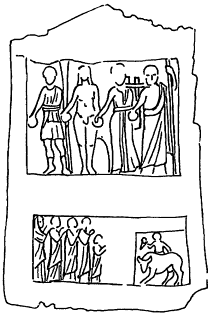
The next stele, which may be slightly later, again displays two relief panels (fig. 14).[25] But there is a significant difference in the disposition of the figures. The upper panel is now entirely taken up by the gods. They are identified by the inscription as Zeus Megistos (on the right), Apollo Bathylimeneites (who is represented twice, in the type of an Archaic kouros and in more contemporary form), and Artemis (on the left). The human worshipers are now relegated to the lower panel, together with the sacrificial bull, which is about to be stabbed to death.
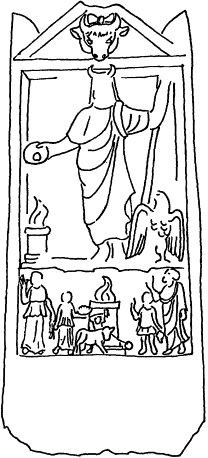
This near allocation of separate relief panels to human and divine figures, though it was never a general rule, is found in many other reliefs from the same area. In one, dedicated to Zeus Olbios by the priest Euodion, the altar is represented twice, thus constituting a link between the
[21] Vienna 1439: L. Robert, "Apollons de Mysie: Apollon Krateanos," in Hellenica , vol. 10 (Limoges, 1955), 137ff., pl. 152; R. Noll, Griechische und lateinische Inschriften der Wiener Antikensammlung (Vienna, 1962), 27f., no. 31.
[22] Athens NM 1486: Svoronos, Athener Nationalmuseum , pl. 112; T. Corsten, Die Inschriften yon Apameia (Bithynien) und Pylai (Bonn, 1987), 47ff., no. 33. On its provenance from Triglia near ancient Apameia on the Propontis, see P. Perdrizet, "Reliefs mysiens," BCH a3 (1899): 592-599, no. III, and L. Robert, "Inscriptions de la région de Yalova en Bithynie," in Hellenica , vol. 7 (Limoges, 1949), 42f.
[23] On the various possible chronologies, see Robert, "Inscriptions," and Corsten, Inschriften .
[24] L. Robert, "Documents d'Asie Mineure," BCH 107 (1983): 545ff., fig. l: "hellénis-tique, on dirait du lie siècle a.C."
[25] Instanbul inv. 4407: L. Robert, "Apollon Bathylimenitès," Hellenica , vol. 10 (Limoges, 1955), 125-133, no. 25, pls. 19.3, 38.2.
upper panel, occupied by Zeus, and the lower panel, where Euodion and his family and assistants are sacrificing a bull (fig. 15).[26] This dedication was made at the god's own command (kathos ekeleusen ), so we should be careful not to jump to conclusions and take the arrangement in separate relief panels as an indication that all direct contact between gods and men was lost. But there is distinctly less feeling of nearness.
Meter Tolypiané is depicted in the top panel of a stele now in Istanbul (fig. 16).[27] Underneath we see eight male worshipers, members of some sort of club; and a servant leading two sheep to a large altar.
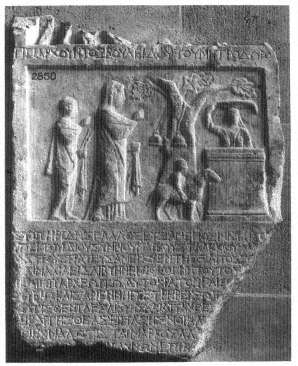
An incomplete relief in the Louvre must have displayed a similar arrangement (fig. 17).[28] Very little remains of the top panel, which again was occupied by a Meter figure: Meter Kotiané, according to the inscription. In the surviving lower panel Meter's cymbals are seen hanging from a tree next to the altar. In the background, behind the altar, is the maid, carrying the flat basket or tray on her head. From the left approach the sacrificial servant with a sheep, a worshiper in woman's clothes, and a slightly smaller figure holding a double flute. My colleagues generally insist on describing the worshiper in woman's clothes as a woman.[29] The inscription, however, which incidentally fixes the date of the monument at 46 BC , informs us that it was dedicated by a certain Soterides, who was a gallos of Meter, and as such may be expected to wear female attire.[30] Soterides offered the stele to Meter for the safety of his companion Markos Stlakkios, who had sailed to Libya as a member of the contingent sent by Kyzikos to help Caesar against the Pompeians and had been made a prisoner of war. Then the goddess appeared to
[26] Istanbul inv. 1909, from Kavak: Edhem Bey, "Relief votif du Musée Impérial Ottoman," BCH 32 (1908): 521-528, pls. 5-6; G. Mendel, Catalogue des sculptures grecques, romaines et byzantines , vol. 3 (Constantinople, 1914), no. 836; L. Robert, "Reliefs votifs de Derkoz," Hellenica , vol. 10 (Limoges, 1955), 45; van Straten, "Daikrates' Dream: A Votive Relief from Kos and Some Other Kat'onar Dedications," BABesch 51 (1976): 11, figs. 20-21.
[27] Istanbul inv. 676, from Deble Köy/Bandirma: Mendel, Catalogue des sculptures , no. 850; A. Schober, "Vom griechischen zum römische Relief," ÖJh 27 (1931): 52, fig. 73; Schwertheim, "Denkmäler zur Meterverehrung," 817, no. II A 11, pl. 194.27; Vermaseren, Corpus Cultus 1:95, no. 389, pl. 63.
[28] Paris Louvre 2850, from Kyzikos: Charbonneaux, Muséc du Louvre , 76; Syll 763; Schwertheim, "Denkmäler zur Meterverehrung," 810f., no. II A 3, pl. 192.23; M. J. Vermaseren, Cybele and Attis: The Myth and the Cult (London, 1977), 29, fig. 15; idem, Corpus Cultus 1:94, no. 287, pl. 62.
[29] E.g., Charbonneaux, Musée du Louvre ; Schwertheim, "Denkmäler zur Meterverehrung"; Vermaseren, Cybele and Attis ; idem, Corpus Cultus .
[30] See van Straten, "Daikrates' Dream," 11f., fig. 22; compare also a self-dedication of a gallos from Pisidia, inscribed Menéas gállos heautón , depicting a long, robed figure: G. E. Bean, "Notes and Inscriptions from Pisidia," AS 9 (1959): 71, no. 5, pl. 15a.
her gallos in a dream and informed him that Markos had been taken prisoner but could be saved from serious danger by invoking the goddess. Here the inscription breaks off, but I do not think we should feel too worried about Markos, for the existence of the votive offering proves that his story had a happy ending.
In the Mysian votive reliefs we have seen so far, the Classical Greek tradition is still fairly strong, although we could observe some interesting shifts in man's perception of his relationship with the gods. We encounter a more diluted version of the Classical heritage when we travel farther inland in Lydia and Phrygia. These regions have yielded considerable series of votive reliefs, mostly of the second and third centuries As.
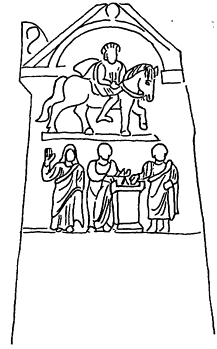
A relief from Kula in the Katakekaumene (fig. 18), dated to 257/8 AD , shows Theos Hosios kai Dikaios on the upper level and underneath three worshipers at an altar.[31] The arrangement is strictly paratactical, and all figures are rendered in full frontal view. Here we are back at the point where we were earlier, and where very little expression of any close relationship between man and god is evident.
Perhaps someone would object that this is merely a matter of style and that not too much meaning should be read into it. I readily concede that we are constantly at risk of overinterpreting this sort of thing, but in the present case there may be some corroborative evidence for the contention that these compositional characteristics are meaningful.
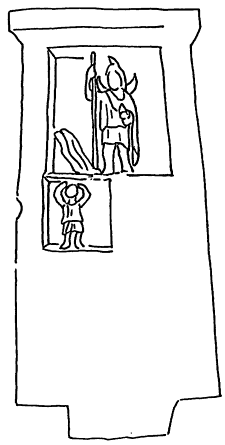
In a Lydian stele of the second century AD (fig. 19), for instance, which is dedicated to the Great Men (Megas Meis Axiottenos Tarsi basileuon ), the small figure of a human worshiper might easily have been accommodated on the same level as the god.[32] There, a cloak is represented, about the theft and recovery of which the inscription informs us. The poor sinner, however, is relegated to a specially prepared box in the basement.
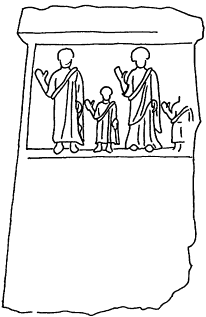
And there is another point. Among this class of late Lydian (and Phrygian) votive reliefs we find an increasing number where either the god or the worshipers are not represented at all.
An example of worshipers and no gods (something that is extremely rare on Classical Greek votive reliefs), is provided by a stele, also from Kula, dated at 196/7 AD (fig. 20).[33] It was dedicated to Artemis Anaeitis
[31] Manisa 1945: Herrmann and Polatkan, "Testament des Epikrates," 50, no. 8, fig. 16; TAM 5.1 (1981): 85, no. 247.
[32] Reported to have been found near Köleköy), dated at 164/5 AD : P. Herrmann, "Ergebnisse einer Reise in Nordostlydien," Denkschriften Wien 80 (1962): 30, no. 21; E. Lane, Corpus Monumentorum Religionis Dei Menis , vol. 1 (Leiden, 1971), no. 69; TAM 5.1 (1981): 50, no. 159.
[33] Boston MFA 94.14: Lane, Corpus Monumentorum , vol. 1, no. 63; C. Vermeule, "Dated Monuments of Hellenistic and Graeco-Roman Popular Art in Asia Minor: Ionia, Lydia, and Phrygia," in Mélanges Mansel (Ankara, 1974) l:119-126, pl. 61; I. Diakonoff, "Artemidi Anaeiti Anestesen: The Anaeitis-Dedications in the Rijksmuseum van Oudheden at Leyden and Related Material," BABesch 54 (1979): 151, no. 32, fig. 19; TAM 5.1 (1981): 104, no. 319.
and Men Tiamou. The dedicator and his wife and two children are represented in frontal pose, the right hand raised in the familiar gesture of worship. They face the viewer or, in a broader sense, they face the world, testifying to and proclaiming the omnipotence of the gods: mar-tyrountes tas dynam(e)is ton theon , as the inscription states with a phrase that recurs regularly in this class of stelai.
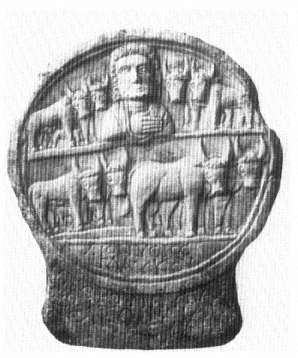
The counterpart to this type of representation may be illustrated by one of a series of reliefs from Phrygia dedicated to Zeus Ampelites (fig. 21).[34] The god is portrayed as a frontal bust, with a powerful hand, and the cattle, tahyparchonta , for the sake of which the dedication was made, are quite literally placed under his protection. But the dedicators themselves are absent.
So much for a general sketch of the development of the expression of self-identity on Classical Greek and later Greek and less and less Greek votive reliefs. Before we go on to some special categories, we should perhaps at this point take a moment to consider whether the development sketched above may in fact be taken as a continuous line of development in any real sense.[35] The material, examples of which have been presented so far, falls more or less naturally into three classes: (l) votive reliefs of the Classical period (mostly Attic, but other parts of Greece have produced similar monuments); (2) votive reliefs from the Greek cities of northwest Asia Minor (Byzantium, Kyzikos, etc.) and their surrounding areas; iconographically these form a reasonably coherent series, starting in the Hellenistic age and continuing into the Roman imperial period; and (3) late votive reliefs from sanctuaries in Lydia and Phrygia, dating from the imperial period.
The first two groups may certainly be looked upon as representatives of the same tradition (with regard both to their iconography and to the religiosity of which they are the visual expression), if for the purpose of this survey we loosely think in terms of Greek religion in general, ignoring its rich local and regional diversity. To understand the iconographic link between the first and the second group, we should, of course, be aware of the fact that votive representations of worshipers and gods oc-
[34] Van Straten, "Gifts for the Cods," 104, fig. 48; see Robert, "Documents d'Asie Mineure," 529-542: "Zeus Ampélitès," for a series of similar reliefs.
[35] I thank Professor Henrichs for his suggestion that some clarification of my position on this point might be useful.
curred not only on stone reliefs but also, and in far greater quantities, on painted wooden votive plaques and on small metal reliefs.[36] We may envisage these common votive representations, very few of which survive, as a constant undercurrent of votive iconography.
Linking the third class of votive reliefs (which in itself is rather loosely knit anyway) to the second is more of a problem. Religion as practiced in the sanctuaries of Lydia and Phrygia in the second to third centuries AD was certainly not in the mainstream of later Hellenistic religion. Therefore, although it may be interesting to observe that some of the developments seen in votive reliefs of the second group continue to a more extreme degree in the third, we should remember that this may be only part of the picture.
By way of addendum I would like to add a few remarks on dedications of some special categories of people, for whom a closer than average bond with the gods may be expected: the sick, dreamers in general, and founders of sanctuaries.
For the Classical period we have an abundance of data regarding the specific cult practices and the expressions of private religiosity in sanctuaries of healing deities such as Asklepios and Amphiaraos. I need only mention Aristophanes' Ploutos , the Iamata inscriptions from Epidauros, and the votive reliefs from the Asklepieia in Piraeus and Athens and the Amphiareia in Oropos and Rhamnous.
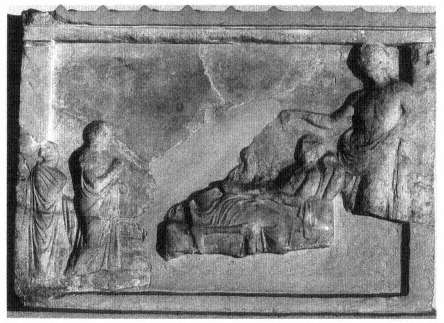
Figure 22, a relief from the Athenian Asklepieion, is one of a series showing the patient reclining on a couch, in the enkoimeterion perhaps, and being visited during his sleep by an apparition of the healing god.[37] Here one deity, probably Asklepios himself, is sitting at his bedside, and one of Asklepios' sons is standing at the patient's head, on the right. The patient, in his dream vision, stretches out his hand, acknowledging the presence of the gods. In sickness, when the personal need for the gods is felt most poignantly, their nearness may be experienced most clearly. After the Classical period, reliefs of this kind are hardly to be found.[38] But that does not mean that the experience they illustrate no longer occurred. Asklepieia flourished throughout the Hellenistic and Roman ages, and we may easily bridge the centuries by using this relief to illus-
[36] For some literary testimonia on less durable votives, see van Straten, "Gifts for the Gods," 78ff.
[37] Athens NM 1841: Svoronos, Athener Nationalmuseum , pl. 133; Sudhoff, "Handan-legung des Heilgottes," 237, pl. 11.4; R. Herzog, Die Wunderheilungen yon Epidauros: Ein Beitrag zur Geschichte der Medizin und der Religion , Philologus Suppl. 22.3 (Lepizig, 1931), 79, n. 27; Hausmann, Kunst und Heiltum , 178, no. 151; van Straten, "Daikrates' Dream," 3, fig. 8; Mitropoulou, Attic Votive Reliefs , 71, no. 143, fig. 203.
[38] A rare example from the second century AD : van Straten, "Gifts for the Gods," 98, fig. 42.
trate the description of an apparition of Asklepios as given more than half a millennium later by Aelius Aristides:
It was revealed in the clearest way possible, just as countless other things also made the presence of the god manifest. For I seemed almost to touch him and to perceive that he himself was coming, and to be halfway between sleep and waking and to want to get the power of vision and to be anxious lest he depart beforehand, and to have turned my ears to listen, sometimes as in a dream, sometimes as in a waking vision.[39]
Dedications made on the strength of a dream vision were not, of course, restricted to the cult of Asklepios. Many other gods appeared in person to their worshipers and, judging from the inscriptions, with increasing frequency during the Hellenistic and Roman periods. In the terminology of these inscriptions the worshipers often present their gods as powerful absolute rulers who give explicit commands (epitage, prostagma, keleusis , etc.).[40]
Founders of sanctuaries, one would expect, may also display a rather special personal relationship with their gods. Founding a sanctuary might well be a deciding factor in determining one's religious identity. Let us meet some founders. First, Telemachos of Acharnai, who was portrayed on the monument which commemorated his foundation of the Athenian Asklepieion in 420/19 BC and which has been painstakingly reconstructed from its disjecta membra by L. Beschi.[41] The two sides of this amphiglyphon show the interior and the exterior of the newly founded sanctuary, and on one side there is also an indication of the Asklepieion in Piraeus, whence Asklepios had come to Athens. Telemachos himself, however, is in no way different from any other worshiper on any other votive relief of the same period. In the inscription on the pillar supporting this relief, though it is extremely succinct and matter-of-fact, we may perhaps detect a certain amount of self-confidence and pride. Telemachos declares, and he emphatically repeats it in another inscription,[42] that he was the first to found the sanctuary of Asklepios and Hygieia and the sons and daughters of Asklepios.
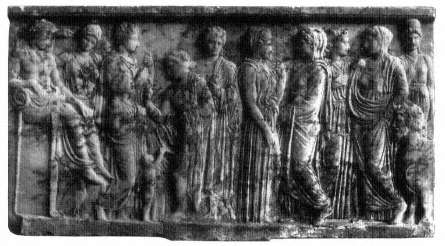
Not much later in Phaleron we encounter a female founder of a sanctuary in a small way: Xenokrateia, who dedicated a shrine to Kephisos and the gods who shared his altar (xunbomoi theoi ).[43] The relief (fig. 23)
[39] Aelius Aristides Sacred Tales 2:31f., trans. Edelstein.
[40] See van Straten, "Daikrates' Dream," 12-13 and App.
[41] L. Beschi, "Il monumento di Telemachos, fondatore dell' Asklepieion Ateniese," ASAA 45/46 (1967/1968): 381-436; idem, "Il rilievo di Telemachos ricompletato," AAA 15 (1982): 31-43.
[42] IG 2 .4355.
[43] Athens N M 2756: Svoronos, Athener Nationalmuseum , 493ff., pl. 181; Walter, "Reliefs aus dem Heiligtum der Echeliden," 1.97-119; Süsserott, Griechische Plastik , 97ff.; Hausmann, Griechische Weihreliefs (1960), 63f., fig. 33; A. Linfert, "Die Deutung des Xenokrateiareliefs," MDAI(A ) 82 (1967): 149-157; M. Guarducci, "L'offerta di Xenokrateia nel santuario di Cefiso al Falero," in Photos: Tribute to B. D. Meritt , ed. D. W. Bradeen and M. F. McGregor (Locust Valley, N.Y., 1974), 57-66; Mitropoulou, Attic Votive Reliefs , no. 65.
shows Xenokrateia and her young son Xeniades in the midst of these gods, and in very dose contact with Kephisos, who is attentively bending over toward her. Here Xenokrateia's special status seems to be expressed in the somewhat exceptional iconography of the relief.
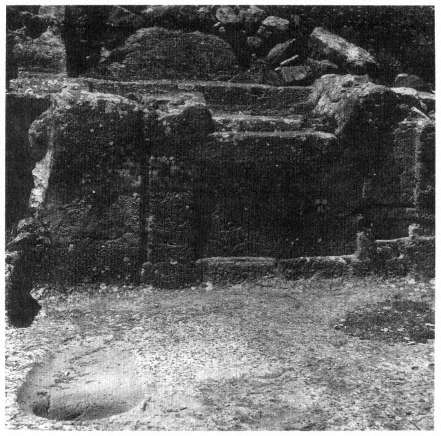
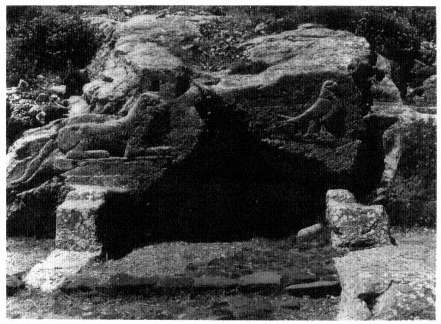
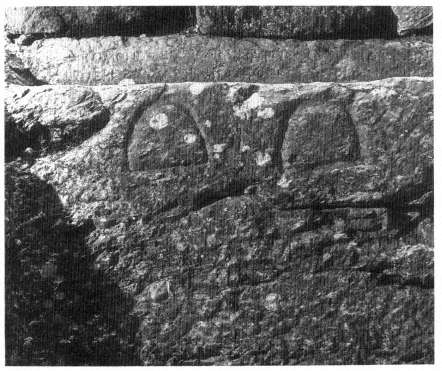
A fascinating founder in the Hellenistic age is Artemidoros of Perge. He had served in Egypt under the first Ptolemy and later retired to the island of Thera, where he founded a complex of altars and sanctuaries near the main gate of the town.[44] Reliefs were carved in the living rock, showing animals and attributes of the gods. The altar in figure 24 is inscribed: "Of Homonoia. Artemidoros son of Apollonios from Perge, in accordance with a dream." And then, in verse: "The immortal altar of Homonoia was founded here for the city in accordance with a dream by Artemidoros who hails from Perge."[45] Next to the eagle, on the right in figure 25, we read: "To Zeus Olympios. The high-flying eagle, messenger of Zeus, an everlasting foundation by Artemidoros for the city and the immortal gods." Underneath is a more general statement: "Imperishable, immortal, ageless, and everlasting are the altars of all the gods for whom Artemidoros as priest founded a sanctuary."[46] The lion (on the left in figure 25) is dedicated Apolloni Stephanephoroi , and the verse inscription reads: "The lion, dear to the gods, was made by Artemidoros in the holy precinct, a monument of the city."[47] Over the piloi and stars (fig. 26), attributes of the Dioscuri, is written: "An altar for the Dioscuri, savior gods who come to the aid of those who invoke them, was made by Artemidoros of Perge."[48] The dolphin (fig. 27), of course, belongs to Poseidon (Poseidoni Pelagioi ): "In the untiring rock Artemidoros made a dolphin for the gods, men's best friend."[49]
In these and numerous other inscriptions Artemidoros is establishing his self-identity in no small way. His name is mentioned in every dedication, often twice over. He insists that the altars and reliefs are everlasting (ageratos, athanatos, aenaos, aphthitos ). With some of the gods Artemi-
[44] IG 12.3.421-422, 863, 1333-1348; Thera 3.89ff.; U. von Wilarnowitz-Moellendorff, Der Glaube der Hellenen , vol. 2 (repr. Basel, 1973), 16, 176, 382ff.; M. P. Nilsson, Geschichte der griechischen Religion , 3d ed., vol. 2 (Munich, 1974), 189ff.; van Straten, "Daikrates' Dream," 18, figs. 23-26.
[45] IG 12.3.1336.
[46] IG 12.3.1345.
[47] IG 12.3.1346.
[48] IG 12.3.1333.
[49] IG 12.3.1347.
doros' relationship seems to have been a very direct one. Homonoia, as we saw, made her will known to him through a dream. And Artemis Pergaia, together with Pronoia, personally saw to it that he lived to a very old age (probably ninety-three).[50] Artemidoros' religiosity was of a distinctly individual nature, but his foundations were not a merely private matter. Like a real euergetes he founded his sanctuaries for the city (tei polei ), as he repeatedly assures us.
Among the reliefs we find Artemidoros' own portrait (fig. 28), which is curiously reminiscent of coin portraits of Ptolemy I.[51] Around it, in his rather imperfect poetry, he has written: "A monument for Thera, and as long as stars rise in the sky and the foundation of the earth remains, Artemidoros' name is not forsaken."[52]
Now that we have tried to look into the visual expressions of religious self-identity of the common people, and of some not so common people, I would like to broach one final subject: the question of individual versus communal religiosity. Signs of increasing individualism have been recognized in Hellenistic religion, and earlier, in the late fifth and fourth century BC .[53] Can we detect such symptoms in the archaeological material?
One might be tempted to point to the fact that the Classical votive reliefs, which are so numerous especially in fourth-century Athens, are all, with very few exceptions indeed, private dedications. At first sight that would seem to indicate a strong individualistic tendency in the religiosity of that period. But I think we should look again. In the first place, as we have seen, the votive reliefs often do not show one individual worshiper, but whole families, even if according to the inscription the dedication was made by only one person. So they are private, but not so very individual. Secondly, at the same time that so many private votive reliefs were produced in Athens, several sacred laws were inscribed on stone. These laws contained cult regulations and sacrificial calendars for the state as a whole, or for individual demes, the Marathonian tetrapolis, and so on, and bore witness to a vivid interest in the communal, civil aspect of religion. Both aspects of religion, the communal and the private, flourished. Both aspects are already mentioned, and distinguished, in Drakon's law: "People should worship the gods and the local heroes, communally (en koinoi ) in accordance with the ancestral laws, privately (idiai ) according to their means."[54] A similar distinction between communal and private religious observances is seen in a sacred law from
[50] IG 12.3.1350.
[51] E.g., G. K. Jenkins, Ancient Greek Coins (New York, 1972), figs. 556, 562.
[52] IG 12.3.1348.
[53] E.g., Nilsson, Geschichte der griechischen Religion , 3d ed., 1:804ff., 2:250.
[54] Porphyry De abstinentia 4.22.
Thasos of the fourth century BC ,[55] which prescribes the sacrifice of specific animals to Dionysos and then adds: "and private worshipers whatever they want (hoi de idi [otai hoti an ]: thelos [in ])." And later even such a typically civic affair as Hellenistic ruler cult had its private aspects too, as Louis Robert has shown in his classic study, "Sur un décret d'Ilion et sur un papyrus concernant des cultes royaux."[56]
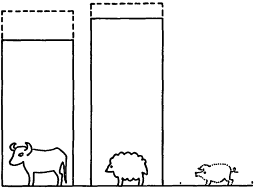
In the Classical period the distinction between communal and private cult is interestingly reflected in the relative frequency of various species of sacrificial animals. In fourth-century Attic sacrificial calendars (fig. 29) there is a distinct preponderance of sheep: 57 to 58.4 percent of all sacrifices recorded, compared to 20.8 percent pigs or piglets and 3.5 to 7.4 percent cows and bulls. In the contemporary votive reliefs with sacrificial representations (fig. 30) the pigs and piglets score much higher: 49.5 to 50.5 percent, as against 28.5 to 32.5 percent sheep and 9.5 to 13.5 percent cows and bulls. I have argued elsewhere that the explanation for these different patterns is to be found in the prices of the victims.[57] The animals for the communal sacrifices mentioned in the sacrificial calendars are, on the average, more expensive than the private sacrifices of the votive reliefs.
How do the later votive reliefs from Asia Minor compare with these patterns? They are rather surprising. Among the sacrificial victims on these reliefs (fig. 31) pigs or piglets appear to be entirely absent, and sheep and cows or bulls each account for approximately 50 percent of the total. In other words, the sacrificial victims on these reliefs are, on the average, far more expensive than the private, or even the communal sacrifices of Classical Athens. This probably reflects the greater affluence of the region, though there may be other contributing factors.
So far we have somewhat shortsightedly concentrated on the opposition between the private individual and the civic community. There is, however, a third category: the smaller social group or club with a religious objective. Such groups might be loosely or more tightly organized. One may think, on the one hand, of the people who accompanied Sostratos' mother to the shrine of the Nymphs near Phyle, in Menander's Dyskolos . Mattresses are provided and hampers with food, and the sacri-
[55] F. Sokolowski, Lois sacrées des cités grecques: Supplément , École française d'Athènes, Travaux et mémoires 11 (Paris, 196a), no. 67.
[56] L. Robert, "Sur un décret d'Ilion et sur un papyrus concernant des cultes royaux," in Essays in Honor of C. Bradford Welles , ed. A. E. Samuel, American Studies in Papyrology 1 (New Haven, 1966), 175-210; P. Frisch, Die Inschriften von Ilion (Bonn, 1975), 84-91, no. 32.
[57] Van Straten, "Greek Sacrificial Representations: Livestock Prices and Religious Mentality," in Gifts to the Gods: Proceedings of the Uppsala Symposium, 1985 , ed. T. Linders and G. Nordquist = Boreas 15 (1987): 159-170.
fice is depicted as quite a social happening. Too much so, in fact, for the taste of the fretful neighbor.
More strictly organized, on the other hand, were the religious associations of orgeones , usually dedicated to the cult of one deity or hero.[58] A votive relief in the Louvre, with a hero and heroine at banquet, may present a rare picture of such an association of orgeones consisting of (at least) fourteen bearded men in two rows.[59]
As Nilsson put it, "Vereine und Klubs hat es immer gegeben. . . . Die Blütezeit des Vereinswesens aber war die hellenistische Zeit."[60] And indeed, among the later Hellenistic votive reliefs from northwest Asia Minor, dedications of social or religious associations seem to form a distinctly higher percentage than in Classical Greece. Occasionally this enhanced social aspect of religion is also expressed in the relief representations.
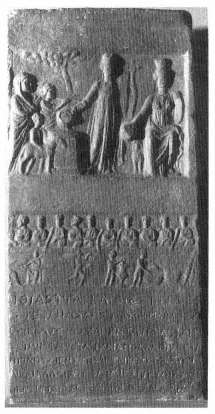
A stele from Apameia on the Propontis (fig. 32), dated either 119 BC or 93 AD ,[61] was dedicated to Apollo and Meter Kybele by a group of thiasitai and thiasitides . The upper panel shows the familiar sacrificial scene. Underneath, the members of the thiasos are enjoying a festive banquet, enlivened by musicians and a dancer, and with a copious supply of drink and souvlakia.[62]
To sum up. To draw general conclusions from our observations would probably not be wise, in view of the rather one-sided concentration on the archaeological evidence. With this reservation, however, we may note that the worshipers in the course of the Hellenistic period seemed to experience an increasing verticality in their relationship with the gods,
[58] W. S. Ferguson, "The Attic Orgeones," HThR 37 (1944): 62-140; idem, "Orgeonika," Hesperia Suppl. 8 (1949): 130-163.
[59] Paris Louvre 956: J.-M. Dentzer, Le motif du banquet couché dans le proche-orient et le monde grec du Vile au IVe siècle avant J.-C ., Bibliothèque des Écoles françaises d'Athènes et de Rome 246 (Paris and Rome, 1982), 622 R472, fig. 693.
[60] Nilsson, Geschichte der griechischen Religion 2: 117. Also, of course, F. Poland, Geschichte des griechischen Vereinswesens (Leipzig, 1909), esp. 514-534, "Geschichdiche Überblick."
[61] See n. 22, above.
[62] Athens NM 1485, from Triglia near ancient Apameia: Svoronos, Athener National-museum , pl. 112; Perdrizet, "Reliefs mysiens," no. II; Robert, "Inscriptions," 3o-44; Schwertheim, "Denkmäler zur Meterverehrung," 119f., no. II A 13; LIMC "Apollon," no. 964; Corsten, Inschriften , 47-56, no. 35; Vermaseren, Corpus Cultus , 81, no. 252, pls. 50-51. See also the votive relief London BM 817, from the Kyzikos area: A. H. Smith, A Catalogue of Sculpture in the Department of Greek and Rmnan Antiquities, British Museum , vol. l (London, 1892), no. 817; Perdrizet, "Reliefs mysiens," pl. 4; GrInscrBM 4.2.1007; A. Bélis, "L'aulos phrygien," RA (1986): 31, fig. 9; idem, "Kroupezai, scabellum," BCH 112 (1988): 325 (in both articles by Bélis the relief is curiously misrepresented as a "stèle funéraire"). The illustrations of the Athens and London reliefs are confused in Nilsson, Geschichte der griechischen Religion 2:666, pl. 14.
not unlike the position of subjects to an absolute ruler. The same phenomenon has been observed by scholars who have studied the epigraphical and literary evidence, and it has been explained as a reflection of the contemporary society.[63] At the same time, at the lower end of this vertical relationship, on the human level, horizontal relationships in the form of socioreligious clubs became more and more important.
[63] See, e.g., H. W. Pleket, "Religious History as the History of Mentality: The 'Believer' as Servant of the Deity in the Greek World," in Faith, Hope, and Worship , ed. Versnel, 152-192. For a different approach, see P. Veyne, "Une évolution du paganisme gréco-romain: Injustice et piété des dieux, leurs ordres ou 'oracles,'" Latomus 45 (1986): 259-283. See also B. Gladigow, "Der Sinn der Götter," in Gottesvorstellung und Gesellschaftsent-wicklung , ed. P. Eicher (Munich, 1979), 41-62.
1.
Brauron 1151 (5): votive relief from Brauron.
2.
Manisa 1944: votive relief from Kula (Lydia).
3.
Athens NM 1338: votive relief from the Asklepieion in Athens. Courtesy of the National Archaeological Museum, Athens.
4.
Padua MC 820: Greek votive relief.
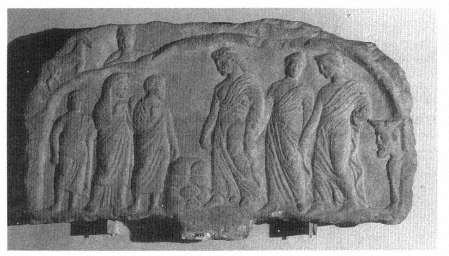
5.
Athens NM 3874: votive relief from Ekali (Attika). Courtesy of the National Archaeological Museum, Athens.
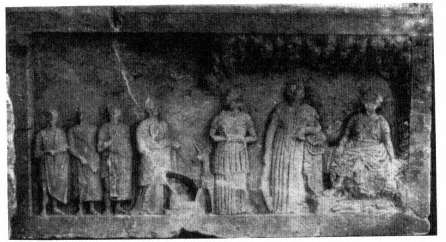
6.
Volos 573: votive relief from Thessaly.

7.
Athens NM 1408: votive relief from Piraeus. Courtesy of the National Archaeological Museum, Athens.
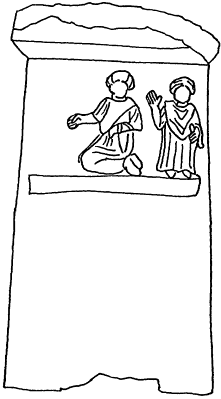
8.
Usak[*] 1.3.74: votive relief.
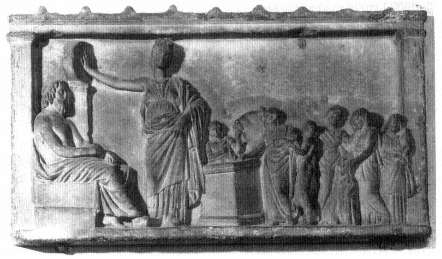
9.
Paris, Louvre 755: votive relief from the Asklepieion in Athens. Courtesy of the Musée du Louvre, Paris.
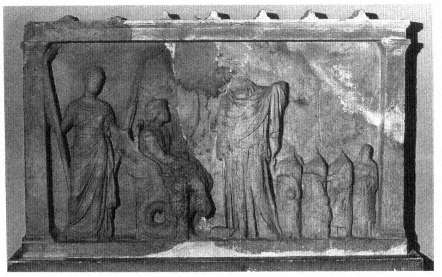
10.
Eleusis: votive relief from Eleusis.
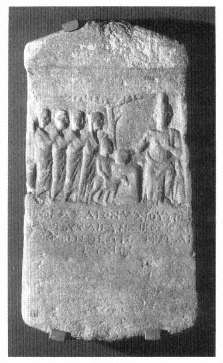
11.
Copenhagen NM 4763: votive relief from Kyzikos.
Courtesy of the National Museum, Copenhagen.
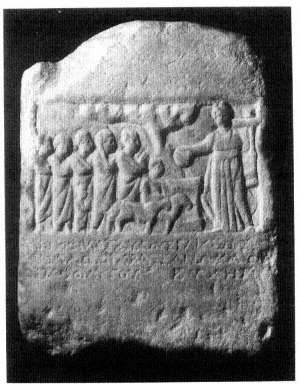
12.
Vienna Kunsthistorisches Museum 1439: votive relief from Mysia.
Courtesy of the Kunsthistorisches Museum, Vienna.
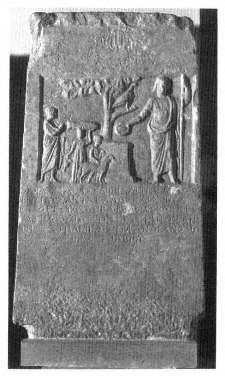
13.
Athens NM 1486: votive relief from Apameia on the Propontis.
Courtesy of the National Archaeological Museum, Athens.
14.
Instanbul inv. 4407: votive relief from Mysia.
15.
Istanbul inv. 1909: votive relief from Mysia.

16.
Istanbul inv. 676: votive relief from Mysia.
17.
Paris, Louvre 2850: votive relief from Kyzikos. Courtesy of the Musée du Louvre, Paris.
18.
Manisa 1945: votive relief from Kula (Lydia).
19.
Votive relief from Köleköy (Lydia).
20.
Boston MFA 94.14: votive relief from Kula (Lydia).
21.
Votive relief from Phrygia.
22.
Athens NM 1841: votive relief from the Asklepieion in Athens. Courtesy of the National Archaeological Museum, Athens.
23.
Athens NM 2756: votive relief from Phaleron (Attika). Courtesy of the National Archaeological Museum, Athens.
24.
Altar of Homonoia, sanctuary of Artemidoros of Perge, Theta.
25.
Altar of Zeus Olympios, sanctuary of Artemidoros of Perge, Thera.
26.
Altar of the Dioscuri, sanctuary of Artemidoros of Perge, Thera.
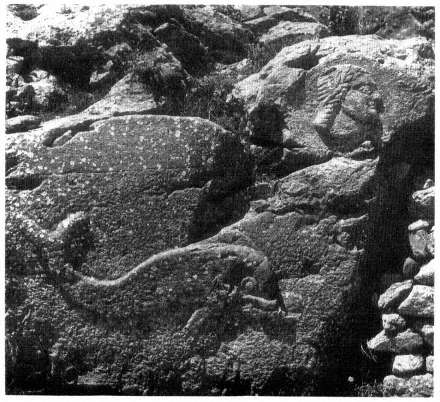
27.
Dolphin of Poseidon, sanctuary of Artemidoros of Perge, Thera.
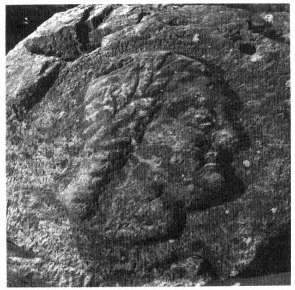
28.
Portrait of Artemidoros, sanctuary of Artemidoros of Perge, Thera.
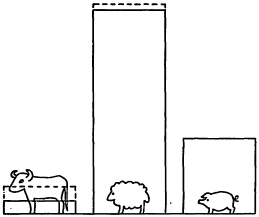
29-31.
Relative frequency of sacrificial animals. 29.
Frequency in Attic sacrificial calendars (Classical period).
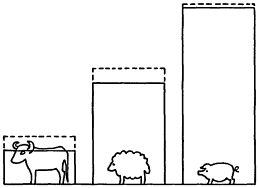
30.
Frequency in votive reliefs from mainland Greece (Classical period).
31.
Frequency in votive reliefs from Asia Minor (Hellenistic-Roman period).
32.
Athens NM 1485: votive relief from Apameia on the Propontis.
Courtesy of the National Archaeological Museum, Athens.
Greek Cities and Greek Commonwealth
Adalberto Giovannini
People who live together for a long time develop common ways of communicating with each other, a common language and common rules of behavior, common values, and common beliefs that together go to make up their culture. As long as these people remain an isolated group, they have no awareness of the specificity of their culture; they just live it. But if they come into contact with people who are different, they analyze their values and rules of behavior by comparing them with the values and rules of the others. If they are strong and self-confident, they will gain from this confrontation a sentiment of superiority; they will feel themselves confirmed in their identity. But if they are weak and insecure, their identity will soon be lost.
Through colonization and commerce, the Greeks came into contact with other people and civilizations, in particular with the East and with Egypt, very early. And although the Eastern civilizations were far more advanced than their own, the Greeks soon developed an astonishingly strong feeling of self-confidence and even superiority. They borrowed from their neighbors their knowledge and their technology and created out of it a culture of their own that rapidly surpassed that of their teachers in almost every field. This feeling of superiority was reinforced in the Classical period as a result of the victories of the Persian Wars: cultural superiority and political strength went together. The confrontation between Greeks and barbarians was in every respect to the advantage of the Greeks.
All this was to change in the fourth century with the decline of the Greek city-states and the rise of Macedonia that resulted in the Battle of Chaeronea, the foundation of the Corinthian League, and the conquests of Alexander the Great. From the point of view of the Greeks, or at least
the majority of them, the rise of Macedonia and the conquest of the East was not a victory of Hellenism over the barbarians; they could not identify themselves with the Macedonians and their kings. These were enemies of the freedom of Greece; they were tyrants, and they were responsible for the decline of the Greek world. The vain efforts of the Greek states to get rid of the Macedonian hegemony after the death of Alexander the Great and the repeated comparison of Macedonia with the Medes allow no doubts about these feelings.[1]
It is a fact that the conquest of Asia and the creation of the Hellenistic kingdoms only accelerated the decline of Greece. Its fate no longer depended on the deliberations of the assemblies at Athens, Sparta, or Thebes; the real decisions were now taken at the courts of Pella, of Antioch, or of Alexandria. Many of the ablest men left their country to take up rewarding positions in Asia or in Egypt. The poor left, too, in order to find a living as mercenaries or a piece of land as colonists. The proud cities of Greece became beggars who asked for material help from the kings, for corn, for schoolmasters, or for the building of porticoes. They flattered them, they voted them divine honors, and they tried to play one power off the other in order to preserve a minimum of independence.
The fate of those who went away as mercenaries or as colonists was not much better. They were uprooted and demoralized; they were deprived of their usual way of life and were threatened in their identity. After the death of Alexander, the Greeks he had settled in his eastern foundations revolted because they longed for Greek customs and way of life (Diod. 18.7.1:  ). According to Dionysius of Halicarnassus (1.89.4), many Greeks
living among barbarians had in a short time forgotten all their Greek heritage, so that they neither spoke the Greek language nor observed the customs of the Greeks nor acknowledged the same gods nor had the same equitable laws by which most of all the spirit of the Greeks differed from that of the barbarians.
Polybius is not much more optimistic about the Greeks of Alexandria, who were just a little better than the barbarian mercenaries who lived there, because they came from Greek stock and had not forgotten Greek customs (34.14.5). The corollary of the geographical expansion of Hellenism in the East was the risk of dilution and dissolution.
Still worse was to come with the Roman conquest. In a few decades,
[1] See the Athenian decree calling the Greeks to rebellion against Macedonia after the death of Alexander (Diodorus Siculus 18.10.3) and the decree of Chremonides (Syll 434/ 5.10f.).
the Roman Senate became the only arbiter of Greek affairs. There was no longer the possibility of playing one power off against the other; the Greek states now enjoyed just so much freedom as was acceptable to Rome. Greece suffered from the exactions of the Roman governors and generals, it was stripped of its works of art without the compensation of material help in case of distress. For, if the Romans claimed to be philhellenes, if they respected the "liberty" of the Greek cities under certain conditions, they gave no money for corn or for teachers. The Greeks were humiliated, they were compelled to flatter the Roman governors and generals even when they hated them, they had to hear themselves despised as unworthy of their ancestors, as effeminate and degenerate. It is no wonder that people despaired of the future and, as Polybius says (36.17), no longer wished to marry and to rear children, so that many parts of Greece became deserted and fallow.
And yet, despite these vicissitudes and misfortunes, the Greeks were able to preserve their identity remarkably well. Even in the worst conditions, even as exiles or as slaves, they preserved the awareness that they were the heirs to a great culture that was different from all others. They were proud of their way of living and thinking. The humiliation of economic and political decline was to a certain degree compensated for by the admiration for Greek civilization. Hellenism was extraordinarily attractive, and the Greeks were conscious of this attractiveness. It was attractive for the Jews, who had the greatest difficulties in reconciling their love for Greek culture with their religious beliefs. It was attractive also for the Romans: at the time of Strabo, for instance, Neapolis was an important center of Hellenic culture; many Romans who took delight in this way of living fell in love with the place and settled there (Strab. 5.4.7, C 246).
"Culture," "civilization," "habits," and "values" are very vague notions. People belonging to a common culture can feel and live it in quite different ways. For educated people it is literacy, poetry, music, and works of art that are important. The common past, too, may play this role. Strabo insists at the beginning of his Geography (1.2.3, C 16) on poetry, music, and mythology as the essential elements of education in Greek cities. Ephorus laments that the Thebans neglected the value of learning and of intercourse with mankind and cared only for the military virtues; and Strabo, who quotes the statement of Ephorus (9.2.2, C 401), adds that in dealing with the barbarians force is stronger than reason. For others, it is the behavior toward foreigners that characterizes the civilized man. For Eratosthenes, the expulsion of foreigners was a practice common to all barbarians as opposed to the traditional hospitality of the Greeks (Strab. 17.1.19, C 802). Dionysius of Halicarnassus saw a proof of the Greek origin of the Romans in the fact that Rome was
the most hospitable and friendly of all cities (1.89.1). Diodorus blames the Phoenician city of Aradus for not respecting the sacred rights of ambassadors and suppliants, for breaching the ties of kinship (33.5.2). The Gauls of Narbonensis admired the Greek rhetors and physicians (Strab. 4.1.5, C 181). For many Romans, Greek culture was synonymous with fine cooking and good wines, with Corinthian vases and beautiful jewels.
But I am not competent to expound on the nature of Greek civilization. The purpose of my contribution is more limited and less ambitious: I shall try to describe how the Greeks lived their culture in their everyday life. The necessary condition for the development and survival of a civilization is communication, regular intercourse, and social life. There can be no civilization if people live like the Cyclopes of the Odyssey , dwelling by themselves in their own caves, without assemblies and laws, caring nothing for one another (Od . 9.112f.; it is worth noting that Aristotle quotes these verses at the beginning of the Politics ). Every organized society has its own ways of bringing people together, officially or otherwise: meeting places, religious or profane ceremonies, feasts and festivals, rituals for rejoicing or mourning, and so on. And the specific form of Greek social life was, of course, the polis.
The Hellenistic Polis
The ancient authors, the historians, the orators, and above all the philosophers, have taught us to regard the Greek polis as a political entity, in the sense that the polis is, or ought to be, a free and sovereign city-state. As Aristotle says (Pol . 1280b30f.): "A polis is not merely the sharing of a common locality for the purpose of preventing mutual injury and exchanging goods. . . . It is a partnership of families and of clans in living well and its object is a full and independent life." For modern historians the last words are the most important: they see in the political sovereignty ( and
and  ) and, if possible, the economic self-sufficiency
  the essential features of the true polis, and they translate the word polls as "city-state" or simply "state." In their view, a Greek city that is not wholly autonomous is not really a polis; a real polis must, therefore, constantly fight for its autonomy and independence, it is necessarily individualistic and egoistic;[2] and the logical
[2] See G. Glotz, La cité grecque (Paris, 1928), 1, 35-38; W. W. Tarn and G. T. Griffith, Hellenistic Civilization , 3d ed. (London, 1952), 79ff.; V. Ehrenberg, The Greek State (Oxford, 1960), 92ff.; H. Kreissig, "Die Polls in Griechenland und im Orient in der hellenistischen Epoche," in Hellenische Poleis , ed. E. C. Welskopf (Berlin, 1974), 2: 1074-1084; K.-W. Welwei, Die griechische Polis (Stuttgart, 1983), 9ff.; R. Duthoy, "Qu'est-ce qu'une polis?" LEC 54 (1986): 3-20. Critical, but without alternative, W. Gawantka, Die sogenannte Polis (Stuttgart, 1985).
conclusion of this conception is that the Hellenistic period is the end of the Greek polis.[3]
This definition is correct insofar as the majority of the poleis actually were or had been, at some time in their history, independent city-states. It is also a fact that, since the times of the Persian Wars, "autonomy and freedom of the Greeks" was a much-used slogan against hegemonic powers whether Greek or barbarian.[4] But it is not true that sovereignty was the essential feature of the polis. The cities founded by Alexander the Great and his successors in Asia and Egypt were not sovereign, their status was fundamentally different from that of the old cities of Asia Minor, they enjoyed only a precarious and revocable autonomy, but they were nonetheless poleis.[5] The cities of the Macedonian kingdom[6] and, in my opinion, also the members of the so-called federal states[7] had the same kind of precarious autonomy: they had no sovereignty of their own, they enjoyed only a limited autonomy depending totally on the will of the central government, but they were called poleis all the same. I believe that the definition of the polis as a city-state is misleading and does not denote its specific nature, its difference from all other communities in other civilizations.
A Greek polis was first of all a community of people living together, "a partnership of families and of clans in living well," to use the words
[3] Most explicit in defense of this conception is the great French scholar G. Glotz, Cité grecque , 448: "Elles (the battle of Chaeronea and the foundation of the League of Corinth) donnent une date précise à ce grand événement, la fin de la cité grecque." See also Tarn and Griffith, Hellenistic Civilization , 79: "Man as a political animal, a fraction of the polis or self-governing city state, had ended with Aristotle."
[4] For the period after Alexander, see now E. S. Gruen, The Hellenistic World and the Coming of Rome (Berkeley, 1984) 1: 133ff. It is interesting to note that the argument was already used by Dionysius I against Carthage (Diod. 14.47.2).
[5] For the fundamental difference between the status of the old Greek cities of Asia Minor and that of the foundations of Alexander and his successors, a difference that was not recognized by A. Heuss and E. Bikerman in their well-known controversy, see D. Magie, Roman Rule in Asia Minor (Princeton, 1950) 1: 56, 2: 827.
[6] See A. Giovannini, "Le statut des cités de Macédoine sous les Antigonides," in Ancient Macedonia: Papers Read at the Second International Symposium Held in Thessaloniki, 19-24 August, 1973 (Thessaloniki, 1977), 465-472.
[7] See A. Giovannini, Untersuchungen über die Natur und die Anfänge der bundestaatlichen Sympolitie in Griecheland (Göttingen, 1971), 71ff. My conclusions have been almost unanimously rejected, in particular by F. W. Walbank, "Were There Greek Federal States?" SCI 3 (1976/77): 27-51. But this disagreement is based precisely on the traditional view that a polis is necessarily a "state." There is also in the literature on Greek "federal states" a failure to distinguish between local autonomy and sovereignty: Swiss communes enjoy a large amount of autonomy, they even grant their citizenship, but they are not states.
of Aristotle. Like all communities that enjoy some autonomy, the poleis had decision-making assemblies and common authorities. Like most communities of the world, they had civic cults and temples to express their unity. Meeting places, popular assemblies, temples, and cults are not particular to the Greek poleis, they are universal features of communities in general. But the poleis had forms of social life of their own that were the expression of Greek culture and that fundamentally differentiated a Greek polis from all other communities in the world. These specific forms of social life were concretized in buildings that were exclusively Greek, that is, the gymnasium and the theater: every polis had or was supposed to have a gymnasium and a theater;[8] barbarian cities did not.[9] Everybody knows of course that athletic training and music were the basis of Greek education and culture; but, surprisingly enough, the standard works on the Greek polis practically neglect the gymnasium and the theater as constitutive elements of the community.[10]
First, the gymnasium.[11] Originally, the gymnasium had been the citizens' training place for war. They had to acquire there the physical strength and collective discipline necessary for hoplite tactics.[12] For Aristophanes, the gymnasium was the essential element of the good old education of the winners of Marathon and he blames the young men who frequent the warm baths and chat instead of training in the palaestra (Clouds 1043-54). In the Phoinissae of Euripides (366-68), the exiled Polynikes is full of tears as he sees again the altars of the gods and the gymnasium where he had been trained. And it was said of the Boeotians that they owed their military superiority to their intense training in the gymnasium (Diod. 15.50.5 and 17.11.4).
In the Hellenistic period, the gymnasium still kept its function as a training place for future soldiers. The physical preparation of boys that ended with the epheby was everywhere the basis of the education of citizens. There they practiced fighting with arms, throwing the javelin,
[8] For Pausanias (10.4.1) a town that possessed "no government offices, no gymnasium, no theater, no marketplace, no water descending to a fountain" hardly deserved to be called a polis.
[9] Diod. 1.81.7, for instance, points out that the Egyptians did not practice the physical training of the gymnasium.
[10] Kreissig, "Polis," and the authors he quotes (1077), simply "forget" the theater and the gymnasium. Ehrenberg, Greek State , 150, 155, mentions the gymnasium as the local cultural center of the polis, but only by the way. Duthoy, "Qu'est-ce qu'une polis ?" 15, enumerates, among other buildings of the city, the theater and the gymnasium.
[11] See J. Delorme, Gymnasion: Étude sur les monuments consacrés à l'éducation en Grèce (Paris, 1960), esp. 421ff.
[12] See Delorme, Gymnasion , 24ff.; R. T. Ridley, "The Hoplite as Citizen," AC 48 (1979): 508-548, convincingly connects the origin of the gymnasium with the introduction of hoplite tactics in the seventh and sixth centuries.
and archery.[13] But the gymnasium also became more and more a place of intellectual and political education where philosophers and rhetors dispensed their teaching; it was, at the same time, a place of pleasure and entertainment, where physical training was now an aim in itself, a way of relaxing body and mind.[14] A Hellenistic gymnasium was a complex building with porticoes and baths, with rooms and exedrae for discussions and teaching.[15] It is significant that Pyrrhus, who had been called to help by the Tarentinians but did not want to fight for them "while they remained at home in the enjoyment of their baths and social festivities, dosed down the gymnasia and the public walks, where, as they strolled about, they fought out their country's battles in talk" (Plut. Pyrr . 16, 2). The gymnasium had by now become what was, in Aristophanes' eyes, a degenerate and corrupting environment.
But if it had partly lost its original purpose, the gymnasium was now an attractive and pleasing place to spend one's time. It was now the locus of an intense social life. Quite significantly, the gymnasia of the Hellenistic period were no longer situated outside the walls of the city, as in the Classical period, but in its center, near the agora and the other public buildings.[16] The gymnasiarchy became one of the most prestigious magistracies, if not the most, but at the same time the most expensive. This is abundantly attested by the honorary decrees for gymnasiarchs who generously spent their money for the oil, the salary of the trainers, and sometimes for the adornment of the gymnasium itself.[17] To spend money on the building or the decoration of a gymnasium was the best demonstration of philhellenism a king could give: King Herod the Great provided gymnasia for several Greek dries and also offered the city of Cos a fund for the maintenance of its gymnasium.[18]
[13] On the training of ephebes in the Hellenistic period see O. W. Reinmuth, "A New Ephebic Inscription from the Athenian Agora," Hesperia 43 (1974): 246-250. M. Launey, Recherches sur les armées hellénistiques (Paris, 1950) 2:813-874, defends the theory that the training at the gymnasium was primarily devised as a preparation for service in the Hellenistic armies (this view has been rejected by Delorme, Gymnasion , 469ff.).
[14] See M. Rostovtzeff, Social and Economic History of the Hellenistic World (Oxford, 1941) 2:1058-1060; C. A. Forbes, "Expanded Uses of the Greek Gymnasium," CPh 40 (1945): 32-42; Tarn and Griffith, Hellenistic Civilization , 95ff.; Delorme, Gymnasion , 374ff.
[16] See Delorme, Gymnasion , 441ff.
[17] See, e.g., OGI 764 (Pergamon); Syll 577 (Miletus); Syll 578 (Teos); Bull. ép . (1966): 273 (Istros); BCH 109 (1985): 597ff. (Messene).
[18] Josephus Bellum Judaicum 1.21.421-423. Several examples of donations of kings, especially of the Attalids, have been collected by L. Robert, Études anatoliennes (Paris, 1937), 85 nn. 2, 3; 201; 451f. See also Bull. ép . (1939): 400; Pol. 5, 88; Paus. 1.17.2.
In fact, the attractiveness of Greek culture for the Jews, the Romans, and other people was largely due to the gymnasium and the way of life it symbolized.[19] At the time of the Maccabees, the Hellenized High Priest Jason undertook to mold his fellow citizens into the Greek character  and asked King Antiochos Epiphanes for permission to rename the citizens of Jerusalem Antiocheis and to build in the Holy City a gymnasium and an ephebeion (2 Macc. 4.9-10; Jos. Ant . 12.5.241). The revolt of the Maccabees put an end to this attempt and Jerusalem remained Jerusalem, but the Jews of the diaspora tried to be admitted to the gymnasium and to participate in the ephebeia, in particular in Alexandria.[20] The Jews of the Seleucid kingdom obtained the privilege of getting money for oil from the gymnasiarchs, so that they might use their own oil (Jos. Ant . 12.3. 119). Of the Romans we know of, Scipio Africanus was the first to exchange his Roman toga for a Greek himation and to stroll about in the gymnasia and read Greek books while staying in Sicily at the end of the Hannibalic War (Liv. 29.19.12; Plut. C. Mai . 3.7). Athletic games were first performed in Rome in the year 186 (Liv. 39.22) and became more and more frequent in the last century of the Republic.[21] Antony held the gymnasiarchy at Athens (Plut. Ant . 33-4) and at Tarsus (Strab. 14.5.14, C 674). At Neapolis, where many Romans came to enjoy the Greek way of life, there were gymnasia and ephebeia (Strab. 5.4-7, C 246). And finally, Roman baths, those monumental symbols of ancient culture which even Christians were eager to attend,[22] are nothing other than the last stage of the transformation of the gymnasium into a place of leisure and entertainment. Pleasant for body and mind, the gymnasium was felt to be less a civic duty than a social privilege, just as it had been a privilege of the aristocracy at the time of Homer (see especially Od . 8.158ff.). Only free-born citizens had access to it. In Egypt, those who had been at the gymnasium,
  , constituted a kind of local aristocracy.[23] The splendid law of Beroia, published by the late J. M. R. McCormack, stipulates
[19] See Delorme, Gymnasion , 424ff.
[20] See V. Tcherikover, Corp. Pap. Jud . (Cambridge, Mass., 1957) 1:55ff. I am not convinced by the opposite view of A. Kasher, "The Jewish Attitude to the Alexandrian Gymnasium in the First Century AD ," AJAH 1 (1976): 148-161. I have not seen the dissertation of R. R. Chambers, "Greek Athletics and the Jews" (University of Miami, 1980).
[21] See N. B. Crowther, "Greek Games in Republican Rome," AC 52 (1983): 268-273, who argues that athletic games were performed in Rome before the second century.
[22] See, e.g., Tertullian Apologeticus 42.4; Cypr. Epp. 76.2.4 and De hab. virg . 19; Eusebius Historia ecclesiastica 5.1.5.
[23] See Delorme, Gymnasion , 424ff.
that slaves, freedmen, prostitutes, and tradesmen were to be excluded.[24] Access for foreigners seems to have been very restricted, in particular in the case of Jews, and reserved for the Hellenized elites.[25] The gymnasium was really felt by the Greeks to be a symbol of their cultural superiority, a symbol they were not ready to share.
And now the theater, where the musical festivals, usually called the Dionysia, took place. The increasing success of musical games is no less impressive than the development of the gymnasium: both, in fact, go together. As we know from numerous inscriptions, every Greek city had its annual music festival. Inscriptions show also that flautists, citharists, actors, and dancers were no less famous, that they enjoyed the same privileges as boxers or runners. Their growing importance is attested by the creation of guilds, the technitai of Dionysus. The most renowned were the technitai of Teos, those of Athens, and those of the Isthmus; but there were also guilds of technitai in Cyprus, in Egypt, and in Sicily.[26]
But the inscriptions attesting the existence of the Dionysia or of other music festivals are not, for the most part, concerned with the festivals themselves. They are decrees for friends and benefactors of the city, they express the city's recognition or goodwill in the form of grants of honors and privileges. These honors were to be solemnly proclaimed at the musical or sometimes at the gymnic festivals the city organized every year.[27] The proclamation was to be made by the herald at the beginning of the festival, immediately after—or sometimes even before—the religious offerings. They were of the kind: "The demos crowns and honors X or Y for his goodwill and merits." It was also a rule to invite to the festivals, and to seat in the front rows, friends and benefactors of the city by granting them the proedria . Thus, the annual festivals in the theater were not only an artistic performance; they were also a social and civic event, the public recognition, in the presence of all citizens and of invited friends, of the gratitude and goodwill of the city to her friends and benefactors.
These benefactors and friends could be individuals, citizens, or for-
[24] J. M. R. McCormack, "The Gymnasiarchal Law of Beroea," in Ancient Macedonia (Thessaloniki, 1977) 2: 139ff., B 27ff. = SEG 27.261.
[25] See Delorme, Gymnasion , 1.1. The fact that the emperor Claudius strictly prohibited the Jews of Alexandria from taking part in the gymnasiarchic and cosmetic games leads us to suspect that this was a main cause of the conflicts with the Greeks (Select Papyri no. 212.92f.). In Antioch, the privilege of the Jews of getting money for oil (Jos. Antiquitates Judaicae 12.3.120ff.) aroused serious discontent among the Greeks.
[26] See F. Poland, RE 5 A (1934), col. 2474ff., s.v. "Technitai"; A. Pickard-Cambridge, The Dramatic Festivals of Athens (Oxford, 1953), 286ff.
[27] Usually the honors were proclaimed at the Dionysia: see L. Robert, Op. min. sel . (Paris, 1969) 1:73. But proclamations at the gymnic festivals are also attested (see, e.g., IvMagnesia 101.18f. and IG 2/3[2] 456b, 4f.
eigners. They could be kings and dynasts. They were often other poleis. For there were ties of friendship and recognition not only between dries and individual citizens or foreigners, between dries and kings or dynasts, but also between cities and cities. And this leads me to a most fundamental but almost ignored function of the Greek polis: the polis as the subject of social relations with other poleis.
Relations Between Poleis and Poleis
Works dealing with the relations of the Greek cities with each other are mainly interested in the conflicts between hegemonic powers and dries striving to preserve their autonomy, or between hegemonic powers, or between cities and their neighbors. There is an immense literature on the great hegemonies of the Classical and the Hellenistic periods. Much has been written on war, on treaties and conventions, on symmachies. The overall impression is that war was the "normal" relation among Greek cities and that peace was only a temporary interruption of this "normal" state of war.
But a careful and unprejudiced examination of the evidence, especially of the inscriptions, reveals a rather different picture. We discover that the Greek cities assiduously cultivated relations with each other and that these relations were essentially friendly and pacific. Their distinguishing mark is that they did not belong, for the most part, to the field of international relations that states maintain with other states as such, but were the kind of relations people living together in a community practice with friends, relatives, and neighbors. That is, relations such as those involved in paying visits, in helping or asking for help, in giving and receiving presents, in participating together in common ceremonies and festivals. These relations were not really "interstatal" but "interhellenic." The subjects of these relations were not the Greek states as states, but the poleis in their quality as specifically Greek communities, quite independently of their juridical status.[28] These "social" relations were a particularity of the Greek commonwealth just as the relations of client-ship were a particularity of Roman society. The Greek world was in fact a community of communities bound together by an intense network of ties of friendship and kinship and other moral obligations.
There is no comprehensive study of these social relations between polis and polis. They are briefly evoked in the classic handbooks, mainly as a symptom of the decline of the polis in the Hellenistic period.[29] Louis
[28] See Giovannini, Untersuchungen , 84-86.
[29] See, e.g., Glotz, Cité grecque , 412ff.; Rostovtzeff, SEHHW 2:1109; Tarn and Griffith, Hellenistic Civilization , 79ff.; Ehrenberg, Creek State , 103ff.
Robert, who was the first fully to realize their importance, unfortunately never wrote the monographs he projected on this topic. But he showed the way. It remains to gather, to complete, and to exploit systematically the material scattered in his immense production. It is a considerable enterprise, of which I can here only sketch out the main lines.
The dominant feature of these relations is the solidarity of the Greek communities, their readiness to help each other in different ways. The best-documented example, one that is typical of the Hellenistic period and more particularly of the second century, is the sending of judges to help cities unable by themselves to settle pending law cases.[30] The remarkable feature revealed by the decrees for foreign judges (we have more than two hundred) is that the cities that were in such an embarrassing position never resorted to individual specialists but always asked another polis to send them some able men of its choice. The decrees not only express the gratitude of the city for the judges; they not only underline their zeal and their incorruptibility; they also thank the city that sent them, praising its good choice and insisting on the ties of friendship and goodwill that bind both communities. It is equally significant that at the proclamation of the honors at the Dionysia, the proclamation for a city always precedes the proclamation for the judges it had sent.
Another much-practiced form of solidarity was mediation or intercession, that is, the intervention in a conflict to convince the parties of the need to come to an agreement or to plead with the stronger in favor of the weaker. It seems that arbitrations of conflicts, which were more and more frequent in the Hellenistic period,[31] were often the result of mediation or intercession. At the great siege of Rhodes by Demetrius Poliorcetes in 305/4, more than fifty envoys from Athens and other cities asked the king to come to terms with the Rhodians (Diod. 20.98.2). The Rhodians themselves were assiduous ambassadors for peace: they were particularly active during the Social War of 220-217 (Pol. 5.24.11 and 28.1; 5.100.9) and, at the same time, in the war between Antiochus III and Ptolemy IV (Pol. 5.63.46). Magnesia on the Maeander offered her
[30] See Magie, Roman Rule 2:963 n. 81; L. Robert, "L'histoire et ses méthodes," Encyclopédie de la Pléiade (Paris, 1967), 467 - 469 = Robert, Die Epigraphik der klassischen Welt (Bonn, 1970), 26-28; idem, "Les juges étrangers dans la cité grecque," in Xenion: Festschrift für P. J. Zepos , ed. E. von Caemmerer (Athens, 1973) 1:765-782; A. J. Marshall, "The Survival and Development of International Jurisdiction in the Greek World under Roman Rule," ANRW 2.13 (1980): 636-640.
[31] On arbitration in Greece, the standard works remain the old dissertation of E. Stone, "De arbitris externis quos Graeci adhibuerunt ad lites et internas et peregrinas componendas quaestiones epigraphicae" (Göttingen, 1888), and the collection of A. Rae-der, L'arbitrage international chez les Hellènes (Paris and Munich, 1912). The second volume of L. Picirilli, Gli arbitrati interstatali greci , is not yet published.
mediation to the quarreling cities of Cnossus and Gortyn (IvMagnesia 65 = Raeder 44); the Aetolians did the same for Messene and Phigalia
(Syll3 472), Pergamon for Mytilene and Pitana (IvPergamon I 245 = Raeder 46), Cnossus for Lato and Olus (Syll 3 712 = Raeder 77). After the Roman intervention, appeals to a Roman general or to the Senate for a befriended city became quite common: thus the Rhodians and the Athenians appealed to L. Cornelius Scipio for the Aetolians in 189 (Liv. 37.6.4-6 and 38.3.7); in the same year, Stymphalos and the Achaeans appealed to M'. Aquilius for Elatea (SEG 25, 445) and the Rhodians pleaded before the Senate in favor of the city of Soloi (Pol. 21.24.10-12).[32]
In this period of insecurity, due to wars and raids by pirates, many cities tried to ensure the consecration and the inviolability of their sanctuaries or of their whole territory  .[33] We have in inscriptions a large number of decrees granting asylia to a city or a sanctuary: decrees for Cos,[34] for Magnesia on the Maeander,[35] for Teos;[36] decrees of the Aetolian League for different cities.[37] These documents confirm that the Greek cities really wanted peace and did what they could to prevent war for themselves and for other cities.
We also have many cases of material help in different circumstances. The lavish contributions of kings overshadow the more modest gifts of the cities, but these should not be ignored. In the year 315, when Cassander decided to rebuild the city of Thebes, many Greek cities not only from Greece but also from Sicily and Italy contributed to the undertaking because they took pity on the unfortunate and because of the glory of the city.[38] At the time of the First Punic War, several cities contributed with money and food to the foundation or refoundation of Entella.[39] By the middle of the third century, a small city of the Aetolian League, Kytinion, sent envoys to cities and kings to collect money for the reconstruction of their walls. The people of Xanthus, in their answer, regret-
[32] See also Syll 591 (Massilia for Lampsacus) and Syll 656 (Teos for Abdera).
[33] On territorial asylia see E. Schlesinger, "Die griechische Asylie" (Diss. Giessen, 1933); and P. Herrmann, "Antiochos der Grosse und Teos," Anadolu 9 (1965 [1967]): 121-128.
[34] R. Herzog and G. Klaffenbach, Asylieurkunden aus Kos , Abh. Dtsch. Ak. Berlin (Berlin, 1952).
[35] IvMagnesia 16-64.
[36] CIG 3045-3058 = Le Bas-Waddington 3:60-85; SEG 4 (1929): 599f.; Herrmann, "Antiochos der Grosse," 121f.
[37] IG 9.1[2] 135 (for Lysioi), 169 (for Cos), 189 (for Mytilene), 191 (for Tenos), 195 (for Chios).
[38] Diod. 19.54. Ten years later, cities were still contributing to this reconstruction (Syll 337).
[39] ASNP 12 (1982): 778ff., especially no. 5 (= SEG 30.1121).
ted being unable to give substantial help because of their own difficulties, but nonetheless gave the envoys from Kytinion a modest contribution of 580 drachmae.[40] A few years later, the Rhodians did the same after the great earthquake that destroyed their city: Polybius, who reports the fact, says that it would be difficult to enumerate all the cities that contributed money according to their means (5.90.2). The Rhodians lent money without interest to the Argives;[41] the Thessalians gave money to the Ambraciots;[42] Cnidus allowed Miletus to borrow money from her citizens and guaranteed the debt.[43] After Aegina fell to the Romans in 209, the captured Aeginetans obtained from the Roman generals permission to beg their kindred cities for ransom (Pol. 9.42.5-8). Populations expelled from their own country were generously received in befriended cities—for instance, the Elateans in Stymphalus (SEG 25.445) and the Entellians in two unknown cities.[44] Also worth mentioning is the habit of sending colonists to depopulated cities.[45]
And finally, there is the phenomenon of the collective grant of citizenship  .[46] It appears that the poleis of the Hellenistic period were much more generous in granting their citizenship, both to individuals and to whole communities, than either Athens or Sparta in the Classical period. Sometimes the already mentioned privilege of proedria —that is, the right to sit in the front rows at the festivals of the city—was added to isopoliteia .[47] We also have several examples of reciprocal isopoliteia , either by convention or by exchange of grant.[48]
All these acts of friendship and solidarity, all these grants of money, of citizenship, or of inviolability, have this in common: they are not based
[40] The decree for Xanthus, known for more than twenty years (see H. Metzger, RA [1966]: 108), has now been published by J. Bousquet, REG 101 (1988): 12-53.
[41] L. Moretti, Iscr. stor. ell . I, no. 40 = L. Migeotte, L'emprunt public dans les cités grecques (Québec and Paris, 1984), no. 19.
[42] C. Habicht, "Ambrakia und der thessalische Bund zur Zeit des Perseuskrieges," in Demetrias , ed. V. Milojcic and D. Theocharis (Bonn, 1976): 1:175-180.
[43] Delphinion , no. 138 = Migeotte, Emprunt public , no. 96.
[44] ASNP 12 (1982): 780, nos. VII, VIII.
[45] After the campaign of Timoleon in Sicily, the Corinthians sent envoys all over the Greek world to ask for colonists to resettle the devastated cities of Sicily, with the result that more than sixty thousand people answered the invitation (Diod. 16.82 and Plutarch Timoleon 22-23). Magnesia on the Maeander sent colonists to Antiocheia Persis (IvMagnesia 61).
[46] See W. Gawantka, "Isopolitie," Vestigia 22 (Munich, 1975).
[47] See IvPriene 5 (Priene for Athens); Syll 443 (the Aetolians for Chios); ASNP 12 (1982): 778ff. (Entella for various cities); R. Stroud, Hesperia 53 (1984): 193ff. (Argos for Aspendus).
[48] See the list by Gawantka, Sogenannte Polis , 206ff. The best example of exchange of citizenship without formal convention is the decree Delphinion 143 (Miletus and Seleuceia Tralleis), erroneously entitled a "Vertrag" by the editor.
on formal obligations resulting from treaties, conventions, or contracts, nor are they imposed by force. Their only justification is the moral ties binding together the communities concerned; their result is a strengthening of these ties for the future. They all begin by recalling the friendship  and the goodwill
  existing between the two communities.[49]
Most significant is the frequent evocation of the ties of kinship (
 ) as a reason for the grant or gift.[50] This syngeneia was often historical, a result of common origin or colonization: for instance, the syngeneia between Magnesia and Teos (IvMagnesia 97), between Magnesia and Larbenus (IvMagnesia 101), or the kinship binding Priene and Colophon to Athens (IvPriene 5 and IG 2/3[2] 456).[51] It was often mythical[52] and sometimes even fictitious, as was the Cretan origin of Magnesia on the Maeander, "authenticated" by a forced decree of the Cretans.[53] But it does not matter whether the kinship was historical, pseudohistorical, or mythical. The important fact is that the cities, especially the small and weak ones, felt the need to renew and to intensify these ties by sharing with their kin their cults and festivals, by sharing with them their citizenship. The nicest example is the decree of Apollonia on the Rhyndacus for Miletus, which describes how the Milesians, after hearing the envoys from Apollonia, carefully examined the historians and various documents and came to the conclusion that Apollonia had actually been founded by their ancestors (Delphinion 155).[54] And these renewals were not merely meaningless exchanges of courtesies: they worked. As Diodorus says (10.34.3): "Children, when they are being ill-treated, turn for aid to their parents, but cities turn to the peoples who once founded them"
  . Many of the acts of solidarity enumerated above illustrate this principle; they show that cities in diffi-
[49] See P. Herrmann, "Die Selbstdarstellung der hellenistischen Stadt," in Acts of the Eighth Epigraphical Congress (Athens, 1984): 108-119.
[51] On the relationship between metropolis and colony see J. Seibert, Metropolis und Apoikie (Würzburg, 1963) and A. J. Graham, Colony and Mother City in Ancient Greece (Manchester, 1964).
[52] L. Robert gives two good examples in BCH 101 (1977): 120ff. (Argos and Aigai) and in BCH 102 (1978): 477ff. (Heracleia and the Aetolians). See also SEG 25.445, with the commentary of Habicht, Pausanias' Guide to Ancient Greece (Berkeley, 1985), 67-69 (Stymphalus and Elatea), and the recently published decree of Xanthus for Kytinion, REG 101 (1988): 19ff. (the Aetolians and the descendants of Heracles).
[53] IvMagnesia 20. This decree of the Cretans, supposed to have been issued at the time of the foundation of Magnesia, was evidently recognized as a forgery by the editor.
[54] See also SEG 12.511 (Antiocheia on the Pyramus "invites" Antiocheia on the Cydnus) and IvPergamon 1.156 (Tegea and Pergamon on the initiative of Tegea).
culty resorted by preference to kindred cities. This is true of the Aeginetans, when they wanted to obtain their ransom (Pol. 9.42.5: 
 ); and of Heracleia on Mount Latmus, which successfully asked the Aetolians to intercede for them with King Ptolemy, although their kinship was purely mythical.[55] The Magnesians offered their mediation to Cnossus and Gortyn by invoking their—fictitious—kinship with the Cretans (IvMagnesia 65). Acraiphia chose the city of Larissa as arbitrator for the settlement of conflicts with her neighbors because of the syngeneia that bound the Larissaeans with her and with all Boeotians (IG 7.4130 = Raeder 70). It was normal for a city that needed foreign judges for the settlement of its law cases to ask first a kindred city.[56] as it was natural for a colony in distress to ask its metropolis for aid or advice.[57] The Greeks took syngeneia more seriously than some modern historians are inclined to believe.[58]
As I stated above, the cities proclaimed their gratitude and goodwill to other cities at their annual festivals, in the presence of all the citizens and of the invited foreigners who had been honored with the proedria .[59] The decrees sometimes specify that the proclamation was to be made at all festivals of the city[60] or that it was to be renewed every year.[61] It was also a rule that the beneficiary of a grant or benefit asked her benefactors to proclaim her gratitude at their own festivals.[62] Thus, the citizens of the poleis were reminded every year at the beginning of their festivals of the ties that bound them to other poleis. The proclamations made by the heralds constantly revived in them the awareness that they were not an isolated community in a hostile world, but that they belonged to a commonwealth of communities where friendship, kinship, and solidarity between community and community were not empty words.
[55] FD 3.3.144 with the commentary of Robert, BCH 102 (1978): 477ff.
[56] See, e.g., IvMagnesia 15 (Cnidus and Magnesia), IvMagnesia 97 (Magnesia and Teos), IvMagnesia 101 (Magnesia and Larbenus), IvPriene 50 (Erythrai and Priene), Hellenica 11/12, 204ff. (Samos and Lebedus), IvMagnesia 65 (the fictitious syngeneia between Magnesia and the Cretans).
[57] See CIG 2.1837b with the commentary of Robert, BCH 59 (1935): 489-507 (Pharos and Paros), and SEG 19.468 (Histros and Apollonia).
[60] IvMagnesia 101, 1.76-78.
[61] IvMagnesia 15b.4 and 97.48f.
The Panhellenic Festivals
This commonwealth of Greek poleis had its regular meetings at the panhellenic festivals. It is again important to emphasize that these festivals were not gatherings of individuals; the competitions were not the confrontations of athletes fighting exclusively for their own glory. The panhellenic games were the festivals of the Greek poleis, which sent official delegations  to bring their offerings to the gods, to represent the community at the games, and to applaud their champions.[63] The victorious athletes brought glory and fame to their mother city, they consecrated to her the crown they had won and were rewarded by her with honors, privileges, and material advantages.[64]
We all know the famous statement of Isocrates in the Panegyricus (43):
Now the founders of our great festivals are justly praised for handing down to us a custom by which, having proclaimed a truce and resolved our pending quarrels, we come together in one place where, as we make our prayers and sacrifices in common, we are reminded of the kinship which exists among us and are made to feel more kindly toward each other for the future, reviving our old friendships and establishing new ties.
The epigraphical material gives us an impressive image of the popularity of the panhellenic games, athletic or musical or both, in the Hellenistic period. The presence of twenty thousand exiles at Olympia in the year 324 to hear the proclamation of Alexander the Great ordering the return of all exiles (Diod. 18.8 and Dein. 1.82), the crowd assembled at the Isthmia in 196 to listen to the decision of the Senate after the Second Macedonian War (Pol. 18.46), are due to exceptional circumstances. But the great list of the thearodokoi of Delphi from the end of the third century, which bore the names of more than five hundred cities, is unquestionably testimony for this popularity.[65] Moreover, we observe the creation of a series of new panhellenic festivals, both gymnastic and musical.[66] About 280 BC , Ptolemy II instituted the Ptolemaia in honor of his father. We have decrees of acceptance from the Delphic Amphictyony and from the League of the Nesiotai, and we hear of delegations from Kalynda, Samos, Cos, and Argos.[67] The Aetolians celebrated their vic-
[63] P. Boesch, Theoros (Berlin, 1908); L. Ziehen, RE 15 A (1934), col. 2228ff., s.v. "theoria," and col. 2244ff., s.v. "theoros."
[64] See L. Robert, RPh 41 (1967): 14ff. (not in the Op. min. sel .).
[65] Published by A. Plassart, BCH 45 (1921): 1-85.
[66] See Tarn and Griffith, Hellenistic Civilization , 113f.
[67] See H. Volkman, RE 23 (1959), col. 1578ff., s.v. "Ptolemaia."
tory over the Celts by inviting the Greek world to their Soteria.[68] In 243/2 the city of Cos dispatched embassies in all directions, even to Macedonia, Sicily, and Italy, to invite kings and cities to their penteteric Asclepieia, a musical and gymnastic festival.[69] Some time later, Aratus of Sicyon flattered his ally King Antigonus Doson by inventing the Antigoneia (Plut. Ar . 45.2). At the end of the century, Magnesia on the Maeander organized a spectacular and successful campaign for her penteteric games for Artemis Leucophryene. In the unique collection of decrees of acceptance found in that city,[70] we have answers from the kings, from the Cretan cities, and from most of the cities of the continent as far away as Ithaca, Corcyra, and Epidamnus; from Syracuse only a few years after her destruction by the Romans; and also answers from the other end of the Greek world, from Antiocheia in Persis, from Seleuceia on the Tigris, and from Seleuceia on the Red Sea.
The archives of Cos and Magnesia reveal the spirit of the institution of these new festivals and of the panhellenic games in general. Their ambition is to bring about the participation of all Greek poleis.[71] The envoys of Magnesia recall the good deeds of their ancestors in favor of many other Greek poleis as documented by the oracles of Apollo, the poets, and the honorary decrees of the poleis.[72] The decrees of acceptance praise the Magnesians for their piety toward the gods and for their philhellenism, they promise to send a delegation, and they appoint a citizen to give hospitality to the envoys who will come in the future to announce the festival every four years. Some decrees are of a more personal character. The people of Ithaca are thankful to the envoys for taking pains to visit them so far away (IvMagnesia 36.25-26). Antiocheia of Persis reminds us that at the time of Antiochus I the city of Magnesia had sent her a good number of colonists, thus establishing an authentic tie of kinship (IvMagnesia 61.14-20). We learn from the decrees of Ca-
[68] See F. Pfister, RE 3 A (1927), col. 1223ff., s.v. "Soteria," and the decree of Abdera in BCH 64/5 (1940/41): 100ff.
[69] Herzog and Klaffenbach, Asylieurkunden aus Kos . The festival is defined as penteteric, gymnastic, and musical in the decree of Camarina (no. 12), 15-16.
[70] O. Kern, Die Inschriften von Magnesia am Maeander (Berlin, 1900), nos. 16, 18-64.
marina and Gela for the Asclepieia of Cos that these cities had answered the appeal of Timoleon and the Corinthians favorably and had sent colonists to Sicily.[73] As Isocrates states, the panhellenic festivals really were an opportunity to revive old feelings and to create new ties.
They also gave the Greeks a chance to express spontaneously their sentiments for leading statesmen and leading powers. The unpopularity of Dionysius I of Syracuse, stirred up by the orator Lysias, provoked serious incidents at the Olympic Games of 388 (Diod. 14.109). Philip II was hissed at but did not care (Plut. Mor . 179a and 457-458). Antigonus Doson was praised by the Spartans as a savior and a benefactor in the presence of all Greeks (Pol. 9.36.5). Philopoemen was applauded at the Nemean Games as a champion of Greek freedom against Philip V (Paus. 8.50.3), while the pro-Roman Callicrates and his party were so hated, if we are to believe Polybius, that at the Antigoneia people refused to bathe with them and booed and hissed when one of them was proclaimed victor (Pol. 30.29). The panhellenic festivals were the agora of the Greek world, the place for the exchange of information, for political discussions, for comment and gossip. The talks and rumors that preceded and followed the proclamation of Flamininus at the Isthmus in 196 give us a good idea of the atmosphere.
Finally, these festivals provided the Greeks with a means of expressing their identity. I shall illustrate this by relating two incidents that seem to me particularly revealing. The first, narrated by Diodorus (17.100-101), occurred during the expedition of Alexander in India. At a banquet and after much drinking, a famous Athenian boxer, Dioxippus, was challenged by a Macedonian soldier named Coragus. The contest took place a few days later in the presence of the whole army. The Macedonians and their king favored Coragus because he was "one of them," while the Greeks encouraged the Athenian. To the great disappointment and anger of Alexander, Dioxippus was victorious and "left the field winner of a resounding victory and bedecked with ribbons by his compatriots, as having brought a common glory to all Greeks." The other incident, which we know from Polybius, is in the same vein. Polybius, who tries to explain, or more exactly to minimize, the popularity of King Perseus among the Greeks at the beginning of the Third Macedonian War, compares the feelings of the Greeks with the reactions of the public at athletic games. They are inclined to support the weaker against the stronger even if the latter is their champion. The historian proves his point by telling the story of the Theban boxer Cleitomachus, whose invincibility had made him the most famous fighter of his time. King
Ptolemy was eager to have him beaten and trained a challenger. As the two athletes fought against each other at the Olympic Games, the crowd first took the part of the challenger, delighted as they were to see a fighter courageous enough to brave the invincible Cleitomachus. Cleitomachus was irritated by this attitude of the public, withdrew for a while from the fight to recover his breath, turned to the crowd, and asked them what they meant by cheering on Aristonicus; whether they did not understand that he, Cleitomachus, was now fighting for the glory of Greece and Aristonicus for that of King Ptolemy; whether they would prefer to see an Egyptian conquer the Greeks and win the Olympic crown, or to hear a Theban and Boeotian proclaimed by the herald as victor. The sentiments of the spectators changed at once and, concluded Polybius, Aristonicus was beaten by the crowd rather than by Cleitomachus.
As we see, the unity of the Greek commonwealth was not an idealistic abstraction. Despite geographical dispersion and different conditions of life, the Greeks remained a remarkably homogeneous society throughout the Hellenistic period. This homogeneity expressed itself at the numerous panhellenic festivals, old and new, which were more than ever meetings of the Greeks as Greeks. If we remember that there were several such festivals every year, to which hundreds of cities sent delegations to represent them and to offer sacrifices to the gods, if we imagine all these people spending several days together, attending the games, exchanging information, and discussing political or other events, then we understand better how the Greeks were able, in a changing world, to preserve their identity.
Conclusion
The traditional view that the Greek polls was, "by definition," an independent and individualistic city-state has distorted our understanding of the function of the polis in the Hellenistic world. It has been widely admitted that Philip II and Alexander the Great were responsible for the decline and fall of the polis, that the polls ceased to be the frame in which Greek civilization achieved its perfection. It has even been said that after Chaeronea the Greek polis no longer existed and that the Greek ceased to be a citizen of his city and became a citizen of the world.
The available material, especially the inscriptions, reveals that the polls was, first of all, a "partnership in living well," a community of a particular kind involving a specifically Greek way of living together. And it appears that in the Hellenistic period the polis preserved its identity better than ever. The gymnasium and the theater, which concretized this identity, became more and more the symbols of the Greek education of
body and mind, of the superiority of Greek culture and the Greek way of life. They differentiated the Greeks from other people, from the Jews, the Egyptians, or the Syrians.
But the polis had another, no less important function: it was the link between individual citizens and the Greek commonwealth as a whole. For the Greeks were not members of the Greek commonwealth as individuals, they belonged to it as members of a Greek polis. It was the function of the polis to create and entertain relations of friendship and solidarity with other poleis, it was its function to send official delegations to the great panhellenic festivals. The poleis were the subjects of what I called interhellenic relations. And this network of interhellenic relations between cities made of the Greek world a community of communities, a homogeneous society of poleis.
The scholars who have shown some interest in this network of relationships between cities and cities in the Hellenistic period consider this "overture" of the polis to the outside world to be the result of the political decline of Greece after Chaeronea. They think that the Greek cities discovered, at last, "the consciousness of their unity and solidarity, of the existence of vital common interests among them," that "Greek 'political' exclusiveness gradually gave way to a broader conception, of a kind of brotherhood among all who were entitled to call themselves 'Hellenes.'"[74]
This belief results from the evidence we have. Our knowledge of the ties of friendship and solidarity among cities depends mainly, and for some aspects almost exclusively, on the inscriptions. The literary sources, historians, orators, and philosophers, are not particularly concerned with the everyday life of the average polis and mention only incidentally these kinds of peaceful and—in a certain sense—banal relations. Since the epigraphical material is rather scanty for the Classical period and totally nonexistent for the Archaic, it is finally the lack of information that explains the common view that there was no or only very little solidarity among the Greek communities before Alexander.
But, despite the limitations of our evidence, we have in the literary sources some indications that this solidarity already existed in the Classical period and even before. We find in Herodotus several examples of solidarity which are quite similar to those attested by the inscriptions for the Hellenistic period. It was in recognition of old benefits that Sparta and Corinth came to the aid of the Samians against Polycrates (Her. 3.47-48). The Eretrians sent assistance to the Milesians for similar reasons (5.99). The Spartans had granted the Attic deme of Deceleia ateleia
[74] Rostovtzeff, SEHHW 2:1109.
and proedria in acknowledgment of a—mythical—benefit of the Deceleians at the time of the Trojan War (9.73.3). The Milesians were bound together by a tie of reciprocal hospitality with Sybaris and decreed a public mourning at the fall of this city (6.21). The Milesians asked the Parians to send them their best citizens to settle their internal conflicts, an interesting precedent for the practice of calling foreign judges (5.28). The kinship of all Greeks in blood and speech and the likeness of their way of life asserted by Herodotus in a famous statement (8.144.2) was not an idealistic proclamation of faith, it expressed the fact that, despite their quarrels and disputes, the Greek poleis already in early times constituted a commonwealth of communities bound together by an intense system of relationships.
In fact, the homogeneity of the Greek world with its network of friendships goes back to the times of Homer, with the essential difference, however, that the world of Homer is a world of individuals, not a world of cities.[75] The Homeric heroes are bound together by the consciousness of a common origin (they are all offspring of Zeus), by ties of hospitality and intermarriage. They pay visits to each other. They exchange gifts and countergifts. They help each other in cases of necessity for common undertakings. They practice athletics in common and listen to the rhapsodes who sing about the heroes of the past. The unity of the Greek world is a creation of the Dark Ages.
The rise of the polis in the seventh and sixth centuries did not destroy this system of personal relationships, which survived through the Archaic and the Classical periods.[76] But the polis, the community, progressively superseded the individual as the subject of these relations. The poleis established with each other relationships that were of the same kind and were based on the same principles as the personal ties of Homeric society. Thus, we find in Herodotus cities bound to other cities or to kings by ties of hospitality  , which, in a typically Homeric way, are concretized by exchanges of gifts and countergifts: for instance, Sparta with Croesus, with Amasis, and with the Samians (Her. 1.69-70 and 3.47). The privileges granted by the Spartans to the Deceleians, because these had revealed to the Dioscuri the place where their sister
[75] See M. I. Finley, The World of Odysseus , 2d ed. (London, 1977). I share the opinion of A. Lesky, Geschichte der griechischen Literatur , 3d ed. (Bern and Munich, 1971), 73ff., that Homer essentially reflects the society and values of his own time (the problem of the "historicity" of the Trojan War is, of course, quite another question).
[76] See the interesting book by G. Herman, Ritualised Friendship and the Creek City (Cambridge, 1987), and the remarkable, but unfortunately little known, article of A. Heuss, "Die archaische Zeit Griechenlands als geschichtliche Epoche," A&A 2 (1946): 26-62 (reprinted in Zur griechischen Staatskunde , ed. F. Gschnitzer, WdF 96 (Darmstadt, 1969), 36-96, at 68ff. (the best pages I know on Archaic tyranny).
Helen was hidden, are another nice illustration of this evolution. The consciousness of unity and solidarity among all Greeks is not a late discovery of the Hellenistic period: it is a direct inheritance from Homeric society; it is the result of the progressive transformation of a society of individual aristocrats into a society of poleis.
The rise of the polis is the victory of the community over the individual, the family, and the clan.[77] The life of most Greek cities was a constant fight for survival and independence, a fight against neighbors for land or for cattle, a fight against ambitious powers or against rivals; but it was not a fight against the unity of the Greek commonwealth as such. There was no incompatibility between political independence from neighbors and from hegemonic powers on the one hand, and solidarity with the Greek world on the other. The cities inherited from Homeric society the consciousness that all together, whether large or small, were related to each other by a common origin, a common way of life, and a common destiny. And despite their conflicts and wars, they were able to keep the unity of the Greek commonwealth throughout their history. The totally individualistic poleis, living in splendid isolation and caring nothing for one another, like the Cyclopes in their caves, never did exist.
[77] See Glotz, Cité grecque , 5: "En réalité, la cité grecque, tout en conservant l'institution familiale, n'a pu grandir qu'à ses dépens. . . . La cité a dû longtemps lutter contre le génos, et chacune de ses victoires a été obtenue par la suppression d'une servitude patriarcale." See also Heuss, "Archaische Zeit Griechenlands," 57ff.
Response
Albrecht Dihle
Man, according to Aristotle, is a  , a being that fulfills its nature only within the frame of a political community. The Stoics, whose anthropological doctrine presupposed the social conditions in the Greek world after Alexander's campaign, changed Aristotle's definition. They called man a
  , that is to say, an animal whose destiny is to live in a human community of any kind.[1] This difference in defining the nature of man seems to corroborate what Professor Giovannini pointed out in his most stimulating paper. He stressed, as you will remember, the importance of the cities, of urban culture as the decisive factor in the life of a Greek during the Hellenistic period. However, he was inclined to value the institutions of a Hellenistic city, its temples, theaters, festivals, officials, as phenomena of social rather than political life.
This evaluation is undoubtedly correct, at least in many respects. Very few cities in the Hellenistic world enjoyed over an extended period of time what we would call full sovereignty and were capable of determining their own destiny.
Moreover, our problem today is the identity of a Greek individual in the Hellenistic world, or that of a Corinthian, Antiochene, or Magnete. Institutions like those mentioned above were typical of all Greek cities in the Hellenistic world. Everyone who shared the advantages or duties arising from these institutions was likely to feel as a Greek for this very reason, without regard for his political allegiance. Finally, I should like to mention that in the course of Hellenistic history the functions of municipal administration and the social reputation going with them became
[1] Aristotle Politica 1253a3; Stoicorum veterum fragmenta 3.686.
more and more monopolized by the upper class, people of landed property and education.[2] The simple folks' share in the institutions of public life became that of consumers and spectators.
Yet in spite of all these restrictions which have to be taken into account, once you apply the term political life to the conditions prevailing in the Greek cities of the Hellenistic world, an average Greek in the third or second century BC would probably not have agreed on our differentiating between political and social life, state and society. And this disagreement would not have been only a question of terminology.
From early Hellenistic times down to the late Roman Empire, philosophers did not cease to discuss the problem of whether or not the  , the wise and perfect man, should partake in political life, and if so, under which circumstances.[3]
 , partaking in political life, was always regarded as strictly separate from service in the army or administration of a king. The term was used to denote only the public activity in the cities and the corporations called
  , which resembled in many ways an urban community.[4] The royal service took its officers from all over the world. There was no community to which its functionaries could have been attached in their quality as administrators.[5]
Even those cities that were founded by a king, used law as given by the king, and had even been given royal judges,[6] were meant to attain, in due time, the autonomy of a self-governing body; and the same applies to the  , corporations of Greek subjects of a Hellenistic king. Although the royal administration and legislation of the great monarchies tended to unify the legal system all over the territory ruled by the king,[7] the principle according to which every city had its own laws was never seriously contested.
None of the Hellenistic monarchies developed a general law of citizenship applying to every inhabitant. Every individual and every ethnic, social, or professional group had their direct and personal relationship to the crown. Thus, the internal structure of a Hellenistic kingdom was exclusively vertical, without any bond uniting horizontally the ruled persons and groups. Perhaps the cult of the god Serapis, introduced by the first Ptolemy,[8] was meant to create such a horizontal connection between
[2] M. Rostovtzeff, Gesellschafts- und Wirtschaftsgeschichte der hellenistischen Welt (Darmstadt, 1955), 408f., 888ff.
[3] E.g., SVF 3.611, 616.
[4] W. Ruppel, "Politeuma," Philologus 82 (1927): 269ff.
[5] Rostovtzeff, Gesellschafts- und Wirtschaftsgeschichte , 256ff.
[6] Ibid., 412ff., 1151f.; L. Robert, "Les juges étrangers dam la cité grecque" in Xenion: Festschrift für P. J. Zepos , ed. E. von Caemmerer (Athens, 1973) 1: 765ff.
[7] E. Seidl, Ptolemäische Rechtsgeschichte , 2d ed. (Glückstadt, Hamburg, and New York, 1962), 2, 73f.
[8] Tacitus Historiae 4.83ff.
all the individuals under the rule of his dynasty. But the attempt failed, since Serapis became a Greek god with a slightly exotic flavor instead of uniting Egyptians and Greeks in Egypt and elsewhere. The cult of the ruler, on the other hand, made the subjects realize the overwhelming power of the king and his dynasty rather than creating a feeling of togetherness among the ruled. Its religious importance seems to have been very little. No one sent his prayer to the godlike ruler, but many prayers are attested which were directed to the real gods for the health and well-being of the ruler.[9] No dedications to a ruler have been found so far, whereas we know of thousands of dedications in the sanctuaries of the gods; and sometimes the personified Demos could replace the divine ruler.[10]
The efficiency of the royal administration, at least in the early period of Hellenistic civilization, seems to have been something new and unheard-of in the previous epoch. But so was its lack of emotional appeal. It did not create much loyalty on the side of the ruled. This can be seen from a little detail. No Greek army during the Archaic and Classical periods moved into a campaign without seers and priests, whose activity was thought indispensable for military success. The legions of the Roman emperors also had their cult. Nothing of the sort is known for the Hellenistic armies. Moreover, no general, no official of the royal administration seems to have had any religious duties attached to his service, in contrast to the functions of the elected officials in a Greek city. It is hard to see how the subject of a Hellenistic ruler could be emotionally or religiously attached to the political order in which he lived.
Under these circumstances the public life in the Greek cities had its own and absolutely unique quality in the Hellenistic world. I am inclined to classify this quality as political, even in the modern sense of the word. I should explain this statement in more detail.
Politics can be defined as the art of establishing, preserving, and defending a system of social rule according to one's own or one's group's aspiration, and of developing and using the existing social and economic potential for this very purpose. Many among the Hellenistic rulers were masters of that art. But you can define politics quite differently, namely as the art of creating and preserving communities where the members arc bound together by feelings of mutual loyalty—over the generations or even centuries and despite all differences in social standing, group adherence, or economic influence. In the world of the Hellenistic kingdoms only the Greek cities met this challenge.
[9] For seeming exceptions, see M. P. Nilsson, Geschichte der griechischen Religion (Munich, 1974) 2: 182f.
[10] Cf. R. Melior, The Worship of the Goddess Roma in the Greek World (Göttingen, 1975), 13ff.
They were able to provide their citizens with the sense of identity which is, after all, the main factor of political life, and not only a social phenomenon. The Greek city remained the point of reference for its citizens' identity even under Roman or Parthian rule.
This is not to idealize the social and economic conditions which prevailed in the Greek cities at that time. Many of them suffered from extreme social tensions, and the ruling class frequently turned out to be unable to identify the problem and solve it. Nearly all the Hellenistic kings, however, encouraged urban life and privileged the Greek cities, sometimes even encouraged their striving for autonomy.[11] This undoubtedly indicates that these rulers had delegated the second function of politics to their Greek cities. The city had to create the basis of political loyalty and identity. The utopian literature of the period always represents the ideal human community in the setting of a city,[12] never as a kingdom or a tribal community. The highest praise given to the Roman Empire in the famous speech of Aelius Aristides is implied in the statement that Rome has turned the whole civilized world into one city.[13]
So I believe we have to admit that the Greek cities of the Hellenistic world opened up a wide area for political activity—at least according to our second definition of the term and mainly to men of property and education. Yet this kind of political activity created the feeling of identity for all the inhabitants.
There was, however, a marked difference between political conditions in the cities of the Hellenistic world and those of the previous time, even apart from the loss of full sovereignty which I have already mentioned. In the Archaic and Classical periods the individual was inseparably bound to the city and community of his birth, so that the loss of one's home city usually meant the destruction of one's social existence. Alexander had opened up a wide area for Greek enterprise and many opportunities of mastering one's life, socially and economically, even outside one's ancestral home. There were many alternatives to political activity in the city of one's birth throughout the Hellenistic period. That is why the question raised by the philosophers,  , pointed to a real choice, open to anyone of some initiative. Man, even if he belonged to the upper class, was no longer necessarily a
  .
.
We have been told that a Greek individual became aware of his ethnic and cultural identity mainly by participating in the public institutions of his city, that is to say, visiting the theater, entering the gymnasium, and so forth. All the Greek cities of the Hellenistic and Roman periods of-
[11] Rostovtzeff, Gesellschafts- und Wirtschaftsgeschichte , 314ff., 666ff.
[12] Euhemerus ap. Diodorus 6.1; Iambulus ap. Diod. 2.55ff.; Zenon SVF 1.258; 262.
[13] Aristid. Paneg. Rom . 59ff.
fered a great many clubs, corporations, thiasoi of various kinds, and the individuality of a given city largely depended on the number and character of such corporations. This again was a political factor, because it was the main constituent of a city's character and thus created the basis for the patriotism of its citizens. This kind of social life replaced, to a certain extent, the traditional allegiance to ancestors, family, and ancestral home during the previous period. We can see this change from the fact that the cult of the deceased ancestors and their graves became rare or had to be supported by special donations and institutions because of the growing belief in an afterlife.[14] Many families in the new cities even had to create their ancestry, and the cities usually made their founders heroes of the place.[15] This clearly indicates awareness of a religious deficit in comparison with the ancient cities of the Greek mainland.
Yet the most important group to which loyalty could be extended was the civic community itself. Its legal order, its institutions with all the challenges they had to offer, together with the possibility of social care and peacemaking—all these factors provided security and social orientation to the inhabitants. I would like to call this a political phenomenon, since the civic community embraced people of very different social standing, education, and religious aspiration. In this respect, the civic community was far more effective than, say, a congregation of worshipers of Isis.
The political reality described above had its most convincing expression in the official cult of the city. Professor van Straten's impressive paper has warned us that we should not prematurely draw generalizing conclusions from the material available. This is wise and prudent advice, since Hellenistic culture produced extremely different or even contradictory phenomena. Moreover, the preservation of the monuments is largely due to chance. Nevertheless I must neglect his advice for a moment.
There can be little doubt that minor deities such as heroes, Asclepius, the deities of the private homestead, had always been of greater importance for the individual in his everyday life than the powerful and imposing gods or goddesses of the city. This applies to the Classical period as well as to postclassical times.[16] However, literary, epigraphical, and monumental evidence from Classical Athens testifies to largely the same attitude, which the Athenian showed in any religious practice regardless of the standing of the god involved and regardless of the public or private character of the cult or ceremony. The Athenians took the mutilation of the Hermai—that is to say, religious objects of entirely private
[14] Nilsson, Geschichte der griechischen Religion , 233f.; 544ff.
[15] T. J. Cornell, "Gründer," RLAC 12 (1983): 1141ff.
[16] Cf. Menand. Dysc . 260ff., 430ff.
character—as seriously as the profanation of the Eleusinian Mysteries, one of the holiest institutions of the Athenian state.[17]
The picture looks different in Hellenistic times, and again philosophy gives a hint as to how to explain the difference.
Every philosophical school had its theological doctrine. This was necessary for two reasons: since the question of whether or not divine beings really existed had been raised in the context of the Sophistic movement,[18] no philosopher could ignore the problem. On the other hand, the part played by religious practice in Hellenistic society was still important, and any teacher of the art of the good life had to take it into account. The theological doctrines of the Hellenistic schools were multifarious. But apart from the Epicureans they all agreed on the conception of a great variety of divine beings. These they tried to classify, mainly according to the importance they may have for men and, consequently, according to their specific cults. This method can already be seen in the theology of Plato and his first successors.[19]
The gods whose cult was a public institution in the Greek dries are always given a prominent place in such classifications. This fits in very well with Aristotle's statement that the common religious practice of the community is one of the most important factors of political life and a constituent of the political order.[20] Accordingly, every Hellenistic city had its temple, its specific religious celebrations, which were the pride of the citizens and also the comfort of the poor.[21]
It is difficult to tell the feelings of the inhabitants of a Hellenistic city who celebrated an official and public sacrifice. The sacred laws that gave the rules for such a festival are mostly restricted to the order of procedures, and there are very few texts—in Strabo, Aristides Quintilianus, and Plutarch—which contain reflections on the meaning of religious festivals, the joy of the participants, and the like.[22] But the joyous communication with the powerful protector of one's own city seems to have been the dominant feeling of the congregation.
The gods of the Hellenistic dries mostly came from the traditional
[17] Thucydides 6.27f., 60f.; Andocides 1.
[18] A. Dihle, "Philosophie und Tradition im 5. Jh. v.C." in HumBild , Beiheft 1 (Stuttgart, 1986), 13ff.
[19] E.g., Xenokrates F 23-25 Heinze; Ps. Plat. Epin . 984Dff.
[20] Ari st. Pol . 1328b5ff.
[21] The motif is mentioned in the famous inscription of Antiochus of Commagene. Cf. H. Dörrie, Der Königshult des Antiochos yon Kommagene (Göttingen, 1964), 77ff.
[22] Strabo 10.3.9; Aristides Quintilianus 3.25; Plutarch Non posse suav. viv. sec. Epic . 1101E.f. Cf. A. Dihle, "Zur spätantiken Kultfrömmigkeit," in Pietas: Festschrift für Bernhard Kötting , ed. Ernst Dassmann and K. S. Frank (Munster, 1980) = JbAChr Ergänzungsband 8, 39-54.
pantheon of the Greek mainland. Those who were in reality local divinities or newly invented, such as Tyche, were always given the character and appearance of one of the old Olympians.[23] Above all, every one of them really cared for his city.
I do not know of any account about the army of a Hellenistic ruler miraculously saved through divine intervention that is comparable to the fighting heroes in the Battle of Marathon, the rain wonder that saved the troops of the emperor Marcus Aurelius, or the miracle of the Frigidus which caused the victory of Theodosius I. But Apollo and Artemis did save Delphi from the onslaught of the Celtic barbarians.[24] and similar accounts about a city saved by its god are known from Asia Minor. True, the Athenians put Demetrius Poliorcetes among the gods of the city. The story is well known, and so is the hymn which was composed and sung on this occasion.[25] But no miracle caused Demetrius' deification. The Athenians were only disillusioned with their traditional gods, as the text of the hymn indicates. As a religious phenomenon the cult of Demetrius seems to have been as meaningless as the cult of the rulers in general. This was quite different in the case of the traditional city cult, as can be seen from temples, festivals, offerings, votives, prayers and, above all, the political influence of the traditional oracles in the Hellenistic world.[26]
So the traditional cult of each city must have been of outstanding political importance,[27] for every city was independent and unique in this respect, as it was with regard to its laws, its calendar, or the election of its leading officials.
Some kings and emperors from Ptolemy I to Aurelian tried to introduce the cult of just one common god for all their subjects. All of them utterly failed in such attempts, mainly because every city had a firm tradition of its own and a specific public religious practice. We cannot discover, during the said epoch, any signs of opposition against henotheistic or monotheistic tendencies, which were necessarily implied in every universal state cult. On the contrary: most philosophers from the fourth century BC onward embraced the idea of one supreme god, the ruler of the universe, and interpreted the many gods of the religious tradition as his visible representatives or subordinate divine beings.[28] That is why
[23] Nilsson, Geschichte der griechischen Religion , 207ff.
[24] SIG (3) 398 (278 BC ); Diodorus Siculus 22.9; Pausanias 10.23.
[25] Athenaeus 6.253Dff.
[26] Nilsson, Geschichte der griechischen Religion , 229ff.; interesting details of Hellenistic oracular practice discussed by L. Robert, "De Delphes à l'Oxus," CRAI (1968): 416ff.; idem, "Sur un Apollon oraculaire à Chypre," CRAI (1978): 338ff.
[27] This can be seen, for example, from the impressive inscription IvMagnesia no. 98 (second century BC ) which gives the description of the festival of Zeus Sosipolis.
[28] E.g., Ps. Arist. De mund . 398a20ff.
some divinities that were not too closely attached to the religious tradition of just one city or region could easily be understood as the universal or supreme god.[29] This happened to Isis, Helios the Sun God, the Great Mother of Asia Minor, and others who had their worshipers all over the Hellenistic world or the Roman Empire. Yet the political importance of these cults was small.
This was rightly observed by the philosophers in their attempts to classify the various kinds of religion.[30] They never omitted to mention what they called political theology, that is to say the conception of the divine as implied in the cult of the city gods. Being the citizen of a Greek city always meant being under the protection of one or several specific deities. Being conscious of one's own Greek identity was brought about through participation in the cult of the city, regardless of one's own religious or philosophical predilections, regardless even of the attachment to a minor deity or the god of mystery cult in the needs and sorrows of private life. The inseparable link between political loyalty and religious tradition which was typical of the Greek cities accounts for the unbroken persistence of the traditional cults under changing conditions in intellectual, social, and religious life during the Hellenistic and Roman periods. Philosophers and emperors who tried to cope with the rise of Christianity from the second century AD onward always insisted on the idea that the great number of the gods and cults testifies to the truth of the traditional religion, although their own creed was mostly more or less monotheistic.[31] Yet the struggle against Christianity was primarily a political one, and from the point of view of political loyalty religion referred to many gods according to the tradition of the many Greek cities. This tradition, however, was the only religious one in Hellenistic and Roman times which can be classified as political in the true sense of the word.
Hellenistic culture produced many kinds and types of religious practices. The political religion of the Greek cities which we have been describing is far from representing the enormous wealth of religious life in that particular period. The wide extension of the Hellenistic world and the mobility of its population created religious needs unheard of in preceding centuries. Many people had to look for divine assistance outside the precinct of a Greek city; they turned to gods who were present at many places and whose worshipers gathered in Asia Minor as well as in Syria or Egypt.[32]
[29] E.g., the hymn to Isis POxy . 1380.
[30] SVF 2.1009; cf. G. Lieberg, "Die Theologia tripartita," RhM 125 (1982): 25ff.
[31] E.g., Celsus in Origen Contra Celsum 8.2.
[32] M. P. Nilsson, Griechischer Glaube (Bern, 1946), 106ff.
But none of the many religious phenomena in the Hellenistic world to be listed by the historian—such as oriental cults, mystery cults, oracles, astrology, healing gods, and so forth—turned out to be as persistent and hard-dying as the traditional cults of the city gods, the sole exception being perhaps modest local cults, whose receivers could easily be reinterpreted as Christian saints without the cult being substantially changed. Hellenistic philosophers were quite right in stressing the importance of what they called political theology.[33] The traditional cult of the traditional city gods turned out to remain the main factor of social integration for many centuries, far more so than ruler cult, oriental religious practice, or mystery cults. Philosophy did not supersede it but rather gave the interpretation of this religious phenomenon as pointing to and representing, in the visible world and for the benefit of the intellectually weak, some aspects of the cosmic order and its divine ruler. Oriental cults that were imported to the Greek world may be more interesting for the historians, as they were for Renan or Cumont. But the mainstream of political and religious life originated from the old Olympian gods, even in Hellenistic times.
[33] The affinity of religion or theology and politics is stressed by Cicero (De legibus 1.22; De natura deorum 2.78).