
Chapter II
The Ideal City
Working in the fields of distant Worcestershire or Gloucestershire, the ordinary thirteenth-century peasant would never have seen the physical city of Rome. He would not even have been able to think of it in any serious sort of physical detail. He would probably have spent his whole life within twenty or thirty miles of the place where he was born.[1] But as unlikely as his having been to Rome or his having been able to imagine its detail is his not having heard of it or having some idea of what it stood for. Of all the cities of the world only Jerusalem and its sacred satellites can have competed with Rome for a place in thirteenth-century men's minds.
The peasant's neighbors, the monks in monasteries, knew more of Rome. Most of them must at least have known someone who had actually seen the city, walked in and out of its gates, and prayed above its martyrs' bones. They could be expected to appreciate in some detail, in the 1280s, the disastrous news that part of Saint Peter's had fallen "where the altar of the apostles stood, with their celebrated and far-famed statues." The two most familiar English monk historians of the twelfth and thirteenth centuries both put the city of Rome into their work. William of Malmesbury wrote, as Master Gregory would, in the great tradition, of Rome's fall from being the mistress of the world, and he decorated his lament with the verses of Hildebert. But William also, in the fourth book of his "Deeds of the Kings of England," wrote an important and somewhat knowledgeable description of the city, with its gates and its martyrs' shrines. Matthew Paris in his "Itinerary to Apulia" drew a plan of Rome, which was, as he said, "the end of the road for many."[2]
The idea of Rome which was spread through Christendom, although often not very intricately realized, was complex. It was, in various ways, the idea of many Romes combined—ancient and modern, pagan and Christian, governmental and spiritual, holy and sinister. It
was this ideal complexity, magical and mysterious, which was the real Rome to most thirteenth-century men.
The magic and memories of the place made people believe that wonderful treasures were buried beneath its surface. That common medieval belief, and knowledge, that many beautiful and valuable old things were buried in barrows and hoards in the ground, with all its historical and psychological implications, concentrated itself upon "Golden Rome." The richest of treasures was thought to be the treasure of Octavian, Augustus, and that treasure was sometimes connected, as it was by William of Malmesbury, with a story of treasure, various in its location and its telling and long and deep in its appeal (as Jean Cocteau's brilliant use of it in his version of "Beauty and the Beast" shows); but, in the middle ages, the treasure was buried particularly in the soil of Rome.[3]
There was an image in the city of Rome, in the Campo Marzio some versions say, on top of the middle finger of whose extended right hand was inscribed, Percute hic! ("Strike here!"). But for a long time no one understood what the inscription meant, until finally it was interpreted by a certain shrewd clerk (who, according to William of Malmesbury, was the, in twelfth-century memory, magician pope Silvester II, Gerbert, from the end of the first millennium). The clerk dug away the ground where the shadow of the image's finger fell when the sun was above it, until he found steps which led him down into a noble underground palace. He entered its hall and there found a king and queen and their court, all magnificently dressed, at dinner, but no one said a word to him. And they were all of gold in William of Malmesbury, and gold knights were playing with gold dice. The clerk looked into one corner of the hall and saw a great polished stone, a rubylike carbuncle, which gave light to the whole place; and he saw in the corner across from the carbuncle a man (or, in Malmesbury, a boy) standing with a drawn bow in his hand and on his forehead written, "I am who I am. No one can escape my bow. Especially cannot that carbuncle which shines so splendidly."
The clerk wandered through the rooms of the palace, but no one spoke to him. In the stables he touched the beasts, but they felt like stone. He went back to the hall, but said in his heart, "I have seen wonderful things (mirabilia ) today, all the heart could desire can be found here, but who will believe me?" So as a sign he took a gold cup and one of the magnificent knives from the table; but as he slipped them into his costume to carry them away, the statue in the corner shot his arrow and smashed the carbuncle to pieces and threw the whole
hall into total darkness. The now contrite clerk could not find his way out. There in the palace he died his wretched death. (Avaricious Silvester's morally informed end, better known, was less dire.) Again, this richness of fable and gold, some thought, lay beneath the Campo Marzio, a place that a fourteenth-century Roman notary could remember in casual dating as ubi er at exercitus ("where the Roman army was").[4]
The persuasion about the ancient riches of Rome, of which the local application of the legend of the golden palace was one expression of one face, showed quite another face, one that has been seen in the documents recording the leases of Roman lands. In them, the landlord reserved for himself part of any gold, silver, or other valuable metal or stone found in the land. The land of Rome was queerly rich; the men of the Calcarario who ground up marble into chalk knew it. Both the perplexity of the expression and the combination of the mysterious and the mundane are characteristically Roman.
There was a related movement, a similar dispersal, in the various explanations of individual Roman monuments. A good example of this movement exists in Master Gregory's discussion of the equestrian statue of Marcus Aurelius then at the Lateran but which later, in the sixteenth century, was moved and became the center around which Michelangelo reconstructed the Capitol.[5] Master Gregory assures his readers that the immense figure of horse and rider was known by three names to three different groups of viewers. Pilgrims called it Theodoric. The Roman populace called it Constantine. Cardinals and clergy of the Roman curia called it either Marcus or Quintus Quirinus. Master Gregory tells something of its (mistaken) history: that it had stood on the Capitol, that Gregory the Great had used its columns for Saint John Lateran, that the people of Rome had set horse and rider up again before the papal palace at the Lateran. Master Gregory describes the position of the horseman and the bird on the horse's head. He explains that the names given it by pilgrims and Romans are based on foolish fable which he rejects, but explains rather the basis for the correct name, Marcus, which he says he has learned from the aged, from cardinals, and from learned men.
He then tells a conventional story of Marcus Crassus's defense of the Romans against the Mesi. Not only is Master Gregory's story given an additional complexity, an extra dimension of error, by his and his informants' choosing the right name for the wrong reasons, it is given an even further dimension by his misrepresentation of what must have been common belief. The oldest (essentially twelfth-century) redaction of the Mirabilia , the most common of Roman guidebooks, and Master
Gregory's predecessor, also makes a distinction, although a less pretentious one.[6] The Mirabilia begins its account of the equestrian statue by saying, "At the Lateran is a certain bronze horse called Constantine's, which it isn't." The Mirabilia then, after saying that whoever wants to know the truth can read the story, tells a story much like Master Gregory's. Obviously the confusion about the horseman's identity was pretty broadly appreciated by the time of Master Gregory.
The guidebooks' and the medieval observers' dual (and more than dual) view of the Roman past and the relation of individual monuments to that past comes into sharpest focus when it observes the disparity between, or the combination of, the classical-pagan and Christian pasts. Sometimes this duality is handled perfectly straightforwardly (if not perfectly historically). It is, for instance, in the Mirabilia's story of the origin of the feast of Saint Peter's Chains.[7] That account tells of Octavian's assuming power after Caesar's death, and of his brother-in-law Anthony's opposition to him, of Anthony's repudiation of Octavian's sister and his taking to wife of Cleopatra "queen of Egypt, most mighty (she) in gold and in silver and in precious stones and in people." The Mirabilia tells of the great sea battle of Epirus, of the death of Anthony on his sword, of Cleopatra's vain attempt to seduce Octavian, and then, in her husband's mausoleum, of her taking two serpents to her breasts. Octavian took great riches from his victory and triumphed in the East and in Rome, where he was received by the senators and all the people. Because the victory took place on the Kalends of August, the whole city came to have a huge festa in honor of Octavian Caesar Augustus on that day. And that festa continued, according to the Mirabilia , moving into a story with a cast from mixed centuries, until the time of Arcadius, the husband of Eudoxia.
This good woman, who ruled the empire for her son Theodosius after her husband's death, was divinely inspired to go to Jerusalem to visit the sepulchre of the Lord and other sanctuaries. There she procured from a Jew the chains with which Herod had bound Peter; in her joy at finding the chains she decided that they should go back to the place where the body of the blessed Peter rested in the dust. She came to Rome on August 1, and there she saw in its full rapture the ancient pagan feast in honor of Augustus, the celebration of which no pope had been able to stop. Eudoxia approached the pope, Pelagius (from the mid-sixth century, much later than any of the candidates for the "true foundress Eudoxia," who is most commonly identified as a combination of Eudoxia, wife of Valentinian III, and her mother, the
wife of Theodosius II, both early to middle fifth century); she went, too, to the senate and people. She said to them all:
I see you so eager in your celebration of the festa in honor of the dead emperor Octavian, because of the victory he won over Egypt. I ask you that, for me, you give over the honor of the dead emperor Octavian for, instead, the honor of the Emperor of heaven and his apostle Peter, whose chains I have brought out of Jerusalem. Just as that other emperor freed you from Egyptian slavery, this heavenly Emperor would free you from slavery to evil spirits. And I wish to make a church to the honor of God and Saint Peter and to put the chains in it. And our apostolic lord should dedicate the church on the Kalends of August and it should be called "Sanctus Petrus ad Vincula," Saint Peter at the chains. There each year our apostolic lord should come to celebrate Mass. Just as Peter was freed by an angel, the people of Rome can go away freed from their sins with his blessing.
The people acceded to the request. The church was built. The pope dedicated it on August 1, just as Eudoxia christianissima imperatrix proposed. There, at San Pietro in Vincoli, Saint Paul's chains were added to Peter's, and each year on the first day of August the Roman people came and celebrated the feast.
The first day of August and the chains gather together the two great Roman traditions, put them together by showing the change from one to the other, through the agency of a woman whose very title, christianissima imperatrix , joins the two. The story also shows the movement from Jerusalem to Rome (rather forgetting Constantinople). It shows, in men's minds, Rome's becoming the second Jerusalem. The story is not the only medieval explanation of the chains, it cannot be historically correct, but it is historically interesting. Best of all, it illustrates, with a nicely balanced rhetoric, a common way of dealing with Rome's dual tradition, by showing the connection of one with the other, on a day, at a place, and the replacement of, or the enrichment of, one by the other.
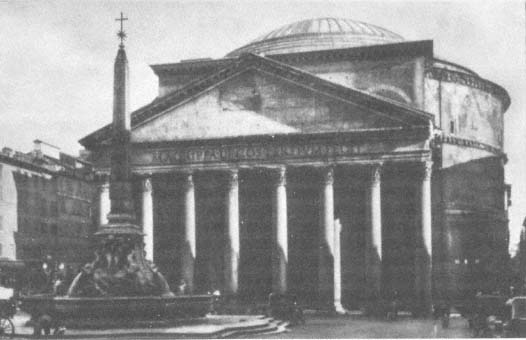
This sort of replacement is seen again in the Mirabilia in its story of the Pantheon.[8] In this story the Mirabilia tries to recall for its readers the time "of the consuls and senators" (actually the time of Augustus) when the "prefect" Agrippa had (according to the account) subjugated the Suevi and Saxons and other Western peoples and was then asked to fight the Persians (because Rome was warned by the alarm in the statue that stood for Persia among the "multitude of statues" on the Capitol, the legendary alarm system of empire). Agrippa worried about
the problem; and in his worry a woman appeared to him and told him that she would make him victorious if he would build her a temple of a sort that she would show him. Agrippa replied, "Faciam, domina" ("I will, madam"), or as his phrase translates with surprising modernity into the vernacular guide based on the Mirabilia , the Miracole de Roma, "Madonna, volentieri." The vision showed him how to build the temple, and he asked her who she was. She said that she was Cybele, mother of all the gods. She said that Agrippa should make a libation to Neptune, a great god, that Neptune would help him, that Agrippa should dedicate the new temple to Neptune and to Cybele, and that they would both be on his side and he would win. Agrippa told this to the senate. He then went forth and conquered the Persians and forced them to tribute. Victorious, he returned to Rome and built the temple and dedicated it to Cybele, to Neptune, and to all divine spirits. He called it the Pantheon. He placed on its roof, above its eye, a great gilt statue of Cybele, and had gilded its bronze tiles.
Then much later, in the time of the Emperor Phocas (early in the seventh century), Pope Boniface IV saw this wonderful temple dedicated to Cybele in front of which Christians had often been afflicted by spirits (daemonibus , the ancient gods turned devils), and he asked the emperor to give him the temple. It had in the classical past, it was thought, been dedicated to Cybele on the Kalends of November, and so by Boniface it was dedicated on the Kalends of November to Blessed Mary ever Virgin. The temple had, the Mirabilia says, been dedicated to the mother of the gods; the church was now dedicated to the mother of all saints. It was decreed that on the first day of every future November the pope should come to the Pantheon to say Mass, and that the people should receive the Body and Blood of Christ as on Christmas Day, and there should be a festa for the Virgin and all saints, and the dead should have, through the churches of the whole world, Masses for their souls. The pattern of prototype and change, of day and feast, the rhetorical balance, the pairing of pope and emperor are all very similar to those of the story of Saint Peter's Chains. In each case a day and a Roman place are specifically tied to the two great Roman pasts, and they to each other, and a Roman day and place are made doubly wonderful and doubly attractive to pilgrim tourists.
There existed, however, in the guidebooks as elsewhere (even in stories for sermons to be spread about the world) a more potent and imaginative, a more universal and significant combination of the two pasts, one that showed foreknowledge as well as prototype of Christianity in ancient Rome, among classical heroes themselves. The great in-
stance of this sort of combination again centers around Augustus, often remembered as a powerfully benevolent historical figure, for various reasons, including his having ruled at the time of Christ's birth and, in fact, at the time of this story. Augustus, the model of strength and peace and good government, is at the other end of the imperial spectrum from the evil, brooding, destructive, perverse persecutor, Nero. They are counterfigures, and both are important to the Christians' imagined history of the Roman past. The Mirabilia's connection of Augustus with Christ is a story with a past, with many tentacles and relations, cousins and ancestors of various lines, eastern and western, of which the finest, but far from the closest, was the Fourth Eclogue of Virgil, for the middle ages the greatest and purest, and again partly because of this Eclogue, of Roman poets.
In the Mirabilia's version, the senators, having seen the beauty of the emperor and the peace and prosperity with which the whole world lay subject to him, came to him and said: "We want to adore you, because there is divinity in you. If there were not, all fortunes could not lie subject to you." Augustus initially opposed the idea and asked for time. He then called to himself the Tiburtine Sibyl and told her what the senators had said. She in turn asked for three days and then returned and told him in her verses (learned from Augustine's Sibyl) that a king would come from the heavens. And then on the spot the heavens burst open and a great light shone upon him; and he saw in the sky, standing over an altar, a beautiful virgin, holding a boy in her arms. And he heard a voice saying, "This is the altar of the Son of God." The emperor immediately fell upon the ground in adoration. Later he told the story to the senators and they were, as he had been, filled with wonder. This vision, the Mirabilia continues, occurred in the chamber of Octavian the emperor where now is the church of Santa Maria in Capitolio. That is why it is called "Sancta Maria Ara Caeli."
The location of the legend is significant. It is the governmental Augustus who is involved, in the place where great old government was remembered and present government was transacted. If woods were changed to miracles, Virgil's evocative line from the Fourth Eclogue could apply to the legend maker's song:
si canimus silvas, silvae sint consule dignae.[9]
In general the joining of Christianity and the classical past in the Mirabilia and related texts is not so pointed, so intellectualized, so carefully conceptualized, as it is in the case of Augustus's altar or of the Pantheon and San Pietro in Vincoli. In general the Mirabilia seems a
sort of palimpsest with one civilization written over the other, or perhaps a tapestry with the two stitched together. The fascinating thing about this palimpsest is that it is sometimes hard to decide what is background, what foreground. One is repeatedly shown Christian churches so one may mark the places where there were once great pagan temples. But sometimes one seems to be shown classical landmarks so one may know what martyr acted there (as at the sewer by the palace of Septimius Severus into which Saint Sebastian was thrown). Beyond this there is much accumulated jumble of gates, bridges, measured columns, obelisks, and of Christian act—the place beyond the Porta Appia where Saint Sixtus was beheaded and where the Lord appeared to the fleeing Peter, and Peter said to Him, "Domine, quo vadis?" and the Lord said, "To Rome, to be crucified again."[10]
But none of the jumble of the guidebook seems frivolous because of the importance of the matter, both matters, and of the place, Rome. None of it, or little, even in the style of the Mirabilia , seems dead in a city where the juncture of civilizations it proclaimed was still alive and visible, where cardinals were locked up to elect a pope in the Septizonio, the palace of Septimius Severus, where one could go to see the Ara Coeli, where at the end of the century one could go to Santa Maria in Trastevere and see in Cavallini's mosaic the picture of the Taberna Meritoria , on the site of Santa Maria, where the oil had flowed in Rome, at the birth of Christ in Bethlehem, and had thus connected physically the promised birth of Christ with Augustus's City. Moreover, the jumble, the complexity, of ideas about Rome was less disorderly, more controllable, because much of it was actually the complexity of joined opposites.
One of the most potent of all the ideas about Rome in the thirteenth century was the idea that Rome stood for government. It stood for government because it was still remembered that in Rome, in the distant past, serious government had come closest to being realized. Both the Mirabilia and the related Graphia Aureae Urbis include an old description of offices of government in their more general description of the city. Roma caput mundi regit orbis frena rotundi ("Rome, the world's head, holds the round globe's reins") was, the Graphia makes clear, a pleasing verse and inscription in guidebooks as well as on crowns and coins. And Nicola Pisano remembered it when he built his great fountain at Perugia.[11] That strange medley, macedonia , of fragments of republican and imperial Roman history, which the twelfth and thirteenth centuries recalled, illustrated for them as it had
for their predecessors, the surface that both hid and revealed the secret of true governance and political power. When in the eleventh century William of Poitiers had tried to make William the Conqueror sound as if his prudence was the sagacity of planned government, he spoke in the idiom of Rome; and William of Poitiers wrote in a tradition that had moved through Bede, Charlemagne, and the Ottos brokenly to himself.
The general governmental memory was of course remembered in connection with specific places within Rome. In the Mir abilia it is specifically connected with the Capitol, "which was the head (caput ) of the whole world, from which consuls and senators were accustomed to rule the globe. . . . It was called the golden Capitol because in its wisdom and its splendor it overpowered all the realms of the whole world."[12] But the whole of guidebook Rome was seen as emanating an aura of past governmental greatness, resounding with the echoes of great names, not just Augustus, but Julius Caesar, Trajan, Antoninus, Nerva, Hadrian. Thirteenth-century Rome had a senate and senators, admittedly oddly realized. The twelfth century had recalled republican institutions to join distorted imperial ones. Rome saw itself, as it was seen from the distance, as growing from a great, and always a particularly governmentally great, past.
The earliest beginnings of Rome's great past found in the middle ages a rather peculiar legendary statement. It was peculiar because it needed to combine two elaborately known but disparate pasts, a fact that in context is unsurprising in a Christian city whose inhabitants bore names like Enea and ottaviano. It could not, and could not want to, escape the great heritage of Trojan Rome, of Aeneas and Romulus, a Rome enshrined by Virgil for both classical and medieval Rome. But the history of Rome, like the histories of other Christian medieval places (like, for example, Genoa or Saxon England), had to fit into the history of the Old Testament too. By the time of the writing of the thirteenth-century manuscript of the "Graphia" this fitting together, for Rome, based theoretically on the legends of "Hescodius" (probably a distorted Hesiod) had been accomplished, although by the early fourteenth century the history of "Hescodius" was already being sharply attacked, at least in northern Italy.[13] This fitting together was not only not uniquely Roman, it was also not a very tight juncture; and it was complicated.
The story began with the building of the tower of Babel, after which Noah with his sons took ship for Italy and built a city near what later became Rome. Janus, or Giano, Noah's son, together with an-
other Janus, his grandson or nephew, the son of Japhet, and Camese, a local man, built a city, Ianiculum (Gianicolo). They ruled, eventually Giano alone, after having built with Camese a palace also called Ianiculum in Trastevere, where "now" is the church of San Giovanni ad Ianiculum, by the Porta Settimiana. Giano also built and then ruled from a palace on the Palatine. In Giano's time, Nemroth-Saturn came and made a city called Saturn on the Capitoline; and Italus and Hercules and Tibris and Evander and Coribas and Glaucus and Aventinus Silvius came and built cities, and so did Romae, daughter of Aeneas, with her Trojans. Finally, in the four hundred and thirty-third year after the destruction of Troy, Romulus of Priam's royal blood, in his twenty-second year, on April 17, built a wall around all these places and called the collective place Rome; and noblemen from all the surrounding races came and lived there with their families.
Like medieval Christians, medieval Jews had to deal with the central historical importance of Rome. They, too, had legends of foundation, the miracle of the planted reed, the efforts of the sage Abba Kolon.[14] The city of Rome was alive with history, fabulous and "real." One might have thought that so much "real" history would have obviated the necessity for fabulous history, that the good history might have driven the bad history out; but in Rome it certainly did not. The whole place glowed with fable and magic. "When the Sibyl had come to Rome, there came to meet her the entire city, both great and small."[15]
Rome's wonderful governmental past was naturally attractive to medieval "Roman Emperors." The magic of past politics entranced the Hohenstaufen. Its sibyl spoke to them, particularly to Frederick 11.[16] Through Frederick's long ruling life, until his death in 1250, Rome and its idea were important to him. What the nature of that importance was depends upon the sort of man Frederick was. About what sort of man he was, although he is in lots of ways very visible and he certainly has been carefully studied, there is room for considerable difference of opinion. He can seem, as he has to those who have known him best, a genius, a man of rare perception and ideals, even of great, of grandiose, political understanding, the hero of the thirteenth century. He can also seem, as he does, for example, to me, a bright, pathological, egocentric bore, a man incapable of individual personal relationships, of real human relationships, a man incapable of relating seriously to his own surrounding external "reality," and so pressed to a life of hyperbolic fantasy, rhetoric, and violence (which he could express, and we can see, because of his exalted position). The things
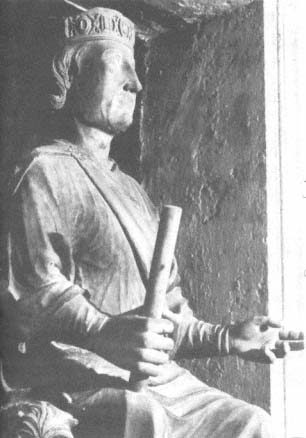
1.
Charles of Anjou by Arnolfo, in the Palazzo dei
Conservatori on the Capitol, see pp. 67 and 98.
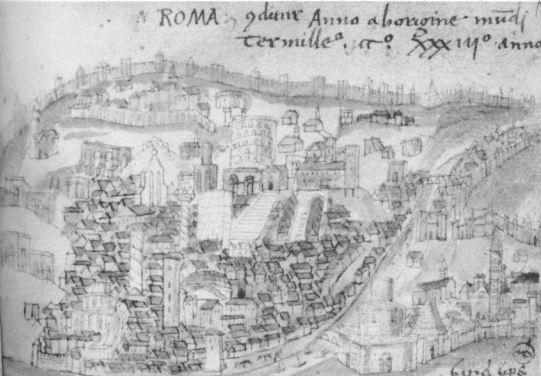
2.
The two cities, crowded and open, within the walls of Rome, a late medieval drawing from a manuscript in
Turin: Biblioteca Reale, Varia 12, fo. 28, see p. 15.
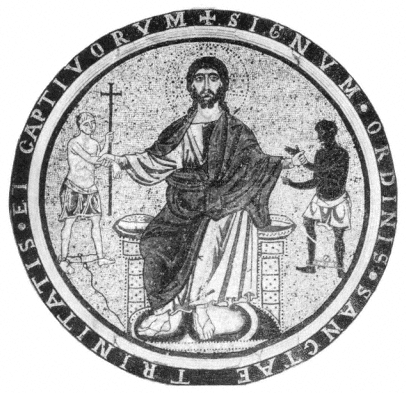
3.
San Tommaso in Formis: Cosmati mosaic of John of Matha's vision, see p. 14.
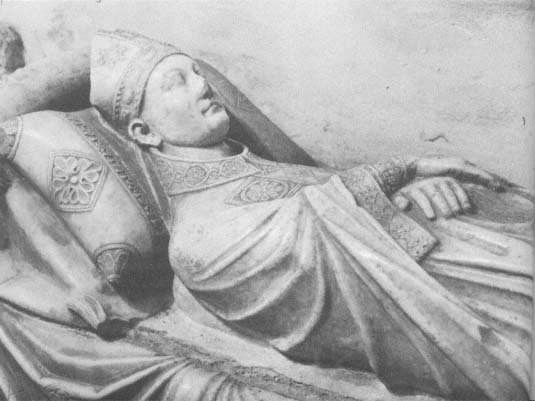
4.
Cardinal Ancher, and drapery, in Santa Prassede, see pp. 68, 193.
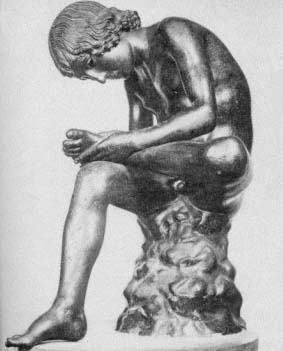
5.
Boy with a thorn in his foot, piece of antique sculpture in the Palazzo
dei Conservatori on the Capitol, see p. 90.
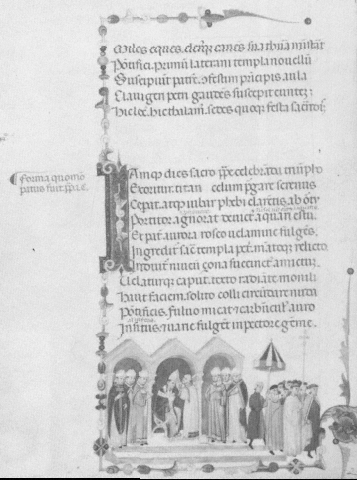
6.
Steps of Saint Peter's after coronation of Boniface VIII (January 1295) with
part of the procession moving off toward the Lateran, from a volume of Stefaneschi's
Opus Metricum once in Boniface VIII's library and now Vat. Lat. 4933 (fo. 7v ) in the
Biblioteca Apostolica Vaticana, see p. 189.
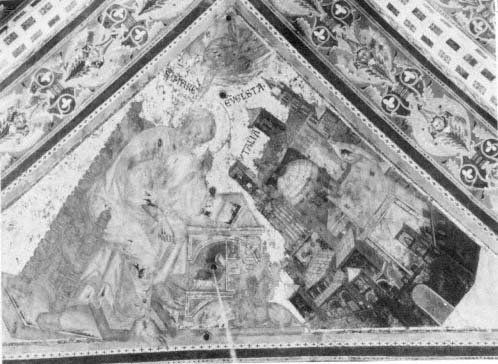
7.
Rome, representing Italy, with Saint Mark, by Cimabue, in the
upper church at San Francesco in Assisi, see p. 9.
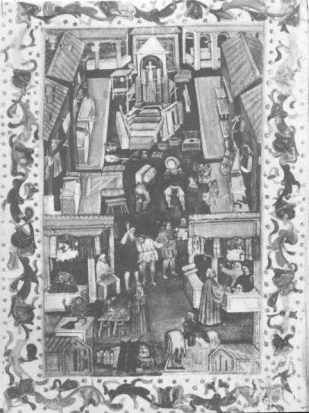
8.
Cloth merchants and their customers, from a fifteenth-century
manuscript in Bologna, see p. 53.
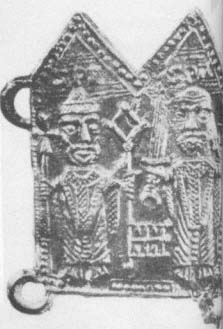
9.
Pewter pilgrim's badge with figures of Peter
and Paul, probably thirteenth century, discovered
in Dublin and preserved in the National Museum
of Ireland, see p. 54.
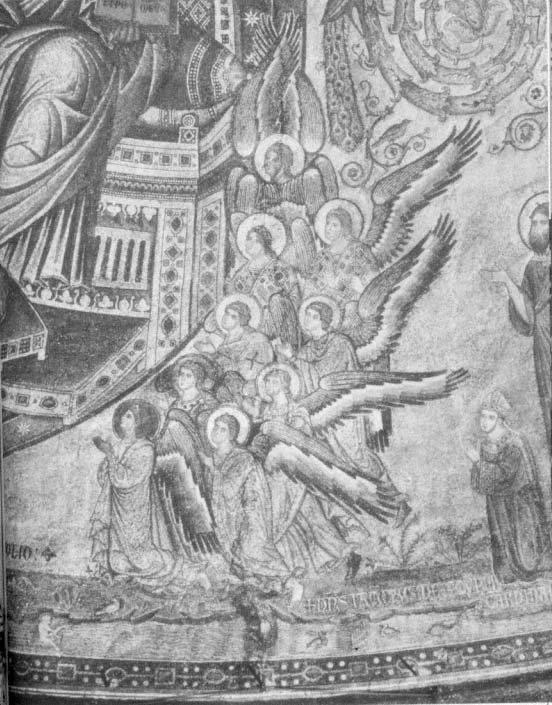
10.
Angels and Cardinal Colonna, in detail of the Coronation of the Virgin, mosaic by Torriti
in the apse of Santa Maria Maggiore, see pp. 66, 177, 268.
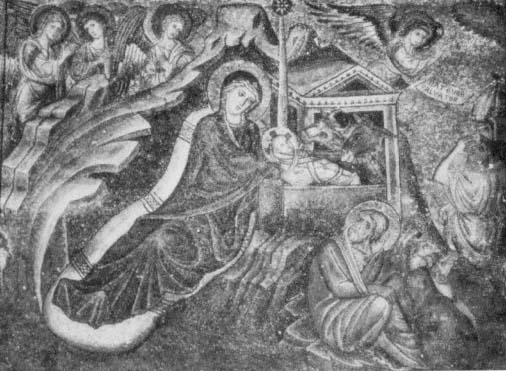
11.
Nativity, mosaic by Torriti in the apse of Santa Maria Maggiore, see pp. 66.
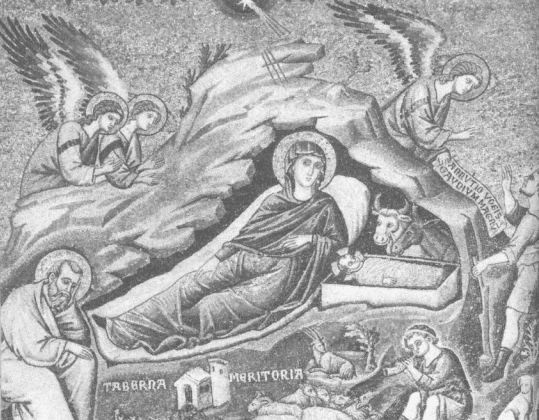
12.
Nativity, mosaic by Cavallini in the apse of Santa Maria in Trastevere, see pp. 58, 66, 270.
13.
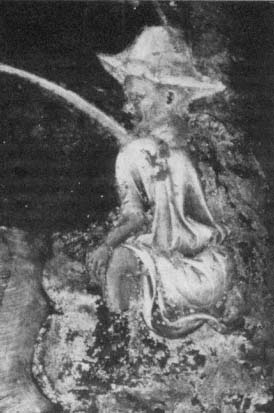
Fresco of fisherman from Tre Fontane, see p. 67.
14.
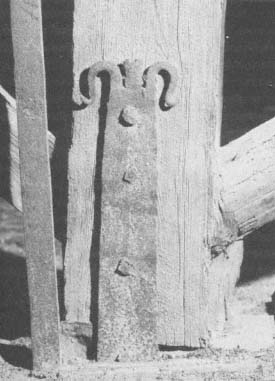
Thirteenth-century metal brace from The Fontane, see p. 67.
15.
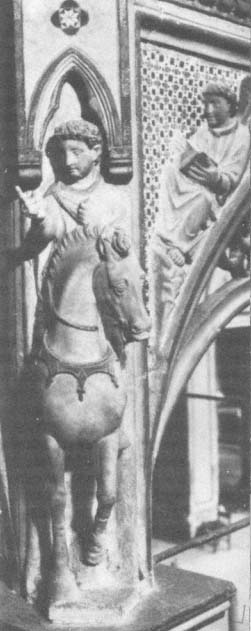
Mounted saint on the ciborium by Arnolfo at
Santa Cecilia in Trastevere, see p. 67.
16.
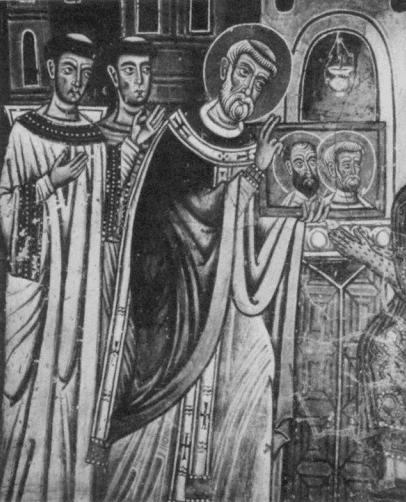
Pope Saint Silvester showing the images of Peter and Paul to the Emperor
Constantine, fresco in the oratory of San Silvestro at Quattro Coronati, see p. 84.
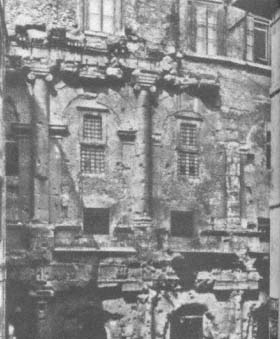
17.
The Theater of Marcellus, before restoration, see p. 42.
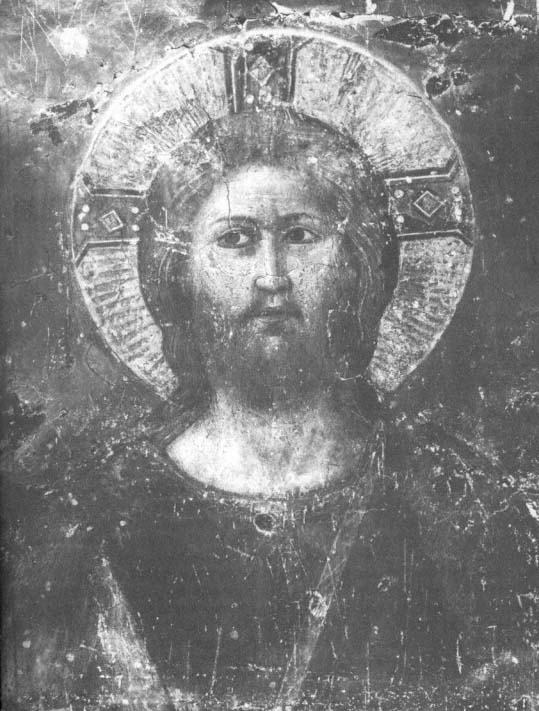
18.
Face of Christ from Last Judgment by Cavallini at Santa Cecilia in Trastevere, see p. 67.
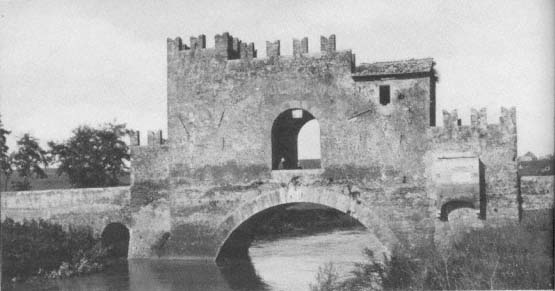
19.
The Ponte Nomentano, see p. 69.
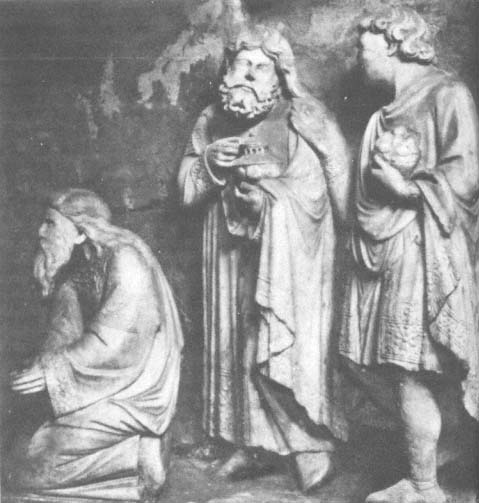
20.
The Three Kings by Arnolfo in Santa Maria Maggiore, see p. 67.
21.
The Pantheon, restored, see pp. 77, 199.
22.
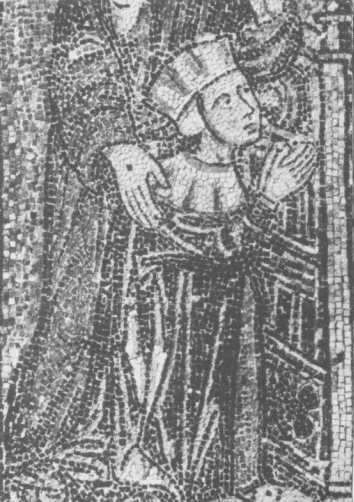
Mosaic Senatorial Donor, Chapel of Santa Rosa in
Aracoeli, see p. 117.
23.
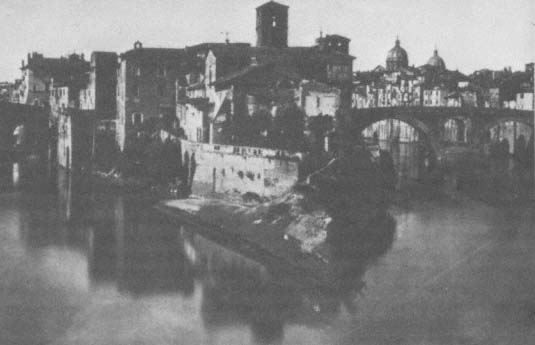
Island in the Tiber from downstream, before the building of the anti-flood embankments, see p. 17.
24.
Ciborium of Saint Paul's outside the Walls, hanging
angel censing, see pp. 67 and 216.
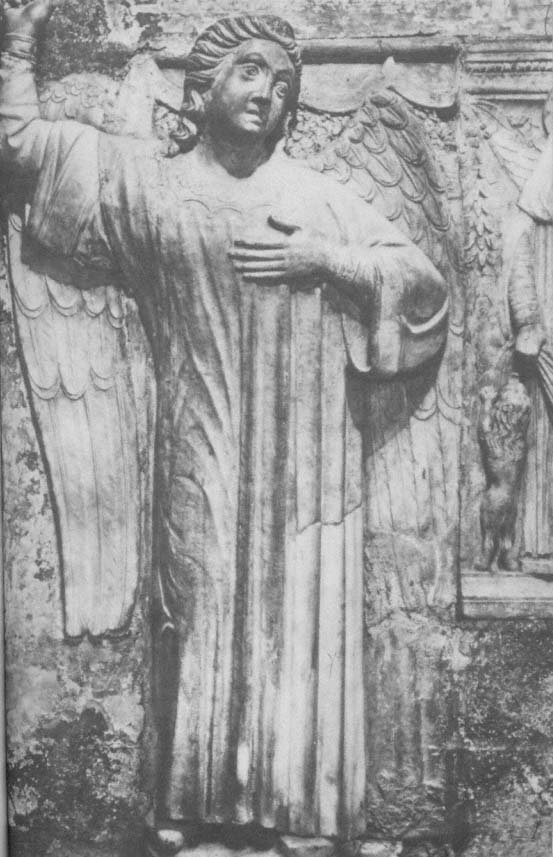
25.
Angel from the tomb of Boniface VIII, Grotte of Saint Peter's in the Vatican, see p. 265.
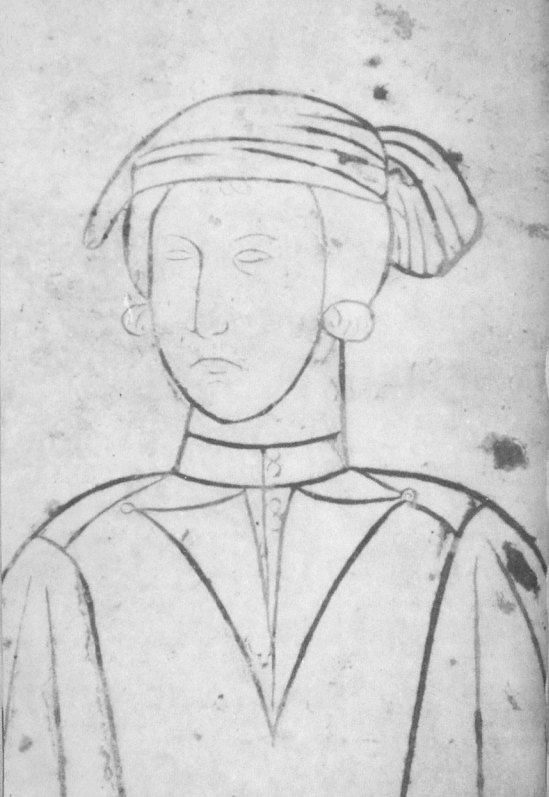
26.
Tomb of Matheus Scrinianus, detail, floor of the Aracoeli, see p. 69.
Frederick did and said about Rome must be interpreted, even be seen, by every historian in terms of his own Frederick. But one thing about Frederick must generally be seen and admitted. For a medieval emperor, Frederick was very Italian. He came from Italy, and, in part, he lived there.
In April 1212 Frederick, a boy of seventeen, came to Rome to be received as uncrowned emperor by the people of Rome and by his distant guardian, the pope, Innocent III. In November 1220 Frederick, by now twenty-five, came to Rome, to the Vatican, for his coronation at the hands of the pope, Honorius III. But Frederick's great flirtation with the city came later in 1236 and in the years that followed. In 1236 began "Frederick's wooing of the Romans with rhythmical high-sounding phrase."[17] Frederick II tried to make the Romans of Rome seem, perhaps to the world and to the Romans themselves, and certainly to himself, the citizens who created emperors, the basis of, and the partners in, his power and his victories.
This is most apparent physically after the Battle of Cortenuova, in which Frederick defeated the Milanese in November 1237. In victory, Frederick celebrated a great triumph which, he told the Romans, was after the pattern of the triumphs of his predecessors, the old Roman emperors. He sent to the senate and people of Rome the captured Milanese carroccio, a chariot, the symbol of the city which bore its standard: "Our wishes would . . . be far removed from reason if we, illumined by the radiance of the Caesars, were to tolerate the Romans' being left without a share in the rejoicings over a Roman victory."[18] The chariot was installed on the Capitol. There is still, in the Capitol, a Sala del Carroccio with its inscription. Like Frederick's famous statue on the bridge gate at Capua, the carroccio was a palpable token of his self-conscious "Romanness," but in a different way. Unlike the Capuan statue, this sign was deposited within the city that Frederick tried to revive, so that it might meet his own pretensions.
Frederick's pattern touched his successors, and a great apologist of the Hohenstaufen could move himself to Roman rhetoric over Corradino in Rome in 1268, saying that Romans "remembered now that they were of the blood of Romulus."[19] The Hohenstaufen pattern of securing Roman allegiance was, at least by Frederick II, supported and the rhetorical superstructure given some underpinnings by the emperor's buying tenements from Roman nobles and regranting them to their former owners as fiefs. But in general, in spite of the dreams historians have dreamed of it—"The shades of Rome, of the Romans and their Caesars, had tasted blood: they began to stir again. . . ."—
it was all dream.[20] Rome did indeed have valuable memories of its ancient past, but valuable for guidebooks, for cadging tourists' coins, for building the wealth of men and trades who grew fat from the pilgrims' coming, not for building a state (at least not a secular state). It was an economically, not a directly politically, valuable memory (and only valuable economically in conjunction with other dreams). Its direct political use by Frederick has a queer, false, insubstantial air as it also has in Dante but not, I think from Charles Davis's work, in Nicholas III or in the republican ideas of Ptolemy of Lucca. The dream was necessary to Frederick, psychologically, not politically; he had to think of himself as an old emperor in old Rome, gloriously independent of his contemporaries.
The closest thing to a secular rekindling of the ashes of old political and constitutional Rome came, in the thirteenth century, through the efforts of Brancaleone, a Bolognese. And it is in fact to Bologna, rather than to Rome the city, that one should look in the twelfth and thirteenth centuries for a serious attempt to recapture that particular ancient Rome.
Not only was the imperial-political Roman memory, in Rome, a limited one, it was also overshadowed, dominated, in most areas of thought and act by the other memory, the memory of Peter and Paul. In repeated statement, Rome was the city consecrated by the very glorious blood of the two martyrs for Christ, the two princes of the apostles, bearers of the Word, teachers, who died, wonderfully, at the hands of the same persecutor, at the same time, in the same place, this place, Rome. Upon the ground enriched by their blood, in rhetorical fancy, had grown the power and importance of new Rome. And the rhetorical fancy was matched by economic and ecclesiastical political fact.
Peter's primacy (enhanced in medieval sentiment by Paul's closeness) and his presence in Rome were the assumed basis for the presence there of pope and curia, although the real basis had more to do with past politics and Caesars than thirteenth-century Roman denizens were perhaps prepared to realize. One aspect, however, one parable, of the importance of the popes' Caesarean heritage was clearly recognized. The thirteenth century did not forget the donation of Constantine to Pope Saint Silvester I. In a city which had long known pictorial propaganda, a new cycle of the story of Silvester and Constantine was painted in mid-century at the palace of Quattro Coronati. Earlier, Innocent III had preached, in his sermon for Saint Silvester's Day, of the great Constantine, cleansed from his leprosy through Silvester's baptizing him, who kept for himself Byzantium and gave Silvester the West
(and gave the Church tranquillity). Later Nicholas III, in his urban constitution, spoke of this baptismal cure as one of the historical reasons for papal rule. But the story was used rather than needed by Innocent and Nicholas. It helped them, and, again, it connected the old and the new Rome, the political and the religious. Both popes surely would have regretted the public discovery of the literal falsehood of the story of the donation; but it is hard to believe that either would have been deeply, personally surprised or, in any serious way, embarrassed by the discovery. The donation was one of many "reasons" for papal power; each enhanced the others and helped to rationalize reality, or desired reality. But if any of these "reasons" was in fact necessary, it was not the donation. It was in fact subsidiary to the past presence in Rome of Peter and Paul.[21]
The presence of the active, greedy, public, pretentious papal establishment kept Rome's relics burnished and obvious. It gave Rome the jubilee. It brought masses of litigants to Roman courts, and diplomats and petitioners and penitents to the Roman curia. Papal government made Rome rich with court incomes and with the profitable demands it made upon the trades that fed, housed, clothed, doctored, and wrote for people. The court was of course not always within the city. It moved to Anagni, Viterbo, Orvieto, Perugia, even Lyons, but it remained the Roman court. (Where the court was, there was Rome.) In the thirteenth century, Rome was its most normal home; and from it Rome assumed the airs and riches of a capital city.
Peter and Paul were among the most prominent of a mass of spectacular relics. These relics were the real hoard buried in Roman earth or in Roman altars for which all the other buried treasures, gold, marble, the palace at Campo Marzio, can be made to seem only the language of symbol. It was the hoard of relics that made Rome the glowing center of the thirteenth-century world, that, with the court, made Rome rich by drawing pilgrims to it. The richness of Rome as reliquary made it a constant festa. On each day of the calendar (so at least it seems) some church was lighted to celebrate the feast of the saint of whom it held some fragment. Often there was a concelebration in several churches; the city was (and is) like one of those boards which are maps with lights which respond to the pressing of buttons marked for each of a group of categories—botanical gardens, museums, churches; Saint Panfilo, Saints Pietro and Marcellino, Saint Erasmo. It was this richness, this existence as the great and final focus for the medieval fascination with deposited relics, a richness that was made relatively richer after the plundering of its great rival Constan-
tinople at the beginning of the century, that gave Rome its most powerful, positive aspect, its strongest and most distinct "idea" in the thirteenth century.
Not all of the relics were dead buried coin. The most exciting of them were connected with Christ, with His life and suffering; and Christ was alive in the thirteenth century. Although the violence of Christ's reality was dulled, as well as enhanced, by the accentuation of the Real Presence within the Eucharist, the great importance of the Eucharist (honored in pyx and under ciborium, honored by Francis) was due to the pressing reality of Christ Himself to thirteenth-century men. In approaching the Eucharist they were approaching the real Christ, as well perhaps as hiding from the painful implications of a less pious and more active response to His commanding presence.
The importance of the Veronica—Dante's la Veronica nostra, probably the greatest treasure at Saint Peter's, the more than iconic relic before which poor William of Derby was crushed and which Innocent III and his successors caused to be carried to Santo Spirito each year—was an importance close to the Eucharist's. On it (although not on it alone in late thirteenth-century Rome), one saw Christ. (And Santo Spirito, like other thirteenth-century hospitals, was a place where Christ's work was done.) The earth and cross of Saint Helen, a more important predecessor of Eudoxia with her chains, enriched Santa Croce in Gerusalemme. The column of Christ's flagellation (at Santa Prassede) was brought, by a Colonna, from the Holy Land. The Jerusalem that Christ had touched had been and was being moved to Rome.[22] At Rome, too, the number of churches directly dedicated to the Savior was unusually high.[23]
Although the serious Christ was the great center of the Roman reliquary, His seriousness was suspended in a more various mixture of relics and observances, perhaps including His own rather curious relics at the Lateran. Relics of new saints joined those of old ones (as, for example, Saint Francis joined Saints Cosmas and Damian at San Cosimato in Trastevere) just as new saints in mosaics joined old ones (as did Saint Francis and Saint Anthony at Santa Maria Maggiore and the Lateran under the Franciscan pope, Nicholas IV). Roman churches covered the relics and even houses of the old mistily remembered saints of the heroic era of Roman martyrs, as at Saint Cecilia and Santi Giovanni e Paolo. The treasuries of Roman churches, like those of churches everywhere, contained inscrutable bits of overly dismembered distant saints both famous and obscure; and Rome was bursting with churches (414 according to the Catalogue of Turin's final sum).[24]
In Rome, however, as elsewhere, in dedications and celebrations, if not in relics, the Virgin dominated. Her feasts segmented the year. Her churches were great and small—the Popolo, the Minerva, the Pantheon, Aracoeli, Santa Maria in Trastevere, drifting down to churches unremembered except in old lists. As she was connected in Trastevere with miraculous oil, she was connected at her great church, Maria Maggiore, with miraculous snow. There the legend grew that on a hot Nones of August snow fell, and as Cybele before her had showed Agrippa, she with the aid of dreams and the Roman patriciate showed Pope Liberius where to build her church. There is clear evidence that this old legend was increasingly popular in the thirteenth century. Thirteenth-century popes repeatedly granted indulgences to those who visited the church on the anniversary of the miracle. In about 1222 or 1223 Pope Honorius III, who had been a canon of Santa Maria Maggiore, ordered the papal court to celebrate the feast. By 1269 the old local feast was acknowledged by the international Franciscans. By the early fourteenth century the mosaics of the snow had been placed on the façade of Maria Maggiore (and the snow still falls there on this feast of the Virgin).[25]
Mary, in fact, epitomizes the confusion of the thirteenth-century view of sanctity and religion. She above all was involved with the living Christ. It was she, at Cana, who provoked Christ to human charity (in that part of the gospel that was the text for Innocent III's and subsequent popes' celebration of the carrying of the Veronica to the hospital of Santo Spirito). In connection with her the pious man was almost forced to see Christ as the man who did and advocated certain specific acts in Palestine. But the figure of Mary was also particularly susceptible to the dilution of vapid sentimentality. Her figure lent itself to a vague unfocused religiosity. She could most easily absorb the extravagances of Cybele and Minerva. And her figure, perhaps even more than Peter's and Paul's, contributed its tone to the general mysterious miasma of religion that hung like a cloud over the relics and ceremonies of thirteenth-century Rome and attracted to itself the fascinated hordes of pilgrims.
Having assembled the classical and Christian memories of Rome, and having put together again its governmental and its religious aura, any historian might reasonably presume that he had gathered the essential components of its complex thirteenth-century image. He would think perhaps that he had tasted at least briefly all the flavors, seen at least in passing all the hues, of the "idea" of Rome.
He would be grossly in error. He would have excluded the major
paradox within the idea. Against all the white magic and wonder of Rome (with certain contrapuntal darknesses like the figure of Nero or Simon Magus on the Via in Selcis, defeated figures), against all this splendid complexity, stood the evil Rome, the Rome of black magic, greed, poison, and fever. Against, or with, the new Jerusalem stood the new Babylon. Against the lady of the world of the pilgrims' hymn, rose with the red blood of martyrs, white with virgin lilies, stood the noxious sump of the satirists' poems; against the flower of all cities, the greedy gullet or, in another image, the leech. Juvenal, unidentified, was quoted:
What shall I do in Rome?
I don't know how to lie.[26]
The Rome which connoted greed to the world was essentially the Rome of the papal curia. "My Lady Money" transacted "all business in the Curia."[27] To frightened and harassed provincials, money seemed the key to everything there. Letters to and from Rome are full of the problems of purchase and bribery. Sometimes it seemed wise to pretend to have more money than one really had, sometimes less. The horrid sophistication of the place had to be met, and in meeting it innocence was of necessity lost. As a representative of Canterbury reflected in 1188, after having gained experience at the curia: "How sweetly innocent are the days of youth, the child playing at his games, . . . how blessed they seem from the hard age of man." In bitterness, not admiration, the poet wrote, "I have seen, I have seen, the caput mundi." His was not, or was only ironically and complexly, the golden capitol. This poet was Walter of Chatillon, and his verse, at its best, caught most fully the glancing, sharp, mixed metallic beauty which satire on Rome was capable of producing—the keys, the coin, the colors, the grammar, the wept-for ruins, the broken marriages, the mute flock, the crying law (Clamabat decalogus ), jangling coin, jangling meter, jangling rhyme, woven perfectly together. This purest, or least pure, statement had perfected the tone of thirteenth-century satirical statement before the century had begun. (A heavier, more solemn, less exhilarating, but sounding and scripturally intricate form of denunciation of the curia, but more especially of the people of Rome, had also been by then long written and established by the great Bernard of Clairvaux, not only but particularly in the fourth book of his de consideratione, to which Saba Malaspina need only have looked to find rationalization for the local ambitions of his late thirteenth-century popes.)[28]
The Rome where one lost money, and jewels and presents, was
essentially curial Rome, the Rome of expensive lawsuits and disguised simony, but it was also by implication and extension the entire city. The Miracole says of the Porta Taurina (the Porta San Lorenzo or Tiburtina) that it has sculpted on it a double-headed ox (bove ), with a dry, thin face on the outside and a fresh, green, fat face on the inside. And according to the Miracole the double head stood for those people who came to Rome poor and left it rich.[29] People could get rich as well as poor in Rome; it was the same process in reverse.
And the butchers, the poulterers, the vintners, the money-lenders, the taverners into whose hands the foreigner fell were not narrowly curial. Debts to them delayed him when he would go home. Moreover, Rome, even in its decay, still seemed urban, as Italy did, to much of rustic Europe. In its anonymous, transient urbanity, it projected a frightening sense of untrustworthy sophistication—a variant of the medieval Constantinople theme.[30]
The evil city was particularly connected with poison and fever. In its damp heat, mysterious malaria brooded, the shadow, in disease, of the spirit of the place. Hugh of Evesham, the English cardinal, the "Phoenix," master physician, cardinal priest of San Lorenzo in Lucina from 1281 to 1287, was thought to have been made a cardinal so that he might stay close to Rome and protect Pope Martin IV from the fever. In the year of Hugh's elevation, his old associate, William Wick-wane, archbishop of York, wrote to him to warn him to keep dangerous, poisonous concoctions away from his house. After Hugh's death it was said both that he had died from poison and from fever.[31] In writing of the year 1240, Matthew Paris, the English monastic chronicler, wrote of other English deaths in Rome. "In Rome four monks, exhausted by the wiles and delays of the curia, laid themselves down and died—in the words of Solomon, 'a broken spirit drieth the bones'—and thus perished a significant part of their convent. But the exact cause of their deaths is not known, whether they were from disease or despair, plague or poison."[32] The treasure hoard and memories of Rome were, like Saint Guthlac in his fen, surrounded by feverish, diabolical, poisonous mists and damp. The gold was guarded by fever, the cross was surrounded by corruption.
So the thirteenth-century idea of this "politically negligible, and universally powerful," "more than one city," rich with its legend-swathed peculiar monuments—Castel Sant'Angelo, the pyramid "of Remus's tomb," the marble horses—with all its dappled qualities seems as various and centrifugal as a local chestnut shell.[33] But actually the diversity is rhetorically balanced and controlled. It makes it-
self up into surprisingly neat patterns of contrast and paradox and repeated image and argument.
Of these patterns, three related major ones seem dominant. First of all, Rome, as one sees her in later drawings, weeps among her ruins and sings the song of Master Gregory and William of Malmesbury, the song of the distance between past greatness and present failure. In this paradox of distance between past and present, between different conditions of the same place, the idea is sometimes a relatively frivolous celebration of classical engineering or just classical ingenuity as it is, at its frailest, in Master Gregory's visual machine of the Priapus (the boy with the thorn in his foot now at the Capitol). Sometimes, at its strongest, it reaches a melancholy grandeur, as it does in the conventional but final passage of the Mirabilia: "These and many other temples and palaces of emperors, consuls, senators, and prefects existed in pagan times in this Roman city, as we have read in ancient histories and have seen with our own eyes and have heard from the old ones. We have tried to write down, as well as we were able, what great beauty and splendor there were, of gold and silver, of bronze and ivory and precious stones, to preserve their knowledge in future memory."[34]
Against this melancholy stands the pattern of Christian joy, of a Rome once barrenly pagan with its pathetic Cybele now enriched with martyrs' blood and Christian understanding. And against both of these, in their different ways, serious patterns stands a third, mockingly but not lightly ironic, exposing the distance between pompous pretensions and actual corruption. All three patterns swathed themselves in the mystery of a magic place, a place unlike all other places. This complex but balanced, "mobile," idea of Rome prevailed in the century before Dante, Cola, and Petrarch applied their minds to the meaning of the idea of the city.