
Integration of Land-Use Activities
Life in Khumbu is a complex integration of the requirements of conducting crop production and pastoralism at the altitudinal limits of both (fig. 9). The use of forest resources is also interwoven with agropastoral-ism as well as making an essential contribution to the provision of fuel and shelter. Agropastoral practices must also be integrated with the seasonal rhythms of conducting long-distance trade and with the required commitments of time and energy for tourism work and business operations. I have not heard of any Khumbu Sherpa family during the twentieth century which specialized in trade to the total exclusion of agriculture, and no Khumbu Sherpa family today relies solely on earnings from tourism. Farming continues to be carried out by all households and ways are found to compensate for the scheduling problems and occasional labor shortages created by the demands of tourism employment. Even the families which have grown wealthiest from trade and tourism continue to place great importance on maintaining the cultivation of their land and many also keep livestock. Some are among the largest stockowners in their villages.
Khumbu crop production is intimately linked to pastoralism even for those families who own little or no livestock. Annual fertilization of potato fields is a fundamental principle of Sherpa agriculture and although everything from composted weeds and forest-floor litter to human waste is used, the most important soil additive is undoubtedly manure. This is so important that the route and timing of herd movements is decided in part on the basis of where household fields are located and when the optimal times are to supply them with manure. Families without sufficient livestock of their own either scour the slopes for dung or devote scarce cash to purchase it--in some places even doing so a year in advance in order to be sure of an adequate supply.
Crop production in turn contributes to pastoralism. Livestock are grazed in autumn on field stubble and fed fodder in winter, which includes
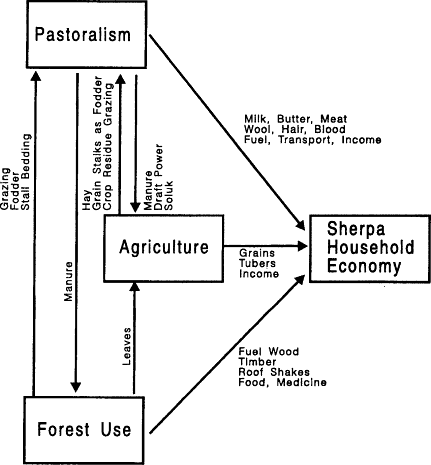
Figure 9.
Khumbu Sherpa Land-Use Integration
carefully dried and stored stalks of buckwheat, barley, and danur , a perennial plant believed to have medicinal and stimulative qualities for cattle. Large amounts of land and labor are devoted to the cultivation of hay that is grown on fields in the lower valleys and in some main villages as well as on a large scale above the range of productive potato cultivation.
Both crop growing and herding are further linked to forest use. Khumbu is at the upper limit of tree growth, and only its sub-4,000-meter, lower reaches support temperate and subalpine forests. Sherpas depend on these limited forest areas for timber and fuel wood and also rely on them for grazing and for soluk , dried leaves and needles scoured from the forest floor.[27] Open woodland in the vicinity of villages provides much-
used grazing and browsing, especially in winter, so much so that its intensity may be affecting forest regeneration in some areas. Forest-floor litter is gathered twice a year and carefully used as stable bedding, after which the urine- and dung-rich material is stored until spring when it is dug into the fields. In some areas and for some families this constitutes a far higher percentage of fertilizer by volume than does manure. The intensity of foraging for leaves and needles gives the forest in the vicinity of villages a freshly swept look and in places every fir needle or birch leaf seems to have been removed. Both the gathering of dead leaves and needles and grazing were permitted even in forests that were traditionally strongly protected by Sherpas from logging or lopping.