
An Empirical Scheme
In order to clarify the issues, figure 7.1 presents a simplified scheme that depicts the main ways that intergroup feelings and policy goals can intersect, for people in dominant and subordinate groups, respectively. Each axis is dichotomized. On the horizontal axis, intergroup feelings are divided into (1) those making no distinction between groups or even showing a preference for the other group (labeled inclusive feelings), and (2) those expressing a preference for their own group over the other (labeled estranged feelings). On the vertical axis, policy goals are divided into (1) those advocating affirmative change (that is, that the government should do more than it currently is doing), and (2) those taking conservative or reactionary positions (that is, that the government should do no more, or less than it is currently doing). Four
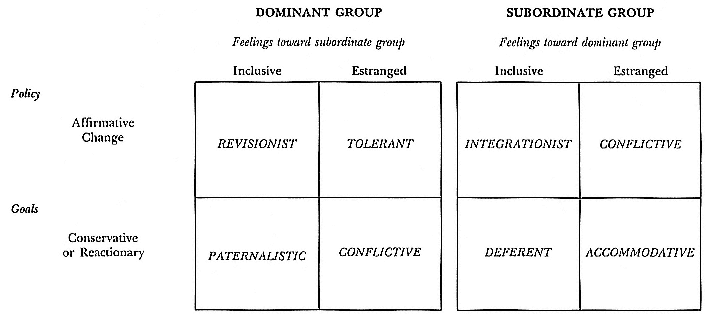
Figure 7.1
Paternalism and conflict: Alternative configurations of intergroup feelings and policy goals for dominant and subordinate groups.
distinct compounds of feelings and policy goals may thus be identified in dominant and subordinate groups.
The first thing that is highlighted by this scheme is that the meaning of particular configurations is altered entirely according to whether one is examining the attitudes of dominant-group members or subordinates. Among the members of dominant groups, those configurations that fall on the diagonal going from top left to bottom right (revisionist and conflictive attitudes) are the "consistent" ones that have been the target of scholarly scrutiny. They combine inclusive feelings with support for affirmative policy change or estranged feelings with conservative or reactionary policy goals. These are the attitudinal configurations that are commonly termed "unprejudiced" and "prejudiced," respectively.
Of the two "irregular" cells, one—the compounding of estranged feelings with affirmative policy dispositions (tolerant )—has received considerable attention from students of political tolerance. The other formally inconsistent cell—the compounding of inclusive feelings toward subordinates with conservative or reactionary policy goals (paternalistic )—has been bypassed in conventional approaches to public opinion and has fallen by the wayside as an awkward anomaly. It is this configuration, however, that holds the most promise for scholars in unraveling the dynamics of intergroup ideologies.
Among the members of subordinate groups, it is the configurations that fall on the opposite diagonal, going from top right to bottom left (conflictive and deferent attitudes), that have conventionally been treated as consistent. Subordinates are logically expected either to take a conflictive approach by expressing estranged feelings from the dominant group and demanding affirmative change, or to be deferent toward the dominant group by espousing inclusive feelings toward them (possibly even showing a higher regard for the dominant group than for their own) and adopting conservative or reactionary policy views.
Neither of the two "irregular" cells has been the object of investigation in public-opinion research on subordinate group consciousness. However, the accommodative cell (that combines estranged intergroup feelings with conservative or reactionary policy dispositions) is certainly implied by theories that postulate that subordinates express "hidden resistance" (Genovese 1974; Cloward and Piven 1979; Anyon 1984; Scott 1985, 1990). Such theories imply that although subordinates generally comply with dominant group demands, their compliance is nothing more than a tacit acknowledgment of the superior power of the stronger group that masks an underlying alienation in spirit that is manifested in small, hidden acts of resistance. If the compliance of subordinates is merely a veneer, we would expect them to populate the accommodative cell, espousing conservative or reactionary policy views but retaining alien-
ated feelings from the dominant group. Accommodation among subordinates might be regarded as the logical counterpart to tolerance in the dominant group: in each case, estranged feelings must be overridden to behave in a supportive way toward the other group.
The opposite "irregular" cell—the combination of inclusive feelings toward the dominant group with calls for affirmative change—I have labeled integrationist , because it reflects the spirit of the movement for racial integration in the United States in the 1950s and 1960s, as advocated by Dr. Martin Luther King, Jr. Despite the prominent position of the civil rights movement in recent U.S. history, this attitudinal compound has had no place in conventional analyses of group consciousness, since it is logically inconsistent. This configuration of feelings and policy goals might be regarded as the subordinate counterpart to paternalism in dominant groups: subordinates might find it strategic to moderate their demands for change with assurances that they feel no hostility toward those from whom they wish to extract concessions.
The simplified scheme that I have outlined identifies four main ways that dominant-group members and subordinates may blend their intergroup feelings and policy goals. The meaning of any specific compound of feelings and policy dispositions cannot be interpreted out of context but depends on whether the exponent is a member of a dominant or a subordinate group. Only one term is applicable to both kinds of groups—conflictive attitudes—but note that it is constructed quite differently, depending on whether one occupies a dominant or a subordinate position in an intergroup relationship. All the other terms are unique to dominant or subordinate groups. For example, it is not germane to ask whether subordinates are willing to override their estranged feelings and grant equality to the people who exceed them in status and perquisites. Similarly, the attitudinal state of deference is a prospect that members of dominant groups are spared.