
Alternative Attitudinal Compounds
The analysis thus far has conceived of the relationship between intergroup feelings and policy goals in the conventional way—that is, in terms of the "consistency" between the two. That approach looks for positive feelings to go with affirmative policy goals and negative feelings to go with conservative or reactionary policy goals among the members of dominant groups and for the opposite relationship to hold among subordinate group members. I ask the reader now to abandon that mold of thinking. It restricts our thinking about intergroup attitudes to a narrow track that bypasses the very types of attitudes that are, I argue, the primary draw for groups. I suggest a new approach that delineates the various ways that intergroup feelings and policy goals may intersect.
An Empirical Scheme
In order to clarify the issues, figure 7.1 presents a simplified scheme that depicts the main ways that intergroup feelings and policy goals can intersect, for people in dominant and subordinate groups, respectively. Each axis is dichotomized. On the horizontal axis, intergroup feelings are divided into (1) those making no distinction between groups or even showing a preference for the other group (labeled inclusive feelings), and (2) those expressing a preference for their own group over the other (labeled estranged feelings). On the vertical axis, policy goals are divided into (1) those advocating affirmative change (that is, that the government should do more than it currently is doing), and (2) those taking conservative or reactionary positions (that is, that the government should do no more, or less than it is currently doing). Four
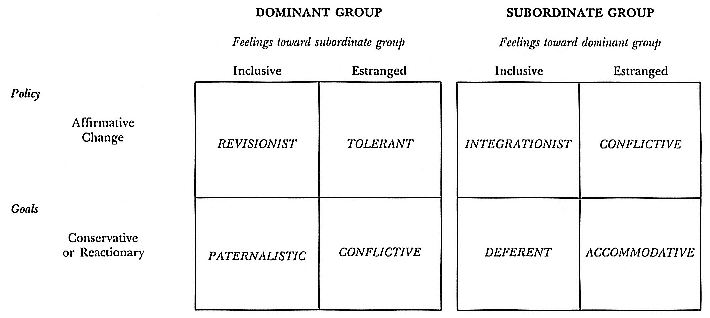
Figure 7.1
Paternalism and conflict: Alternative configurations of intergroup feelings and policy goals for dominant and subordinate groups.
distinct compounds of feelings and policy goals may thus be identified in dominant and subordinate groups.
The first thing that is highlighted by this scheme is that the meaning of particular configurations is altered entirely according to whether one is examining the attitudes of dominant-group members or subordinates. Among the members of dominant groups, those configurations that fall on the diagonal going from top left to bottom right (revisionist and conflictive attitudes) are the "consistent" ones that have been the target of scholarly scrutiny. They combine inclusive feelings with support for affirmative policy change or estranged feelings with conservative or reactionary policy goals. These are the attitudinal configurations that are commonly termed "unprejudiced" and "prejudiced," respectively.
Of the two "irregular" cells, one—the compounding of estranged feelings with affirmative policy dispositions (tolerant )—has received considerable attention from students of political tolerance. The other formally inconsistent cell—the compounding of inclusive feelings toward subordinates with conservative or reactionary policy goals (paternalistic )—has been bypassed in conventional approaches to public opinion and has fallen by the wayside as an awkward anomaly. It is this configuration, however, that holds the most promise for scholars in unraveling the dynamics of intergroup ideologies.
Among the members of subordinate groups, it is the configurations that fall on the opposite diagonal, going from top right to bottom left (conflictive and deferent attitudes), that have conventionally been treated as consistent. Subordinates are logically expected either to take a conflictive approach by expressing estranged feelings from the dominant group and demanding affirmative change, or to be deferent toward the dominant group by espousing inclusive feelings toward them (possibly even showing a higher regard for the dominant group than for their own) and adopting conservative or reactionary policy views.
Neither of the two "irregular" cells has been the object of investigation in public-opinion research on subordinate group consciousness. However, the accommodative cell (that combines estranged intergroup feelings with conservative or reactionary policy dispositions) is certainly implied by theories that postulate that subordinates express "hidden resistance" (Genovese 1974; Cloward and Piven 1979; Anyon 1984; Scott 1985, 1990). Such theories imply that although subordinates generally comply with dominant group demands, their compliance is nothing more than a tacit acknowledgment of the superior power of the stronger group that masks an underlying alienation in spirit that is manifested in small, hidden acts of resistance. If the compliance of subordinates is merely a veneer, we would expect them to populate the accommodative cell, espousing conservative or reactionary policy views but retaining alien-
ated feelings from the dominant group. Accommodation among subordinates might be regarded as the logical counterpart to tolerance in the dominant group: in each case, estranged feelings must be overridden to behave in a supportive way toward the other group.
The opposite "irregular" cell—the combination of inclusive feelings toward the dominant group with calls for affirmative change—I have labeled integrationist , because it reflects the spirit of the movement for racial integration in the United States in the 1950s and 1960s, as advocated by Dr. Martin Luther King, Jr. Despite the prominent position of the civil rights movement in recent U.S. history, this attitudinal compound has had no place in conventional analyses of group consciousness, since it is logically inconsistent. This configuration of feelings and policy goals might be regarded as the subordinate counterpart to paternalism in dominant groups: subordinates might find it strategic to moderate their demands for change with assurances that they feel no hostility toward those from whom they wish to extract concessions.
The simplified scheme that I have outlined identifies four main ways that dominant-group members and subordinates may blend their intergroup feelings and policy goals. The meaning of any specific compound of feelings and policy dispositions cannot be interpreted out of context but depends on whether the exponent is a member of a dominant or a subordinate group. Only one term is applicable to both kinds of groups—conflictive attitudes—but note that it is constructed quite differently, depending on whether one occupies a dominant or a subordinate position in an intergroup relationship. All the other terms are unique to dominant or subordinate groups. For example, it is not germane to ask whether subordinates are willing to override their estranged feelings and grant equality to the people who exceed them in status and perquisites. Similarly, the attitudinal state of deference is a prospect that members of dominant groups are spared.
Fitting the Data
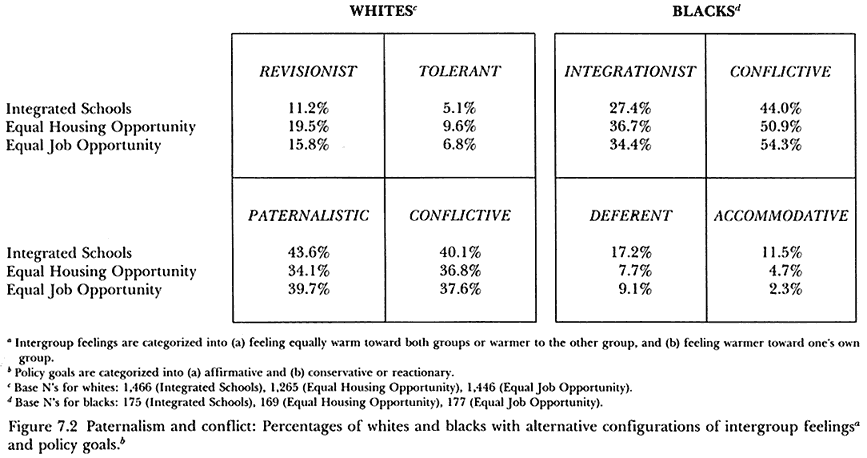
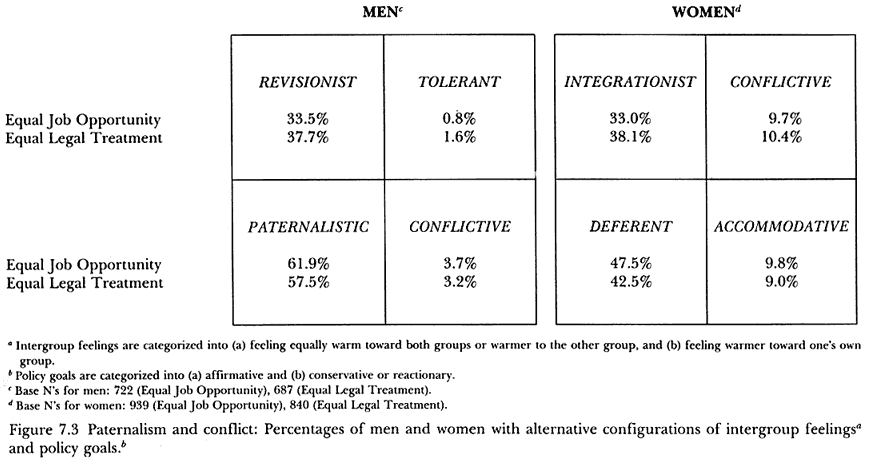
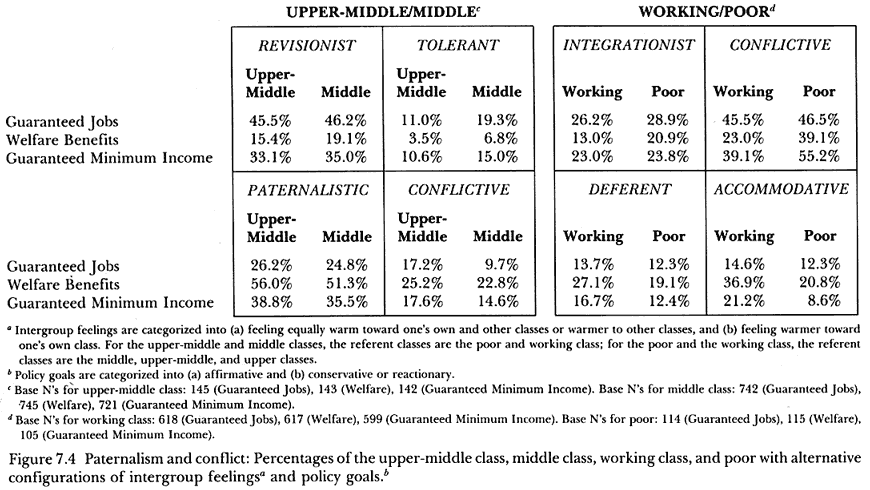
The next step is to apply this empirical scheme to the data for race, gender, and class. To that end, figures 7.2, 7.3, and 7.4 present the percentages of the pertinent dominant and subordinate groups expressing each of the four possible attitudinal compounds, for race, gender, and social class, respectively. Intergroup feelings are measured in terms of warmth or coldness. And recall that since feelings are measured in terms of affective differentiation (rather than absolute feelings toward other groups), the effect is to create more respondents who are categorized as having "negative" feelings, since more people draw affective distinctions between groups than express outright negative feelings toward the other group. Policy goals are reported separately for each specific policy, in order to capture the variant reactions that
different policies elicit. Thus the patterns of attitudes can be mapped in the form in which they find expression in the evolving policy debate—around specific policy issues.
The construction of these figures focuses our attention on the structure of intergroup attitudes in a different way than the conventional approach. Instead of asking what percentage of a group with particular intergroup feelings support logically "consistent" policy goals, we now catalog the varying ways that intergroup feelings and policy goals intersect. The concern becomes, what percentage of each group compound their intergroup feelings and their policy goals in various alternative ways?
Two tiers of questions await us. First, what proportion of responses are logically consistent or inconsistent, and does that vary between dominant and subordinate groups or across the three intergroup relationships? Second, we move to the more important set of questions, which are unconstrained by concerns with logical consistency: What kinds of attitudinal compounds prevail among dominant and subordinate groups? What are the attitudinal blends by which dominant groups rule or concede and by which subordinate groups comply or resist? And what is the fit between the attitudinal compounds that are favored by dominant groups and the subordinates they seek to control?
Consistency
First, what percentage of responses fall into the logically consistent cells?[7] About 51 to 56 percent of whites, about 40 percent of men, between 41 and 63 percent of the upper-middle class, and 42 to 56 percent of the middle class espouse feelings and policy dispositions that are either consistently positive or consistently negative. Among subordinate groups, the comparable figures for those taking either a consistently conflictive or consistently deferent position are about 60 percent of blacks, about 55 percent of women, 50 to 59 percent of the working class, and 58 to 68 percent of the poor.
In general, then, the proportion of responses that could be considered conventionally consistent falls in the range from somewhat below one-half to just over one-half. The proportion giving consistent responses is somewhat less in the context of gender relations than for either race or
[7] Scholars have conventionally relied on measures of association to assess attitudinal consistency, but, as Weissberg (1976) has suggested, a more direct measure of attitudinal consistency is the percentage of respondents giving consistent responses—that is, the percentage giving responses that fall on the main diagonal when two attitude items are cross-tabulated. As Weissberg points out, measures of association can be depressed when there is restricted variance on the items (even if responses are very consistent), and two items can be strongly associated in the absence of consistency if responses on two items fall in the same rank-ordering.
class relations. And in all three intergroup relations, dominant groups show a slightly greater aversion to logically consistent responses. However, the proportion of logically consistent responses does not vary greatly from one intergroup relationship to another, or between dominant and subordinate groups.
Alternative Compounds
Overall consistency may not vary dramatically across groups or intergroup relationships, but there is substantial variance in the types of consistent responses that prevail. We turn now to the second tier of questions: What blends of feelings and policy goals are espoused by dominant and subordinate groups in the three intergroup relations? I start by comparing the prevalence of alternative types of "consistent" responses, and I then consider the prevalence of alternative "inconsistent" compounds. Finally, I evaluate the way dominant and subordinate attitudes dovetail with one another to form a patterned exchange in each intergroup relationship.
Among whites, consistently conflictive responses far outweigh consistently revisionist responses, by a ratio of at least two to one. And on the issue of integrated schools, conflictive responses outnumber revisionist responses among whites by almost four to one. Among men, however, consistently revisionist responses outnumber conflictive responses by more than ten to one: almost no men take a conflictive stance in gender relations. In the upper-middle and middle classes, the ratio of revisionist to conflictive responses fluctuates, depending on the extent to which the specific policy is redistributive. On two of the policy issues, revisionist responses outnumber conflictive ones in both the upper-middle and middle classes, by ratios between two to one and four to one. But on the issue of welfare benefits, conflictive responses either equal or slightly outnumber revisionist responses.
On the subordinate group's side, consistently conflictive responses far outnumber consistently deferent ones among blacks and the poor and working class. Among blacks, conflictive responses prevail by more than two to one on the issue of school integration (the most sensitive of the three race policy issues) and by more than five to one on the other two race policy issues. Only between 8 and 17 percent of blacks assume a deferent orientation in their racial feelings and policy goals. Among the poor and working class, the margin favoring conflictive responses over deferent ones is slightly smaller than for race. And on the most sensitive class policy issue (welfare benefits), the margin in favor of conflictive responses drops to about two to one among the poor, and it disappears completely among working class respondents. The poor and working class thus manifest just slightly more deference than do blacks, with the figures ranging from 14 to 27 percent among the working class and 12
to 19 percent among the poor. Among women, the ratio of deferent responses to conflictive ones flips around completely from that observed for blacks and the poor and working class. For women, deferent responses outnumber conflictive ones by more than four to one, with almost one-half of women taking a deferent position.
Thus, over the three intergroup relations, conflictive orientations are most heavily in evidence among whites and blacks: approximately 40 percent of whites and 44 to 54 percent of blacks take a conflictive stance. Gender relations manifest the smallest evidence of conflictive orientations: fewer than 4 percent of men and about 10 percent of women take this stance. In class relations, the poor manifest about the same proclivity as blacks for a conflictive orientation, and the working class lag just slightly behind them. The upper-middle and middle classes, however, do not match the propensity of whites for a conflictive orientation: among the upper-middle class, about 17 to 25 percent take a conflictive stance, and among the middle class, conflictive responses drop to between 10 and 23 percent. Note that in all three intergroup relations, even in gender relations, subordinates are more drawn to conflictive responses than are the members of dominant groups. I return to this point below.
The response pattern that draws dominant groups more than any other is a technically inconsistent one: paternalism. Paternalistic attitude blends are most in evidence among men, of whom about 60 percent evince such a response pattern. Among the upper-middle and middle classes, paternalism accounts for about 25 to 56 percent of responses, with the sensitive welfare-benefits issue drawing the most paternalistic responses. Finally, even among whites, whose propensity for conflictive responses exceeds that of any other dominant group, still between 34 and 44 percent take a paternalistic position—roughly the same percentage as take a conflictive position.
The alternative inconsistent attitude blend for dominant groups—tolerance—is the one that has received much more attention from students of intergroup attitudes, but it is the least common response pattern among dominant groups in all three intergroup relationships. Only about 5 to 10 percent of whites and a minuscule 1 to 2 percent of men indulge in affirmative policy dispositions with feelings that are estranged from the other group. Among the upper-middle and middle classes, as many as 10 to 20 percent take a tolerant position on the two relatively tame policies of guaranteed jobs and guaranteed minimum income, but only 4 to 7 percent ascend to a tolerant position on the more threatening issue of welfare benefits. It seems that it is far easier to discriminate against groups one likes than to give equal treatment to groups from whom one feels estranged.
A similar but less extreme phenomenon occurs among subordinates. In general, it seems to be easier to demand affirmative change from a group one likes (the integrationist response) than to accept the status quo from a group from whom one feels estranged (the accommodative response). Among blacks, integrationist responses sharply outnumber accommodative ones, with about one-third of blacks taking an integrationist position and only between 2 and 12 percent taking an accommodative stance. Interestingly, it is on the explosive issue of integrated schools that blacks yield the most. The figures are similar for women, with about one-third or more of women taking an integrationist position and about one-tenth taking an accommodative posture. Among the poor, integrationist responses have a smaller edge over accommodative ones, with about one-quarter of the poor expressing integrationism and about one-tenth being accommodative on the two tamer policy issues and about 20 percent taking each position on the tougher issue of welfare benefits. Among the working class, integrationism loses its edge over accommodative responses. On the two less demanding issues, about one-quarter of the working class take an integrationist stance, with either a smaller percentage or the same percentage taking an accommodative stance. And on the tougher issue of welfare benefits, integrationist responses are far outweighed by accommodative ones in the working class, with only 13 percent being integrationist and 37 percent being accommodative. Thus, overall, subordinates find it more difficult to be accommodative than to be assertively upbeat—but on issues that find stronger resistance among dominant groups, subordinates are somewhat more likely to yield, despite estranged feelings.
Finally, I consider how dominant and subordinate response-patterns dovetail with one another. Surely the response pattern that dominant groups crave from subordinates is deference—the willing and friendly accession to the modus vivendi. To that end, dominant groups drift easily into paternalism, extending the hand of friendship as they withhold resources. How successful are they in their endeavor? Is paternalism rewarded with deference, or is it met with rebuff?
It is in gender relations that paternalism has its fullest flowering, with about 60 percent of men expressing a paternalistic compound of warmth and discrimination. Consistently positive responses are the only other compound to be expressed by any significant number of men, with about one-third being revisionist and only minuscule numbers taking either a tolerant or a conflictive approach. In short, men's gender attitudes commonly include discriminatory policy goals, but estranged feelings from women are virtually absent. And it is in gender relations that deference is most in evidence: close to half of women reward men's paternalism with deference. Some women seek affirmative change, but when they
do so they are much more likely to take the route that is the subordinate counterpart to dominant paternalism—integrationism—than to be flagrantly conflictive. About one-third of women are integrationist. Only about 10 percent of women venture into a conflictive mode, and another 10 percent take the accommodative route. Note, however, that much as deference is the prevailing mode among women and conflictive attitudes uncommon, still deference is less in evidence among women than paternalism is present among men. And, by the same token, a few more women than men launch into a conflictive approach. It seems that the paternalistic-deferent mode of interaction holds somewhat more appeal for men than for women.
In class relations, the upper-middle and middle classes appear primarily as either revisionist or paternalistic, depending on the policy issue at hand. On the two more moderate issues, revisionists tend to equal or outnumber paternalists, but on the tougher issue of welfare benefits paternalists lead the way, with over half of these classes taking a paternalistic line on the issue of welfare benefits and only 15 to 19 percent venturing into revisionism. The poor and working class are much less likely to show deference than are women, although deference is slightly elevated on the sensitive issue of welfare benefits. And as in gender relations, fewer subordinates exude deference than seems called for by the rate of paternalism among dominant group members—indeed, this imbalance is stronger than in gender relations. Over the three policy issues, between 12 and 27 percent of the poor and working class express deference. Matching the class imbalance between paternalism on the one hand and deference on the other, the poor and working class are also considerably more likely than the upper-middle and middle classes to engage in a conflictive approach. Note, however, that on the tougher issue of welfare benefits, the conflictive tendencies of the upper-middle and middle classes are somewhat heightened and the temerity of the poor and working class slips somewhat. Over the three policy issues, between one-tenth and one-quarter of the upper-middle and middle classes take a conflictive stance, whereas the comparable figures for the poor are about 40 to 55 percent and for the working class about 23 to 46 percent.
The exchange of attitudes between blacks and whites is especially revealing. As whites face blacks, they find a group that is more combative than any other subordinate group. Among blacks, conflictive responses are at about the same high level as among the poor (44 percent on the sensitive issue of integrated schools and 51 to 54 percent on the other two issues). In addition, the level of deference among blacks is lower than in any other subordinate group (17 percent on the issue of school integration and less than 10 percent on the other two issues). The response among whites is that a higher percentage is drawn to the conflic-
tive mode than is the case for dominant class or gender groups—approximately 40 percent of whites assume a conflictive orientation. At the same time, however, it is interesting that whites still do not match the level of conflictive orientation found among blacks. In addition, despite the low levels of deference and high levels of conflictive attitudes among blacks, still about 40 percent of whites cling to a paternalistic mode—just as many whites as take a conflictive approach. Despite the failure of paternalism to elicit any significant level of deference from blacks, many whites still cling to this comforting ideological mode.
In each case, then, it is subordinates who seem to lead the way on the path to conflict—albeit with caution. In gender relations, this is manifested in women's slight lag in returning deference for paternalism and in their timid lead in venturing into conflictive dispositions. In class and race relations, where paternalism has less of a grip, these asymmetries between dominant and subordinate groups are more pronounced. The middle and upper-middle classes remain more likely to express paternalism than outright conflictive dispositions, and whites are as likely to express paternalism as conflictive dispositions, even as these dominant groups are confronted with subordinates who generally fail to be deferent and who seem more drawn to the conflictive path.