
A. COMPENDIUM MUSICAE: IMAGINATION AND MUSICAL PERCEPTION
The Compendium begins with various reflections. "The end [of music] is that it please, and that it move in us various affections." "The means to the end, or the affections of sound, are two principal ones: namely differences in the ratio of duration or time, and in the ratio of the intensity with regard to acute [= sharp] and grave [= flat]. For the quality of sound itself, from what body and in what way it comes out more pleasing, is treated by physicists." "And so, because of all things it [= the human voice] is most in conformity to our spirits, it appears to make the human voice most pleasing to us. Thus perhaps [the voice] of a closest friend is more pleasing
[3] The composition of the Regulae was until recently thought to have taken place in or around 1628. Jean-Paul Weber, La Constitution du texte des "Regulae" (Paris: Société d'édition d'enseignment supérieur, 1964), changed the terms of debate by arguing for a complex layering of the work that has to be unraveled by using contradictions and tensions to distinguish between parts and to reconstruct their sequence of composition; in addition, he claimed that the last two paragraphs of Rule 4, the so-called Rule 4-B, were where Descartes started the project in October or early November 1619. The Weber thesis has struck even some of its supporters as oversubtle. John A. Schuster has reduced the number of strata to basically three: first, a concern with universal mathematics that predated November 1619 (the topic of 4-B, mentioned nowhere else in the Regulae, at least not under that name); second, an elaboration of method in the period 1619-1621 (corresponding to the rest of the first eight rules); and, finally, a return to heuristic questions and a problem-solving mathematics in the later 1620s (reflected from the middle of Rule 8 to the end of the extant work). See Schuster, "Descartes' Mathesis Universalis: 1619-28," in Descartes: Philosophy, Mathematics and Physics, ed. Stephen Gaukroger (Brighton, Sussex: Harvester Press/Totowa, N.J.: Barnes and Noble Books, 1980), esp. 41 and 81n.4. Jean-Luc Marion, Sur L'Ontologie grise de Descartes: Science cartési-enne et savoir aristotelicien dans les Regulae (Paris: J. Vrin, 1975), criticizes the Weber thesis on the grounds that what seem to Weber to be contradictions often are not, and he offers in response a generally coherentist reading of the Regulae that dissolves many of the "contradictions" that were supposed to reveal different layers. Frederick Van de Pitte, "Descartes' Ma-thesis Universalis," Archiv für Geschichte der Philosophie 61 (1979): 154-174, makes the case that Weber misunderstood the precise character of mathesis universalis and so falsely distinguished mathematics and method (a similar point might be addressed, with qualification, to Schuster). Although my work addresses the Weber thesis only occasionally and indirectly, I can say here that I find it highly unlikely that any part of the Regulae was composed before the early 1620s, and I think it is conceivable that Descartes abandoned it as late as the early 1630s. My reading of the Regulae is, like Marion's, basically coherentist, but by placing it in the context of Descartes's understanding of imagination, I believe that we can see more clearly the kinds of tensions and perhaps even contradictions that do mark it.
than that of an enemy, from the sympathy and antipathy of affections: for the same reason from which people say that the skin of a sheep used for a drumhead becomes silent if it happens that a wolf's skin resounds in another drum" (AT X 89-90).
In the last remark one is immediately struck by the distinctly unCar-tesian tone of sympathy and antipathy used as principles of explanation. The passage has led some critics to depreciate the importance of the Compendium and others to interpret it as Descartes's implicitly polemical dismissal of a kind of ancient and medieval occultism, which is left, slightingly, to those who deal with matter and its qualities (the physicists) rather than to mathematicians.[5] This interpretation has the advantage of making the passage more recognizably Cartesian but commits the fallacy of assuming that the twenty-two-year-old Descartes was in essential respects the philosopher of the Meditations. As shall become evident shortly, other notes from around t620 suggest that explanations in terms of sympathies would not have seemed prima facie inconceivable to the young Descartes. Even more important, however, is that those who wish to read the Compendium as a step in the Cartesian project of mathematizing nature overlook (or dismiss) his characterization of the study of mathematical ratios as a means to understanding an end, the end of music, which is to arouse affections in the soul.
That the work is chiefly an investigation into ratios or proportions is not in doubt, but the framework in which their investigation makes sense is not that of the abstract mathematization of nature. This is made clearer by the eight postulates, which immediately follow the remarks just quoted.
1. All senses are capable of a certain delight.
2. For this delight there is required a certain proportion of the object with
[4] Beeckman (1588-1637) and Descartes met in Holland in October 1618, apparently while both were inspecting a poster announcing a problem in mathematics. Beeckman, who had just received his medical degree and had begun teaching school, was interested in approaching the physical sciences with techniques that were experimental, mathematical, and above all picturable. See Klaas van Berkel, Isaac Beeckman (1588-1637) en de mechanisering van bet wereldbeeld, Nieuwe Nederlandse Bijdragen tot de Geschiedenis der Geneeskunde en der Natuurwetenschappen, no. 9 (Amsterdam: Rodopi, 1983), chaps. 4, 7; see also pp. 317-319.
[5] See René Descartes, Abrégi de rausique, suivi des "Eclaircissements physiques sur la musique de Descartes" du R. P Nicolas Poisson, trans, and ed. Pascal Dumont (Paris: Méridiens Klinck-sieck. 1990), 17, 147n.4.
its sense. Whence it happens, for example, that the din of muskets or thunder does not seem suitable to music: because, namely, it hurts the ears, just as the very great brilliance of the sun [hurts] eyes directed toward it.
3. The object must be such that it does not befall sense too difficultly and confusedly. Whence it happens that, for example, a certain very complicated figure, even if it be regular, as is the mater[6] in the astrolabe, does not please sight as much as another that is made of more equal lines, such as the astrolabe's fete usually is. The reason of this is that sense is more satisfied in the latter than in the former, where there are many things that it does not perceive distinctly enough.
4. That object in which there is less difference of parts is more easily perceived by sense.
5. We call less different from one another the parts of a whole object between which there is greater proportion.
6. That proportion must be arithmetic, not geometric.[7] The reason is that there are not so many things in it to be noticed, since the differences are everywhere equal, and therefore sense is not so fatigued, so that it perceives everything in it distinctly. Example: the proportion of [these] lines [fig. l] is more easily distinguished by the eyes than of those [fig. 2], because, in the first, one only has to notice the unit as the difference of each line; but, in the second, the parts ab and bc, which are incommensurable, and therefore, as I judge, they can in no way be perfectly known simultaneously by sense, but only in an orderly relation to arithmetic proportion: in other words, should one notice, for example, two parts in ab, three of which exist in bc It is plain that here sense is constantly deceived.[8]
[6] In the planispheric astrolabe, which was used by astronomers and navigators for taking the altitudes of celestial bodies, the mater was a plate engraved with crisscrossing circles of altitude, while the rete was a rotatable circular ring of the stars, "often beautifully designed in fretwork cut from a sheet of metal, with named pointers to show the positions of the brighter stars relative to one another and to a zodiacal circle showing the sun's position for every day of the year." S.v. 'astrolabe', Encyclopaedia Britannica (Chicago: Encyclopaedia Britannica, 1967), 2:640.
[7] A series of numbers, or of lines having those numbers as measure, constitutes an arithmetic proportion if the series increases (or decreases) by a fixed amount; thus 2, 5, 8, 11, 14 are in arithmetic proportion because the series increases each time by 3. A series constitutes a geometric proportion if each successive element is derived by multiplying the preceding one by a fixed number; thus 2, 6, 18, 54, 162 are in geometric proportion because each element is three times the preceding one.
[8] AT notes that the concluding sentence of postulate 6 is present in two Latin manuscript copies and in the Latin text published in 1650, but not in the French translation of 1668 prepared by Nicholas Poisson, who had at hand Descartes's original MS. It is not necessary, at any rate, to interpret the sentence as a reason for doubting the reliability of the senses in general. Rather, it indicates a tendency of the senses to "read" the proportions of things as simpler or more commensurate than they actually are; this tendency produces a need for the intervention of higher powers of mind to establish the true ratios, as will become clear from what follows.
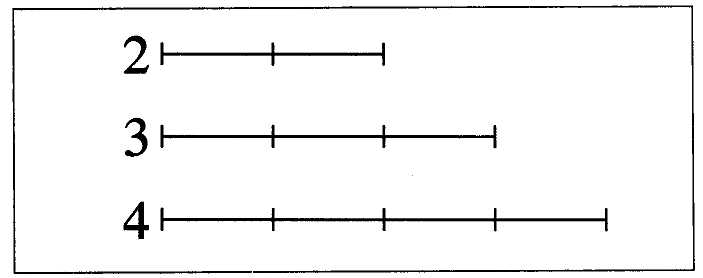
Fig. 1. The three line segments can be easily compared because
each contains a whole number of units.
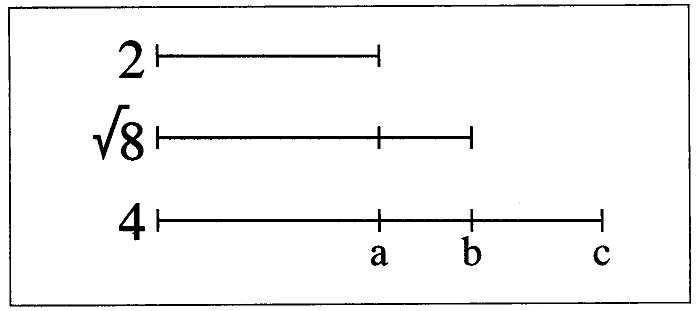
Fig. 2. The middle line segment is not commensurable with the other two,
so that a visual comparison of the parts is more difficult.
7. Among objects of sense the most pleasing to the soul is not that which is most easily perceived by sense, nor that which is perceived with most difficulty; but that which is not so easy, so that the natural desire by which the sense is drawn to the objects not be completely satisfied, nor so difficult that it tire sense.
8. Finally it is to be noted that in all things variety is most pleasing. (AT X 91-92)
It has been said that if one is searching for the originality of the Compendium musicae, one will not find it in these postulates, for the doctrine of sensation being itself a kind of proportion (or based on proportion, logos ) goes back at least to Aristotle.[9] One might mention also Aquinas, for
[9] See Descartes, Abrégée de musique, 16. The particular passage in Aristotle noted as one that "everyone recopied for centuries" is De anima, bk. 3, chap. 2,426a27-426b7.
whom "beauty consists in due proportion, for the senses delight in things duly proportioned, as in what is like them—because the sense too is a sort of ratio, as is every cognitive power."[10] The doctrine is not intrinsically Aristotelian-Scholastic, for Pythagoreanism and Platonism likewise understood sensation, or at least its most perfect forms, as having a basis in proportionality or even as being proportion.[11]
Indeed, the convergence of different philosophical traditions on this basic point is a reason for thinking that, regardless of what specific works Descartes read or did not read, the doctrine could not have been unknown to him. (This is especially true since the doctrine is a staple of traditional musical theory, with which Descartes shows a more than passing acquaintance.) Plato's writings, especially the Republic and the Timaeus, give an account of the cosmos as proportionally structured. The divided line of Book 6 of the Republic presents what could be called an ontology of pro-portionalized imaging that grounds an epistemology of proportionalized imaging, in which the Forms are imaged in the Mathematicals, the Mathe-maticals in the objects of the physical world, and the objects of the physical world in shadows and reflections—and between each major category there obtain strictly proportional relations. In Aristotle the operations of the senses with respect to their objects are frequently said to be proportional to the operation of the intellect with respect to its objects. Although Plato gives somewhat more emphasis to ontological imaging than to proportions, and Aristotle emphasizes the proportionalities without explicitly addressing the possible resemblance of the sensible species to an intelligible species, both thinkers provide adequate space for reflecting on the overall importance of resemblance and proportionalities in the process of moving from sensation to intellection. This is a contextual topography that opens up the significance of Descartes's Compendium rausicae more re-vealingly than does the search for Descartes's putative originality in the history of musical theory (a "reduction to mathematical abstractions," for example).
My initial thesis is this: It was precisely in pursuing the question of the proportionalities of the senses and the other cognitive powers that Descartes became a philosopher. He began this pursuit not because he already had in mind a mathematical method but rather because he suspected that proportionality was the fundamental principle of knowing and that it reflected the way the cosmos was structured. The underlying theory of such proportionality is what Descartes eventually called mathesis universalis : a theory expressible not just in the abstractions of intellect but also, and equally well, or perhaps even better, in the figuration of extension, whether according to sense or according to imagination.
[10] Summa, theologiae, I,q. 5, art. 4, ad 1
[11] For example, in Augustine's De musica. See Summers, Judgment of Sense, 67-69.
The Compendium musicae shows that by late 1618 Descartes had already taken at least the first steps toward working out a theory of the communication of proportions from the external world to the senses. It attempts to demonstrate that the rhythms and tones of music are subject to a logic inherent in the senses in general and in the sense of hearing in particular, a logic (from logos, one of whose meanings in Greek is 'ratio' or 'proportion') of arithmetic proportion. Both rhythm and tone are governed by relations that can be expressed in terms that are arithmetically increased or decreased through the addition or subtraction of a unit. The doctrine of the Compendium is therefore a particular application of the principles enunciated in the postulates, which are understood as applying to all sensation. This does not in itself imply a radical reduction to mathematics any more than it does for Aristotle or Plato. Rather, because sound, like all other sensibles, reflects the order and measure of the world, it implicitly contains and reflects the principles that Descartes educes and represents through mathematics. The specific qualities of sound are in no way eliminated; they are rather understood to necessarily carry with them a proportional structure that can be, and is, communicated from thing to thing, and from thing to mind.
The basic mathematics of consonance and dissonance has been recognized at least since Pythagoras. Descartes's specific contribution with respect to this mathematical tradition in the Compendium is to show that the consonant tonal relationships can be discovered in, and represented by, the arithmetic proportionalities of a single string (line) divided into five parts by first bisecting the whole string, next bisecting the rightmost of the two segments, then the leftmost of these two and finally the leftmost of this last division (see fig. 3).[12] According to the principles enunciated in the postulates, these tones, because of the simplicity of their relationships, are precisely those that are most suited to the sense of hearing and the most easily perceived. The sense of hearing is so constituted that the tones based on an arithmetic division of the string are perceived as simplest in their relationships to one another. The theory of these simplest relationships, which the Compendium presents, is the fundamental theory that Descartes believes should guide intelligent musical composition toward the end of music, the delight of the senses.
A corollary of the standard thesis that Descartes abstractly mathematized musical theory is that he subjectivized musical perception. But the
[12] See AT X 98-105. This division and its novelty in the tradition of musical theory are discussed by Johannes Lohmann, "Descartes' 'Compendium musicae' und die Entstehung des neuzeitlichen Bewußtseins," Archiv für Musikwissenschaft 36, no. 2 (1979): 81-104, and H. F. Cohen, Quantifying Music: The Science of Music at the First Stage of the Scientific Revolution, 1580-1650, University of Western Ontario Series in Philosophy of Science, no. 23 (Dordrecht: D. Reidel, 1984). esp. 161-179.

Fig. 3. Descartes's division of a line by successive bisectioning gives rise to ratios of the principal consonances. Point C bisects AB; D bisects CB; Ebisects CD; and F bisects CE. AC produces the octave above AB; AC and AD yield a fifth; AD and AB produce a fourth; AC and AE yield a major third. These proportions are based on the numbers 2, 3, and 5 or their multiples; the process of bisection makes this visually comprehensible. All the relationships dependent on the last bisection at F lead to dissonances. As a result of this technique of division, all the consonances are simply imaged by a single line.
corollary is as questionable as the thesis. It is indeed true that, from 1630 on, Descartes described the pleasure taken in music as depending on the peculiarities of individual history and taste, but such testimony cannot decide what Descartes thought in 1618.[13] The method and doctrine of the Compendium are predicated on the real existence of proportions in tone and rhythm, the real correlation of such proportions to the satisfactions of hearing and the soul, and the real ability of the human psyche to detect, at first implicitly and eventually with knowledge, the presence of these proportions, whether in the sounds of nature or in musical compositions. If there is such a "preestablished harmony," then it should not be surprising that the human ear might have a natural sympathy for the human voice (presumably human beings would try even in speaking to produce tones pleasing to their own ears and thus to the ears of those with souls and organs similarly attuned) and a natural antipathy for sounds not in accordance with the natural proportions. The recognition of such proportions
[13] See, for example, AT I 128 (letter to Mersenne, 4 March 1630). Even at this later date Descartes makes a distinction: although "everyone knows that the fifth is sweeter than the fourth," what pleases more, or is found more agreeable, may be something different. This apparently corresponds to the distinction the Compendium's postulates make between what is perceived most easily and what is most pleasing. In any case, Descartes's so-called subjectivization of aesthetics occurs after a decisive shift in his thought away from the cognitive value of sensible proportions. One should also note that the Compendium's postulates 6 through 8 imply that the satisfactions of music, which are proper to the soul rather than to physical organs, are not to be settled on the level of what is satisfying to the sense. Sense per se is pleased by the simplest arithmetic proportions; they are not always to be found in good music (end of post. 6), however, because the purpose of music is not to satisfy immediately and completely the natural desire of the sense or to frustrate sense by complexity, but to present the soul with an intermediate difficulty in knowing (post. 7). When all is said and done, the soul is satisfied not by simplicity but by variety (post. 8). This gives a glimpse into Descartes's earliest anthropological psychology: the human soul is constituted so as to take delight in difficulties, at least so long as the difficulties can be overcome. It is therefore of the nature of the human soul to solve problems.
constitutes the foundation of Descartes's theory. The theory is expressed in the mathematics of proportions, but this mathematics is precisely what is detected or perceived in the sensation of sound, in its aisthesis. In this precise sense, the Compendium musicae is the foundation of the mathematical aesthetics of sound.
In this study, the particular question to be asked is how imagination enters into this mathematical aesthetics. In the course of the Compendium, Descartes talks frequently about the senses and perception, but only occasionally about imagination. The imagination words occur infrequently, ordinarily without any great intrinsic significance. For example, the adjective imaginarius is used as synonymous with 'fanciful' or 'merely fictional', and the verb imaginor occurs in the sense of 'depict' or 'conceive'.[14] But the imagination does figure importantly in the section following the postulates: "On the number or time in sound that is to be observed." After noting that musical tempi are divided into double and triple times, Descartes explains how we perceive them.
This division is marked by percussion or beat, as they call it, which occurs in order to aid our imagination; by means of which we might more easily be able to perceive all the parts of the song and enjoy [them] by means of the proportion that must be in them. Such proportion is most often observed in the parts of a song so that it might aid our apprehension thus, that while we are hearing the last [part] we still remember the time of the first one and of the rest of the song; this happens, [for example] if the whole song consists of 8 or 16 or 32 or 64, etc., parts, that is, when all the divisions proceed in double proportion. For then, when we hear the first two members, we conceive them as one; when [we hear] the third member, we further conjoin that with the first ones, so that there occurs triple proportion; thereafter, when we hear the fourth, we join that with the third so that we conceive [them] as one; thereupon we again conjoin the two first with the latter two so that we conceive these four simultaneously as one. And thus our imagination proceeds all the way to the end, where at last it conceives the entire song as one thing fused out of many equal members. (AT X 94)
Perception, apprehension, memory, imagination, and conception all enter into the mental process described in this paragraph, and we might suspect that the young Descartes was not necessarily using these terms very precisely. 'Imagination' and 'conception', for example, appear to be synonymous. However, we have noted earlier that Descartes allows precisely this synonymy in Rule 12, probably ten years later, which makes it more likely that it reflects a constant in Descartes's understanding of the two terms before 1630.[15]
[14] AT X: 109 and 102, respectively.
[15] In chap. l, above. All theories dating the Regulae agree that the composition of Rule 12 was relatively late.
The discussion begins and ends with imaginatio. Rhythm aids imagination by marking divisions so that they might be perceived; the proportionality among the parts of the song produces "delectation," enjoyment, and aids apprehension by enabling us to remember what came before as we hear what comes next. How does this happen? By continually recursive acts of conceiving, each synthesizing the new part with all the preceding and expressing it in relation to the others by means of a unit of time. Accordingly, rhythm, just like tone, is governed by arithmetic proportion. But, in contrast with tone, this proportion is expressed not all at once or in a short musical phrase but throughout the entire song, so that sense by itself or even with the aid of short-term memory will not be able to perceive the proportions. It is imagination that performs the task of synthesizing the individual deliverances of the sense, of the individual units that mark the rhythm. "And thus our imagination proceeds all the way to the end, where at last it conceives the entire song as one thing fused out of many equal members." That is, apprehension and delectation come about by imagination's progressively, proportionately synthesizing one thing to another.
Imagination is portrayed here as an extraordinarily active power that is responsible for the ability to perceive the complex unity of sounds as a whole rather than as simply a congeries of unconnected tones. In the passage it is also the primary agent of cognition, of the grasping by mind (apprehension). It is an agent: that is, imagination does the work of conceiving/synthesizing; an agent of cognition: that is, the imagination is not simply projecting visual (or auditory) images but recognizing something not directly perceived by the sense, the proportions in the song taken as an entirety. Moreover, the memory required for this synthesis and cognition appears to be a by-product of the process as it takes place from moment to moment, from musical part to musical part.
By late 1618, Descartes conceived imagination as a synthetic conceptive power operating on sensation, a power that gathers or collects the various parts or moments that are successively presented and then conceives them as unified by the determinate proportional relationships they bear to one another. The notion of proportionality will be discussed presently, under the aspect of the relation of imagination to the mathematics of proportion. Here we might remark that imagination comes up first not in the visual realm but in the auditory, which suggests that Descartes was already thinking of the power of imagination as transcending the specific character of any single sense. It is precisely imagination's character of being presentative, synthetic, and memorative that seems to interest him, rather than any merely representational use. This character rests on proportionality or, to use the Greek equivalent, analogy.
There is in the Compendium no comparable explanation of imagination's
functions in the case of tone, the other basic component of the aesthetics of music, but this should not be surprising. Rhythm ordinarily extends in an equable way throughout an entire song (or throughout each of its major units), so that the synthetic activity of conceiving rhythm creates a complex unity by iteration and temporal projection/retention, a complex that nevertheless falls into one of two classes, either double or triple time. With tone there is less need for an extended synthesis (putting aside the loose regularity determined by the key or mode of a passage), since the relationships of primary importance exist between tones sounded in immediate succession or even simultaneously. These immediate relationships are already proportioned to the sense of hearing and its pleasures, so the synthetic functioning of imagination is less urgent for properly appreciating them. Moreover, there is a greater variety of melodic effects than two, and to explain all of them would require a greater complication in the investigation both of the ways in which the soul is moved and of how the proportions expressed in one harmony or phrase are related backward and forward to the other parts of the song. At the end of the Compendium, Descartes in fact notes with respect to the variety of grades and proportions of tone that
from these and similar [items] various things might be deduced about their nature, but it would be long. And it would also follow that I should treat separately about the individual motions of the soul that can be excited by music and should show by means of what grades, consonances, tempi, and so forth, these ought to be excited; but I would exceed the purpose of the compendium.[16] (AT X 140)
Descartes's purpose was not to exhaust the theory of music but to set down its principles. In such a context the account of imagination's work presented in the section on rhythm should not be taken as a feature of accidental interest but as a process essential to cognition through the senses.