
Universal Exposition of 1873, Vienna
The precedent set by the Ottoman and Egyptian quarters at the 1867 exposition determined the format in Vienna six years later. The main exposition building was a longitudinal structure with a domed central section. The Ottoman and Egyptian pavilions were in the southeastern part of the park in front of the main hall (Fig. 27). Once again picturesque landscaping brought the two displays into relation and created an Islamic village on the periphery of the fairgrounds.
The Ottoman quarter consisted of seven small structures: a main pavilion carefully duplicating the Sultan Ahmed Fountain (1728) in Istanbul and presenting it as an example of Ottoman architecture (see Fig. 66); a high domed pavilion, the Sultan's Treasury, where valuable items such as jewelry were displayed (Fig. 28); a residential structure based on the Yali Kösk in Istanbul and reminiscent of the Pavilion du Bosphore of 1867; a bath, along the lines of Parvillée's bath in 1867; a café (Fig. 29), and a small two-story building with a bazaar on the first floor and residential apartments on the second floor (Fig. 30).[16] Whereas all the Ottoman buildings in 1867 were designed according to a set of clear principles that followed historic references, here the main pavilions quoted monuments, and the commercial structures interpreted vernacular traditions.
Unlike the Ottoman section, the Egyptian section consisted of a single building, composed of several distinct parts (Fig. 31). The dominant feature was a pavilion that duplicated the funerary complex of Sultan Qaytbay in Cairo from the late Mamluk period (1470s), its minaret and dome carved in arabesques and star patterns. A second minaret, with a square base, possibly inspired by the minarets of the mausoleums of Salar and Sanjar al-Jawli from the early Mamluk period (1300s), marked the other end of the structure. The eclectic styles in between enhanced the impression of a street facade rather than suggesting a single building. As in the Ottoman section, the structure referred to both the monumental and the vernacular.
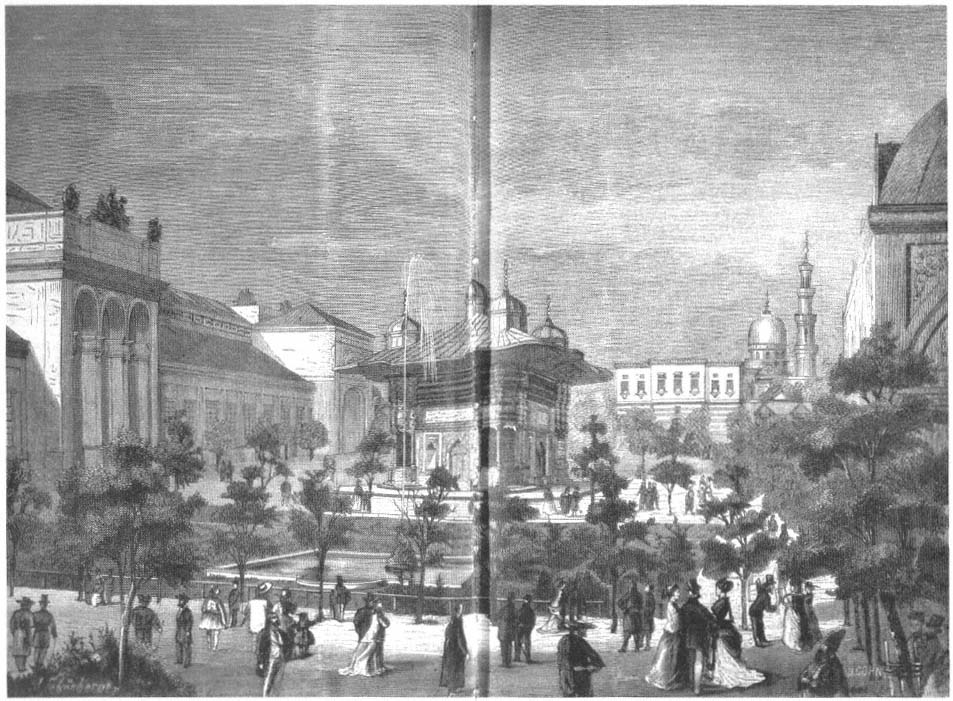
Figure 27.
The Ottoman section, with (left) the main exhibition hall and (background)
the Egyptian buildings, Vienna, 1873 (L'Esposizione universale di Viena, no. 10).
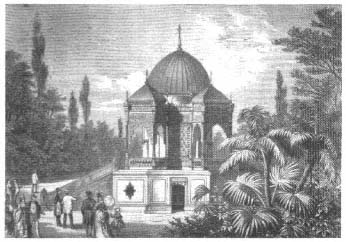
Figure 28.
Sultan's Treasury, Vienna, 1873 (L'Esposizione universale
di Viena, no. 19).
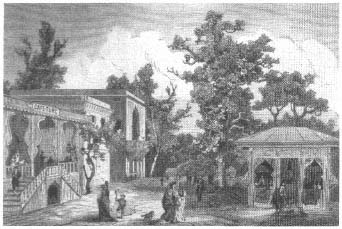
Figure 29.
Turkish café, Vienna, 1873 (L'Exposizione universale
di Viena, no. 36).
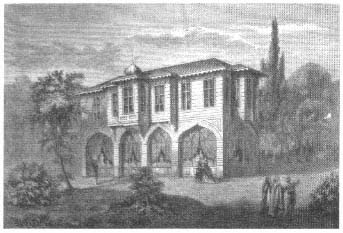
Figure 30.
Turkish bazaar, Vienna, 1873 (L'Esposizione universale
di Viena, no. 16).
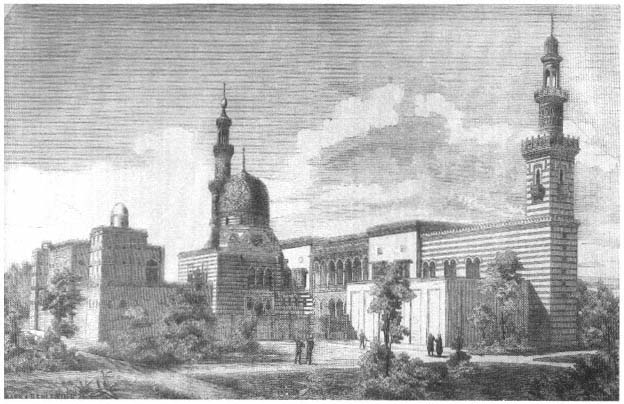
Figure 31.
Egyptian section, Vienna, 1873 (L'Esposizione universale di Viena, no. 3).
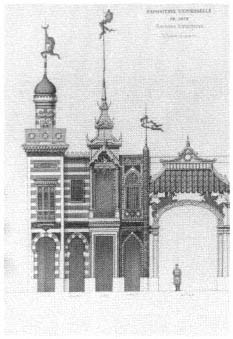
Figure 32.
Jacques Drévet's drawing of (from left)
the Tunisian, Morroccan, Siamese, Persian,
and Annam pavilions, Paris, 1878 (Jacques
Drévet, architecte ).